Showing posts with label Chicago. Show all posts

JOHN BELUSHI: A LIFE from BEGINNING to END (Kindle) by Hourly History


Published in January of 2026 by Hourly History.

John Belushi has always known as a cautionary tale for me - an amazing talent that quickly rose to national prominence and then died of a drug overdose just when things really got going.

Hourly History specializes in short histories and biographies that take about an hour to read. In this case, this biography gives a lot of details about his early life, but simply fails to give the reader a sense of what Belushi or the characters he created on Saturday Night Live was like. 

It does no better with any of the four movies. Belushi only made 4 movies, but two of them are classics - The Blues Brothers and Animal House. You would think that there would have been a lot more about those movies and a lot less about his first really run-down apartment in New York City.

I rate this e-book 3 stars out of 5.

This e-book can be found on Amazon.com here: John Belushi: A Life from Beginning to End.

THIS BOOK WON'T BURN (audiobook) by Samira Ahmed


Published by Little, Brown Young Readers in 2024.
Read by Kauser Mohammed.
Duration: 10 hours, 34 minutes.
Unabridged.

Book summary

Noor Khan is a senior in high school and she is devastated. Her father walked out on her family and moved back to his native England. He gave no warning and the family is reeling.

Noor's mother decides that a change of location would be best. Noor, her little sister (a freshman), and her mom move from their diverse upper middle class Chicago neighborhood to a downstate Illinois small town so that her mom can work at a small college. 

Noor hates it. She misses her friends and the vibrancy of Chicago. She also feels like an oddity because she is Indian and Muslim in a school that is very white and very Christian. 

She determines to gut out this one last semester of high school and then head back to Chicago to go to college. She decides she doesn't need friends or even to enjoy this small town - she just needs to get in, get the diploma and then get out.

But, she finds friends - the only Muslim/Indian boy in the area and his best friend - an proudly out-of-the-closet feisty lesbian. Together, these three comprise the diversity of their high school. They hang out in the school library whenever possible.

The library seems like a refuge until Noor notices that the stacks are missing lots and lots of books. The local chapter of a Moms for Liberty-type group has demanded that dozens and dozens of books be removed due to content. Like most of the large scale book bans across the country, this book ban has focused on books with LGBTQ+ characters, books with black and brown authors, and books that focus on America's troubled racial history. The local school board President is using his support of the high school library's book ban as the springboard to a run for the state legislature.

Can Noor stick to her original plan and just be quiet and graduate? Or, does she speak up in defense of her ideals of free speech and the freedom to read? 

Also, she is very much intrigued by the Indian/Muslim boy. But, she is also strangely attracted to a very nice white boy - he's an athlete, he's polite, and he thinks Noor is great - and his stepdad is the school board member that initiated the book ban...

My Review

The author, Samira Ahmed
The author, Samira Ahmed, has written several books that have been added to the seemingly never-ending book ban lists. She was inspired to write this book when a small town teacher spoke with her about her experience. The teacher was using one of Ahmed's books in her class when the book was banned. The teacher was caught in a bind - small town politics meant that her school administration would not support her and she feared for her job if she pushed to her hard. Her colleagues didn't fight for the books because they were about people who were different than those who lived in their town. They refused to fight for books written by and about people who were unlike themselves (NOTE: I am a public school teacher and I am so unbelievably disappointed that literature teachers would respond to a book challenge like that.)

The author changed that story a bit - instead of a teacher, she created a fiercely independent high school student with a strong sense of right and wrong when it comes to the First Amendment. 

I liked this story a lot. It drew me in - Noor and her friends are great characters. The love triangle aspect of the story works to make the consequences of Noor's actions even more powerful.

The reader was Kausar Mohammed and she did a fantastic job with a wide variety of voices and accents. Excellent work.

I rate this audiobook 5 stars out of 5. It can be found on Amazon.com here: This Book Won't Burn by Samira Ahmed.


WILL GRAYSON, WILL GRAYSON (audiobook) by John Green and David Levithan


Audiobook published in 2010 by Listening Library.
Performed by MacLeod Andrews and Nick Podehl.
Duration: 7 hours, 51 minutes.
Unabridged.

Synopsis

Will Grayson, Will Grayson is the story of two Chicago area teens named Will Grayson who attend different schools and do not know one another.

One Will Grayson is determined not to risk hurt romantic feelings by not putting himself out there to make connections and possibly get hurt. Instead, he focuses on knowing all about obscure bands and lives vicariously through his over-the-top best friend, Tiny Cooper. Tiny Cooper is a massive mountain of young man who is also gay and is also the school's most talented athlete. Think of the biggest football lineman you have ever seen, make that lineman great at every sport, able to sing show tunes at the drop of a hat, and the biggest social butterfly in the school.

The other Will Grayson is a closeted gay teen who has found an online boyfriend from Ohio. He muddles through high school life by getting involved in low commitment activities like the math team (he is only on the team to provide the minimum number of bodies required - the math geniuses take care of all of the real work). He has a pushy female frenemy that clearly is interested in him and does not understand why he does not reciprocate. 

One day, the two Will Graysons meet. When their worlds collide, everything changes...

My Review

Tiny Cooper is, without a doubt, one of the best characters I have read in a book this year. He is a walking talking stereotype in many ways - the gay character who loves musical theater, writes his own songs, and falls in love at the drop of a hat. But, he is such a big personality character that he transcends all of those stereotypes.

The story itself pulls the reader in (or in my case, the listener). As a teacher, I found the characters mostly realistic when compared to the students I see and hear in my classroom every day.

But, there were some ridiculous things that were so unrealistic that the teacher in me just couldn't buy it. For example, Tiny Cooper is given student council funds to put on a musical that he has written in the school theater. There is no way that any school would put on this musical. You might be able to put on an overtly gay-themed musical, but not one with so many direct sexual references. They just keep on coming - one after another after another.

I could buy it if they were putting this musical on in a local theater that was not affiliated with the school. I've seen that happen a couple of times in my 35+ year teaching career.

That being said, it is a fun book. An acquaintance told me that this was her all time favorite book. I wouldn't go that far, but I did like it quite a bit. 

I rate this audiobook 4 stars out of 5. It can be found on Amazon.com here: Will Grayson, Will Grayson by John Green and David Levithan

This book has been included in book ban lists across the country due to its LGBTQ+ themes, sexual references, alcohol, and cursing. Shocker! High school students curse! Orange County in Florida is one of those places (Link to article).

2 B R 0 2 B (audiobook) by Kurt Vonnegut


Originally published in 1962 in
 the magazine If: Worlds of Science Fiction.

Published in 2017 by Author's Republic.

Read by Phil Chenevert

Duration: 19 minutes.

Unabridged.

2 B R 0 2 B is set in a future world where the population is kept at a strict limit so that the living can live in a clean and safe environment. When a new person is born into the world, someone must volunteer to leave because aging has pretty much been cured. The Federal Bureau of Termination keeps track of all of the births and deaths to be sure that the math works out. The phone number for the Federal Bureau of Termination is 2 B R 0 2 B - pronounced "two be or naught to be."

The story is about a father whose wife is about to give birth to triplets. One of the grandparents of the triplets has agreed to die. Unless something changes, the future parents will have to pick out two babies to kill...

This is an intentionally provocative short story that had a quick and brutal ending that surprised me. 

I rate this short story 4 stars out of 5. It can be found on Amazon.com here: 2 B R 0 2 B by Kurt Vonnegut.

THE PRICE YOU PAY (Peter Ash #8) (audiobook) by Nick Petrie


Published in 2024 by Penguin Audio.
Read by Stephen Mendel.
Duration: 13 hours, 18 minutes,
Unabridged.


Almost every book of this series follows this model:

1) Peter Ash, a retired Marine, travels the backroads of America in an effort to deal with his PTSD from his service in Iraq and Afghanistan. Peter is more than competent in a fight and he is much smarter than the average wandering do-gooder. Despite these advantages, he eventually runs into a person that needs so much help that even Peter can't take care of it. 

2) At that point he calls his friend and business partner Lewis for backup. Lewis is also a former soldier, but his post-Army life is much more checkered. The details have always been been kept shrouded in mystery, but everyone knows that it was a criminal enterprise. 

3) Lewis shows up with a whole lot of guns and his special talents for mayhem and destruction. Peter and Lewis save the day going forth and kicking butt.

*****

It's a formula, but I like the formula. It's time-honored and has been used in plenty of other series. The main character calls in their mysterious friend to help finish the fight. Robert Parker's Spenser called Hawk for backup. Robert Crais' Elvis Cole calls Joe Pike. C.J. Box's Joe Picket calls Nate Romanowski. Peter Ash calls Lewis. 

This time it's different. This time Lewis comes to Peter Ash and asks for help in the first few minutes of this audiobook.

Peter drops everything and they head off to the frozen woods of northern Wisconsin to meet with a old member of Lewis' crew from back in the bad old days. They soon find out that someone from the bad old days is tracking down Lewis and his old crew and looking for revenge...

*****

The action is top notch, and even though some of the scenes are a bit ridiculous (the computer hacker scene, for example). That being said, I quickly plowed through this audiobook. The action is compelling, the bad guys are truly bad.

Stephen Mendel's reading was excellent. He covered a wide variety of accents like a trooper and his female voices are quite good.

i rate this audiobook a weak 5 stars out of 5 - if it were a letter grade, it would be an A-.

This book can be found on Amazon.com here: The Price You Pay by Nick Petrie.

SLAUGHTERHOUSE-FIVE: THE GRAPHIC NOVEL by Kurt Vonnegut and Ryan North.


Adapted by Ryan North.
Illustrated by Albert Monteys.

Graphic novel published in 2020 by Archaia. 
Original novel published in 1969.

This is my third review of Slaughterhouse-Five. I've reviewed the audiobook, the written novel, and now the graphic novel. 

All are different, of course. I've given 5 out of 5 stars to every version, but the graphic novel is the weakest of the three. It's a good graphic novel, but it seemed a little thin when compared to the novel. It's good for its medium.

I'm not going to review the plot of one of the most famous anti-war books of the last century - it's too well-known for that. Vonnegut can be weird, but he's always approachable. He writes in an friendly, easy to follow style, no matter if it is the audiobook, the written novel, or this graphic novel.

But, if the very idea of reading this book intimidates you, read the graphic novel. It hits the main plot points and it would certainly support you if you went ahead and read the novel at some points afterwards.

I very much enjoyed the style of the art in this graphic novel. I think Albert Monteys did an exceptionally good job of making the art clear, clean, and easy to follow. Let's face it, the story goes all over the place - the art did not need to add to the confusion. I really liked the way he drew the Tralfamadorians.

I rate this book 5 stars out of 5. It can be found on Amazon.com here: Slaughterhouse-Five: The Graphic Novel.

Note: This book has been challenged multiple times over the last 50 years for sexual content, foul language and teaching principles contrary to the Bible. Amazingly, it has stayed on "banned books" lists for more than 50 years. The graphic novel is no different. It made a banned book list in Florida and in Missouri and other places as well (Texas, Utah, and Iowa - to name a few.)

Note: This book was put on book ban lists in Tennessee in multiple counties in 2025. The article has a searchable database because the list has more than 1,100 unique titles

To its credit, the Vonnegut Museum in Indianapolis has a history of sending free copies of Slaughterhouse-Five to students at schools where the book has been banned.

WELCOME to PAWNEE: STORIES of FRIENDSHIP, WAFFLES, and PARKS and RECREATION (audiobook) by Jim O'Heir


Published by HarperAudio in November of 2024.

Read by Jim O'Heir, George Newbern, Eva Kaminsky, Janina Edwards, Roger Wayne, Jim Meskimen, and Adam Verner.

Duration: 6 hours, 24 minutes.

Unabridged.

Jim O'Heir has been knocking around Hollywood for years as a journeyman actor. He has had roles in dozens and dozens of TV shows and movies - good stuff and bad stuff - but always regular stuff. He was well on his way to becoming one of those character actors that you see so often that you say, "Oh! There's that guy! He was on that one show."

Then in 2009, he showed up on the new NBC show Parks and Recreation playing the bumbling and often befuddled lovable loser Jerry Gergrich. He kept playing this character for all 123 episodes of the show.

This book is a dual biography of sorts. It is the story of Jim O'Heir and how he came to the show, but it's also the story of the show itself. Jim interviews producers, writers, directors, and other actors to give us the story of Parks and Recreation itself. We learn about how it was conceived, how they cast the main characters, what life was like on the set, and more.

Indianapolis is my adopted hometown so I particularly was interested in the field trip episodes that were filmed in Indianapolis. I do have to point out that O'Heir incorrectly claims that the famed St. Elmo Steak House in downtown Indianapolis is not named after the 1985 Rob Lowe movie St. Elmo's Fire. The restaurant first opened in 1902.

I rate this audiobook 4 stars out of 5. It is a must read for fans of Park and Recreation. It can be found on Amazon.com here: Welcome to Pawnee: Stories of Friendship, Waffles, and Parks and Recreation.

SLAUGHTERHOUSE-FIVE by Kurt Vonnegut

The first edition cover


Published with the alternate title "The Children's Crusade: A Duty Dance with Death."
Originally published in 1969.

Listed in Time Magazine's 100 Best Novels Since 1923.


Slaughterhouse-Five is the most famous, most celebrated, and most controversial novel of Kurt Vonnegut (1922-2007.) 

My synopsis:

The book serves as a memoir to Vonnegut's horrific experiences as a prisoner of war in World War II and as a sci-fi exploration of the concept of time travel. 

Vonnegut's very green unit was rotated to the front in December of 1944 in order to give experienced combat troops a break. The weather was bad, the terrain was bad, and the Germans had been retreating regularly. It was presumed that the Germans would be content to settle in to winter quarters, rest, refit, and pick up the fighting in 1945. 

Instead, the Germans launched a surprise offensive and what followed was the Battle of the Bulge. Lots of Americans were captured and taken back to Germany to be prisoners of war, including Kurt Vonnegut. Eventually, Vonnegut was taken to Dresden to work. The main character of this novel, Billy Pilgrim, was also captured and eventually taken to Dresden.

At Dresden, in February of 1945, Billy Pilgrim and Vonnegut were firebombed along with the rest of the city. The prisoners of war survived because they were being housed in partially underground slaughterhouse for hogs (the hogs had long ago been consumed.) They were in slaughterhouse number 5. 

Where Pilgrim and Vonnegut's stories separate is the sci-fi portion. At the beginning of the book we are told that "Billy Pilgrim has come unstuck in time." 

Pilgrim is sliding back in forth in time along his own timeline. He can do nothing to change events, he just keeps sliding back and forth. 

My review:

Vonnegut graded his own books in his book
Palm Sunday. I agree with his assessment of 
Slaughterhouse-Five.
This is the second time I've read this book. This time around I really paid attention to the non-science fiction parts of the book and looked for the connections to Vonnegut's own life. Chapter One practically screams for the reader to do so, but I did not the first time around.

This time, I could really see that Vonnegut was working through his wartime experiences through the story of Billy Pilgrim and his own story as the narrator. 

I was struck by the passage describing the condition of the American prisoners of war as their overloaded train car waited on the tracks for a turn on the tracks:

"Even though Billy's train wasn't moving, its boxcars were kept locked tight. Nobody was to get off until its final destination. To the guards who walked up and down outside, each car became a single organism which ate and drank and excreted through its ventilators. It talked or sometimes yelled through its ventilators, too. In went water and loaves of black-bread and sausage and cheese, and out came shit and piss and language.

Human beings in there were excreting into steel helmets which were passed to the people at the ventilators, who dumped them. Billy was a dumper. The human beings also passed canteens, which guards would fill with water. When food came in, the human beings were quiet and trusting and beautiful. They shared."

Vonnegut in 1965.
What struck me was that there in the middle of the most destructive war in human history, enemies were taking care of their enemies like decent people. Later in his career Vonnegut would make the same point with this comment in his book A Man Without a Country"A saint is a person who behaves decently in a shocking indecent country."

Vonnegut's trademark humor and clever new ways of saying the same old things abound in this book. Here is his commentary on a female character: "She was a dull person, but a sensational invitation to make babies. Men looked at her and wanted to fill her up with babies right away."

And there it is in a nutshell. This is Vonnegut's masterpiece. It is profoundly sad. It is funny. It is a memoir. It is sci-fi. And so it goes.

I rate this book 5 stars out of 5. It can be found on Amazon.com here: Slaughterhouse-Five by Kurt Vonnegut

Note: This book has been challenged multiple times over the last 50 years for sexual content, foul language and teaching principles contrary to the Bible. Amazingly, it has stayed on "banned books" lists for more than 50 years. At one point, it was referred to a prosecutor to see if the school was distributing pornography to students. The prosecutor said that it was "not in violation of criminal laws." See this site for more information.

Note: This book was put on book ban lists in Tennessee in multiple counties in 2025. The article has a searchable database because the list has more than 1,100 unique titles

To its credit, the Vonnegut Museum in Indianapolis has a history of sending free copies of Slaughterhouse-Five to students at schools where the book has been banned.

I AM NOT YOUR YOUR PERFECT MEXICAN DAUGHTER (audiobook) by Erika L. Sánchez


Finalist for the National Book Award for Young People's Literature.
Named to Time Magazine's 100 Best YA Books of All Time.

Published by Listening Library in 2017.

Read by Kyla Garcia.
Duration: 9 hours, 41 minutes.
Unabridged.

Synopsis:

Julia is the daughter of Mexican immigrants to the United States. They live in pretty run down neighborhood in Chicago. She is in high school. Her family doesn't really understand her (basic YA fare) and she really loves writing. She is looking forward to moving on to college - like so many kids she wants nothing more than to get far, far away from where she grew up.

There is one presence that looms over everything - her dead sister Olga. Olga was older than Julia and has recently died in a bizarre accident - she stepped off of a city bus and was hit by a semi-truck. Her family is traumatized, of course. To make matters worse, Julia is constantly being compared to Olga - the perfect daughter who only gets more perfect in memory.

Julia digs around in her sister's bedroom (untouched since the day she died) and finds a few things that just seem out of character for Olga. Suddenly, there's a mystery and Julia just has to follow the clues...

My review:

At first, I found myself really liking this book. I was intrigued about the mystery element.

But, suddenly we are going from one YA (and Latino) stereotype to another. It got so ridiculous that I starting listing them. If only the author had just settled for 2 or 3 of them (instead of 15 or so.)

*****

This book is a frequent flyer on lists of books that MAGA parents turn in to be banned from local public libraries and school libraries. Here is a ban attempt from South Carolina and here is one from Texas, for example. It's not a book I would want to teach in my classroom (there are things that I would not particularly want to discuss in class) and I didn't particularly enjoy it, but I would be more than happy to have it in a classroom library.

I rate this book 2 stars out of 5. It can be found on Amazon.com here: I AM NOT YOUR YOUR PERFECT MEXICAN DAUGHTER (audiobook) by Erika L. Sánchez

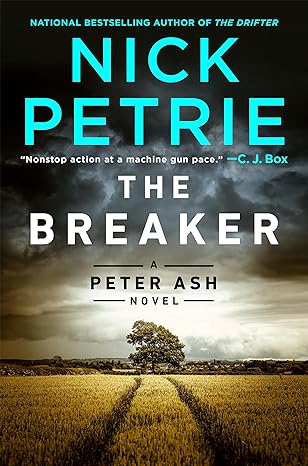
THE BREAKER (Peter Ash #6)(audiobook) by Nick Petrie


Published by Penguin Audio in 2021.
Read by Stephen Mendel.
Duration: 12 hours, 10 minutes.
Unabridged.


Synopsis

Fugitive good guy Peter Ash is hiding out in the open in the city where his adventures began in book number one of the series - Milwaukee. In The Breaker Peter Ash has an assumed identity with very good fake papers. His girlfriend June has joined him, resuming her career as a reporter with the local Milwaukee big city paper. Of course, his friend Lewis is around as well.

In the previous books Peter Ash is dealing with untreated PTSD from his time as a soldier in Iraq and Afghanistan. Too many searches in too many small confined areas has left him with severe claustrophobia.

Peter is working on the claustrophobia, though. Peter, Lewis, and June are at the Milwaukee Public Market for lunch. It is indoors, but it is very open concept with a lot of open space above. He's been eating there to get used to being inside. 

The Milwaukee Public Market

Lewis and Peter notice a figure carrying a hidden weapon entering the crowded Market. That's bad enough - but there's also a bus full of elementary school children unloading for a lunch field trip. 

Lewis and Peter leap into action and things get very complicated very quickly...

My Review

This book was the weakest in the series so far. There was plenty of action - almost non-stop action.

*****Spoilers******

June became a much less nuanced character in The Breaker. Most of her lines consist of her yelling, "Marine!" at Peter and then ranting about how much she loved him and how he needed to take care of himself and how he needed to neutralize the threats facing them without creating any fuss that would bring unwanted attention to him. That was cute at first but it got old.

It also makes zero sense for June, a woman who owns a tech research company and owns an entire mountain valley to put Peter Ash (and herself) at legal risk by letting him wander around Milwaukee all day. Hide that man away until you can figure out how to get Peter out of his predicament.

There is a police stop early on in the book for a burned out tail light that seemed needlessly petty. It was designed to introduce a grizzled old cop character who might see through Peter Ash's elaborate paperwork disguise. But, instead of giving the impression of an experienced cop who has hunches that pay off, I got the impression of a petty man who likes to push people around and make them search for electrical shorts in their tail lights by making them crawl around their vehicles in the rain and get soaking wet and dirty first thing in the morning. 

The book almost approaches sci-fi, with giant hydraulic-powered machines adapted to a wheelchair-bound man, scientifically talented orphans seeking revenge, hundreds of armed robots powered by revolutionary long-lasting batteries, and self-driving vehicles that can travel anywhere on any road.

Throw in a secret government agency and its seemingly all-knowing mysterious representative and it was just too much.

*****end spoilers*****

If this had been the first book in this series, it would have been my last. Hopefully, the next one is much, much better.

I rate this audiobook 2 stars out of 5. It can be found on Amazon.com here: THE BREAKER (Peter Ash #6) by Nick Petrie.

THE HOUSE on MANGO STREET (audiobook) by Sandra Cisneros

Originally Published in 1983.
Read by the author, Sandra Cisneros.
Duration: 2 hours, 18 minutes.
Unabridged

The House on Mango Street is the story of a Hispanic girl named Esperanza who grows up in a little house in a poor neighborhood in Chicago. Her story is told in a series of unrelated vignettes (44 in all) that tell some sort of story about her family life or the neighborhood itself. In some, the main character clearly has no idea of the more adult themes that occur around her, while in others she is very astute and understands the larger implications. 

At first, Esperanza's family intends that the house is going to be a temporary stop on their climb towards economic success in America. But, they never quite are able to move out of this troubled neighborhood and the reader is able to see how the neighborhood affects the lives of everyone around Esperanza as she grows up.

To be fair, the neighborhood is not all bad, but it is a tough place for children to grow up and keep their innocence. Some kids run away, some get married early and try to build some stability (one gets married extremely early.) Esperanza is determined to work her way out of the neighborhood and then come back and help others get out.

I read this book for two reasons:
1) It has a tremendous reputation. 
2) It has been placed on multiple book ban lists and I like to read those books to form my own opinion (unlike a lot of people who ban them.)

My review:

The author, Sandra Cisneros
I found that this book's biggest issue was that it was just boring. It's a 2 hours audiobook and I found myself wanting to listen to anything else at times. I simply could not get into this story. 

I certainly wouldn't ban this book. It has a lot of adult themes, but I think too many sheltered adults don't realize that a lot of kids live very unsheltered lives. This book will come off as very real to a lot of those kids, assuming that they can get past the back that it is a very, very tedious read. This 30+ year teacher would put it in a classroom library or in a school library and support any student wanting to read it. 

Here are two stories about districts that have banned this book - one based in Texas and one based in Florida.

I rate this book 2 stars out of 5. It can be found on Amazon.com here: 
THE HOUSE on MANGO STREET by Sandra Cisneros.


AN ABUNDANCE of KATHERINES (audiobook) by John Green


Colin Singleton is a child prodigy who has recently stopped being a child. He has graduated from high school, is preparing to go to a great college but he is unsettled by a couple of things.

Number one: being a child prodigy means that you are potentially an important adult. Colin is aware that it is now time for potential to turn into something - anything - meaningful.

Number two: Colin just got dumped - again. He has dated 19 different girls and all are named Katherine. Technically it is 18 different girls because Katherine 1 is also Katherine 19, but the point is pretty much the same.

So, Colin is wallowing in self-pity when his best friend, a slacker named Hassan, comes to him and suggests that they need to go on a road trip. They head south through Indiana and eventually end up in Gutshot, Tennessee where Colin meets a girl named Lindsey who has only dated a boy named Colin...

My Review:

Despite the 3 star review, I thought this book has several good quotes.
This is a fair to middling audiobook. For the first half of the audiobook, I would have rated it 2 stars out of 5. I kept on listening because I am a fan of John Green (both his books and him generally) and he and I have both adopted the same city as our hometown. 

As the book went on, I bumped it up to a weak 3 stars because it did get better. By the way, I am very aware of the irony of reviewing a John Green book on a 5 star scale considering how much that Green hates assigning stars to things in reviews (check out his excellent collection of essays The Anthropocene Reviewed for more info.)

Part of the problem with this book was the reader Jeff Woodman. He has a perfectly pleasant reading voice and is very clear but - whatever "it" is, he didn't have "it" in my opinion. By the way, this is the reason that Green hates the 5 star system - I am rating the reader based on something that I can't define. We all do this, though. You hear two different bands play the same song and one has "it" and one clearly doesn't. In this case, I may very well have liked the book a little better with a different reader.

My other complaint about this book is Colin's insistence on trying to create a mathematical formula to figure out who is going to dump who in a relationship. I get that only a kid would try to do such a thing, but there were so many tedious scenes describing the development of the formula and discussions of the formula that I got sick of hearing about it. At one point, I thought that Colin had accidentally shot the notebook with the formula with a shotgun and I was so happy to be done with it all. I think it was a convenient thing for Green to use to occupy Colin's time - a sponge to suck up his time while other things were going on. Character A does this, Character B does that and Colin goes into the other room and works on his formula for 3 hours. 

So, while not a bad book, certainly not a great book. So far, I've read 5 of his books. 3 have 5 stars and 2 have 3 stars. That's a pretty good track record.

Update  - in November of 2023 it was announced that the  group Moms for Liberty challenged 300+ books in Florida. This book is one of them. See the entire list of books that the Moms want banished here.

I rate this audiobook 3 stars out of 5. It can be found on Amazon.com here: AN ABUNDANCE of KATHERINES by John Green.

THE AMERICAN DREAM? A JOURNEY on ROUTE 66 DISCOVERING DINOSAUR STATUES, MUFFLER MEN, and the PERFECT BURRITO: A GRAPHIC MEMOIR by Shing Yin Khor


Published in 2019 by Zest Books.
Illustrated by the author, Shing Yin Khor.


In another recent review I wrote this:

I have a real weakness for oddball travel books. I have read a memoir about a man that hitchhiked throughout Europe and North Africa, a book about a man's bicycle trip from the UK to India, a book about a man who walked across Afghanistan, a book about a man who rode a motorcycle around the edges of Afghanistan, a book about two women who biked from Turkey to China, a book about a man who walked the length of the Nile, a man who walked the Appalachian Trail with his deeply irresponsible friend from high school...and more. And more. And more.

This book continues that tradition with a twist - it is done in comic book style. Usually, this is called a graphic novel, but this book is not a novel because it is not fiction. The author calls it a "graphic memoir."

Illustration from the back cover
The author/illustrator is an immigrant from Malaysia. She came over as a child and is very familiar with southern California. She realizes that she doesn't really know a lot about the rest of her adopted country so she decides to travel the old Route 66.

The author travels with only her little dog as a companion. She is on a tight budget so she often sleeps in her car.

Along the way she sees a lot of interesting Americana, Americans of all types and ponders her relationship with the country and its people. Plus, her dog makes friends everywhere.

I rate this graphic memoir 4 stars out of 5. It can be found on Amazon.com here: THE AMERICAN DREAM? A JOURNEY on ROUTE 66 DISCOVERING DINOSAUR STATUES, MUFFLER MEN, and the PERFECT BURRITO: A GRAPHIC MEMOIR by Shing Yin Khor.

THE FIRE NEXT TIME (audiobook) by James Baldwin


Read by Jesse L. Martin.
Duration: 2 hours, 45 minutes.
Unabridged.


James Baldwin (1924-1987) was an African-American essayist, playwright, poet and novelist. This book is a collection of two lengthy essays on race and religion in the United States. The book comes from a line from the song Mary Don't You Weep:

God gave Noah the rainbow sign
No more water, the fire next time.


The first essay is in the format of a letter to his nephew entitled "My Dungeon Shook: Letter to My Nephew on the One Hundredth Anniversary of the Emancipation."  As suggested by the title, it is about America's ugly racial history, including incidents from Baldwin's life.

The second, longer essay is "Down at the Cross: A Region in my Mind." This is a discussion of religion in America, including how Christianity had been warped into a tool to prop up a social structure that kept whites on top and blacks on the bottom waiting for their justice to come in the afterlife. It includes an interesting story of a dinner he had with the head of the Nation of Islam, Elijah Muhammad at Muhammad's home. 

The author in 1964.
This is a short audiobook, but it is an intense one. It clocks in at 2 hours and 45 minutes, but feels much longer because there is not an ounce of fluff anywhere to be found. The reader is the veteran Broadway, film and movie actor Jesse L. Martin and I think he hit the right tone throughout. 

While reading this audiobook I decided to do some research on James Baldwin because I was woefully ignorant except to recognize his photograph and the time period that he wrote in. I found this video of a debate between Baldwin and William F. Buckley, one of the founders of the modern Conservative movement. It is an excellent summary of what Baldwin says in this audiobook. Buckley is a renowned debater but he gets his clock cleaned in this debate because Baldwin is so good and Buckley has chosen to defend the indefensible. 

I rate this audibook 5 stars out of 5. It can be found on Amazon.com here: THE FIRE NEXT TIME (audiobook) by James Baldwin.

GANGSTERS vs. NAZIS: HOW JEWISH MOBSTERS BATTLED NAZIS in WARTIME AMERICA (audiobook) by Michael Benson


Highly Recommended

Published in 2022 by Tantor Audio.
Read by Gabriel Vaughan.
Duration: 8 hours, 53 minutes.
Unabridged.


Flag of the German American Bund
In the United States in the 1930's there was a small, loud, enthusiastic, and growing group of Americans that were great fans of Hitler and the Nazi party. They were largely ethnic Germans and formed organizations that sported Nazi symbols and mimicked the big rallies that Hitler had in Germany. They also mimicked the overt antisemitic speech exhibited by the Nazis. The most successful of these was the German American Bund (German American Federation).

There were a lot of small groups but there were two larger organizations with a different take than the Bund. The Silver Legion of America (Silver Shirts) had a spiritualist take on hate. Father Coughlin was a literal Catholic priest who brought a "Catholic" view on antisemitic hate and anti-interventionism from Detroit. He had a massive radio audience that was so enthusiastic that his church superiors were afraid to muzzle him.

Officially, Nazi Germany did not support these groups, but there were plenty of unofficial connections.

The national government could officially do nothing to stop them quickly (although the age-old tactic of looking for things like tax violations did work to slow some of them down over time.)

There was also very little that local governments could do to stop these meetings. Some localities, like New York City, outlawed wearing some of their Nazi-style outfits (dubious legality). Others just buckled down and over-scrutinized all of their rental applications for meeting halls, applications for parades, and so on. If there was a misspelling, or any similar type of mistake it was denied. 

But, that kind of thing only lasts so long. Eventually these American Nazis learned to double check their paperwork and take advantage of America's wide open freedom of speech rules to advocate for actions that would kill those very same freedoms.

A judge from New York City named Nathan Perlman decided that if the American antisemites were going to have paramilitary organizations, American Jews needed one to literally punch back. Turns out he knew a whole bunch of tough Jewish guys that paraded through his court room on a regular basis - Jewish mafia gangsters. People like Mickey Cohen, Meyer Lansky, Davie "the Jew" Berman*, and Bugsy Siegel were talked to in an unofficial way. 

The deal was simple - no killing, lots of roughing up (but not too rough), try to disappear afterwards, no overt help from the judge, avoid the press. In return, there would be lots of backroom maneuvers to get them out of jail if needed. The judge appealed to their sense of ethnic loyalty and it worked. These men were not good Jews in any kind of moral way. Most had long since stopped going to temple. However, most had had enough of a connection to the larger Jewish community to have had a Bar Mitzvah and they all understood that if people were going after harmless rabbis and little old ladies that go to temple, they would certainly go after Jewish mobsters.

Mugshots of Meyer Lansky (1902-1983)
Meyer Lansky said this about their involvement: 
"The stage was decorated with a swastika and a picture of Adolf Hitler. The speakers started ranting. There were only fifteen of us, but we went into action. We threw some of them out the windows. Most of the Nazis panicked and ran out. We chased them and beat them up. We wanted to show them that Jews would not always sit back and accept insults"

This Nazi-Gangster fight did not go on for too long - a couple of years at longest. The German American Bund began to fizzle out during 1939 when everyone was starting to get a real sense of what Nazi Germany was all about. Pearl Harbor pretty much brought an end to the pro-fascist meetings thanks to Italy and Germany declaring war on the United States to express their solidarity with Imperial Japan. 

Are there thorny free speech issues in this scenario? Well, it looks bad when a judge is recruiting a crew of guys to beat people up for expressing their political thoughts. But, when you consider the record of Nazis before and during the war it's pretty hard not to enjoy hearing about the mobsters beating the crap out of a bunch of loud-mouthed racist bullies.

I recommend the audiobook version because of the reading of Gabriel Vaughan. The book is written is written in a lively and engaging manner and uses words or phrases from movies or newsreels from the time period, using slang like "heaters" (guns) and "whacked" (mafia ordered murder). Vaughan doubles down on this theme by reading with a mild accent reminiscent of newsreel narrators of the time.

I rate this audiobook 5 stars out of 5. It can be found on Amazon.com here: GANGSTERS vs. NAZIS: HOW JEWISH MOBSTERS BATTLED NAZIS in WARTIME AMERICA (audiobook) by Michael Benson

*Note on Davie "the Jew" Berman. Mobster nicknames are almost always colorful. Berman has to have the least imaginative nickname of all the mobsters of this era. That's most likely due to the fact that he was operating out of Minneapolis and Iowa City - places not known for large Jewish populations.

SO COLD the RIVER (audiobook) by Michael Koryta


Published in 2010 by Hachette Audio.
Read by Robert Petkoff.
Duration: 13 hours, 33 minutes.
Unabridged.


Synopsis:

Eric Shaw is a down on his luck film maker who has moved back to Chicago from Hollywood. His marriage is on the rocks, he feels sorry for himself and he is making ends meet by making little movies out of family photos for funerals. He is good at his job - so good at it that he is offered a special job.

A woman asks him to travel to French Lick, Indiana and research the early years of her father-in-law, an eccentric billionaire. The only clue he has is a strange bottle of Pluto brand mineral water, bottled in French decades earlier. The bottle seems to be forever cold and the water inside looks strange.

Once Shaw arrives in French Lick the water is not the only strange thing he encounters...

*******

My Review:

This is good supernatural thriller. I did not realize this when I started listening because I had picked out this book because it was set in the French Lick area. I have vacationed in the area a few times over the years and wanted to read what this author had to say about the area. This author is from nearby Bloomington, Indiana and he absolutely captures the over-the-top beauty and splendor of the West Baden Springs Hotel (see picture.) 

All of his Indiana references are spot-on perfect, which made the book all the more enjoyable for this lifelong Hoosier.

The audiobook is enhanced with a violin music and other occasional sound effects. 

This book was adapted into a movie on 2022.

I rate this book 4 stars out of 5. It can be found on Amazon.com here: So Cold the River by Michael Koryta.

WILDLAND: THE MAKING of AMERICA'S FURY (audiobook) by Evan Osnos


Published in September of 2021 by Macmillan Audio.

Read by the author, Evan Osnos.
Duration: 17 hours, 7 minutes.
Unabridged.

Evan Osnos is a reporter for The New Yorker. He was inspired to write about the phenomenon of Donald Trump and the 2016 and 2020 elections when he returned from an multi-year assignment in China and noted that politics, journalism and even economics in the United States had changed. He didn't use this analogy, but I will: Parents don't notice their kids changing and growing because they see them every day. But, the aunts and uncles who only see them at the holidays can easily detect the changes.

For Wildland Osnos went to three places that he used to live to investigate: Greenwich, Connecticut; Chicago, Illinois; and Clarksburg, West Virginia. 

In West Virginia, he primarily looks at the changes in journalism such as the loss of local news and small town newspapers. He also looks at government pulling back environmental regulations and business avoiding responsibilities such as living up to pension obligations and cleaning up their messes. The shenanigans from Peabody Energy to avoid pension obligations were especially egregious.

In Connecticut he follows up on the business theme by looking at Greenwich - a town seemingly full of hedge fund managers. Really, it's not, but their wealth and their change of mindset is changing the town. The mindset embraces famed economist Milton Friedman's maxim that the purpose of a corporation is to maximize returns for its shareholders. I grew up in a town with one very large corporation with multiple factories. It provided scholarships, paid for public art and architecture and provided benevolent leadership through boards, committees and generally being engaged with the community that its leadership lived in and provided its labor force. 

In Chicago, he looks at the near-collapse of some communities - the ones that make the news all of the time for the murders. He discusses how the manufacturing base of Chicago left and how that helped lead to the decline of some neighborhoods. which ties into the Greenwich part of the book.

On top of all of this, throw in the Supreme Court case generally known Citizens United. It opened up the flood gates for money in politics. Now millions of dollars could be spent on primary campaigns. In 2020, my state was not really a player in Presidential politics, but we saw almost non-stop ads over 1 race for the House of Representatives. One ad after another from both sides. Those kinds of ad campaigns are the result of the Citizens United decision in 2010.  The Supreme Court held that the First Amendment prohibits the government from restricting independent expenditures for political campaigns by corporations, including non-profit corporations, labor unions, and other associations. With that decision, politics changed.     

Outsiders with a lot of money now had a chance to come in and be effective without having the strong organization and the political contacts of a political party.    

The book takes a long time to develop and I nearly quit several times in the first couple of hours. There was so much talk of hedge fund managers and the new prevailing mercenary quality in big business. Notice that I said "prevailing" - the mercenary quality has always been there but it was restrained by other cultural norms. But, once it moves on to West Virginia and Chicago the book got more interesting to me. I guess it's simply because I don't know ultra-rich hedge fund managers and I don't identify with that lifestyle, but I do know poor black people in a big city and I grew up in a rural area. 

At the halfway point, he starts to tie all of this stuff together and then the book gets good. About 3/4 of the way through the book he starts to tie in the rise of Trumpism. To be honest, I had forgotten that this was the point of the book in the frist place. 
Osnos ties it together. It's not some big nefarious plot, but rather the result of a lot of forces converging - the Citizens United decision, the change in the philosophy of big business, the loss of local news reporting, the loss of good jobs in rural areas and the big cities all come together.

Toss in a great deal of frustration, Osnos makes it seem that the arrival of a person like Donald Trump was inevitable. I contend that it also explains Bernie Sanders. Like Trump, Sanders is truly a political outsider. Sanders isn't even a member of the Democrat party and has not put in a lot of work building the party organization. Still, he almost won their nomination in 2016 and ran very strong in 2020 because this decision lets money make up for not being part of a party and having access to all of the connections and organization that political parties can provide. 

This book doesn't have a lot of answers, but it points out a lot of problems and you have to know what the problems are before solutions can be found.

I rate this audiobook 5 stars out of 5. It can be found on Amazon.com here: WILDLAND: THE MAKING of AMERICA'S FURY by Evan Osnos.

Featured Post

<b><i>BAN THIS BOOK (audiobook)</i></b> by Alan Gratz

Published in 2017 by Blackstone Audio, Inc. Read by Bahni Turpin. Duration: 5 hours, 17 minutes. Unabridged. My Synopsis Ban This Book is t...

Popular posts over the last 7 days