Showing posts with label men and women. Show all posts

THE ROARING TWENTIES: A HISTORY from BEGINNNG to END (kindle) by Hourly History


Published by Hourly History in 2023.

Hourly History specializes in producing little histories and biographies that can be read in about an hour. 

If you are pretty well-versed in the basics of 1920's America, this short history offers nothing new. If you remember the basics from your U.S. history textbook or if you watched a documentary on the topic, this e-book ill offer nothing new.

The e-book repeats some of its main themes multiple times, sometimes within a few paragraphs of each other. I kept wondering if they were trying to fill space, which seems kind of ridiculous in a book with literal space limits (able to be read in just an hour). It also made me wonder if this book were written by an AI.

As an example of what I was talking about, the e-book mentioned that people grew more accepting of LBTQ+ people in the 1920's. That is undoubtedly true, but it was mentioned so many times that it might persuade some readers that the 1920's were a very accepting time. I think it would be fair to say that the during the 1920's, the needle of the gauge of LGBTQ+ acceptance moved off of "zero", but that's about it. Progress, to be sure, but hardly worth mentioning multiple times. 

The facts presented in the book are all solid, which is why I am giving it 3 stars out of 5, even if it was written in a clunky way.

This e-book can be found on Amazon.com here: The Roaring Twenties: A History from Beginning to End.

THE HOUSE on MANGO STREET (audiobook) by Sandra Cisneros

Originally Published in 1983.
Read by the author, Sandra Cisneros.
Duration: 2 hours, 18 minutes.
Unabridged

The House on Mango Street is the story of a Hispanic girl named Esperanza who grows up in a little house in a poor neighborhood in Chicago. Her story is told in a series of unrelated vignettes (44 in all) that tell some sort of story about her family life or the neighborhood itself. In some, the main character clearly has no idea of the more adult themes that occur around her, while in others she is very astute and understands the larger implications. 

At first, Esperanza's family intends that the house is going to be a temporary stop on their climb towards economic success in America. But, they never quite are able to move out of this troubled neighborhood and the reader is able to see how the neighborhood affects the lives of everyone around Esperanza as she grows up.

To be fair, the neighborhood is not all bad, but it is a tough place for children to grow up and keep their innocence. Some kids run away, some get married early and try to build some stability (one gets married extremely early.) Esperanza is determined to work her way out of the neighborhood and then come back and help others get out.

I read this book for two reasons:
1) It has a tremendous reputation. 
2) It has been placed on multiple book ban lists and I like to read those books to form my own opinion (unlike a lot of people who ban them.)

My review:

The author, Sandra Cisneros
I found that this book's biggest issue was that it was just boring. It's a 2 hours audiobook and I found myself wanting to listen to anything else at times. I simply could not get into this story. 

I certainly wouldn't ban this book. It has a lot of adult themes, but I think too many sheltered adults don't realize that a lot of kids live very unsheltered lives. This book will come off as very real to a lot of those kids, assuming that they can get past the back that it is a very, very tedious read. This 30+ year teacher would put it in a classroom library or in a school library and support any student wanting to read it. 

Here are two stories about districts that have banned this book - one based in Texas and one based in Florida.

I rate this book 2 stars out of 5. It can be found on Amazon.com here: 
THE HOUSE on MANGO STREET by Sandra Cisneros.


THANK YOU for VOTING: THE MADDENING, ENLIGHTENING, INSPIRING TRUTH ABOUT VOTING in AMERICA (audiobook) by Erin Geiger Smith


Read by Lisa Cordileone.
Duration: 6 hours, 3 minutes.
Unabridged.


As the title says, his book is intended to be a primer on the history of elections in America and how elections work now in different states. It was thorough enough without drowning the listener in details.

The book does a solid job with both of those major topics without feeling partisan. Those topics comprise the first and last two hours of this audiobook. The middle two hours just felt like padding. There was an extended discussion of how to raise the voter participation rate that just dragged with discussions of how businesses can encourage employees to vote, ad campaigns from local government, and so on. 

I would rate the first two sections 4 stars out of 5, but the middle section is a 2 out of 5 at best. That makes a final score of 3 out of 5.

This book can be found on Amazon.com here: THANK YOU for VOTING: THE MADDENING, ENLIGHTENING, INSPIRING TRUTH ABOUT VOTING in AMERICA (audiobook) by Erin Geiger Smith.


THE MAKING of BIBLICAL WOMANHOOD: HOW the SUBJUGATION of WOMEN BECAME GOSPEL TRUTH (audiobook) by Beth Allison Barr


Published by Christianaudio.com in 2021.

Beth Allison Barr is a professor of medieval and church history at Baylor University. She has written a lot about women in the medieval world. She is also an evangelical Christian and a youth pastor's wife. This puts her in a rather unique position to comment on the role of women in the evangelical church and topics like complementarianism in the more conservative churches.

Complementarianism is a church teaching that men and women have very distinct roles in family life, marriage, and the church. These roles are distinct, but of equal value, but men are given leadership roles. In more conservative churches, women are never put into any sort of leadership roles over men. They will not be pastors. They will not lead a board. They won't even teach older boys or men in Sunday school. In some interpretations, they will not teach men or older boys any topic at all.

The more Barr studied, the more she knew that this view was not the norm in the beginning years of the church (going back to Peter, Paul, and even Jesus), it was not the norm in Medieval times and it was not the norm in evangelical churches as late as the Great Depression/World War II era. 

Barr places the blame on at least three things. One is a lack of knowledge of church history. Some denominations offer lots of training in church history or their pastors/leadership. Some churches offer practically none - and it shows. Barr demonstrates a lack of knowledge of doctrines that go back nearly 1,700 years, such as the Athanasian Creed.

She also notes that over and over again women were allowed to teach, preach, and/or lead in the Western church. To be clear, the Western Church would be the Roman Catholic Church and, after the Reformation, the Protestant breakaways. It would not include the Orthodox Church or the Coptic Church. She notes these women throughout the book and tells their stories. To be fair, they were not half or anything close to half of the teachers, preachers, and/or leaders - but they were still there - she names the names, she quotes their writings. Denying their existence is simply willful ignorance.

The other thing she blames is translation. I am going to add to her thesis a bit. I am a Spanish teacher. There is always wiggle room when you translate. Translators can emphasize certain things and de-emphasize others. This is the "art" of translation. This happens all of the time when translating from English to Spanish and Spanish to English because the two languages don't always match up perfectly even though they co-exist at the same time and oftentimes in the same place and have bumped into each other on a regular basis for centuries.

Barr argues that where translation is unclear but allows for including women, the translators have consistently chosen translations that exclude women in Paul's New Testament letters.  Sometimes, they make a comment in the notes. Sometimes, they don't. In at least one case some translators appear to have changed the gender of a person who was in a leadership role. In another case, the leadership role a woman played in a local church was changed to a lesser role so the translators can support the complementarian theological position. They just changed the word to make it fit their theology and that is a bad habit to get into if you want people to read the Bible and take it seriously.


And that last point - the point about changing history, the translations, and the Bible itself to fit a pre-determined theology that does not match with the Bible or past practice - that is the part that hurts the church in the short run and the long run. 

I rate this audiobook 5 stars out of 5. It can be found on Amazon.com here: THE MAKING of BIBLICAL WOMANHOOD: HOW the SUBJUGATION of WOMEN BECAME GOSPEL TRUTH by Beth Allison Barr.

OF BOYS and MEN: WHY the MODERN MALE IS STRUGGLING, WHY IT MATTERS, and WHAT to DO ABOUT IT (audiobook) by Richard V. Reeves


Published in September of 2022 by Blackstone Publishing.
Read by the author, Richard V. Reeves.
Duration: 6 hours, 55 minutes.
Unabridged.

Men, as a group, are struggling in today's economy. The average male's income has falling in inflation-adjusted terms, especially so when you factor out upper class and upper middle class men.

Men are more likely to be arrested, be addicts, be homeless, and more likely to succeed at killing themselves.

Boys are struggling in today's educational system. They are far more likely to be suspended, expelled or placed in a special education program. They are far less likely to graduate from high school. They far less likely to attempt any sort of post-secondary education (a majority of all college students are female) or training and far less likely to complete that training or degree - even in the rare situations where the post-secondary training and/or education are essentially free.

Reeves, an economist with the Brookings Institutions, sees these trends as part of a larger problem and does not see it as a problem caused by women being part of the workplace, going to college or participating in advanced training. That is a reality and he has literally no interest in changing it. He makes this point several times. 

I highly recommend this book. It offers an honest assessment of where we are as a country and that assessment is often depressing. But, Reeves  doesn't just list a bunch of problems. He offers practical solutions that are based on policies that have already proven successful in other ways.

The audiobook is read by the author. He does an excellent job, which is not always the case when authors decide to read their own audiobooks.
 
I rate this book 5 stars out of 5. It can be found on Amazon.com here: OF BOYS and MEN: WHY the MODERN MALE IS STRUGGLING, WHY IT MATTERS, and WHAT to DO ABOUT IT by Richard V. Reeves.

A MAN WITHOUT a COUNTRY by Kurt Vonnegut


Originally published in 2005

Published when Kurt Vonnegut (1922-2007) was 82, A Man Without a Country is a series of short essays from a man who is pretty embarrassed by his country with the election and re-election of George W. Bush - thus the title. (One can only imagine Kurt Vonnegut's reaction to the election of Trump!)

But, very little of the book directly deals with politics. He wanders from topic to topic - this sounds like it should be a mess, but each of these essays flow right along, breaking every rule that your English teachers taught you about having a proper opening paragraph, a clearly stated thesis, etc. 

But, then again, your English teacher wasn't Kurt Vonnegut. Vonnegut, by the way, strongly recommends against the use of semi-colons. I absolutely agree. 

If you haven't read Vonnegut, brace yourself. He is angry, sarcastic, insightful and brilliant. He writes about a wide variety of topics. Some are dated, like the comments about the fights over placing the 10 Commandments in courthouses and on courthouse lawns. Or, is it out of date? Those same people have just moved on to fight to be able to discriminate against the LGBTQ community and advocate the QAnon conspiracy theory. Same goofiness, new topics.

Vonnegut discusses a wide variety of topics, including:

-What topics are off-limits when it comes to humor;
-Eugene V. Debs;
-Socialism;
-The power of the Sermon on the Mount (Vonnegut was an avowed atheist, but he dearly loved the Sermon on the Mount);
-Carl Sandburg;
-War;
-The importance of art and the importance for regular people to get in there and give it a try;
-Women, men and divorce (it made sense to me - very insightful);
-and more. So much more. He meanders, and it works. 

About when you think that Vonnegut is irredeemably cranky - a curmudgeon that even other curmudgeons think is unnecessarily grumpy, Vonnegut hits you with a thought that is so sweet and so pure that you just stop reading and think, "Wow!"

He did this to me towards the end of this book. He was talking growing up and tragedy and his annoying Uncle Dan. Then, you turn the page and there is an entire page about his Uncle Alex whose "...principal complaint about other human beings was that they so seldom noticed it when they were happy. So when they were drinking lemonade under an apple tree in the summer, say, and talking lazily about this and that, almost buzzing like honeybees, Uncle Alex would suddenly interrupt the agreeable blather to exclaim, 'If this isn't nice, I don't know what is.'" And he urges us to do the same. 

Pretty good advice from a man who was earlier complaining that he was going to sue because the cigarette warning labels were wrong - they had promised to kill him and he was still here.

I rate this book 5 stars out of 5. It can be found on Amazon.com here: A MAN WITHOUT a COUNTRY by Kurt Vonnegut.


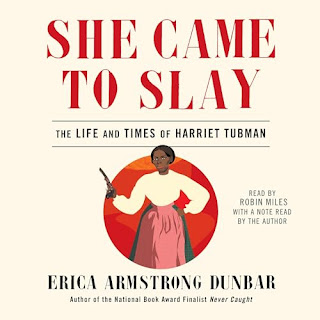
SHE CAME to SLAY: THE LIFE and TIMES of HARRIET TUBMAN (audiobook) by Erica Armstrong Dunbar


Published in 2019 by Simon and Schuster Audio.

Read by Robon Miles.

Duration: 5 hours, 53 minutes.

Unabridged. 

Erica Armstrong Dunbar brings us an accessible biography of one of the true heroes of American history - Harriet Tubman. She Came to Slay is long enough to give a decent picture of her life but short enough that it doesn't intimidate potential readers.

A traveling statue named honoring
Harriet Tubman named "Journey to Freedom"
I am not going to go through the entire biography of her life, but this book covers all of the major points of her life such as: 

-Her escape from slavery; 

-Her multiple trips back to Maryland to free family, friends and anyone that would go;

-Her work in anti-slavery societies where she met and worked with people like Frederick Douglass, William Seward and John Brown;

-The communities she helped start in New York and Canada;

-Her work with women's rights groups and her struggles to get white women to include black women in their fight;

-Her service as a nurse in the Civil War;

-Her service as a spy and a scout in South Carolina in the Civil War and her fight to be recognized for that service.

The book has a lively pace.

I rate this audiobook 5 stars out of 5. It can be found on Amazon.com here:  SHE CAME to SLAY: THE LIFE and TIMES of HARRIET TUBMAN by Erica Armstrong Dunbar.

THE CIVIL WAR REMEMBERED: OFFICIAL NATIONAL PARK SERVICE HANDBOOK by various authors


Originally published in 2011 by Eastern National

Eastern National is the publisher of the official books published by the National Park Service. Their books are on display in National Park gift shops in visitor centers across the country. Most are pretty good - I've bought more than my share of them because they are compact volumes, full of great, pertinent illustrations printed on glossy paper and their information is solid. The problem is that the writing is always solid, if not particularly engrossing. 

The Civil War Remembered is an exception that pattern because the authors are historians who are also name brand Civil War authors - some are authors that have hit the top of the non-fiction best seller lists and you don't do that if you write dense prose.

There are 16 essays in this 175 page book. Each one covers a specific topic that makes for a rough narrative telling of the history by exploring themes such as America before the Civil War, what it is was like to serve in the military in the Civil War, how the war changed from a war to only preserve the Union to a war to end slavery in order to preserve the Union, industry in the Civil War, the West in the Civil War and Reconstruction. Some of the big names include James McPherson, Edward L. Ayers and Eric Foner

This book would serve as a great introduction to the Civil War for anyone. I was very pleased to see a review on Amazon that said that their college professor used this in class. This volume is that good. 

Highly recommended.

I rate this book 5 stars out of 5. It can be found on Amazon.com here: THE CIVIL WAR REMEMBERED: OFFICIAL NATIONAL PARK SERVICE HANDBOOK.

THE OTHER SIDE of HISTORY: DAILY LIFE in the ANCIENT WORLD (The Great Courses) by Robert Garland


Published by The Great Courses in 2013.

Read by the author, Robert Garland.
Duration: 24 hours, 28 minutes.
Unabridged.

Robert Garland
Robert Garland gives his listeners a look at the "other side of history" - meaning from the point of view of the lower and middle classes, slaves, regular soldiers, women and children from the Stone Age through Medieval Europe. Occasionally, he looks at the rich, but not quite famous as well. He also explores how religion worked in every day life, family life, marriage ceremonies, how many jobs were performed and funeral rites in Mesopotamia, Ancient Egypt, Ancient Greece, the Persian Empire, the Roman Empire and Medieval Europe, particularly England.

Garland is a lecturer at Colgate University in New York State so he delivers this information through a series of 48 half-hour lectures. Asking for all 48 lectures to be 5 star quality is asking too much, but I found this to be an enjoyable and educational listen.

Highly recommended.

I rate this audiobook 5 stars out of 5. It can be found on Amazon.com here: THE OTHER SIDE of HISTORY: DAILY LIFE in the ANCIENT WORLD (The Great Courses) by Robert Garland.

LIVING DOLLS: THE RETURN of SEXISM by Natasha Walter


Published in 2010 by Virago Press.

Natasha Walter is an English feminist who is looking at how modern culture treats women. She has two main points in Living Dolls: The Return of Sexism. I will reverse the order of their presentation in my review.

Her second main point is the new belief in biological determinism, meaning men and women have areas that they are naturally better at - and that fact overrides everything.

She notes that the scientific studies that this belief is based on have never really
The author, Natasha Walter
been scientifically proven, meaning that they were limited and not replicated on a regular basis. Some have never been replicated even once.

The danger is that people just assume things like "girls aren't good at math" and "men can't take care of babies or children" and they become reality. I see it in the classroom all the time - parents tell their kid they struggled with a certain class and they understand if the kid struggles and the kid struggles. It's a self-fulfilling prophecy.

The main point that she presents at the beginning of the book is more complicated and controversial. She laments that modern Western culture's willingness to affirm female sexuality has, all too often, been appropriated by men to promote male sexual fantasies. She interviewed a lot of women for this book and makes a compelling argument that men have co-opted this idea to encourage women to strip, pole dance, make porn movies and basically do over thing that used to be considered damaging to women -all in the name of feminism.

Her argument is not that female sexuality is a bad thing, but rather that it has become, for too many, the only tool that women have to get ahead. Or, going back to that theme of a self-fulfilling prophecy, too many women think that sex is their only way to get ahead in the world.

She hints at, but never quite labels another way these two thoughts go together. Could it be that the biological determinism theme is reinforcing her argument from the beginning of the book by taking options away from women so that they feel that they have to fall back on sex to get ahead?

This was an interesting book, even if I am reading it as an outsider (being a male). I flew through it. I rate it 5 stars out of 5. It can be found here: LIVING DOLLS: THE RETURN of SEXISM by Natasha Walter.

SPEED GIRL: JANET GUTHRIE and the RACE that CHANGED SPORTS FOREVER (kindle) by Stephen Talty


Published by Amazon Publishing in 2017.


Every racing fan has heard of Danica Patrick. She raced successfully for seven years in IndyCar, raced in 8 Indy 500s (with 6 top ten finishes) and 7 years in NASCAR (with less success). Long before Danica there was Janet Guthrie - a true pioneer in motorsports.

This short kindle book puts Guthrie's achievement in context in two ways. First, it details how truly startling it was to the drivers at the top levels of NASCAR and IndyCar for a woman to show up and try to add a little diversity to the field. Drivers that I always looked up to, like Richard Petty, said startlingly sexist comments about Guthrie.

The second way Speed Girl puts Guthrie's achievement in context is the more important one.  The author, Stephan Talty, describes how Guthrie worked her way up the ranks, tore apart engines, suspensions and body work and worked on her cars in her spare time as she gave up her personal life to go faster and faster in any car she could get her hands on. As a racing fan, this is the same story I have heard over and over again - which means she was what she always wanted to be - a racer. Not a fluke, not a curiosity - a racer.

Janet Guthrie, after qualifying for the Indy 500 in 1977.
I am a fan of the Indy 500. I've been to 32 straight Indy 500s and when I was 11 years old I got an autograph of Janet Guthrie in 1980 at a qualification day or practice for the Indy 500. Turns out that that was her last attempt to make the Indy 500 due to a lack of funding. Sponsors didn't know what to do with her and when there is no money, there is no car. There are times in a book like this that the truth is ugly, but it was good to read about the big names of yesteryear again, such as Foyt, Andretti and even Dick Simon.

The Kindle version of this book is enhanced with video built right into the page. It does little to advance the story, but it is fun. There is also an audiobook version of the book. They can be found on Amazon.com here: SPEED GIRL: JANET GUTHRIE and the RACE that CHANGED SPORTS FOREVER.

I rate this book 5 stars out of 5.


WHAT WOULD SHE DO? 25 TRUE STORIES of TRAILBLAZING REBEL WOMEN by Kay Woodward


Published by Scholastic in 2018

What Would She Do? is collection of very readable short biographies of women - which, after being factually correct, is the most important thing. As David McCullough said, "No harm's done to history by making it something someone would want to read." 

Woodward writes in an informal, approachable style that I enjoyed quite a bit. Each biography is accompanied by a full page illustration of the woman and a little chart with basic biographical information. There is also a large pullout quote from or about her. For example, for Emma Watson there is this quote: "The saddest thing for a girl to do is to dumb herself down for a guy."


Generally, I did not like the "What Would _____ Do?" section that was included at the end of each biography. The author was clearly trying to make a connection between the women in the book and the typical American student with typical American student problems. But, trying to connect Cleopatra to a student who is being laughed at for their fashion choices or Rosa Parks to a girl being left out of group texts was just too far of a stretch for me.

Otherwise, though, this is a strong book. I am gladly handing it over to my 6th grade daughter to read and then we are going to pass it on to her teacher for her classroom library.

The publisher recommends this book for ages 8-12. I would say ages 10-15.


I rate this book 4 stars out of 5.

This book can be purchased on Amazon.com here: WHAT WOULD SHE DO? 25 TRUE STORIES of TRAILBLAZING REBEL WOMEN by Kay Woodward.


Note: I received a free review copy of this book as part of the Amazon Vine program in exchange for an honest review.

WHAT the DOG SAW and OTHER ADVENTURES (audiobook) by Malcolm Gladwell


Published by Hachette Audio in 2009

Read by the author, Malcolm Gladwell
Duration: 12 hours, 49 minutes
Unabridged

This fascinating audiobook is actually a collection of articles that Malcolm Gladwell has written over the years. Each story in What the Dog Saw is about 30-45 minutes long and cover a great variety of subjects. Topics include ketchup, mammograms, FBI profilers, pit bulls, menstrual cycles, Ron Popeil (founder of Ronco), the dog whisperer, plagiarism, the Challenger Explosion/risk, home hair coloring products and the opportunities that those products offered for female executives, first impressions/job interviews, homelessness and how to solve it (really!), The Pill, Enron and the importance of having a great teacher in every classroom.

I am a teacher and I was of course interested in his discussion about teachers. What was best was his emphasis on the day-to-day interaction between students and teachers and how one can observe quality education in action. What was worst was the insistence that a standardized test can really identify good teaching. There are so many variables that go into a one time standardized test such as overall climate of the school, the day-to-day mood and health of the students and the teacher, the students' personal lives (at home and at school) that I would compare it to a giant stew rather - and it is hard to figure out what makes a great stew great. Is it the meat, the potatoes, the broth, the temperature it was cooked at, the way the ingredients were cut, and so on.

The article about one of the creators of The Pill was tedious at best. Unfortunately, it comes fairly early and I decided while I was listening to it that if there was another one like this one I was going to bail on the whole audiobook.

Malcolm Gladwell.
Photo by PEN American Center

Thank goodness I didn't. The rest of the book is really very interesting and provided some good discussion fodder between my daughter and I as we carpooled to school in the morning.

The Enron article was mind-blowing for me. It was a massive scandal when Enron collapsed but the fact that they were doing was literally posted on their website and the IRS had figured it out beforehand (they did nothing because it wasn't illegal, just really, really stupid) makes me wonder about the people who rate stocks and investments. 

The article on homelessness hit the listener in the gut in multiple ways. By not dealing with it, we are making it much, much, much more expensive and gumming up the works in other areas, like emergency rooms. But, by dealing with it do we break faith with people who are doing things "the right way" but not having much success.

The book was read by the author. He has a lot of experience being interviewed and participating in panel discussions on TV and radio so it wasn't like he was a complete rookie in front of the microphone. There are times when he has a peculiar way of saying a word but I think it really was an overwhelmingly positive experience having him read the book. His slightly quirky reading style matched his offbeat topics and writing style making the whole experience feel like Gladwell was riding in the backseat of the car telling you all about some topic that he thought was interesting and was sure that you would to. 

And, he was almost always right.

I rate this audiobook 5 stars out of 5.

This audiobook can be found on Amazon.com here: What the Dog Saw.

APPALOOSA (Virgil Cole and Everett Hitch #1) (audiobook) by Robert B. Parker


A western for grown-ups. It's not about the guns, horses or bullets. It's about friendship, sex and, ultimately, love.


Published by Random House in 2005
Read by Titus Welliver
Duration: 4 hours, 57 minutes
Unabridged

There are four main characters in Appaloosa: Marshal Virgil Cole, Deputy Everett Hitch, Bragg (a rancher/hotel owner) and Mrs. French, a pathetic woman that leeches onto powerful men out of some deep seeded need that we never quite have explained. Suffice it to say, Mrs. French is a survivor because she uses sex to endear herself to the most powerful man in her immediate area. 

Robert B. Parker loves to explore the sometimes complicated psychology of men and women and the way they express friendship and love, both platonic and amorous. His books are full of people (mostly women, but not always) that claim to be in love but really they are psychologically needy and act out sexually in strange, disruptive ways. 

There are four main characters in this story: Marshal Virgil Cole, Deputy Everett Hitch, Bragg (a rancher and later a hotel owner) and Mrs. French, a pathetic woman that leeches onto powerful men out of some deep seeded need that we never quite have explained. Suffice it to say, Mrs. French is a survivor because she uses sex to endear herself to the most powerful man in her immediate area. 

But, the problem is, who is the most powerful man? Is it the Marshal, Bragg or even the Deputy? And, will they even realize they are being manipulated? Does she even know she is doing it? Can the Cole and Hitch's friendship endure this tension?

The audiobook is read by the actor Titus Welliver. I like Welliver's work and his voice is smooth and mellow - just about perfect for Hitch, who tells the story. 

I rate this audiobook 4 stars out of 5.

This audiobook can be found on Amazon here: Appaloosa

A CALL to ACTION: WOMEN, RELIGION, VIOLENCE, and POWER (audiobook) by Jimmy Carter


Published in 2014 by Simon and Schuster (AUDIOWORKS)
Read by the author, Jimmy Carter
Duration: 6 hours, 33 minutes

Jimmy Carter and I have a strange relationship. Don't get me wrong, the 39th President and I have never met and are not likely to. I think that his presidency was, on balance, a well-intentioned mess and his post-Presidential career has been a mix of amazing achievements (Habitat for Humanity, for example) combined with annoying commentary and self-intervention into areas where he was not invited (ask Bill Clinton what he thinks of Carter's self-appointed mission to North Korea during the Clinton Administration).

This book only re-affirms my impressions of Jimmy Carter. I admire his religious faith and his intimate knowledge of the scriptures. I also admire his willingness to learn about other faiths and the fact that he teaches in his church's Sunday school. His work through the Carter Center has also been a mixed bag of amazing work against poverty and disease and less-than-helpful self-insertion into international politics. 

As Carter describes it early in his book, A Call to Action was written because so many people asked him to use his position to call attention to the how religion was being used against women around the world. 

The book also looks at the economic and political status of women and often ties religious views into how women and doing economically and politically. This is mostly a look at Christianity and Islam with some commentary on Judaism but almost none on Buddhism, Hinduism, Shintoism or any of the other faiths of the world.

Carter is especially critical of Christian denominations that do not allow women to be pastors or priests. He lays down his arguments here quite well, which is appropriate since he publicly broke with the Southern Baptists over this topic in 2000 and has laid out his reasoning for doing so many times. 

Former President Jimmy Carter signing
 A CALL TO ACTION in April of 2014. 
Photo by Mark Turner
He is less critical of the Islamic world. Don't get me wrong, he is critical, but spends much less time on the topic than he does in criticizing Christianity. He dismisses a lot of the more obvious things like burkas, not letting women go to school and not letting women receive medical treatment as local tradition. This is true, but it is tradition bolstered by certain verses in the Koran or by attitudes that draw on those verses for strength. 

This leads to the heart of my strange relationship with Jimmy Carter. It is not that he did not have a point about any of this stuff, it is that he points his finger at America and the West for so long in comparison to the other religions and countries.  He gushes over the improvement of the conditions for women in China in a section that focuses on China and brushes over the one child policy, forced abortions (he addresses the forced abortions at the end of the book but only as part of a larger movement) and the number of girls in orphanages. He focuses on the positives and brushes over the negative. When discussing America, he brushes over our positives and focuses on the negatives. Note, I am not saying we are perfect, I am saying his focus is often out of balance. 

The book was read by Jimmy Carter. At first, I thought that this was an odd choice considering his age (he was 89 when this book was released). His weaker voice has only deepened his accent and it does take a few minutes to get used to it. But, in the end, Carter's unique voice, especially if you remember his presidency, was the only one that could read this audiobook - his style is all over the text and you would have been imagining it being read in his voice anyway. At times, his emphasis on certain words while reading express his feelings more than the words themselves would have. Every time he says the phrase "female genital cutting" he practically spits out the word "cutting" - his distaste is obvious.

I rate this audiobook 4 stars out of 5. It can be found on Amazon.com here: A CALL to ACTION: WOMEN, RELIGION, VIOLENCE, and POWER (audiobook) by Jimmy Carter.

Reviewed on May 31, 2014.

In Pursuit of Spenser: Mystery Writers on Robert B. Parker and the Creation of an American Hero edited by Otto Penzler


Published  in 2012 by Smart Pop


I discovered Robert B. Parker's Spenser about 20 years ago. In a way, that is sad because I could have been enjoying Spenser for a lot more years. But, in a way it was fantastic because I had so many Spenser books to read to catch up and there were new ones coming out regularly. For years I was able to read or listen to his books as quickly as I wanted. But, eventually I caught up and had to just wait for the new ones. Sadly, in 2010 Parker died so all of his series came to an end.

In Pursuit of Spenser is an attempt to honor the long and noteworthy career of Robert B. Parker. Editor Otto Penzler has collected 14 essays by such writers as Lawrence Block, Loren D. Estleman and Dennis Lehane (and one work by Parker himself that explains Spenser) in a must-read for any fan. Although the focus is on Parker and Spenser, many of the other of the dozens of characters that  he created are covered as well. His role in re-invigorating the detective story, his take on male-female relationships, race relations and, of course, Spenser's wonderful wisecracks are thoroughly discussed.
Robert B. Parker 
(1932-2010)


I found it to be a wonderful celebration of a unique voice in American literature and a fitting tribute. I know the Spenser "franchise" is being continued by Ace Atkins, but I found myself agreeing with Lawrence Block who decided made the analogy between tribute bands and the real thing. I won't be moving forwards into the  "tribute band" portion of the Spenser franchise. I'll just re-visit the real thing from time to time.

I rate this book 5 stars out of 5.

This book can be found on Amazon.com here: In Pursuit of Spenser: Mystery Writers on Robert B. Parker and the Creation of an American Hero

Reviewed on March 14, 2013

A World Out of Time (audiobook) by Larry Niven


To the center of the galaxy and back

Re-published by Blackstone Audio in 2012.
Read by Tom Weiner
Duration: 7 hours, 59 minutes
Unabridged

First published in 1976, A World Out of Time is a grand adventure that literally follows its hero, Corbell,  across the galaxy and across three million years of time as he reacts to one twist after another that eventually finds him carrying the fate of the entire world on his shoulders.

The story begins with Corbell being revived from being frozen in a cryogenic chamber almost 200 years after he had been frozen in the 1970s because he had in incurable form of cancer. He is not in his own body, however. The patterns of his mind have been recovered and scanned into the "mindwiped" empty brain of a criminal by a totalitarian government called "The State." The State controls the entire world and is interested in interplanetary travel. The great distances and times involved have compelled The State to revive some of the "corpsicles" in order to train them to fly seeder ships that will introduce oxygen-creating simple life to likely planets in order to begin the prep work that will make them habitable. They are sending revived people because it will have to be a solo trip and these people have no friends or loved ones that they would miss (and are given no time to make new friends).

Larry Niven (Photo by David Corby)
So, Corbell passes all of the tests and is launched into space. But, his independent nature is not anticipated by The State and he steals the spaceship and heads to the center of the galaxy with nothing but a sarcastic and difficult computer named Peerssa for company. Their travels last for three million years on Earth, but are far less than that on the ship due to the effects of Relativity and a stasis bed.

When Corbell and Peerssa make it back to Earth, but almost nothing about the solar system is recognizable - the sun is too big, the Earth's climate is radically changed, Jupiter is acting like a small sun, planets and moons are missing and orbits are not the same. But, this is Earth and Corbell is determined to return home, even a home that is super-heated, dry and mostly de-populated.

The second part of the story is where the heart of the story lies. Corbell is now an old man exploring a world he barely recognizes. Plants, animals and people have evolved since he last was on earth three million years earlier. Corbell's eventually learns what happened to The State, the solar system and Earth. He also learns that man has found a way to be immortal (actually two ways) and that there was also a literal war between the sexes and the ramifications of that war threaten all of humanity in multiple ways. In fact, the title accurately describes the situation that Corbell finds - a world that is out of time to do anything but find a way to save itself from its own foolish actions.

This book was originally two separate short stories, which goes a long way towards explaining the two distinct parts of A World Out of Time. The overall flow of the book is herky-jerky at best. Sometimes it hums along, other times there are slow sections such as the long, detailed tale of how Corbell made a fire and hunting tools and then stalked, killed, plucked, gutted and cooked a turkey and then had more of it the next day.

The feel of the book reminded me of a lite version of Robert A. Heinlein's Farnham's Freehold. Part of that comes from the fact that both were read by Tom Weiner and he used the same gruff voice characterization for the lead characters in both books. But, they also both feature time travel, loosened sexual mores that would make Larry Flynt blush, a world order turned upside down, and hard men who strive for what they want above all else.

Tom Weiner's voice characterization was solid throughout. He created distinctive voices that matched the personalities of the characters. The story itself is up and down, but Weiner's reading helps it through the worst patches and makes the better parts work a little better.

This is the first of three books about The State.

I rate this audiobook 3 stars out of 5.

This audiobook can be found here: A World Out of Time.

Reviewed on September 1, 2012.

Why We Suck: A Feel Good Guide to Staying Fat, Loud, Lazy and Stupid (audiobook) (abridged) by Denis Leary


Published in 2008 by Penguin Audio
Read by the author, Denis Leary
Duration: 5 hours (abridged)

Denis Leary. If you have never seen his act before, catch a bit of him on the internet and see if he suits your tastes. If he does, this book is just a lot more of the same - Leary's acid commentary on stupid parents, the Catholic Church, why there won't be many female race car drivers, obese people, helicopter parents, George W. Bush, his family and just about everything else are designed to outrage as much as entertain. Do not listen to this book if foul language or rude comments are a deal-breaker.

Leary's tales of his childhood are actually quite endearing and they make up the best part of the book. His anger at the Catholic Church is only partially tempered by respect for the Catholic school that he attended as a child (in reality, the Catholic Church becomes the whipping boy for all organized religion) and his politics clearly run to the Democrat side of the spectrum. His arguments are entertaining (usually), but not always coherent. He never quite addresses the issue of correcting the problem that too many Americans are "fat, loud, lazy and stupid" except to stress the importance of family.

Leary reads the book himself and any listener familiar with Leary's performances will recognize that this book is essentially an extended version of his live show - it is well-polished, smooth and comes off feeling fresh.

Get this book at Amazon.com here: Why We Suck: A Feel Good Guide to Staying Fat, Loud, Lazy and Stupid by Denis Leary.

I rate this audiobook 4 stars out of 5.

Reviewed on May 4, 2012.

Featured Post

<b><i>BAN THIS BOOK (audiobook)</i></b> by Alan Gratz

Published in 2017 by Blackstone Audio, Inc. Read by Bahni Turpin. Duration: 5 hours, 17 minutes. Unabridged. My Synopsis Ban This Book is t...

Popular posts over the last 7 days