Showing posts with label middle east. Show all posts

CONQUERORS: HOW PORTUGAL FORGED the FIRST GLOBAL EMPIRE (audiobook) by Roger Crowley


Published by Recorded Books in 2015.
Read by Jonathan Davis.
Duration: 13 hours, 7 minutes.
Unabridged.


In the mid-1400s Portugal was poised to be a major world power, despite being a backwater of Europe in so many ways. Portugal sits at the western extreme of Europe, destined to be a minor player in European politics most of the time. All of Portugal's border touches Spain, so if Portugal wanted to interact with anyone but Spain they had to take to the sea.

IThe Portugese developed a new type of little wooden ship called the caravel, armed them with cannons, filled them with food, water, sailors, and stone monuments to mark the areas they explored. They pushed down the coast of Africa, hoping to find a way to the spices of Asia.

They were looking to trade, especially for spices because the Muslim countries had established a stranglehold on the spice trade with the decline and eventual fall on the Byzantine Empire in 1453.  They were also looking to link up with the fabled African Christian king Prester John, join up to defeat the Muslims, spread Christianity, and make a lot of money along the way.

And, with the exception of the Prester John part of the plan, that's basically what happened. Prester John turned out to be the Christian kingdom of Ethiopia. It was real, but not nearly as powerful as the Portugese believed - and it wasn't very interested in attacking the Muslims in a religious war. 

Conquerors: How Portugal Forged the First Global Empire is a pretty thorough look at the Portugese conquistadores and their escapades in the Indian Ocean. From the first, Portugal came with guns a-blazin'. They laid waste to cities, took slaves, took hostages, burnt ships, and were confrontational with almost everyone. 

Then, they headed home and made plans to return with even more ships. They made annual trips and made plans to make permanent posts from Africa to India. 

At this point, this history bogs down. It's not that it isn't accurate - it just becomes a litany of outrageous attacks by the Portugese, a minor setback, and then an even more audacious attack. It all kind of blurred together for me because Crowley didn't take a moment to pull away from the history to do a bit of analysis.

He didn't even step away to look at what the Portugese were doing in other parts of the world, such as Brazil and west Africa and put the Portugese efforts in the Indian Ocean into a larger context until the literal last three or four minutes of the audiobook. The title says it is a book about Portugal's empire and it ignores a lot of their empire.

The audiobook reader was Jonathan Davis. He is a very good reader and has a flair for accentuating the dramatic moments. But, he is also very slow. I rarely do this, but I set the audiobook player to play at 120% and he was still a bit slow at times.

I rate this audiobook 3 stars out of 5. It can be found on Amazon.com here: CONQUERORS: HOW PORTUGAL FORGED the FIRST GLOBAL EMPIRE by Roger Crowley.

WHAT DOES ISRAEL FEAR from PALESTINE? (audiobook) by Raja Shehadeh


Published by Tantor Audio in June of 2024.
Read by Khalid Abdalla.
Duration: 2 hours, 26 minutes.
Unabridged.


Raja Shehadeh is a Palestinian lawyer, human right advocate, and author. Shehadeh grew up as a Christian and Palestine has been occupied his entire life. This short book is an extended essay of sorts on the state of Palestinian/Israeli relations. 

The book is often critical of Israeli policy and actions, especially under Benjamin Netanyahu, but it is hardly a justification of the October 7 attacks.

Shehadeh does question the sincerity of Israel's attempts to work out something with Palestine - be it a two state solution, a common government with Israeli and Palestinian representatives, or some other system. Ignoring the situation does not make it go away. There are more than 5 million Palestinian refugees and they are not going anywhere - mostly because they are not really allowed to.

It was an interesting listen, providing a lot to think about. It was read very well by Khalid Abdalla.

I rate this audiobook 4 stars out of 5. It can be found on Amazon.com here: What Does Israel Fear from Palestine?

THE DAWN of EVERYTHING: A NEW HISTORY of HUMANITY (audiobook) by David Graeber and David Wengrow


Published by Macmillan Audio in 2021.

Read by Mark Williams.
Duration: 24 hours, 2 minutes.
Unabridged
.

In my professional life I am a high school history teacher. I don't teach it now (I teach another subject), but in the past when I taught world history I taught that the origins of civilization in the traditional way and it always goes something like this:

-At first there were wandering groups of people, probably based around 1 or 2 families. Things were fairly democratic because these groups had to talk things out to make decisions.

-Somebody along the way figured out how to domesticate a few animals.

-Somebody along the way figured out how to domesticate plants. Some small fields were started and left mostly on their own while the wandering continued with scheduled returns to the fields.

-Eventually, the fields were so productive that it made no sense to leave them.

-Populations grew, towns were developed and simple authoritarian government led by almost always by a man who served as an all-powerful king of some sort always sprang up to manage the resources, resolve property disputes, etc.

-With the exception of Athens and a few other Greek city-states, democracy was non-existent. 

The classic case for this was Egypt. The way we taught it is that it has always gone this way, pretty much without fail - like it was a law of human behavior.

In The Dawn of Everything, these authors come at this with a different perspective. They've done a lot of research and have come to the conclusion that what happened in Egypt was not only not the norm but may have been a fairly unique exception. 

The authors look at the roots for our the official history of how it had to have happened (we really have no idea how, when you think about it). They then proceed to take a long look at why it is wrong to say that all or even most civilizations followed that pattern when they adopted agriculture. 

The authors spend 24 hours of audiobook telling us something that we all should have known to begin with without being told - there is no law to human behavior in any area. Human beings continue to come up with a multitude of familial, work, governmental and religious arrangements. Is that a feature of modern man or has that been the situation all along? My vote goes to "all along."

Monks Mound at Cahokia in Illinois. It is the largest
pyramid structure in the Americas north of Mexico
and one of the largest pyramids in the world.
This audiobook is interesting and makes a serious, well-considered argument. It looks at ancient Egypt, Crete, ancient Pakistan, Turkey, Stonehenge, Ukraine, China, Japan, Cahokia near the Mississippi River in Illinois, Poverty Point, the Aztecs, the Mayas, the Inca and more. Sometimes it gets a little too detailed, especially in the first one-third of the book, but it did bring a different perspective to my view of ancient history and was well worth listening to.

I rate this audiobook 4 stars out of 5. It can be found on Amazon.com here: THE DAWN of EVERYTHING: A NEW HISTORY of HUMANITY (audiobook) by David Graeber and David Wengrow.


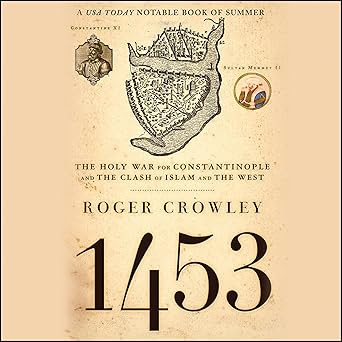
1453: THE HOLY WAR for CONSTANTINOPLE and the CLASH of ISLAM and the WEST (audiobook) by Roger Crowley


EXCELLENT!


Unabridged Audio Edition 
Published in 2016 by Hachette Audio and Blackstone Audio
Read by Simon Prebble
Duration: 10 Hours, 56 Minutes

When Rome was at its height, it split itself in half and created a second capital for the eastern half in Constantinople (modern day Istanbul). The eastern half survived the official "Fall of Rome" in 476 AD and continued on for nearly 1,000 more years until it succumbed to the Ottoman Turks in 1453. It was the seat of the Orthodox Christian Church and oftentimes stood as the bulwark against Muslim military advances into Eastern Europe.

From the time of the first formal attack against Constantinople in 674 AD until it finally fell in 1453, the capture of this city was, at the least, on every Muslim leader in this region's "to do" list, if not an active goal.


Once the Ottoman Turks arrive on the scene the Byzantine Empire is clearly on its last legs. The city is still defended by one of the most elaborate set of walls ever built and its history and architecture are truly amazing. But, its glory days are long gone. The city has sold a lot of its treasures to defend itself. Its territorial holdings, at one point, included a majority of the territory of the Roman Empire. By 1453 it only held a part of modern Greece and the territory immediately around the walled city.

The Ottomans, in contrast, were an Empire on the rise and they understood that the capture of Constantinople offered great strategic, economic and symbolic value. 


1453: The Holy War for Constantinople and the Clash of Islam and the West is a book that could have truly been horrible. We've all had that professor or teacher or book that takes the most exciting parts of history and drains all of the joy from the learning experience and leaves behind a dry, lifeless exercise in tedium. 

This book had all of the hallmarks of that experience. 

1. Medieval battle? Check.

2. The Byzantine Empire, whose very name is literally synonymous in English with being unnecessarily complicated? Check.

3. Multiple religious traditions that most American readers know little about? Check (Islam) and check (Orthodox Christianity).

Constantine XI (1405-1453)
However, Roger Crowley's history is almost always highly entertaining and informative. He paints vivid word pictures of the battles and they come off much more like the epic struggles depicted in a Tolkien novel than the a dry recitation of facts. He introduces new historical figures and makes them feel like real people.

Constantine XI, the Byzantine Emperor comes to life as an honorable and brave warrior who refused to escape and leave his city even when there was no hope. He was an experienced soldier who actively led his men throughout the siege. Legend has it that he dressed as a regular soldier in his last moments and led his men in a hopeless last-ditch defense of the city. His body was never definitively identified.

Mehmed II was the hard-headed and often difficult young Ottoman emperor. He spoke multiple languages, survived the brutal family dynamics of the Ottoman leadership and embraced new technologies, like cannon. He was rewarded for this flexibility when he took the city that many considered impossible to take.


Simon Prebble's reading of this book was excellent. It was like listening to an amazing English history professor give one of the most interesting history lectures you have ever heard. Perfect combination of voice and text.

I rate this audiobook 5 stars out of 5,

This book can be found on Amazon.com here: 1453: THE HOLY WAR for CONSTANTINOPLE and the CLASH of ISLAM and the WEST by Roger Crowley.


A LITTLE HISTORY of the WORLD (audiobook) by E.H. Gombrich


Published by Blackstone Audio in 2006
Translated by Caroline Mustill and E.H. Gombrich
Narrated by Ralph Cosham
Duration: 9 hours, 14 minutes
Unabridged

As the title states A Little History of the World is a small history of, well, everything. Sort of.

This history was originally written in 1935. The author was an unemployed art historian and was asked to write a history of the world for children for an Austrian publisher. The first edition was written in six weeks and it sold well and has sold consistently ever since. Gombrich retained the rights and after World War II set out to keep it updated and translated it into multiple languages. He was working on translating it into English when he died in 2001 at the age of 92. The work was finished by others and no one is quite sure how exactly he was planning on ending it.

The chapter on early man is quite memorable in that it gives early men and women a lot of credit for figuring out a lot of important things like agriculture, cooking with fire, stone tools and so on. Think about it - it really is quite remarkable.

The history is told in a kid-friendly, patronizing, but not annoying way. It is definitely a Eurocentric history, especially after the Mesopotamian Empires (Sumeria, Babylon, etc.) are discussed.
India is mentioned, but mostly as an introduction to Hinduism and Buddhism. China gets a lot more attention, but not much more. The Americas, including the United States are barely mentioned. The Native American civilizations (Mayas, Aztecs, Incas) are only mentioned in the context of being conquered by the Spanish and being brutalized. Africa may not have been mentioned again after Ancient Egypt.

E.H. Gombrich (1909-2001)
However, keeping in mind this bias, this is a pretty solid history of Europe. The reader, Ralph Cosham, sounds like a welcoming old grandfather who is telling the story of the world as he knows it to the little ones. It is easy to imagine him in a chair on a cold winter's night with the little ones gathered around and the fireplace ablaze. And, in a way, this translation was exactly that - a 92 year old man telling the story of the world the best he could.

I  rate this audiobook 4 stars out of 5. It is a limited history and I would never make this the only history book that I handed to my child (it has some popularity among home-school parents), but it is readable and interesting. A good place to start.


This audiobook can be found on Amazon.com here: A Little History of the World.

TRIDENT'S FIRST GLEAMING: A SPECIAL OPERATIONS GROUP THRILLER (audiobook) by Stephen Templin


Published by ListenUp Audiobooks in September of 2014.

Read by Brian Troxell.
Duration: 9 hours, 14 minutes.
Unabridged

In many ways Trident's First Gleaming is a pretty typical special forces book. You've got a terrorist threat from somewhere in the Middle East, you have an elite group of American operatives who are scrambled to eliminate it, they discover it is worse than anyone has imagined and only they can somehow overcome these newer incredibly long odds and save America and the world.

But, in other ways it is different. The main character, Chris Paladin, is more than just a really talented (but retired) operative - he is also an associate pastor of a church in Dallas, Texas. But, when a former colleague reaches out to him and requests his help he returns to his former life, with restrictions.

His former colleague has been assigned to recover a downed Switchblade Whisper, a new type of military drone that can be launched from a submarine. Its wings swing out and lock open when fired out of the submarine, much like a switchblade's blade swings out and locks open.


Unfortunately, it has crashed in Syria and by all indications it was taken down by a genius with an astounding grasp of technology. Also, he is a madman with real issues about his sister and a taste for eating people.

Photo by Niels Nordhoek
Stephen Templin has a talent for writing military thrillers. This book could have been over-the-top in so many ways. The pastor angle could have been overdone with preachy sermons and the like, but it was not. The weapons angle could have been overdone with discussions of guns to the level of a fetish. The bad guy was certainly creepy but he was not the focus because this is not a Hannibal Lechter novel. 

Instead, once this book gets going it becomes part thriller, part "buddy" book, part romance and injected with a real sense of humanity and, from time-to-time, a great gag to relieve the tension.

Don't get me wrong, this is not a "change-your-life" novel and it's not perfect, but for a military thriller this is about as good as it gets.

Narrator Brian Troxell has a great voice for reading these types of books. He makes everything he reads seem very dramatic, very edgy and very macho. I look forward to hearing more of his work.

Note: I received a copy of this audiobook from the publisher in exchange for an honest review.

I rate this book 5 stars out of 5. It can be found on Amazon.com here: Trident's First Gleaming: A Special Operations Group Thriller

Reviewed on November 25, 2014.


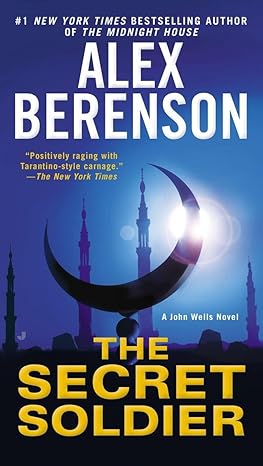
THE SECRET SOLDIER (John Wells #5) (audiobook) by Alex Berenson


Published by Recorded Books in 2011.
Read by George Guidall
Duration: 11 hours, 23 minutes
Unabridged


The Secret Soldier is my first John Wells book. For those not in the know, John Wells is a former CIA agent who is also a Muslim (if not a particularly devout one when it comes to all of the formalities). He now freelances, sometimes working with the CIA, sometimes not.

The first part of The Secret Soldier deals with John Wells tracking down a former operative in Jamaica and bringing him back to the United States. I am unsure as to why this was included in the book - it had nothing to do with the rest of the story except to establish that John Wells is burned out and is unsure about the life of violence that he has led. 


The heart of the story involves a plot against the royal family of Saudi Arabia. Wells is hired by the King  of Saudi Arabia himself to investigate a series of terrorist attacks within Saudi Arabia. As Wells investigates he discovers that the source of these attacks may by closer to the King than he ever imagined and the trail leads Wells to the Saudi kingdom and into the holy city of Mecca itself.

Once the audiobook moves into the main plot, this book hums along. There is plenty of action, intrigue and the occasional funny moment. The author includes plenty of background information about the political state of Saudi Arabia and its relationship with the Wahhabi movement in Islam so the reader gets a solid grasp of what is at stake. This book is eerily on track with current events even though it was published two years ago. The NSA program that became so controversial in the summer of 2013 is explained in detail as well as the dangerous line walked by governments that do not completely kowtow to the rule of Muslim clerics (witness the current struggles in Egypt and Syria).


Legendary audiobook reader George Guidall reads The Secret Soldier. Guidall covers the wide variety of accents that a book of this scope requires in his typical professional and competent manner. But, in the fight scenes Guidall shines - he speeds up and slows down and makes it like a movie scene with sped up segments and slow-mo parts that makes the reader sit up and take notice. Well done, sir.


This is an excellent book with the exception of the Jamaica-based introduction. Overall, it comes out to a score of 4 out of 5.


Reviewed on October 10, 2013.


This book can be found on Amazon.com here: The Secret Soldier

What Went Wrong?: The Clash Between Islam and Modernity in the Middle East by Bernard Lewis


Not the best of Bernard Lewis


Published January 24th 2002 by Oxford University Press, USA
Hardcover, 192 pages

I've read two other books by Lewis and found both of them to be much more comprehensive and satisfying than this one. My dissatisfaction stems from the title. The title What Went Wrong? implies a discussion of how the Islam world went from being the most advanced culture on the planet to one of the most insular and, in many ways, most backwards cultures on the planet. While such a discussion is implied, it is barely touched upon in the body of the book.

Lewis finally gets to this general topic in his conclusion. He notes, "By all standards that matter in the modern world-economic development and job creation, literacy and educational and scientific achievement, political freedom and respect for human rights - what was once a mighty civilization has indeed fallen low." (p. 152)

Bernard Lewis
"To a Western observer, schooled in the theory and practice of Western freedom, it is precisely the lack of freedom - freedom of the mind from constraint and indoctrination, to question and inquire and speak; freedom of the economy from corrupt and pervasive mismanagement; freedom of women from male oppression; freedom of citizens from tyranny - that underlies so many of the troubles of the Muslim world." (p. 159)

Lewis also notes that many Islamic countries blame their troubles on European colonialism and feel very inadequate when other former colonies surpass them as well: "The proud heirs of ancient civilizations had got used to hiring Western firms to carry out tasks that their own contractors and technicians were apparently not capable of doing. Now they found themselves inviting contractors and technicians form Korea - only recently emerged from Japanese colonial rule - to perform these tasks. Following is bad enough; limping in the rear is far worse." (p. 152)

Those are the the types of thoughts that I believed the book was going to be discussing throughout. Instead it gets included, almost as an afterthought, in the conclusion. The main body of the text is primarily concerned with how the Ottomans, and to a lesser extent the Persians, dealt with the rise of the Europe throughout the 1600s through the 1900s. Don't get me wrong, it is legitimate to discuss those issues, especially since they were the main two Muslim powers during that era, but it does little to illuminate the issues of the 21st century. It established a pattern of not keeping up with the West but little to add to an understanding of modern Muslim reaction to the West, with the exception of a few passing references to Khomeni's changes to the role of Islamic clergy in Iran that were not followed up on with enough detail to offer any insight.

A better book about modern Islam and an exploration into 'what went wrong' is Lewis' more controversial The Crisis of Islam: Holy War and Unholy Terror. It was one of the best books that I read in the entire year of 2004. It would not be a bad idea to consider What Went Wrong and The Crisis of Islam to be two volumes of a set that deal with the historical decline of the much accomplished historical Islamic civilization and some of its more modern adaptations to Western challenges, both perceived and real

What Went Wrong?: The Clash Between Islam and Modernity can be found on Amazon.com HERE.

I give this one a grade of 3 stars. The information is good and well-written. However, I felt like I had been a victim of a bait-and-switch scam - the title of the book and the text of the book really did not match. Maybe it should have been called "The Clash Between Islam and the European Renaissance and Enlightenment Movements."

Reviewed on November 18, 2006.

Worlds at War: The 2,500-Year Struggle Between East and West by Anthony Pagden


Disappointed


Published in 2008.

Anthony Pagden's Worlds at War: The 2,500-Year Struggle Between East and West was a book I was really looking forward to reading. It sat on my wish list for months and when I saw it just sitting there at my local library I greedily snatched it up and considered myself lucky to even have found it checked in.

Thank goodness I did not waste my money buying it.

I suppose the problem with a book of this nature is that it is bound to disappoint - some things will be "too" highlighted, some left out. Even worse for this book, niggling factual errors crop up that bother the careful reader and throw into doubt the validity of the more complicated interpretations of the work as a whole.

Positives:

The book is quite readable and you must give a tip of the hat to anyone who undertakes such a large and sweeping history.

Negatives:

The anti-religious comments taint large sections of the book: "...nor have I made any attempt...to disguise the fact that I believe the myths perpetrated by all monotheistic religions - all religions indeed- have caused more lasting harm to the human race that any other set of beliefs..." (p. xix) In my opinion, his anti-religious bias does immeasurable harm to this history because holders of religious belief are held in disdain. This is a history full of religious beliefs, perhaps even based on it. Viewing all of those beliefs as despicable and marginalizing them leads to some of the more simplistic interpretations noted in other reviews of this book.

-The author comments that in this book Christianity "seems to fare slightly better than Islam in this story..." (p. xix) but I really doubt that. At least he spent several pages on the life of Muhammad and the early history of Islam. He doesn't even bother to tell about the life of Jesus (not even a "supposed" version) or a history of St. Paul (whom he refers to in passing several times, but the uninformed reader is left, well, uninformed.) Imagine, a history of the West without even a page devoted to the beginnings of Christianity. The closest we get to an outline of Christ is a brief comparison to Mithraism (pp. 130-1). Christians are often slighted, such as on page 519 when he opines that Christians would like to make Shari'a law for the United States if only they could figure out how.

-Judaism fares even worse. It is rarely mentioned. Even then it has inaccuracies, such as on pages 151-2 when he notes, incorrectly that Moses was only given 10 laws. A passing glance through the book of Deuteronomy would tell the most casual of reader that dozens and dozens of laws were given to Moses.

-The Persian-Roman conflicts. I was looking forward to learning more about the Persian empire(s) that fought Rome to a standstill. Usually in this type of history there is just one paragraph that tells you little more than I've already mentioned - that the Persians fought the Romans to a standstill and an accomodation was made. He includes a fancier explanation, but it is still just the one paragraph. (pp. 175-6) I was hoping for much more - especially since this accounts for roughly 500 years of the 2,500 years of conflict that is discussed in the book.

--Refers to the year 1098 as being a part of the "ninth-century". (p. 231)

Martin Luther (1483-1546)
-Luther's teachings are misstated at times. "Mankind did not need to labor to win God's favor, as the Church had always maintained; it could be vindicated by faith alone. To be justified in the eyes of God, one had only to believe and lead a true and godly life." (p. 297) The part about leading a true and godly life would be the same as laboring to win God's favor. It is not Luther's theology. He stated the godly life would proceed from one's faith, it would not, in and of itself, do anything to get one into heaven.

Some might find the point about Luther trivial, but this is not a small thing. In the last 500 years there have been two large-scale organized religious movements in the West and both were inspired by Martin Luther - the Reformation and the Counter-Reformation (aka the Catholic Reformation). Failing to understand this simple part of Luther's theology means that those two movements are not understood as well. If you were reading a book that mentioned the philosopher Socrates and the author failed to grasp the concept that Socrates wanted people to question everything you'd have to question the author's competence as an authority on the topic. If the author also openly ridiculed philosophers in general and Greek philosophers in particular you'd question why he even bothered to write on the topic in the first place.   

-On page 74 there is a reference to "brothels in Pompey" (p.74). Pompey was one of Julius Caesar's rivals. Pompeii is the standard spelling for the city he is referring to.

-On page 249 he refers to the Afghan War of 1991. 2001, perhaps?

-There is a complete failure to mention the clash between Communism, Fascism and the East. The Ba'ath Party was influenced by the Fascist movements. Afghanistan was nominally Communist when the USSR invaded it to support the floundering government in 1979. He expounds on the murderous history of religious movements but blows off the terrible history of secular movements like Communism with one really long sentence (pp. 533-4) that fails to address the issue or the scope of their own murderous pasts.

-"Soviet Block"? (p. 526). The standard spelling is bloc, not block.

-On page 526 it is claimed that East Germany "took the first steps that would eventually bring down the Communist regimes of eastern Europe." (p. 526) Funny, I remember it being Poland with Lech Walesa and Solidarity being the first. The Wall came down only when Hungary and other countries had already lowered their barriers and made East Germany's Communist rulers irrelevant.

Final thought: Buy something else. Perhaps more specific histories rather than a more general, biased one that demonstrates little respect for the religious traditions of the peoples involved.

I rate this book 2 stars out of 5.

This book can be found on Amazon.com here: Worlds at War: The 2,500-Year Struggle Between East and West.


Reviewed on October 28, 2008.

The Middle East: A Brief History of the Last 2,000 years by Bernard Lewis


2000 years in 387 pages - A great effort but somewhat unsatisfying.

Published in 1997.

Don't get me wrong - I am came to The Middle East: A Brief History of the Last 2,000 Years as a true fan of Bernard Lewis. His book The Crisis of Islam: Holy War and Unholy Terror was one of the more thought-provoking books I read last year. However, this book is quite different than 'Crisis'. It's scope is massive, and it is a history book rather than a work of examination and informed conjecture.

Lewis addresses these shortcomings in his introduction and admits that it will be a difficult undertaking to do it well. He acknowledges that whatever format he chooses to cover this history, it will be unsatisfying for some. I give him credit for doing it well, but not as great as the other books and articles of his that I've read.

Bernard Lewis
The book is broken up into three general sections. The first is a general overview of the Middle East over the last 2,000 years. It is a bit overwhelming and frustrating. Overwhelming because the empires, dynasties and civilizations rise and fall so quickly that I felt like I was watching a time-elapsed movie. It was frustrating because there were some new areas (for me) that I really wished he would explore, such as the link between the Persians and the Jews of the Roman Era. I was also intrigued by the Coptic Christians, but learned little more than I already knew. Lewis is fairly skimpy with the life of Mohammed and the early spread of Islam as well. I give this section 3 stars.

The second section is called 'Cross sections' and it deals with specific topics throughout the 2,000 years of history, such as the military or agriculture. I give this section 4 stars.

The last section goes into the struggles the Middle East has experienced since Europe and the West have become such a vital part of the world since the European Renaissance. This is Lewis' strongest area and by far the most interesting to read. I give this section 5 stars.

So, the average of the 3 sections is 4 stars - my final score for this book.

This book can be found on Amazon.com here: The Middle East: A Brief History of the Last 2,000 Years.

Reviewed on August 2, 2005. 

Drive Thru History: East Meets West DVD


I love this series


Published in 2006 by Coldwater Media

I teach history in a public school so using this Drive Thru History: East Meets West in my classroom is not a viable option due to the contemporary religious references. However, if you are in a Christian school or homeschool with a Christian emphasis I can enthusiastically recommend this series.

East Meets West has two 30 minute plus programs about Turkey and Asia Minor. Turkey is literally where the Middle East meets the West.

In episode 1, Dave Stotts takes us to Cappadocia, a unique area with an underground city and roots in the Old Testament and in the post-Biblical era as a scene of anti-Christian persecution by both the Romans and the Muslims.

Episode 2 is the stronger of the two. It covers the Emperor Constantine, the controversy that caused the creation of the Nicene Creed, the fall of Constantinople and the wonderful Hagia Sofia church turned to mosque now museum.

Episode 3 is a "best of" for the first 4 volumes with a blooper reel.

Okay - bottom line. The history is good. The presentation is light and effective. The graphics are great. It's funny. Highly recommended.

I rate this DVD set 5 stars out of 5. It can be found on Amazon.com here: Drive Thru History: East Meets West DVD.

Reviewed on July 21, 2009.

Featured Post

<b><i>BAN THIS BOOK (audiobook)</i></b> by Alan Gratz

Published in 2017 by Blackstone Audio, Inc. Read by Bahni Turpin. Duration: 5 hours, 17 minutes. Unabridged. My Synopsis Ban This Book is t...

Popular posts over the last 7 days