Showing posts with label India. Show all posts

ALL the WAY to the TIGERS: A MEMOIR by Mary Morris


Published by Recorded Books in 2020.
Read by Susan Bennett.
Duration: 6 hours, 32 minutes.
Unabridged.


Sometimes I fall asleep listening to the news on my local NPR station. One morning I woke up to PBS's Rick Steves (the guy who does all of the European travel shows) interviewing Mary Morris about this book. Turns out he has a travel-themed NPR radio show and they discussed her travels around the world. They discussed where she went in India and why she went (to see a tiger in the wild) and I immediately looked it up on my audiobook up and requested it.

But, I was unpleasantly surprised to find out that this book was not the book I heard described in the interview. I heard a great discussion about a travelogue book to India. I am always interested in hearing about India because it is an ancient society, it is a democracy and it is an up-and-coming economic power.

Also, I am a sucker for travelogue books.

I have read a book by a man who hiked across America following an oil pipeline, a man who hiked the Appalachian Trail with his semi-drunk friend, two guys who hiked from Mexico to Colombia, a guy who biked from the UK to India, a guy who rode a motorcycle around Afghanistan, a guy who hiked across Afghanistan when the Taliban collapsed in the early 2000's, and two ladies that rode bikes from Turkey all the way to India and China. I am sure there are more.

This book has some travelogue features to it, but about 1/3 of the book is flashbacks to her childhood and her parents. They are both weird. One could easily argue that they were abusive.  About 1/3 is flashbacks to the time she broke her ankle while ice skating and all of the reconstructive surgery she had to endure. The remaining 1/3 (maybe less) talks about her trip to India to look for tigers in the wild.

The travelogue portion was the best part. The flashbacks parts, at their best, were tolerable. I almost quit listening at multiple points. But, in the end, I just had to know if she saw a tiger or not (they are elusive, solitary creatures).

I rate this audiobook 2 stars out of 5. It can be found on Amazon.com here: All the Way to the Tigers: A Memoir by Mary Morris.

SUBHAS CHANDRA BOSE: A LIFE from BEGINNING to END (kindle) by Hourly History


Published by Hourly History in 2020.


I am an avid reader of history, but I have areas of weakness that I am perfectly willing to shore up a bit, but I don't want to invest a ton of time in. The long history of India is just one of those areas for me. I know more than most people, but I can see the glaringly empty areas of ignorance.

Subhas Chandra Bose was one of those people for me. I had heard of him, but only described as sort of an "anti-Ghandi". He wanted independence as much as Ghandi did, but thought the non-violent protests were a waste of time. Subhas Chandra Bose was not only willing to fight - he thought it was the only way India would be free of English rule.

Bose was born in India but formally educated in England. He was poised to take his place in the bureaucracy of colonial India. But, he rejected that offer and became active in the independence movement. 

As World War II loomed, Bose saw it as an opportunity to free India. He approached the Fascist powers for support. Germany and Italy poo-pooed him but Japan saw the potential and financed a army of Indian nationals - but waited too late to make a difference. 

The beauty and the weakness of this book series is the brevity of each book. They are designed to be read in about an hour, which means I can explore a whole new area or person with little time commitment. But, I always end up with questions. In this book, I found myself wondering how much faith the Japanese really had in Bose and his army and why they waited so long to fund it.

I rate this book 4 stars out of 5. It can be found on Amazon.com here:  SUBHA CHANDRA BOSE:  A LIFE from BEGINNING to END (kindle) by Hourly History.

WHEN HITLER TOOK COCAINE and LENIN LOST HIS BRAIN: HISTORY'S UNKNOWN CHAPTERS (audiobook) by Giles Milton


Published in 2016 by Macmillan Audio.

Read by the author, Giles Milton.
Duration: 4 hours, 53 minutes.
Unabridged.

Giles Milton is a prolific British writer of histories and historical fiction. This is a collection of odd stories of history that he has run across doing his research.

Lenin, preserved in his tomb. 
He has gone from being an 
object of reverence to a
tourist attraction.
There are the two stories mentioned in the title - Hitler using stimulants and Lenin's odd burial, but there are a lot more from several different time periods.

The problem is that there were a lot of similar stories and some weren't really from "unknown" chapters. Lots of Nazi-related stories and three separate stories of cannibalism (a plane crash, a sailing ship caught in the duldrums and a prison escape in an isolated area). That's a lot of Nazis and cannibals for a 5 hour audiobook.

I found this stories to be neither great nor bad and often repetitive. I rate it 3 stars out of 5. 

This book can be found on Amazon.com here: WHEN HITLER TOOK COCAINE and LENIN LOST HIS BRAIN: HISTORY'S UNKNOWN CHAPTERS.

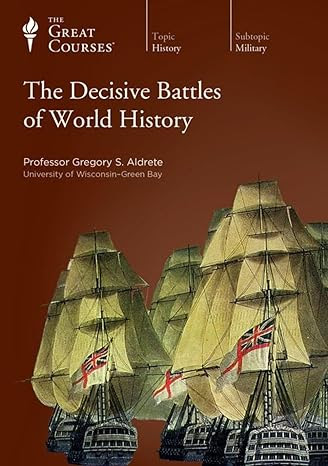
THE DECISIVE BATTLES of WORLD HISTORY (The Great Courses) (Audiobook) by Gregory S. Adlrete


Published by The Great Courses in 2014.
Lectures delivered by the author, Gregory S. Aldrete.
Duration: 18 hours, 29 minutes.
Unabridged.

As long as there has been war, there has been discussions about which battles were the most important, the most pivotal. This takes some analysis, since the temptation might be to simply discuss the battle that finally ended a long conflict, like Appomattox was the functional end to the American Civil War. 

The temptation might also be to collect a list of the biggest battles of history, but that would exclude Aldrete's tiniest choice - the Battle of San Jacinto. While that battle had less than 2,500 soldiers, he persuasively argues that the battle not only made Texas independent from Mexico, it also set off a chain of events that led directly the the American Civil War, Reconstruction and more.

In The Decisive Battles of World History, Adlrete presents the battles in chronological order and spends at least as much time on the background information of each battle as he does on the battles themselves. A few of the entries are not battles, but are entire campaigns.
The Battle of San Jacinto

Almost all of these lectures are informative and entertaining, but I did find the one set in Medieval Japan to be very hard to follow. I found that to be surprising since I took two classes on this topic back in college. 

I rate this audiobook 4 stars out of 5. It can be found on Amazon.com here: THE DECISIVE BATTLES of WORLD HISTORY (The Great Courses) (Audiobook) by Gregory S. Adlrete.

GOD IS NOT ONE: THE EIGHT RIVAL RELIGIONS THAT RUN the WORLD - and WHY THEIR DIFFERENCES MATTER (audiobook) by Stephen Prothero


Published in 2010 by HarperAudio.
Read by Paul Boehmer.
Duration: 14 hours, 37 minutes.
Unabridged.


Stephen Prothero is a professor of religion at Boston University. The purpose of God Is Not One is to inform the reader of the eight greatest world religions, their philosophies and their way of looking at the world.

Prothero is very aware that choosing just eight religions is fraught with problems. How do you choose? Is it based on influence? Number of adherents? Importance of the countries it is in? He went through all of those questions again once again when he chose the order he would present the religions he picked.

The religions he profiled are: Islam, Christianity, Buddhism, Hinduism, Confucianism, Judaism, Yoruba religion, and Daoism. He spends about 90 minutes discussing each religion and includes nearly an hour on Atheism at the end, on the theory that militant Atheism (Richard Dawkins, Christopher Hitchens) behaves much like a religion, complete with evangelistic movements and a coherent worldview.
Prothero takes great pains to point out that these religions do not approach the world in the same way. He is pretty irritated at the "all religions are basically the same - they answer the same questions in different ways" view of religion. He thinks it is intellectually lazy. For example, Christianity teaches that the main problem with the world is sin. Daoism doesn't even have that concept - they think the main problem is society polluting people and making them unhappy by making them take on roles that go against their nature. Confucianism thinks the biggest problem is people not knowing their place in society - embrace the role given you and you will be happy. Yoruba religion is all about power, including spiritual power and leveraging it to your advantage. Atheism think religion itself is the problem - but they are usually most vocal against the three monotheistic religions (Islam, Judaism and Christianity). They might be okay with Daoist and Confucian philosophy and some Buddhist sects. Of course, all of those summaries are super-simplistic.

Prothero is not making this point in order to say that the religions of the world can't get along. Rather, he is making this point in order to say that if we are going to get along, we actually have to know what the other religions are saying and where they are coming from.

Prothero's explanations include Western cultural references to movies and books. If you are a well-read person these can be quite helpful.

I rate this audiobook 5 stars out of 5. It can be found on Amazon.com here: GOD IS NOT ONE: THE EIGHT RIVAL RELIGIONS THAT RUN the WORLD - and WHY THEIR DIFFERENCES MATTER by Stephen Prothero.

DECEPTIVE CADENCE (The Virtuosic Spy, Book One) (audiobook) by Kathryn Guare


Audio edition published in March of 2016.
Originally published in January of 2014.
Read by Wayne Farrell.
Duration: 11 hours, 19 minutes
Unabridged


I have reviewed a lot of indie and small publishing house audiobooks lately and have been mildly disappointed with almost all of them. I don't want to be cruel, but there's a reason why some of these books are languishing in the publishing wasteland.

But, sometimes you find a true gem out among the 2 and 3 star books. A gem just sitting there waiting to be noticed.

Deceptive Cadence is such a gem and it is worthy of your notice.

It is an international thriller with a giant soul and a great deal of introspection. If you are looking for a "shoot 'em up" this is not your book, even though there is plenty of shooting. It is the story of two brothers, and like all families, this family is complicated.


The McBride family consists of Conor, a talented musician who plays violin at the international level and Thomas, the brother who stayed behind in northern Ireland to care for the family farm and their ill mother. But, one day, Conor's world comes crashing down when he learns that his brother has been scamming the European Union with falsified applications for farming grants. The money was sent to Thomas and Thomas left with all of it.

A slum in Mumbai. Photo by A.Savin
Conor loses his position in an orchestra due to government pressure and returns home to manage the family farm in disgrace. He has done nothing but he bears the family shame.

Conor is approached by a government operative who says that he knows where Thomas is. He is laundering money for a terrorist ring in India and that Conor could be just the man to lead them to him. Conor is intrigued - not because he wants to punish his brother so much as he wants to try to figure out why he did what he did.

So, Conor receives intensive training in how to be a spy and he is off to India. He hoped for a quick "in and out" meeting with his brother. Instead, he has a life-changing adventure full of action, danger, deep introspection, thoughtless violence, sorrow, pain, joy and humor.  Conor travels from the filthiest slums to the highest mountains for his brother. In the end, the reader is left to wonder if all of it was worth it.

The answer - yes, the journey is the point of it all and this is a journey worth hearing.

Clearly, the weakness of the book is the idea that a violin player can be turned into a spy. At one point it is noted that Conor is one of those people that just seems to be good at everything. You know the type of person - you admire them and envy them at the same time. In the real world, Indianapolis native David Wolfe is one of those guys. He is a aerobatics pilot/award-winning medical doctor/electrical engineer/astronaut with 15 patents. So, these guys do exist.

The audiobook was read by Wayne Ferrell and he was amazing. His voice drew me right in and brought this excellent text to life. He demonstrated a mastery of multiple accents and, more importantly, carried the mood of the story in his tone and pacing as he read.


I rate this book 5 stars out of 5.

This book can be found on Amazon.com here: Deceptive Cadence.

Note: I received a free copy of this audiobook from the author in exchange for an honest review.

A VISION of FIRE: A NOVEL (Earthend Saga #1) (audiobook) by Gillian Anderson and Jeff Rovin


Published in 2014 by Simon and Schuster

Read by one of the authors, Gillian Anderson

Duration: 9 hours, 34 minutes

Unabridged


A Vision of Fire is a mix of political thriller with sci-fi and a heavy dose of the occult thrown in as well. The book starts out with top-level negotiations taking place at the United Nations between India and Pakistan over the disputed region of Kashmir. Both countries are nuclear powers and both countries are sending troops to the border. An Indian ambassador is trusted by both sides and he is trying to broker a peace between them before a nuclear war starts.

But, after dropping off his daughter Maanik at her school mysterious assassins make an unsuccessful attempt on his life. He reassures his daughter that he is fine and proceeds to the negotiating table. But, his daughter starts to have some sort of break down and starts clawing at her arms.  She is rushed home and heavily sedated because she is hurting herself.

The translator for the ambassador has a close friend who is a child psychologist named Caitlin O'Hara who also works at the United Nations. He calls O'Hara in because he knows that she is discrete. She immediately drops the medication and tries to calm the girl with hypnosis. It seems successful at first but the symptoms start coming back with more and more intensity. To make matters worse, other cases that are similar start to pop up in young people around the world...

Meanwhile, a secret group of explorers based in New York City is assembling an exotic collection of treasures from antiquities - and this latest piece is doing some very strange things...

Okay - this sounds like it could be a very good book, doesn't it? 

Sadly, I was very disappointed on multiple levels. 

This book just drags and drags as the child psychologist struggles with Maanik and her symptoms. Even worse, as O'Hara starts to grasp that there is a paranormal side to this case the paranormal stuff is so loosely connected and presented in such a sporadic manner that it was just boring. I grew tired of trying to make a connection as I listened and I felt like it was something to be endured rather than something to be enjoyed. 

When I finally get to the end I realize that most of this book was not needed to prepare the reader for part two of the series. In movie terms, it was like watching Star Wars Episode 1 - only about five minutes of the movie is really needed to prepare you for Episode 2. The rest is just extra stuff and you had to watch Jar Jar Binks for most of the movie!

The book was read by Gillian Anderson. I really like her in the X-Files - she is my favorite character on the show. But, this is the second time I have heard her read an audiobook and I can honestly attest to this - I am not a fan. It took me a while to figure out who she was reminding me of as I listened and then it hit me - she sound like Madeline Kahn singing "I'm Tired" in Blazing Saddles . Anderson is so weary-sounding, her voice is so flat that it sounds like she was going to fall asleep as she was reading her own book!


So, I cannot recommend this book. It is not entirely without merits. The premise is interesting, the interaction between O'Hara and the translator was rewarding. But, I will not be moving on to part two.

I rate this audiobook 2 stars out of 5.

This book can be found on Amazon here: A Vision of Fire

Mysteries of the Ancient World by National Geographic Society


Okay, but a bit disappointing


Published in 1979 by National Geographic

So, why am I disappointed?

I was hoping for an theme-based work that looked at different mysterious objects, behaviors and cultures of the ancient world across the world and made comparisons and connections between them.

Instead, Mysteries of the Ancient World is a series of unrelated articles that have the look and feel of the National Geographic style. Don't get me wrong - I like the National Geographic style but the book as a whole lacks flow and feels more like a copy of the magazine than a special book. It is not an integrated work and leaves out plenty of big mysteries (Great Zimbabwe, Nazca Lines, Petra, the Olmecs) in favor of smaller mysteries such as the Etruscans and Catal Huyuk.

Topics include:

-The Etruscans
-Ice age cave paintings
-Stonehenge and related Megaliths
-Minoan civilization
-Mycenaean civilization
-Catal Huyuk and Jericho
-Easter Island and the South Pacific Ocean
-Ancient Egypt
-Ancient India

I rate this book 4 out of 5 stars

This book can be found on Amazon.com here: Mysteries of the Ancient World.

Reviewed January 8, 2008

The White Tiger: A Novel by Aravind Adiga


Winner of the 2008 Man Booker Prize

Published in 2008.

Aravind Adiga's The White Tiger: A Novel is many things. It is a fascinating look at modern India and how it is still stuck in a sort of feudalistic state combined with the very modern world of democracy, high technology and international influences. It is also the story of corruption and how one young man rose above the masses to become an entrepreneur by using that corrupt system for himself. It is the story of how a young man who has lost his moral compass can make it through tricks, hard work and murder. Most importantly, it is very, very readable - a well-written story that pulls the reader into its world.

 For many, this look at the third world - with its rampant corruption, absolute poverty and, sadly, a strong sentiment of "life is cheap" will come as a surprise. This is not the sanitized travelogue view of India. The characters are between cultures - they are old India and new India at the same time - and, maybe, because of that they are neither and maybe nothing at all.  It is also certainly not told from the perspective of those new members of the international economy that man the phone banks that deal with the complaints of American customers.

Aravind Adiga
Balram Halwai comes from a small rural town in India and he wants to be more than a rickshaw-puller like his father. His father was a good man but, ultimately, he died because he was too poor to stop working and too poor to get adequate medical care (or any at all thanks to corruption). A government official came to the local school and told Balram Halwai that he was the white tiger - the rarest of all creatures. In this case, he was referring to Balram Halwai's academic talents and he promised a scholarship for the boy - which promptly disappeared in the corruption of the education system. So, Balram Halwai becomes a chauffeur and eventually works for the wealthy family that practically owns and operates his tiny village like a medieval fiefdom.

Balram Halwai uses and manipulates the system and the people in it playing by no rules at all until he ends up wanted for murder and running his own company (all of that is revealed in the first chapter so I am not writing spoilers).

This is a harsh book. Balram Halwai is hardly a likable character and no one else is either. Everyone, including the family buffalo uses everyone around him and sucks them dry. But, this is an antidote for the reader that things that everyone lives in quaint suburban neighborhoods and drives their SUV to Super Target every weekend after soccer practice.

I rate this book 4 stars out of 5.

Reviewed on June 16, 2011.

This book can be found on Amazon.com here: The White Tiger: A Novel.

The Copper Bracelet (audiobook) by Jeffrey Deaver and 15 other authors


Much like the last one in the series, the experiment in making the story is better than the story.


Published in 2009 by Audible Originals.
Read by Alfred Molina.
Duration: 8 hours, 31 minutes.
Unabridged.


The Copper Bracelet is the second installment in the Harry Middleton story. Harry is former military officer, former music teacher, current hunter of war criminals. Along with his compatriots, the Volunteers, Harry Middleton is after war criminals from Kashmir.

The story behind the book is pretty simple - Jeffery Deaver (Garden of Beasts: A Novel of Berlin 1936), a well-known writer of action thrillers started out an international thriller by writing the first chapter. Then the story was handed off to another author and a chapter was added (16 authors in total) until it got back Deaver who wrote the concluding chapter.

This is a slightly different group of writers than in the first novel, The Chopin Manuscript: A Serial Thriller. The Copper Bracelet is a bit smoother than the first book, but it still has its herky-jerky moments in which characters are introduced and then promptly killed. To me, the bad guys seemed rather James Bond Super-Villain-ish, which for me is too cartoonish to be interesting.

The most interesting feature of the audiobook is the last "Bonus" disc that includes an interview with the narrator, veteran actor Alfred Molina (Spider-Man 2) and an interview with Jeffrey Deaver and a couple of authors about the process they used to write the book. Most interestingly, no overall plot was ever discussed beforehand - the authors receive the completed chapters and have a limited amount of time to add another chapter before it gets handed off to the next author in line.

I rate this audiobook 3 stars out of 5. It ca be found on Amazon.com here: The Copper Bracelet.

Reviewed on March 10, 2010.

Featured Post

<b><i>BAN THIS BOOK (audiobook)</i></b> by Alan Gratz

Published in 2017 by Blackstone Audio, Inc. Read by Bahni Turpin. Duration: 5 hours, 17 minutes. Unabridged. My Synopsis Ban This Book is t...

Popular posts over the last 7 days