Showing posts with label Korean War. Show all posts

FOR the COMMON DEFENSE: A MILITARY HISTORY of the UNITED STATES of AMERICA by Allan R. Millett and Peter Maslowski


Originally published in 1984 by The Free Press.

Note: This is a review of the original version of this book, published in 1984 and ending with the first Reagan administration. It has been expanded and updated to include events up to 2012.

Way back in my undergrad days at Indiana University I took a class called American Military History. It was taught by a visiting professor from West Point and FOR the COMMON DEFENSE: A MILITARY HISTORY of the UNITED STATES of AMERICA was an excellent choice for the text for the class.

For 30+ years I have carried this book around with me - through 5 different moves and who knows how many book shelves this book was the anchor of my history section because it is quite beefy. But, I decided it was time to clear out some books. Technically, this book was a re-read but I didn't really remember anything from all of those years ago so...

The book starts with colonial defense and moves along with the same format up through the early 1980's. There is a chapter about a war or conflict followed by a chapter on the interwar years followed by a chapter on the next war or conflict. 
Soldiers in the Korean War in 1950.
Each chapter is about 30 pages with a bibliography, with the exception of World War II and the Civil War - they are each covered by two chapters. 

Generally speaking, the war chapters are more interesting than the interwar chapters. The interwar chapters can get bogged down in detailed discussion of the upper level command structure of the military (Joint Chiefs of Staff, the role of the Secretary of War/Defense, etc.) , but I found the interwar chapter that covered Reconstruction and the Gilded Age to be one of the best in the book. 


It is striking to read how American defense policy changed radically after World War II and the book provides little discussion of those changes, it just notes that they happened.

I rate this book 4 stars out of 5. It can be found on Amazon.com here: FOR the COMMON DEFENSE: A MILITARY HISTORY of the UNITED STATES of AMERICA by Allan R. Millett and Peter Maslowski.

THE SECOND KOREAN WAR (audiobook) by Ted Halstead


Published in 2018 by Ted Halstead.
Read by Cody Banning.
Duration: 15 hours, 4 minutes.
Unabridged


Ted Halstead's The Second Korean War is a multi-country thriller in which North Korea tries a desperate gamble to force South Korea to submit to North Korean rule.

The book starts out on an military base on the far eastern part of Russia. North Korea has found out that Russia has a small nuclear "backpack" weapon (a battlefield nuke) dating from the early days of nuclear weapons that has been lost from the inventory over the years. North Korea acquires the weapon so that they can start a two-pronged effort to force South Korea to surrender and force the United States to withdraw from South Korea without fighting.

But, things don't go as smoothly as they hoped, people die and a Russian police detective starts putting things together. The question is, will he put things together fast enough?
The last thing I want to do is write out a bunch of spoilers, so I won't tell how everything breaks down. Some of the twists and turns were nicely done. I especially liked how the Russians were the good guys and honest brokers throughout. There's a lot of technology (radar-eluding planes, submarines) and geo-political intrigue in the vein of Tom Clancy. It's not as good as the best Tom Clancy, but that is a high bar. I found the North Korean plan for South Korea to be exceedingly implausible simply because of their hardheaded insistence on using a specific vehicle. I get it, the stereotype of military dictatorships is that they are ultra-orthodox and inflexible.

I listened to The Second Korean War as an audiobook. It was not a particularly good production. The reader, Cody Banning, has a clear voice - but, his rhythm is just not there. At times, it sounds like he is trying to imitate William Shatner, with odd long pauses at commas. According to my research, this is just his second audiobook, so that explains a few things. There's a lot of potential there.

The audiobook was poorly edited. Multiple times you can hear the reader clear his throat, shake papers and sometimes start over as he botched a line. Botched lines happen - but things like this are supposed to be corrected and the mistakes edited out. Also, the editor/producer should have caught the fact that Banning mis-read the word "emphatically" as "empathically" throughout the book. This is my 467th audiobook review and this one stood out for its rather poor editing. Too bad.

I rate this audiobook 3 stars out of 5, despite the production/editing work. It was a unique take on a potential Korean conflict.

This audiobook can be found on Amazon.com here:
The Second North Korean War
by Ted Halstead
.


Note: I was asked to give an honest review of this audibook by the publisher in exchange for a free download of the audiobook.

THE GENERALS: PATTON, MACARTHUR, MARSHALL and the WINNING of WORLD WAR II (audiobook) by Winston Groom


Published in November of 2015 by Blackstone Audio, Inc.
Read by Robertson Dean
Duration: 16 hours, 2 minutes
Unabridged

Winston Groom, forever associated with his iconic character Forrest Gump, has written an interesting and solid history of three equally iconic World War II generals: George Patton, Douglas MacArthur and George Marshall. 

Groom's triple biography format works quite well as all three of these men's life stories were on parallel tracks once they entered World War I and they all knew one another and had worked with one another in one capacity or another through the years (the story of Patton and MacArthur meeting up and working together on the front lines of World War I is a great one).

The histories of these men during peacetime only served to reinforce my impression that both of these men were eccentric, sometimes to the point of being bizarre - especially Patton. But, in wartime these men all shined, despite some controversies. I never had much of a positive opinion about MacArthur. He always seemed to me to more of a strutting peacock than he was a competent general - more good PR than real talent. But, this book has changed my opinion of the man's talents as a general. Still a strutting peacock, though...

This was an enjoyable and informative read. Winston Groom weaves the three biographies together in an interesting way, generally using their parallel lives to reinforce each other's stories. The reader, Robertson Dean, gave distinctive voices to each of the three generals and his reading enhanced an already strong text. 

I rate this audiobook 5 stars out of 5.

This audiobook can be found on Amazon.com here: The Generals: Patton, MacArthur, Marshall and the Winning of World War II

OUR SERVICE, OUR STORIES: INDIANA VETERANS RECALL THEIR WORLD WAR II EXPERIENCES by Ronald P. May


Published in July of 2015 by Fideli Publishing Inc.

The World War II generation is rapidly passing away and with them go their individual stories. 

Ronald May has collected a number of these stories and had them published in the Martinsville, Indiana newspaper as a regular feature. Our Service, Our Stories is a collection of these stories with a lot of full color pictures. Some of the stories have been expanded.


Typically, each story tells a little about each man's life before his military service, focuses on his time in service and then tells about life after the war (some went on to serve in Korea as well but those efforts are not highlighted in this book). For me, the most interesting part of the book is reading about the wide variety of jobs that these men held during the war. When you read the history books or watch the movies you tend to think that everyone carried a gun, flew a plane, maintained the planes or worked in a hospital. 


To be sure, those stories are in this book but there are other jobs that I never even think about like the soldier who maintained the fires for a field kitchen, a pilot who searched for downed military airmen (ironically, he washed out of pilot school but he was deemed good enough to land those rescue planes on back roads or any open spot in the China-Burma-India Theater), men who manned the ships that escorted troops and supplies across the Atlantic, a carpenter who designed a unique communication tower that could be easily assembled and torn down and a man who led the crew of a mobile radar station. For me, it was a reminder that World War II was an amazingly complicated endeavor and a true group effort. Without all of these men the effort would have faltered.
A photograph from the book of a B-26 Marauder
being shot down


I feel that I need to disclose that the author was formerly the pastor at my church. I decided before I read the book that I would not review it unless I could not write a good review of it - that is what I do with all books where I know the author. So, this is not just a good review for someone I know. I would have simply not written a review if I did not think that this is a very good local history of our World War II generation. 

I rate this book 4 stars out of 5.

This book can be found on Amazon.com here: Our Service, Our Stories.

A THOUSAND MILES to FREEDOM: MY ESCAPE from NORTH KOREA by Eunsun Kim with Sebastien Falleti. Translated by David Tian


A Remarkable Tale


To be published in the United States on July 21, 2015. 
I received an "Advance Reading Copy" 


Eunsun Kim's tale of her escape from North Korea, along with her mother and her older sister is remarkably easy to read, remarkable engrossing and just a remarkable tale in general.

When Eunsun Kim was 11 years old her mother determined that they could no longer live in North Korea. Eunsun's grandparents were dead, her father was dead, almost everything in the house was sold for money to buy food but there was almost no food to be had because North Korea was in the middle of its Great Famine (1994-1998). Depending on whose statistics you use, the estimates range anywhere from 250,000 to 3,500,000 people starved to death or died from starvation-related causes. Of course, it is hard to say for sure because North Korea is such a closed off society.

Eunsun Kim and her family lived in the northernmost part of North Korea and they decided to cross the Tumen River into China and live as illegal aliens. They would have no promise of safety, no guarantee of work and risked being shot by the border guards on both sides of the border. But, at least they would have chance to eat.

She details several botched attempts at escape and I was pleased to see that at least one border guard was a decent human being. He could see they were starving and desperate and he took pity on them and let them go with a warning - twice! But, he couldn't feed them because there was no food to be had so this small family eventually makes it to China. The family tries to stay together but when Eunsun Kim's mother is sold into sexual slavery (she calls it an unofficial marriage, but the entire purpose of the marriage was to produce a son for her "husband" and no one recognized the marriage as legitimate) the family splits up. The daughters have a better time of it, but it is not easy.

As you can tell by the title, eventually Eunsun Kim makes it to freedom. Their last push to make it to South Korea is tension-filled and her story of how she adjusts to life in South Korea is interesting in and of itself. Now, she lives in South Korea and has lived and travelled all over the world studying (making up for lost years when she had to work to collect wood rather than go to school so they could get food) and promoting her book.

Ironically, A Thousand Miles to Freedom is late to be translated into English (it was published in French in 2012). I say ironically because the United States has had so much involvement with North and South Korea over the last 60+ years. This translation is very good (I teach Spanish and I know how hard it can be to make foreign text sound smooth in a different language). The text flows easily and makes it sound like Eunsun Kim is sitting with you telling her story in everyday, conversational language over a cup of tea.

Last two lines of the book: "The Kim dynasty has so successfully isolated my country that it would be easy for the rest of the world to forget about us. If my memoir can even play a small part in raising global awareness about our suffering and about the tragedies taking place at the hands of this regime, then all that I have endured will not have been in vain."

It can be purchased at Amazon here:  A Thousand Miles to Freedom: My Escape from North Korea

I rate this book 5 stars out of 5.

THE SAVIOR GENERALS: HOW FIVE GREAT COMMANDERS SAVED WARS THAT WERE LOST - FROM ANCIENT GREECE to IRAQ by Victor Davis Hanson


Published in 2013 by Bloomsbury Press

Victor Davis Hanson, best known for his works on Ancient Greece, looks at five different generals from five different time periods and discusses how these generals became what he calls "Savior Generals". This book is very similar in structure to his 2003 book Ripples of Battle.

Hanson picked five generals to discuss in The Savior Generals: How Five Great Commanders Saved Wars That Were Lost - From Ancient Greece to Iraq.  All are from the West and he notes that this is not an all-inclusive list. They are not even particularly spread out well over history. One is from Ancient Greece, one from the early Byzantine Empire and three of them are American generals. In my opinion, not all of them fit the mold perfectly. In fact, I think only two of them do.

To be a Savior General you have to have been on the outs with the establishment and then, when everything has fallen apart and the situation is about as dire as possible, the establishment command structure looks to you to come in with your unorthodox ways and save the day. You also have to have an odd sense of how people work - a sense that makes you approach the crisis at hand in a different way than everyone else. Once the victory is won, the "Savior General" is removed in some way.

Themistocles (524-459 B.C.)

Hanson starts out with Themistocles, the general turned admiral who almost single-handedly created the Athenian navy in order to prepare for a repeat Persian invasion after the Athenians defeated the Persians at the Battle of Marathon. While most Athenians assumed that the Persians were not going to return after their defeat at Marathon, Themistocles understood the true size and scope of the Persian military and knew that the military losses at Marathon were a drop in the bucket compared to their true potential. When the Persians returned it was with "the largest amphibious invasion of Europe until the 1944 Normandy landing more than 2,400 years later." (p.23)


While the Sparta's famed 300 soldiers and their king slowed the Persian advance  for a few days at Thermopylae, the Athenians fled their city state using the navy that Themistocles had pushed for so hard between invasions. Hanson goes into detail about how Themistocles argued, cajoled, harangued and demagogued this fleet into existence and then repeated his performance all over again with the Greek allied leaders as they tried to figure out if they should even engage the Persians or if they should simply surrender. Luck, skill, sleight of hand, superior knowledge of the waters around Athens all contributed to a victory when defeat seemed so sure.

No general in this book was so far behind the 8 ball as Themistocles. His country (the Athenian city-state) was lost. It had been looted and burned and occupied. Thousands of foot soldiers were lost. For all practical purposes all that was left was the navy. but, Themistocles had prepared his country for exactly this moment and, even they they were heavily outnumbered (366 Greek ships against more than 600 Persian ships), the plan worked. Despite the great victory, Themistocles died in exile.

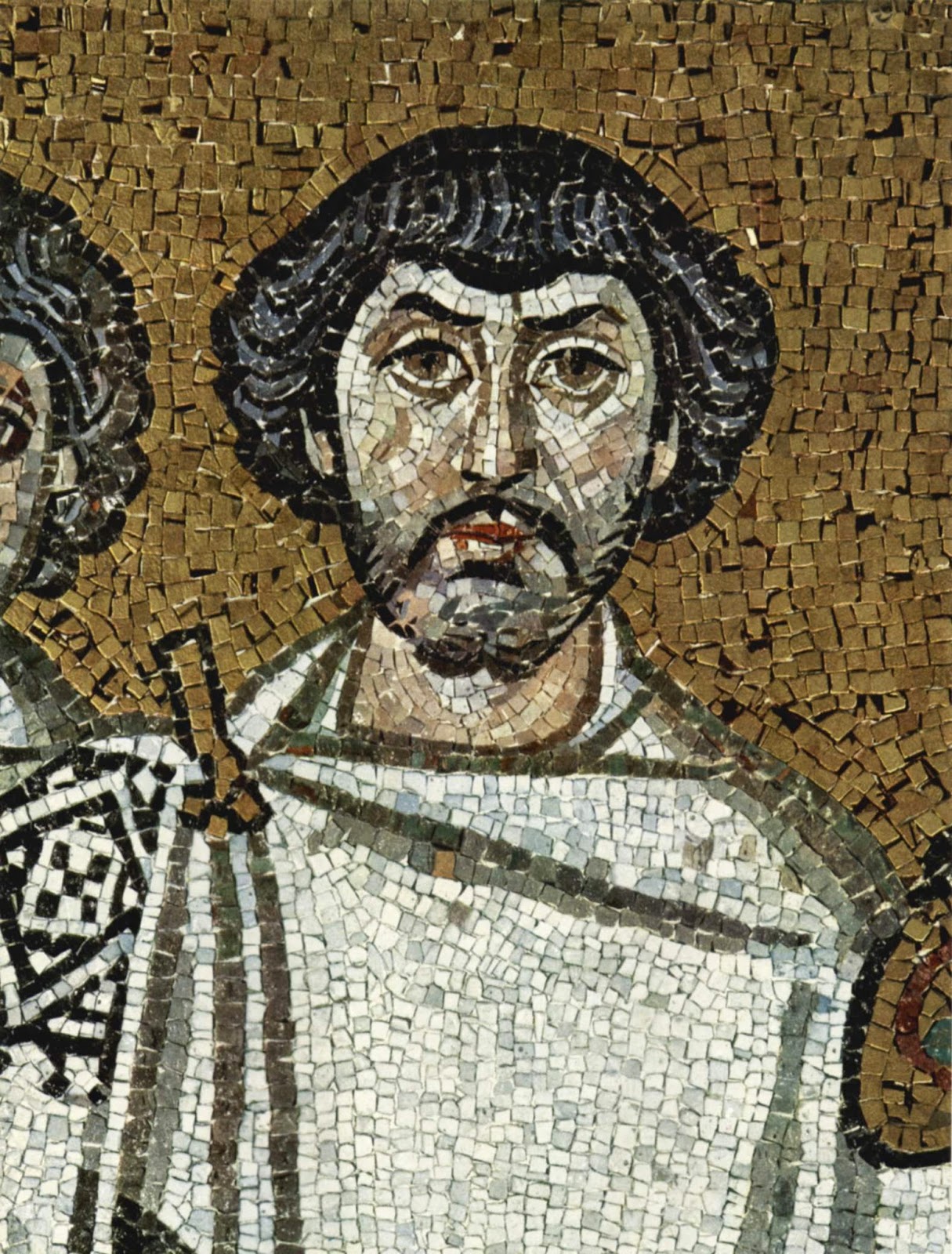
Belisarius (500-565 A.D.)

By comparison to Themistocles, Belisarius's story is not nearly so dramatic. He mostly fought on the Byzantine frontier - only once was the Empire itself at stake and even then, it probably could have been recovered easily enough if some troops had been recalled. He was a soldier always, rarely dabbling in court politics, unlike Themistocles who was a gifted politician for far longer than he was in actual combat.

The only known portrait
of Belisarius. 
But, the career of Belisarius is remarkable in that he went from one lost cause to another and made the Byzantine Empire (really the Eastern Roman Empire) grow to the point where it nearly re-captured most of the combined Eastern and Western Roman Empires. His Emperor, the famed Justinian, never quite trusted Belisarius and deprived him of resources, men or clear orders necessary to finish the jobs properly. As I was reading, I found myself wondering if Justinian was a genius in his own right who was depriving a potential rival of the resources he needed to overthrown him, or a twit that was depriving a talented general of the resources he needed to complete his mission. Was he a brazen leader who was expanding his empire with a minimum of resources because that's all that was available or was he timid and just refused to completely commit to a military course of action. I decided that the answer to all of these questions was YES. Yes, he knew Belisarius was a potential rival and he was a twit for depriving him. He wanted to grow the Empire while the opportunity was there but he was all too aware of the risks of sending too many soldiers abroad. 

Despite his years of loyal service and saving the Emperor from a revolt and an attempted invasion of his capital, Belisarius was forcibly retired and brought back to the capital so the Emperor and his spies could keep an eye on him. 

William Tecumseh Sherman (1820-1891)

In a way, the story of Sherman is the story of two Savior Generals. Sherman fought in the first major battle of the American Civil War and even earned an important command and then had a nervous breakdown. Up-and-coming general Ulysses S. Grant discovered Sherman and brought him along with him. When Grant earned promotions, Sherman did, too. 

When Grant was promoted to be the head of the Union Army and headed to Washington, D.C. to confront Robert E. Lee, Sherman took over Grant's forces in the West and began to move on Atlanta.This is where Sherman does the atypical thing. Rather than seeking battle or blindly making a dash for the city, Sherman tries to outmaneuver his opponent in order to take the city with a minimum of losses.

Grant struggled with Lee and offered a demoralizing series of battles with massive casualties as Grant and Lee's armies grappled all over northern Virginia, rarely separating more than a few days before re-engaging and generating thousands of more Union casualties. 

Most historians believe that Lincoln's re-election was far from assured in 1864 and that Sherman's taking of Atlanta right before the election certainly helped. This is the crux of Hanson's argument for Sherman being a Savior General. Sherman helped ensure the re-election of Lincoln and Lincoln's re-election helped ensure the defeat of the Confederacy. 
1864 Portrait of Sherman
by Matthew Brady
.

On top of that, Hanson argues that Sherman's infamous March to the Sea was a revolution in warfare - a war on the property used to wage war rather than on the people that were fighting in the war. He argues that this revolution was more merciful than what was typical in most Civil War campaigns because it mostly avoided casualties with the focus on property.

Hanson has an amazing grasp of the Civil War for an historian that focuses on Ancient Greece. I enjoyed his analysis of Sherman but was frustrated with his dismissal of Grant as a Savior General as well. Before Grant arrived in the East the call was always, "On to Richmond!" with little concern about the Confederate army in the field except the degree that it kept the Union Army out of the Confederate capital. However, Grant re-focused the army on Lee, knowing that eventually Lee would simply run out of men and supplies. Grant's relentless effort ensured that Sherman would never have to face reinforcing units detached from Lee's army.

Sherman deviates from the mold of Savior General in his post-war career. Unlike most of the generals he profiled, Sherman had a successful post-war career.

Matthew Ridgway (1895-1993)

When Ridgway arrived in what remained of South Korea in December of 1950 the war in Korea had already been lost, won and lost again - in just six months.

Ridgway with his characteristic grenade
on his right strap and a first aid kit on
the left.
Ridgway was unpopular with the brass because he had plenty of opinions and never failed to share them. But, in just 100 days he moved the United Nations forces from a defensive (if not outright retreating) posture to an offensive footing and began pushing the North Korean and Chinese forces back across the pre-war border. 

His style of being with the fighting men and seeing what was really going on rather than being told through intermediaries re-invigorated a largely defeated army. He brought enthusiasm, proper supplies for the winter and an argument as to why this war in this place was important and he shared them all freely with his men. He also recognized the American advantages in this war (superior air power, having occupied Japan nearby as a source of men and supplies among other). He also limited the war aims to simply restoring the pre-war border rather than conquering North Korea. By doing that, he helped make the current truce that has largely held for 60+ years possible. 

Sadly, the Korean War is often referred to as "the forgotten war" and Ridgway's amazing success is often forgotten.

David Patraeus (born 1952)

Perhaps the most controversial Savior General to be added to Hanson's list is David Patraeus. 

This book was written before his disgrace over his mistress/biographer and her access to sensitive documents and information.

No matter his personal failings and his failure in Afghanistan, Patreus had success in Iraq with George W. Bush's unpopular "Surge" from January of 2007 to May of 2008. Hanson details how Patreus had been removed from the Iraq theater earlier and then brought in to implement the Surge strategy that he had been advocating to calm the fighting in the unpopular Iraq War.

This strategy seemed almost counter-intuitive. Embrace the very communities that are attacking the American army. Move among them, become a part of those communities. And, once trust is earned, convince those communities that they should turn on Al-Qaeda and embrace the new government. It cost more lives lost at first because the trust had not yet been earned and the American soldiers were more exposed. 

Reading about the real progress made with the Surge was bittersweet considering the current problems in Iraq with ISIS and all of the beheadings, murder, mayhem and chaos as well as Patreus's fall from grace. 

I rate this collection 4 stars out of 5. 

More information on this book can be found here: The Savior Generals

Reviewed on January 20, 2104.

The Presidents Club: Inside the World's Most Exclusive Fraternity (audiobook) by Nancy Gibbs and Michael Duffy


Very Interesting History of the Modern Presidency


Published by Simon and Schuster Audio in 2012
Read by Bob Walter
Duration: 22 hours, 1 minute
Unabridged

Nancy Gibbs and Michael Duffy, both editors at Time, have delivered a very listenable, fascinating look at each American president from Harry Truman to Barack Obama. No matter their political persuasion, their life experiences or their qualities as a human being, all 12 of these men share one thing: they were once President. This is an exclusive club and it seems that just about every president has looked to a former president for a shoulder to lean on, advice or even as a personal envoy sent to convey a sense of urgency to the message.

The Presidents Club is told in a rough chronological order starting with Truman. When Truman was President there was only one other member of the Presidents Club: Herbert Hoover. Yes, the same Hoover that Truman and FDR disparaged for 12 years. However, to his credit, Truman sent out feelers and discovered that Hoover was still willing and able to help. Together, they set up the ground rules for this "club." Hoover was tapped by Truman to get food to Europe at the end of World War II (Hoover did this at the end of World War I as well) and to help re-organize the Executive Branch.

Gibbs and Duffy discuss how each President interacted with his predecessor and his successor and even other presidents (for example, Nixon interacted with every President from Truman to Clinton). Gerald Ford had a similar lengthy history. They also discuss how the "Club" grew and shrank over the years. During Bill Clinton's presidency, there were as many as six members (Nixon, Ford, Carter, Reagan, Bush41 and Clinton). At one point in the Nixon years, there was only Nixon.
The current "Presidents Club" membership:
George H.W. Bush (41), 
Barack Obama,
George W. Bush (43), Bill Clinton and Jimmy Carter.

If you are a political junkie or a fan of modern American history, this anecdote-filled book is a must-read. It gives a different feel for the men, their personalities and their legacies. For example, I was surprised at how often Johnson reached out to Eisenhower for advice and reassurance concerning the Vietnam War.  I was even more surprised at how often Johnson was out hustled politically by Richard Nixon. I know Johnson was a world class politician, but Nixon maneuvered him and manipulated him throughout 1968. Johnson fared no better in his post-Presidential years.

Nixon comes off as talented but very deeply flawed. The authors quote longtime advisor to multiple presidents, Brent Scowcroft, calling Nixon a "shit" and former President George H. W. Bush (Bush41) referred to him as "first-rate intellect but also a third-rate person." However, you do have to admire how Nixon calculates how to get to the forefront of American politics again and again and again. Reagan comes off surprisingly cold. Carter, as an enigma. Gerald Ford comes off as principled and maybe even heroic for his decision to pardon Nixon and destroy any chance he had to be elected. The Clinton-Bush41 friendship was a joy to learn about and the source of some of the best stories.

Leadership lessons abound in this book. Every president had his own style in office and some even managed to exert a large influence long after they left office. Some Presidents chart the general path and expect their subordinates to follow it. Others are intimately involved in so many decisions that they are spread too thin. Some are charmers. Some intimidate. Some scheme and plan every move. No matter the president, Gibbs and Duffy take the reader behind the scenes and give a sense of the times and the way their administrations worked.


I found this audiobook to be thoroughly enjoyable. Bob Walter's narration was excellent. He varied his rate, read with a lot of emphasis and made a 22 hour long audiobook fly by. I particularly enjoyed his very slight inflections he put in his quotes. For example, his LBJ quotes had a small amount of Texas twang and his Reagan quotes had his characteristic tone to them (If you were alive during the Reagan Administration, think about his famed "Well...").

I rate this audiobook an enthusiastic 5 stars out of 5.

This book can be found on Amazon.com here: The Presidents Club.

Reviewed on February 1, 2013

Note: This audiobook was provided to me free of charge by the publisher in exchange for an honest review. I honestly thought this was an exceptional audiobook.

A People's Army (kindle) by T.C. McCarthy


Published in 2012 by Orbit

This short story (Amazon's Kindle Store estimates its length to be about 32 print pages) is the tale of a North Korean tank commander named Choi Chung Ho in a future war against the Americans on a frozen planet. The North Koreans and the Chinese combined forces are taking a beating from an advancing formation of American tanks. There are four people in Choi Chung Ho's damaged tank and two are rookies. His under-gunned, practically crippled tank is the only thing that can prevent the American forces from completely sweeping the field.

Kim Il Sung (1912-1994)
The story of how Choi Chung Ho repairs his tank and goes back into the fight is interesting enough, but McCarthy spices things up by throwing in little tidbits like having the North Koreans cloning Kim Il Sung (the original member of the Kim family to rule North Korea) over and over again to lead North Korea. Kim Il Sung #58 is in charge now. It seems a little crazy at first, but then again, maybe not. North Korea is more than a little odd and they still refer to him as the "Eternal Leader" and his son has been given several posthumous jobs (yes, he still gets work, even though he is quite dead).

T.C. McCarthy
A frequent theme of the story is the ubiquitous presence of the North Korean propaganda machine and how the experienced soldiers just aren't buying it any more. This is not just a North Korean issue - in all wars the propaganda just loses most of its meaning when the bullets are flying and your friends are dying. It is interesting to watch the changes in one of the newbies as the story moves along.

I was also struck by the parallels to the Korean War. One of the most famous battles is the Battle of Chosin Reservoir. At the "Frozen Chosin" we have the position reversed - overwhelmed American forces barely escape an onslaught of Chinese and North Korean troops.

With top rate action and plenty to think on as you read, A People's Army is a great one sitting short story.

I rate it 5 out of 5 stars.

You can find this short story on Amazon.com here: A People's Army

Reviewed on June 21, 2012.

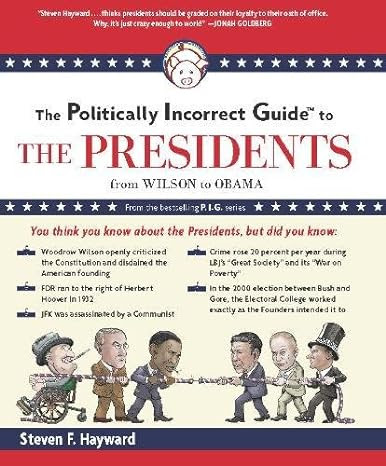
The Politically Incorrect Guide to the Presidents from Wilson to Obama (P.I.G. Series) by Steven F. Hayward


An entertaining read and a great way to rate the presidents

Published in 2012 by Regnery Publishing, Inc.

First and foremost, the latest entry in the P.I.G. series is a great read. Steven Hayward is to be commended for making what could have been a very stale read into an entertaining read - he has a light touch.

Secondly, how sad is it that grading presidents by how well they "preserve, protect, and defend" the constitution is a unique idea?

Hayward begins The Politically Incorrect Guide to the Presidents with a look at what the founders wrote about the office of the president and compares that to the modern presidency. He then looks at the presidency in the 19th century and how most presidents took the restrictions of the Constitution very seriously.

As Hayward proceeds to grade the 17 presidents we have had from 1913 until the 2012 (from Wilson to Obama) on an A to F scale (just like in school) he gives a thumbnail sketch of each president with the major issues of the election and/or his time in office, where he diverged from the Constitution (or supported it) and how the Supreme Court justices he appointed fared by way of the Constitution as well.

Each president gets about 8-12 pages per term in office and the text includes sidebar boxes with recommended readings, great quotes and interesting factoids. The overall grade is presented on the first page of each president's particular chapter and the last page explains how it was arrived at.

Richard Nixon, president from 1969-1974
So, what did I think? I agreed with the great majority of the grades given, although there were some I would have been a little tougher on or a little easier on (a C+ vs. a C- type of thing). I very much disagreed with the C+ for Richard Nixon - and not because of Watergate (although Hayward largely excuses it with the "the other guys did it, too!" defense) . The growth of the regulatory bureaucracy under Nixon was incredible - according to a factoid on page 173 it grew by 121% under Nixon. Throw in federal wage and price controls and I don't see how you can give Nixon the C+ that Hayward does.

But, that is just one grade out of 17 (and even that chapter was interesting). This is a book that I am going to keep handy for those great online political debates. Nothing like a great Warren G. Harding quote like this one: "There is not a menace in the world today like that of growing public indebtedness and mounting public expenditure" to get a little discussion going in this election year, huh?

Note: I would love to see an expanded re-issue of this book with 2 co-authors. One co-author would be a presidential historian who would provide a lot of the heavy lifting for the section detailing the history of each president's administration. The third co-author would be someone from the left politically. This would be a much larger book, but also a much more comprehensive and accurate book. 

I rate this book 5 stars out of 5.

This book can be found on Amazon.com here: The Politically Incorrect Guide to the Presidents from Wilson to Obama.

Reviewed on March 23, 2012.

The Last Stand of Fox Company: A True Story of U.S. Marines in Combat by Bob Drury


A slow start - but don't let that deter you

Published in 2009.

Although I am a history teacher, I have to admit that I am woefully under-informed on the Korean War - at least when compared to our other wars. Sadly, I am not alone in this fact - there's a reason why the Korean War is called "The Forgotten War".

Drury and Clavin start off slowly, in part because there is no context as to why the soldiers are marching around in the subzero weather in northern Korea. However, once they explain the purpose of this particular campaign in the war as a whole and show the reader a few maps I got a lot more comfortable with how they were telling the story and appreciated it a lot more.

Marines during the Chosin Campaign
 in the Korean War
The Last Stand of Fox Company: A True Story of U.S. Marines in Combat is not a fancy history - it is told from the ground level perspective of the the Marines on the hill and is full of tales of bodily fluids, men too young to actually join the Marines, frozen toes, poor equipment and a command structure that not only failed to realize the Chinese Army had entered the war, but failed to realize that a few thousand Marines were up against tens of thousands of those same Chinese soldiers.

Highly recommended for those who enjoy a "Band of Brothers" type perspective on the war. This book is not a general history but I'd suggest it as a companion to any general history in order to get that gritty feel of the front line perspective - the point of view of the men who actually fought the war.

I rate this book 5 stars out of 5 and it can be found on Amazon.com here: The Last Stand of Fox Company: A True Story of U.S. Marines in Combat.

Reviewed on December 19, 2008.

Character Above All: Ten Presidents from FDR to George Bush edited by Robert A. Wilson


Fascinating! Informative!


Published in 1996.

As the title implies, Character Above All: Ten Presidents from FDR to George Bush is a collection of biographical essays on each of the 10 presidents from FDR to George H.W. Bush (Bush 41) by 10 different authors who are either expert historians or knew the President while in office. The thing that ties them all together is that each essay is supposed to look at each man as president and find that one part of his character that made him the type of president he was. Each essay is about 30 pages and it makes for interesting reading.

A good sample would come from Doris Kearns Goodwin's look at Franklin Delano Roosevelt. She asserts that the most valuable component of his personality was his self-confidence. I thought this quote from FDR makes the point wonderfully: "I'll tell you...at night when I lay my head on my pillow, and it is often pretty late, and I think of the things that have come before me during the day and the decisions that I have made, I say to myself - well, I have done the best that I could, and turn over and go to sleep."

The essays are wonderful - some inspiring, such as Gerald Ford's, some disturbing such as JFK's. However, all are well-written and this is a fantastic collection.

This book can be found on Amazon here: Character Above All: Ten Presidents from FDR to George Bush   

I rate this book 5 stars out of a possible 5 stars.
 
Reviewed on February 11, 2005.

Featured Post

<b><i>BAN THIS BOOK (audiobook)</i></b> by Alan Gratz

Published in 2017 by Blackstone Audio, Inc. Read by Bahni Turpin. Duration: 5 hours, 17 minutes. Unabridged. My Synopsis Ban This Book is t...

Popular posts over the last 7 days