Showing posts with label Jonah Goldberg. Show all posts

SUICIDE of THE WEST: HOW the REBIRTH of POPULISM, NATIONALISM, and IDENTITY POLITICS IS DESTROYING AMERICAN DEMOCRACY (audiobook) by Jonah Goldberg


Published by Random House Audio in 2018.
Read by the author, Jonah Goldberg.

Duration: 16 hours, 1 minute.
Unabridged.

Jonah Goldberg, noted political commentator and an editor at the conservative political magazine National Review, takes a long time to set up his argument that modern West culture and its economic system, as it developed under the Enlightenment, is unique and worthy of preservation. He goes on an in-depth look at the conditions that brought about the Enlightenment and makes some reasonable conclusions - certainly nothing that was earth-shaking. But, he makes them in easily understandable terms because this is not a poli-sci or an economics textbook - this is the political version on an evangelistic tract trying to sell the citizens of The West, particularly Americans, that their political and economic culture is worthy of saving, even if it is imperfect.

In Suicide of the West, Goldberg notes that the vast majority of human history has been the story of dictatorships (history in the formal sense, that is, the part that we have been able to record in written form in some way or another over the last 5,000 years or so). Some of those dictatorships have been formal dynasties, some mere military strongmen. He looks at why and how governments formed through the lens of both John Locke and Thomas Hobbes and notes how they were both correct, in their own ways. 

But, the modern West is really based on the ideas that Locke described and the Enlightenment movement used those ideas to re-think government and emphasize the rights of the individual, even if it inconveniences or irritates the majority. Sometimes these new political system were formally discussed and created (as in the United States Constitution) and sometimes as a matter of cultural evolution (which at least partially explains the British system). I particularly enjoyed his discussion of how the capitalist economic system and Western political models developed together.

Once he establishes why the Enlightenment was so unique, he then looks at several threats to American political culture in our current climate, paying special attention to Donald Trump. Jonah Goldberg, like me, is a "Never Trump" Republican (I call myself a "Republican in exile") who finds himself in a quandary in regards to Trump. While Goldberg and I don't always agree on why, we do both agree that Trump is not a valid choice and is certainly not a Republican. I will not distill his arguments here because he has made them known many times in his opinion pieces.

The audiobook was read by the author and he did a great job of making it a very lively reading, filling it with intonations and areas of special emphasis that only the author can give.

I found this to be an intriguing book, definitely one of the more enjoyable audiobooks I have listened to in the last two or three months. Highly Recommended.

I rate this audiobook 5 stars out of 5. It can be found on Amazon.com here:  SUICIDE of THE WEST: HOW the REBIRTH of POPULISM, NATIONALISM, and IDENTITY POLITICS IS DESTROYING AMERICAN DEMOCRACY by Jonah Goldberg.

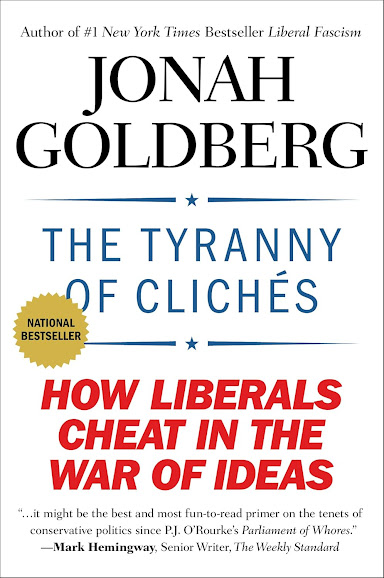
The Tyranny of Clichés: How Liberals Cheat in the War of Ideas by Jonah Goldberg


A Worthy (and Very Different) Follow-Up to Goldberg's Liberal Fascism

Published by Sentinel HC in 2012.

Jonah Goldberg's Liberal Fascism is one of the most profound political books that I have read in my entire life. It changed my view of politics and made me focus a lot of thinking that I had been doing about the actions of government in our daily lives.

So, four years later, I was pleased to hear that Goldberg had written another book. The Tyranny of Clichés is not as serious as Liberal Fascism, but it does a worthy job of going after lazy thinking in our political discourse.

The book goes after shorthand, cliched arguments that people use to try to win (or not lose) political arguments. Take the phrase "Violence never solved anything." This is said by any number of people to protest a war or people having guns or things of that nature. I have a personal history of that story. I used to teach in a small high school with a very liberal English teacher who used her class time to pontificate her views on a regular basis. In this case, it was the run-up to the War in Iraq and she put a handmade poster on her door with the question, "What problem has violence ever solved?" So, I made up a series of post-it-note answers and stuck them all over the poster with notes like "Violence by the British Navy stopped the slave trade" and "Violence ended the Holocaust" and the like. The poster came down after one day, but not before the students had seen that there were responses to glib philosophy like hers (she is now retired, thank goodness.)

Jonah Goldberg
The lesson here is not that violence is the answer to all things, but that sometimes violent action is the answer - life is too complicated to let bumper sticker reasoning rule (and the debate over the Iraq War should not have been framed in the idea that Violence is never the answer but, rather, is it the answer in this case?)

Another lesson is not to just let someone spout out some well-worn piece of pseudo-wisdom as though it were real wisdom. Sometimes there is "strength in diversity," sometimes there is not - woe to the NBA team that goes with the strategy of fielding a team with radically diverse heights and skill levels.

But, it is clear that just as one man's terrorist is another man's freedom fighter and it equally clear that as we all slide down the Slippery Slope into Social Darwinism, Understanding, Dissent (the highest form of patriotism according to some), Social Justice and the Living Constitution will help us grow into a world with No Labels, Understanding and experience Unity and an end to Dogma.

If the above paragraph was a bunch of gibberish feel-good phrases to you, read this book.  If the above paragraph made sense to you, please don't, you are hopeless.

Goldberg goes after these snippets of wisdom and points out that they often sound profound but need to be exposed as shorthand for lazy thinking. It is a interesting and entertaining reading with a lot of humor (how many references to The Princess Bride can you squeeze into a book, Mr. Goldberg?) that made me laugh and think, often at the same time.

My favorite cliché was the cliché of "understanding." It usually goes something like this: "If we only made the effort to understand each other a little more we would have less violence, wars, racism, sexism, etc." Goldberg points out that the worst wars are civil wars precisely because they know each other so well. In the United States the North and the South understood each other quite well and went about killing one another by the thousands for four years. How about Rwanda? The Hutu killed more than half-a-million of their Tutsi neighbors in the course of 100 days. Or, in the case of ideology, the Libertarians have a special dislike of Conservatives (because they are so close to being Libertarian but do not cross over). I was reminded of this special moment from Cheers in which Woody discovers his new bride is a different kind of Lutheran than he is (and the antipathy is that real, even though they are very close. I would suggest that it is precisely because they are so close) :


A great read even though it is just slanted at one side. The Right and the Left both engage in clichés - shorthand thought that isn't really thought at all.

I rate this book 4 stars out of 5.

This book can be found on Amazon.com here: Tyranny of Clichés.

Reviewed on August 12, 2012.

Liberal Fascism: The Secret History of the American Left, From Mussolini to the Politics of Meaning by Jonah Goldberg


An Impressive Amount of Research


Published in 2208.

According to Goldberg, the traditional left-right concept of political beliefs is incorrect. Understanding this is key to understanding Goldberg's thesis that modern liberalism is the intellectual heir to Rousseau's ideas, the French Revolution and is, at the very least, the intellectual cousin to both fascism (especially Italian Fascism) and Soviet Communism.

To fully understand this you have to understand that measuring political philosophy with a one-dimensional left-right line lack the depth to measure both social and economic political philosophies. A quadrant map used to measure political beliefs will more accurately show depth of support for government involvement in economic issues, political rights and social issues. Anarchists lie at the edge of one quadrant, Libertarians a little more toward the center of that same quadrant but totalitarians lie in the opposite corner. Search the web to discover more about the grid concept for yourself.

Knowing this and actually knowing the stated goals of the fascist states (not including the racial discrimination of the Nazis), one can easily see that those goals are more in line with those of modern liberals and not with those of the Right, despite the popular belief that Fascists are nothing more than extreme Conservatives.

On the political grid, one can see that Fascists and Communists are really nearly the same thing, or at the very least political cousins of one another. They are both Totalitarians. Totalitarianism it the opposite of the Enlightenment philosophies that America was founded upon (see John Locke) and they are the opposite of the views of Classical Liberals.

Goldberg's thesis in Liberal Fascism: The Secret History of the American Left, From Mussolini to the Politics of Meaning is that modern liberals are not Adolph Hitler death camp fascists. Rather, they are akin to Mussolini's pre-World War II vision of fascism. Goldberg likens Mussolini's fascism to being very masculine and he likens modern liberalism to being more of an "eat your vegetables" nanny-state style of fascism, a more feminine model, if you will. Not classic Totalitarianism, but with clear Totalitarian features. The government is getting more and more involved in your daily life. The government tells you cannot smoke in your own business (Indianapolis), the type of grease you can cook with (New York City) and what types of grocery bags you can use (San Francisco).

None of those things belongs in the realm of government in the view of Classical Liberalism, which is more concerned about protecting you from government intervention, not in protecting you from yourself. While a nanny state is clearly not a Totalitarian state, it also is clearly closer to fascism on the quadrant grid than it is to classical liberalism.

Goldberg uses an impressive array of quotes and sources to back up his arguments. Goldberg is not afraid to go after Republicans as well. He's not happy with Karl Rove or George W. Bush for their own fascist tendencies. Mind you, his complaints are not those that the hyperbolic bloggers on the Left obsess over. He is bothered by the faith-based initiatives and the tremendous reach of No Child Left Behind into areas that were once left to local and state government.

Liberal Fascism is often dense reading, more like a political science textbook than the typical political stuff put out by partisans like Michael Moore, Ann Coulter and Sean Hannity. A strong working knowledge of political philosophy and political science vocabulary is a must with this book.

Goldberg provided tons of endnotes to document his work which is a strength and indicative of the quality of work that he has created. It was also quite annoying. Not the notes themselves, but the fact that they were endnotes with commentary requiring the reader to constantly flip back and forth to the end of the book and to keep two sets of bookmarks- one for the text and one for the endnotes. If a writer plans to write additional commentary in his or her notes common decency would suggest that footnotes are better for the reader. The continuity and flow of the main text is not broken by constant flipping to the back of the book. Shelby Foote did this to great effect in his gigantic 3 volume Civil War series. Tom Holland uses both in his book "Rubicon" - notes at the end, additional commentary at the bottom of the text.

I rate this book 5 stars out of 5.

This book can be found on Amazon.com here: Liberal Fascism.

Reviewed on May 2, 2008.

Featured Post

<b><i>BAN THIS BOOK (audiobook)</i></b> by Alan Gratz

Published in 2017 by Blackstone Audio, Inc. Read by Bahni Turpin. Duration: 5 hours, 17 minutes. Unabridged. My Synopsis Ban This Book is t...

Popular posts over the last 7 days