Showing posts with label Indiana. Show all posts

ABRAHAM LINCOLN by James Daugherty


Originally Published in 1943.
The edition I read was a re-print published by Scholastic in 1966.

While not a terribly deep dive into Lincoln, Daugherty's (1889-1974) very readable small telling of his life has some of the most poetic prose I have ever read in a biography. 

There are a couple of factual errors in the book. One example that I noted is the assertion that Robert E. Lee replaced a wounded James Longstreet at the head of what became known as the Army of Northern Virginia in 1862. It was Joseph E. Johnston. That bears very little bearing on the story of Lincoln, even though I am sure he would rather Johnston would have been in the fighting rather than Longstreet. 

Here is an example of Daugherty's excellent prose (concerning Lincoln's early days as a lawyer): 

For the long, bony, sad man who was Billy's partner, the law office became a sanctuary and a refuge and a workshop, where through the years he slowly grew and learned and thought out the dark meanings and drifts of a troubled time. (page 55)

I rate this book 4 stars out of 5. It can be found on Amazon.com here: ABRAHAM LINCOLN by James Daugherty.

COMMEMORATIVE HISTORY of the GEORGE ROGERS CLARK BICENTENNIAL EXHIBIT by The Indiana State Museum


Published in 1976 by the Indiana State Museum Society.

1976 was the bicentennial celebration of the Declaration of Independence and if you were not alive in 1976, you have no idea how much went into that recognition. Every store had special decorations, every town had commemorations, everyone had red, white, and blue clothing and this went on for a long time - not just on the Fourth of July in 1976.

Part of this ongoing celebration took place in museums. The Indiana State Museum had a 3 year exhibit on Indiana's role in the American Revolution. People remember the original thirteen colonies and correctly note that Indiana was not one of those colonies. None of Indiana's immediate neighbors were, either.

But, the modern states of Kentucky, Ohio, Indiana, Michigan, and Illinois were on the front line of a different kind of war zone during the American Revolution. There were no great ships, no massed armies, and precious few soldiers even wearing an actual uniform - but there were pitched battles. 
Commemorative History of the George Rogers Clark Bicentennial Exhibit tells one of the most dramatic parts of that story.

During the fighting, White towns and settlements were wiped out. Indian villages were burned to the ground. much of the fighting was due to the encouragement and financing of the British government. The British Lt. Governor in Detroit was ordered to finance Indian attacks on white settlements in an effort to start a wide ranging guerrilla war in the Ohio River Valley to distract the American colonies from the main fight on the Atlantic coast.

This was not hard to do since a low grade fight had been going on for more than a decade. In order to keep up their side of the fight, the Indians needed supplies to feed their families and weapons and the British could easily supply those. The supplies were shipped out of Detroit to a network of smaller forts in Illinois and Indiana.

George Rogers Clark figured that the way to shut down this fight was to take those British forts. He did some preliminary reconnaissance and found that they were lightly defended, depending mostly on the vast spaces of friendly Indian territory between them to protect them. He secured funding from Virginia Governor Patrick Henry to buy powder and supplies for 350 frontiersmen to attack two forts in Illinois near the Mississippi and Vincennes on the Wabash.


Clark got together about half the amount of men he thought he would need and launched his attack in 1778. He was so successful that Lt. Governor Hamilton personally led an expedition to retake Vincennes. From there, he planned a reconquest of the Illinois forts.

Clark decided that a bold move had to be taken before Hamilton could bring in more supplies, equipment, and men. Clark led a 180 mile march across southern Illinois in February of 1779 in order to surprise Hamilton. 

If you do not live in the midwest, you may not understand how truly miserable it can be in February. It may not snow much, but it will be very wet and very miserable - and it was in 1779. It wasn't cold enough to freeze, but it rained for days on end and the rivers came out of their banks. Imagine hiking nonstop through a sloppy mudhole in 35 degree weather with no dry land to be found for days on end with no modern clothing to keep you warm.

At one point their drummer boy had to cross a flooded area by using his drum as a flotation device while he kicked with his feet. The expedition ate all of their food because the floods drove away most of the wild game.

There was a reason that Hamilton felt secure in Vincennes - no one was crazy enough to march through this mess!

Clark's 170 man force surprised Hamilton and convinced him they were a much larger force through some trickery. Hamilton to surrender on February 25, 1779.

Clark's surprise attack cemented America's claim to what is now called the Old Northwest and was one of the factors that helped convince France to support the Colonies in the Revolutionary War. Clark described it this way: "Great things have been effected by a few men well conducted."

This book has a lot of photographs of items displayed in the exhibit. It also includes the illustrations commissioned for them. I found the illustrations to be helpful and interesting, although a bit retro. The strength of this small book does not lie in the pictures, however. The text is the real strength of the book. The story of the entire campaign is told in well-paced bite-sized bits. 

I rate this history 5 stars out of 5. It can be found on Amazon.com here: Commemorative History of the George Rogers Clark Bicentennial Exhibit.

A completely horrible scan of this small book can be found here: https://eric.ed.gov/?id=ED139709. The text is legible, and that's about all that can be said for it.

BOUND for CANAAN: THE EPIC STORY of the UNDERGROUND RAILROAD, AMERICA'S FIRST CIVIL RIGHTS MOVEMENT (audiobook) by Fergus Bordewich


Published by Harper Audio.

Read by the author, Fergus Bordewich.

Duration: 5 hours, 29 minutes.

Abridged.

The abridged version of Bound for Canaan hits the highlights of the Underground Railroad movement, but leaves quite a bit out. This is a radically abridged audiobook - fourteen hours of a nineteen hour audiobook were cut out - more than 70% of the book. I did not realize how much it had been abridged until I had already listened to it.

What remains is solid, but more of traditional hero study. The reader learns about the Quakers, Levi Coffin and Harriet Tubman and a few other stalwarts of the movement. Frederick Douglass shows up as an example of the Underground Railroad in action. There is a nod to the importance of women in the movement and how that led to the Women's Suffrage movement. 

The book goes off track a bit when it comes to John Brown of Bleeding Kansas fame. Brown did participate in the Underground Railroad movement, but the book follows him to the Kansas and the violence that he committed there as an abolitionist. 
It follows with a detailed re-telling of John Brown's attempt to instigate a slave rebellion by seizing the national armory at Harper's Ferry, Virginia (now West Virginia).

While these are all things that Brown did, he did them separately from the actions of the Underground Railroad. I know that the author was trying to tie the Underground Railroad to the political climate that led to the Civil War and the eventual liberation of the slaves, but this was clunky. I am going to blame it on the extreme abridgment of the book.

What was left after the abridgement wasn't bad, but it wasn't anything that was groundbreaking, either.

I rate this abridged audiobook 3 stars out of 5. It can be found on Amazon.com here: Bound for Canaan: The Epic Story of the Underground Railroad, America's First Civil Rights Movement

KURT VONNEGUT: THE LAST INTERVIEW and OTHER CONVERSATIONS (Last Interview Series) edited by Tom McCartan


Published in 2011 by Melville House.

The Last Interview Series is a collection of 42 books that collect interviews with various artists, celebrities, and political figures. The book includes the last interview given by the featured person.

In the case of Vonnegut, his last interview is very short because he was ill at the time so he cut it short.

There are six interviews here. The best is a co-interview with fellow author Joseph Heller (best known for Catch-22) from Playboy (turns out their interviews were a good reason to buy the magazine!) Heller helps Vonnegut focus a bit - he tends to go off on riffs and some interviewers don't know what to do with that (the first one seemed annoyed by this tendency.)

If you like Vonnegut's essays, you will enjoy these interviews. I love his collections of essays so I rate this book 5 stars out of 5. This book can be found on Amazon.com here: Kurt Vonnegut: The Last Interview and Other Conversations.

WELCOME to PAWNEE: STORIES of FRIENDSHIP, WAFFLES, and PARKS and RECREATION (audiobook) by Jim O'Heir


Published by HarperAudio in November of 2024.

Read by Jim O'Heir, George Newbern, Eva Kaminsky, Janina Edwards, Roger Wayne, Jim Meskimen, and Adam Verner.

Duration: 6 hours, 24 minutes.

Unabridged.

Jim O'Heir has been knocking around Hollywood for years as a journeyman actor. He has had roles in dozens and dozens of TV shows and movies - good stuff and bad stuff - but always regular stuff. He was well on his way to becoming one of those character actors that you see so often that you say, "Oh! There's that guy! He was on that one show."

Then in 2009, he showed up on the new NBC show Parks and Recreation playing the bumbling and often befuddled lovable loser Jerry Gergrich. He kept playing this character for all 123 episodes of the show.

This book is a dual biography of sorts. It is the story of Jim O'Heir and how he came to the show, but it's also the story of the show itself. Jim interviews producers, writers, directors, and other actors to give us the story of Parks and Recreation itself. We learn about how it was conceived, how they cast the main characters, what life was like on the set, and more.

Indianapolis is my adopted hometown so I particularly was interested in the field trip episodes that were filmed in Indianapolis. I do have to point out that O'Heir incorrectly claims that the famed St. Elmo Steak House in downtown Indianapolis is not named after the 1985 Rob Lowe movie St. Elmo's Fire. The restaurant first opened in 1902.

I rate this audiobook 4 stars out of 5. It is a must read for fans of Park and Recreation. It can be found on Amazon.com here: Welcome to Pawnee: Stories of Friendship, Waffles, and Parks and Recreation.

ATTUCKS! OSCAR ROBERTSON and the BASKETBALL TEAM THAT AWAKENED A CITY by Phillip Hoose


Published in 2018 by Farrar, Straus and Giroux (BYR)

NOTE: Also published under the title UNBEATABLE!

Attucks! appears to be just a story about a 1950's era basketball team, but it is much more than that.

it is the story of Jim Crow style racism in a northern state. It is the story of an underdog school getting its chance to compete at the highest level. It is the story of one amazing player, a great coach, and Indiana's famous single class basketball system.

First - the single class basketball system. Back in the 1900's, Indiana had a single class basketball system. This means that every team was in the same playoff system together - no matter how big or how small. This was highlighted in the based-on-a-true-story movie Hoosiers. The true story had Milan High School (161 students) beating Muncie Central (1600+ students) in 1954. Usually, it wasn't that dramatic of a disparity, but small town schools did very well from 1911-1954. The biggest city in the state, Indianapolis, won zero championships during that time.

This is where the story of Crispus Attucks High School comes in. Attucks was an all African-American segregated high school smack dab in the middle of the city of Indianapolis. Indianapolis was a late arrival to the Jim Crow practice of segregated education (Attucks opened in 1927.) The school was named for the Crispus Attucks, an African-American and the first person to die in the Boston Massacre and possibly the American Revolution.

Attucks vs. Tech - a massive rivalry. Attucks is wearing the darker jerseys.

Attucks was prohibited from playing in the high school tournament until 1942 because...well, there really was no legal reason so we can just chalk that up to racism.

The book focuses on the development of the Attucks basketball program until it became a powerhouse in the 1950's. It's not just that though. This was the first really good team to come out of Indianapolis. It was all African-American in a highly segregated city. It had style, class, and pride in its underdog status. It had perhaps the best player to come out of Indianapolis ever - Oscar Robertson (no kidding - he was astoundingly good.) They won 45 games in a row and won back-to-back state championships in 1955 and 1956. 

How good was this team? The author tells the story of a game that Attucks won 123-59. A player on the losing team was crying after the embarrassing loss. His father told him, "You might as well stop that crying. Because can't nobody beat them. You ought to be glad you ever played against them." (p. 152)

I rate this book 5 stars out of 5. It is very readable and told the human side of the story very well. It can be found on Amazon.com here: ATTUCKS! OSCAR ROBERTSON and the BASKETBALL TEAM THAT AWAKENED A CITY by Phillip Hoose.


GOD BLESS YOU, MR. ROSEWATER by Kurt Vonnegut


Originally published in 1965.

After a steady stream of science fiction books, Kurt Vonnegut delivers a straight out social commentary with God Bless You, Mr. Rosewater

Synopsis:

Eliot Rosewater is the heir to a family fortune built on selling munitions in the Civil War and every war after that. The family fortune was built in Indiana but the family has moved to Providence, Rhode Island where it has a family mansion along with all of the others along the waterfront. His father is one of the senators from Rhode Island.

The Rosewater family avoids paying income taxes on this vast fortune by funding the Rosewater Foundation. Generally speaking, the foundation has been a legal way to not pay taxes and instead pay Eliot a whole lot of money to do nothing but supervise a foundation that does next to nothing.

A mural of Vonnegut in his
hometown - Indianapolis.
Photo by DWD
Eliot is suffering from PTSD (called "combat fatigue" in this book) from his experiences in World War II and drowns in troubles in bottle after bottle of alcohol. His only interests are science fiction and volunteer fire departments. He often gets black out drunk and comes back to his senses in a new town. He checks out the nearest volunteer fire department and sees if they have any new techniques or if they need any new equipment. Either way, he gives them something with foundation money.

Eliot is convinced to settle down in Rosewater County in southern Indiana. This is where his ancestors came from. He moves the foundation headquarters to Rosewater, Indiana and becomes the de facto caretaker of the people in this small town. People come to him with their problems and he listens. Sometimes, they need a little money to get over a rough patch or to help with a medical expense. It's all tedious, but the town needs him - even if it is to be someone to yell and scream at. 

The problem is, a lawyer at the law firm that handles the foundation business has found a different Rosewater from another branch of the family. The lawyer thinks he can remove Eliot as the head due to insanity. He will replace him with this other Rosewater and then make a fortune by representing him...

My review:

Vonnegut's report card
I am reading the Vonnegut novels in order of publication. This one is my favorite so far. Eliot is both a great man and a terrific loser. In a way, he is an imitation of Jesus and in a way he's a pathetic drunk that reads too much science fiction. This book is also the introduction to Vonnegut's literary alter-ego, Kilgore Trout.

Vonnegut famously graded his own books in the essay collection Palm Sunday. He gave God Bless You, Mr. Rosewater an A and I agree. 

I rate this book 5 stars out of 5. It can be found on Amazon.com here: God Bless You, Mr. Rosewater.

DIFFER WE MUST: HOW LINCOLN SUCCEEDED in a DIVIDED AMERICA (audiobook) by Steve Inskeep


Published by Penguin Audio in 2023.
Read by the author, Steve Inskeep.
Duration: 8 hours, 57 minutes.
Unabridged.


It's been said that no American has been the subject of more biographies than Abraham Lincoln. I don't know if that it is true, but I do know that it is pretty tough to come up with a new angle on the 16th President. In Differ We Must, NPR reporter/host Steve Inskeep has managed to do just that.

Inskeep follows through Lincoln's life and sees how he dealt with people that he had disagreements with. Some of them were major, some were minor. Sometimes, Lincoln responded to these disagreements by befriending the people he disagreed with, sometimes by patiently arguing his point of view, sometimes by appearing to accommodate them only to slowly change their minds, and sometimes by arguing fiercely against his opponent.

And, sometimes, as in the case of Frederick Douglass, Lincoln realized he was wrong and changed his mind as was the case with Frederick Douglass (and other black dignitaries) and black men serving as soldiers and him dropping his insistence on sending freed slaves to Africa.

One is left to wonder, as always how Lincoln would have reacted to the end of the Civil War and Reconstruction - the ultimate test of his ability to work with people that he disagreed with. We know that his successor, Andrew Johnson, failed that test in a spectacular way, but we will always have to wonder how Lincoln would have done.

While this was a unique entry into the collection of Lincoln biographies, I found it to be merely an "okay" biography. I listened to the audiobook and Inskeep's pleasant reading voice didn't hold my attention particularly well. I rate this biography 3 stars out of 5. It can be found on Amazon.com here: 
DIFFER WE MUST: HOW LINCOLN SUCCEEDED in a DIVIDED AMERICA by Steve Inskeep.

PALM SUNDAY: AN AUTOBIOGRAPHICAL COLLAGE by Kurt Vonnegut


Published in 1981 by Delacorte Press.

Kurt Vonnegut offers this collection (he calls is a "collage") of fiction, non-fiction, interviews, and even a musical based on Dr. Jekyll and Mr. Hyde. 

As is the case with all collections, some parts of the collection are excellent and some parts are not very good. I believe that he first half of the collection is the best, mostly because of the inclusion of a history of the Vonnegut family in Indianapolis. Ironically, it was not written by Vonnegut, but by a family member who had married into the Vonnegut family. 

Indianapolis is my adopted hometown and this Vonnegut family history reads like a history of the city from the mid-1800s to the mid-1900s. I found it fascinating reading, especially the story of the subscription brothel gentlemen's club that was frequented by the city's elite in an area that still has political "clubs" with fancy dining and smoking rooms more than 100 years later. It would be tacky to pay a prostitute, but paying club dues that were used to maintain the club and also to pay the prostitutes - well that's not tacky at all!

The musical based on Jekyll and Hyde written in 1978 was completely horrible.

Vonnegut is well-known for having written a report card of his published books - this is the book that features that report card. Oftentimes, I disagree with his self-assessment - but not this time. He gives this book a "C" (yes, he graded the book as he was writing/collecting all of the parts of it) and I agree.

I rate this book 3 stars out of 5. It can be found on Amazon.com here: PALM SUNDAY: AN AUTOBIOGRAPHICAL COLLAGE by Kurt Vonnegut.


YOU SHOULD SEE ME in a CROWN (audiobook) by Leah Johnson


Published in 2020 by Scholastic Audio.

Read by Alaska Jackson.
Duration: 7 hours, 18 minutes.
Unabridged.


Synopsis:

High School senior Liz Lighty is depending on a $10,000 music scholarship to be able to afford to attend the college she has always wanted to go to.  When she discovers that she doesn't get the scholarship, she's afraid her grandparents will sell their house to pay for her college.

Her high school offers a $10,000 scholarship for the winner of the Prom Queen competition. Enthusiastic band member Liz, supported by her outsider group of friends, joins the competition against all cheerleaders, legacies, and the beautiful people...

My Review:

In a lot of ways, You Should See Me In a Crown is a typical high school ugly duckling story - the underdog great kid goes up against the popular clique.

But, there are some additional nuances that make this more interesting. 

The book is set in the Indianapolis area (Indianapolis is my adopted hometown) and the high school in the book (Campbell) is a play on the real Indianapolis suburb named Carmel. Carmel and its neighbors have had multiple incidents with race, inclusion, book bans, and the like. Remember the Moms for Liberty parent group that published a newsletter with the Adolph Hitler quote? This is that place.

This matters in this book because Liz Lighty is African American and lesbian, like the author. Those two facts, especially the second one, are a big deal.

The Indianapolis Arts Garden, the site of 
the prom in this book.
Readers from the Indianapolis area will appreciate the mentions of local landmarks like Mass Ave, Rick's Café and Boatyard, and the Arts Garden.

The book is interesting because of the issues of race and sexuality, but it is a very good book because Leah Johnson is a very good author. Her characters look like they are the standard high school kids from a teen movie or TV show, but she breathes life in them and makes them stand out. Her descriptions of those first few exciting, confusing and embarrassing days of falling in love ring true and were fun to listen to in this audiobook.

I rate this audiobook 5 stars out of 5. This book can be found on Amazon.com here: YOU SHOULD SEE ME in a CROWN (audiobook) by Leah Johnson.

Note: In 2022, the Oklahoma Attorney General announced he was going to review a list of more than 50 books that "several concerned individuals" had submitted top his office rather than going through their local school boards. His office decided to determine if the books were "obscene." Later, he dropped his investigation, but not the recommendation that local school boards take these complaints seriously. Although most of the books on this list have an LGBTQ+ theme, it is a wide-ranging list, including classics like Of Mice and Men, Brave New World, and Lord of the Flies. There is nothing "obscene" in this book. There are no sexual acts beyond a few kisses.

This book 
was also put on a book ban list in Tennessee. The article has a searchable database because the list has more than 1,100 unique titles.
 

FIGHTER PILOT: THE WORLD WAR II CAREER of ALEX VRACIU by Roy E. Boomhower


Published in 2010 by Indiana Historical Society Press.

Alex Vraciu (1918-2015) was a World War II flying ace, ranking fourth in the U.S. Navy in World War II. He destroyed 19 Japanese planes in the air and 21 on the ground. 

This short book is very approachable and tells the story of Vraciu's childhood during the Great Depression in Northwest Indiana (now commonly known as "The Region") and his college years at DePauw University in Greencastle, Indiana. 

Vraciu took advantage of a U.S. government program that trained civilians to be pilots with the understanding that if the U.S. went to war those pilots would become military pilots. He trained in Muncie, Indiana and immediately joined the U.S. Navy after the Japanese attack on Pearl Harbor on December 7, 1941.

Vraciu had a remarkable military career over the next 23 years. Besides destroying 40 Japanese planes, he lost multiple planes, including being shot down over the Philippines and leading a group of guerrilla fighters against the Japanese, he became a test pilot, he led squadrons after they navy transitioned to jets and scored the highest in the predecessor to the Navy's "Top Gun" training program in a jet 12 years after the end of World War II. 

The book is very readable and full of interesting photographs. It would be good for a well-read student of World War II or an interested newbie. I rate it 5 stars out of 5. It can be found on Amazon.com here: FIGHTER PILOT: THE WORLD WAR II CAREER of ALEX VRACIU by Roy E. Boomhower.

THE FREE FALL of WEBSTER CUMMINGS (audiobook) by Tom Bodett


Originally published in 1995 by Brilliance Audio.
Read by the author, Tom Bodett.
Duration: 15 hours, 43 minutes.
Unabridged.


The author and narrator.
I think Tom Bodett's End of the Road series of short stories is just one of the best audiobook experiences out there. Technically, this book is part of that series even though almost none of it takes places in that oddball community of End of the Road, Alaska (it earned its name by being, well, the place where the road ends.)

Bodett is well-known as a frequent panelist on the NPR show Wait Wait...Don't Tell Me! but he is most well-known for his voiceovers for Motel 6 in which he promised in his folksy way, "We'll leave the light on for you."

I say all of this just to say that this book was a major disappointment. 

Everything about this book seems like it should work. It has a grounding in his Alaska stories. It consists of a series of short stories - his area of expertise.

But, there is just way too much going on in this book. There are way too many plotlines going on and Bodett tries to weave them together so they all tie up in a couple of nice little knots at the end and he just doesn't get it done.

There are two plotlines from Alaska, two plotlines from Seattle (one is mysteriously dropped about 1/3 into the book), a cross country plotline from New York City and Los Angeles, a family from Ohio that heads west in stages to find themselves (one finds that Indiana may be far enough west), supernatural forces, PTSD, memory loss, mysticism and a man named Webster Cummings who fell more than a mile from a commercial jet plane over New England and survived. Webster near death experience inspired him to find his biological parents. 

Just too much and I just ended up wanting it to end.

I rate this audiobook 2 stars out of 5. It can be found on Amazon.com here: THE FREE FALL of WEBSTER CUMMINGS (audiobook) by Tom Bodett.
.

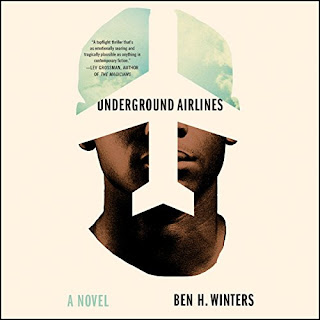
UNDERGROUND AIRLINES (audiobook) by Ben H. Winters


Underground Airlines is set in the year 2015 in an alternate historical timeline. This is a world where the American Civil War almost happened but did not. In the real historical timeline, an amendment to the Constitution called the Crittenden Compromise was proposed in December of 1860 as the first Confederate states were seceding. It preserved slavery, limited its spread and clarified the role of the federal government in returning runaway slaves. The Crittenden Compromise was not taken seriously by most people and it failed.

In this alternate history, the Crittenden Compromise was taken  seriously because President-elect Lincoln was assassinated in Indianapolis as he was traveling to his inauguration in Washington, D.C. The shock of the assassination brought all of the states back together to negotiate and a version of the Crittenden Compromise passed. There was no Civil War and American slavery continues in 4 states on into the 21st century (Louisiana, Mississippi, Alabama and a combined North/South Carolina.

The protagonist of the book is an escaped slave turned into a hunter of escaped slaves. He is working undercover using the name Jim in Indianapolis, Indiana tracking down an escaped slave. He's bothered a bit because the paperwork for this slave is very incomplete and this is rare. Usually, slaves are meticulously tracked, literally tattooed, bar coded and even chipped. 

Jim is nervous because the incomplete file. But, as you can imagine, he's not happy being an escaped slave who hunts down escaped slaves - but he has no choice. He is chipped with a device in his neck that tracks him and, with the flip of a switch, can kill him. It puts him an emotionally painful paradox - in order to maintain his freedom he must catch others.

Jim meets all kinds of people as he searches through Indianapolis - members of the Underground Airlines (the modern successor to the Underground Railroad movement of the 1800s), militant anti-slavers, militant pro-slavers, a white woman searching for the love of her life (an escaped slave), members of the black market that exists in freedman neighborhoods, and more. 

Still, once he finds out what is going on, it involves more than he could ever imagine and makes him go where he never thought he would go...

My review:

I am a fan of:

1) alternate histories,
2) study of the Civil War,
3) my adopted hometown - Indianapolis.

This means I was pretty much perfectly set up to enjoy this book and I did. This was a well-told story. I enjoyed learning about how this alternate world was different and the same. For example, Michael Jackson is a big deal in this alternate world, too.

But, the United States is technologically behind the rest of the world by a few years due to anti-slavery boycotts by the rest of the world and lack of technical innovation coming from America itself. It's about 20 years behind and not really an economic leader in anything except the production of cotton and cotton clothing.  America's big ally is South Africa, with its policy of apartheid.

It's clear that Ben H. Winters knows his way around Indianapolis. Indy is my adopted hometown - I've lived here for 30 years. Every bit of Indianapolis he describes makes sense historically. 

I enjoyed this book. I rate it 5 stars out of 5. It can be found on Amazon.com here: UNDERGROUND AIRLINES by Ben H. Winters.

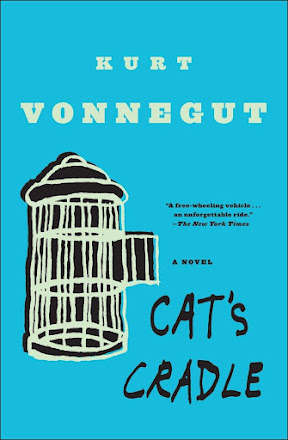
CAT'S CRADLE by Kurt Vonnegut


Originally published in 1963.

Synopsis:

Cat's Cradle
is Kurt Vonnegut's fourth novel. The narrator is a writer who wants to tell the story of the first atomic bombing by telling what various people did that day. One of the people he is interested in is one of the creators of the bomb, a researcher named Felix Hoennikker. 

Hoennikker has already passed away so the author reaches out to his three children and finds two of them. They describe a man with no real emotions. He is not a cruel man, he is utterly detached from everything except research. 

During his interviews with a colleagues at the laboratory he worked at in Ilium, New York (also the setting for his first novel Player Piano, but these books are clearly not in the same time line) the narrator discovers that Hoennikker may have invented a more dangerous weapon than the atomic bomb - a substance called "ice-nine."

Ice-nine was created as a simple thought experiment that came from an offhand comment from a general who had complained about how the U.S. Army kept getting bogged down in the mud. Ice-nine solidifies all of the water it contacts - freezes it at room temperature. And, it keeps spreading. Ice-nine creates more ice-nine as it freezes. Theoretically, if someone dropped it into a body of water it would just keep on going until it runs out of water to freeze. If you dropped it into a river it would just keep going until it got to an ocean and then keep going around the world.

That's when the narrator figures out that each of the three children possesses a chunk of ice-nine and one of them who was missing has just become the head of the military of a very backward third world country in the Caribbean...

My Review: 

Kurt Vonnegut (1922-2007)
This book, unlike the previously mentioned Player Piano, has the complete feel of a Vonnegut novel. There is a lot of dark humor that is barely trying to hide Vonnegut's commentary about the insanity of the Cold War and the concept of Mutual Assured Destruction. It fits in nicely with the 1964 movie Doctor Strangelove.

I found the first part of the book to be fairly slow and tedious (the part described in my synopsis), but the second half zips along pretty well and gets better and better as it gets more ridiculous, including the creation of an original religion.

Vonnegut has a habit of mentioning his native Indiana and/or Indianapolis in his books and this book features plenty of those mentions. 

At one point, Vonnegut gave all of his books a letter grade. He gave Cat's Cradle an A+. I think it was good, but not that good. I will give it a B.

I rate this book 4 out of 5 stars. It can be found on Amazon.com here: CAT'S CRADLE by Kurt Vonnegut.

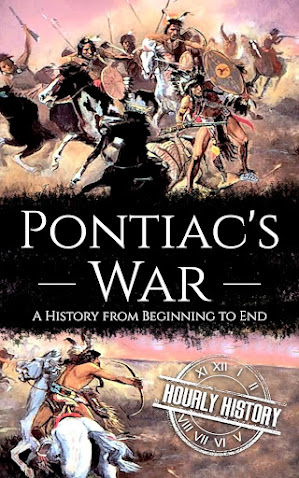
PONTIAC'S WAR: A HISTORY from BEGINNING to END (kindle) by Hourly History


Published by Hourly History in 2021.

Hourly History publishes histories and biographies that you can read in about an hour. That can be a tough job for larger topics in history like "The Industrial Revolution" or "The Roman Empire" but it works out about right for this short war (1763-1766.)

The war arose directly from unaddressed issues as a consequence of the French and Indian War (1754-1763.) In the French and Indian War, the American frontier became a battlefield. American settlements were wiped out, Native American villages were destroyed. French and English soldiers participated and ultimately agreed to a settlement that ignored the realities of the vast borderlands between the colonies and the Native Americans.

The biggest issue was constant push westward from European (American) settlers into areas that were already inhabited by Native Americans. The colonies were all for this westward push, even if the British government was ambivalent or even against the idea. 

Pontiac was an Ottawa. They were centered in the Great Lakes in and around Michigan. Pontiac wanted the French government to resume control of the area - something that simply was not going to happen.

Pontiac was sick of the English colonies moving westward. He encouraged all of the Native American groups to join together to overwhelm the British forts in Michigan, Indiana, Ohio, Pennsylvania and upstate New York. He led an attack against Fort Detroit that failed, but a number of smaller forts fell, including Fort Ouiatenon near modern-day Lafayette, Indiana. I only mention Fort Ouitatenon because I live in Indiana, have been to the fort, and this is the only time I have ever seen the fort mentioned in a history book.

Once the British figured out that it was a united push against their forts and settlements they slowly pushed more troops into the area. They began with only 500 soldiers to hold an area that comprises all or parts of upstate New York, western Pennsylvania, Ohio, Indiana, Michigan, part of Illinois and nearby areas of southern Canada.  Transportation was horribly slow and more than once the united Native Americans attacked, blocked or diverted attempts to reinforce forts. 

It isn't quite clear how big a part Pontiac had in this war. The British considered him to be one of the big leaders - big enough that they called the war Pontiac's Rebellion. But, seeing the number of other critical errors and misunderstandings they committed during the war, it is entirely possible that they imagined him to be THE leader when he was actually one of a number of leaders.

The agreements in this war didn't last for long and did not resolve the underlying issues. There were three other wars and countless skirmishes in this area with the exact same issues in the 50 years that followed. 

I rate this short e-book 5 stars out of 5. It can be found on Amazon.com here: PONTIAC'S WAR: A HISTORY from BEGINNING to END by Hourly History.

DEEP SLEEP (Devin Gray Book 1) (audiobook) by Steven Konkoly


Published in February of 2022 by Brilliance Audio.
Read by Seth Podowitz.
Duration: 10 hours, 18 minutes.
Unabridged.


Synopsis:

Devin Gray is a retired military operator working for a high-end private security contractor. He is on assignment that goes a little sideways in the D.C. metro area and he is sent away to let things cool off.

While packing up to go, he is contacted about his mother. She is estranged from the rest of the family because she is always off researching a conspiracy theory, which is kind of ironic because she works in a government intelligence agency that looks for conspiracies. She is dead after some short of shoot out in Tennessee and everyone is keeping it quiet.

Gray discovers a note from his mother to him with instructions. It turns out to lead to her evidence that proves the conspiracy and he finds it to be plausible enough to reach out to others. Once they start digging, they find more than it is worse than they ever imagined...

My review: 

I was excited about this book. I really enjoyed the first two book of an his unfinished Rogue State series (link to review of the first book here: Fractured State.) That series is full of non-stop and, frankly, ridiculous action - but it is fun and demands your attention.

This book had a complicated conspiracy that you know in your head is simply too complicated to work, but your gut says, "Oh crap! This could really happen!" I had no problem with the premise of the book.

I had problems with the pacing of the book and the proliferation of characters. Konkoly decided to make characters out of some of the bad guys in an effort to confuse the reader at first. It worked and it was kind of a good choice except that he keeps on adding character after character after character and this audiobook reader got confused as to who exactly was who. I just decided to ignore character names and label them "good guy" and "bad guy" in my head. That totally defeated the purpose of creating a named character with lines and a personality, but I couldn't keep up. When one of them goes down in a gun fight, I didn't care a whole lot - I just kept a little running tally in my head to see if any of the good guys were going to survive.

For an action story, this book has an awful lot of sitting around and talking. Sitting around and talking in a restaurant, in a car, in a secret hideout, in another car, in an SUV, in a rented house, in another SUV, in a hotel, in a mansion, in a helicopter, in another hotel.

So many of these conversations were repeats of other conversations. The conspiracy is discovered and then explained to another person. That person explains it to a small group. That group explains and discusses with another group and by that point I felt like I could have stepped in and gave the explanation myself.

So, to sum up - too many characters makes the story hard to follow. Too much repeat conversations stretched the story out for no real reason.

On a pet peeve note: Konkoly is from Indianapolis and lives in Indianapolis. So do I. I was pleased to see part of the book took place in an Indianapolis suburb that he described perfectly (Carmel.) However, the audiobook reader mispronounced it. It is pronounced the way many people mispronounce the candy "caramel." He pronounced it like the California city "Carmel by the Sea." This was not important to the story and people who do not live in Indiana would have no idea but considering that the author lives here...

I rate this audiobook 2 stars out of 5. I will not be moving on to book two in this series. This book can be found on Amazon.com here:  DEEP SLEEP (Devin Gray Book 1) (audiobook) by Steven Konkoly.

IF THIS ISN'T NICE, WHAT IS? (EVEN MORE) EXPANDED THIRD EDITION: THE GRADUATION SPEECHES and OTHER WORDS to LIVE BY by Kurt Vonnegut


Published in 2020 by Seven Stories Press.
Edited by Dan Wakefield.
Introduction by Dan Wakefield.


Many of the well-known quotes from Kurt Vonnegut (1922-2007) were not actually in his novels - they came from speeches he gave (mostly) in the latter half of his career. Vonnegut became quite a popular deliverer of graduation speeches. And why not? He was witty, irreverent and sometimes came up with a great quote like this one: "Another flaw in the human character is that everybody wants to build and nobody want to maintain it." (p. 230)

The title of this book comes from a story that Vonnegut has included in other essays. Vonnegut had two uncles who responded very differently to his World War II experiences. His Uncle Dan congratulated Vonnegut for having gone to war as a boy and come back as a man. 

His Uncle Alex was a different sort of man. The kind of man who encouraged everyone to notice the good things of life as they happen around us. "...when life was most agreeable - and it could be just a pitcher of lemonade in the shade - he would say, 'If this isn't nice, what is?'" He goes on to note, "If he hadn't said that so regularly, maybe five or six times a month we might not have paused to notice how rewarding life can be sometimes." (p. 135)

An illustration from the book
and the inspiration for the cover.
The book has several of Vonnegut's unique illustrations with their own distinctive Vonnegut style. The book is printed with multiple colors and is literally one of the most attractive looking paperback books I have held in my hands. 

The quality of speeches is all over the place. If you read a lot of Vonnegut, you are used to him rambling along in a seemingly pointless way with any number of weird observations and then he suddenly he drops a profound thought. Some of these are very much that way. Some are strong throughout and some are kind of weak. Having said that, this collection could serve as a fine introduction to a reader who is starting to read Vonnegut's essays. 

I rate this collection 4 stars out of 5. It can be found on Amazon.com here: IF THIS ISN'T NICE, WHAT IS? (EVEN MORE) EXPANDED THIRD EDITION: THE GRADUATION SPEECHES and OTHER WORDS to LIVE BY by Kurt Vonnegut.
 

CORYDON: THE FORGOTTEN BATTLE of the CIVIL WAR by W. Fred Conway


Published in 1991 by FBH Publishers.


If you have ever traveled across Southern Indiana visiting historical sites like the Falls of the Ohio (a great fossil bed and a Lewis and Clark site), the Lincoln boyhood site and New Harmony then you have certainly seen a history written by W. Fred Conway.

I know that the top-rated, best-selling history authors depend a lot on writers like W. Fred Conway in order to get the more popular, wider-audience histories written. Why? Because Conway is a fan of Indiana history and he has done a lot of research that big name historians would never have time to do simply out of a love for his local area. This is one of the many books he has written about Indiana, Kentucky and/or Ohio and life along the Ohio River. Conway knows his stuff.

Unfortunately, there's not much of a story in the story of the Battle of Corydon. It was part of John Hunt Morgan's July 1863 into Union territory. The raid started June 11 in Tennessee and after more than 1,000 miles ended July 26 in Ohio along the Ohio River near West Virginia and Pennsylvania.

Along the way, Morgan fought one real battle, although he had lots of little skirmishes. On July 9 a little less than 400 members local home guard militia set up a battle line and fought more than 2,000 Confederate cavalry in the Battle of Corydon. They were quickly outflanked on both sides and captured. This was one of two Civil War battles fought on Union soil - the other one was Gettysburg a week earlier. 

To their credit, the militia gave better than they got. The militia killed 11 Confederate soldiers and wounded 40 and suffered 4 dead and 10-12 wounded. The captured militia was paroled (released on the promise that they would no longer fight in the war in any way) and Morgan's men moved on after some looting and taking more than $25,000 in Union money from local businessmen in exchange for not burning down their businesses. 

That's the basics of the battle. It didn't take very long and was tiny in comparison to the two massive battles that took place in July of 1863: Vicksburg, Mississippi and Gettysburg, Pennsylvania. It was interesting to note that Morgan learned about the results of those other two battles while he was in Corydon.

The book goes on to tell a "lite" version of the rest of the raid, including Morgan's capture and subsequent escape. However, there's still not a lot to this book. There are dozens of photos and drawings (always appreciated - but there were so many that it felt like filler). There is also an appendix about "Corydon Today" - a historical document in it's own right, considering it was printed 31 years ago. All of the pictures and the appendices made me wonder of the publisher had a minimum page requirement. 

I rate this book 3 stars out of 5. It can be found on Amazon.com here: 
CORYDON: THE FORGOTTEN BATTLE of the CIVIL WAR by W. Fred Conway.

Featured Post

<b><i>BAN THIS BOOK (audiobook)</i></b> by Alan Gratz

Published in 2017 by Blackstone Audio, Inc. Read by Bahni Turpin. Duration: 5 hours, 17 minutes. Unabridged. My Synopsis Ban This Book is t...

Popular posts over the last 7 days