Showing posts with label Hawaii. Show all posts

FIGHTER PILOT: THE WORLD WAR II CAREER of ALEX VRACIU by Roy E. Boomhower


Published in 2010 by Indiana Historical Society Press.

Alex Vraciu (1918-2015) was a World War II flying ace, ranking fourth in the U.S. Navy in World War II. He destroyed 19 Japanese planes in the air and 21 on the ground. 

This short book is very approachable and tells the story of Vraciu's childhood during the Great Depression in Northwest Indiana (now commonly known as "The Region") and his college years at DePauw University in Greencastle, Indiana. 

Vraciu took advantage of a U.S. government program that trained civilians to be pilots with the understanding that if the U.S. went to war those pilots would become military pilots. He trained in Muncie, Indiana and immediately joined the U.S. Navy after the Japanese attack on Pearl Harbor on December 7, 1941.

Vraciu had a remarkable military career over the next 23 years. Besides destroying 40 Japanese planes, he lost multiple planes, including being shot down over the Philippines and leading a group of guerrilla fighters against the Japanese, he became a test pilot, he led squadrons after they navy transitioned to jets and scored the highest in the predecessor to the Navy's "Top Gun" training program in a jet 12 years after the end of World War II. 

The book is very readable and full of interesting photographs. It would be good for a well-read student of World War II or an interested newbie. I rate it 5 stars out of 5. It can be found on Amazon.com here: FIGHTER PILOT: THE WORLD WAR II CAREER of ALEX VRACIU by Roy E. Boomhower.

THE FREE FALL of WEBSTER CUMMINGS (audiobook) by Tom Bodett


Originally published in 1995 by Brilliance Audio.
Read by the author, Tom Bodett.
Duration: 15 hours, 43 minutes.
Unabridged.


The author and narrator.
I think Tom Bodett's End of the Road series of short stories is just one of the best audiobook experiences out there. Technically, this book is part of that series even though almost none of it takes places in that oddball community of End of the Road, Alaska (it earned its name by being, well, the place where the road ends.)

Bodett is well-known as a frequent panelist on the NPR show Wait Wait...Don't Tell Me! but he is most well-known for his voiceovers for Motel 6 in which he promised in his folksy way, "We'll leave the light on for you."

I say all of this just to say that this book was a major disappointment. 

Everything about this book seems like it should work. It has a grounding in his Alaska stories. It consists of a series of short stories - his area of expertise.

But, there is just way too much going on in this book. There are way too many plotlines going on and Bodett tries to weave them together so they all tie up in a couple of nice little knots at the end and he just doesn't get it done.

There are two plotlines from Alaska, two plotlines from Seattle (one is mysteriously dropped about 1/3 into the book), a cross country plotline from New York City and Los Angeles, a family from Ohio that heads west in stages to find themselves (one finds that Indiana may be far enough west), supernatural forces, PTSD, memory loss, mysticism and a man named Webster Cummings who fell more than a mile from a commercial jet plane over New England and survived. Webster near death experience inspired him to find his biological parents. 

Just too much and I just ended up wanting it to end.

I rate this audiobook 2 stars out of 5. It can be found on Amazon.com here: THE FREE FALL of WEBSTER CUMMINGS (audiobook) by Tom Bodett.
.

HOW to HIDE an EMPIRE: A HISTORY of the GREATER UNITED STATES (audiobook) by Daniel Immerwahr


Published in 2019 by Recorded Books.
Read by Luis Moreno.
Duration: 17 hours, 25 minutes.
Unabridged.

If I asked you to think of a map of the United States you would almost certainly imagine the contiguous 48 states and maybe imagine the little inset maps of Alaska and Hawaii. 

But, you probably would not imagine other areas like American Samoa being a part of that map. How about Guam or the U.S. Virgin Islands even though the people who live there are American citizens? How about Puerto Rico? Puerto Ricans are citizens and Puerto Rico has a population bigger than at least 15 states.

How to Hide an Empire is about how America has maintained an empire of sorts from the very beginning. At first, it was by continually moving out of the official states into Indian territory, Mexico, Spanish territory and English territory. The United States took several strategic "guano" islands that were not claimed by anyone in the late 1800s. The United States has held a traditional empire since the Spanish-American War in 1898 when it took the Philippines, Guam, Puerto Rico and Cuba. It went on the acquire other properties by trading and conquering during the World Wars (the World War II section of this book is excellent).

Nowadays, the United States maintains a hybrid empire. It has kept some territories and turned others into states (Hawaii and Alaska) but it has also tried something new. 

The United States seems to have learned a lesson with its experience in the Philippines. The United States spent a lot of time, treasure and blood pacifying the Philippines only to have it become a liability during World War II - the Japanese attacked it within hours of the attack on Pearl Harbor. The U.S. quickly granted the Philippines its independence and changed its "business model".

Rather than conquer and hold other countries, the United States has maintained an immense series of bases and installations across the world. The most famous is probably Guantanamo Bay in Cuba, but others include Ramstein Air Base in Germany with 53,000 people.

On the other end of the spectrum there are also tiny little properties that house radio listening stations or broadcasting stations.   According to this article by the Libertarian think tank the Cato Institute, the United States has about 750 foreign military installations around the world - 
 three times as many installations as all other countries combined. Note the article is an opinion piece and the Cato Institute is generally of the opinion that the U.S. military should pull back. They always write with a political point in mind, but I don't usually find the Cato Institute to be untruthful.

This was an interesting look at American history. Some of it is shameful - such as the medical experimentation that has done on unsuspecting Puerto Ricans. Some of it is amazing - such as the immense supply chain that the U.S. used to supply Chinese forces and help keep the Japanese bogged down in China throughout the war. The supply line flew through 4 continents, over two oceans, the world's largest desert and over the world's tallest mountain range. It supplied the model for the base system the United States uses now. 

I rate this book 5 stars out of 5. It can be found on Amazon.com here: HOW to HIDE an EMPIRE: A HISTORY of the GREATER UNITED STATES by Daniel Immerwahr

1942: THE YEAR THAT TRIED MEN'S SOULS by Winston Groom


Originally published in 2004.


Winston Groom is best known as the author of Forrest Gump. He is also the author of 14 different non-fiction books and shows a real talent for writing narrative history.

1942: The Year that Tried Men's Souls focuses on the year that Groom considers to be the crisis year for the Allies and America in particular in World War II - 1942.  He starts his story just before World War II with the attack of Pearl Harbor on December 7, 1941 and ends it in February of 1943 with the ending of the fighting on Guadalcanal.

This was a bad time, especially early in 1942 when Japan conquered one territory after another and American forces were seemingly caught off guard or under-prepared everywhere.

Groom focuses primarily on the Pacific Theater in this book (75 % or more), although he does offer a decent look at the North African campaign. His look at the fall of the Philippines and the Bataan Death March was very compelling.

Groom has no problem pointing out incompetent leadership when he sees it. He also looks at the American home front, describes in detail the work to figure out Japan's secret code and how that successful effort affected the war.

Claire Phillips (1907-1960)
Groom likes to point out the stories of individuals in the middle of the war. He looks at a couple of pilots who took part in an extraordinary escape from a Japanese prison in China and eventually worked their way all of the way to India. He also looks at non-military people, like Claire Phillips, a night club owner in the Philippines who provided information to anti-Japanese forces and helped to sneak food and clothing into a Japanese-run POW camp of American soldiers. She believed her husband was in the camp, but continued to help after she discovered he had been dead for months. Her nickname was "High Pockets" because she used her bra to store money and useful information.

Very readable, informative and well-done.

I rate this book 5 stars out of 5. It can be found on Amazon.com here: 1942: THE YEAR THAT TRIED MEN'S SOULS by Winston Groom.

Morning of Fire: John Kendrick's Daring American Odyssey in the Pacific by Scott Ridley


Well-researched but ultimately fails in its goal


Published by William Morrow in 2010

John Kendrick was a well-respected sailor from the Boston area during the Revolutionary War era. He was rumored to have participated in the Boston Tea Party. He captained a privateer, captured prizes and was highly regarded by political and business leaders and the men who sailed on his ships.

As America struggled to revive its foreign trade after the Revolutionary War (The United States was officially cut off from English trade) tales came to Boston about the beautiful furs available along the Northern Pacific coast of North America. Investors hired Kendrick to lead an expedition of two ships to explore the trading opportunities in the Pacific. Kendrick set off in 1787 to find new markets for American goods. He ended up visiting what is now Alaska, Washington State and British Columbia, Hawaii, China and Japan. He nearly sparked a war between Spain and England, got involved in a brutal war in Hawaii, nearly was killed by officials in Japan (if he had been discovered), survived a monsoon, suffered through the bureaucratic shenanigans of Chinese port officials and was betrayed by the captain of the second ship of his expedition.

Reading about all of that adventure makes Morning of Fire sound like it would be exciting, but this book does not live up to the exciting life lived by Kendrick.

What this book does well:

-This book is extraordinarily well researched. I would imagine that Ridley laid his eyes on every known scrap of paper that mentioned Kendrick or his voyage that has survived to the modern day. He includes dispatches sent to the court of Spain and England, notes from his American employers and more.

-America's place in the geopolitical situation of the day is laid out nicely. Spain was declining, Britain was pushing to take over its role as master of the Pacific, Russia was pushing into the Northern Pacific from its Asian ports, France was floundering in the throes of the French Revolution, China was involved in trade only, Hawaii was coveted by all of the major powers as a place to refit ships in the middle of the Pacific.

What this book does poorly:

-Ridley establishes that Kendrick was the first American in the area and he compares him to the likes of Daniel Boone and explorers Lewis and Clark. However, that is not an apt comparison. Daniel Boone and his generation of explorers directly led to the American occupation of the Ohio River Valley and the Tennessee Valley. Lewis and Clark's route to the Pacific, especially their trip up the Missouri River was, quite literally, the route taken by hundreds and later thousands of settlers within a generation or two of their trip. Kendrick's men were the first Americans to reach the Washington State area, but it was largely settled by Americans who followed Lewis and Clark's route.

-I found this book caught up in its own minutiae, and the larger goal (why Kendrick's long trip was important) was lost in the ups and downs of fur prices and blow-by-blow details of negotiations. I learned about the prices of furs in China, the nasty wars of Hawaii's various kings and how Western involvement was a factor, about how England and Spain nearly came to war over the Pacific (what Kendrick does not stress is that England and Spain nearly came to war over some thing or another many, many times while England was ascending and Spain was declining on the world stage). Spain's strategies to recapture its actual control of the Mississippi and Ohio River Valleys (it had the Mississippi Valley in name, but not much control in reality) were discussed. So much detail was involved that I often felt like I was slogging through the book. The telling of the story drowns in the sea of details. When Ridley pulled out of full detail mode the book was quite excellent. But then the extraneous details would start to fill the book again. I literally read dozens of histories a year and I am a history teacher. I love reading history and this book was a chore for me to read.

-Too much of the historical record has been lost. Ridley has reference after reference to what Kendrick "may have" or "probably" did. While these leaps of faith and logic all made sense, it may have been more prudent for the author to have pulled away from his devotion to detail and simply lay out the facts he had and tell the story in a broader sense rather than insisting on a detailed look at facts he really did not have.

I rate this history 2 stars out of 5.

This book can be found on Amazon.com here: Morning of Fire.

Reviewed on May 12, 2012.


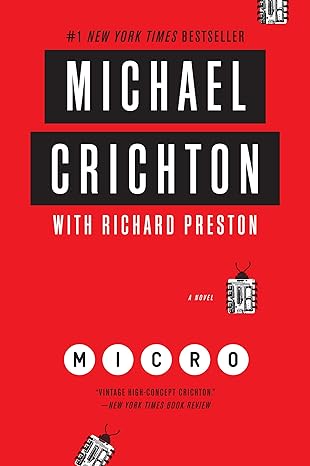
Micro: A Novel (audiobook) by Michael Crichton and Richard Preston


Although it is a collaboration, it reads remarkably like a typical Crichton novel

Published 2011 by Harper Audio
Read by John Bedford Lloyd
Duration: 14 hours
Unabridged.

Michael Crichton died in 2008 and left Micro as an unfinished manuscript. I have no idea how much of this book is actually Crichton's and how much belongs to Richard Preston. To me it felt like a typical Crichton novel.

A typical Crichton novel for me is a mixed bag. It has grand themes - truly big, big ideas with foundations in real science. Grand themes about the dangers of too much innovation without enough ethical considerations, lots of Gee Whiz stuff (think of the movie Jurassic Park where the paleontologists are mesmerized when they first see the dinosaurs) and laughable plot lines with sketch characters (the worst for me was State of Fear in which the big menacing bad guys were wedging themselves into Toyota Priuses as they stalked their opponents - yes, the Prius, the ultimate pursuit car!).

This book has all of that in spades.

The plot revolves around NanoGen, a Hawaiian start up company that has figured out (or stolen) how to shrink full-sized objects down to a very, very small size. People are about one half of an inch tall when they are shrunk. NanoGen claims to be using the technology to thoroughly search the Hawaiian rain forest for biological discoveries that  could be used to help create medicines. Their plan is to search the micro-world bit by bit (literally square foot by square foot) in tiny detail so that even creatures that cannot be seen with the naked eye can be harvested and investigated for possible uses in a bio-technology laboratory.
Micheal Crichton (1942-2008)


But, the bad guy in charge of the project also wants to use these tiny robots as weapons and has made plans to corrupt the original vision of NanoGen's founders. So, murder and mayhem result and soon enough we are following a group of college graduate students who have been shrunken and dumped into the rain forest in an attempt to get rid of even more witnesses (why weren't they immediately squished and flushed down the toilet? The bad guy is so over-the-top in his sadism that he wants to prolong their punishment, which of course eventually backfires.).

So, when our seven college graduate students are dumped in the rain forest (in the micro world as Crichton/Preston usually refer to it) we have several scenes that are reminiscent of Jurassic Park, except we don't have T. Rex and Velociraptors. Rather, we have centipedes, spiders, wasps and ants - all armored and all very dangerous to very tiny people. This part of the book is by far the best - the descriptions of the bugs, their habits, their defenses and their weapons are all fascinating. If it weren't for these details I would have to rate this novel poorly, but the descriptions are entertaining in and of themselves.

John Bedford Lloyd's narration of the book was solid but really did little to enhance or detract from the book.  His voices were solid. To be fair, most of the plot was inane, so it was not like he was working with a literary classic. His deep voice did add a lot to the menacing descriptions of the bugs.

I rate this audiobook 3 stars out of 5.

This book can be found on Amazon.com here: Micro: A Novel.

Reviewed on December 27, 2011.


One Man's Law by John Clarkson


Over-testosteronized and just bad.


Published in 1994 by Berkley

First things first. I am a fan of good action stories. David Morrell - great. Robert Parker - Very good. This book. Ugh.

It's as though John Clarkson sat down after watching an A-Team marathon and decided what he needed in order to write this book was a little more cartoonish violence, a lot more sex, long descriptions of S&M sessions and a James Bond girl.

One Man's Law was too much for me. I can't tell you how many cars exploded from being shot in the gas tanks. The lead female character is aloof and built like a fashion model. Don't worry - Devlin will get in her pants over and over again! The bad guys have hundreds of guns an unlimited supply of money and some are even trained killers. Don't worry - Devlin and his Samoan-stereotype sidekick will just run fast, kick and punch harder and shoot accurately on the run while hundreds of bullets zing harmlessly by (if Devlin does get hit, it will only be a flesh wound and he'll heal quickly thanks to a quick rubdown and some more sex).

The ending wraps itself up too quickly and too neatly - we found out about another conspirator after he's been taken out. The dialogue is stiff. The big final confrontation scene is hoaky. Can I go on? Sure, but I won't.

If you have nothing else to read except for this book, watch TV.

I rate this book 1 star out of 5.

This book can be found on Amazon.com here: One Man's Law.

Reviewed on June 14, 2008.

1942: A Novel by Robert Conroy


Some really good parts but...


Published in 2009 by Ballantine Books

 1942: A Novel follows up on a simple "What if?" from history. What if the Japanese actually invaded and conquered Hawaii rather than simply attacked it on December 7, 1941?

Conroy's book is very strong up until the point where the Japanese invade. The premise of the book is historically strong, the strategies seem logical, the personalities of the real historical figures are consistent with what we know of them nowadays.

But..

Once the invasion happens, Conroy indulges in exploring the depravities of the Japanese secret police with too much vigor. Yes, I know that the Japanese were brutal, cruel, heartless conquerors that literally raped cities like Nanking, China. He shows a similar brutality in the invasion of Hawaii, which is fine and appropriate - there is no reason to assume the Japanese would have acted any better in Hawaii than they did in China, Korea and the Philippines. But, Conroy insists on showing one brutal act after another - multiple rapes, guttings, hands chopped off, heads chopped off, genitalia mutilated and so on.

It becomes a parade of atrocities and, in my opinion, the story starts to drown in it all, which is too bad because it started so well.

I rate this book 3 stars out of 5.

This book can be found on Amazon.com here: 1942: A Novel.

Reviewed on March 27, 2009.

Bye Bye Miss American Empire: Neighborhood Patriots, Backcountry Rebels, and Their Underdog Crusades to Redraw America's Political Map by Bill Kauffman


While I am sympathetic to a point, Kauffman drives his point home with so much rancor and vigor that I ended up being both bored and repulsed.

Published in 2010 by Chelsea Green Publishing.

Bye Bye Miss American Empire takes what should have been a fun look at the various groups that want to split apart current U.S. states and/or make independent countries out of U.S. states and turns it into a long, repetitive, angry rant about American foreign policy, both Presidents Bush and the United States (indivisible, as the pledge goes) in general.

Kauffman starts off on the right foot with an introduction to these various splinter groups (or groups that wish to splinter America, to be more accurate) by taking the reader to a meeting of secessionist movements from all around the country in Vermont. For me, this was the first and last enjoyable chapter.

Kauffman then launches into an extended discussion of secessionist movements in America in which he "scores points" by making multiple snide comments about the Constitution's use of the phrase "more perfect" (just to clarify, it means that it is intended to push the Union closer towards perfection, not that it was already perfect and now it becomes even more so), advocates the murder of Founding Fathers (Alexander Hamilton on page 13) and gets into a political argument with a master politician (Abraham Lincoln, on page 34) that only serves to demonstrate that Kauffman has not truly listened to what Lincoln was saying. Lincoln declared that "secession is the essence of anarchy." Kauffman scoffs and fails to truly follow Lincoln's logic. If New York City were to secede from the United States (a popular notion, Kauffman notes,  several times in American history), what would make it stop there? Could the Bronx secede from New York City? Could an individual neighborhood secede from the Bronx? Could an apartment building secede from that neighborhood? Could a single apartment secede from that building? Could an individual person in a room secede from that apartment? That would indeed be anarchy and that was the argument that Lincoln was making.

Kauffman moves on to explore the idea of New York State and New York City separating. I truly have sympathy for the upstate New Yorker. The provincial, self-important thinking of NYC is difficult for anyone in "flyover country" to stomach -  being politically attached to it must be frustrating in the extreme.

The Great Seal of the
proposed State of
Jefferson.
Other secessionist movements covered in this book include Puerto Rico, Hawaii, Alaska, the South and various movements to create 2 or more states out of several states, including a very commonsense one to break California up into 2, 3 or even 4 states. Kauffman's description of the various attempts to turn northern California and parts of southern Oregon into the State of Jefferson is quite interesting.

Kauffman makes his points throughout the book and can write with an amusing twist. Unfortunately, he throws in so many other snide comments and forced witty observations that don't really tell the reader anything except Kauffman's political leanings that I found myself wondering if this book could have been shrunk by 40 or 50 pages if a strong-handed editor had taken control of this project. Kauffman tells you early on his opinion on Bush, the War on Terror and why the principle of "one man, one vote" is unfair (I am not sure why he thinks rural voters should get more representation than urban voters, but he does). He also tells you about these items in the middle and at the end of the book many, many times. Enough already! Is this a book about secessionist movements in America or a personal political rant?

Long story short - great topic, maybe even the right guy to write this book, with the proper editor. But, in the end, I found that the topic was overwhelmed by all of the other baggage.

I rate this book 2 stars out of 5.

This book can be found on Amazon.com here: Bye Bye, Miss American Empire: Neighborhood Patriots, Backcountry Rebels, and their Underdog Crusades to Redraw America's Political Map

Reviewed on December 18, 2010.

Featured Post

<b><i>BAN THIS BOOK (audiobook)</i></b> by Alan Gratz

Published in 2017 by Blackstone Audio, Inc. Read by Bahni Turpin. Duration: 5 hours, 17 minutes. Unabridged. My Synopsis Ban This Book is t...

Popular posts over the last 7 days