Showing posts with label Gettysburg. Show all posts

AMERICAN HERITAGE NEW ILLUSTRATED HISTORY OF THE UNITED STATES: VOLUME 8: THE CIVIL WAR by Robert G. Athearn


Published in 1971 by Fawcett Publications, Inc.

This book was part of a series intended to be a supplement to a history curriculum as part of a classroom library or in a school library. It is part of a multi-volume series. When I was a kid, I would see books like this used for extra credit (outline chapter X, etc.) when I was a kid.

Positives:

The pictures are great. The book title says it is illustrated and it does not lie. There are pictures on almost every page and many of them are the most famous photos, paintings, and drawings of the war.

There is an "Encyclopedic Section" at the end of the book. It has biographies of prominent people of the war and explanations of some of the big ideas, and events of the war. Before the internet, these little encyclopedias about a dedicated topic were extremely helpful.

There is an essay from Bruce Catton between the regular text and the Encyclopedic Section. It is excellent.

Negatives:

There is literally no explanation of the events that led to the Civil War. The first sentence of the book is: "The Confederate bombardment of Fort Sumter sparked a great military conflagration that was to blaze in America for four bitter, bloody years." Then, it proceeds to talk about the post-Sumter military build-up. Page 2 discusses Bull Run and page 3 talks about Fort Donelson. Iti is almost like the war just happened. 

Slavery is almost entirely ignored. Because of this, I would describe this book is a "Lost Cause" lite history. The facts that are presented are accurate, but when you ignore the role slavery played in the Civil War, you are slanting things towards the Confederacy. It's not advocating "Lost Cause" points, but it lends itself towards that interpretation. This is not surprising for a book written in 1971.

The Reconstruction section is also tilted to the side of the former Confederates. 

I rate this mixed bag of a book three stars out of 5. It can be found on Amazon.com here: 
AMERICAN HERITAGE NEW ILLUSTRATED HISTORY OF THE UNITED STATES: VOLUME 8: THE CIVIL WAR by Robert G. Athearn.

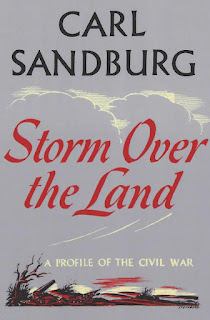
STORM OVER the LAND: A PROFILE of the CIVIL WAR by Carl Sandburg


I read a 2009 re-print published by Konecky and Konecky.

Carl Sandburg (1878-1967)
In 1940, the famed poet, journalist and author Carl Sandburg won a Pulitzer Prize for his four volume biography Abraham Lincoln: The War Years (published in 1939.)

In 1942, his publishers came to him and asked him to re-work the biography into a history of the Civil War in response to America's recent entry into World War II. 

The result is a pretty solid history of the Civil War from basically the Union point of view. 

Carl Sandburg is best known as a poet and that shines though with some of his prose. From time to time, he comes up with a different and interesting way of telling the story of the war. 

The most obvious weakness to this history is the story of African-Americans in the war - the free, the enslaved, the recently freed, the soldiers and others. He mentions them, but does not look at them very hard. To be fair to Sandburg, this book was published 81 years ago and he covered the topic about as well as any mainstream history would have.

I rate this history 4 stars out of 5. It can be found on Amazon.com here: STORM OVER the LAND: A PROFILE of the CIVIL WAR by Carl Sandburg.

THE PRESIDENTS' WAR: SIX AMERICAN PRESIDENTS and the CIVIL WAR THAT DIVIDED THEM by Chris DeRose


Published in 2014 by Lyons Press.

This is my 142nd Civil War-related review. When I heard about this book, I found myself wondering how no one else thought to write this book before.

Former presidents have their own political power and impact current events. Nowadays, you can see this with Jimmy Carter's modeling of volunteerism and his attempts to be a peace mediator in the 1980s and 1990s, Bill Clinton's maneuvering to remain relevant, George W. Bush's refusal to endorse or approve of anything done by Donald Trump, the calls that the Biden Administration is really just the third Obama Administration and, obviously, the 45th President's refusal to admit he lost the 2020 election.

DeRose starts with a rundown of the political careers of each politician involved: John Tyler, Martin Van Buren, James Buchanan, Millard Fillmore, Franklin Pierce and Abraham Lincoln. 

Then, he discusses how they reacted to Lincoln's candidacy, the break up of the Democrat Party in 1860, Lincoln's election and the Secession Crisis. 

John Tyler, the 10th President (1790-1862)
To a man, they were all critical of Lincoln's handling of the Secession Crisis. John Tyler surprised me, though. Tyler was from Virginia and owned slaves and had a working slave labor plantation so he was never going to be supportive of Lincoln who was philosophically against slavery but only against expanded it into new territories and/or states as a matter of policy. 

Tyler left the presidency politically unpopular and seemed to have relished in the attention he received during the Secession Crisis. Suddenly, people were seeking his opinion on the most important issue of his lifetime. Tyler came to D.C. and led a peace conference hosted by Virginia in the Willard Hotel. 

Nothing came from the conference. Tyler operated as a proxy for the Confederacy, in my opinion, and his proposals were ridiculous. Tyler was elected to the Confederate Conference and served in the Provisional Confederate Congress until his death. He remains the only President that ever served in a government at war with the United States. 

I was amused by the constant thread of James Buchanan's post-presidency - he was going to write a book to explain his actions during the Secession Crisis. He claimed over and over again that he would be vindicated once everyone knew all of the facts and ... he never was. It was almost like a running gag throughout the book. Even today, he is universally acknowledged to be the one of the worst presidents of all of the presidents. 

The book continues on with reactions from each of the surviving presidents to the events of the war such as Antietam, the Emancipation Proclamation, Gettysburg, the fall of Atlanta, Lee's surrender and, finally, the assassination of Lincoln. 

I rate this book 5 stars out of 5. It can be found on Amazon.com here: THE PRESIDENTS' WAR: SIX AMERICAN PRESIDENTS and the CIVIL WAR THAT DIVIDED THEM by Chris DeRose.

THE MYTH of the LOST CAUSE: WHY the SOUTH FOUGHT the CIVIL WAR and WHY the NORTH WON by Edward Bonekemper III


Published in 2105 by Regnery History.

Edward Bonekemper (1942-2017) was a lawyer by day and historian in his spare time. He worked for the federal government in a couple of regulatory departments. Imagine an attorney coming into a conference room and telling you that you have regulatory issues and then proceeding to lay down one document after another after another that proves it until you have a pile of papers covering your table.

Bonekemper brings that tenacity to his history books as well. He often comes with a point to prove and he brings tons of proof.

In this case, he goes after "The Lost Cause". What is The Lost Cause? It was (and still is) an apologist movement for the Confederacy that says that slavery was not a primary cause of the war and, besides that, slavery was not that bad. Robert E. Lee was the best general of the war (maybe American history) and his personal honor was unimpeachable and his only fault was that the trusted men like his subordinate General James Longstreet who betrayed him at the Battle of Gettysburg. Grant was a butcher who simply used brute force, superior numbers and more supplies to complete the task of overwhelming the brave defenders of the Confederacy who were clearly the more superior soldiers. Throw into this mix the myth that literally thousands of African Americans joined the Confederate army, formed units and actively participated in combat in great numbers. 
Ulysses S. Grant (1822-1885)
and Robert E. Lee (1807-1870)

Bonekemper is devastatingly thorough in his arguments. He argues quite convincingly that Grant was the most brilliant general of the war. To be fair to Grant's reputation, it should be remembered that there were only 4 complete armies that surrendered during the war and Grant took 3 of them. Bonekemper decides to make his argument about the skill of Grant by re-telling the details of his Vicksburg campaign. Typically, Lee's performance at Chancellorsville is often highlighted as the best performance by a general in a battle, but Grant's 6 month plus long Vicksburg campaign is simply an amazing example of initiative, diversrion and speed. This campaign led to the surrender of an entire army, opened the Mississippi as a save way to ship goods into and out of the Midwestern United States, severed of Louisiana, Texas and Arkansas from the Confederacy, destroyed the capitol of Mississippi and defeated of a second Confederate army. All of this while mostly avoiding direct assaults and being outnumbered by the total number of Confederate troops in the field. 

Bonekemper is very critical of Robert E. Lee's skills as a commander - both strategically and tactically. He makes good points especially on a strategic level (big picture, the entire country view), but I think he is a bit tough on Lee, especially on his performance during the Seven Days Battles in 1862 when Lee took over the Army of Northern Virginia in the middle of a campaign because its original commander was severely wounded (he was sidelined for more than 5 months).

Interestingly, this book is published by Regnery History, a publisher that mostly features Lost Cause Civil War history. 

I rate this book 5 stars out of 5. Highly recommended.

This book can be found on Amazon.com here: THE MYTH of the LOST CAUSE: WHY the SOUTH FOUGHT the CIVIL WAR and WHY the NORTH WON by Edward Bonekemper III.

CUSTER'S LAST STAND (Landmark Books #20) by Quentin Reynolds


Published in 1951 by Random House.

In the 1950's and 1960's Random House created an extraordinary history series for children called Landmark Books. There were 122 books in the American history series and 63 in the World Landmark series. A very solid description of the series can be found here: link. When I was a kid my little hometown library had what seemed like an endless shelf of these books (I even remember where it was in that little library nearly 40 years later). Undoubtedly, these books are part of the reason I am a history teacher. I have started a collection of these books. When I run across them at library sales and thrift sales I pick them up. Some of the texts have aged well, some have not.

Custer's Last Stand is aimed at students from 3rd to 8th grade. It is a simple read with line drawings. It could use a few more maps. 

The history is basically accurate in the broad strokes, but it is full of "quotes" and scenes that never happened in order to make the story move along. This whole series is like that, though. They are basically like a movie that is "based on a true story."

Brevet Major General George Armstrong Custer 
in 1863. The term "brevet" means it was a 
temporary rank that would be reconsidered
after the war when the Army shrank to
peacetime size. 
This story is easy to read, but comes up short in the story of George Armstrong Custer (called "Autie" throughout the book) of the famous (infamous?) Custer's Last Stand. It really focuses on the time when he was in school, including West Point.  The story of his transition from West Point to the Battle of Bull Run was well told, but the rest of his remarkable career as a Civil War officer was glossed over. 

It barely discusses the reasons for the Civil War and skips most of Autie Custer's impressive Civil War accomplishments. Besides fighting with distinction at First Bull Run, he also checked Jeb Stuart of Gettysburg (a rarity), Sheridan's Shenandoah Valley Campaign and played a prominent role in Lee's surrender. He was the youngest general in American history when he received that rank at the age of 23. 

Even worse, his brother Thomas Custer is giving the short shrift in this book. If all you knew about Thomas Custer was what you read in this book, one would get the idea that Thomas joined up with his more famous brother just to join in his campaigns in the West with no prior military experience.  Thomas Custer fought from almost the beginning of the Civil War, entering as a private at age 16 and leaving as a brevet Lt. Colonel at age 20. Along the way he became the first solider to win two Congressional Medals of Honor.  

This book tries to deal fairly with the situation that the Sioux found themselves in 1876, but it comes off as clunky and cringey 70 years after it was written. The book readily and frequently acknowledges that the United States "made hundreds of promises to the Indians and broke almost all of them." (p. 139)

But, the book tries to walk a fine line compromise position: "Everyone has to judge for himself who was right. Was it the Indians, to whom this land was given? Was it the Americans, who insisted that the country had to grow in the West, and that you needed a railroad to help the country grow? There were good arguments on both sides, but Autie Custer didn't care about arguments. He was a soldier...Soldiers obey orders." (p. 139)

The book mentions over and over that Custer wanted to be a soldier so he coukd be an "Indian fighter" - from age 4 on that was his goal. As a literary device, it works. As history - it makes Custer look like an obsessed nut.

I am sure that the ending of the book was not accurate - with Custer and his brother being the last two of 200+ soldiers to survive, surrounded by dead soldiers and dead horses while bravely fighting on. Very dramatic, highly unlikely.

Some history books hold up well over time. This one is 70 years old and it did not.

I rate this book 2 stars out of 5. It can be found on Amazon.com here: CUSTER'S LAST STAND (Landmark Books #20) by Quentin Reynolds
.

CONFEDERATE GENERALS of the CIVIL WAR (Collective Biographies series) by Carl R. Green and William R. Sanford


Published in 1998 by Enslow Publishers, Inc.


Part of a series of 8 books, Confederate Generals of the Civil War was intended to be a classroom or school media center supplement for students to use as a resource. It is not a large book - 112 pages including a glossary, some charts comparing the the Union and the Confederacy, 2 maps and a timeline of the Civil War.

There are 10 biographies, arranged in alphabetical order. Each biography is 8-9 pages, including a photograph of the general and a related picture (photo of a battlefield, drawing of a battle scene, etc.). 

The biographies themselves are pretty neutral, although it does take some mild stands on a few controversial items. It states in a matter of fact manner that Robert E. Lee was anti-slavery (It was definitely more complicated than that). It puts a lot of blame for Pickett's Charge on Longstreet, not on Lee. And, it gets sappily sentimental in the last paragraph of Pickett's biography. I would rate it as very mildly slanted towards the old "Lost Cause" theory of the war (the three areas I mentioned are all at the heart of the theory), but not fatally so. 

The featured generals are:

Nathan Bedford Forrest;
William Joseph Hardee;
A.P. Hill;
John Bell Hood;
"Stonewall" Jackson;
Confederate General George Pickett
(1825-1875)
Joseph Johnston;
Robert E. Lee;
James Longstreet;
George Pickett;
J.E.B. Stuart

Other books in the series include a collection of biographies of Union Generals, "Women in America's Wars" and "American Heroes of Exploration and Flight".

I rate this book 3 stars out of 5. The biographies are just not all that interesting out of context. This book can be found on Amazon.com here:CONFEDERATE GENERALS of the CIVIL WAR (Collective Biographies series) by Carl R. Green and William R. Sanford.

HOW ROBERT E. LEE LOST THE CIVIL WAR by Edward H. Bonekemper, III


Published in 1998 by Sergeant Kirkland's Museum and Historical Society, Inc.

Bonekemper lived the dream of most students of the Civil War - once he retired as an attorney, he created a second career as a Civil War author, college lecturer and a frequent guest on C-SPAN to talk about leadership in the Civil War. He also gave 10 lectures at the Smithsonian!

Bonekemper is an unabashed fan of the Union side in the war, especially General Grant. I reviewed a book he wrote about Grant here. As Bonekemper loves to point out, only 4 armies were captured during the Civil War and Grant captured 3 of them Grant's subordinate Sherman captured the fourth after Lee had already surrendered his army to Grant. The only general on the Confederate side that can compare to Grant is, of Course, Robert E. Lee. Lee is generally celebrated as the best general in the war and Bonekemper dedicates How Robert E. Lee Lost the Civil War to proving that wrong. 

Bonekemper ignores the easiest place to go after the iconic image Lee - his betrayal of his oath as an officer of the U.S. Army to go fight for the Confederacy. Literally, no human being is responsible for more deaths of American soldiers than Robert E. Lee. Instead, he goes after Lee's record as a general on the battlefield - the part that is supposed to be unassailable. 

Bonekemper doesn't argue that Lee's tactical skills on the battlefield weren't formidable and sometimes even brilliant. 

Instead, Bonekemper argues that Lee was a failure when it came to national military strategy for the Confederacy. Lee spent most of the war as CSA President Jefferson Davis's main military advisor - oftentimes the only one Davis took seriously. At the end of the war he commanded every soldier in the entire Confederacy.

Yet, he never left the Army of Northern Virginia to see what else was happening. He never demonstrated that he understood the value of any army other than his own except that they might send him extra troops (which they did on a regular basis. The exception was when he loaned out a chunk of his army with Longstreet for a few months to Braxton Bragg in Tennessee and Georgia. Within a few weeks Lee was lobbying to have them returned)

All Lee had to do was not lose. This sounds obvious, but it is much easier than the North's goal. The North had to actually conquer the South - defeat all of its armies, stop it from operating as a government and take away its ability to keep on fighting. Lee's model should have been George Washington in the Revolutionary War. Washington hung around long enough that the British home front got sick of the war and agreed to terms.

Lee's surrender at Appomattox in April of 1865.
But, instead of fighting for time and playing defense, Lee acted like he was trying to conquer the North. Twice he invaded the North (Antietam and Gettysburg) and twice he was defeated and came back to Virginia with nothing to show for it except the worst losses he suffered in the war. After Gettysburg he never was able to gather enough troops to go on the offense in any meaningful way again. 

The Battle of Chanecellorsville is symptomatic of the problem with Lee. Lee was outnumbered by more than 2 to 1 and still won the battle with a combination of speed, daring and confidence. It is an impressive victory by any standard. But it came at a massive cost. The Union had 17,000 casualties out of 130,000 (13%) that were replaced within weeks. Lee had 12,000 casualties out of 60,000 (20%) that were only replaced by pulling troops away from other fronts and causing them to lose. 

If it costs you a greater percentage of your force to win battles and you have the smaller army you cannot win. Almost every battle Lee fought in could be described in that way. 

Bonekemper argues that Lee ground his army to dust, refused to consider the needs of other theaters and kept fighting for months after it had become obvious that he had no hope of winning the war, costing the lives of tens of thousands of soldiers on both sides.

The research is impeccable and the facts become overwhelming as the pages go rolling along. It almost becomes tedious - another battle, another costly win (usually) that bled away irreplaceable men for a win that did little to further the war effort. Meanwhile, Generals Grant, Sherman and Thomas chewed up every army in the West, conquered or cut off every state except for Virginia and North Carolina until Lee finally surrendered.

Ironically, if Lee had stayed with the Union, the rumor was that he would have been offered the command of Union forces. He would have been the general that that army desperately needed - not afraid to attack, not afraid to strike the enemy to win the war and he would have had the extra men and resources that his fighting style required. It might have been a short war.

5 stars out of 5 because it proves a long-needed point.

This book can be found on Amazon.com here: 
HOW ROBERT E. LEE LOST THE CIVIL WAR by Edward H. Bonekemper, III.

A GREAT CIVIL WAR: A MILITARY and POLITICAL HISTORY, 1861-1865 by Russell F. Weigley


Published by Indiana University Press in 2000.

Russell F. Weigley (1930-2004) was a professor of military history at Temple University for 36 years. He wrote a whole bookshelf full of military histories, but only one book that focused exclusively on the Civil War (however, he was working on a multi-volume study of Gettysburg when he passed away). 

A Great Civil War is an excellent single volume history of the Civil War saddled with an unfortunate piece of art done in American primitive style that makes it look like it was illustrated by the author's elementary school-aged great-grandchild. I know you aren't supposed to judge a book by its cover, but this cover makes the book look like a children's book.

This is far from a children's book. 
No more than a page or two is spent on the issues that brought on the war and no more than a page is spent of Reconstruction, but this is a Civil War history for people who have read a lot of Civil War histories. It tells the same story as many histories (this will be the 112th history that I have reviewed on this blog, so I am pretty familiar with the genre), but it takes a much more comprehensive look at the war than most histories.
Engineers of the 8th New York State Militia  
from the National Archives.

Weigley doesn't spend a lot of time on individual battles (usually, just a page or two per battle) and certainly doesn't cover all of them. But, he does a good job of highlighting the main generals, the bigger battles and the political problems faced by both the Union and Confederate governments. He also explores important but usually overlooked areas like how the war was financed on both sides. Yeah, that can be boring, but someone had to buy the bullets, the uniforms and feed the soldiers and, in the end, the Confederacy ran out of that capacity.

I am rating this history 5 stars out of 5 despite its writing style. For example, here is a particularly egregious sentence on page 209 as part of a discussion of how the Union financed the war and reformed the banking system: "A system of national banks under Federal supervision, issuing bank notes secured by U.S. bonds and guaranteed by the Federal government, might strike down at last the state bank notes of bewildering variety and uncertain security that had plagued the Jacksonian conscience ever since Andrew Jackson himself had destroyed the Bank of the United States only to spawn an inadequately regulated congeries of state banks in its place." Nearly 70 words that should have been split into two or maybe three sentences.

But, it is an excellent history if you are willing to wade through the writing every once in a while.

This book can be found on Amazon.com here: A GREAT CIVIL WAR: A MILITARY and POLITICAL HISTORY, 1861-1865.

MURDER at GETTYSBURG (Miranda Lewis #2) by Leslie Wheeler


Published in 2007 by Worldwide Library (Worldwide Mystery).
Originally Published in 2005.


Historian Miranda Lewis has been invited to a Gettysburg re-enactment on the anniversary of the Battle of Gettysburg (July 1-3) by her old college roommate, Ginny. She accepts for two reasons - she wants to see her old friend and she has a serious crush on her friend's father, a retired judge and amateur historian who will also be there. She has been nursing this crush since she was 19 years old and he took her on a tour of the battlefield and taught her all about the battle.

Things get complicated, though, when Ginny's estranged husband Wiley shows up. He is a hardcore Civil War Confederate reenactor, the sort of man who starves himself to the point of being ill just to look more authentic. The sort of man who decorates his personal vehicle (called the "Battlemobile") with little plastic Civil War army men. Wiley has been gone on the reenactor circuit for a while, traveling from place to place and never checking back in with his family.

Even worse, Ginny's old college boyfriend comes to the reenactment looking for her. And, Wiley's friend Dred Davis is lingering around, with his menacing attitude.

But, when Wiley gets shot during the reenactment of Pickett's Charge and then dies of a heart attack things are just starting to get complicated...

Worldwide Mystery  is a big publishing house you have probably never heard of. They are in imprint of Harlequin (yes, the folks that sell the romance novels). When I used to work at a used book store we used to get a lot of these books in because they come in the mail - 2 per month. I have read more than my share of these books - some were really horrible, some were pretty good. But, they sure crank them out.

So, this mystery was not very good. It wasn't horrible, but it suffered from an amazing amount of characters. Every 20 pages or so, a new character was introduced with another subplot. So many subplots and so many characters that it was hard to keep track of them all. You have the historian with the daddy issue crush on a patronizing man at least 20 years older than her that she has maintained for all of these years without ever seeing the man in between, (*****Spoiler alerts for the rest of this paragraph*****) a gun-running operation, a guilt-ridden woman, 2 plots to recover lost love, a plot to foil lost love, multiple weird reenactors, nice guy that fixes cars (and his wife and his sun-bathing niece), a creepy guy that the protagonist sort of likes who likes to flash his EMT patch like he is a cop, a creepy cop and a cop that somehow doesn't arrest the confessed murderer because he wants to comfort the widow of the man he killed (yes, that is right) and somehow lets him take enough pills to kill himself instead. Explain that one back at the station.

I rate this book 2 stars out of 5. It can be found on Amazon.com here: MURDER at GETTYSBURG (Miranda Lewis #2)
by Leslie Wheeler.

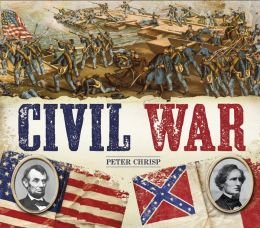
CIVIL WAR: THE CONFLICT THAT CREATED MODERN AMERICA by Peter Chrisp


Union General William Tecumseh Sherman
near Atlanta in 1864.
This book is aimed at 4th-8th graders. It tells an abbreviated history of the Civil War, featuring a lot of pictures and text boxes. It makes for a disjointed read, but it is really designed to be a kid version of a coffee table book.

I was not fond of its description of slavery vs. abolitionism argument on page 6. It takes a neutral stand, meaning that it makes an equal space for the argument for abolitionism and point of view of the slave owners. Really?

The description of the Springfield Rifle on page 18 makes it sound like it could be fired accurately up to 500 yards. In reality, it was a lot less than that for the average soldier. Sure, it could kill someone at 500 yards, but in the hands of the average soldier that would be the shot of a lifetime - or an accident.

On page 39, it pronounces that Sherman intentionally burned Atlanta. He may have, but if he did he kept it to himself. He did order the cotton in storage burned - and that spread to the rest of the city. Intentional? Maybe. Maybe not. To be sure, Sherman didn't spend a lot of time crying over Atlanta.

What does it do well? It gives biographies of the major commanders, includes both Confederate flags (not just the more famous "battle flag"). It also includes a section on "Lost Cause" revisionism, the KKK and sharecropping, rather than just ending with Lincoln's assassination as so many books do.

I rate this book 3 stars out of 5. It can be found on Amazon.com here: CIVIL WAR: THE CONFLICT THAT CREATED MODERN AMERICA by Peter Chrisp.

THE BLUE and the GRAY: THE CONFLICT BETWEEN NORTH and SOUTH by Martin F. Graham, Richard A. Sauers and George Skoch.


Published in 1997 by Publications International, LTD.

At first glance, The Blue and the Gray: The Conflict Between North and South is a typical coffee table book about the Civil War. There are tons of them - I ought to know, I own several myself. They are all over-sized, hardback and full of great pictures. Most have lots of details about the battles and the strategies of the war and a little about topics such as the daily life of the soldier, medicine of the time, the use of spies or daily life in camp. This book is set up exactly in the reverse. It is all about those other topics, discusses the overall strategy and offers very little about the specifics of any actual battles. There are literally no battle maps.

But, that doesn't stop this from being a great book. It is a great book precisely because it doesn't treat those other topics as interesting filler - it treats them as topics that can stand alone and are worthy of exploration. 


Every page is colored either blue or gray. If it is a blue page, it discusses something about the Union, if it is gray, it discusses the Confederacy. Almost always, they go back and forth on the same theme, such as: Lincoln's Cabinet vs. Davis's Cabinet; manufacturing; the Union Strategy vs. the Confederate Strategy; the New York Draft Riots vs. the Richmond Bread Riots; Prison Camps; Uniforms; Northern Weapons Technology vs. Southern Weapons Technology; Newspapers on both sides; Artists on both sides; the two First Ladies; Spies; and how Reconstruction affected both sides. 
Union General Ambrose Burnside (1824-1881)


I particularly enjoyed the story of the Memphis Appeal, a successful newspaper that was forced to flee (printing press and all) from from advancing Union troops who wanted to shut it down. It fled from Memphis to Grenada, Mississippi to Jackson, Mississippi and then on to Atlanta. They fled to Montgomery, Alabama and were finally caught , after nearly three years of flight, in Columbus, Georgia after the war was over. The Union General and the editor had a drink and within 6 months the paper was once again publishing in Memphis (with that same much-traveled press). 

I found this to be an exceptionally balanced and well-written collection. It is an excellent choice to give to a student of the Civil War or to keep in a classroom as a resource. Really, the only problem I saw was on a general map on page 111. My adopted hometown of Indianapolis is placed about 50 miles too far to the south.

I rate this book 5 stars out of 5. It can be found on Amazon.com here: THE BLUE and the GRAY: THE CONFLICT BETWEEN NORTH and SOUTH.

MATTHEW BRADY: PHOTOGRAPHER of the CIVIL WAR (Historical American Biographies series) by Lynda Pflueger


Published in 2001 by Enslow Publishers, Inc.

Matthew Brady is most famous for being THE photographer of the Civil War, but he had quite the career before the war. He was arguably the most famous photographer in the world before the war and the war cemented him in the historical record.

Every American has seen his team's handiwork - one of his photographs of Lincoln was the model for Lincoln's image on the penny. But, if you are a student of the Civil War, you have seen Brady's handiwork over and over again - such as his picture of Lincoln conferring with McClellan in a tent at the Antietam battlefield, his portrait of Lincoln with his son Tad, and his picture of Robert E. Lee taken right after the war.

This biography is intended to be a supplemental reading in a fifth grade or higher classroom. I am a voracious reader of just about anything about the American Civil War (this is my 100th book I am reviewing with a Civil War theme) and I found this slim volume to be quite informative. The pictures that were chosen for the book were excellent. The book features 110 pages of pictures and text followed by a chronology of Brady's life, a set of end notes, a glossary, suggestion for further reading and an index for a grand total of 128 pages.

Matthew Brady (1822-1896)
The maps in the book are accurate, but I don't think I have ever found a more worthless set of maps in a Civil War history. They are focused so close in to the action that the reader cannot see the larger picture. For example, the map showing McClellan's Peninsular Campaign is so tight that you cannot see how the sweep of the Army of the Potomac's movements and how this would have been a stunning attack on Richmond that would have avoided the bulk of the Confederate Army if it had been implemented more quickly. 

I rate this book 4 stars out of 5 and it can be found on Amazon.com here: Matthew Brady: Photographer of the Civil War

THE BATTLE of GETTYSBURG: AMERICAN HERITAGE SERIES (audiobook) by Bruce Catton


Published by Highbridge, a division of Recorded Books in January of 2017
Read by Eric Martin
Duration: 3 hours, 4 minutes
Unabridged

I love Bruce Catton's histories of the Civil War. As a rule, Bruce Catton (1899-1978) wrote histories that are easy to read, thorough enough to give the reader a solid grasp of the issues and peppered with well-told human interest stories. 

Confederate Major General
George Pickett (1825-1875)
This history of Gettysburg feels a bit disjointed, sort of like it was a knitted together from a series of articles that Catton wrote for American Heritage magazine. For example, it spends a lot of time looking at the events just before the battle and skips one of the more dramatic and important moments of the battle on the second day (Little Round Top).

However, the exaggerated emphasis on the first day did not bother me. Too often the first day is sort of skipped over and it's not like the second day was ignored - it just focused on Dan Sickles' horrible deployment and the danger it posed to his own army. That is also important. 


The third day, of course, focuses on the infamous Pickett's Charge. Catton's short history also includes a solid look at Lee's retreat back to Virginia, the consequences of this loss to the Confederacy and a peek at the ceremony in which Lincoln delivered his famed Gettysburg Address, including a reading of the speech itself.

Eric Martin did a nice job with the book. He has a pleasant voice.

I rate this audiobook 4 stars out of 5.

This audiobook can be found on Amazon.com here: THE BATTLE of GETTYSBURG: AMERICAN HERITAGE SERIES by Bruce Catton.


CAIN at GETTYSBURG (audiobook) by Ralph Peters


T
here is a problem with a book about Gettysburg in which George Meade is the most likable character...


Published by Blackstone Audio in 2012
Narrated by Peter Berkrot
Duration: 15 hours, 20 minutes
Unabridged

It is easy to give a simple shorthand review of Cain at Gettysburg as an attempt to re-make the magic of Michael Shaara's classic Pulitzer Prize-winning The Killer Angels from the Union point of view. To be fair, I will give more than a simple shorthand review, but I will be comparing the two books quite often.

The title Cain at Gettysburg is a biblical reference to the story of Cain and Abel - the story of when one brother killed another. It is the first of many religious references throughout the book.

Like the Shaara book, Cain at Gettysburg goes back and forth between the two armies as they draw together for the fateful Battle of Gettysburg in July of 1863. While The Killer Angels focuses on the senior Confederate officers, this novel focuses on the senior Union officers. The Confederate officers are probably the more interesting characters but Ralph Peters' strongest points in Cain at Gettysburg are when he focuses on the never-ending political rivalries at the top of the Union command. The constant strivings and squabbles of both sets of officers are readily apparent. 
 

Cain at Gettysburg comes up short in two key areas when compared to The Killer Angels


1) It fails to convey the larger overview of the battle to the reader. However, its battle details are much more gritty and it does include street fighting in Gettysburg itself, something that is often overlooked. 

Union General George Meade
(1815-1872)
2) It fails to create a character that the reader can really root for, with the exception of Meade. Peters manages to do something just short of miraculous in this book. He makes Union General George Meade the single most likable and sympathetic character in a book filled with characters of all backgrounds and ranks. Meade was, by all accounts, one of the most gruff and difficult officers in the entire Union army. He was nicknamed "Old Snapping Turtle", but in this book he comes off as a likable curmudgeon (Meade always gets the short shrift, so this was an interesting change of pace.) In contrast, Lee comes off as an uncaring megalomaniac. 

But, there is a problem with a book about Gettysburg in which George Meade is the most likable character - it means that there is really no one to root for as you read (or listen, in my case). There were a whole slew of regular Confederate soldiers as characters with complex back stories that all led to the same conclusion - religious faith is a fool's game at best. There were a similar number of Union soldiers from a German unit based out of Wisconsin. They were often funny and interesting but I found myself not really caring about them so much as wishing they would finally get the recognition that they deserved.


A rather long section of the book is all about the political stratagems of Union General Daniel Sickles. It is wearisome, at best.

A very big positive to the audiobook is the performance of the narrator Peter Berkrot. He is brilliant. He creates a number of accents (his German accent is fantastic!) and literally yells, whispers and growls his way through the book.

I rate this audiobook 3 stars out of 5.


This audiobook can be found on Amazon.com here: Cain at Gettysburg by Ralph Peters.

NPR AMERICAN CHRONICLES: THE CIVIL WAR (audiobook) by NPR


Published in 2011 by HighBridge Audio
Multicast performance
Duration: 2 hours, 59 minutes

NPR has searched through its archives and found 29 stories that make for a very interesting listen if you are a student of the Civil War.

There are interviews with historians, including James McPherson and Shelby Foote and authors like Tony Horwitz, Jay Winik and E.L. Doctorow. Sam Waterston reads the Gettysburg Address (so good!) and Hal Holbrook talks about a project of his about the impact of the Civil War on Iowa.

There are also interviews with regular people, like the African American family that comes to see the original Emancipation Proclamation and turns it into a profound and moving educational event.

None of it is very deep, but all of it is deeply interesting. This is a must-listen for all amateur historians of the Civil War.


I rate this audiobook 5 stars out of 5.

This audiobook can be found here: NPR American Chronicles: The Civil War.

MY BROTHER'S FACE: PORTRAITS of the CIVIL WAR in PHOTOGRAPHS, DIARIES, and LETTERS by Charles Phillips and Alan Axelord


Published in 1993 by Chronicle Books

Designed to be a "coffee table book" rather than a thorough re-telling of the war, this history of the American Civil War is quite enjoyable. The strength of My Brother's Face is immediately obvious - the gorgeous, large photographs of soldiers, sailors, spies and other participants in the events of the Civil War.

I find that as I get older I catch myself looking at the faces of these people and wondering what life was like for them. Some of them look stiff and fake, but some, including a lot in this collection, imbue a sense of vitality, a sense that these were living, breathing people. Sometimes it is a smirk, or perhaps a look of unease.

I simply love a picture that is used in this book of the 4th U.S. Colored Troops on p. 121. This is a close-up of the picture from the book. These men all have a look of confidence, determination and even distrust that speaks to us even more than 150 years later and exemplifies what a well-chosen picture can tell the reader that even a well-written text cannot.


4th U.S. Colored Troops stationed at Fort Lincoln in
Washington, D.C.
The history part of the book is told simply and sometimes in an abrupt manner, such as on page 49 in the one page description of the Battle of Antietam. It concludes with this paragraph:

"McClellan had won a costly, if strategically vital victory, but he now seemed reluctant even to give chase to Lee. A much-frustrated Abraham Lincoln sacked his general and freed the slaves."

While all of that is true, it completely skips over the slavery debate within Lincoln's cabinet and the strategy involved - especially the need to pacify foreign governments that were contemplating intervening on behalf of the Confederacy.


Clearly, if this were the reader's only exposure to Civil War history, this book would come up short. But, if you are a student of the Civil War, this book offers something different with these portraits and photographs of camp life. Many books include pictures, including many of the pictures in this book, but few offer them in such a large format which can make all of the difference.

Despite its flaws, I rate this book 4 stars out of 5.


This book can be found on Amazon.com here: My Brother's Face.

NPR ROAD TRIPS: NATIONAL PARK ADVENTURES: STORIES THAT TAKE YOU AWAY (audiobook)


Published in 2012 by HighBridge
Multicast performance
Duration: 1 hour, 7 minutes


NPR has searched its archives for stories about America's National Park System for this enjoyable collection. These stories don't just tell us about the park but tell us an interesting story in the park.

The stories vary from the humorous (the story about the smallest National Park - Thaddeus Kosciuszco National Memorial in Philadelphia which consists of a single room and covers .02 acre to honor this figure from the Revolutionary War) to the wondrous (Death Valley in full bloom after a once-in-a-lifetime rainstorm). The listener learns about the small city of employees that run Grand Canyon National Park, spooky tales of love at White Sands, an effort to preserve the music of New Orleans and a park employee who charts and maps the roadkill that he finds as he goes about his work. 

The audio quality is, of course, excellent since these stories were originally produced for broadcast on NPR. Besides that, this is an interesting collection - the stories are not repetitive, they alternate in mood and length and come together to make an excellent listening experience.

I rate this collection 5 stars out of 5.

This CD can be purchased on Amazon here: NPR Road Trips: National Park Adventures: Stories That Take You Away . . .

GETTYSBURG: THE FINAL FURY by Bruce Catton


Published by Berkley Windhover in 1974


Bruce Catton was the most famous Civil War historian of his era and mastered the art of writing narrative history for the masses. I freely admit that I am an unabashed fan of Catton. I am quite sure that he kick-started my interest in the Civil War that has caused me to fill my shelves with over 100 Civil War books.

Catton tells the story of Gettysburg in slightly more than 100 pages His approachable style is in full display here. For example, his description of Confederate General A.P. Hill: "...a heads-down slugger always willing to take a blow in order to land one." (p. 20)   No one is better at telling a Civil War story than Catton and Gettysburg is the single biggest story of the war. He knows how to keep the story moving but to add just enough detail to make it feel like a special re-telling.

The book is full of great maps, illustrations and photographs and is well worth the time of a student of the Civil War or someone who is simply interested in learning more about Gettysburg.

I rate this history 5 stars out of 5. It can be found on Amazon.com here: Gettysburg: The Final Fury by Bruce Catton.

Reviewed on March 5, 2015

GETTYSBURG: THE GRAPHIC NOVEL by C.M. Butzer


Sometimes Brilliant, Sometimes Lacking and Sometimes Just Plain Wrong


Published in December of 2008 by HarperCollins

This is the 65th review of a book that is somehow connected to the Civil War that I have written. I am also a teacher of American history. I only mention this so that the reader knows that I do not come to my critiques of this book lightly.

In Gettysburg: The Graphic Novel, Butzer has attempted to do something that would be tough no matter who the author is - tell the entire story of Gettysburg in just 80 pages of a graphic novel. By the entire story, I mean why the war was going on in the first place, the status of both sides when the battle started, the battle itself and dealing with the dead, the wounded and the dignitaries that came to nose around afterwards. It also includes the decision to make a special cemetery at Gettysburg and the Gettysburg Address and a discussion of the famed speech, plus additional comments and a bibliography.

If I were asked to do this as two typewritten pages I would find it to be a difficult challenge, so I do appreciate the task faced by Butzer.

Butzer's treatment of the Gettysburg Address is brilliantly conceived and wonderfully demonstrates the power of the little speech to the crowd at the cemetery and the power of the speech as it has resonated down through time.

He also does a great job of talking about how difficult it was to deal with so many dead and wounded once the armies had moved on. The awful nature of Civil War surgery is shown (including a pile of amputated limbs).

 However, his focus was just wrong in so many ways and there are at least two factual errors. The battle itself gets just 9 pages out of the 80 - the little skirmish in Gettysburg itself that started the battle gets two complete pages! If you are uninformed as to the particulars of the Battle of Gettysburg, this book will do little to inform you. But, there is a great deal of, in my opinion, wasted space dedicated to Lincoln's trip to Gettysburg and the build up to the dedication ceremony. 

On pages 22 and 23 Pickett's Charge is drawn in one epic sweep, but the dimensions are wrong (the length of the charge is dramatically shrunken) and the height and angle of Cemetery Ridge is greatly exaggerated. It is a low rise, not the steep angle shown in the book. It looks like Pickett is leading a charge up the dam of a man-made lake, not up the gentle heights of Cemetery Ridge. This distinction makes Lee's decision to attack the Union line directly look like less of a calculated risk and more like a cruel suicidal attack on an impregnable position.

The Evergreen Cemetery Gatehouse
On page 38 workers are building the gatehouse to the cemetery in order to prepare for the ceremony. He also alludes to this in his notes at the end of the book. But, this gatehouse was built before the war (its cornerstone was laid in 1855 and it was used as Union General O.O. Howard's headquarters during the battle) as a part of Evergreen Cemetery, not the national cemetery. When I first visited Gettysburg, I also assumed that the gatehouse went with the National Cemetery so it's an understandable mistake - if you weren't writing a book on the topic. When you visit the cemetery they let you about 

So, sometimes brilliant, sometimes lacking and sometimes just plain wrong, I rate this graphic novel 3 stars out of 5.

This graphic novel can be found on Amazon.com here: Gettysburg: The Graphic Novel.

Reviewed on May 17, 2014

Featured Post

<b><i>BAN THIS BOOK (audiobook)</i></b> by Alan Gratz

Published in 2017 by Blackstone Audio, Inc. Read by Bahni Turpin. Duration: 5 hours, 17 minutes. Unabridged. My Synopsis Ban This Book is t...

Popular posts over the last 7 days