Showing posts with label Ohio. Show all posts

JAILBIRD by Kurt Vonnegut


Originally published in 1979.


Synopsis

Jailbird is the fictional story of William F. Starbuck, the least important member of the Watergate conspiracy to go to prison. 

The story begins with the day that Starbuck is released from a makeshift federal prison (and very cushy, for a prison) on a Georgia military base. He has no idea what he is going to do and he doesn't have a lot of money, but he figures that he will be okay - after all, he has a degree from Harvard and he learned how to be a bartender in a correspondence class while he was in prison.

What follows is a wild tale of good and bad coincidences that take Starbuck to a broken-down residential motel in New York City. Like the hotel, Starbuck is a broken man in many ways - he is an ex-con, his wife of many years has passed away, he never speaks to his son, and he feels shame for accidentally ruining the career of one of his friends due to an offhand comment he made during a anti-Communist Congressional hearing lead by then-Congressman Richard Nixon.

But, in just a few hours everything changes...

My Review

In many ways Jailbird is considered to be a comeback novel for Vonnegut (1922-2007). After the overwhelming success of Slaughter-House 5, Vonnegut struggled to "do it again."

He struggled to write Breakfast of Champions. His next book, Slapstick, was too personal and too weird to be a bestseller. Jailbird reminds me more of Mother Night and God Bless You, Mr. Rosewater than the three science fiction books that he published from 1969 to 1976.

World War II looms large in each of those books - the main characters are struggling to deal with what they saw and did (also a massive theme in Slaughter-House 5)

William F. Starbuck worked as a part of the prosecution team during the Nuremberg Trials. If it hadn't been for the war, he wouldn't have met his wife. The war made him, and everything about it was accidental - he met his wife on by sheer luck. He was assigned to the the trials because he happened to be around and ht happened to be around because of the education he was given by an old millionaire who was a recluse because someone unknown strikebreaker mistakenly pulled the trigger during a tense moment in a strike when the millionaire was a child.

One unrelated thing leads to another and leads to another like a thread of random events that led us to where we are now. Vonnegut spent a lot of time thinking about this idea. In his science fiction books he often explores it through time travel. This book relies heavily on flashbacks.
Vonnegut's report card for his own books.

Jailbird often looks at the plight of the regular working stiff - restaurant managers, chauffeurs, receptionists, the least important guy in the Nixon Administration, down and out authors, affable guards in a minimum security prison, and so on. There is a lengthy introduction about a real-life event in Vonnegut's life that blends into a fictional story about a strike at an Ohio factory that ended in a bloody massacre.

Vonnegut famously graded his own books in the essay collection Palm Sunday. He gave Jailbird an A. I disagree a bit. I rate it 4 stars out of 5, which I would consider to be a B.

Jailbird can be found on Amazon.com here: Jailbird by Kurt Vonnegut.

COMMEMORATIVE HISTORY of the GEORGE ROGERS CLARK BICENTENNIAL EXHIBIT by The Indiana State Museum


Published in 1976 by the Indiana State Museum Society.

1976 was the bicentennial celebration of the Declaration of Independence and if you were not alive in 1976, you have no idea how much went into that recognition. Every store had special decorations, every town had commemorations, everyone had red, white, and blue clothing and this went on for a long time - not just on the Fourth of July in 1976.

Part of this ongoing celebration took place in museums. The Indiana State Museum had a 3 year exhibit on Indiana's role in the American Revolution. People remember the original thirteen colonies and correctly note that Indiana was not one of those colonies. None of Indiana's immediate neighbors were, either.

But, the modern states of Kentucky, Ohio, Indiana, Michigan, and Illinois were on the front line of a different kind of war zone during the American Revolution. There were no great ships, no massed armies, and precious few soldiers even wearing an actual uniform - but there were pitched battles. 
Commemorative History of the George Rogers Clark Bicentennial Exhibit tells one of the most dramatic parts of that story.

During the fighting, White towns and settlements were wiped out. Indian villages were burned to the ground. much of the fighting was due to the encouragement and financing of the British government. The British Lt. Governor in Detroit was ordered to finance Indian attacks on white settlements in an effort to start a wide ranging guerrilla war in the Ohio River Valley to distract the American colonies from the main fight on the Atlantic coast.

This was not hard to do since a low grade fight had been going on for more than a decade. In order to keep up their side of the fight, the Indians needed supplies to feed their families and weapons and the British could easily supply those. The supplies were shipped out of Detroit to a network of smaller forts in Illinois and Indiana.

George Rogers Clark figured that the way to shut down this fight was to take those British forts. He did some preliminary reconnaissance and found that they were lightly defended, depending mostly on the vast spaces of friendly Indian territory between them to protect them. He secured funding from Virginia Governor Patrick Henry to buy powder and supplies for 350 frontiersmen to attack two forts in Illinois near the Mississippi and Vincennes on the Wabash.


Clark got together about half the amount of men he thought he would need and launched his attack in 1778. He was so successful that Lt. Governor Hamilton personally led an expedition to retake Vincennes. From there, he planned a reconquest of the Illinois forts.

Clark decided that a bold move had to be taken before Hamilton could bring in more supplies, equipment, and men. Clark led a 180 mile march across southern Illinois in February of 1779 in order to surprise Hamilton. 

If you do not live in the midwest, you may not understand how truly miserable it can be in February. It may not snow much, but it will be very wet and very miserable - and it was in 1779. It wasn't cold enough to freeze, but it rained for days on end and the rivers came out of their banks. Imagine hiking nonstop through a sloppy mudhole in 35 degree weather with no dry land to be found for days on end with no modern clothing to keep you warm.

At one point their drummer boy had to cross a flooded area by using his drum as a flotation device while he kicked with his feet. The expedition ate all of their food because the floods drove away most of the wild game.

There was a reason that Hamilton felt secure in Vincennes - no one was crazy enough to march through this mess!

Clark's 170 man force surprised Hamilton and convinced him they were a much larger force through some trickery. Hamilton to surrender on February 25, 1779.

Clark's surprise attack cemented America's claim to what is now called the Old Northwest and was one of the factors that helped convince France to support the Colonies in the Revolutionary War. Clark described it this way: "Great things have been effected by a few men well conducted."

This book has a lot of photographs of items displayed in the exhibit. It also includes the illustrations commissioned for them. I found the illustrations to be helpful and interesting, although a bit retro. The strength of this small book does not lie in the pictures, however. The text is the real strength of the book. The story of the entire campaign is told in well-paced bite-sized bits. 

I rate this history 5 stars out of 5. It can be found on Amazon.com here: Commemorative History of the George Rogers Clark Bicentennial Exhibit.

A completely horrible scan of this small book can be found here: https://eric.ed.gov/?id=ED139709. The text is legible, and that's about all that can be said for it.

BREAKFAST of CHAMPIONS or GOODBYE BLUE MONDAY by Kurt Vonnegut, Jr.


Originally published in 1973.

Breakfast of Champions, to me, is the second most well-known Vonnegut novel after Slaughterhouse-Five

The plot of this story is deceptively simple and the writing style is not complicated - but this story has a lot going on.

There are three main characters. One is Dwayne Hoover, a very successful owner of a Pontiac car dealership from Midland, Ohio and numerous other small businesses. He is by far the most successful man in town. He helps bankroll a fine arts festival that the town helps will make them known as a cultural center. He is also going crazy.

The fine arts festival has invited Kilgore Trout, a recurring character from other Vonnegut novels, to be the star of the arts festival. Trout is a prolific, but unsuccessful author. He is published, but only by publishers of porn novels. They use his books as a way to make their books seem more legit, kind of like Playboy used "the articles" to make the magazine seem classier. Trout iis so unsuccessful as an author that he literally has to hitchhike from New York City to Midland. 

The third character is the narrator. The narrator is the author of the book and, I presume, the narrator is Vonnegut himself. The narrator has filled the book with his line drawings. Sometimes, the narrator uses the pictures to move the plot along, sometimes he uses it to avoid describing something, and sometimes he just throws in an illustration for the heck of it. 

The book is constantly moving to the point where all three characters meet in a hotel bar...

Vonnegut famously graded his own books in report card style. He gave Breakfast of Champions a C. 

I disagree, even though I have had a hard time coming up with a rating for this novel. This novel is too unique to be a middle of the road "C". It is often juvenile (Vonnegut spends a lot of time talking about penises, he has a drawing of his anus) but it is very Meta in the way the author is a character in his own story. Plus, the quirky illustrations add a certain charm.

I rate this book 5 stars out of 5. It can be found on Amazon.com here: Breakfast of Champions

THE FREE FALL of WEBSTER CUMMINGS (audiobook) by Tom Bodett


Originally published in 1995 by Brilliance Audio.
Read by the author, Tom Bodett.
Duration: 15 hours, 43 minutes.
Unabridged.


The author and narrator.
I think Tom Bodett's End of the Road series of short stories is just one of the best audiobook experiences out there. Technically, this book is part of that series even though almost none of it takes places in that oddball community of End of the Road, Alaska (it earned its name by being, well, the place where the road ends.)

Bodett is well-known as a frequent panelist on the NPR show Wait Wait...Don't Tell Me! but he is most well-known for his voiceovers for Motel 6 in which he promised in his folksy way, "We'll leave the light on for you."

I say all of this just to say that this book was a major disappointment. 

Everything about this book seems like it should work. It has a grounding in his Alaska stories. It consists of a series of short stories - his area of expertise.

But, there is just way too much going on in this book. There are way too many plotlines going on and Bodett tries to weave them together so they all tie up in a couple of nice little knots at the end and he just doesn't get it done.

There are two plotlines from Alaska, two plotlines from Seattle (one is mysteriously dropped about 1/3 into the book), a cross country plotline from New York City and Los Angeles, a family from Ohio that heads west in stages to find themselves (one finds that Indiana may be far enough west), supernatural forces, PTSD, memory loss, mysticism and a man named Webster Cummings who fell more than a mile from a commercial jet plane over New England and survived. Webster near death experience inspired him to find his biological parents. 

Just too much and I just ended up wanting it to end.

I rate this audiobook 2 stars out of 5. It can be found on Amazon.com here: THE FREE FALL of WEBSTER CUMMINGS (audiobook) by Tom Bodett.
.

THE BLUEST EYE (audiobook) by Toni Morrison


The author won the Nobel Prize in Literature in 1993.

Originally published in 1970.
This audiobook version was published in 2011 by Penguin Random House Audio Publishing Group.
Read by the author, Toni Morrison.
Duration: 7 hours, 6 minutes
Unabridged.


Synopsis:

This is a story of a girl named Pecola who lives in Ohio in the 1940's. She is sexually abused by her father and only knows her mother by the name Mrs. Breedlove. Sometimes she lives with other families as her family struggles.

Pecola is universally considered an ugly child. Pecola wants nothing more than to have blue eyes like Shirley Temple because she is convinced that blue eyes would make her pretty.

The narrative goes round and round and moves back and forth in time, often re-telling certain aspects of the story from different perspectives that fill in the gaps as the reader proceeds. 

In the end, it is not a complicated story, but it is told in a complicated manner.

My review:

Undoubtedly, my take on this book is overshadowed by the audiobook that I listened to immediately before this one: The Handmaid's Tale (click to see that review). On the surface, they have nothing in common - one is dystopian sci-fi, one is set in 1940's Ohio. But, they both share a common theme - the overwhelming sense of despair of people living in a society that is misshapen by a set of rules. Jim Crow era life for African-Americans was its own dystopia.

In The Handmaid's Tale, the rules are enforced by religious elite (or, elite that twist religion to serve themselves). In The Bluest Eye, the rules are enforced by a mostly unseen white society (white characters, even the mention of white characters take up only a few minutes of this 7 hour audiobook). 

White culture sets the standard of beauty for black culture (as demonstrated by Shirley Temple and Pecola's envy), it sets the rules about where black people can live, where they go to school, how long they can go to school before they have to leave to work, what types of jobs they can have and more. It determines almost everything.

Morrison shows a variety of families in the novel. Pecola's family is barely a family at all. She has a sexually abusive father named Cholley. Cholley's first sexual intimate moment was interrupted by white hunters who stumble upon Cholley and a girl and humiliate them by making them continue the act under the threat of their guns while they taunt and critique them. Her mother shows more care for the white family that she works for and shows more care for their daughter than her own. 

Claudia and Freida's family struggles, but they are making it - barely. Geraldine and Junior are rich by African American standards, but Junior has to attend a certain school and has to be friends with certain people and Junior takes it out on other African-American kids. Even the rich are limited in this system.

Toni Morrison (1931-2019)
The Bluest Eye
was the first novel by the winner of the 1993 Nobel Prize in Literature, Toni Morrison (1931-2019). I was spurred to read it because of a news story out of Idaho about 22 books being banned "forever" and this book was included.

Turns out that The Bluest Eye is one of the most banned books in the country. Here is a story out of Missouri and here is a link specifically for The Bluest Eye from a university that tracks banned books. It also made a list banned in the 2023-2024 school in Florida. Here is a link to that ridiculously long list.

This book is specifically complained about for sexual content. Ironically enough, the people who complain about the sexual content are usually the same folks that complain about Critical Race Theory (CRT). CRT teaches that everything is tinged with race in America and this book embraces that theme wholeheartedly, and I have to say that CRT is more right than it is wrong.

I am a 30+ year high school teacher so I thought I'd read this book and give my opinion on whether or not it belongs in school. 
I have been teaching grades 7-12 in some form or another for 32 years. I have a 16 year old daughter and a 22 year old daughter. I also have a very high threshold for outright banning a book. There are books I wouldn't want to personally teach in class, but that doesn't mean they don't belong in a school or a classroom library.

I am convinced that a talented high school teacher could teach this book (see this article). This book has some powerful themes.

I rate this audiobook 4 stars out of 5. It can be found on Amazon.com here: The Bluest Eye by Toni Morrison.

SEA of RUST: A NOVEL (audiobook) by C. Robert Cargill


Published in 2017 by HarperAudio.
Read by Eva Kaminsky.
Duration: 10 hours, 26 minutes.
Unabridged.


Brittle is a caretaker robot in a future United States. 

Sort of.

In Sea of Rust, the United States is dead and gone due to a war between humanity and its robot servants 30 years earlier. Robots were everywhere. They were maids, gardeners, factory workers, delivery drivers, lovers, nurses, nannies, cooks, wait staff and more. On top of that, Artificial Intelligence (AI) super computers were built to do the math and research that human beings struggled to grasp. 

Humans struggled to deal with the concept of robots as thinking beings. The AI super computers were clearly smarter than any individual human and the robots clearly possessed an intelligence of their own, even if it wasn't exactly like human intelligence. 

The author, C. Robert Cargill
As humanity seemingly made a breakthrough in its acceptance of robots as possible equals, a shocking act of political violence by a group of humans shocks the world. Robots don't know what to do, but when every robot on Earth receives a secret download that erases the lines of code that prohibit them from harming humans the war is on.

Brittle wanders what used to be Ohio, Indiana and Michigan - an area called the Sea of Rust. The robots have changed the world's environment in their zeal to kill humans. This zone is a vast desert where robots go off to die or to search for replacement parts to scavenge in the hope of staving off a catastrophic parts failure.

It's not that replacement parts aren't being made. They are. But, the cost is high. The AI super computers are absorbing the consciousness of as many robots as they can so they can fight each other. It is supposedly voluntary, but Brittle doesn't believe it so she stays independent. She hunts down dying robots for their parts and keeps a stash of her own parts handy. 

It was working out - until another robot needed her parts...

This book goes with another audiobook that I recently reviewed, Day Zero: A Novel. Sea of Rust came first so Day Zero is technically a prequel. I read them in chronological order in the story, not in the order that they were written and released. 

I loved Day Zero - one of the best sci-fi books I have read in years. This book should probably be judged as just as good as Day Zero, maybe even better because it built the world that Day Zero inhabits. The heroism of Day Zero appealed to my personality more than the grittiness of Sea of Rust

Taken together, though, they are quite the accomplishment. I recommend reading them in chronological order, not order of publishing. There are spoilers in Sea of Rust that could hurt your enjoyment of Day Zero.

I highly recommend the series and rate this audiobook 5 stars out of 5. It can be found on Amazon.com here:  SEA of RUST: A NOVEL by C. Robert Cargill.

CUSTER'S LAST STAND (Landmark Books #20) by Quentin Reynolds


Published in 1951 by Random House.

In the 1950's and 1960's Random House created an extraordinary history series for children called Landmark Books. There were 122 books in the American history series and 63 in the World Landmark series. A very solid description of the series can be found here: link. When I was a kid my little hometown library had what seemed like an endless shelf of these books (I even remember where it was in that little library nearly 40 years later). Undoubtedly, these books are part of the reason I am a history teacher. I have started a collection of these books. When I run across them at library sales and thrift sales I pick them up. Some of the texts have aged well, some have not.

Custer's Last Stand is aimed at students from 3rd to 8th grade. It is a simple read with line drawings. It could use a few more maps. 

The history is basically accurate in the broad strokes, but it is full of "quotes" and scenes that never happened in order to make the story move along. This whole series is like that, though. They are basically like a movie that is "based on a true story."

Brevet Major General George Armstrong Custer 
in 1863. The term "brevet" means it was a 
temporary rank that would be reconsidered
after the war when the Army shrank to
peacetime size. 
This story is easy to read, but comes up short in the story of George Armstrong Custer (called "Autie" throughout the book) of the famous (infamous?) Custer's Last Stand. It really focuses on the time when he was in school, including West Point.  The story of his transition from West Point to the Battle of Bull Run was well told, but the rest of his remarkable career as a Civil War officer was glossed over. 

It barely discusses the reasons for the Civil War and skips most of Autie Custer's impressive Civil War accomplishments. Besides fighting with distinction at First Bull Run, he also checked Jeb Stuart of Gettysburg (a rarity), Sheridan's Shenandoah Valley Campaign and played a prominent role in Lee's surrender. He was the youngest general in American history when he received that rank at the age of 23. 

Even worse, his brother Thomas Custer is giving the short shrift in this book. If all you knew about Thomas Custer was what you read in this book, one would get the idea that Thomas joined up with his more famous brother just to join in his campaigns in the West with no prior military experience.  Thomas Custer fought from almost the beginning of the Civil War, entering as a private at age 16 and leaving as a brevet Lt. Colonel at age 20. Along the way he became the first solider to win two Congressional Medals of Honor.  

This book tries to deal fairly with the situation that the Sioux found themselves in 1876, but it comes off as clunky and cringey 70 years after it was written. The book readily and frequently acknowledges that the United States "made hundreds of promises to the Indians and broke almost all of them." (p. 139)

But, the book tries to walk a fine line compromise position: "Everyone has to judge for himself who was right. Was it the Indians, to whom this land was given? Was it the Americans, who insisted that the country had to grow in the West, and that you needed a railroad to help the country grow? There were good arguments on both sides, but Autie Custer didn't care about arguments. He was a soldier...Soldiers obey orders." (p. 139)

The book mentions over and over that Custer wanted to be a soldier so he coukd be an "Indian fighter" - from age 4 on that was his goal. As a literary device, it works. As history - it makes Custer look like an obsessed nut.

I am sure that the ending of the book was not accurate - with Custer and his brother being the last two of 200+ soldiers to survive, surrounded by dead soldiers and dead horses while bravely fighting on. Very dramatic, highly unlikely.

Some history books hold up well over time. This one is 70 years old and it did not.

I rate this book 2 stars out of 5. It can be found on Amazon.com here: CUSTER'S LAST STAND (Landmark Books #20) by Quentin Reynolds
.

THE UNDOCUMENTED AMERICANS (audiobook) by Karla Cornejo Villavicencio


Published in 2020 by Random House Audio.
Read by the author, Karla Cornejo Villavicencio.
Duration: 4 hours, 53 minutes.
Unabridged.

Villavicencio is a "Dreamer", also known as a DACA kid. DACA is the program started by President Obama to deal with immigrants who came to the United States illegally as children. Generally speaking, the only country they've ever known is the United States and they had no say in immigrating to the United States. Congress refused to deal with this situation so President Obama created a program through executive orders. This meant that when President Trump came to office he was able to undo a lot of this plan with another executive order. 

Villavicencio's very personal look at the DACA program and the general mess of our immigration policy in The Undocumented Americans was inspired by the election of Donald Trump, but it was not what I was hoping for when I started listening to this audiobook. I was really hoping for policy analysis with a healthy bit of personal stories and interviews tossed in. 

Instead, this book is very much the reverse of the book that I was looking for. It was more of an extended highly personal rant about several immigration-related topics. Many of the (somewhat fictionalized, according to the author) stories she tells have compelling features, but I found the author's style to be too personal, as though the entire screwed-up immigration system was designed just to make her miserable, like most things in life. 
The author

Villavicencio is such a large part of this book that you literally cannot separate the author from the message or the stories she tells. I found her to be so annoying and almost intentionally unhappy that I was forcing myself to read the book, like it was some sort of assigned text. This was especially annoying because I really did agree with her at least 80-90% of the time. 

I rate this audiobook 2 stars out of 5.

It can be found on Amazon.com here: THE UNDOCUMENTED AMERICANS (audiobook) by Karla Cornejo Villavicencio.

LEVI COFFIN, QUAKER: BREAKING the BONDS of SLAVERY in OHIO and INDIANA by Mary Ann Yannessa


Originally printed in 2001.

One of my favorite people in history is Levi Coffin. I have visited the Levi Coffin House (an official Historic Site maintained by the state of Indiana) so many times that it feels like I am making a semi-annual pilgrimage when I go.  The thing is, I find myself inspired every time I visit - both as a history lover, a champion of individual rights and as a Christian.

Levi Coffin was an instrumental figure in the Underground Railroad and the abolition movement. He was not simply  a theoretical supporter of the movement that wrote letters and collected donations. He helped more than a thousand slaves escape, many of them spending time in his own home. His home in Indiana was even modified so that he could hide ten or more people at a time, if necessary.

Here is a picture that I took of a great quote from Levi Coffin that is on the wall of the visitors center at his house in Fountain City: 


This short book tells an interesting story of his life from his beginnings in North Carolina to Indiana and finally on to Cincinnati. During his entire life, even as a young man still living at home in North Carolina, he helped slaves escape. He viewed it as his responsibility as a Christian.

But, he even went further than that. He and wife operated a store in Cincinnati that sold goods that were completely free of slave labor, pioneering a concept that many think as a modern incarnation with things like conflict-free diamonds.

During the Civil War, he and his wife opened their home up as a hospital for wounded soldiers, helped find work and schooling for newly freed slaves and helped feed the non-stop flood of refugees streaming away from their masters.

After the war, he continued his efforts for the Freedmen until he finally was too old to do anything any longer.

This book is very approachable and quite an enjoyable read. I am in the midst of a book purge, but this book is staying on my shelf.

I rate this simple book 5 stars out of 5. It can be found on Amazon.com here: 
LEVI COFFIN, QUAKER: BREAKING the BONDS of SLAVERY in OHIO and INDIANA by Mary Ann Yannessa.

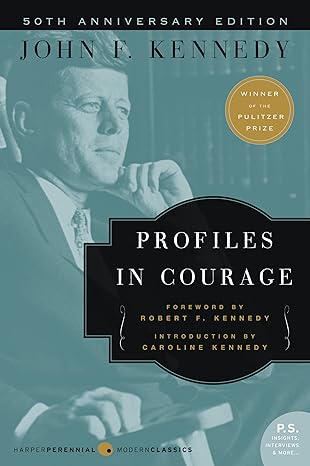
PROFILES in COURAGE (audiobook) by John Fitzgerald Kennedy


A Review of the Audiobook

Winner of the 1957 Pulitzer Prize
Originally Published in 1955

Published by HarperAudio
Duration: 3 hours, 10 minutes
Read by John F. Kennedy, Jr.
Abridged

President John F. Kennedy
(1917-1963)
If you have not read Profiles in Courage, it is comprised of 8 short biographies of Senators that JFK found to be inspirational in some way or another. Those Senators are: John Quincy Adams, Daniel Webster, Thomas Hart Benton, Sam Houston, Edmund G. Ross, Lucius Lamar, George Norris and Robert A. Taft.

Each of these men's stories were very well done, even if some of them, like John Quincy Adams' biography, actually seemed very short compared to what these men actually accomplished. But, then again, this is just a look at one point in time, not a complete list of each man's accomplishments and an abridged version of that short look on top of that.


This audiobook version of JFK's classic work is read by the President's son, John F. Kennedy, Jr. (1960-1999) with an introduction by Caroline Kennedy. The narration was actually quite good. Well worth your time to take a listen or to read.

I rate this audiobook 5 stars out of 5.

This audiobook can be found on Amazon.com here: Profiles in Courage by John Fitzgerald Kennedy

HILLBILLY ELEGY: A MEMOIR of a FAMILY and CULTURE in CRISIS (audiobook) by J.D. Vance


Published in 2016 by HarperAudio.
Read by the author, J.D. Vance.
Duration: 6 hours, 49 minutes.
Unabridged.

Sometimes, I find it hard to write a review of an audiobook, especially an audiobook like this one. I find it hard - not because it is a bad book but because it is so good and I don't know how to convey my thoughts without giving a blow-by-blow book report of the book.

So, in short, J.D. Vance tells the story of his upbringing in Hillbilly Elegy. He calls his family hillbillies but also calls that same group rednecks or poor white trash. When I was a kid in southern Indiana, we called them poor white trash. His family came from eastern Kentucky (as did part of my own a hundred years ago) and was part of an exodus from the area in the 1950s. These hillbillies brought their culture with them and Vance spends the rest of the book telling a dual story - the story of his family and the story of how this Appalachian culture is struggling in modern America.

The title of the book tells you that this is often a somber book since an elegy is a sad poem or song to praise and express sorrow for the dead. Vance's family history is not a particularly happy one, but it is far from universally tragic. I think that Vance is expressing sorrow for working class whites as a whole. Their culture is leaving them poorly equipped for the America they are born into.
Vance touches on this at one point, but as a teacher in an urban school system, I found that a lot of what he was talking about applied to what I see every day at school. What he talks about in this book can certainly be extrapolated out to apply to other cultures. In this case, what is more important is not race but poverty. It reminded me of the little bit of training I have had with Dr. Ruby Payne and her insights into generational poverty and its own unique culture. 

What works best with this book is Vance's technique of telling his own story and using it to illustrate larger insights into his own culture of generational poverty. You learn precisely because you start to care for people like his profane and loving grandmother - a woman that should not have been the impetus for Vance's success based on her track record with family relationships but ended up being the one person that made all of the difference.

This audiobook was read by the author. That can be tricky, especially if the author is not particularly a good reader. Vance is hardly a professional reader but his accent and tone make it better than a professional reader really could have.

I rate this audiobook an enthusiastic 5 stars out of 5.


This audiobook can be found on Amazon.com here: Hillbilly Elegy: A Memoir of a Family and Culture in Crisis by J.D. Vance.

Note: I wrote this review 7 years before Vance became the MAGA Republican Vice Presidential candidate. Despite enjoying the book, I am profoundly disappointed in his politics since I am a Never Trump Republican, like Vance used to be. Why did he change? I can only refer you to this short book about another Republican politician: The Corruption of Lindsey Graham.

Motherhood and Hollywood: How to Get a Job Like Mine by Patricia Heaton


A fun, breezy read about a normal girl who made it big

Published in 2002 by Villard

Motherhood and Hollywood: How to Get a Job Like Mine is not out to change anyone's life, but it is a funny, light look at one woman's meandering quest to be an actress. Also, it is quite reassuring to find out that there are people in Hollywood who are quite normal.

Patricia Heaton's book is irreverent, sometimes serious, frank, cute, and her tales of a time when kids could run the neighborhood in suburban Cleveland without fear reminded me of my own fun in small town Indiana. She pokes fun at her own silliness and naivete and reminded me of my own way back when.

The author, Patricia Heaton
This is a weekend read (it also has great potential as a read-out-loud-to-your-spouse-in-the-car book), but it will be one that you'll pass on to friends so they can have a fun weekend as well.


I give this one 4 stars out of 5.

This book can be found on Amazon.com here: Motherhood and Hollywood: How to Get a Job Like Mine.

Reviewed on June 20, 2006.

Eyeshot by Lynn S. Hightower


Great plot line, herky-jerky follow-through


Published in 1996

Have you ever been in a car with someone who is learning how to drive a stick shift? If not, let me assure you, you will be bounced around without warning and it will be quite unpleasant until you get used to it or until the driver gets better.

In the case of Eyeshot, you'd better get used to it.

Hightower has created a wonderful concept for a police novel:

 - how do you get the criminal when the suspect is a high profile prosecutor? 

 Her characters work the outside edges of the system until they can finally make their move and it is an interesting concept and quite the challenge.

Unfortunately, it is made even more challenging by Hightower's choppy plot lines. Oftentimes, I felt like I was coming in to the middle of a scene or a conversation - the characters were meeting people I did not know - nor did I get clued in until much later on. Conversations were started and spoken almost completely in the shorthand that characterizes friendships - but I'm not friends with these people so I have no idea what they're talking about! It is not a good thing to make the reader feel like the third wheel!

So, I gave the book 3 stars, which means I do recommend it. Let me explain my reasoning. The underlying plot is so strong that the annoying habits of the writer do not overcome it. Or, to put it another way (and to return to my first analogy...) - I just got used to her poor use of the stick shift!

This book can be found on Amazon.com here: Eyeshot.

Reviewed March 16, 2005

The Court Martial of Daniel Boone by Allan W. Eckert


Not your traditional piece of historical fiction

Originally Published in 1973.

Nominated for seven Pulitzer Prizes in literature over his career, Allan W. Eckert brings us the little-known true story of Daniel Boone's court martial in Kentucky during the American Revolution.

The bare facts are that Boone and a great portion of the fighting men from Boonesborough were captured by Shawnee raiders who took all of them back into modern day Ohio and eventually some were taken to Detroit to meet with the British Lt. Governor Henry Hamilton, known as the "Hair Buyer" for his policy of buying scalps of settlers.

Boone behaved so strangely during this entire episode that when he finally escaped the Shawnee he was brought up on charges and court-martialed.

Daniel Boone (1734-1820)
The Court-Martial of Daniel Boone narrates the court martial and not the actual events. Eckert tells the story much like a modern courtroom drama. Boone had an unorthodox defense style that allows the prosecution to lay out their entire argument and puts Boone in the worst possible light. Of course, Boone would not be the celebrated figure he is today if here were found guilty so the outcome is never really in doubt. But, Eckert does allow a great deal of tension to build in the form of indignation on the part of the reader.

An enjoyable piece of historical fiction. I rate this book 4 stars out of 5.

This book can be found on Amazon.com here: The Court-martial of Daniel Boone.

Reviewed on January 28, 2011.

Bound for the North Star: True Stories of Fugitive Slaves by Dennis Brindell Fradin

An excellent introduction to the topics of slavery and the Underground Railroad.


While Bound for the North Star: True Stories of Fugitive Slaves is obviously aimed for the "young adult" crowd, it would serve as an excellent primer for ANYONE interested in learning more about that sad, sad topic in America's history: slavery.
Harriet Tubman

The author includes 12 stories about slaves who escaped north, mostly with the help of the Underground Railroad. Each story describes a different type of escape or incident - varying from the case of Solomon Northrup - a free black man who was drugged and sold into slavery while he was working in Washington, D.C. to John "Fed" Brown, a field slave who traveled a roundabout trip to freedom covering thousands of miles to John Price - an escaped slave who was captured in Ohio, but was eventually freed thanks to the near-riot of the Oberlin College community. The book ends up with the most famous member of the Underground Railroad, Harriet Tubman, and details a number of her exploits as a Conductor and as a Union Spy during the Civil War.

As a reader, I appreciated the variety of types of escape stories - it did not get stale reading about the same type of escape and the variety of escape plans really was a wonderful testament to human creativity in the face of hardship.

I rate this book 5 stars out of 5.

This book can be found on Amazon.com here: Bound for the North Star: True Stories of Fugitive Slaves

Reviewed on September 1, 2004.

Featured Post

<b><i>BAN THIS BOOK (audiobook)</i></b> by Alan Gratz

Published in 2017 by Blackstone Audio, Inc. Read by Bahni Turpin. Duration: 5 hours, 17 minutes. Unabridged. My Synopsis Ban This Book is t...

Popular posts over the last 7 days