Showing posts with label crusades. Show all posts

YEARS THAT CHANGED HISTORY: 1215 (The Great Courses)(audiobook) by Dorsey Armstrong


Published in 2019 by The Great Courses.
Lectures by Dorsey Armstrong.
Duration: 12 hours, 29 minutes.
Unabridged.


The Great Courses offers a lecture series by college professors that the average person can listen to on their own time. 

In this case, Purdue University history professor Dorsey Armstrong is focusing on the year 1215 as a pivotal year. 

1215 is well-known to Americans as the year of the Magna Carta, but it is also the year of the Fourth Lateran Council of the Catholic Church. The rest of the lecture series is about general things that were going on around 1215. These include the crusades, a brief look at the Americas, a look at the Islamic world, Japan, and an extended look at Genghis Khan and the Mongol Empire.

This is a lecture series that could have used a bit of editing. If two hours were removed, that would have been good. Three hours would have been great. This was especially true in the section about Genghis Khan. Armstrong admitted that she was excited about this topic and she really just laid on the details - way too many details for even this history teacher. It just got bogged down in the early details of his life and scooted through the height of the Mongol Empire and its eventual collapse.

I rate this audiobook 3 stars out of 5. I don't really blame Armstrong for this - this series tends to like 20+ half hour lectures and I don't think this was a rich enough vein of information for her to mine.

This audiobook can be found on Amazon.com here: YEARS THAT CHANGED HISTORY: 1215 (The Great Courses) by Dorsey Armstrong.

THE OTHER SIDE of HISTORY: DAILY LIFE in the ANCIENT WORLD (The Great Courses) by Robert Garland


Published by The Great Courses in 2013.

Read by the author, Robert Garland.
Duration: 24 hours, 28 minutes.
Unabridged.

Robert Garland
Robert Garland gives his listeners a look at the "other side of history" - meaning from the point of view of the lower and middle classes, slaves, regular soldiers, women and children from the Stone Age through Medieval Europe. Occasionally, he looks at the rich, but not quite famous as well. He also explores how religion worked in every day life, family life, marriage ceremonies, how many jobs were performed and funeral rites in Mesopotamia, Ancient Egypt, Ancient Greece, the Persian Empire, the Roman Empire and Medieval Europe, particularly England.

Garland is a lecturer at Colgate University in New York State so he delivers this information through a series of 48 half-hour lectures. Asking for all 48 lectures to be 5 star quality is asking too much, but I found this to be an enjoyable and educational listen.

Highly recommended.

I rate this audiobook 5 stars out of 5. It can be found on Amazon.com here: THE OTHER SIDE of HISTORY: DAILY LIFE in the ANCIENT WORLD (The Great Courses) by Robert Garland.

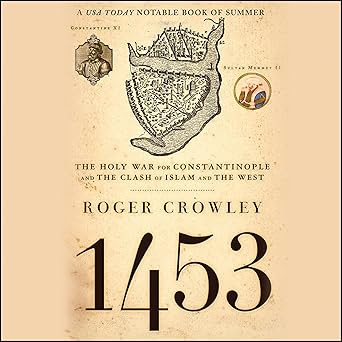
1453: THE HOLY WAR for CONSTANTINOPLE and the CLASH of ISLAM and the WEST (audiobook) by Roger Crowley


EXCELLENT!


Unabridged Audio Edition 
Published in 2016 by Hachette Audio and Blackstone Audio
Read by Simon Prebble
Duration: 10 Hours, 56 Minutes

When Rome was at its height, it split itself in half and created a second capital for the eastern half in Constantinople (modern day Istanbul). The eastern half survived the official "Fall of Rome" in 476 AD and continued on for nearly 1,000 more years until it succumbed to the Ottoman Turks in 1453. It was the seat of the Orthodox Christian Church and oftentimes stood as the bulwark against Muslim military advances into Eastern Europe.

From the time of the first formal attack against Constantinople in 674 AD until it finally fell in 1453, the capture of this city was, at the least, on every Muslim leader in this region's "to do" list, if not an active goal.


Once the Ottoman Turks arrive on the scene the Byzantine Empire is clearly on its last legs. The city is still defended by one of the most elaborate set of walls ever built and its history and architecture are truly amazing. But, its glory days are long gone. The city has sold a lot of its treasures to defend itself. Its territorial holdings, at one point, included a majority of the territory of the Roman Empire. By 1453 it only held a part of modern Greece and the territory immediately around the walled city.

The Ottomans, in contrast, were an Empire on the rise and they understood that the capture of Constantinople offered great strategic, economic and symbolic value. 


1453: The Holy War for Constantinople and the Clash of Islam and the West is a book that could have truly been horrible. We've all had that professor or teacher or book that takes the most exciting parts of history and drains all of the joy from the learning experience and leaves behind a dry, lifeless exercise in tedium. 

This book had all of the hallmarks of that experience. 

1. Medieval battle? Check.

2. The Byzantine Empire, whose very name is literally synonymous in English with being unnecessarily complicated? Check.

3. Multiple religious traditions that most American readers know little about? Check (Islam) and check (Orthodox Christianity).

Constantine XI (1405-1453)
However, Roger Crowley's history is almost always highly entertaining and informative. He paints vivid word pictures of the battles and they come off much more like the epic struggles depicted in a Tolkien novel than the a dry recitation of facts. He introduces new historical figures and makes them feel like real people.

Constantine XI, the Byzantine Emperor comes to life as an honorable and brave warrior who refused to escape and leave his city even when there was no hope. He was an experienced soldier who actively led his men throughout the siege. Legend has it that he dressed as a regular soldier in his last moments and led his men in a hopeless last-ditch defense of the city. His body was never definitively identified.

Mehmed II was the hard-headed and often difficult young Ottoman emperor. He spoke multiple languages, survived the brutal family dynamics of the Ottoman leadership and embraced new technologies, like cannon. He was rewarded for this flexibility when he took the city that many considered impossible to take.


Simon Prebble's reading of this book was excellent. It was like listening to an amazing English history professor give one of the most interesting history lectures you have ever heard. Perfect combination of voice and text.

I rate this audiobook 5 stars out of 5,

This book can be found on Amazon.com here: 1453: THE HOLY WAR for CONSTANTINOPLE and the CLASH of ISLAM and the WEST by Roger Crowley.


The Jester by James Patterson and Andrew Gross


Patterson switches up big time


Published in 2003.

Known for his murder mysteries, James Patterson and co-author Andrew Gross decided to try something new and have given us The Jester, a fun, fast-paced adventure set in war-torn medieval Europe.

Hugh De Luc is a happily married innkeeper until he heads off to fight in the Crusades. The gruesome fighting and wanton disregard for life change and sicken him so he deserts and heads home only to find his wife taken captive and his infant son dead.

At this point, Patterson is on more familiar ground. Hugh De Luc must find out who did it and try to bring him to justice. Unfortunately, medieval customs and laws interfere with that search. Throw in some religious relics and a menacing group of French knights who believe they are condemned to hell and you have the indgredients for a fine book.

Patterson's descriptions of medieval life ring true, although the ending may not have worked out so well in a real medieval scenario. Nevertheless, it was lots of fun and a big improvement over the Women's Murder Club series.

I rate this book 5 stars out of 5.

This book can be found on Amazon.com here: The Jester.

Reviewed on July 16, 2006.

A World Without Islam by Graham E. Fuller


Published in 2010.


Graham Fuller has a long history in the intelligence communities (27 years) and may be most famous for being the man behind the idea that led to the whole "Iran-Contra" affair (and an ironic mis-quote in Chapter 12 when he quotes Reagan as calling the Afghan mujahideen the "moral equivalent of our Founding Fathers" when he said that of the Nicaraguan Contras). This book is a response to the book The Clash of Civilizations and the Remaking of World Order by Samuel P. Huntington. Fuller makes repeated references to Huntington's most famous line from the book: "The bloody borders of Islam." Fuller contends that it is not Islam vs. the World but rather East vs. West.

I cannot disagree with Fuller's ultimate thesis in A World Without Islam - the East and the West are two civilizations (cultures, if you prefer) that are in tension with one another. That tension has been there since before Christ. The Roman Era exacerbated the problem by having two capitols - Rome and Constantinople. The church divided along that axis and the Roman Catholic (Latin) Church and the Greek Orthodox churches fought, or at least bickered, as often as not. The rise of Islam rose in the Orthodox sphere and largely assumed their anti-Western stance.


Fuller presents a compelling case and I cannot help but agree with almost everything he says, but I will point out a few troubling issues:


-In Chapter Three he notes that the beginning of East/West struggles begin with Alexander the Great's invasion of Persia in 334 B.C. Funny, I would have thought that he would have chosen events such as the Persian domination of Greek city states in modern Turkey and the Persian invasion of Greece in 480 B.C. (146 years earlier) made famous in the popular mind by the recent movie 300. Or, perhaps the Persian involvement in the last stages of the Peloponnesian War (413-404 B.C.) where they interfered in the war, paid for a Spartan navy that defeated the Athenian navy and tried to make Sparta a client state.


But, there is a reason that he has chosen Alexander's invasion to start his history and not given the reader the entire story - his other thesis, and perhaps most important one is that the West is the reason for the West's troubles with the East, better known as Russia and Islam in the modern world. The West is always the aggressor. The East is always more inclusive and the victim of the West's aggression.


The Crusades? Only a precursor to Western Imperialism and definitely not a reaction to Islam's spread to Spain, its slow-mootion engulfing of the Byzantine Empire and its abuse of Christian holy sites and pilgrims.


How should the West have behaved? We are given the example of Russia - which Fuller claims as a model of ethnic and religious integration - for all religions , including Judaism. This is the same Russia that gave English the word "pogrom" to describe state sponsored violence against Jewish communities. Fuller refers to popular theater to support his thesis over and over again. He should have noted the movies Fiddler on the Roof and An American Tail before making too much of Russia's successes. On a similar note, he promotes the fact that Russian integrations worked so well that a million Muslims fought for Russia against the Ottomans in World War I but, on the next page, he also notes there was a violent uprising against "new Tsarist poliices that tried to force Muslims into military service." Well, which is it?


I think it is both, but Fuller tries too hard throughout the book to make certain facts conform to his thesis. These are not square pegs being forced into round holes. More like oval pegs being forced into round holes. They are sort of right, and, with a little careful trimming here and there they fit. There's a pattern: ignore Persia's pre-Alexander invasions of Greece, overlook legitimate Christian concerns about the spread of Islam at the expense of the Christian Byzantine Empire and the treatment of Christian holy sites and pilgrims, overstate Russia's success at becoming a multi-ethnic, multi-religion state. Why? If the truth is shaved a bit here and there, and with a little pounding, the pegs do fit in those holes - sort of, if you don't look too close.


Fuller does not mention, at all, the well-documented ethnic/religious strugges in Indonesia or Darfur. In fact, with the exception of Egypt, the entire continent of Africa is barely mentioned at all, despite its being one of the more fluid and contentious areas of religious turmoil in the world.


What does Fuller get right?


A lot.


Alexander did spread a thin veneer of Western values over the Middle and Near East and it was resented - just look, for example, at Judea's continued reaction to Hellenic rule, from the time of the Maccabees through the multiple rebellions against the Romans. Were the Crusades all about religious fervor? Clearly not. Lots of money was made (by such groups as the Knights Templar), reputations were made (Richard Lionheart) and landless knights were able to carve out kingdoms in the Middle East (at least for a while). Was Russia better at integration than such multi-religion states as Spain? Clearly so- Spain expelled all of the Jews and Muslims. But, let's not pretend Russia had it all figured out, either.


His history and comparisons of Christianity, Islam and Judaism are well-written, despite the biases noted above. Read carefully and you will learn a lot.


Much to his credit, Fuller does not only offer criticism. He also offers thoughtful advice on how to proceed in the future. It makes sense and has given me lots to think about. I also appreciated the last paragraph in which he notes that secular violence has been much worse in our recent history. World War I, World War II, the Nazis and the Communists were all secular and were responsible for the deaths of tens of millions. "We in the West will be on a sounder path if we can de-Islamize our perceptions of regional issues and view them simply as universal human social and political problems for which we, too, share some responsibility."


I give it three stars - this would be a 5 star book but I have to take away one star for the "shaving" of facts I mentioned above and I have to take away another for not mentioning much of anything at all about Africa or Indonesia and Bangladesh - these areas alone account for more than a third of all Muslims, have been the source of a lot of violence and tension and should have been considered when having any sort of discussion about "A World Without Islam."


This book can be found on Amazon.com here: A World Without Islam.

Reviewed July 9, 2010.


3 stars out of 5.

Featured Post

<b><i>BAN THIS BOOK (audiobook)</i></b> by Alan Gratz

Published in 2017 by Blackstone Audio, Inc. Read by Bahni Turpin. Duration: 5 hours, 17 minutes. Unabridged. My Synopsis Ban This Book is t...

Popular posts over the last 7 days