Showing posts with label Detroit. Show all posts

WE LIVE HERE: DETROIT EVICTION DEFENSE and the BATTLE for HOUSING JUSTICE (graphic novel) by Jeffrey Wilson and Bambi Kramer


Published in 2024 by Seven Stories Press.

The 2008 Financial Crisis and the Great Recession that followed led to a myriad number of local problems all over the United States. In some places, major projects slowed or stopped. In others, manufacturing came almost to a halt. In others, there were so many subprime mortgages issued in that area that the housing market practically collapsed.

Detroit is famously home to tons of auto-related factories and they all slowed dramatically. It was so bad during the Great Recession that the American auto industry had to be bailed out by the federal government. Those job losses left the Detroit economy in a shambles.

On top of that, Detroit was one of the places with simply too many subprime mortgages. It wouldn't have been a problem if Detroit's economy didn't have any hiccups. The problem is that the Great Recession was much, much more than a hiccup - it was like a financial bomb went off in the city.

This graphic novel details the financial troubles that Detroit faced and how many of the subprime loan programs worked, including government supports that simply dried up when the property tax started to dry up. All of these led to an eviction of foreclosure crisis that snowballed across the city.

The best part of the book are the stories of neighbors banding together to prevent foreclosures. They literally blocked streets and called banks day and night urging them to negotiate with their mortgage customers. This should have been a no-brainer - the banks already had a glut of homes in the same neighborhoods. When too many homes are for sale, the prices are driven down so low that the banks may never get their money back. 

I do like the idea behind this book - using the graphic novel format to preserve local history. It was a lot more interesting than reading an article about the topic. It was quite effective in telling the story of neighbors that defended their homes because, as the title says, "We live here!"

I did have one complaint - the simple pencil illustrations are fine, but some of the characters look the same and it was hard to tell whose story we were reading about.

I rate this graphic novel 4 stars out of 5. It can be found on Amazon.com here: WE LIVE HERE: DETROIT EVICTION DEFENSE and the BATTLE for HOUSING JUSTICE by Jeffrey Wilson and Bambi Kramer.

THE ASCENT: A NOVEL (Kurt Argento #1) (audiobook) by Adam Plantinga


Published in 2024 by Grand Central Publishing

Read by Charles Halford and Christine Lakin.

Duration: 10 hours, 44 minutes.

Unabridged.

Synopsis

The Ascent features Kurt Argento, a former Detroit police officer. His wife died from cancer and he is not dealing with it well. During a small riot, he defied orders to protect a civilian and hospitalized several members of a gang with his night stick - he literally worked out some of his grief on their not very sympathetic bodies. It was heroic act, but because he disobeyed orders he was forced to resign.

Argento takes his dog and heads out towards California. For some reason, he has it in his head that seeing the Pacific Ocean would be a good thing for his peace of mind. While traveling through Missouri he ends up in a scuffle with a corrupt local sheriff. The sheriff claims that his jail cells are too full so he can store Argento in a nearby for-profit state prison in hopes of Argento getting caught up in some sort of prison fight and perhaps getting shanked.

Before Argento can even get logged in to the prison it erupts in a completely out of control riot. To make matters worse, the governor's daughter is also in the prison as part of a visit for a college class and the only way to safety requires them to travel through every floor of the prison to get to the roof...

My Review

If you like the Jack Reacher novels, this book will feel very familiar. The book's plot is obvious when you read the summary, but almost all of it is a good read with unlikely, but not impossible, complications. There are two parts that are extremely (and unnecessarily) graphic. 

This book would make a pretty good plot for a videogame.

I rate this book 4 stars out of 5. It can be found on Amazon.com here: The Ascent by Adam Plantinga

ARETHA FRANKLIN: A LIFE from BEGINNING to END (kindle) by Hourly History


Published in 2023 by Hourly History.

Aretha Franklin (1942-2018) was a true music legend. Nicknamed the Queen of Soul, she dominated the charts in the late 1960s and early 1970s and popped in and out of the charts for the rest of her life. She appeared on television, in movies, and, of course, in concert.

Hourly History specializes in short biographies and histories that most readers can complete in about an hour. The reader is not going to get a super-detailed biography, but the reader will get a decent overview.

Some of these biographies are quite good, some read like a well-written Wikipedia page. This book was much more like the latter than the former. It went through the Franklin's life and told all of the details, but you never get a sense of what she was like as a person. 

I was pleased to see that they mentioned her small but outstanding role in The Blues Brothers. I think it is one of the major highlights in a movie full of highlights.

I rate this e-book 3 stars out of 5. It can be found on Amazon.com here: ARETHA FRANKLIN: A LIFE from BEGINNING to END by Hourly History.

EVERYTHING I LEARNED, I LEARNED in a CHINESE RESTAURANT: A MEMOIR (audiobook) by Curtis Chin

Published in 2023 by Little, Brown, and Company.
Read by the author, Curtis Chin
Duration: 8 hours, 12 minutes.
Unabridged.

Curtis Chin grew up in the 1980s in and around Detroit, Michigan. His immediate family and his extended family shared ownership in a Chinese restaurant in Detroit's Chinatown. Chin spent a considerable chunk of his early life working, eating, and doing homework in the restaurant.

Chin tells about how his family ended up in Detroit, how his parents met and got married, the sometimes uncomfortable extended family dynamic, and the decline of Chung's Cantonese Cuisine's once vibrant neighborhood.

There is also plenty of discussion about school from kindergarten through a four year degree at the University of Michigan. These parts of the story often discussed the racial dynamics of going to school in Detroit's majority minority school system. Later, when the family joined the white flight to the suburbs, there was a new dynamic of going to a school where there were almost no minority students. On top of that, the family was clearly not welcome in the suburbs because they were not white.

As Chin grew older, he had another issue that had his attention more than the ins and outs of the shifting racial currents - his sexual orientation.

Chin starts this part with an amusing story of how he and a cousin snuck out of the restaurant to go into a store near the restaurant that sold porn magazines to take a look. It's an enlightening story for a couple of reasons. It shows how the neighborhood around the restaurant had declined. But, Chin knows something is different when he is more interested in the magazines featuring men than the ones featuring women.

The family restaurant in 1976
Photo from Detroit News archives.
From that point, the book focuses heavily on Chin's struggles with who he can safely come out to and how to meet a man while constantly being surrounded by a very traditional family. Chin often wonders how his family will react when he finally comes out to them.

I have two big criticisms of the book. The first is that we never find out how his family reacts when he comes out to them. He worries about that throughout the second half of the book and he almost tells them at one point at the very end. The second is that considering the title of the book, I found it disappointing that there is no summary at the end of the book that points out the life lessons he learned in a Chinese restaurant.

Not a bad book, but I was disappointed by the two omissions that I mentioned. I rate this audiobook 3 stars out of 5. It can be found on Amazon.com here:  EVERYTHING I LEARNED, I LEARNED in a CHINESE RESTAURANT: A MEMOIR (audiobook) by Curtis Chin.

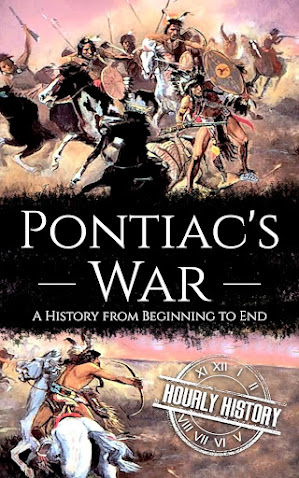
PONTIAC'S WAR: A HISTORY from BEGINNING to END (kindle) by Hourly History


Published by Hourly History in 2021.

Hourly History publishes histories and biographies that you can read in about an hour. That can be a tough job for larger topics in history like "The Industrial Revolution" or "The Roman Empire" but it works out about right for this short war (1763-1766.)

The war arose directly from unaddressed issues as a consequence of the French and Indian War (1754-1763.) In the French and Indian War, the American frontier became a battlefield. American settlements were wiped out, Native American villages were destroyed. French and English soldiers participated and ultimately agreed to a settlement that ignored the realities of the vast borderlands between the colonies and the Native Americans.

The biggest issue was constant push westward from European (American) settlers into areas that were already inhabited by Native Americans. The colonies were all for this westward push, even if the British government was ambivalent or even against the idea. 

Pontiac was an Ottawa. They were centered in the Great Lakes in and around Michigan. Pontiac wanted the French government to resume control of the area - something that simply was not going to happen.

Pontiac was sick of the English colonies moving westward. He encouraged all of the Native American groups to join together to overwhelm the British forts in Michigan, Indiana, Ohio, Pennsylvania and upstate New York. He led an attack against Fort Detroit that failed, but a number of smaller forts fell, including Fort Ouiatenon near modern-day Lafayette, Indiana. I only mention Fort Ouitatenon because I live in Indiana, have been to the fort, and this is the only time I have ever seen the fort mentioned in a history book.

Once the British figured out that it was a united push against their forts and settlements they slowly pushed more troops into the area. They began with only 500 soldiers to hold an area that comprises all or parts of upstate New York, western Pennsylvania, Ohio, Indiana, Michigan, part of Illinois and nearby areas of southern Canada.  Transportation was horribly slow and more than once the united Native Americans attacked, blocked or diverted attempts to reinforce forts. 

It isn't quite clear how big a part Pontiac had in this war. The British considered him to be one of the big leaders - big enough that they called the war Pontiac's Rebellion. But, seeing the number of other critical errors and misunderstandings they committed during the war, it is entirely possible that they imagined him to be THE leader when he was actually one of a number of leaders.

The agreements in this war didn't last for long and did not resolve the underlying issues. There were three other wars and countless skirmishes in this area with the exact same issues in the 50 years that followed. 

I rate this short e-book 5 stars out of 5. It can be found on Amazon.com here: PONTIAC'S WAR: A HISTORY from BEGINNING to END by Hourly History.

GANGSTERS vs. NAZIS: HOW JEWISH MOBSTERS BATTLED NAZIS in WARTIME AMERICA (audiobook) by Michael Benson


Highly Recommended

Published in 2022 by Tantor Audio.
Read by Gabriel Vaughan.
Duration: 8 hours, 53 minutes.
Unabridged.


Flag of the German American Bund
In the United States in the 1930's there was a small, loud, enthusiastic, and growing group of Americans that were great fans of Hitler and the Nazi party. They were largely ethnic Germans and formed organizations that sported Nazi symbols and mimicked the big rallies that Hitler had in Germany. They also mimicked the overt antisemitic speech exhibited by the Nazis. The most successful of these was the German American Bund (German American Federation).

There were a lot of small groups but there were two larger organizations with a different take than the Bund. The Silver Legion of America (Silver Shirts) had a spiritualist take on hate. Father Coughlin was a literal Catholic priest who brought a "Catholic" view on antisemitic hate and anti-interventionism from Detroit. He had a massive radio audience that was so enthusiastic that his church superiors were afraid to muzzle him.

Officially, Nazi Germany did not support these groups, but there were plenty of unofficial connections.

The national government could officially do nothing to stop them quickly (although the age-old tactic of looking for things like tax violations did work to slow some of them down over time.)

There was also very little that local governments could do to stop these meetings. Some localities, like New York City, outlawed wearing some of their Nazi-style outfits (dubious legality). Others just buckled down and over-scrutinized all of their rental applications for meeting halls, applications for parades, and so on. If there was a misspelling, or any similar type of mistake it was denied. 

But, that kind of thing only lasts so long. Eventually these American Nazis learned to double check their paperwork and take advantage of America's wide open freedom of speech rules to advocate for actions that would kill those very same freedoms.

A judge from New York City named Nathan Perlman decided that if the American antisemites were going to have paramilitary organizations, American Jews needed one to literally punch back. Turns out he knew a whole bunch of tough Jewish guys that paraded through his court room on a regular basis - Jewish mafia gangsters. People like Mickey Cohen, Meyer Lansky, Davie "the Jew" Berman*, and Bugsy Siegel were talked to in an unofficial way. 

The deal was simple - no killing, lots of roughing up (but not too rough), try to disappear afterwards, no overt help from the judge, avoid the press. In return, there would be lots of backroom maneuvers to get them out of jail if needed. The judge appealed to their sense of ethnic loyalty and it worked. These men were not good Jews in any kind of moral way. Most had long since stopped going to temple. However, most had had enough of a connection to the larger Jewish community to have had a Bar Mitzvah and they all understood that if people were going after harmless rabbis and little old ladies that go to temple, they would certainly go after Jewish mobsters.

Mugshots of Meyer Lansky (1902-1983)
Meyer Lansky said this about their involvement: 
"The stage was decorated with a swastika and a picture of Adolf Hitler. The speakers started ranting. There were only fifteen of us, but we went into action. We threw some of them out the windows. Most of the Nazis panicked and ran out. We chased them and beat them up. We wanted to show them that Jews would not always sit back and accept insults"

This Nazi-Gangster fight did not go on for too long - a couple of years at longest. The German American Bund began to fizzle out during 1939 when everyone was starting to get a real sense of what Nazi Germany was all about. Pearl Harbor pretty much brought an end to the pro-fascist meetings thanks to Italy and Germany declaring war on the United States to express their solidarity with Imperial Japan. 

Are there thorny free speech issues in this scenario? Well, it looks bad when a judge is recruiting a crew of guys to beat people up for expressing their political thoughts. But, when you consider the record of Nazis before and during the war it's pretty hard not to enjoy hearing about the mobsters beating the crap out of a bunch of loud-mouthed racist bullies.

I recommend the audiobook version because of the reading of Gabriel Vaughan. The book is written is written in a lively and engaging manner and uses words or phrases from movies or newsreels from the time period, using slang like "heaters" (guns) and "whacked" (mafia ordered murder). Vaughan doubles down on this theme by reading with a mild accent reminiscent of newsreel narrators of the time.

I rate this audiobook 5 stars out of 5. It can be found on Amazon.com here: GANGSTERS vs. NAZIS: HOW JEWISH MOBSTERS BATTLED NAZIS in WARTIME AMERICA (audiobook) by Michael Benson

*Note on Davie "the Jew" Berman. Mobster nicknames are almost always colorful. Berman has to have the least imaginative nickname of all the mobsters of this era. That's most likely due to the fact that he was operating out of Minneapolis and Iowa City - places not known for large Jewish populations.

DETROIT: AN AMERICAN AUTOPSY (audiobook) by Charlie LeDuff


Published by HighBridge in 2013.
Read by Eric Martin.
Duration: 7 hours, 21 minutes.
Unabridged.

Detroit: An American Autopsy is one of the best audiobooks I have listened to in a very long time.

It made me laugh, made me think, made me glad I don't live in Detroit, made me worried that I live in another Rust Belt city that has lost a lot of its industrial base, and, over and over again, it shocked me.

Charlie LeDuff grew up in the Detroit area and moved away to do a lot of different things, including being a reporter for the New York Times (where he won a Pulitzer Prize). He came back home to Detroit to work for a newspaper and to be close to family. When you go away from someplace and come home you see things a little more clearly and he was more than a little surprised Detroit was not only every bit as bad off as most of the country believes - it was actually a lot worse.

I recently read the book Janesville: An American Story by Amy Goldstein.  In a lot of ways, it is similar to Detroit: An American Autopsy in that they both detail the stories of a community wrecked by the collapse of the American automobile industry during the Great Recession. Janesville, Wisconsin is a small city that lost its lifeblood - a General Motors truck factory. Janesville lost one factory - Detroit has been losing factory after factory after factory for 50+ years. When Charlie LeDuff was growing up in Detroit, it was dying - but nobody knew it. When he returned it was painfully obvious that Detroit was gone.

The author, Charlie LeDuff
But that's too simple. Detroit is not dead. It has firefighters fighting to save the town from chuckleheads that set fire to abandoned homes just to watch the show when the fire department shows up. It has police that keep plugging away, even though Detroit is regularly known as the "murder capitol" and its leadership seems focused on looking good rather than being good. It has people just trying to make a living even though almost all of the good factory jobs are long gone.

It has its lost people, its thieves and hustlers. It has people that use religion as a tool to fleece the people. Its schools are literally falling down around its children. It has people that just don't care. But it also has Keiara Bell, a middle schooler who scolded a member of Detroit's City Council for being rude during a council meeting (if only Keiara Bell had known the half of it). Bell, it turns out, graduated from a Detroit public school, went on to Wayne State University (in Detroit) and graduated and wants to go into city management. She is featured in this TV story by Charlie LeDuff.

This is a tough book. There is no happy ending. It's a messy discussion of race, class, crime, politics, money and LeDuff's personal life and it is compelling. I blasted through this audiobook, looking for chances to listen a little more. Eric Martin read the audiobook and he was perfect for it. He never hit a wrong note as he read the book. I hope he won some sort of award, but in keeping with the theme - why would he? After all, it is about Detroit.

I rate this audiobook 5 stars out of 5 and it can be found on Amazon.com here: DETROIT: AN AMERICAN AUTOPSY (audiobook) by Charlie LeDuff.

The Court Martial of Daniel Boone by Allan W. Eckert


Not your traditional piece of historical fiction

Originally Published in 1973.

Nominated for seven Pulitzer Prizes in literature over his career, Allan W. Eckert brings us the little-known true story of Daniel Boone's court martial in Kentucky during the American Revolution.

The bare facts are that Boone and a great portion of the fighting men from Boonesborough were captured by Shawnee raiders who took all of them back into modern day Ohio and eventually some were taken to Detroit to meet with the British Lt. Governor Henry Hamilton, known as the "Hair Buyer" for his policy of buying scalps of settlers.

Boone behaved so strangely during this entire episode that when he finally escaped the Shawnee he was brought up on charges and court-martialed.

Daniel Boone (1734-1820)
The Court-Martial of Daniel Boone narrates the court martial and not the actual events. Eckert tells the story much like a modern courtroom drama. Boone had an unorthodox defense style that allows the prosecution to lay out their entire argument and puts Boone in the worst possible light. Of course, Boone would not be the celebrated figure he is today if here were found guilty so the outcome is never really in doubt. But, Eckert does allow a great deal of tension to build in the form of indignation on the part of the reader.

An enjoyable piece of historical fiction. I rate this book 4 stars out of 5.

This book can be found on Amazon.com here: The Court-martial of Daniel Boone.

Reviewed on January 28, 2011.

METAtropolis: The Dawn of Uncivilization (audiobook) collection edited by John Scalzi


Up and down - the ups are solid, the downs are low, so low I nearly quit listening

Published in 2008 by Audible Studios.
Performed by 
Michael Hogan, Scott Brick, Kandyse McClure, Alessandro Juliani, Stefan Rudnicki, John Scalzi
Duration: 9 hours, 7 minutes.
Unabridged

METAtropolis: The Dawn of Uncivilization is a collection of short stories about a fictional future world in which the United States government is much weaker and local governments have had to shoulder most of the responsibility for governing. We get to see 4 future settings in this anthology - Cascadia in the American Northwest, Detroit, New St. Louis and Scandinavia. While the U.S. government is much weaker, the role of technology has grown much stronger. There are virtual on-line worlds and cellphones are everywhere and even more plugged in than they are now. The five authors sat down and mapped out the ground rules of this future world and than separated to write their stories. John Scalzi edited the collection and was the last one to write a story. He specifically tailored his story to fill in the blanks left by the other four.

So far, so good but what about the individual stories?

What's good is pretty good, what's bad is real, real bad.

The first story is "In the Forests of the Night," by Jay Lake. It is bad. The worst of the bunch. The story concerns a messiah-like figure called Tyger Tyger who arrives at Cascadia, a city of anti-technology greens in the Cascades in the Washington/Oregon area. The messiah-figure concept was done poorly. The anti-capitalist, anti-technology, anti-religion angle was silly (for example, in one scene creationists storm the geology department of a university and kill all of the geologists).

I doubt that Lake actually understands the meaning of the political term "Libertarian" and he certainly overuses the phrase "reputation economics" - in fact the concept is bantered around in the book so often that you'd think this was a new idea. Nah - just overuse of a cool-sounding phrase. The government of Cascadia is so loose and yet so complicated that it reminded me of the peasant collective government in Monty Python and the Holy Grail described by Dennis the Peasant ("Come and see the violence inherent in the system. Help! Help! I'm being repressed!").

Lake's premise that you can hide an entire city under the basalt and loam (two more overused words in this story - buy a thesaurus, man!) and keep all of the heat created by people just living hidden from heat-detecting satellites is so silly that I have to wonder why this wasn't sent back for a re-write. 1 star for this story.


The second story is set in Detroit. It is "Stochasti-City," by Tobias Bickell. I enjoyed this one. It explored the conditions of America in this world the authors created and the story was in and of itself interesting as well. 4 stars

"The Red in the Sky is Our Blood" by Elizabeth Bear is the third story. It is forgettable except that I noted that it was the victim of long soliloquies about the evils of globalization. 1 star.

"Utere Nihil Non Extra Quiritationem Suis" by John Scalzi is the fourth story, and in my opinion, the best of the bunch by far. It had the most important thing that any story has to have - good characters. As a bonus, the slacker is kinda likable and we do get to learn even more about the world these authors created because, as I already noted, he specifically tailored his story to fill in the blanks left by the other four. 5 stars.

"To Hide from Far Celenia" is the last story. Written by Karl Schroeder, it builds on the notion that people can and will retreat into a video game world. This is not news - people do that now with online games. There are already online economies. They'll do it even more with the addition of 3D video glasses that overlay the online world over the real one. The story just didn't really go anywhere and the author's comments on economics are a joke. Too many long monologues - at points it was like listening to a half-baked graduate dissertation on economics and computer technology. I only finished it because I had already invested so much time listening to the other stories. I have to give it 1 star.

So - 5 stories with scores of 1 + 4 + 1 + 5 + 1. That equals 12. 12/5 = 2.4

Total score: 2 out of 5 stars.

This audiobook can be found on Amazon.com here: METAtropolis.

Reviewed on January 27, 2010.

Featured Post

<b><i>BAN THIS BOOK (audiobook)</i></b> by Alan Gratz

Published in 2017 by Blackstone Audio, Inc. Read by Bahni Turpin. Duration: 5 hours, 17 minutes. Unabridged. My Synopsis Ban This Book is t...

Popular posts over the last 7 days