Showing posts with label Mississippi. Show all posts

GRANT and LEE: VICTORIOUS AMERICAN and VANQUISHED VIRGINIAN by Edward H. Bonekemper III


Originally published in 2007.

Edward Bonekemper was a Civil War historian who came to the game kind of late in life - after he retired as an attorney for the federal government. 

However, he brings his skills as an attorney to this book. Imagine a regulatory attorney bringing all of his research to bear in order to win a case by simply  overwhelming the other side with binder after binder of evidence. In this case, the evidence is almost 200 pages of appendices, endnotes, and a bibliography. 

Bonekemper makes an argument in this book that Grant was undoubtedly the superior general when compared to Lee. In fact, he makes the arguments that Grant was the best general in the Civil War by far and Lee squandered his soldiers and his resources by going on the offense almost all of the time.

Being the best general does not mean Grant made no mistakes. It does not mean Grant was perfect. Bonekemper acknowledges mistakes by Grant in every campaign and gives Lee his due from time to time. 

Grant and Lee is really a dual history of these two generals, comparing their pre-war careers and then various stages of the war itself. For example, there is a chapter called May-July 1863 where the Vicksburg campaign is compared to the Chancellorsville/Gettysburg campaigns. 

A constant refrain is that Lee's biggest weakness is that he did not conserve his resources by falling back on the defensive. His argument is that Lee did not grasp the strategic fact that the North had to literally conquer the South while the South just had to stay alive until popular support collapsed in the North and the Europeans recognized the Confederate government. 

Instead of building a series of fortifications and compelling the Union forces to destroy themselves in useless attacks, Lee kept lashing out at Union forces and invaded the North twice only to lose both times and discourage European intervention after both failures.

Lee rarely lost more soldiers than the Union forces he fought, but he did not have a constant supply of new soldiers coming to the front - and the North did. Not only did the North replace soldiers at an amazing rate, they also managed to create all new armies when needed.

I found that I basically agreed with Bonekemper. Grant was the better general. Lee was too focused on Virginia and too eager to go on the offense. He did not save his resources and did not share the ones he had with other theaters of the war.

I rate this book 5 stars out of 5. It can be found on Amazon.com here: GRANT and LEE: VICTORIOUS AMERICAN and VANQUISHED VIRGINIAN by Edward H. Bonekemper III.

VICKSBURG, 1863 by Winston Groom


Originally published by Knopf in 2009.

Winston Groom will always be best known as the author of Forrest Gump, but he should be equally well known as the author of a series of well-told American histories. Included in those histories is a trilogy of Civil War histories that focus on the Western Theater of the war.

Vicksburg 1863 is the second book in the trilogy, but it can be easily read as a stand-alone history. After a short introduction to the war itself, it follows Grant's campaign to take the Mississippi River away from the Confederacy, beginning with a mess of a battle in Missouri that proved nothing of any importance except that Grant was game to fight and push forward, even if the conditions were not perfect.

That, it turns out, was pretty much the key to Grant's eventual success in this campaign and in the war.

From there, we follow Grant through Kentucky, into Tennessee and the terrible Battle of Shiloh. Although ultimately successful, this marked a low point for Grant because he nearly lost his army. His immediate superior came to Shiloh to supervise him and killed most of the momentum of the campaign

Eventually, Grant regained his command (his superior officer was promoted to a desk position in the Eastern Theater) and began his campaign to remove the last major obstacle for Union control of the Mississippi River - Vicksburg, Mississippi.

Vicksburg was a challenge due to its location on an imposing cliff on a massive bend in the Mississippi River. The Confederate military placed cannons on the cliff that threatened any ship that dared to try to pass by. This book details the many efforts he made to bypass Vicksburg, including attempts to build a canal to reroute the Mississippi and an attempt to go through the swamps around Vicksburg. Eventually, he crossed the river south Mississippi and quickly moved his army to cut off Vicksburg, lay siege to it while also engaging and driving away any Confederate troops that could have helped to lift the siege.

Some people will argue with Groom's assertion that Grant did have bouts of drunkenness during the campaign. He describes a rather wild bender featuring Grant cruising through the swampy rivers north of Vicksburg during a lull during the siege, switching boats, and looking for more and more booze. Grant's defenders will deny it all, Grant's detractors will claim it was probably even worse. I go with the simple knowledge that addiction is powerful and Grant often brought along people that kept him accountable. If those people weren't around, I can easily imagine him falling off the wagon. Whether it was a wild run through the swamps or a binge drunk in the corner of a cabin...well, that depends on who told the story back then and who is writing the story now.

I rate this history 5 stars out of 5. It reads as easy as a novel. It can be found on Amazon.com here: Vicksburg, 1863 by Winston Groom.

See my review of Groom's Shiloh, 1862 here. 

RUN: BOOK ONE (graphic novel) by John Lewis and Andrew Aydin


Illustrated by L. Fury and Nate Powell.
Published by Harry N. Abrams in 2021.


This spring I read the MARCH, the three volume graphic novel series about Congressman John Lewis (1940-2020) and the Civil Rights movement. When I finished the series, I thought to myself that it would be interesting to see how John Lewis ran for Congress and the struggles he encountered in an era where the KKK still openly marched.

My Synopsis:

The graphic novel RUN picks up right where MARCH trilogy left off. At the end of the MARCH trilogy, there was a celebration of the passage of the Civil Rights bills - a moment of success. There was also the murder of a volunteer who was helping with the celebration by anti-Civil Rights forces.

RUN explores what happened after the Student Non-Violent Coordinating Committee (SNCC) had it first taste of success. 
At the end of MARCH, there was a celebration of the passage of the Civil Rights bills. With that, a long-term goal achieved there was a lot of discussion about where to go next. there were a lot of things to consider, including the beginnings of the Vietnam War.

The discussions soon became arguments and those arguments led people to leave the SNCC and for the movement to fragment. Some pushed for more of the same strategies due to a belief in the power of non-violence and for the simple reason that they had been effective up to this point. 

Others, led by Stokely Carmichael, wanted to pursue separatist strategies. Eventually, this leads John Lewis to leave the SNCC and run for political office.

My Review:

As I look over what I wrote in my synopsis of the book, it sounds boring. It really was not. You normally don't hear much about the Civil Rights movement after the passage of the Voting Rights Act and the Civil Rights Act in 1964 and 1965, so I found it interesting.

Sadly, Lewis died before this book was finished and I doubt there will be more in this series. 

I rate this graphic novel 5 stars out of 5. It can be found on Amazon.com here: RUN by John Lewis and Andrew Aydin.

MARCH: BOOK THREE (graphic novel) by by John Lewis and Andrew Aydin


Published in 2016 by Top Shelf Productions

Written by John Lewis and Andrew Aydin.

Illustrated by Nate Powell.

2016 National Book Award Winner for Young People's Literature

2017 Printz Award Winner

2017 Coretta Scott King Author Award Winner

2017 Sibert Medal Winner

2017 YALSA Award for Excellence in Nonfiction Winner

2017 Walter Award Winner

Congressman John Lewis (1940-2020) continues his life story in book three of the March series, focusing on his struggles in the Civil Rights Movement. The book starts with the 16th Street Birmingham Church Bombing in September of 1963 and ends with the signing of the Voting Rights Act in August of 1965.

These were, by any account, much like the famous Charles Dickens line from A Tale of Two Cities: "It was the best of times, it was the worst of times, it was the age of wisdom, it was the age of foolishness, it was the epoch of belief, it was the epoch of incredulity, it was the season of light, it was the season of darkness, it was the spring of hope, it was the winter of despair..."

It was the best of times in that the Civil Rights Act of 1964 and the Voting Rights Act of 1965 were passed. It was the worst of times because of these landmark laws were passed due to great sacrifices. As noted on page 91, in the state of Mississippi in the summer of 1964 during an attempt to mobilize and register black voters there were "more than 1,000 arrests, 80 beatings, 35 church burnings, and 30 bombings."

A theme that runs throughout the trilogy is that every success is soured by a violent response. I was particularly struck by an act of pointless violence at the end of the book. When the march from Selma, Alabama to Montgomery, Alabama finally happens (it had been turned back on other attempts by violence and by court order) there is a rally, there are speeches, and a concert given by an amazingly diverse crowd of artists - diverse in race and in musical styles. What should have been a beautiful moment is marred by the murder of a volunteer driver named Viola Luzzo from Detroit. She was shuttling people back to Selma. She was heading back to Montgomery to pick up more people when a car pulled alongside. A single shot was fired and she was killed (see picture.)

This is an excellent trilogy and an excellent way to tell this history. I rate this book and the entire trilogy 5 stars out of 5. 

This book can be found on Amazon.com here: MARCH: BOOK THREE (graphic novel) by by John Lewis and Andrew Aydin.

Click here for March: Book One.

Click here for March: Book Two.

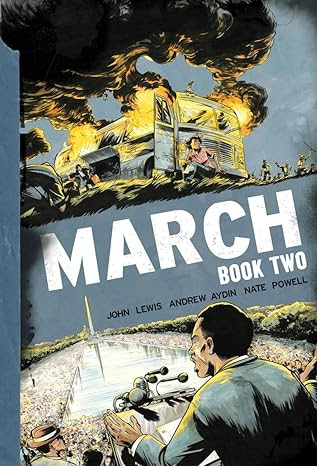
MARCH: BOOK TWO (graphic novel) by by John Lewis and Andrew Aydin


Published in 2013 by Top Shelf Productions.

Written by John Lewis and Andrew Aydin.

Illustrated by Nate Powell.

Congressman John Lewis (1940-2020) continues his life story in book two of the March series, focusing on his struggles in the Civil Rights Movement. The book starts in November of 1960 and ends with the 16th Street Birmingham Church Bombing in September of 1963.


The story includes some very harsh responses to attempts to integrate restaurants in Tennessee, the freedom riders (young African Americans were attempting to desegregate bus lines after a court ordered them to be desegregated), and the bus boycott campaign in Birmingham. 

The violent response is horrible and shocking

Infamous segregationist lawman Bull Connor of Birmingham figures prominently throughout the middle of the book. I am pretty well-versed in the major points of the Civil Rights Movement but I was still moved by the portrayal of the Children's Crusade.

The book includes all of the negotiations, concerns, and demands before the famed March on Washington. Lewis spoke at the march, followed by the world-famous "I Have a Dream" speech by Martin Luther King. 

And, as often happens in this history, a giant step forward is followed by tragedy. In this case, the book ends with the death of 4 girls in the terrorist bombing of a church in Birmingham. 

I rate this book 5 stars out of 5. It can be found at Amazon.com here: MARCH: BOOK TWO (graphic novel) by by John Lewis and Andrew Aydin.

Click here to see my review of March: Book One.

Click here to see my review of March: Book Three.

TEAR IT DOWN (Peter Ash #4)(audiobook) by Nick Petrie


Published in 2019 by Penguin Audio.
Read by Stephen Mendel.
Duration: 11 hours.
Unabridged.


Synopsis:

Peter Ash served multiple tours of duty with the Marines in Iraq and Afghanistan. When he left the service, he wandered the roads of America - partly because he could not find a place to settle down and partly because he suffers from claustrophobia as a form of PTSD. He can't sleep indoors. He has a very tough team being inside unless it's a spacious room or has lots and lots of windows. 

The author, Nick Petrie.
Peter has been living with his very serious (and very rich) girlfriend helping maintain her compound and recuperating from the misadventures of the last book. But...he's getting bored.

His girlfriend gets word from a friend named Wanda in Memphis that people are threatening her in her new house that she bought in a tax auction. They are throwing bricks through windows and the like. Peter drives across the country in his restored work truck to help keep an eye out. When he arrives he discovers that things have gotten a lot worse.

They're not just throwing bricks any longer - they've driven a dump truck right into her house...

My review:

This owes a lot to Lee Child's Jack Reacher series (lone drifter who is retired from the military who works very well with smart, talented, independent women) and to Robert B. Parker's Spenser series (man with a moral code, a girlfriend and an African American friend with a brother-like bond of questionable background that comes in with things get tough) but it has a distinct voice of its own.

The series also has a formula that I happen to like. It would be wise of Petrie to shake it up a bit, but it is a formula that is working for me.

Petrie's descriptions of a musician in the grove approached poetry. Nicely done. It more than makes up for the touch of the paranormal that was throw in.

I rate this audiobook 5 stars out of 5. It can be found on Amazon.com here: TEAR IT DOWN (Peter Ash #4)(audiobook) by Nick Petrie.

SHILOH, 1862 by Winston Groom


Published by National Geographic in 2012.
443 pages.

Winston Groom is best known as the author of the novel that inspired the classic Tom Hanks movie Forrest Gump. Most people don't know that Winston Groom wrote several histories, including three about the Civil War.

****Synopsis****

Shiloh, 1862 is, of course, about the Civil War Battle of Shiloh, sometimes known as Pittsburg Landing in southern Tennessee very close to where Tennessee, Alabama and Mississippi touch. 

The commanders were Ulysses S. Grant, William Tecumseh Sherman and Don Carlos Buell for the Union and Albert Sidney Johnston, P.G.T. Beauregard and Braxton Bragg for the Confederacy. 

Ulysses S. Grant (1822-1885)
Grant was on a roll of sorts. He was the only winning Union commander, having won the Battles of Fort Henry and Fort Donelson in Kentucky in the winter of 1861-62. These welcome victories not only buoyed the sagging morale of the Union after the loss of the first big battle of the war, Bull Run, but it also opened up Tennessee, Mississippi and Alabama to invasion following the river systems of the area.

This is how Grant ended up at Pittsburg Landing in southern Tennessee in April of 1862 and this is how this almost unknown location became the site of the first truly large battles of the war with casualties rivaling those of later battles such as Antietam and Gettysburg. Much like those battles, there were also a lot of questionable decisions made by the principal generals during this battle.

****My review****

This is one of the finest histories of the early days of the Western Theater of the Civil War that I have ever read. This is the 144th book that I have reviewed that has been tagged Civil War and I honestly cannot think of a more approachable and well-written history as this one. 

Highly recommended.

I rate this book 5 stars out of 5. It can be found on Amazon.com here: SHILOH 1862 by Winston Groom.

THE RANGER (Quinn Colson #1) (audiobook) by Ace Atkins


Originally published in 2011.
Audiobook version published in 2022 by Recorded Books.
Read by MacLeod Andrews.
Duration: 8 hours, 36 minutes.
Unabridged.


Synopsis:

Quinn Colson is an Army Ranger at the end of his "storming the castle" days. He is in the process of transitioning to a role as a trainer of Army Rangers at Fort Benning, Georgia when he finds out that his Uncle has committed suicide.

So, Colson goes to Northern Mississippi for the funeral.

His uncle was the country sheriff and one of the deputies (a high school friend) tells Colson that she believes that it was a murder staged to look like a suicide. Colson doubts it. 

Meanwhile, word gets out that Colson will inherit all of his father's land, his house, and everything else. Colson starts to believe the deputy's theory of murder vs. suicide once he starts getting major pressure to dump the property as soon as possible to a shady county board member with a reputation of putting together shady deals.

So, Colson decides to stay a few more days to try to figure out what is going on. The more he digs, the worse it gets...

My Review:

First, the negatives:

*Colson knows EVERYBODY in this small county (except for the outsider bad guys). Like this character, I grew up in a rural area and left due to work. I have met literally hundreds of new people and I have tended to forget the ones that I left behind because I didn't see them any longer. Colson has been on active military duty in war zones for the majority of the 9 years and has met lots and lots of people and he still remembers every detail about everyone he knew. He must've been the most well-connected 18 year old in the county because he knows everyone. Someone will say something like, "Do you remember Jimmy?" and he will say sure - and ask if he still dyes his hair, works the morning shift at the gas station, likes ketchup on his scrambled eggs and drives a blue ford 4x4 with a white passenger door. C'mon. Also, yes, Jimmy still does all of these things 9 years later.

*The situation that caused Colson to come back to town would have worked out for the bad guys if they had just stayed patient for a few more days. It's weird that they didn't because they had spent years working on it.

*The first third of the book worked so hard to set a Southern Gothic mood that I almost quit at the 1 hour mark and the 2 hour mark. It was as if the author went down a checklist and tried to squeeze as many things in as soon as possible:

-Broken down homes? Check.

-People with eccentric hobbies or obsessions? Check.

-Grotesque characters? Check.

-Decayed surroundings? Check.

-The weight of the past upon the present? Check.

-Sinister events related to or stemming from poverty, alienation, crime or violence? Check, check, check and check. This is the plot of the book.

Positives: 

-In some books, when a person gets hit or shot it's no big deal and they get up and fight again even though they have a broken jaw or a punctured lung or their spine was severed. Not in this book. When someone gets shot or punched hard that injury stays with them.

-The conspiracy, when it is finally uncovered, makes a lot of sense and rings true.

-The reader of this book is excellent. He doesn't just read the book - he performs it. 

So, three really annoying things and three really good things. That's why I am rating this book 3 stars out of 5. It can be found on Amazon.com here: The Ranger (Quinn Colson #1) by Ace Atkins.

THE AFFAIR (Jack Reacher #16) (audiobook) by Lee Child


Published by Random House Audio in 2011.

Read by Dick Hill.
Duration: 14 hours, 5 minutes.
Unabridged

Any fan of the Jack Reacher series knows that they are not written in chronological order. The Affair is set in Reacher's later years in the Army. He is a major and, as fans know, he is part of the military police. Chronologically, it is set directly before the events of The Killing Floor, the first Jack Reacher book that was published.

Jack Reacher has been sent to Mississippi as part of a two man team to investigate a murder of a young woman that took place outside of a military base. It is presumed that the murderer was a soldier on base, maybe even the captain of a team of Rangers that have been shuttling in and out of Kosovo on secret missions as part of the Balkan civil war that followed the collapse of Yugoslavia.

That is a problem because this captain is very connected politically. His father is a U.S. Senator that is on the committee that helps set the military budget. 

The author, Lee Child
Reacher is part of a two man team. The other guy has been officially sent to the base to solve the murder - everyone knows he is coming. Reacher has been ordered to assume the role of a drifter - an ex-military guy with no home who has come into town. His job is to keep an eye on the local police and see if they have made any progress on the case and to report it. He has been given multiple warnings that this will be a sensitive case and he should tread lightly. Reacher decides that solving the case would be a good thing, even if it is politically unpopular.

When Reacher discovers that it's not just one murder but three very similar murders of local girls he knows that he is in for much more than he bargained for...

If you have read a few books in this series, you know how they all go. Reacher comes to town, identifies a problem and starts working towards resolving it. Along the way he drinks gallons of coffee, eats in a diner, buys replacement clothing and meets an extremely talented female professional (Lee Child has no problem doling out the talent to women and men in equal measure in his stories) and does a lot of walking.

This was a solid Reacher story. Not the best, certainly not a bad one. A couple of the side stories had some real emotional resonance. The main story doesn't quite hold up to intense scrutiny so don't do that - enjoy the story and move on. 

Not all Reacher books do this, but this one has multiple sex scenes with a fetish thrown in. There were six scenes - I know this because Reacher keeps counting them as part of a series of observations about how the first time is special, the second time can be a better experience and so on. The whole thing got tiresome for me and one of them seemed even weirder since it happened right after an extremely sad and tragic event that had an element of their fetish worked in with it. It would have soured me from it, but I think Lee Child was on a roll of some sort and wanted to keep on going with it.

Dick Hill read the audiobook. Dick Hill is the reason that I quit reading the series as physical books. He is my favorite audiobook reader (sadly, now retired) and I just think that he had a feel for reading Reacher's dialogue. 

I rate this book 4 stars out of 5. It can be found on Amazon.com here: The Affair (Jack Reacher #16) by Lee Child.

APOSTLES of DISUNION: SOUTHERN SECESSION COMMISSIONERS and the CAUSES of the CIVIL WAR (A NATION DIVIDED: STUDIES in the CIVIL WAR ERA) by Charles B. Dew


Originally published in 2001.


The greatest argument among people who study the Civil War isn't who was the best general or what would have happened if Lincoln hadn't have been assassinated or even what would have happened if the Union had lost at Gettysburg.

No, the greatest argument is this: What caused the Civil War?

For the better part of the last century, the argument has been that the Confederacy seceded in order to protect "their rights". The counter-argument has always been to protect "the right to do what?"

For me, the answer has always been a simple one - they fought for their right to own people and to keep African Americans at the bottom of the heap in Southern society. For the Confederate States of America, slavery was the reason to fight. For the Union army, maintaining the Union, with or without slavery, was the reason to fight - a goal claimed many times by Lincoln himself. 


There will be arguments that claim that Confederate states seceded over differences in culture and differences in attitude and the disagreement over federal tax policy. If you think so, I encourage you to read the Ordinances of Secession (basically Declarations of Independence) from Georgia, Texas, Mississippi, South Carolina and Virginia. They are full of all sorts of reasons to secede, but they keep coming back to slavery-related issues. These are wonderful resources because they are frozen in time, before the loss of the war by the Confederacy. Many post-Civil War authors who fought for the South obscure the importance of slavery, perhaps realizing it was a great moral wrong, or perhaps simply being cognizant that slavery had become politically incorrect and it would hurt their overall argument. Let's face it - many Union soldiers became proud of their role in ending slavery long after the war ended, being indifferent to or even mildly pro-slavery during the war.

 Several of the seceding states did more than issue their own Declarations of Independence. Some of these states sent out ambassadors from their newly independent states to try to convince the other slave states to join them. They were generally referred to as Southern Secession Commissioners. The title of this book, Apostles of Disunion refers to them. The Apostles of Jesus were sent out to teach about Jesus. These apostles were sent out by several secessionist states to to convince the other slave states to join them. Just the fact that they were only sent to slave states should serve as a major clue as to what caused the Civil War.

The texts of their letters and speeches make it very clear that their main arguments were these: fear of the abolition of slavery by "Black Republicans", fear of slave revolt, the loss of the investment of money in their slaves, fear of former slaves having the power to vote and the fear of race mixing. William L. Harris, the Commissioner from Mississippi sent to reach out to the state of Georgia said on December, 17, 1860: "Mississippi is firmly convinced that there us but one alternative: This new union with Lincoln Black Republicans and free negroes, without slavery; or, slavery under old constitutional bond of union, without Lincoln Black Republicans, or free negroes either, to molest us. If we take the former, then submission to negro equality is our fate." (p. 87)


He followed up with a comment about how Mississippi would "...rather see the last of her race, men, women and children, immolated in one common funeral pile, than see them subjected to the degradation of civil, political and social equality with the negro race." (p. 89)

Stephen F. Hale (1816-1862. He served Alabama
as a Secession Commissioner and as a Lt. Colonel
in the 11th Alabama. He died of wounds sustained
during the Battle of Gaines' Mill in 1862.
Hale County, Alabama is named for him
.
Stephen F. Hale of Alabama sent a letter to the Governor of Kentucky to convince him to push for secession. In the letter he calls Lincoln's election "...nothing less than an open declaration of war, for the triumph of this new theory of government destroys the property of the South, lays waste her fields, and inaugurates all the horrors of a San Domingo servile insurrection, consigning her citizens to assassination and her wives and daughters to pollution and violation to gratify the lust of half-civilized Africans."

He continued: "What Southern man, be he a slave-holder or non-slave-holder, can without indignation and horror contemplate the triumph of negro equality, and see his own sons and daughters in the not distant future associating with free negroes upon terms of political and social equality, and the white stripped by the heaven-daring had of fanaticism of that title to superiority over the black race which God himself has bestowed?" (p. 98)

The author of Apostles of Disunion included plenty of similar quotes throughout the book and also includes the entire text of the Harris speech and the Hale letter. He found snippets of speeches and letters from the other Commissioners in newspaper articles and journals and found similar comments to the ones in the complete texts. Combine these texts with ambassadors hand-picked by the newly-seceded states and the Ordinances of Secession and you have the answer to why the Civil War started.


I rate this book 5 stars out of 5. It can be found on Amazon.com here: APOSTLES of DISUNION: SOUTHERN SECESSION COMMISSIONERS and the CAUSES of the CIVIL WAR (A NATION DIVIDED: STUDIES in the CIVIL WAR ERA) by Charles B. Dew.

THE RECKONING: A NOVEL (audiobook) by John Grisham


Could Have Been Something Special. Instead, This Book Is a Hot Mess.

Published by Random House Audio in October of 2018.
Read by Michael Beck.

Duration: 17 hours, 36 minutes.
Unabridged.

Pete Banning was a decorated World War II veteran and had been home less than a year in 1946 when he took his pistol to town and shot and killed his church's minister. The question everyone had was why this Mississippi-born-and-bred hero would do such a thing.

The Reckoning features romance, betrayal, racial injustice, an execution by electric chair, hit-and-run guerrilla warfare against Imperial Japan, the Bataan Death March, two court cases, a family member committed to an insane asylum, a murder, a suicide, explosions, war crimes, a submarine sinking a ship and marital infidelity. The amazing thing is that, after all of that, this book is a tedious mess - something to be endured more than enjoyed.

The problem with this book is that Grisham spends hour after hour after hour giving excruciatingly detailed backstories all about the Banning's whirlwind romance of his wife, how his farm worked, his sister's pink house, a hotel in Memphis and the in-laws lackluster lives.

The World War II section of the book is actually quite good. But, it just doesn't fit in with the rest of the book and is actually not needed to make the rest of the book work. It's almost like Grisham had two books written - one a Southern Gothic mystery and the other a World War II action-adventure and he just stuck them together. Too bad - he writes a pretty good war story.

This book is a hot mess. As I am writing this review, this book is the #2 on Amazon's best-seller list and #3 on the New York Times list. The only reason that it is there is because of the author's name - not the quality of this book.

I listened to the audiobook, read by Michael Beck. Beck has a pleasing voice, but this book would work against any narrator. It desperately needed hours of text edited out of the book.


I rate this audiobook 2 stars out of 5. It can be found on Amazon.com here: The Reckoning by John Grisham.  My advice, pick another Grisham book to read - any other book.

THE STATE of JONES: THE SMALL SOUTHERN COUNTY that SECEDED from the CONFEDERACY by Sally Jenkins and John Stauffer


Published by Random House Audio in 2009

Read by Don Leslie
Duration: 13 hours
Unabridged

I am an avid reader of Civil War era histories (I own more than 100 and who knows how many that I have read from the library) and it is rare for me to find a book that covers new territory for me.

This book did. I knew as an abstract fact that there were thousands of white Union soldiers that came from the Confederacy. They are mentioned in many histories, but they are rarely a focus.

The State of Jones focuses on the family of Newton Knight, an unwilling Confederate soldier who was forcibly drafted, fought in multiple battles and eventually went AWOL. 
Newton Knight was not afraid to fight and kill for what he believed in. When the government tried to force him back into the military he started an anti-Confederate insurgency movement centered in Jones County, Mississippi. Those renegades tied up Confederate military assets and virtually stopped in-kind tax collections that were necessary to feed the Confederate military.
Newton Knight (1837-1922)


Newton Knight was a larger-than-life figure. A complicated man from a complicated family. His grandfather was one of the largest slaveholders in Jones County. But, Newton Knight's parents were outspoken opponents of slavery and Newton continued that tradition. Newton was an anti-secessionist but, when drafted, he became a competent soldier who earned at least one promotion.

The book's authors do a fantastic job of describing life on the march in the Confederate Army - no luster and no sheen. Very honest.

Knight's family back home was often targeted because of his political stances and that was one of the reasons Newton Knight left the army and, in his mind, switched sides and began to fight for the Union. The book runs into some of his weakest parts (scholarship-wise) in this section. Generally speaking, insurgency movements don't keep detailed written records of the membership or their plans, so there are gaps. The authors are clear that they are filling in the gaps with extremely educated guesses - but they are still not confirmed. These educated guesses are the only reason that I am giving the audiobook 4 stars out of 5.

Newton Knight's post-war life was just as complicated. He supported the Reconstruction government of Mississippi as it dealt with its own insurgency movement. Eventually, he completely broke with Southern tradition and married a former slave. They may have been the first interracial couple in the county. And, the county didn't know what to do with them. Thanks to the fearsome reputation of Newton Knight, the county mostly ignored them because they did not fit in to an easy category.

The audiobook was read by Don Leslie. His mournful, somber voice was perfect for Newton Knight and his story.

This audiobook can be found on Amazon.com here: THE STATE of JONES: THE SMALL SOUTHERN COUNTY that SECEDED from the CONFEDERACY.

A CHAIN of THUNDER: A NOVEL of the SIEGE of VICKSBURG (audiobook) by Jeff Shaara


Published by Random House Audio in 2013
Narrated by Paul Michael
Duration: 22 hours, 5 minutes
Unabridged.

Just to establish where I am coming from - I am a huge Civil War buff. I have over 100 books on my shelf. Although I live in Indiana, I have managed to make it to three Civil War battlefields in the last two years (Murfreesboro, Fort Donelson and Chickamauga) and I just bought my father the original Shaara Civil War trilogy (the one based around The Killer Angels ) for Christmas. I own Shaara's World War I and World War II series as well as his original Civil War series and his Mexican War book.

I am a fan.


Confederate Lt. General
John C. Pemberton
(1814-1881)
But, I am not a fan of A Chain of Thunder.

I have no problem with the authenticity of the book and there are parts that are amazing, intense and just about perfect.

But, the first half of this book feels like it is trying to be "The Great American Novel" and failing at the attempt. There is so much repetitious introspection on the part of General Pemberton (the Confederate commander at Vicksburg) and Bauer, a Union front line soldier who is brought into a new unit against army protocol in an effort to promote some continuity in the series, that I just wanted to yell at the narrator to get on with the story. There is a shockingly ham-fisted attempt to address the evils of slavery, a lot of description of marching (in rain, in mist, in heat and than we get descriptions of sitting in rain, heat and mist and then sleeping in rain, heat and mist) and a seemingly never-ending discussion about the proper duties of a Civil War general. 


Mostly, though, I was disappointed that this book just did not have the pop and sizzle of A Blaze of Glory , the first book in this series.

But, at about the halfway point (8 or 9 hours into this book - I continued listening only because I am a fan and I refused to believe that it would stay this bad throughout the whole book), the story finally gets into stride and tells the awful story of the siege of Vicksburg and tells it well. The awful details of a field hospital, the strange one-on-one fight of sniper vs. sniper in the middle of a battle of tens of thousands, the secret world of spies, the power of secure supply lines, and the danger of rivalry and politics among the generals. The conversations between Sherman and Grant feel so right that I cannot imagine that they would go any other way than how they are described in the book.


Audiobook narrator Paul Michael was good. Of course, he can only do so much with bad text and he made the better parts a joy to listen to. 

So, I give it 3 stars as an average score - 1 star for the first part, 5 stars for the last part.

This audiobook can be found on Amazon.com here: 
A Chain of Thunder: A Novel of the Siege of Vicksburg (the Civil War in the West)

The Iron Will of Jefferson Davis by Cass Canfield


A flawed biography of a man who is often overlooked

Published in 1981 by Fairfax Press.

Jefferson Davis (1808-1889) is an oft-overlooked figure in American history, especially when compared to his presidential counterpart in the Civil War, Abraham Lincoln. This biography is not recommended as a place to start by this history teacher, though. It has too many flaws.

First, there are strong points:

1. The basics of Davis's life are correct.

2. Lots of good pictures and maps.

Weak points:

The Iron Will of Jefferson DavisThe Iron Will of Jefferson Davis is replete with factual errors, such as claiming that Lexington, KY was "in the East" (pg. 8) in 1823, when this was clearly considered the "West" by Americans of the time. He claims that Southern slave plantation farming was more productive than Northern agriculture - this has been proving to be untrue, unless you consider that you can get extended growing seasons and get multiple crops in Deep South, which is all about climate, not slavery (pg. 11). He also erroneously claimed that "slave trading had almost died out by mid-nineteenth century." (pg. 11) International slave trading was nearly dead (but still in existence as demonstrated by the Amistad incident), but internal trading was alive and quite healthy.

He comments "if all plantation owners had treated their slaves as Jefferson did, slavery might have been considered a beneficent institution." (pg. 20) If this were a biography written in the early 20th century, I could understand such an ignorant statement about slavery. Not for a book published in 1978! Slavery as a positive!

He claims that plantation managers were among the first to be conscripted in 1862 (p. 22) - untrue. They were given exemptions throughout the war.

He claims on page 50 that all of the slave states were united in the war when Kentucky, Maryland, Delaware and Missouri never left the Union and West Virginia split from Virginia to stay in the Union.

He contradicts himself: On page 92 he notes the the choice by Lee to go on the offensive in September 1862 was poor because it was "a bad moment to wage an offensive in the North..." On page 93 he comments, "Had the Confederates won decisively at this time, Great Britain would probably have intervened on the side of the South and forced mediation." It was either a bad time or it wasn't.

Canfield blames George Pickett for Pickett's charge and excuses Lee (pg. 96). In reality, Pickett was all for making the charge but the decision to go rested entirely on Lee.

On page 102 he claims the Union had 100,000 African-American soldiers in 1864, and on page 104 claims it was 200,000.

In sum, the basics of Davis's life are correct, but so many other errors force me to recommend that those interested in Jefferson Davis look elsewhere.

I rate this biography 2 stars out of 5. It can be found on Amazon.com here: The Iron Will of Jefferson Davis.

Reviewed on March 25, 2008.

The Judas Field: A Novel of the Civil War by Howard Bahr


Majestic and Poetic - an Outstanding Experience

Published in 2007 by Picador

Howard Bahr
If you pick up The Judas Field give it about 30 pages. Up to that point I was fairly confused and lost. Then, it suddenly comes together and this book became one of the most powerful books I've read all year.

The book features two story lines - one set approximately 20 years after the Civil War and one that consists of flashbacks about the Battle of Franklin. Both are interesting. Bahr's descriptions of the battle contain some of the most poetic descriptions of the most awful things that men can do to one another that I've ever read. Truly beautifully written.

On top of that there is an ongoing discussion about the role of God in war. Does he take sides? Has he forsaken both sides? This discussion is not done lightly. These are not post-modernist characters - they believe in God but they must reconcile that belief with the awful experience of war - what they did, what they saw done, what they prayed for, and why God has allowed it. Here's a snippet of this discussion:

Confederate soldiers at the end of the war.
" 'What do you ask for then?' said the boy.

Roger pulled the quilt around his shoulders. 'To be forgiven,' he said.

They were quiet then. The snow swirled around them, borne on a cutting wind, and through it ghostly shapes began to pass, bending, searching, speaking softly." (pp. 168-9)

The dialogue works. The descriptions are so thorough that I could almost hear the horses stamp and the men groan and stretch. This book is an outstanding experience.

I rate this novel 5 stars out of 5. It can be found on Amazon.com here: The Judas Field: A Novel of the Civil War by Howard Bahr.

Reviewed on October 24, 2008.

Six-Legged Soldiers: Using Insects as Weapons of War by Jeffrey A. Lockwood


Interesting topic but a chore to read in many places


Published in 2008 by Oxford University Press.

As a history teacher, I was excited to see a whole new take on warfare so I eagerly snatched up Six-Legged Soldiers: Using Insects as Weapons of War.

However, as good as the information in the book is, it is a difficult read. There's a lot of repetition in the first part of the book and it just bogs down in the sections on World War II, Korea and the Cold War. A good co-author would have been my recommendation.

The best two sections are the ones on the American Civil War and the last chapters on the dangers we face nowadays from the prospect of insect-based terrorism. They are shorter and move along nicely.

Lockwood admits that he is not a professional historian in his introduction on page X and at times it shows. He is probably the only person to have ever asserted in print that General Henry Halleck was a good field commander after he assumed command from Grant after the Battle of Shiloh. He assumes Halleck made the connection between mosquitoes and malaria (most assumed malaria came from things such as "swamp vapors") and let the mosquitoes force Beauregard to retreat.

Vigo County, Indiana,
home of Terre Haute and
a World War II defense plant.
Named for a true hero of the
Revolutionary War,
Francis Vigo.
In another chapter he made the mistake of "creating" an entire new county in Indiana on page 147 (he mislabels Vigo County as Terre Haute County). I would have let it slide and not even have mentioned it but he is so snide and so specific for so many pages about where the defense plant was and how foolish it was to build it near a population center (Terre Haute) that I was shocked that he made the simple mistake of getting the name of the county wrong.

Perhaps the biggest frustration for me was his constant pointing out that the United States captured and used the scientists involved in Japan's large-scale insect/biological warfare unit. He acts as though this were unique and not just part of the larger pattern that played out after the war. The West and the Soviets both used captured Axis power scientists after the war in their rocket, nuclear and biological programs. Not a pretty thought, but nothing unique, either.

I rate this book 2 stars out of 5.

This book can be found on Amazon.com here: Six-Legged Soldiers.

Reviewed on September 19, 2009.

Featured Post

<b><i>BAN THIS BOOK (audiobook)</i></b> by Alan Gratz

Published in 2017 by Blackstone Audio, Inc. Read by Bahni Turpin. Duration: 5 hours, 17 minutes. Unabridged. My Synopsis Ban This Book is t...

Popular posts over the last 7 days