Showing posts with label Persian Empire. Show all posts

ARCHAEOLOGY: AN INTRODUCTION to the WORLD'S GREATEST SITES (audiobook) by Eric H. Cline


Published in 2016 by The Great Courses.

Read by the author, Eric H. Cline.
Duration: 12 hours, 37 minutes.
Unabridged.

Eric H. Cline is a well-respected and highly experienced archaeologist who is a professor at George Washington University. He has excavated at several sites for a total of 30 seasons, doing everything from being an inexperienced newbie to being Co-Director of well-established sites.

Turns out that Cline is also a very likable guy who does a good job of explaining archaeological techniques. He tells about a number of sites that he worked on and some of the most famous digs in history (King Tut's tomb, Troy) in the first half of the book. It was a bit frustrating for me because they were all within 100 miles of the Mediterranean Sea. 

In the second half of the book, Cline tells about other digs around the world - Machu Pichu, the Terracotta soldiers, Teotihuacan and more. 

On the whole, this was a pleasant if not particularly riveting listen as an audiobook. I rate it 4 stars out of 5.

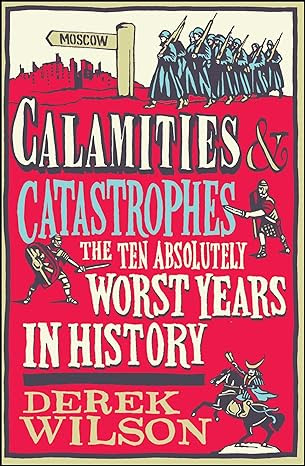
CALAMITIES and CATASTROPHES: THE TEN ABSOLUTELY WORST YEARS in HISTORY by Derek Wilson


Published in 2015 by Marble Arch Press

Going into this book, I knew that I would have a bone to pick with almost every one of the author's choices. After all, there are 5,000 years of recorded history and every last one of them is filled with tragedy. How can you pick and choose the actual worst 10 years?

Wilson, a British historian, focuses in this book on a Western point of view and the earliest date is 541 A.D. So, if you are making a pitch for the 10 worst years in the West in the last 1500 years, his choices are pretty solid.

The years he picks are:

541-542: The first outbreak of the Bubonic Plague weakens the nascent Byzantine Empire and the Persian Empire, killing millions.


1241-1242: The Mongols invade Eastern Europe.

1572: The Spanish Inquisition and everything that came with it.

1631-1632: The worst year of the Thirty Years War.

1709: The Great Freeze

1848: The "Year of Revolutions" in Europe

1865-1866: The assassination of Abraham Lincoln and the failure of the United States to follow through properly with Reconstruction after the Civil War. Also, the rise of terror groups like the KKK.

1942-1943: He almost exclusively focuses on the Russian front - the bloodbaths around Leningrad, Moscow and Stalingrad.


Robert F. Kennedy, Sr. (1925-1968)
1968: The Vietnam War, the assassinations of Martin Luther King and Robert Kennedy, protests around the world.

1994: The Rwandan genocide. There is a lot of focus on how and why the Western powers just watched it happen.

Sometimes, Wilson has a nice turn of phrase in his writing. I especially liked this line from page 151: "Over the centuries, whatever game Europe's nations played, the weakest hand always seemed to be dealt to Poland."

But, there were lots of typos, a weird use of texting-style writing on page 122 and several errors with commas that made me have to re-read passages just to figure out if what Wilson had written was what he really meant to say. Other times, there are factual errors (that may have been editing errors - as I just noted, editing was a real issue in this book). The most egregious error was actually a double error in the same paragraph on page 227. Wilson notes:

 "By the end of 1967 the war had cost the lives of almost 16,000 combat troops and was gobbling up more than $2-3 million per month. What made matters worse was that America's youth had no way of avoiding military service because conscription (the 'draft') still existed."

First: a quick internet search says the Department of Defense spend $168 billion between 1965 and 1972 on military operations in Vietnam. I am sure he meant to say $2-3 billion, not million.

Secondly, there were ways to avoid the draft. Let's look at three recent American presidents. Bill Clinton chose the most popular way to avoid the draft - he went to college. It was no guarantee, but it was a good bet. Many universities grew during the Vietnam War due to increased demand. George W. Bush joined the Air National Guard. Also, it was no guarantee not be sent to Vietnam, but it was not likely. Donald Trump claimed disability (bone spurs in his feet).

I rate this book 3 stars out of 5. The limited focus on the West while claiming to be about all of history was a disappointment. The atrocious editing was also a concern.

This book can be found on Amazon.com here: CALAMITIES and CATASTROPHES: THE TEN ABSOLUTELY WORST YEARS in HISTORY by Derek Wilson.

Featured Post

<b><i>BAN THIS BOOK (audiobook)</i></b> by Alan Gratz

Published in 2017 by Blackstone Audio, Inc. Read by Bahni Turpin. Duration: 5 hours, 17 minutes. Unabridged. My Synopsis Ban This Book is t...

Popular posts over the last 7 days