Showing posts with label Hoosier Author. Show all posts

JAILBIRD by Kurt Vonnegut


Originally published in 1979.


Synopsis

Jailbird is the fictional story of William F. Starbuck, the least important member of the Watergate conspiracy to go to prison. 

The story begins with the day that Starbuck is released from a makeshift federal prison (and very cushy, for a prison) on a Georgia military base. He has no idea what he is going to do and he doesn't have a lot of money, but he figures that he will be okay - after all, he has a degree from Harvard and he learned how to be a bartender in a correspondence class while he was in prison.

What follows is a wild tale of good and bad coincidences that take Starbuck to a broken-down residential motel in New York City. Like the hotel, Starbuck is a broken man in many ways - he is an ex-con, his wife of many years has passed away, he never speaks to his son, and he feels shame for accidentally ruining the career of one of his friends due to an offhand comment he made during a anti-Communist Congressional hearing lead by then-Congressman Richard Nixon.

But, in just a few hours everything changes...

My Review

In many ways Jailbird is considered to be a comeback novel for Vonnegut (1922-2007). After the overwhelming success of Slaughter-House 5, Vonnegut struggled to "do it again."

He struggled to write Breakfast of Champions. His next book, Slapstick, was too personal and too weird to be a bestseller. Jailbird reminds me more of Mother Night and God Bless You, Mr. Rosewater than the three science fiction books that he published from 1969 to 1976.

World War II looms large in each of those books - the main characters are struggling to deal with what they saw and did (also a massive theme in Slaughter-House 5)

William F. Starbuck worked as a part of the prosecution team during the Nuremberg Trials. If it hadn't been for the war, he wouldn't have met his wife. The war made him, and everything about it was accidental - he met his wife on by sheer luck. He was assigned to the the trials because he happened to be around and ht happened to be around because of the education he was given by an old millionaire who was a recluse because someone unknown strikebreaker mistakenly pulled the trigger during a tense moment in a strike when the millionaire was a child.

One unrelated thing leads to another and leads to another like a thread of random events that led us to where we are now. Vonnegut spent a lot of time thinking about this idea. In his science fiction books he often explores it through time travel. This book relies heavily on flashbacks.
Vonnegut's report card for his own books.

Jailbird often looks at the plight of the regular working stiff - restaurant managers, chauffeurs, receptionists, the least important guy in the Nixon Administration, down and out authors, affable guards in a minimum security prison, and so on. There is a lengthy introduction about a real-life event in Vonnegut's life that blends into a fictional story about a strike at an Ohio factory that ended in a bloody massacre.

Vonnegut famously graded his own books in the essay collection Palm Sunday. He gave Jailbird an A. I disagree a bit. I rate it 4 stars out of 5, which I would consider to be a B.

Jailbird can be found on Amazon.com here: Jailbird by Kurt Vonnegut.

SLAUGHTERHOUSE-FIVE by Kurt Vonnegut

The first edition cover


Published with the alternate title "The Children's Crusade: A Duty Dance with Death."
Originally published in 1969.

Listed in Time Magazine's 100 Best Novels Since 1923.


Slaughterhouse-Five is the most famous, most celebrated, and most controversial novel of Kurt Vonnegut (1922-2007.) 

My synopsis:

The book serves as a memoir to Vonnegut's horrific experiences as a prisoner of war in World War II and as a sci-fi exploration of the concept of time travel. 

Vonnegut's very green unit was rotated to the front in December of 1944 in order to give experienced combat troops a break. The weather was bad, the terrain was bad, and the Germans had been retreating regularly. It was presumed that the Germans would be content to settle in to winter quarters, rest, refit, and pick up the fighting in 1945. 

Instead, the Germans launched a surprise offensive and what followed was the Battle of the Bulge. Lots of Americans were captured and taken back to Germany to be prisoners of war, including Kurt Vonnegut. Eventually, Vonnegut was taken to Dresden to work. The main character of this novel, Billy Pilgrim, was also captured and eventually taken to Dresden.

At Dresden, in February of 1945, Billy Pilgrim and Vonnegut were firebombed along with the rest of the city. The prisoners of war survived because they were being housed in partially underground slaughterhouse for hogs (the hogs had long ago been consumed.) They were in slaughterhouse number 5. 

Where Pilgrim and Vonnegut's stories separate is the sci-fi portion. At the beginning of the book we are told that "Billy Pilgrim has come unstuck in time." 

Pilgrim is sliding back in forth in time along his own timeline. He can do nothing to change events, he just keeps sliding back and forth. 

My review:

Vonnegut graded his own books in his book
Palm Sunday. I agree with his assessment of 
Slaughterhouse-Five.
This is the second time I've read this book. This time around I really paid attention to the non-science fiction parts of the book and looked for the connections to Vonnegut's own life. Chapter One practically screams for the reader to do so, but I did not the first time around.

This time, I could really see that Vonnegut was working through his wartime experiences through the story of Billy Pilgrim and his own story as the narrator. 

I was struck by the passage describing the condition of the American prisoners of war as their overloaded train car waited on the tracks for a turn on the tracks:

"Even though Billy's train wasn't moving, its boxcars were kept locked tight. Nobody was to get off until its final destination. To the guards who walked up and down outside, each car became a single organism which ate and drank and excreted through its ventilators. It talked or sometimes yelled through its ventilators, too. In went water and loaves of black-bread and sausage and cheese, and out came shit and piss and language.

Human beings in there were excreting into steel helmets which were passed to the people at the ventilators, who dumped them. Billy was a dumper. The human beings also passed canteens, which guards would fill with water. When food came in, the human beings were quiet and trusting and beautiful. They shared."

Vonnegut in 1965.
What struck me was that there in the middle of the most destructive war in human history, enemies were taking care of their enemies like decent people. Later in his career Vonnegut would make the same point with this comment in his book A Man Without a Country"A saint is a person who behaves decently in a shocking indecent country."

Vonnegut's trademark humor and clever new ways of saying the same old things abound in this book. Here is his commentary on a female character: "She was a dull person, but a sensational invitation to make babies. Men looked at her and wanted to fill her up with babies right away."

And there it is in a nutshell. This is Vonnegut's masterpiece. It is profoundly sad. It is funny. It is a memoir. It is sci-fi. And so it goes.

I rate this book 5 stars out of 5. It can be found on Amazon.com here: Slaughterhouse-Five by Kurt Vonnegut

Note: This book has been challenged multiple times over the last 50 years for sexual content, foul language and teaching principles contrary to the Bible. Amazingly, it has stayed on "banned books" lists for more than 50 years. At one point, it was referred to a prosecutor to see if the school was distributing pornography to students. The prosecutor said that it was "not in violation of criminal laws." See this site for more information.

Note: This book was put on book ban lists in Tennessee in multiple counties in 2025. The article has a searchable database because the list has more than 1,100 unique titles

To its credit, the Vonnegut Museum in Indianapolis has a history of sending free copies of Slaughterhouse-Five to students at schools where the book has been banned.

GOD BLESS YOU, MR. ROSEWATER by Kurt Vonnegut


Originally published in 1965.

After a steady stream of science fiction books, Kurt Vonnegut delivers a straight out social commentary with God Bless You, Mr. Rosewater

Synopsis:

Eliot Rosewater is the heir to a family fortune built on selling munitions in the Civil War and every war after that. The family fortune was built in Indiana but the family has moved to Providence, Rhode Island where it has a family mansion along with all of the others along the waterfront. His father is one of the senators from Rhode Island.

The Rosewater family avoids paying income taxes on this vast fortune by funding the Rosewater Foundation. Generally speaking, the foundation has been a legal way to not pay taxes and instead pay Eliot a whole lot of money to do nothing but supervise a foundation that does next to nothing.

A mural of Vonnegut in his
hometown - Indianapolis.
Photo by DWD
Eliot is suffering from PTSD (called "combat fatigue" in this book) from his experiences in World War II and drowns in troubles in bottle after bottle of alcohol. His only interests are science fiction and volunteer fire departments. He often gets black out drunk and comes back to his senses in a new town. He checks out the nearest volunteer fire department and sees if they have any new techniques or if they need any new equipment. Either way, he gives them something with foundation money.

Eliot is convinced to settle down in Rosewater County in southern Indiana. This is where his ancestors came from. He moves the foundation headquarters to Rosewater, Indiana and becomes the de facto caretaker of the people in this small town. People come to him with their problems and he listens. Sometimes, they need a little money to get over a rough patch or to help with a medical expense. It's all tedious, but the town needs him - even if it is to be someone to yell and scream at. 

The problem is, a lawyer at the law firm that handles the foundation business has found a different Rosewater from another branch of the family. The lawyer thinks he can remove Eliot as the head due to insanity. He will replace him with this other Rosewater and then make a fortune by representing him...

My review:

Vonnegut's report card
I am reading the Vonnegut novels in order of publication. This one is my favorite so far. Eliot is both a great man and a terrific loser. In a way, he is an imitation of Jesus and in a way he's a pathetic drunk that reads too much science fiction. This book is also the introduction to Vonnegut's literary alter-ego, Kilgore Trout.

Vonnegut famously graded his own books in the essay collection Palm Sunday. He gave God Bless You, Mr. Rosewater an A and I agree. 

I rate this book 5 stars out of 5. It can be found on Amazon.com here: God Bless You, Mr. Rosewater.

YEARS THAT CHANGED HISTORY: 1215 (The Great Courses)(audiobook) by Dorsey Armstrong


Published in 2019 by The Great Courses.
Lectures by Dorsey Armstrong.
Duration: 12 hours, 29 minutes.
Unabridged.


The Great Courses offers a lecture series by college professors that the average person can listen to on their own time. 

In this case, Purdue University history professor Dorsey Armstrong is focusing on the year 1215 as a pivotal year. 

1215 is well-known to Americans as the year of the Magna Carta, but it is also the year of the Fourth Lateran Council of the Catholic Church. The rest of the lecture series is about general things that were going on around 1215. These include the crusades, a brief look at the Americas, a look at the Islamic world, Japan, and an extended look at Genghis Khan and the Mongol Empire.

This is a lecture series that could have used a bit of editing. If two hours were removed, that would have been good. Three hours would have been great. This was especially true in the section about Genghis Khan. Armstrong admitted that she was excited about this topic and she really just laid on the details - way too many details for even this history teacher. It just got bogged down in the early details of his life and scooted through the height of the Mongol Empire and its eventual collapse.

I rate this audiobook 3 stars out of 5. I don't really blame Armstrong for this - this series tends to like 20+ half hour lectures and I don't think this was a rich enough vein of information for her to mine.

This audiobook can be found on Amazon.com here: YEARS THAT CHANGED HISTORY: 1215 (The Great Courses) by Dorsey Armstrong.

PALM SUNDAY: AN AUTOBIOGRAPHICAL COLLAGE by Kurt Vonnegut


Published in 1981 by Delacorte Press.

Kurt Vonnegut offers this collection (he calls is a "collage") of fiction, non-fiction, interviews, and even a musical based on Dr. Jekyll and Mr. Hyde. 

As is the case with all collections, some parts of the collection are excellent and some parts are not very good. I believe that he first half of the collection is the best, mostly because of the inclusion of a history of the Vonnegut family in Indianapolis. Ironically, it was not written by Vonnegut, but by a family member who had married into the Vonnegut family. 

Indianapolis is my adopted hometown and this Vonnegut family history reads like a history of the city from the mid-1800s to the mid-1900s. I found it fascinating reading, especially the story of the subscription brothel gentlemen's club that was frequented by the city's elite in an area that still has political "clubs" with fancy dining and smoking rooms more than 100 years later. It would be tacky to pay a prostitute, but paying club dues that were used to maintain the club and also to pay the prostitutes - well that's not tacky at all!

The musical based on Jekyll and Hyde written in 1978 was completely horrible.

Vonnegut is well-known for having written a report card of his published books - this is the book that features that report card. Oftentimes, I disagree with his self-assessment - but not this time. He gives this book a "C" (yes, he graded the book as he was writing/collecting all of the parts of it) and I agree.

I rate this book 3 stars out of 5. It can be found on Amazon.com here: PALM SUNDAY: AN AUTOBIOGRAPHICAL COLLAGE by Kurt Vonnegut.


MOTHER NIGHT by Kurt Vonnegut


Originally published in 1962
Mother Night is one of Kurt Vonnegut's (1922-2007) early novels (his third) and the first that is not a work of science fiction. 

The book features Howard W. Campbell, a defendant awaiting trial in Israel for war crimes in Israel. He is wanted for being a well-known voice for the Nazis on broadcasts that he made during World War II. 

Campbell freely admits that he did what they say he did, but he does have a defense - he was working as a double agent for the Americans and was passing secret messages during those broadcasts. 

The book sets itself up to be a legal thriller - will the hero of the book be saved? Can he prove what he says is true?

But, there's none of that in this book. Campbell probably would have been the voice of the Nazis in the broadcasts no matter if he was recruited as a spy or not? He is just a self-absorbed author of plays that was way more concerned about bedding his German wife than politics or any "trivial" things like a World War or the mass murder of millions of people. 

Most of the book is about the last few months of Campbell's life and how he was found hiding in plain sight in New York City where he had been living in a tiny apartment. We get to meet a cast of freaks and creeps that loathe or worship Campbell for his part in the war while Vonnegut demonstrates that patriotism, duty, and racism/race loyalty are all illusory constructs at best. 

Self-portrait by the author
The book starts out with these themes by having Campbell introduce his prison guards. One of them is too young to really remember the war, one doesn't care and one worked in a death camp - he helped lead his fellow Jews to the gas chambers by telling them it was just a de-lousing. Then, he would help loot their bodies and bury them. He did this to save his own life - but he still gets to guard a man who literally didn't do anything to hurt anyone in the war except talk.

Vonnegut revels in pointing out that life is contradictory and complicated and no one is who they act like they are.

Good quotes:

"We are what we pretend to be, so we must be careful what we pretend to be." 

"Say what you will about the sweet miracle of unquestioning faith, I consider a capacity for it terrifying and absolutely vile."


I rate this audiobook 5 stars out of 5. It can be found on Amazon.com here: MOTHER NIGHT by Kurt Vonnegut.

TAKING AMERICA BACK for GOD: CHRISTIAN NATIONALISM in the UNITED STATES (audiobook) by Andrew L. Whitehead and Samuel L. Perry


Published by Tantor Audio in 2020.
Read by Tom Parks.
Duration: 6 hours, 44 minutes.
Unabridged.


Whitehead and Perry are the first sociologists who set out to do an in-depth study of Christian Nationalism and Christian Nationalists. Whitehead (Indiana University-Purdue University in Indianapolis) and Perry (University of Oklahoma) both hail from states where Christian Nationalism plays a strong role in the political and cultural realms.

First, you need a working definition of Christian Nationalism. Whitehead describes it as:  
"a cultural framework that is all about trying to advocate for a fusion between Christianity — as they define it — and American civic life." I also like this description by a completely unrelated person, Rev. Skye Jethani
"Christians participating in politics or influencing society with their values is NOT Christian Nationalism. Christians believing they have a God-given right to dominate the government & society by excluding & diminishing the value of their non-Christian neighbors IS Christian Nationalism." Whitehead and Perry piggybacked 6 statements into a periodic national survey on religion that Baylor University has conducted for years. Participants ranked their agreement with the statements and were given a total score. The higher the score, the higher the correlation with Christian Nationalism. Here are the statements
  1. The federal government should declare the United States a Christian Nation.
  2. The federal government should advocate Christian values.
  3. The federal government should enforce strict separation of church and state. 
  4. The federal government should allow the display of religious symbols in public spaces.
  5. The success of the United States is part of God’s plan.
  6. The federal government should allow prayer in public schools.
The results tell us that a little over half of the country (51.9%) is Christian Nationalist or sympathetic. 48.1% of the country is very opposed or supportive of opposition to Christian Nationalism. Once again, the country is very deeply split. 

Regional differences are strong here. Unsurprisingly, the South is the stronghold of Christian Nationalism. Also, it is no surprise that the Northeast is the stronghold of its opposition.

One of the more interesting facts to come from their study is that the long perceived truth that White Evangelical Christian is just another way of saying Christian Nationalist is incorrect. Although there is a strong correlation between the two, there are White Evangelical Christians represented in all four group identified in strong numbers. For example, the reverend that I quoted above with his definition of Christian Nationalism is an Evangelical Christian, but he is certainly no Christian Nationalist. 

The book starts and ends with detailed explanations of how the data was compiled. It's not particularly invigorating listening in an audiobook, but it does demonstrate that the authors used tried and true methods to gather solid data. 

The discussion of the results in the middle was particularly riveting to me, though. It turns out that I must be what they identify as a "rejector" of Christian Nationalism based on how I reacted to what I think is Christian Nationalism's perversion of the ideals and basic tenets of both my faith and the ideals of my country. As they went through comments from individuals that they gleaned from the surveys I often felt sick to my stomach and sometimes felt like crying. I would love to provide examples, but as I already noted, I listened to the audiobook and it is hard to take notes while driving or walking the dog.

I rated this audiobook 4 stars out of 5 only because all of the parts of the book actually tell you that this is reliable information makes for a slow listen and is likely to drive away listeners who have not taken a sociology class or studied how good polls are made (hint: most polls you run across on social media are very bad polls.)

I rate this audiobook 4 stars out of 5. It can be found on Amazon.com here: TAKING AMERICA BACK for GOD: CHRISTIAN NATIONALISM in the UNITED STATES by Andrew L. Whitehead and Samuel L. Perry.
 

YOU SHOULD SEE ME in a CROWN (audiobook) by Leah Johnson


Published in 2020 by Scholastic Audio.

Read by Alaska Jackson.
Duration: 7 hours, 18 minutes.
Unabridged.


Synopsis:

High School senior Liz Lighty is depending on a $10,000 music scholarship to be able to afford to attend the college she has always wanted to go to.  When she discovers that she doesn't get the scholarship, she's afraid her grandparents will sell their house to pay for her college.

Her high school offers a $10,000 scholarship for the winner of the Prom Queen competition. Enthusiastic band member Liz, supported by her outsider group of friends, joins the competition against all cheerleaders, legacies, and the beautiful people...

My Review:

In a lot of ways, You Should See Me In a Crown is a typical high school ugly duckling story - the underdog great kid goes up against the popular clique.

But, there are some additional nuances that make this more interesting. 

The book is set in the Indianapolis area (Indianapolis is my adopted hometown) and the high school in the book (Campbell) is a play on the real Indianapolis suburb named Carmel. Carmel and its neighbors have had multiple incidents with race, inclusion, book bans, and the like. Remember the Moms for Liberty parent group that published a newsletter with the Adolph Hitler quote? This is that place.

This matters in this book because Liz Lighty is African American and lesbian, like the author. Those two facts, especially the second one, are a big deal.

The Indianapolis Arts Garden, the site of 
the prom in this book.
Readers from the Indianapolis area will appreciate the mentions of local landmarks like Mass Ave, Rick's Café and Boatyard, and the Arts Garden.

The book is interesting because of the issues of race and sexuality, but it is a very good book because Leah Johnson is a very good author. Her characters look like they are the standard high school kids from a teen movie or TV show, but she breathes life in them and makes them stand out. Her descriptions of those first few exciting, confusing and embarrassing days of falling in love ring true and were fun to listen to in this audiobook.

I rate this audiobook 5 stars out of 5. This book can be found on Amazon.com here: YOU SHOULD SEE ME in a CROWN (audiobook) by Leah Johnson.

Note: In 2022, the Oklahoma Attorney General announced he was going to review a list of more than 50 books that "several concerned individuals" had submitted top his office rather than going through their local school boards. His office decided to determine if the books were "obscene." Later, he dropped his investigation, but not the recommendation that local school boards take these complaints seriously. Although most of the books on this list have an LGBTQ+ theme, it is a wide-ranging list, including classics like Of Mice and Men, Brave New World, and Lord of the Flies. There is nothing "obscene" in this book. There are no sexual acts beyond a few kisses.

This book 
was also put on a book ban list in Tennessee. The article has a searchable database because the list has more than 1,100 unique titles.
 

FIGHTER PILOT: THE WORLD WAR II CAREER of ALEX VRACIU by Roy E. Boomhower


Published in 2010 by Indiana Historical Society Press.

Alex Vraciu (1918-2015) was a World War II flying ace, ranking fourth in the U.S. Navy in World War II. He destroyed 19 Japanese planes in the air and 21 on the ground. 

This short book is very approachable and tells the story of Vraciu's childhood during the Great Depression in Northwest Indiana (now commonly known as "The Region") and his college years at DePauw University in Greencastle, Indiana. 

Vraciu took advantage of a U.S. government program that trained civilians to be pilots with the understanding that if the U.S. went to war those pilots would become military pilots. He trained in Muncie, Indiana and immediately joined the U.S. Navy after the Japanese attack on Pearl Harbor on December 7, 1941.

Vraciu had a remarkable military career over the next 23 years. Besides destroying 40 Japanese planes, he lost multiple planes, including being shot down over the Philippines and leading a group of guerrilla fighters against the Japanese, he became a test pilot, he led squadrons after they navy transitioned to jets and scored the highest in the predecessor to the Navy's "Top Gun" training program in a jet 12 years after the end of World War II. 

The book is very readable and full of interesting photographs. It would be good for a well-read student of World War II or an interested newbie. I rate it 5 stars out of 5. It can be found on Amazon.com here: FIGHTER PILOT: THE WORLD WAR II CAREER of ALEX VRACIU by Roy E. Boomhower.

AN ABUNDANCE of KATHERINES (audiobook) by John Green


Colin Singleton is a child prodigy who has recently stopped being a child. He has graduated from high school, is preparing to go to a great college but he is unsettled by a couple of things.

Number one: being a child prodigy means that you are potentially an important adult. Colin is aware that it is now time for potential to turn into something - anything - meaningful.

Number two: Colin just got dumped - again. He has dated 19 different girls and all are named Katherine. Technically it is 18 different girls because Katherine 1 is also Katherine 19, but the point is pretty much the same.

So, Colin is wallowing in self-pity when his best friend, a slacker named Hassan, comes to him and suggests that they need to go on a road trip. They head south through Indiana and eventually end up in Gutshot, Tennessee where Colin meets a girl named Lindsey who has only dated a boy named Colin...

My Review:

Despite the 3 star review, I thought this book has several good quotes.
This is a fair to middling audiobook. For the first half of the audiobook, I would have rated it 2 stars out of 5. I kept on listening because I am a fan of John Green (both his books and him generally) and he and I have both adopted the same city as our hometown. 

As the book went on, I bumped it up to a weak 3 stars because it did get better. By the way, I am very aware of the irony of reviewing a John Green book on a 5 star scale considering how much that Green hates assigning stars to things in reviews (check out his excellent collection of essays The Anthropocene Reviewed for more info.)

Part of the problem with this book was the reader Jeff Woodman. He has a perfectly pleasant reading voice and is very clear but - whatever "it" is, he didn't have "it" in my opinion. By the way, this is the reason that Green hates the 5 star system - I am rating the reader based on something that I can't define. We all do this, though. You hear two different bands play the same song and one has "it" and one clearly doesn't. In this case, I may very well have liked the book a little better with a different reader.

My other complaint about this book is Colin's insistence on trying to create a mathematical formula to figure out who is going to dump who in a relationship. I get that only a kid would try to do such a thing, but there were so many tedious scenes describing the development of the formula and discussions of the formula that I got sick of hearing about it. At one point, I thought that Colin had accidentally shot the notebook with the formula with a shotgun and I was so happy to be done with it all. I think it was a convenient thing for Green to use to occupy Colin's time - a sponge to suck up his time while other things were going on. Character A does this, Character B does that and Colin goes into the other room and works on his formula for 3 hours. 

So, while not a bad book, certainly not a great book. So far, I've read 5 of his books. 3 have 5 stars and 2 have 3 stars. That's a pretty good track record.

Update  - in November of 2023 it was announced that the  group Moms for Liberty challenged 300+ books in Florida. This book is one of them. See the entire list of books that the Moms want banished here.

I rate this audiobook 3 stars out of 5. It can be found on Amazon.com here: AN ABUNDANCE of KATHERINES by John Green.

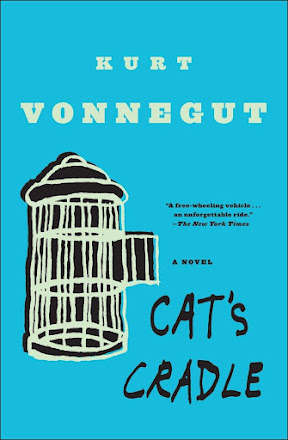
CAT'S CRADLE by Kurt Vonnegut


Originally published in 1963.

Synopsis:

Cat's Cradle
is Kurt Vonnegut's fourth novel. The narrator is a writer who wants to tell the story of the first atomic bombing by telling what various people did that day. One of the people he is interested in is one of the creators of the bomb, a researcher named Felix Hoennikker. 

Hoennikker has already passed away so the author reaches out to his three children and finds two of them. They describe a man with no real emotions. He is not a cruel man, he is utterly detached from everything except research. 

During his interviews with a colleagues at the laboratory he worked at in Ilium, New York (also the setting for his first novel Player Piano, but these books are clearly not in the same time line) the narrator discovers that Hoennikker may have invented a more dangerous weapon than the atomic bomb - a substance called "ice-nine."

Ice-nine was created as a simple thought experiment that came from an offhand comment from a general who had complained about how the U.S. Army kept getting bogged down in the mud. Ice-nine solidifies all of the water it contacts - freezes it at room temperature. And, it keeps spreading. Ice-nine creates more ice-nine as it freezes. Theoretically, if someone dropped it into a body of water it would just keep on going until it runs out of water to freeze. If you dropped it into a river it would just keep going until it got to an ocean and then keep going around the world.

That's when the narrator figures out that each of the three children possesses a chunk of ice-nine and one of them who was missing has just become the head of the military of a very backward third world country in the Caribbean...

My Review: 

Kurt Vonnegut (1922-2007)
This book, unlike the previously mentioned Player Piano, has the complete feel of a Vonnegut novel. There is a lot of dark humor that is barely trying to hide Vonnegut's commentary about the insanity of the Cold War and the concept of Mutual Assured Destruction. It fits in nicely with the 1964 movie Doctor Strangelove.

I found the first part of the book to be fairly slow and tedious (the part described in my synopsis), but the second half zips along pretty well and gets better and better as it gets more ridiculous, including the creation of an original religion.

Vonnegut has a habit of mentioning his native Indiana and/or Indianapolis in his books and this book features plenty of those mentions. 

At one point, Vonnegut gave all of his books a letter grade. He gave Cat's Cradle an A+. I think it was good, but not that good. I will give it a B.

I rate this book 4 out of 5 stars. It can be found on Amazon.com here: CAT'S CRADLE by Kurt Vonnegut.

PLAYER PIANO by Kurt Vonnegut


Originally published in 1952.

Synopsis:

Paul Proteus is the director of the Ilium Works in New York State in an alternate timeline to our current one. It is roughly the 1950's after yet another World War. 

That war taught the engineers to trust mechanization and the government to continue the central planning model that won the war (a more extreme model of the system the real United States used during World War II.)

In the Ilium works there are multiple factory buildings full of machines, but there are no people because the whole thing is automated. Proteus and the other engineers replaced all of the people with machines in the name of efficiency. Even the best human workers make mistakes or get an illness and miss work or, eventually, die. 

The machines don't have that problem. They work and work and work until the day they are replaced with even faster machines.

Kurt Vonnegut (1922-2007)
in 1952
This is the source of the title, Player Piano. A player piano plays itself thanks to a roll that is inserted. In the town across the river from Ilium Works, there is a player piano in the bar where all of the unemployed factory workers drink their days away.

The major theme of the book is that it is not good for humans to have no work, no skills to master and no sense that they have put in a good day's work, even if it is more efficient for machines to do it all.

And...Paul Proteus is starting to come around to that way of thinking.

My Review:

This is Vonnegut's first novel. It follows a more normal narrative form than his later, more famous novels. It's too long. It has too many characters. I has too many side plots that don't really go anywhere.

But, it is amazingly prophetic. Vonnegut was working in the public relations department of General Electric when he wrote this novel. He was constantly being exposed to miraculous "labor-saving" devices and his imagination took him to a world where so much labor has been saved with labor-saving devices that there is practically nothing for anyone to do anymore because a person with nothing to do has no reason to be here at all.

Just look at all of the jobs that have been replaced by technology - Line workers in factories, print setters, cashiers, most farm labor and on and on and on. Everyone thinks all of the jobs have gone oversees, but 85% of them have actually been lost to technology. So it goes.

The book gets better as it goes along and has a bittersweet ending.  

I rate this book 4 stars out of 5. It can be found on Amazon.com here: Player Piano by Kurt Vonnegut.

SUCKER'S PORTFOLIO (kindle) by Kurt Vonnegut


Published in 2012 by Amazon Publishing.

Amazon collected 6 short stories, 1 essay and 1 unfinished sci-fi story and added yet another collection to the Vonnegut library.

Kurt Vonnegut (1922-2007) started writing during the Golden Age of sci-fi, when magazines were filling their pages with short stories. Some of these are sci-fi, some are just little human stories. 

Indianapolis native quoting fellow Hoosier author 
James Whitcomb Riley's poem "Little Orphan Annie"
I particularly enjoyed the first story, called "Between Timid and Timbuktu." It is a "Twilight Zone" type of story that I found satisfying in a gruesome sort of way. I also enjoyed the title story. It actually had a surprise twist that was pretty much out of character for a Vonnegut story. 

The seventh entry is an essay from 1992. Vonnegut was a prodigious writer of essays in the latter half of his career. I generally am more of a fan of his caustic and insightful essays than his fiction and this one did not disappoint. 

But, for me, the eighth entry was the surprise. It was an unfinished dystopian future story set in a small town after a human-robot war. It had a lot of zip to it and I was really intrigued right up to the moment it ended in mid-sentence.

I rate this e-book 4 stars out of 5. It can be found on Amazon.com here: SUCKER'S PORTFOLIO (kindle) by Kurt Vonnegut.

GOD BLESS YOU, DR. KEVORKIAN by Kurt Vonnegut


Originally published in 1999.
Version with Neil Gaiman foreword published in 2010 by Seven Stories Press.

Synopsis:

In the late 1990's Kurt Vonnegut made a series of 90 second recordings for WNYC, the local NPR station for New York City. The premise of each spot was simple enough - Vonnegut travels to the afterlife to conduct a very short interview with someone (some famous, some not) and then he brings word back to the land of the living to tell us the wisdom he has learned.

How does he get to afterlife? Dr. Jack Kevorkian, the creator of the assisted suicide machine works with Vonnegut to render him about 3/4 dead in the very room and on the very bed where the state of Texas administers the death penalty via lethal injection. One of the people he interviews is a murderer who had just been executed - Karla Faye Tucker, although Vonnegut misspells her first name as Carla.

The Vonnegut mural in his hometown
of Indianapolis. Photo by DWD.
Since he is 3/4 dead, Vonnegut is able to travel to the afterlife and is called back away when he is revived. Eventually, St. Peter gets tired of Vonnegut going back and forth and he is told he must wait just outside of the Pearly Gates. 

All of this going back and forth is cut short by the real life arrest of Kevorkian in Michigan in 1998, an event that Vonnegut refers to at the end of the book.

My review:

This short book is not Vonnegut's best work, but it is certainly packed with Vonnegut's famous biting sarcasm. It is an up and down book and it was clearly printed with an eye to making it seem to be a bigger book than it actually is - with extra wide margins, blank pages between chapters and the like. 

I rate this book 3 stars out of 5. It can be found on Amazon.com here: GOD BLESS YOU, DR. KEVORKIAN by Kurt Vonnegut.

DEEP SLEEP (Devin Gray Book 1) (audiobook) by Steven Konkoly


Published in February of 2022 by Brilliance Audio.
Read by Seth Podowitz.
Duration: 10 hours, 18 minutes.
Unabridged.


Synopsis:

Devin Gray is a retired military operator working for a high-end private security contractor. He is on assignment that goes a little sideways in the D.C. metro area and he is sent away to let things cool off.

While packing up to go, he is contacted about his mother. She is estranged from the rest of the family because she is always off researching a conspiracy theory, which is kind of ironic because she works in a government intelligence agency that looks for conspiracies. She is dead after some short of shoot out in Tennessee and everyone is keeping it quiet.

Gray discovers a note from his mother to him with instructions. It turns out to lead to her evidence that proves the conspiracy and he finds it to be plausible enough to reach out to others. Once they start digging, they find more than it is worse than they ever imagined...

My review: 

I was excited about this book. I really enjoyed the first two book of an his unfinished Rogue State series (link to review of the first book here: Fractured State.) That series is full of non-stop and, frankly, ridiculous action - but it is fun and demands your attention.

This book had a complicated conspiracy that you know in your head is simply too complicated to work, but your gut says, "Oh crap! This could really happen!" I had no problem with the premise of the book.

I had problems with the pacing of the book and the proliferation of characters. Konkoly decided to make characters out of some of the bad guys in an effort to confuse the reader at first. It worked and it was kind of a good choice except that he keeps on adding character after character after character and this audiobook reader got confused as to who exactly was who. I just decided to ignore character names and label them "good guy" and "bad guy" in my head. That totally defeated the purpose of creating a named character with lines and a personality, but I couldn't keep up. When one of them goes down in a gun fight, I didn't care a whole lot - I just kept a little running tally in my head to see if any of the good guys were going to survive.

For an action story, this book has an awful lot of sitting around and talking. Sitting around and talking in a restaurant, in a car, in a secret hideout, in another car, in an SUV, in a rented house, in another SUV, in a hotel, in a mansion, in a helicopter, in another hotel.

So many of these conversations were repeats of other conversations. The conspiracy is discovered and then explained to another person. That person explains it to a small group. That group explains and discusses with another group and by that point I felt like I could have stepped in and gave the explanation myself.

So, to sum up - too many characters makes the story hard to follow. Too much repeat conversations stretched the story out for no real reason.

On a pet peeve note: Konkoly is from Indianapolis and lives in Indianapolis. So do I. I was pleased to see part of the book took place in an Indianapolis suburb that he described perfectly (Carmel.) However, the audiobook reader mispronounced it. It is pronounced the way many people mispronounce the candy "caramel." He pronounced it like the California city "Carmel by the Sea." This was not important to the story and people who do not live in Indiana would have no idea but considering that the author lives here...

I rate this audiobook 2 stars out of 5. I will not be moving on to book two in this series. This book can be found on Amazon.com here:  DEEP SLEEP (Devin Gray Book 1) (audiobook) by Steven Konkoly.

SCHOOLED: A NOVEL (kindle) by Ted Fox


E-book published in October of 2022 by Lake Union.

Synopsis:

Jack Parker is a stay-at-home dad - but not really by choice. He used to be a big executive in a growing company, but a series of mishaps one Saturday morning led to him being fired and ending up in a humiliating viral video.

So, he is at home taking care of a toddler and a kindergartner while his wife is moving up the corporate ladder (different corporation, thank goodness.) He is nervous about his kindergartner starting school and is contemplating going back out in the job market because he can see that the need for a full time stay at home dad during the day is coming close to its end.

When he meets his high school bully and nemesis at a local park, he is dismayed. He is more upset to find out that his bully also has a student entering kindergarten at the the same school as his daughter. He decides he has to act when he finds out that the bully is running to be the president of the parent council and is proposing policies that will hurt the poorer families in the school, Jack decides he has to act.

All thoughts of returning to work go out the window because Jack is running for the board and confronting some old nagging ghosts...

My thoughts:

This was an engaging and oftentimes fun novel. Jack is a likable character and the story was interesting, if not always believable.

I did like how the book highlighted the importance of parent involvement in education and the importance of policies that make sure that all families can participate in the school's activities. 

When Ted Fox writes another book I would be interested in reading it.

I rate this e-book 4 stars out of 5. It can be found on Amazon.com here: SCHOOLED: A NOVEL (kindle) by Ted Fox.

Note: Ted Fox is a Hoosier author and this fellow Hoosier likes to recognize authors from the great state of Indiana.

Featured Post

<b><i>BAN THIS BOOK (audiobook)</i></b> by Alan Gratz

Published in 2017 by Blackstone Audio, Inc. Read by Bahni Turpin. Duration: 5 hours, 17 minutes. Unabridged. My Synopsis Ban This Book is t...

Popular posts over the last 7 days