Showing posts with label Iraq. Show all posts

LIFE AFTER POWER: SEVEN PRESIDENTS and THEIR SEARCH for PURPOSE BEYOND the WHITE HOUSE (audiobook) by Jared Cohen


Published by Simon and Schuster Audio in 2024.
Read by Kevin R. Free.
Duration: 14 hours, 4 minutes.
Unabridged.

In Life After Power Presidential historian Jared Cohen looks into the post-Presidential lives of seven Presidents and their quests for some sort of meaning after having one of the most important jobs you can have.

Some Presidents fade away due to health reasons, like Reagan. Others are eager to resume their former lives, like Washington. But, others still feel like they have something more to offer or have unfulfilled goals.

The seven Presidents he looked at are: Thomas Jefferson, John Quincy Adams, Grover Cleveland, William Howard Taft, Herbert Hoover, Jimmy Carter, and George W. Bush.

I have enjoyed hearing about John Quincy Adams' post-Presidential life ever since I first read John F. Kennedy's Profiles in Courage 30+ years ago. I've read more than one book about him and this re-telling is quite good. 

A photo of John Quincy Adams 
taken in 1844.
Jimmy Carter's lengthy post-Presidency is remarkable for how amazingly hard-headed he has been. Carter follows his conscience and lets the political consequences be damned. Cohen notes that Carter did not actually found Habitat for Humanity - he just joined it early on and is easily its most famous and perhaps longest term volunteer.

George W. Bush has done almost the opposite. He lived a very public life for years and has since retreated into more solitary pursuits such as painting. He has said almost nothing about politics in the almost 16 years since he left office.

Each of these men had a different reaction to leaving office. Some left after 2 successful terms, some after experiencing disappointment and 4 of them were defeated after just one term (this is what inspired Cleveland's determination to run again - and win.) I found some to be more interesting than others but, taken a whole, this is a solid set of mini-biographies.

I rate this book 4 stars out of 5. It can be found on Amazon.com here: LIFE AFTER POWER: SEVEN PRESIDENTS and THEIR SEARCH for PURPOSE BEYOND the WHITE HOUSE by Jared Cohen.


DESTINY DISRUPTED: A HISTORY of the WORLD through ISLAMIC EYES (audiobook) by Tamim Ansary


Published in 2009 by Blackstone Audio.
Read by the author, Tamim Ansary
Duration: 17 hours, 28 minutes.
Unabridged.


Tamim Ansary has done something that is very hard to do - he has written a long history of a complicated topic without making it boring and after more than 17 hours of discussion, he left me wishing that it was even longer.

Ansary makes the observation that most histories that people in the West (Western Europe and the Americas) read are written from a Western perspective. That makes sense. But, the history of the world is not just the history of Western Civilization. There are multiple civilizations on the planet. Mesoamerica (the Mayas, Aztecs, Toltecs, etc.) is a separate civilization. China is the historic center of another civilization. So is India. And between the West and India and China is another one. Westerners usually refer to it as the Middle East. This book is a history of that civilization from the beginning of recorded history (empires like Bablyon) to 9/11 and the fallout from that terrorist act.

The strength of this book is that it lets the reader see history from another perspective. For example, the Crusades loom large in European history, but they were mostly an irritant to Muslims of the day since Ghenghis Khan was threatening them from Central Asia at the same time. Compared to Ghenghis Khan, the Crusaders were not an existential threat to their civilization. To make an analogy from American history, the Battle of Lexington and Concord looms large in American history textbooks as "The Short Heard 'Round the World", but most English school children have never heard of it.

The audiobook is read by the author and he does a great job. The book is written in approachable, every day language, literally designed to be an introduction to the history of this civilization. He reminds readers of key concepts throughout, showing how older ways of doing things applied to new situations and were adapted. Ansary's reading is excellent.

I rate this audiobook 5 stars out of 5. I highly recommended this audiobook. It can be found on Amazon.com here: DESTINY DISRUPTED: A HISTORY of the WORLD through ISLAMIC EYES by Tamim Ansary.

NAVY SEAL DOGS: MY TALE of TRAINING CANINES for COMBAT by Mike Ritland


Published in 2013 by St. Martin's Press.

Mike Ritland served as a Navy SEAL, became a trainer of SEALs and eventually moved into training dogs that work with SEALs - the most elite of all service dogs. 

While they look a lot like German Shepherds, Ritland points out that the SEALs usually use Dutch Shepherds or Belgian Malinois - breeds that are lighter, leaner and even more trainable. He describes how they sort out only the most focused dogs and then spend months training them to do things that most dogs would never do - like ride in helicopters, jump out of planes, fight people (but stop on command) and chase down a target through and over everything and be able to sniff out specific odors, like bomb-making materials. 

Ritland's stories of training and combat in Navy Seal Dogs are interesting and sometimes touching, especially the stories of the soldiers bonding with the dogs in their down time (the dogs are supposed to be segregated from the rest of the soldiers, but oftentimes they hang out with them and sleep in their cots - a little bit of normalcy in the middle of a war zone).

The book also includes a "Brief History of Canines in Combat" as an afterward.

I rate this book 4 stars out of 5.

This book can be found on Amazon.com here: NAVY SEAL DOGS: MY TALE of TRAINING CANINES for COMBAT by Mike Ritland.

TAINTED by SUSPICION: THE SECRET DEALS and ELECTORAL CHAOS of DISPUTED PRESIDENTIAL ELECTIONS by Fred Lucas


Published in May of 2016.

The 2016 Presidential election cycle has been wild, to say the least. A rookie politician with an unstoppable mouth and a veteran politician with a long, checkered past are an unlikely pairing. Throw in a couple of strong third party candidates and the fact that these are the two most hated candidates in a generation and you may very well have an election in which no one wins a majority of the votes in the electoral college.

What would happen in no one actually wins, or if it is too close to call?


Aaron Burr (1756-1836)
In Tainted by Suspicion, veteran White House correspondent Fred Lucas gives us some insight as he tells the story of six troubled Presidential elections: 1800, 1824, 1876, 1888, 1960 and 2000.

With each election Lucas describes the political environment of the time, the major players in the election and the reasons why it became a disputed election. He details how it finally worked out and then offers informed speculation as to what would have happened if the other guy had won.

Most of the stories are quite interesting. Even the "what-ifs" are pretty good, with the exception of the "what-if" for Aaron Burr because it just went on for too long. Political junkies will note the definite lean to the right for the discussion of the JFK/Nixon and Bush/Gore elections. It is there, but it is also not inaccurate, in my opinion.

For fans of Presidential politics, this is a must-read. For those that are just curious about what how convoluted American politics can get, this is a worthy introduction.

I rate this book 4 stars out of 5.


This book can be found on Amazon.com here: Tainted by Suspicion.

WYNNE'S WAR by Aaron Gwyn


Published in 2014


Wynne's War is a war story and a western with a bit of A Few Good Men thrown in as well. It starts out in Iraq where Army Ranger Elijah Russell is filmed rescuing a horse during a firefight and becomes a YouTube sensation. Russell and his buddy are taken out of Iraq to a remote base in Afghanistan. Russell is tasked with training horses for a special forces unit to use against Taliban fighters. They want horses because they are quiet compared to any motorized vehicle, can go places where four-wheelers can't and never need to be re-fueled so long as there is available grass.

Russell grew up breaking horses and a great deal of the first third of the book is about Russell thinking about his childhood and detailing his "horse whisperer" style of breaking horses. 


The charismatic leader of this special forces unit, Captain Wynne, is a mystery and so is his real goal with these horses. Russell can't quite figure him out and when he and his buddy are drawn into their first real mission with the horses he just has a feeling that there is more to this mission than meets the eye and that is not good.

I enjoyed the "horse training" part of this book and I admire author Aaron Gwyn's ability to describe a firefight but, on the whole, I felt the book fell short. It left me with a lot more questions than answers and the ending was way too abrupt considering the time and care taken to even get to the heart of the story. I just felt like asking, "Is that it?"

I rate this book 3 stars out of 5.


This book can be found on Amazon.com here: Wynne's War.

INSURGENT: BOOK 2 of AMERICA'S FUTURE by Charles Sheehan-Miles


Published in 2012 by Cincinnatus Press 

Insurgent is a worthy successor to the original book in this series, Republic: A Novel of America's Future. Book One details how a fictional confrontation between the state of West Virginia and the federal government over the proper role of the Department of Homeland Security eventually leads to a very short war in which West Virginia is quickly defeated. 

Book Two deals with post-war relations between the occupying federal government, its troops and the people of West Virginia and the closely monitored civilian government of West Virginia.

The flag of West Virginia
The parallels between this fictional war and the Iraq War and the multi-year struggle to create a stable environment in Iraq once Sadaam Hussein was removed from power are striking and, I am sure, quite intentional. And, since this is a book about Americans in a situation similar to that experienced by the people of Iraq, the Iraqi reactions are made all the more understandable to an American reader. 

Sheehan-Miles switches from the point of view of a small military unit helping to keep a crucial road clear to the civilians who interact with that unit to the officials in the limited civilian government and keeps multiple story lines going, including the origins of a nascent insurgent group with powerful weapons and even stronger religious beliefs who starts taking on the occupying troops with bombs, assassination attempts and threats against those who collaborate. 

It is a compelling read and, like I said about the last book, it is guaranteed to make you think.

It can be purchased here on Amazon.com: Insurgent: Book 2 of America's Future

I rate this book 5 stars out of 5.

THE SAVIOR GENERALS: HOW FIVE GREAT COMMANDERS SAVED WARS THAT WERE LOST - FROM ANCIENT GREECE to IRAQ by Victor Davis Hanson


Published in 2013 by Bloomsbury Press

Victor Davis Hanson, best known for his works on Ancient Greece, looks at five different generals from five different time periods and discusses how these generals became what he calls "Savior Generals". This book is very similar in structure to his 2003 book Ripples of Battle.

Hanson picked five generals to discuss in The Savior Generals: How Five Great Commanders Saved Wars That Were Lost - From Ancient Greece to Iraq.  All are from the West and he notes that this is not an all-inclusive list. They are not even particularly spread out well over history. One is from Ancient Greece, one from the early Byzantine Empire and three of them are American generals. In my opinion, not all of them fit the mold perfectly. In fact, I think only two of them do.

To be a Savior General you have to have been on the outs with the establishment and then, when everything has fallen apart and the situation is about as dire as possible, the establishment command structure looks to you to come in with your unorthodox ways and save the day. You also have to have an odd sense of how people work - a sense that makes you approach the crisis at hand in a different way than everyone else. Once the victory is won, the "Savior General" is removed in some way.

Themistocles (524-459 B.C.)

Hanson starts out with Themistocles, the general turned admiral who almost single-handedly created the Athenian navy in order to prepare for a repeat Persian invasion after the Athenians defeated the Persians at the Battle of Marathon. While most Athenians assumed that the Persians were not going to return after their defeat at Marathon, Themistocles understood the true size and scope of the Persian military and knew that the military losses at Marathon were a drop in the bucket compared to their true potential. When the Persians returned it was with "the largest amphibious invasion of Europe until the 1944 Normandy landing more than 2,400 years later." (p.23)


While the Sparta's famed 300 soldiers and their king slowed the Persian advance  for a few days at Thermopylae, the Athenians fled their city state using the navy that Themistocles had pushed for so hard between invasions. Hanson goes into detail about how Themistocles argued, cajoled, harangued and demagogued this fleet into existence and then repeated his performance all over again with the Greek allied leaders as they tried to figure out if they should even engage the Persians or if they should simply surrender. Luck, skill, sleight of hand, superior knowledge of the waters around Athens all contributed to a victory when defeat seemed so sure.

No general in this book was so far behind the 8 ball as Themistocles. His country (the Athenian city-state) was lost. It had been looted and burned and occupied. Thousands of foot soldiers were lost. For all practical purposes all that was left was the navy. but, Themistocles had prepared his country for exactly this moment and, even they they were heavily outnumbered (366 Greek ships against more than 600 Persian ships), the plan worked. Despite the great victory, Themistocles died in exile.

Belisarius (500-565 A.D.)

By comparison to Themistocles, Belisarius's story is not nearly so dramatic. He mostly fought on the Byzantine frontier - only once was the Empire itself at stake and even then, it probably could have been recovered easily enough if some troops had been recalled. He was a soldier always, rarely dabbling in court politics, unlike Themistocles who was a gifted politician for far longer than he was in actual combat.

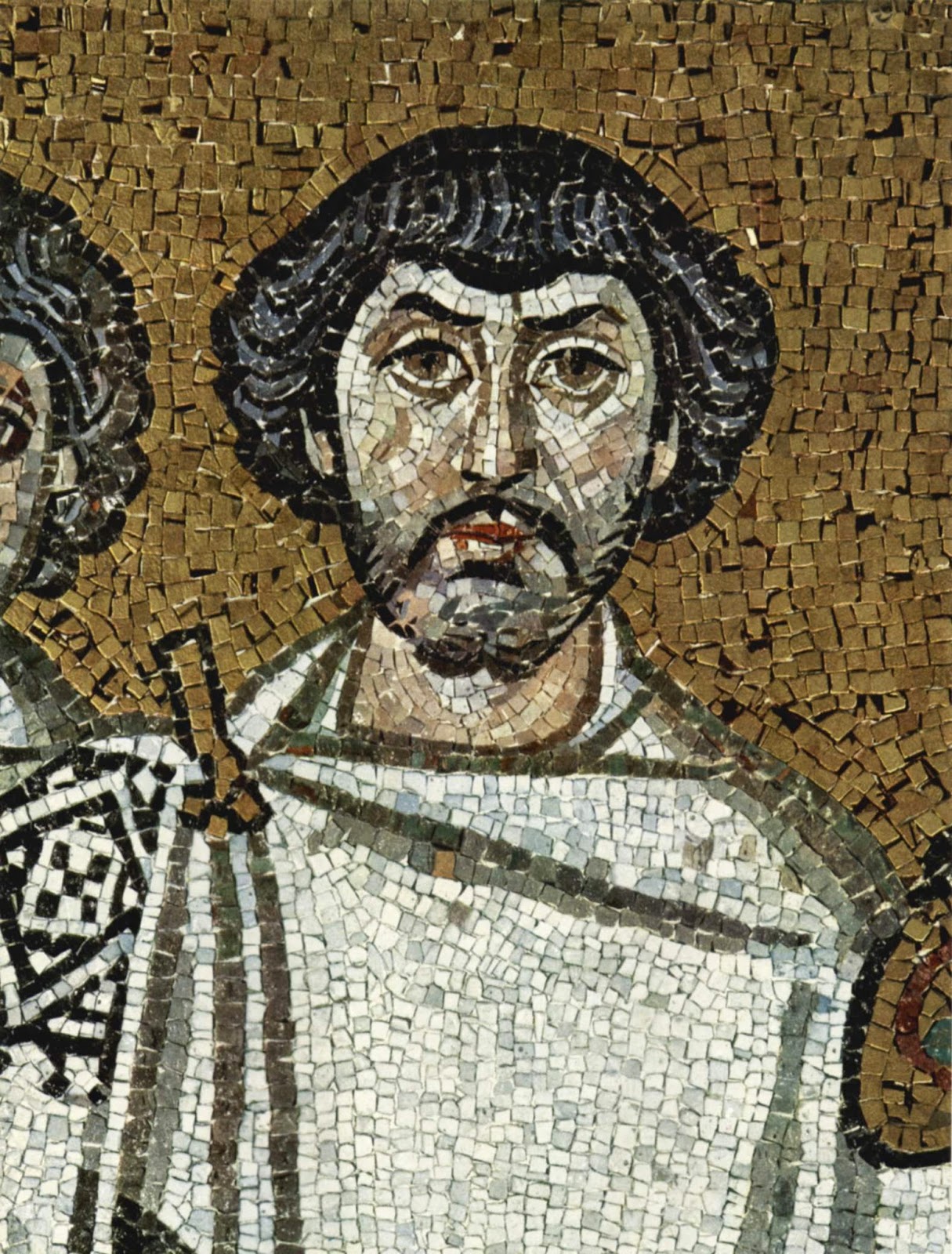
The only known portrait
of Belisarius. 
But, the career of Belisarius is remarkable in that he went from one lost cause to another and made the Byzantine Empire (really the Eastern Roman Empire) grow to the point where it nearly re-captured most of the combined Eastern and Western Roman Empires. His Emperor, the famed Justinian, never quite trusted Belisarius and deprived him of resources, men or clear orders necessary to finish the jobs properly. As I was reading, I found myself wondering if Justinian was a genius in his own right who was depriving a potential rival of the resources he needed to overthrown him, or a twit that was depriving a talented general of the resources he needed to complete his mission. Was he a brazen leader who was expanding his empire with a minimum of resources because that's all that was available or was he timid and just refused to completely commit to a military course of action. I decided that the answer to all of these questions was YES. Yes, he knew Belisarius was a potential rival and he was a twit for depriving him. He wanted to grow the Empire while the opportunity was there but he was all too aware of the risks of sending too many soldiers abroad. 

Despite his years of loyal service and saving the Emperor from a revolt and an attempted invasion of his capital, Belisarius was forcibly retired and brought back to the capital so the Emperor and his spies could keep an eye on him. 

William Tecumseh Sherman (1820-1891)

In a way, the story of Sherman is the story of two Savior Generals. Sherman fought in the first major battle of the American Civil War and even earned an important command and then had a nervous breakdown. Up-and-coming general Ulysses S. Grant discovered Sherman and brought him along with him. When Grant earned promotions, Sherman did, too. 

When Grant was promoted to be the head of the Union Army and headed to Washington, D.C. to confront Robert E. Lee, Sherman took over Grant's forces in the West and began to move on Atlanta.This is where Sherman does the atypical thing. Rather than seeking battle or blindly making a dash for the city, Sherman tries to outmaneuver his opponent in order to take the city with a minimum of losses.

Grant struggled with Lee and offered a demoralizing series of battles with massive casualties as Grant and Lee's armies grappled all over northern Virginia, rarely separating more than a few days before re-engaging and generating thousands of more Union casualties. 

Most historians believe that Lincoln's re-election was far from assured in 1864 and that Sherman's taking of Atlanta right before the election certainly helped. This is the crux of Hanson's argument for Sherman being a Savior General. Sherman helped ensure the re-election of Lincoln and Lincoln's re-election helped ensure the defeat of the Confederacy. 
1864 Portrait of Sherman
by Matthew Brady
.

On top of that, Hanson argues that Sherman's infamous March to the Sea was a revolution in warfare - a war on the property used to wage war rather than on the people that were fighting in the war. He argues that this revolution was more merciful than what was typical in most Civil War campaigns because it mostly avoided casualties with the focus on property.

Hanson has an amazing grasp of the Civil War for an historian that focuses on Ancient Greece. I enjoyed his analysis of Sherman but was frustrated with his dismissal of Grant as a Savior General as well. Before Grant arrived in the East the call was always, "On to Richmond!" with little concern about the Confederate army in the field except the degree that it kept the Union Army out of the Confederate capital. However, Grant re-focused the army on Lee, knowing that eventually Lee would simply run out of men and supplies. Grant's relentless effort ensured that Sherman would never have to face reinforcing units detached from Lee's army.

Sherman deviates from the mold of Savior General in his post-war career. Unlike most of the generals he profiled, Sherman had a successful post-war career.

Matthew Ridgway (1895-1993)

When Ridgway arrived in what remained of South Korea in December of 1950 the war in Korea had already been lost, won and lost again - in just six months.

Ridgway with his characteristic grenade
on his right strap and a first aid kit on
the left.
Ridgway was unpopular with the brass because he had plenty of opinions and never failed to share them. But, in just 100 days he moved the United Nations forces from a defensive (if not outright retreating) posture to an offensive footing and began pushing the North Korean and Chinese forces back across the pre-war border. 

His style of being with the fighting men and seeing what was really going on rather than being told through intermediaries re-invigorated a largely defeated army. He brought enthusiasm, proper supplies for the winter and an argument as to why this war in this place was important and he shared them all freely with his men. He also recognized the American advantages in this war (superior air power, having occupied Japan nearby as a source of men and supplies among other). He also limited the war aims to simply restoring the pre-war border rather than conquering North Korea. By doing that, he helped make the current truce that has largely held for 60+ years possible. 

Sadly, the Korean War is often referred to as "the forgotten war" and Ridgway's amazing success is often forgotten.

David Patraeus (born 1952)

Perhaps the most controversial Savior General to be added to Hanson's list is David Patraeus. 

This book was written before his disgrace over his mistress/biographer and her access to sensitive documents and information.

No matter his personal failings and his failure in Afghanistan, Patreus had success in Iraq with George W. Bush's unpopular "Surge" from January of 2007 to May of 2008. Hanson details how Patreus had been removed from the Iraq theater earlier and then brought in to implement the Surge strategy that he had been advocating to calm the fighting in the unpopular Iraq War.

This strategy seemed almost counter-intuitive. Embrace the very communities that are attacking the American army. Move among them, become a part of those communities. And, once trust is earned, convince those communities that they should turn on Al-Qaeda and embrace the new government. It cost more lives lost at first because the trust had not yet been earned and the American soldiers were more exposed. 

Reading about the real progress made with the Surge was bittersweet considering the current problems in Iraq with ISIS and all of the beheadings, murder, mayhem and chaos as well as Patreus's fall from grace. 

I rate this collection 4 stars out of 5. 

More information on this book can be found here: The Savior Generals

Reviewed on January 20, 2104.

WHERE MEN WIN GLORY: THE ODYSSEY of PAT TILLMAN by Jon Krakauer


This 2009 edition has been updated to reflect new developments and includes new material obtained through the Freedom of Information Act.

I am torn about this book. 

If you are not familiar with Pat Tillman, in the broadest terms, he was an NFL player who quit the NFL to join the army after the 9/11 attacks.

Where Men Win Glory focuses intently about the war in Afghanistan, the ongoing war (when this review was written in 2014) that has been mostly forgotten and ignored. Krakauer's review of the recent history of Afghanistan makes this book worth reading in and of itself. For most people, the reasons that Al Qaeda used Afghanistan as a base of operations is murky at best. The descriptions of how Tillman's unit operated and where they traveled are very vivid.

Krakauer's 2000 Presidential election spin (the Florida recount - he only tells part of the story and does not mention numerous "recounts" by the media had Bush winning - about as many as had Gore winning) was slanted and one-sided against George W. Bush. In fact, every time he mentions Bush throughout the book it is with disdain. There was no particular reason to mention Bush and the election except that Krakauer was building tension to show the inevitability of the Wars in Iraq and Afghanistan so long as Bush was president and as long as those wars were inevitable, Pat Tillman would die. To me, that seemed to be a long way to go to make a point, if that was his intention. Personally, I think Krakauer just wanted to take the opportunity to give Bush a hard time.

The descriptions of Tillman and his life and career left me cold at best. Krakauer's seemingly endless descriptions of the game-by-game performances of Tillman in his college and professional career and the parade of "Pat was just such a great guy" stories made me tired, not of Tillman himself but of the lazy writing style. This is a biography, but there was no need to include all of the exhaustive details of his entire professional life.
Corporal Patrick Tillman.jpg
Pat Tillman (1976-2004)

Pat Tillman's death due to friendly fire was tragic and Krakauer tells the story of the military patrol that ended with the death of Tillman extraordinarily well. The way that his body was treated afterwards was certainly odd and seemed to be covering up something. Krakauer is critical of the way the military handled the whole affair but has no explanation as to what they may have been covering up. If they were covering up the fact that he died due to friendly fire, that was foolish. There has been a steady rate of friendly fire deaths in American wars of about 2% (heck, the famed Confederate General Stonewall Jackson died due to complications from a friendly fire incident). Although I am hardly a firearms expert, my few experiences with archery equipment, target shooting and hunting leave me wondering why the friendly fire rate is not much, much higher.

So, what were they covering up? 

Krakauer does not tell us and I was left wondering how many investigations that Tillman's family was going to be granted and to what purpose? Krakauer's description of the firefight that killed Tillman makes it obvious (to me anyway) that spooked soldiers mistook Tillman and his two companions for the men who had been shooting at them earlier and they thoughtlessly fired on them without verifying their targets. Sad, to be sure, but it sounded like there was no malice behind it, just an awful mistake.

Krakauer's postscript chapter is an odd hodge-podge of stuff. Stories of the continuing chaos in Afghanistan and Pakistan, long quotes from Nietzsche deriding how soft and thoughtful modern man has gotten and then idealizing Tillman as the Ubermensch ideal. Once again, for me, Krakauer's style got in the way of his story-telling. In that way, it was a fitting end for this mixed bag of a book.

I rate this book 3 stars out of 5. This book can be found on Amazon.com here:    WHERE MEN WIN GLORY: THE ODYSSEY of PAT TILLMAN by Jon Krakauer

Reviewed on December 1, 2014.

LION of BABYLON (Marc Royce #1) (audiobook) by Davis Bunn


Published in August of 2011 by Christian Audio

Read by Paul Boehmer
Duration: 10 hours, 40 minutes
Unabridged

Veteran writer Davis Bunn (also known as T. Davis Bunn) is known for writing Christian historical fiction and Christian thrillers. Lion of Babylon is a Christian thriller centered on an intelligence operative named Marc Royce. 

Royce is one of the best of the best but he has recently been forced to retire due to the petty whims of his boss, a well-connected adviser to presidents of both parties. But, one Sunday after church Royce is picked up and offered the chance to return to his job in order to investigate the disappearance of one of his closest friends who was on assignment in Iraq. Even though Royce knows almost nothing about the Middle East he is sent to Iraq to solve this mystery.

Once there, Royce is immersed into a world of intrigue and double-dealing. Royce discovers that his friend is involved in a lot more than anyone ever suspected and all sorts of people do not want him to be found including staff members the American embassy and the ruling elite of Iraq. 

As Royce begins to investigate he quickly develops a reputation as a straight-talking man who tells the truth, has no hidden agendas and is simply too tough to be killed. Once he finds an Iraqi Christian man named Sameh el-Jacobi with a similar reputation for telling the truth and searching for truth and justice they begin to find out what was really going on and discover a religious and political movement that no one could have predicted...

I have to rate this audiobook 3 stars out of 5. It takes far too long to get up and running, the "precocious" and perceptive niece of el-Jacobi was far more irritating that she was endearing. The religious movement that begins to make over Iraq in this novel sounded like an incredible fairy tale when contrasted with the real-life religious atrocities (beheadings, crucifixions, mass murders to name a few) that were occurring under the banner of ISIS as I was listening to this audiobook. While I would hope that this book could be a signpost to a possible future of Iraq, realistically, I have to doubt that any of it could ever happen. Sadly, I think the way of ISIS is a much more likely future.

Paul Boehmer's reading of the book, including a good grasp of accents and the ability to differentiate a great number of characters, was solid but did little to assuage the underlying weaknesses of the book.

I rate this audiobook 3 stars out of 5. It can be found on Amazon.com here: LION of BABYLON (Marc Royce #1) by Davis Bunn.

Reviewed on September 12, 2014


The Presidents Club: Inside the World's Most Exclusive Fraternity (audiobook) by Nancy Gibbs and Michael Duffy


Very Interesting History of the Modern Presidency


Published by Simon and Schuster Audio in 2012
Read by Bob Walter
Duration: 22 hours, 1 minute
Unabridged

Nancy Gibbs and Michael Duffy, both editors at Time, have delivered a very listenable, fascinating look at each American president from Harry Truman to Barack Obama. No matter their political persuasion, their life experiences or their qualities as a human being, all 12 of these men share one thing: they were once President. This is an exclusive club and it seems that just about every president has looked to a former president for a shoulder to lean on, advice or even as a personal envoy sent to convey a sense of urgency to the message.

The Presidents Club is told in a rough chronological order starting with Truman. When Truman was President there was only one other member of the Presidents Club: Herbert Hoover. Yes, the same Hoover that Truman and FDR disparaged for 12 years. However, to his credit, Truman sent out feelers and discovered that Hoover was still willing and able to help. Together, they set up the ground rules for this "club." Hoover was tapped by Truman to get food to Europe at the end of World War II (Hoover did this at the end of World War I as well) and to help re-organize the Executive Branch.

Gibbs and Duffy discuss how each President interacted with his predecessor and his successor and even other presidents (for example, Nixon interacted with every President from Truman to Clinton). Gerald Ford had a similar lengthy history. They also discuss how the "Club" grew and shrank over the years. During Bill Clinton's presidency, there were as many as six members (Nixon, Ford, Carter, Reagan, Bush41 and Clinton). At one point in the Nixon years, there was only Nixon.
The current "Presidents Club" membership:
George H.W. Bush (41), 
Barack Obama,
George W. Bush (43), Bill Clinton and Jimmy Carter.

If you are a political junkie or a fan of modern American history, this anecdote-filled book is a must-read. It gives a different feel for the men, their personalities and their legacies. For example, I was surprised at how often Johnson reached out to Eisenhower for advice and reassurance concerning the Vietnam War.  I was even more surprised at how often Johnson was out hustled politically by Richard Nixon. I know Johnson was a world class politician, but Nixon maneuvered him and manipulated him throughout 1968. Johnson fared no better in his post-Presidential years.

Nixon comes off as talented but very deeply flawed. The authors quote longtime advisor to multiple presidents, Brent Scowcroft, calling Nixon a "shit" and former President George H. W. Bush (Bush41) referred to him as "first-rate intellect but also a third-rate person." However, you do have to admire how Nixon calculates how to get to the forefront of American politics again and again and again. Reagan comes off surprisingly cold. Carter, as an enigma. Gerald Ford comes off as principled and maybe even heroic for his decision to pardon Nixon and destroy any chance he had to be elected. The Clinton-Bush41 friendship was a joy to learn about and the source of some of the best stories.

Leadership lessons abound in this book. Every president had his own style in office and some even managed to exert a large influence long after they left office. Some Presidents chart the general path and expect their subordinates to follow it. Others are intimately involved in so many decisions that they are spread too thin. Some are charmers. Some intimidate. Some scheme and plan every move. No matter the president, Gibbs and Duffy take the reader behind the scenes and give a sense of the times and the way their administrations worked.


I found this audiobook to be thoroughly enjoyable. Bob Walter's narration was excellent. He varied his rate, read with a lot of emphasis and made a 22 hour long audiobook fly by. I particularly enjoyed his very slight inflections he put in his quotes. For example, his LBJ quotes had a small amount of Texas twang and his Reagan quotes had his characteristic tone to them (If you were alive during the Reagan Administration, think about his famed "Well...").

I rate this audiobook an enthusiastic 5 stars out of 5.

This book can be found on Amazon.com here: The Presidents Club.

Reviewed on February 1, 2013

Note: This audiobook was provided to me free of charge by the publisher in exchange for an honest review. I honestly thought this was an exceptional audiobook.

It Worked for Me: In Life and Leadership by Colin Powell with Tony Koltz


Published in 2012 by Harper

Colin Powell updates his 2003 memoir My American Journey with It Worked For Me: In Life and Leadership. The book is really two books. The first part is an expansion on an article that was written about him for Parade magazine in 1989. In that article he listed 13 rules he had for life:
  1. It ain't as bad as you think. It will look better in the morning.
  2. Get mad, then get over it.
  3. Avoid having your ego so close to your position that when your position falls, your ego goes with it.
  4. It can be done!
  5. Be careful what you choose. You may get it.
  6. Don't let adverse facts stand in the way of a good decision.
  7. You can't make someone else's choices. You shouldn't let someone else make yours.
  8. Check small things.
  9. Share credit.
  10. Remain calm. Be kind.
  11. Have a vision. Be demanding.
  12. Don't take counsel of your fears or naysayers.
  13. Perpetual optimism is a force multiplier.
Colin Powell speaking
at the United Nations
Powell then expands on each of these rules, often throwing in interesting real life anecdotes that illustrate the points, including details about his life as a child of immigrants in New York City, his educational career and plenty of stories about his military career at all levels.

The second half of the book is an expansion of his memoir, as noted above. He talks about his life as a professional speaker and other things he has learned over the years (the importance of delegating so you can stay focused on your job, for example, he learned from Ronald Reagan). 

The most interesting part was his descriptions of his time as Secretary of State and his (in)famous speech at the United Nations in which he laid out the details of Iraq's presumed program of building weapons of mass destruction. He uses it to illustrate a larger point that goes with the delegating responsibility lesson I mentioned in the previous paragraph. Clearly he is not happy with the information he was given but he comes short of blaming the Bush Administration of setting him up or of pulling a "bait and switch" operation, which will disappoint some.

I rate this book 5 stars out 5. It can be found on Amazon.com here: It Worked for Me: In Life and Leadership by Colin Powell with Tony Koltz.

Reviewed on December 24, 2012.

The 1990s: A Brief History [Kindle Edition] by Vook

Published in July of 2011 by Vook

Vook is a publisher of e-books enhanced with video clips (Video + Book = Vook). This history is short (Amazon estimates it would be about 32 pages on paper) so it is unlikely to satisfy a history purist. However, for a 32 page history of the United States in the 1990s, it is pretty solid (but admittedly lightweight due to its short length) and very readable.

The most famous image from the
1995 Oklahoma City bombing.
The topics covered include:

-A New World Order/Fall of the USSR;
-Clinton's Impeachment;
-Creation of the World Wide Web;
-Cloning/Genetic therapies;
-David Koresh/Oklahoma City bombing/First Twin Towers Bombings;
-The 1992 NBA Olympics "Dream Team";
-Grunge Music.

I rate this e-book 3 stars out of 5.

This e-book can be found on Amazon.com here: The 1990s: A Brief History

Reviewed on November 6, 2012.

A Thousand Bayonets by Joel Mark Harris


Published in 2011 by iUniverse


Joel Mark Harris is a young Canadian journalist and new novel writer. The advice always given to writers is to "write what you know" so Harris has done that - the main character of this novel is John Webster, an experienced investigative journalist for a Vancouver newspaper. Webster carries physical and emotional battle scars from covering the wars in Afghanistan and Iraq. He is too old to start a blog to promote his articles and he is definitely too experienced to be playing fast and loose with the mob as the bullets start to fly and the bodies start to fall. But, he does, for reasons he doesn't quite understand his whole life has fallen apart since his horrible experiences in the war zones and he seems driven to push away his son and his ex-wife and take on ever more dangerous assignments at home.


The book begins with Webster listening in on a clandestine meeting of mobster leaders in a barn. The meeting becomes a crime scene as professional assassins shoot everyone. Webster lies still and goes unnoticed but his stories quickly grab the attention of a casino boss, mobsters and the local police (rumor has it some have been bought off) as he tries to figure out who ordered the murders and why before he is arrested or, even worse, killed.

Nice early work by a young author. Great at setting a mood and describing scenes. I have never been to Vancouver but I felt as though I had a sense of its gritty underside.

I rate this book 4 stars out of 5.

This book can be found on Amazon.com here: A Thousand Bayonets by Joel Mark Harris.

Reviewed on June 16, 2012.

I received this book from the publisher as part of a drawing on Goodreads.com. The review is an honest assessment of the book.

One Step at a Time: A Young Marine's Story of Courage, Hope and a New Life in the NFL by Josh Bleill with Mark Tabb


Published in 2010 by Triumph Books

In a sentence, this book is about a 27 year-old Hoosier Marine who lost his leg due to an explosion in Iraq, re-built his life and got a job with the Indianapolis Colts as a community spokesman.

All true but the book is so much  more than that because Bleill makes his story resonate with the reader.

Josh Bleill joined the Marines at age 26. He never quite finished college. He never quite got serious with his girlfriend. He never quite got serious about his career. He just never quite going with much of anything until he decided to join the Marines, much to the surprise of his family (and to the dismay of his mother).

Bleill tells the story of his experiences in basic training and the special training he received for Iraq with a lot of humor and gives the reader a sense of how difficult this training can be. Bleill takes us to Iraq and tells of his "one bad day" - the day he lost his legs and two of his friends when his Humvee drove over the top of an Improvised Explosive Device (IED).

The tale of his immediate recovery and the struggle to learn how to use his prosthetic legs take up the great majority of the book. Bleill and his fellow Marines comfort and encourage one another in these struggles and the camaraderie they demonstrate throughout to be very uplifting. The support Bleill received from his family back in Indiana and the community he grew up in was simply amazing. Bleill practically became his own PX as he received hundreds and hundreds of DVDs and dozens of portable DVD players that he handed out all over Walter Reed Medical Center is a testament in and of itself.

All of that being said, Bleill's difficulty with getting his prosthetic legs to fit properly, his survivor's guilt when he thinks about his friends that died in the attack on the Humvee and his initial anger at being stared at when he enters a room makes Bleill all the more human and understandable.

When the Super Bowl Champion Colts visit Walter Reed he and Jim Irsay, the Colts owner hit it off and Irsay tells him that to come see him about a job when he returns to Indianapolis. And, Bleill does. He is a community spokesman for the Colts - and they work him a lot. Here is a great passage that tells a lot about Bleill and the Colts:

     "'Now, don't misundertand me,' he (Tom Zupancic) said, 'I am thankful for what you've done, but I'm not going to feel sorry for you in the least. I know you've lost your legs, but that doesn't mean I'm not going to push you hard every day.'
     This was music to my ears." (p. 189)

Bleill is a spokesman for the Colts. Many years ago I saw a rookie Colt speak to an eager group of parents at the middle school I taught at for 10 uncomfortable minutes. I can only imagine that having a professional help out with some of the public relations duties is a positive for the audience and the players.

By the way, Bleill keeps his sense of humor, gets the girl and gets the job of his dreams. Sometimes, nice guys do finish first - but reading about this nice guy's journey is worth your time and effort.

I rate this book 5 stars out of 5.

This book can be found on Amazon.com here: 
One Step at a Time: A Young Marine's Story of Courage, Hope and a New Life in the NFL
 
Reviewed on June 2, 2012.

The Prince of the Marshes: And Other Occupational Hazards of a Year in Iraq by Rory Stewart


An informative book without an ax to grind from someone who was really there (who also knows how to write well!)


Published in 2006.

If the Iraq war interests you in any way, even if you are a partisan of the pro-war or anti-war persuasion, read The Prince of the Marshes: And Other Occupational Hazards of a Year in Iraq.

Rory Stewart was a member of the CPA (Coalition Provisional Authority.) He functioned as governor of Amara province in Southern Iraq - a semi-swampland where the Tigris and Euphrates come together. His tale is a tale of success, failure, friendship, war, violence, trust and betrayal. In other words, his is a story of real people in a very difficult situation with the compounded challenges of religious, language and cultural barriers.

Here's what you learn from this book:

-Success in Iraq is best measured on a relative scale and will ultimately have to be determined by the Iraqis themselves - on their terms with their leaders.
Rory Stewart


-Iran is definitely active in Iraq, as current news from the Bush administration suggests. If Rory Stewart says Iran was involved in his province's politics, I believe him.

-Lots of money was wasted in Iraq, buts lots of projects were completed.

-The Italian armed forces perform under fire according to their international reputation (not worth much since the fall of Rome in 476 AD), as do the Brits (professional.)

-The CPA did not seem to have a great game plan going in, which is a real disappointment to me since the war was planned well in advance. The CPA upper echelons seemed pretty well removed from the realities of day to day operations, even to the point of denying that Stewart and his officials were being shelled when he called his superiors to ask for help. It reminded me of some of the insanity of some of the early episodes of the TV show M*A*S*H.

-There was no clear command structure between the CPA military and the CPA civilian leadership.

I rate this book 5 stars out of 5.

This book can be found on Amazon.com here: The Prince of the Marshes: And Other Occupational Hazards of a Year in Iraq by Rory Stewart.

Reviewed on February 21, 2007.

Featured Post

<b><i>BAN THIS BOOK (audiobook)</i></b> by Alan Gratz

Published in 2017 by Blackstone Audio, Inc. Read by Bahni Turpin. Duration: 5 hours, 17 minutes. Unabridged. My Synopsis Ban This Book is t...

Popular posts over the last 7 days