Showing posts with label Massachusetts. Show all posts

BOUND for CANAAN: THE EPIC STORY of the UNDERGROUND RAILROAD, AMERICA'S FIRST CIVIL RIGHTS MOVEMENT (audiobook) by Fergus Bordewich


Published by Harper Audio.

Read by the author, Fergus Bordewich.

Duration: 5 hours, 29 minutes.

Abridged.

The abridged version of Bound for Canaan hits the highlights of the Underground Railroad movement, but leaves quite a bit out. This is a radically abridged audiobook - fourteen hours of a nineteen hour audiobook were cut out - more than 70% of the book. I did not realize how much it had been abridged until I had already listened to it.

What remains is solid, but more of traditional hero study. The reader learns about the Quakers, Levi Coffin and Harriet Tubman and a few other stalwarts of the movement. Frederick Douglass shows up as an example of the Underground Railroad in action. There is a nod to the importance of women in the movement and how that led to the Women's Suffrage movement. 

The book goes off track a bit when it comes to John Brown of Bleeding Kansas fame. Brown did participate in the Underground Railroad movement, but the book follows him to the Kansas and the violence that he committed there as an abolitionist. 
It follows with a detailed re-telling of John Brown's attempt to instigate a slave rebellion by seizing the national armory at Harper's Ferry, Virginia (now West Virginia).

While these are all things that Brown did, he did them separately from the actions of the Underground Railroad. I know that the author was trying to tie the Underground Railroad to the political climate that led to the Civil War and the eventual liberation of the slaves, but this was clunky. I am going to blame it on the extreme abridgment of the book.

What was left after the abridgement wasn't bad, but it wasn't anything that was groundbreaking, either.

I rate this abridged audiobook 3 stars out of 5. It can be found on Amazon.com here: Bound for Canaan: The Epic Story of the Underground Railroad, America's First Civil Rights Movement

SPENSER: A MYSTERIOUS PROFILE (Mysterious Profile Series) (Kindle) by Robert B. Parker


The Mysterious Profile series' title pretty much sums up what the series is all about. They are short profiles of famous lead characters in mystery series in the words of the authors themselves. Sometimes they are interviews in which the authors tell about the inspiration for the characters. Other times, they are scenes in which the characters explain themselves.

This profile is of the wisecracking detective Spenser created by Robert B. Parker. Parker (1933-2010) wrote 40 novels featuring wisecracking private detective Spenser and literally had a heart attack and died at his desk writing the 41st novel.

The Spenser books are the mold of any modern book series featuring a principled and competent investigator with a tough, mostly silent friend of dubious morality to back him up. This model is followed in the current-day book series of Elvis Cole by Robert Crais and Joe Pickett by C.J. Box

The problem of having Parker provide a profile of Spenser is that Parker has been dead for a dozen years. This profile is taken from another book, a collection of essays called In Pursuit of Spenser: Mystery Writers on Robert B. Parker and the Creation of an American Hero. Parker wrote a scene where Spenser is interviewed by a Harvard psychology professor (Spenser's love interest is a colleague of this professor) about manliness, love and what makes him tick.

The author, Robert P. Parker
(1933-2010)
If you have read a Spenser novel, you know that half of them have a scene very much like this. Parker was big on having Spenser express a great deal of self-awareness and openly discussing it with his girlfriend Susan Silverman while sitting around the dinner table. I usually found those scenes something to be skimmed over, especially when you've read something similar a dozen times or more.

When I found out about this book, I was hoping it was the type of profile that discussed the creation of the Spenser character. However, I was happy to indulge in a bit of nostalgia and read this "interview."

Note: the formatting in this e-book has issues. It makes the conversation hard to follow until you get the hang of it. 

I rate this e-book 3 stars out of 5. It can be found on Amazon.com here: SPENSER: A MYSTERIOUS PROFILE (Mysterious Profile Series) (Kindle) by Robert B. Parker.


OUR FIRST CIVIL WAR: PATRIOTS and LOYALISTS in the AMERICAN REVOLUTION (audiobook) by H.W. Brand


Published by Random House Audio in November of 2021.
Read by Steve Hendrickson.
Duration: 16 hours, 31 minutes.
Unabridged.


When I read the title of this audiobook, OUR FIRST CIVIL WAR: PATRIOTS and LOYALISTS in the AMERICAN REVOLUTION, I was sure that I was going to be listening to an in-depth look at how the population of the young United States dealt with its neighbors and family that disagreed about the question of independence. The most famous example is Benjamin Franklin and his son William Franklin. William Franklin was the last royal governor of New Jersey and their relationship never recovered from the shock of the Revolutionary War. 

This book deals with more of these issues than most histories of the Revolutionary War era, but that is not particularly hard to do - most of them mention the Franklin family situation and use it as a stand-in for all families. But, it does not go in-depth into this concept of Loyalists vs. Patriots. For example, I learned more about this topic from this Wikipedia page than I did from this book. I should not learn more about the topic from 11 pages of text on a Wikipedia page then I did in a 16+ hour audiobook.

So what is this book, if not an in-depth study of how the American Revolution fractured families, cities and populations?
Benjamin Franklin (1706-1790) and William Franklin (1730-1813)


It's a very good political history of the Revolutionary Era that focuses especially on Benjamin Franklin, George Washington and, to a lesser extent, John Adams. The text hums right along and it was a very good listen. This is one of the few Revolutionary War histories that I've read that actually discusses the dilemma that slaves faced in the war and the offer of freedom that the British military offered for males slaves that were willing to leave their families and volunteer. He looked at the stories of two slaves - one who fought for the British and one who ending up fighting for both sides.

All of that being said, I am going to deduct one point from what would have been a 5 star review. This book does not adequately address what the title promises.

This book can be found on Amazon.com here: OUR FIRST CIVIL WAR: PATRIOTS and LOYALISTS in the AMERICAN REVOLUTION (audiobook) by H.W. Brand.

A VOYAGE LONG and STRANGE: REDISCOVERING the NEW WORLD (audiobook) by Tony Horwitz


Published in 2008 by Random House Audio.
Read by John H. Mayer.
Duration: 17 hours, 16 minutes.
Unabridged.

In A Voyage Long and Strange Tony Horwitz set out to fill in a big gap in his understanding of American history. He vaguely knew that the Vikings arrived in the New World and did something or other and he knew about Columbus' voyage in 1492 and he knew about the Pilgrims and Plymouth Rock and the First Thanksgiving in 1621, but what happened in between? Also, what about the people that were already here?

Horwitz decided to find out what he didn't know and this book is a combined travelogue and history lesson. He starts with the small failed Viking settlement in Newfoundland, Canada, moves on to the Dominican Republic to learn about Columbus and comes to the United States to look at the first Spanish explorers and settlements in New Mexico and Florida. He also looks at the epic and eventually tragic expeditions of exploration that the Spanish sent out. Finally, he turns toward the early English attempts to explore and build colonies. 

A reconstruction of what a Viking longhouse in
Newfoundland may have looked like.
Typically, Horwitz starts out a section of his book by looking at the geographical area he is visiting as it is nowadays. He finds a variety of different locals to interview and lets them supplement the history he presents. Many times those local experts get very philosophical about how the past has influenced their homes.

Horwitz's roundabout way of discussing the history is almost always interesting - usually extremely interesting. However, the section on the Dominican Republic and a museum he visited there was too long and too repetitive. But, he bounces back from that and does a splendid job from that point forward.

I rate this audiobook 5 stars out of 5. It can be found on Amazon.com here: 

THE FIXER (audiobook) by Joseph Finder


Published in 2015 by Penguin Audio.

Read by Steven Kearney.
Duration: 9 hours, 33 minutes.
Unabridged.


The Fixer features Rick Hoffman, who used to be one of the biggest journalists in Boston. But, the magazine he worked for downsized and he lost his job. He also lost his girlfriend (undoubtedly related) and he had to move out. He is forced to move into his father's abandoned house. His father had a stroke years ago and Hoffman let his house fall into disrepair. It's been vandalized and it's pretty obvious that squatters have lived in it in the past. Basically, Hoffman is camping in the house.

His neighbor is a childhood acquaintance. The neighbor heads up a construction crew and offers to work with Hoffman to rehab the house with a sweat equity investment. As they are looking through the house Hoffman climbs into a secret attic room and finds a giant pile of cash - millions of dollars. He realizes two things: 1) this house is not a secure place and 2) he really doesn't know his neighbor that well and he's not sure how much of the money he saw and if can even trust him. 

Hoffman now has to use the skills he honed as a reporter to figure out where the money came from and what his incapacitated father was doing to amass a pile of cash. Soon enough, he discovers that someone with friends in powerful places wants their money back...

The premise of this audiobook is strong. The follow-through was not. There is a long scene at a very upscale men's store that goes into excessive detail when Hoffman uses some of the found money to buy a fancy set of clothes. It goes on and on and on and does very little to add to the story. It could have been handled in a single paragraph. It made me wonder if this was a real-life store in Boston and Finder was giving a friend some free advertising. The same thing happens just a few minutes later in the audiobook with a fancy restaurant. Editing these scenes could have cut at least a half an hour from the book and would have only helped it.

But, there were bigger issues. There are plot lines that dramatically start and then drop without explanation - specifically the interactions between Hoffman and the construction crew. It felt like someone suggested edits to Finder and he made them very sloppily, leaving plot threads everywhere.

This book could have been cleaned up, tightened up and perhaps clocked in at 7 hours and been a very good thriller. Instead, I am rating this audiobook 2 stars out of 5. This book can be found on Amazon.com here: THE FIXER by Joseph Finder


"I LOVE PAUL REVERE, WHETHER HE RODE or NOT" by Richard Shenkman


Originally published by HarperPerennial in 1991.

Richard Shenkman has written several books that show that many of the commonly-held beliefs about history are not quite true and some are absolutely false. The title comes from a quote from President Warren G. Harding when he was asked about a popular newspaper article that asserted that Paul Revere did not actually make his famous ride. Ironically, Paul Revere only gets two mentions: once on page 10 and the other on page 192. The mention on page 192 is simply the complete quote from Harding that inspired the title of the book. So, if you were thinking this was going to be a book about Paul Revere, you will be disappointed. 

Instead, Shenkman's I Love Paul Revere, Whether He Rode or Not is a reminder that there are always multiple views on history. Anybody that tells you that a certain group all believed a certain thing or they all did something for one reason is simplifying things and losing some of the nuance of how it really happened. 

The Boston Tea Party
Shenkman explores several different areas in 12 chapters including patriotism, religion, business, alcohol/drugs, and women. Typically, he brings up a "fact" that people commonly believe, such as the Puritans living in a theocracy, and then demonstrates that they the common belief is, at best, an exaggeration (government often told the ministers to mind their own business and ministers told the government to do the same -even early on. He cites an example from 1639 - just 19 years after Plymouth colony was founded).

But, sometimes he takes things too far in order to make a point. For example, on page 66-67 he discusses the common belief that the Civil War laid the foundation for a post-war explosion of growth. He looks at railroad expansion and notes that "Before the war, railroad track increased at a rate of about 200 percent a decade. In the decade afterward, the rate barely reached 75 percent." Comparing rate of growth to actual growth is a game people play with statistics but does not deal in absolute growth.

His discussion of the Boston Tea Party is similar in that it is completely factual, but does not include all of the facts in order to make a point about the men who led it. It's a valid point, but it is certainly not the only point.

This is an extremely readable book that makes the valuable point, as I've already noted, that history is seldom as simple as we tell one another. It's not always as simple as Shenkman makes it out to be, either. I do recommend this book, however. It teaches that the reader needs to do his or her own research and provides plenty of places to get started.

I rate this book 4 stars out of 5. It can be found on Amazon.com here: "I LOVE PAUL REVERE, WHETHER HE RODE or NOT" by Richard Shenkman.

THE RUNNING MAN by Stephen King writing as Richard Bachman


Originally published in 1982.

Published in 2010 by Simon and Schuster.

Read by Kevin Kenerly.
Duration: 7 hours, 42 minutes.
Unabridged.


Stephen King's long and storied career is legendary. At this point, he has 61 novels, including 7 written under the pen name Richard Bachman. At first, he wrote books under the Bachman pen name because the publishing industry had a rule of thumb - no more than one book per year per author. Clearly, with a prolific author like Stephen King that rule would be problematic. This edition of The Running Man includes an essay by Stephen King that talks about Richard Bachman and his relationship with his pen name.

The Bachman books have a darker tone than the Stephen King books by design. The Running Man has a particularly dark tone. Set in 2025 in an alternate history (even though it was written in 1982, it refers to things in 1978 that did not happen) in which America has become a corporate oligarchy.

The economy is ruled by a company called General Atomics (presumably a mixture of General Electric and General Motors) and the Games Network. 
Every house, every apartment, every hotel room, no matter how broken down, is wired with a working cable TV system called Free-Vee. The Games Network runs a series of violent, often deadly, game shows that are designed to keep the great underclass entertained and quiet (think: Roman "Bread and Circuses").

Ben Richards lives in a horrible neighborhood called Co-op City. He can't get work because he has been blacklisted for complaining that his job at General Atomics was giving people radiation 
poisoning. His wife can only earn money through prostitution and they desperately need money. Their 18-month child, the only child they will ever have because Ben is now sterile due to radiation poisoning, is dying from pneumonia. Any decent medicine costs more than they have any hope of scraping together.

Ben decides to try out for one of the game shows. His surly attitude, intelligence and physical stature qualify him for the most lucrative and most dangerous game show: The Running Man. In this show, the contestant becomes an enemy of the state and is given a 12 hour head start before the Games Network releases its crack team of investigators and killers. Anyone who gives the Games Network information leading The Running Man's death or capture will receive a big reward, including police officers. The longer he runs, the more money he makes. If he makes it 30 days, he will receive $1 billion. No one has ever made it more than 8 days, 5 hours.

But, then again. no one's every had to go up against Ben Richards before...

This is a tough book. It is unrelentingly depressing, even for a novel featuring a dystopian future. Ben Richards is an impressive, but generally unlikable character. For me, the most interesting thing was the gradual revealing of the larger setting of America in 2025.

Kevin Kenerly read the book and did an excellent job.

Note: this book does not follow the same plot as the Arnold Schwarzenegger movie of the same title. That book was the inspiration for the movie, but, at best, you could argue that they could have taken place in the same universe.

I rate this audiobook 4 stars out of 5. It can be found on Amazon.com here:  THE RUNNING MAN by Stephen King writing as Richard Bachman.

Note: In November of 2023 it was announced that the group Moms for Liberty had challenged hundreds of books in Florida. This book was one of those books. Learn more about the list here.

ETHAN FROME by Edith Wharton


Originally published in 1911.

Way back in high school in the 1980's I had to read Ethan Frome. I didn't remember anything about it except that it is set in New England and it involved an accident in the snow (no spoilers - this is laid in the first four paragraphs.)

I decided to revisit this book and was pleasantly surprised at how good it was. Ethan Frome is a New England farmer who limps around town due to a 24 year old injury. He is sad man who almost never has visitors to his struggling farm. He makes up the difference by doing odd jobs, such as ferrying visitors around. The narrator of this book tells us the story of Ethan Frome, as it was told to him (or her?) by Ethan Frome himself when the narrator was forced to stay the night in the Frome house during a terrible snowstorm.

Edith Wharton (1862-1937)
This is a story of regret, love, temptation and obligations. I have no idea why we read this book in high school because there is simply no way that a high school reader would be able to identify with the situations in the book - an older person who has experienced the ups and downs of life can empathize with Ethan Frome even if he or she wouldn't have made the same choices. 

I found the book to be very interesting. Actually it turned out to be a real page-turner for me, much to my surprise. I have had this book in my to-be-read pile for a long time and I picked it just to get it out of the pile only to find out that it was a great book.

I rate this book 5 stars out of 5. It can be found on Amazon.com here: Ethan Frome by Edith Wharton.
 

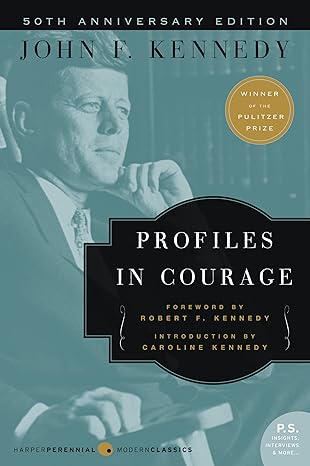
PROFILES in COURAGE (audiobook) by John Fitzgerald Kennedy


A Review of the Audiobook

Winner of the 1957 Pulitzer Prize
Originally Published in 1955

Published by HarperAudio
Duration: 3 hours, 10 minutes
Read by John F. Kennedy, Jr.
Abridged

President John F. Kennedy
(1917-1963)
If you have not read Profiles in Courage, it is comprised of 8 short biographies of Senators that JFK found to be inspirational in some way or another. Those Senators are: John Quincy Adams, Daniel Webster, Thomas Hart Benton, Sam Houston, Edmund G. Ross, Lucius Lamar, George Norris and Robert A. Taft.

Each of these men's stories were very well done, even if some of them, like John Quincy Adams' biography, actually seemed very short compared to what these men actually accomplished. But, then again, this is just a look at one point in time, not a complete list of each man's accomplishments and an abridged version of that short look on top of that.


This audiobook version of JFK's classic work is read by the President's son, John F. Kennedy, Jr. (1960-1999) with an introduction by Caroline Kennedy. The narration was actually quite good. Well worth your time to take a listen or to read.

I rate this audiobook 5 stars out of 5.

This audiobook can be found on Amazon.com here: Profiles in Courage by John Fitzgerald Kennedy

BUNKER HILL: A CITY, A SIEGE, A REVOLUTION (audiobook) by Nathaniel Philbrick


Published in 2013 by Penguin Audio
Read by Chris Sorensen
Duration: 12 hours, 58 minutes
Unabridged

Nathaniel Philbrick's Bunker Hill: A City, A Siege, A Revolution is misnamed. While the battle is in the book, it is only a part of the story. In reality, this book is a history of Boston from the 1750s and 1760s right up to the Declaration of Independence.

In a lot of ways this book is much more of a biography of Dr. Joseph Warren, one of the leaders of the Sons of Liberty movement, along with Samuel Adams, John Adams and John Hancock. Warren is often overlooked nowadays because he died at Bunker Hill (which was really mostly fought on Breed's Hill). The excessive focus on Warren was, in my mind, one of the great weaknesses of the book. Philbrick spent too much time worrying over Warren's alleged personal failures and not enough time getting on with the story. It just bogged things down.
Philbrick does not gloss over the warts of our Founding Fathers, noting that some had mixed motives and some profited from the independence movement. There is plenty of emphasis on the British side of things, something I admire about the book.  

The arrival of Washington in Boston, sent by the Continental Congress to take command and in effect nationalize the militias that surrounded the British troops in Boston, is not explained well. Philbrick does not go much into the goings on of the Continental Congress besides noting that certain people left Boston to attend. Because of this, Washington's arrival comes with very little explanation (much like it may have seemed to some of the militiamen). As the narrative continues, Philbrick does not give Washington much credit for anything around Boston but bad ideas, impatience, a negative attitude and lucky timing.

Chris Sorenson's reading of the audiobook was excellent. 

In short, while there are things to admire about this book, there are problems as well - not problems with the research but problems with choices about what was included (excessive focus on Warren's personal life) and what was left out (the Continental Congress).

I rate this audiobook 3 stars out of 5.

This audiobook can be found on Amazon.com here: Bunker Hill: A City, A Siege, A Revolution.

MAYFLOWER: A STORY of COURAGE, COMMUNITY and WAR (abridged audiobook) by Nathaniel Philbrick


Published in 2006 by Penguin Audio
Read by Edward Herrmann
Duration: 5 hours, 57 minutes
Abridged


Everybody knows the story of the Mayflower and the Pilgrims and the first Thanksgiving. Or, they think they do, anyway.

Nathaniel Philbrick's re-telling of this oft-misunderstood story in Mayflower A Story of Courage, Community, and War is a very approachable for the average reader. He begins with an explanation of the religious differences between the Puritans and the Church of England and how the politics of the day exacerbated the situation. 

Philbrick's re-telling of how the Pilgrims moved from England to Holland and eventually to the New World was very well done, as was the story of the first few seasons of Plymouth Plantation (Plymouth colony), starting in 1620. In fact, the book flowed very well throughout, even though it was abridged. Oftentimes, abridged books are clunky, but this one was not.

The story finishes with King Philip's War (1675-1676). This was a sad war. Wars are all sad, but this one was particularly brutal, complete with decapitations, mutilations, mass murder, and forced deportations into enslavement. On a per capita basis, it was the most devastating war in American history.

Veteran actor Edward Herrmann's (1943-2014) voice is perfect for reading history. He gives it a bit of gravitas but he is not too pompous. 

I rate this audiobook 5 stars out of 5.

This abridged audiobook can be found on Amazon.com here: Mayflower: A Story of Courage, Community and War.

THE FORT: A NOVEL by Bernard Cornwell


Not Cornwell's Best Effort.

Published in 2010 by HarperCollins

Set in 1779 Massachusetts, Bernard Cornwell's The Fort tells the story of the Penobscot Expedition - a small scale invasion by British forces of a bay in what is now Maine.

The government of Massachusetts is determined to repel this invasion without help from the Continental Army. It calls up its militia and its fledgling navy. It does accept help from the American national Navy and its contingent of Marines. By far, the most famous American in this campaign is the commander of the Massachusetts' artillery unit, Lt. Colonel Paul Revere.

Cornwell does a decent job of developing the British officers as characters.  A young officer named John Moore gets his first taste of battle here. In the Napoleonic Wars, Moore was one of the architects of Napoleon's eventual defeat.

Cornwell's battle scenes are, as always, excellently described. He switches from naval battles to land battles with ease. I felt absolutely confident that I had a reasonable grasp of the strategy and tactics of the battle and the successes and failures of the various officers that led to the outcome of the battle.

But, this book has glaring weaknesses.


Paul Revere (1734-1818)
Cornwell never makes it clear as to why Massachusetts refuses to even ask for help from the Continental Army until it is much too late. My opinion is that Massachusetts was very interested in asserting its independence - not just from England but even from the Continental Congress. But, I am basing that on previous knowledge, not from anything that Cornwell provided.

Paul Revere is a star of the book even though he is actually a fairly minor character in the book when it comes to dialogue. He is not even in most of the scenes that refer to him - there are a lot of references to him not being present at locations where he certainly should be present because he is sleeping on a ship or he is waiting for his cook to prepare his breakfast somewhere. The reader just knows that he is a diva but there is no explanation as to why.


The reasons for the British invasion of this particular bay is also not even made clear. This is a fairly lengthy book, but if I were the editor I would have suggested the addition of a few more pages to make the historical context of the story a lot more clearer and make the importance of what is happening here give the story even more drama.

I rate this novel 3 stars out of 5.

This book can be found on Amazon.com here: The Fort by Bernard Cornwell

MORTAL STAKES (Spenser #3) by Robert B. Parker


Originally Published in 1975

If you have not read a Spenser detective novel and you love the detective genre, pick one up and start reading. There are 40 original novels and they all follow a basic premise: Spenser gets a case. Spenser noses around, makes a lot of wisecracks, irritates people who certainly deserve to be irritated, and then he sees if there is a reaction to his nosing around. Usually, that is someone trying to warn him off or, perhaps, trying to kill him outright. From there, Spenser knows who is after him and can figure out why and he knows where to proceed and solve the case.

Sounds simple, doesn't it?

Of course, it is. And, the finest of wines are really just grape squeezings. Simple - but yet there is something else there.

The Spenser series is one of the few series that I am willing to re-read. In this case, I undoubtedly read Mortal Stakes nearly 20 years ago and I mis-remembered it more than I remembered it, so it made for a good re-read. 

In Spenser's third outing he is hired by the Boston Red Sox manager to check out their star pitcher. He is the best in the league but there is some reason to believe that he may have thrown a couple of games, or at least shaved some points (made the score closer than it would have to help out gamblers who bet it would be a close game).

So, Spenser pretends he is an author of an upcoming book about baseball so he can freely nose about the ballpark and talk to everyone who will talk to him. Soon enough, he roots out the truth but now he has another problem - does he really want the truth to come out?


I rate this book 4 stars out of 5.

This book can be found on Amazon.com here: Mortal Stakes

Looking for Rachel Wallace (Spenser #6) (audiobook) by Robert B. Parker


Published in 1989 by Books on Tape, Inc.

Read by Michael Prichard
Duration: 4 hours, 45 minutes.
Unabridged.

I read Looking for Rachel Wallace years ago, but I don't have a great memory for all of the plot details so I am re-enjoying the Spenser books as audiobooks. In this case, Spenser and Rachel Wallace kept me company while I wrapped presents and fed my one-year old. And they were quite good company.

Rachel Wallace is a lesbian feminist activist who lives to shock and provoke the sensibilities of middle America in the late 1970s. Her activism has made her the recipient of several threats so Spenser is hired to protect her. If Rachel Wallace is anything, she is an ultra-feminist and no ultra-feminist (at least not in this book) is going to run to a big strong man for protection. Rachel Wallace realizes this and fires Spenser.

But, soon enough, Rachel Wallace is actually kidnapped and Spenser goes on the hunt for her out of a sense of personal obligation. The climax of the book is one of the more memorable scenes in this long and venerable series.

Robert B. Parker
(1932-2010)
My audiobook was read by Michael Prichard who does a decent Spenser but does a great near-humorless Rachel Wallace.

What can I say about the Spenser books that has not already been said. They're a bit formulaic (wisecracks, meet Susan for some snuggling, fistfights, cooking, etc.) but I love the formula so I enjoyed this one thoroughly. I consider it to be one of the stronger books, despite the fact that the protestations against feminism and lesbianism seem outdated in the year 2006. It almost makes it seem like a period piece. Interesting how the world changes, isn't it?

I rate this book 5 stars out of 5.


This audiobook can be found on Amazon.com here: Looking for Rachel Wallace: A Spenser Novel

Reviewed on December 25, 2006. Updated in 2010.

God Save the Child (audiobook) (Spenser #2) by Robert B. Parker


Good Early Spenser novel


Published August 1st 1988 by Books on Tape, Inc.
Read by Michael Prichard
Duration: 5 hours, 4 minutes
Unabridged

Robert B. Parker and Tony Hillerman are the two authors I most consistently check when I go to a library or a bookstore. When it is a great day, one of the two has a new book. When it is a tremendous day, they both have a new one out and I have to decide which to read first!

In the meantime, I am making do by going back over their collected works as audiobooks. I have a long drive to work every day and Spenser makes a very good ride-along companion. I have long-since read all of the older Spenser books, but the beautiful thing about a faulty memory is that the plot lines get a bit hazy over time and now I can enjoy them all over again!

Besides, it is always interesting to see how the reader interprets Spenser and the gang. One of the best to capture Spenser smart-aleck comments was Burt Reynolds, although his interpretation of Hawk was pleasurable, but questionable in terms of accent.

The reader for God Save the Child was a Michael Prichard. His interpretation of Spenser was neither here nor there, neither good nor bad. However, his reading of the character Mrs. Bartlett was right on the money. Here's the scoop on Mrs. Bartlett: She and her husband hire Spenser to find her son. He is missing and a note has been sent to the Bartletts asking for $50,000 for his safe return. This book was written in 1974 when $50,000 was a whole lot of money. Mrs. Bartlett is an insipid, vapid twit of the first order. A woman more concerned with fashion than her child's safety. She hosts a dinner party in her house on the same day that a man is killed in it and during the time her son is missing. She is a woman who believes herself to be an artist because it gives her an excuse for her bad behavior. Prichard nails her voice so dead on that you wish you could reach through the radio speakers and smack her upside the head on at least half a dozen occasions.

Robert B. Parker
So, how's the plot? Good thriller, although you could see the ending coming as soon as you hear the details of the missing boy's case. Of course, that could be some latent memories from when I read the book 10 years ago...

We meet Susan Silverman.

We meet Healey of the State Police (Prichard nails him too - I never noticed before that Healey was funny, but Prichard reads him as Spenser's straight man foil and I laughed out loud a couple of times).

There's plenty of Spenser's dogged style of detecting and plenty of smart comments.

This listener was struck as to how old Spenser really is - there is a lot of descriptive detail about clothing from the 1970s that reinforce that fact. Luckily, Spenser is forever middle aged but tough enough to take on the world and Susan Silverman is forever ageless and beautiful, no matter the decade.

I rate this audiobook 5 stars out of 5.

This book can be found on Amazon.com here: God Save the Child by Robert B. Parker.

Originally reviewed on November 23, 2006.

High Profile (Jesse Stone) (Sunny Randall) by Robert B. Parker


The Jesse Stone novels continue a rally for the legion of Parker fans - score this one a double.

Published in 2007 by Putnam
304 pages

To use a baseball analogy (Robert B. Parker fans would surely approve...), this one keeps the current rally of good Parker books going.

If you are unsure what I am referring to then you must not get much of the baseball comments that Stone and Spenser use. Anyway, a rally is a run of good offensive plays when your team is down a few runs. Ideally, those offensive plays would be smashed out of the park home runs. However, in a pinch, a base hit beats a strike out.

Robert B. Parker
(1932-2010)
Now, notice that I did not label this one a great book. This is not a home run. It's more of a double. It is a good book but not Parker's best. It's not even the best Jesse Stone novel. The mystery is not terribly complicated (I think I could have solved this one) but I enjoyed this quick read. In a lot of ways the mystery is secondary to Jesse's turbulent personal life (the enticement of Sunny Randall is complicated by issues with his ex-wife) - for me that is not a plus. Not that I'm not interested but I like the ratio of mystery to personal struggles to lean a bit more heavy on the mystery side.

So, I give this one a grade of B- (4 stars out of 5).

This book can be found on Amazon.com here: High Profile.

Reviewed on March 21, 2007.
Updated December 24, 2024.

Stranger in Paradise by Robert B. Parker


I think I've read this one before...


Published in 2008 by Putnam
304 pages

I am a gigantic fan of Robert B. Parker. I've read all of the Spenser books, the Stone books and the Randall books. And I'm slowly "re-reading" the Spenser books as audiobooks.

It is not lightly that I give Stranger in Paradise two stars.

The Stone novels were always different than the Spenser / Sunny Randall novels. Spenser and Sunny always have that buddy network to fall back on (especially Hawk and Spike, respectively) Jesse has always been alone, except for his on-again off-again ex-wife, who actually makes his sense of being alone even stronger.

The whole formula for Jesse Stone is thrown out. Instead, we have a re-make of Spenser's April Kyle and Paul Giacomin stories told under Jesse Stone this time around with a girl named Amber.

Stone is not a lone, principled character this time. Instead, Parker reverts back to a mainstay of the formula he uses in the Spenser novels - the amazing sidekick. Rather than Spenser's Hawk (a mysterious, unstoppable African-American who operates on the wrong side of the law that the ladies find irresistible and shares witty racial banter with Spenser) we now have Stone's Crow (a mysterious, unstoppable Native American who operates on the wrong side of the law that the ladies find irresistible and shares witty racial banter with Stone). Hawk. Crow. C'mon!
Robert B. Parker 
(1932-2010)


Parker often recycles previous plots (how can he not - he's written so many books!) but this was just too much for me. The story is easy to read, interesting and enjoyable, but it has too many recycled features for my taste.

I rate this book 2 stars out of 5.

This book can be found on Amazon.com here: Stranger in Paradise.

Reviewed on February 20, 2008.

Blue Screen (Sunny Randall) by Robert B. Parker


A quick, enjoyable read


Published in 2006.

I came across Blue Screen yesterday afternoon and I snapped it up immediately. I think that I have read through the entire Parker collection at this point and I immediately pick the newest one up as soon as I see it (I have been holding back on reading my last two Michener books since there will be no more ever written and once they're done...)

This is really a tale of two stories. One is a mystery and one is a bit of soap opera. The mystery part is pretty good but really comes off as a bit of a hodgepodge of Parker's enthusiasm for baseball, 'Get Shorty' and the Spenser book 'Back Story'.

Witty banter and familiar faces keep the story moving along. I have no idea if this story could stand alone or not. Probably not. If this might be your first foray into Sunny Randall, pick an older one first and than move to this one.
Robert B. Parker
(1932-2010)


The soap opera is the merging of the worlds of Sunny Randall and Jesse Stone. We could quibble and say that they were already in the same world, but Spenser, Stone and Randall have always interacted with the peripheral characters (Yes, I am saying Susan is a peripheral character) rather than with one another. The coming together of these two characters is interesting and, for once, the psychoanalysis sequences did not bother me too much - they seemed to have a purpose and Sunny actually moved (maybe even leaped) forward.

As has been the case for several books now, the book seems quite hefty when you pick it up. However, open it up and it reminds me of when a college student tries to pad the length of his paper by enlarging the margins and the font size. This book features large print, extra thick paper, lots of space between each line and full one inch margins. Each chapter also starts about 2/3 of the way down the page and there are 61 chapters, so that's a good way to stretch it out an extra 30 pages or so. Not that it makes any difference, but I wonder why they've done this. It weighs in at 306 pages and could have easily have been printed in a 200 page format without straining the eyes. This little one-day read is wider than most textbooks! This has to be more expensive, it adds to shipping costs and makes it harder for the stores to stock multiple copies...which seems counterproductive to me.

I rate this book 5 stars out of 5 and it can be found on Amazon.com here: Blue Screen (Sunny Randall).

Reviewed on August 5, 2006.

Liberty's Children: Stories of Eleven Revolutionary War Children by Scotti Cohn


It just didn't work for me


Published in 2004 by Globe Pequot

Liberty's Children is a collection of stories about the experiences of eleven children during the Revolutionary War (although one is 20 years old, which was definitely not a child in a time when many were married with children at age 16).

The book is well-researched and accurate. I have no complaints with that or the ample bibliography that is sorted by the individual children. But, I just felt like I had to slog through parts of it and I love to read history.

I questioned some of the choices as well. Five of the eleven went off to sea, one of them was 20 years old and one was just a baby. I found myself wondering about the decision not to include the most famous child that served in the Revolutionary War, Andrew Jackson. He served as a courier and had his face slashed by a British soldier for refusing to clean his boots. Or, how about John Quincy Adams, who accompanied his father to Europe during the war to secure supplies and allies and eventually travelled all of the way to Russia. At least Sybil Luddington, the 16 year-old female "Paul Revere" for Connecticut who is featured on Connecticut's quarter coin could have been included rather than another story about a boy gone off to sea.

Not that all of the stories were a chore to read, mind you. I enjoyed the stories of Frances Slocum, James Forten and Sally Wister in particular. If you have read this book and want to know more about Frances Slocum I enthusiastically recommend the novel The Red Heart by James Alexander Thom.

I rate this collection 3 stars out of 5.

This book can be found on Amazon.com here: Liberty's Children.

Reviewed on August 23, 2008.

Sea Change by Robert B. Parker


The Good News: It's a Robert B. Parker Book...

Published in 2006.

The Bad News: It's not a particularly good one.

However, Robert B. Parker's books remind me of those bumper stickers that say 'A Bad Day Fishing is Better Than a Good Day at Work.'

A bad Jesse Stone book is still a fun read.

In Sea Change Stone's police department is investigating a woman's body found floating in the harbor. Along the way, Stone discovers lots of perversion, money, yachts and messed-up rich kids. Or, as his psychologist puts it, Stone is working on a case 'in which control and loveless sexual objectification is rampant.'

Stone comments that pornography is fun for about the first 10 seconds and then it loses most of its appeal for him (he has to wade through hours of personal videotapes of the stuff in the search for victims and suspects) because it gets so repetitive. Unfortunately, this book has the same problem. Lots of sex parties and videotape. Lots of rich boys, easy girls and videotape. The problem is that the story just gets stuck in a rut for about a hundred pages or so. The dialogue is wonderful. The observations are witty. At one point, though, I realized that I was just reading for the witty dialogue and the observations - not for the plot.

Too bad. The last Jesse Stone novel I read was one of the best novels Parker had written, in my opinion. This one goes in the lower half of that long, long list of books.

As has been the case for several of Parker's books now, the book seems quite hefty when you pick it up. However, open it up and it reminds me of when a college student tries to pad the length of his paper by enlarging the margins and the font size. This book features large print, extra thick paper, lots of space between each line and full one inch margins. Each chapter also starts about 2/3 of the way down the page and there are 62 chapters, so that's a good way to stretch it out an extra 30 pages or so. Not that it makes any difference, but I wonder why they've done this. It weighs in at 296 pages and could have easily have been printed in a 200 page format without straining the eyes. This little one-day read is wider than most textbooks! This has to be more expensive, it adds to shipping costs and makes it harder for the stores to stock multiple copies...

I rate this book 3 stars out of 5.

This book can be found on Amazon.com here: Sea Change (Jesse Stone Novels)

Reviewed on June 22, 2006.

Featured Post

<b><i>BAN THIS BOOK (audiobook)</i></b> by Alan Gratz

Published in 2017 by Blackstone Audio, Inc. Read by Bahni Turpin. Duration: 5 hours, 17 minutes. Unabridged. My Synopsis Ban This Book is t...

Popular posts over the last 7 days