Showing posts with label Great Depression. Show all posts

PALM SUNDAY: AN AUTOBIOGRAPHICAL COLLAGE by Kurt Vonnegut


Published in 1981 by Delacorte Press.

Kurt Vonnegut offers this collection (he calls is a "collage") of fiction, non-fiction, interviews, and even a musical based on Dr. Jekyll and Mr. Hyde. 

As is the case with all collections, some parts of the collection are excellent and some parts are not very good. I believe that he first half of the collection is the best, mostly because of the inclusion of a history of the Vonnegut family in Indianapolis. Ironically, it was not written by Vonnegut, but by a family member who had married into the Vonnegut family. 

Indianapolis is my adopted hometown and this Vonnegut family history reads like a history of the city from the mid-1800s to the mid-1900s. I found it fascinating reading, especially the story of the subscription brothel gentlemen's club that was frequented by the city's elite in an area that still has political "clubs" with fancy dining and smoking rooms more than 100 years later. It would be tacky to pay a prostitute, but paying club dues that were used to maintain the club and also to pay the prostitutes - well that's not tacky at all!

The musical based on Jekyll and Hyde written in 1978 was completely horrible.

Vonnegut is well-known for having written a report card of his published books - this is the book that features that report card. Oftentimes, I disagree with his self-assessment - but not this time. He gives this book a "C" (yes, he graded the book as he was writing/collecting all of the parts of it) and I agree.

I rate this book 3 stars out of 5. It can be found on Amazon.com here: PALM SUNDAY: AN AUTOBIOGRAPHICAL COLLAGE by Kurt Vonnegut.


ESPERANZA RISING (audiobook) by Pam Muñoz Ryan


Duration: 4 hours, 42 minutes.
Unabridged.


Synopsis:

Esperanza is the main character in a fictionalized version of the author's grandmother's adolescence. 

In Mexico, Esperanza is the daughter of a wealthy landowner in Aguascalientes. On this ranch, life is wonderful. She has servants and attends a private school. But, life in Mexico in 1930 is fraught with danger. It is only 10 years after the 10 year long Mexican Revolution and armed bands still roam the countryside. One of these groups kills Esperanza's father and her conniving uncles take the ranch and burn the house down to make sure they keep the land. 

The author, Pam Muñoz Ryan
Esperanza and her mother join a family of their servants (the ranch manager, the household manager, and their son) and flee to America (California) with false paperwork. They hope to work on American farms and re-establish themselves.
However, America is in the beginnings of the Great Depression...

My Review:

The book has a slow start (probably the first 1/3), but once the family makes it to the American border the book truly gets steadily better as it goes along. The migrant labor camps in this book tie in very well with a much older book that is set a little later in the Great Depression in California, The Grapes of Wrath. By the end of the book, I was pretty invested in seeing how it turned out.

For all of the people that act as though the immigration crisis at the border is a new thing that one political candidate discovered just a few years ago, this book feels like it could be easily updated to 2023 with a few technological changes. It is set 93 years in the past, but it involves criminal violence forcing people north to America, migrant camps, illegal border crossings, forged paperwork, low wages, border patrol agents, homelessness, families separated by the border, racial prejudice, and more.

I rate this book 4 stars out of 5. It can be found on Amazon.com here: ESPERANZA RISING by Pam Muñoz Ryan.

FIGHTER PILOT: THE WORLD WAR II CAREER of ALEX VRACIU by Roy E. Boomhower


Published in 2010 by Indiana Historical Society Press.

Alex Vraciu (1918-2015) was a World War II flying ace, ranking fourth in the U.S. Navy in World War II. He destroyed 19 Japanese planes in the air and 21 on the ground. 

This short book is very approachable and tells the story of Vraciu's childhood during the Great Depression in Northwest Indiana (now commonly known as "The Region") and his college years at DePauw University in Greencastle, Indiana. 

Vraciu took advantage of a U.S. government program that trained civilians to be pilots with the understanding that if the U.S. went to war those pilots would become military pilots. He trained in Muncie, Indiana and immediately joined the U.S. Navy after the Japanese attack on Pearl Harbor on December 7, 1941.

Vraciu had a remarkable military career over the next 23 years. Besides destroying 40 Japanese planes, he lost multiple planes, including being shot down over the Philippines and leading a group of guerrilla fighters against the Japanese, he became a test pilot, he led squadrons after they navy transitioned to jets and scored the highest in the predecessor to the Navy's "Top Gun" training program in a jet 12 years after the end of World War II. 

The book is very readable and full of interesting photographs. It would be good for a well-read student of World War II or an interested newbie. I rate it 5 stars out of 5. It can be found on Amazon.com here: FIGHTER PILOT: THE WORLD WAR II CAREER of ALEX VRACIU by Roy E. Boomhower.

THE GRAPES of WRATH (audiobook) by John Steinbeck


Originally Published in 1939.
Audiobook version published in 2011 by Penguin Audio.
Performed by Dylan Baker.
Duration: 21 hours, 1 minute.
Unabridged.

Winner of the National Book Award.
Winner of the Pulitzer Prize.
Declared to be the best-selling book of 1939 by the New York Times.

I last read The Grapes of Wrath when I was in high school, nearly 40 years ago. It was assigned reading for my English class and all I really remembered about it was a couple of scenes. I remembered the last scene, with the flood and starving man. And I remembered and early scene where the tractor operator is plowing up the farms, the farmyards and even intentionally damaging homes in Oklahoma. Besides that, I had nothing but a pervasive memory of sorrow and injustice.

I've always thought of this book and Of Mice and Men as kind of a set of books about migrant farm workers during the Great Depression. I've read Of Mice and Men 5 or 6 times, though - a fact that I can one hundred percent attribute to the fact that The Grapes of Wrath is 6 or 7 times longer. 

The Grapes of Wrath is longer and it is much more powerful. 

I am not going to go through all of the plot details for a book that has been labeled in the top 100 books by Le Monde, the BBC, Time magazine and The Daily Telegraph, but I am going to tell you the thoughts I had as I listened.

The book follows the Joad family as they lose their farm, load up all of their family and their worldly goods and head off to California in search of plentiful farm labor jobs that they have been told exist. They join tens of thousands of economic refugees and take Route 66 to California. Collectively, they were insultingly referred to as "Okies."

The problem is that while the jobs do exist, California is a magnet for economic refugees having 10 men and women show up for each job drives the wage down to starvation level. No one can get ahead and they are forced to live in shanty town camps on the edge of town. When the harvests are done, the sheriff and a bunch of local tough guys force everyone out and burn the camp to the town so they can't settle down.

As I was listening, I noted that some things haven't changed. Any time someone discusses organizing the workers or improving the working conditions someone accuses them of being a socialist. Not much has changed almost 85 years later. There are also parallels to the modern era migrant farm workers.

This book is compelling from beginning to end and is performed (not read - performed) wonderfully by Dylan Baker. He creates a series of unique voices and just hits all of the right notes throughout. 

This book deserves all of the hype.

I rate this book 5 stars out of 5. It can be found on Amazon.com here: THE GRAPES of WRATH (audiobook) by John Steinbeck.

PROHIBITION in the UNITED STATES: A HISTORY from BEGINNING to END (kindle) by Hourly History


Hourly History publishes histories and biographies that you can read in about an hour. That can be a tough job for larger topics in history like "The Industrial Revolution" or "The Roman Empire" but it works out about right for this topic.

This history goes all of the way back to the arrival of the
 Mayflower in 1620. Turns out the Puritans brought hundreds of gallons of alcoholic beverages with them to the New World and immediately set up the means to produce even more.

The book then goes on to show the ups and down of America's relationship with alcohol. When the reader gets to the temperance movement, there is a solid context to understand why the 18th Amendment to the U.S. Constitution was passed in 1919 and why it was eventually abolished by the 21st Amendment a mere 14 years later.

For a short read, this book provides a lot of good, basic information. 

I rate this e-book 5 stars out of 5. It can be found on Amazon.com here: PROHIBITION in the UNITED STATES: A HISTORY from BEGINNING to END (kindle) by Hourly History.


BLUEBEARD by Kurt Vonnegut


Originally published in October of 1987.

The premise of Bluebeard is that it is the autobiography of a has been artist named Rabo Karabekian. Karabekian also appears in an earlier Vonnegut book (Breakfast of Champions).

Karabekian is an abstract expressionist, like the real-life famed artist Jackson Pollock, who is in this novel as a friend of Karabekian. Karabekian's paintings are basically canvases covered with a coat of house paint and then some strips of tape. They were popular for a while.

Karabekian's paintings are really a way for him to deal with his PTSD from World War II. He doesn't want to deal with the details so he basically paints pictures of nothing.
A self portrait of Kurt Vonnegut.

Karabkeian tells about how he got started in the art business, kind of hints around at his World War II experience and intersperses the whole thing with talk about what is going on in his life as he is writing. 

I read the book with Karabekian and his author friend Paul Slazinger as sort of a stand-ins for Vonnegut himself. Both have loads of sarcastic comments and a lot of dark humor. 

This is a bit different for a Vonnegut book. There are a lot of absurd scenes and situations and there are references to the Battle of the Bulge. But, unlike most of his books, there is a relatively happy ending.

I rate this book 5 stars out of 5. It can be found on Amazon.com here: Bluebeard by Kurt Vonnegut. 

THE HOUSE of DANIEL: A NOVEL of WILD MAGIC, the GREAT DEPRESSION, and SEMIPRO BALL by Harry Turtledove


Published in 2016 by Tom Doherty Associates (A Tor Book)

Harry Turtledove specializes in alternate histories. Usually, he has a big twist - what if the South won the Civil War? What if Atlantis were a real continent? What if the Colonies lost the Revolutionary War? What if MacArthur actually dropped atomic bombs during the Korean War?

The House of Daniel is a different kind of story, with a twist.

To be perfectly honest, I read the description of this book, with its references to The Great Depression, baseball, "hotshot wizards" and zombies and missed the fact that it was actually referring to actual wizards and zombies, not metaphorical wizards (the whiz kid experts that FDR hired) and zombies (the unemployed masses who are desperate for work). I really thought that Turtledove had just written a straight book about semipro baseball in the Great Depression.

And, basically he has. 85% of this story is about baseball.

Jack Spivey does odd jobs, plays semipro baseball for a few bucks a game and a little muscle work for a local mobster-type named Big Stu in Enid, Oklahoma. He is contracted to go to a neighboring town to give a beating to the sibling of a client that is behind on his payments. When the sibling turns out to be a beautiful young woman, Jack can't do it. Instead, he takes a position with a traveling semipro baseball team called "The House of Daniel" and hits the road.

If you don't like baseball, this book will bore you to tears. Jack tells about his life on the road and about dozens of baseball games - sometimes in great detail, with play by play and even pitch by pitch descriptions. 

But, the world that they live in is a little off from our world. Major League Baseball exists, but none of the names are recognizable. Magic exists - regular magic, dark magic and even religious magic. So do vampires. And zombies. And magic carpets. And mystery creatures like chupacabras. 

I really enjoyed this book, despite my original confusion. 

I rate this book 5 stars out of 5. It can be found on Amazon.com here: THE HOUSE of DANIEL: A NOVEL of WILD MAGIC, the GREAT DEPRESSION, and SEMIPRO BALL by Harry Turtledove.


OF MICE and MEN (audiobook) by John Steinbeck


Penguin Audio edition published in 2011.
Read by Gary Sinise.

Duration: 3 hours, 11 minutes.
Unabridged. 


The narrator, Gary Sinise, as the character
George in the 1992 film version of this novel. 
This is probably the 5th or 6th time that I have read this book. I reviewed it as a print book 10 years ago (click here to see that review).

Gary Sinise read this book and did a fabulous job, especially with the voices of Lennie and Crooks. He played George in one of the many movie adaptations of this novel in 1992.

This was my first time hearing this book as an audiobook and I was very impressed that it was an even more effective book when read aloud than in print.

This review of one of the most-read, most-celebrated novels in the English-speaking world will not include a plot synopsis - what's the point? Instead, let me say that this short novel has an amazingly tight plot. In this 3 hour and 11 minute story, nearly every scene, and most lines of dialogue are relevant to the climax of the story.

Foreshadowing abounds in the first half hour of the audiobook, almost all of the conversations in the bunkhouse point towards the dramatic scene at the end and the point to the theme of the little guy never getting a real shot to improve his lot in life. Even the title, Of Mice and Men, is a reference to the poem To a Mouse by Scottish poet Robert Burns that was written when he accidentally destroyed a mouse's nest while plowing at the beginning of winter. The mouse had done everything right, only to lose it all to events beyond its control. The poem contains this line:

The best laid schemes of mice and men
Go often askew,
And leave us nothing but grief and pain


I rate this audiobook 5 stars out of 5. Highly recommended. It can be found on Amazon.com here: Of Mice and Men (audiobook) by John Steinbeck. 

Note: In February of 2022 I tagged this book "MAGA Censorship List" because a group called Moms for Liberty created a list of 51 books that they wanted removed from their school library. This article is pretty good because it has a lot of details. It includes the whole list and one activist's assertion that the books may be part of an agenda on the part of George Soros or the United Nations or the American Library Association. (Seriously - it's a direct quote in the article. This is the kind of crazy that fills these groups.)

This book is also on lists of books that Progressives want to ban. Here is a link to a list maintained by a university that tracks book bans. In this case, it is for inclusion of the n-word.

MILTON HERSHEY: MORE than CHOCOLATE: HEROES of HISTORY (audiobook) by Janet Benge and Geoff Benge


Published in 2015 by YWAM Publishing.
Read by Tim Gregory.
Duration: 4 hours, 55 minutes.
Unabridged.


YWAM Publishing offers a series of biographies of Christian "heroes of history" aimed at home school students. The fact that this was part of series about "Christian" heroes was a surprise to me since this book didn't mention Hershey's faith at all. Nevertheless, this is an interesting and enjoyable biography of one of America's most successful businessmen, Milton Hershey (1857-1945).

Milton Hershey: More than Chocolate is a book showcasing the value of persistence. Starting with a failed attempt by his father in the oilfields of Pennsylvania in the late 1850's, the first half of this book is a series of business failures from Milton Hershey and his father, Henry.

Henry Hershey was more of a dreamer sort of entrepreneur - prone to rash decisions, excited by new technology and not very good on doing the follow up work to make sure that the venture succeeds. They traveled from Pennsylvania to Colorado to Louisiana, chasing the next big thing. Turns out that the next big thing was something that Milton Hershey learned from a baker in Colorado about how to make caramel that tastes better and stays fresh longer - milk.

So, Milton Hershey headed home to Pennsylvania and sets up his kitchen and everything just falls into place - except that it doesn't, at least not right away...
The stories of Hershey's struggles are by far more interesting than the story of his success. That being said, Hershey's commitment to charity once he became a success is extraordinary and worthy of note.

I did have one quibble. When it comes to the Hershey strike in 1937, the book doesn't really tell why some of the employees wanted to organize. Now, compared to most other places in the United States during the Great Depression, the workers in Hershey, Pennsylvania had it pretty well. Still, they had lost 1/3 of their hours per week and the worker learders that tried to organize a union were laid off in what looked like retaliation.

The story is well told and well-read by the narrator, Tim Gregory. We listened to this book as a family on a vacation and found it interesting and were eager to start listening again as soon as we hit the highway.

I rate this audiobook 4 stars out of 5. It can be found on Amazon.com here: MILTON HERSHEY: MORE than CHOCOLATE: HEROES of HISTORY.

THE YEAR of FEAR: MACHINE GUN KELLY and the MANHUNT THAT CHANGED the NATION (audiobook) by Joe Urschel


Published in 2015 by Macmillan Audio.
Read by Jeremy Bobb.
Duration: 9 hours, 4 minutes.
Unabridged.

In the early years of the Great Depression, kidnapping became a fairly common crime, especially in the Midwest. It was viewed by some as a safer alternative to bank robberies, especially since unsuspecting victims were often not armed.

The most famous kidnapping of the era was the Lindbergh baby case. It ended tragically, but did result in a Federal anti-kidnapping law. That law got its first test when George "Machine Gun Kelly" Barnes and his wife Kathryn planned the kidnapping of oil tycoon Charles F. Urschel (no relation to the author of The Year of Fear, but he admits to initially researching the topic due to the victim having the same last name as his). Urschel was taken from his home in Oklahoma to a farm in Texas. The moment they crossed the border, the kidnapping became a federal crime.

Machine Gun Kelly started out his career as a bootlegger, but his new wife Kathryn wanted more for him. She bought him his machine gun at a pawn shop and made him practice with it. She gave him his nickname and bragged to everyone that he was so adept with his machine gun that he could spell his own name out as he fired it. With that, a relative small-timer acquired a catchy name and a reputation that would eventually secure him a place in the public's imagination.


George "Machine Gun Kelly" Barnes (1895-1954)
 and his wife Kathryn (1904-1985)


The Urschel kidnapping became the first major case of the fledgling FBI (it wasn't even called the FBI yet) and it's new director, J. Edgar Hoover. Hoover's men cracked the case fairly quickly (Urschel was a tremendous help - he worked very hard to remember everything that he could while he was kidnapped and even participated in a raid) and conducted a nation-wide manhunt for Machine Gun Kelly and his wife. When Kelly surrendered it was widely reported that he shouted, "Don't shoot, G-Men! Don't shoot, G-Men!" and forever gave FBI agents that nickname.

Kelly left another legacy as well. The federal government felt that some of their prisons were vulnerable to super-criminals like Kelly and Al Capone so they were moved to the newly built prison on Alcatraz Island near San Francisco that was designed to be escape-proof. Kelly was among the first prisoners moved there and spent 17 years there.

This audiobook was read by Jeremy Bobb. He did a very good job, including making special voices for some people, such as Machine Gun Kelly. However, the book was written in an uneven manner. The first half of the book includes a fascinating look at the crime wave that gripped the Midwest in those days. The tale of the Urschel kidnapping is told so well that it felt like I was
 listening to a crime novel more than a history. But, the story becomes tedious when re-telling the cross-country trips of Machine Gun Kelly and his wife Kathryn. Even worse, the story of the trial had too much cutting and pasting of trial transcripts. There was a lot of overblown grandstanding on the part of the prosecutor and it was often a challenge to listen to.

I rate this audiobook 3 stars out of 5. The first half is excellent. I trudged through the post-kidnapping part of the book just to see how it ended.

This book can be found on Amazon.com here: THE YEAR of FEAR: MACHINE GUN KELLY and the MANHUNT THAT CHANGED the NATION.

A CHRISTMAS STORY: THE BOOK that INSPIRED the HILARIOUS CLASSIC FILM (audiobook) by Jean Shepherd


Published by Listening Library in 2004.
Read by Dick Cavett
Duration: 3 hours, 36 minutes.
Unabridged

A lot of people aren't aware that the plot for the classic Christmas movie A Christmas Story was not written as a coherent novel but was actually a collection of short stories that the author had written about his childhood in northwestern Indiana during the Great Depression over the years that were then skillfully edited into a movie.

These stories don't follow the plot of the movie exactly, but all of the high points are here, including the infamous lamp, the bully, the BB gun, the visit to Santa and the Bumpus hounds. 
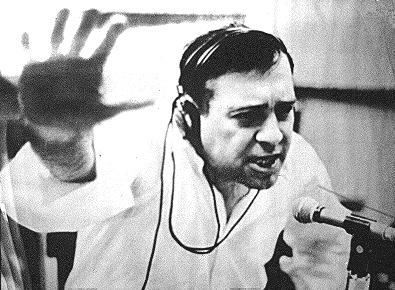
Jean Shepherd (1921-1999)


Interestingly, this audiobook was not read by Jean Shepherd, who was a professional radio personality and told most of these stories over the air (he is also the narrator in the movie). Instead, it is read by television host Dick Cavett. At first, I was disappointed - but Cavett did a great job. This audiobook was a lot of fun.

5 stars out of 5.

This audiobook can be found on Amazon.com here: A CHRISTMAS STORY: THE BOOK that INSPIRED the HILARIOUS CLASSIC FILM (audiobook) by Jean Shepherd.

1944: FDR and the YEAR THAT CHANGED HISTORY (audiobook) by Jay Winik


A Review of the Audiobook

Published in 2015 by Simon and Schuster Audio
Read by Arthur Morey
Duration: 21 Hours, 10 minutes
Unabridged

The premise of 1944: FDR and the Year That Changed History is that 1944 is the most important year of World War II - the year that the Allies grew certain that they were going to win the war, the year that post-War plans were laid out, the year of the D-Day invasion and more.

This effort by Jay Winik is very readable and was an informative and entertaining listen. There are times when he creates fabulous images in the listener's mind that are worthy of any novelist. His description of the extent of anti-Jewish operations throughout Europe and particularly in Auschwitz and other death camps are so vivid and so striking that I can readily recommend this book as a good place to start for anyone who wants a serious look.

The book focuses on FDR, his personality and how he shaped the war effort and post-War institutions like the United Nations. Winik details Roosevelt's health problems and points out how Roosevelt's health affected his efforts and possibly affected his judgment.

However, there is a problem with the book and that is the title - what he wrote about does not match the title.

Josef Stalin (1878-1953), FDR (1882-1945) and Winston
Churchill (1874-1965) at the Tehran Conference in 1943.
He has written an excellent book, but I don't think that he proved his assertion of the title that 1944 was THE YEAR. The book covers all of FDR's life and spends a lot of time in every year of the war but 1944. The topics he covered were important and he covers them well. A great deal of the book covers the holocaust and FDR's response to the proof that the "final solution" was underway. I have no problem with this as a topic (I already noted this above) but I do have a problem with a book that purports to talk about the importance of 1944 to world history and goes on to literally spend more time talking about Anne Frank than the entire Pacific Theater of World War II. I am not kidding. Don't get me wrong - Anne Frank's story is compelling, but it is not, in and of itself, worthy of more mention than all of the fighting in Korea, China, the Philippines, the attempted invasion of Australia, the use of the atomic bombs, the war atrocities throughout the theater and the millions of soldiers and sailors involved in fighting throughout the theater.

The reader, Arthur Morey, did an excellent job, even going so far as to mimic the voice of FDR when he read quotes from him.

This is a well-written and immensely informative book that is simply mistitled. 


I rate this book 4 stars out of 5 because of the misleading title.

This audiobook can be found on Amazon.com here: 
1944: FDR and the Year That Changed History.

THE JEFFERSON RULE: WHY WE THINK the FOUNDING FATHERS HAVE ALL the ANSWERS (audiobook) by David Sehat


Published by Tantor Audio in May of 2015
Read by Tom Perkins
Duration: 8 hours, 16 minutes

If you are a person that likes to debate on the internet than you have undoubtedly experienced Godwin's Law. Godwin's Law states that if you debate long enough on the internet, someone will inevitably make a comparison to Nazism, Hitler, the Holocaust ("You don't like Donald Trump's hair? What are you? The hairdo Nazi?!?"). 

A similar rule exists when discussing American politics - eventually someone will refer back to the Founding Fathers. It is especially easy to quote Thomas Jefferson - he was so prolific and well-written that it is easy to break out a quote to support your point of view. In the case of Jefferson, it is often too easy because he was extremely inconsistent in his political views. To start easy, he did write "
We hold these truths to be self-evident: that all men are created equal; that they are endowed by their Creator with certain unalienable rights; that among these are life, liberty, and the pursuit of happiness." And, he also owned a whole lot of people and certainly did not allow them liberty or the pursuit of happiness. He was also advocated strictly following the letter of the Constitution...until it suited him not to when he became President, like with the Louisiana Purchase.

So, Jefferson is quoted all of the time because, likely as not, he has written or uttered a very lofty-sounding quote that supports your point of view, no matter what it is. In short, the man was so inconsistent that he was, at one point or another, on your side and and at a different point he was also against it.

Sehat uses this as a jumping off point in The Jefferson Rule to look at two general phenomena. The first is the traditional big activist government vs. small strict constructionist government argument. In the Washington Administration this was personified with Alexander/Washington on one side and Jefferson on the other.


But, the argument continues throughout American history and Sehat looks at some of the high points in his study, including the debate on slavery, the two crises with secession, The New Deal, the Civil Rights movement, The Reagan Revolution, The War on Terror, Obamacare and the Tea Party movement. 

In his second point, he notes that politicians have always referred back to the Founders and referred to them as if they were a united front, despite the ugly split in the Washington Administration itself. Also, the image of the Founders is changed as needed by current politicians.

I found the whole book to be fascinating and a well-told tour of American history. There were times when I thought Sehat was surprisingly harsh on the liberal side of things than I found him to be equally harsh on the conservative side. To be fair, I think Sehat is harsh on politicians in general and finds them all, no matter their political stripe, guilty of the same sin when it comes to referring to the Founding Fathers.

I rate this book 5 stars out of 5.

This book can be found on Amazon here: 
The Jefferson Rule: Why We Think the Founding Fathers Have All the Answers

TO KILL a MOCKINGBIRD (audiobook) by Harper Lee


Published by Harper Audio in 2008
Originally published in 1960
Winner of the Pulitzer Prize
Voted "Best Novel of the Century" in a Library Journal poll
Read by Sissy Spacek
Duration: 12 hours, 17 minutes

I almost feel silly writing a review for a book that is nearly universally regarded as one of the best, if not THE best, novels written in the last century. This book is read in schools across the country, was adapted into an amazingly successful movie that is as highly regarded as the book. This book is not just respected - it is loved.

I also hate to admit that it had been nearly 25 years since I had read To Kill a MockingbirdAlthough I remembered that I loved the book, I had really forgotten why.

So, when I was offered the chance to review this audio version by the publisher for free I jumped it at. It had been such a long time that I needed to remind myself why it was so great. 

I am not going to waste everyone's time by re-telling the story in detail. Harper Lee creates a wonderfully rich world set in a small town in Alabama during the Great Depression. The story is told from the point of view of young "Scout" Finch. Scout starts as a first grader but the story progresses through several years. She lives with her brother Jem and her father Atticus, an attorney. Her daily life at home is maintained by the African American housekeeper Calpurnia who treats Jem and Scout like they are her own children. Later, her aunt moves in to provide a more permanent feminine role model in the house.

In the first part of the book, Scout's world comes to life as Harper Lee takes the time to lay out her world for us. In the second part of the book, this world is interrupted by an outrageous court case in which Atticus is appointed to defend a black man wrongfully accused of raping a white woman. The third part of the book deals with the consequences of that case. 

Harper Lee (born in 1926)  in c. 1962. 
But, the book is so much more than that. I grew up in a small town in Indiana and her descriptions of the rhythms of childhood play in the summer felt so true to me that the characters become so real that I felt like I actually knew them in my own childhood. 

Sissy Spacek's reading of this book is as timeless as the book itself. The decision not to have her actually change voices as she reads the story was a brilliant stroke. Most audiobook readers change voices and make separate voices for each of the characters even if it is told from the point of view of just one of the characters. Spacek keeps the entire story in the voice of Scout because the entire story is told from her point of view. It is her story.

I thoroughly enjoyed this audiobook. I found myself listening to it whenever I could. I happily rate it 5 stars out of 5.

See my review of Harper Lee's Go Set a Watchman here.


This book can be found on Amazon.com here: To Kill a Mockingbird.

This book was on a list of books to be investigated in Oklahoma by conservative parents. Here is a link to an article.

This book is also on lists of books that Progressives want to ban. Here is a link to a list maintained by a university that tracks book bans. In this case, it is for inclusion of the n-word.

NPR AMERICAN CHRONICLES: WORLD WAR I (audiobook) by NPR


Multicast performance
Duration: 3 hours, 25 minutes

National Public Radio (NPR) has gone through its archives and pulled out almost thirty stories about World War I in honor of the 100th anniversary of the start of the war. The stories include interviews with soldiers and historians and various authors. 
File:Eddie Rickenbacker.gif
World War I flying ace Eddie
Rickenbacker (1890-1973) in his Spad
plane in October of 1918.

Topics include a look at pre-World War I Europe, a look at the creator of the Sopwith Camel, discussions of several battles, hand-created masks for men whose faces were damaged in the war, a mini-biography of America's famed flying ace Eddie Rickenbacker, a look at the post-war Bonus Army during the Great Depression and audio visits to several World War I museums, including one that recognizes Herbert Hoover's efforts to feed Belgium during the war (mostly forgotten in America).

The audio quality of all of these stories is excellent since they were all originally broadcast on the NPR network. They are told in a logical manner and make for an interesting look at this oft-overlooked war.

I rate this audiobook 5 stars out of 5 and it can be found on Amazon.com here: NPR American Chronicles: World War I by NPR

Umbrella Mike: The True Story of the Chicago Gangster Behind the Indy 500 by Brock Yates


Incorrectly Named and a Rather Disjointed Effort

Published by Thunder's Mouth Press in 2006


Full disclosure: I am a huge fan of the Indy 500. I have been to every 500 since 1986 and I live within earshot of the track. I have whiled away many a day at the track watching qualifications, practice or just going through the gift shop during the winter when the track is silent.


I was dimly aware that a Chicago gangster had fielded an entry in the Indy 500 in the 1930's so I hoped that this book would tell that story. And it does, but the title of the book makes it sound like Umbrella Mike (Mike Boyle, the crooked boss of Chicago's International Brotherhood of Electrical Workers) somehow saved the race or even financed the construction of the Indianapolis Motor Speedway.

He did not.

What he did was use his race teams to launder some of his illegally obtained cash and financed several race teams at the Indy 500, eventually winning it three times, including the back-to-back wins in 1939 and 1940 by racing legend Wilbur Shaw.

The title also gives the impression that the book is primarily about Umbrella Mike while I would argue that the book is really about the Indy 500 and auto racing in general in the 1930's, especially the late 1930's. That was fine with me, I mostly enjoyed the digressions away from Umbrella Mike. I especially was amazed with the story of the American-born woman living in France who so desperately wanted to field an Indy 500 team that she smuggled a Maserati race car out of Fascist Italy, across embattled France and into Fascist Spain to be smuggled out to America. Then, she got a driver released from his duties in the French Army and got him out to America as well.
Wilbur Shaw in 1939 in one of the Boyle Maseratis.
He won the 1939 Indy 500 in this car.
Photo courtesy of the Indiana Historical Society


Mostly, though, this book was a chore to read because of its herky-jerky nature such as switched topics with no segues, super-clumsy attempts to tie in what was happening in World War II and American politics.

Even worse, was Yates' insistence on repeating himself. Often he would say something and than say it again. He would write about it and then write about it again . Then, he would write about it again. At times, he would mention something and then at other times he would mention it all over again like it was the first time.

If the preceding paragraph was annoying, imagine a whole book full of it and you can see why I am rating this book 3 stars out of 5.

This book can be found on Amazon here: 
Umbrella Mike: The True Story of the Chicago Gangster Behind the Indy 500
 
Reviewed on June 7, 2013

The Presidents Club: Inside the World's Most Exclusive Fraternity (audiobook) by Nancy Gibbs and Michael Duffy


Very Interesting History of the Modern Presidency


Published by Simon and Schuster Audio in 2012
Read by Bob Walter
Duration: 22 hours, 1 minute
Unabridged

Nancy Gibbs and Michael Duffy, both editors at Time, have delivered a very listenable, fascinating look at each American president from Harry Truman to Barack Obama. No matter their political persuasion, their life experiences or their qualities as a human being, all 12 of these men share one thing: they were once President. This is an exclusive club and it seems that just about every president has looked to a former president for a shoulder to lean on, advice or even as a personal envoy sent to convey a sense of urgency to the message.

The Presidents Club is told in a rough chronological order starting with Truman. When Truman was President there was only one other member of the Presidents Club: Herbert Hoover. Yes, the same Hoover that Truman and FDR disparaged for 12 years. However, to his credit, Truman sent out feelers and discovered that Hoover was still willing and able to help. Together, they set up the ground rules for this "club." Hoover was tapped by Truman to get food to Europe at the end of World War II (Hoover did this at the end of World War I as well) and to help re-organize the Executive Branch.

Gibbs and Duffy discuss how each President interacted with his predecessor and his successor and even other presidents (for example, Nixon interacted with every President from Truman to Clinton). Gerald Ford had a similar lengthy history. They also discuss how the "Club" grew and shrank over the years. During Bill Clinton's presidency, there were as many as six members (Nixon, Ford, Carter, Reagan, Bush41 and Clinton). At one point in the Nixon years, there was only Nixon.
The current "Presidents Club" membership:
George H.W. Bush (41), 
Barack Obama,
George W. Bush (43), Bill Clinton and Jimmy Carter.

If you are a political junkie or a fan of modern American history, this anecdote-filled book is a must-read. It gives a different feel for the men, their personalities and their legacies. For example, I was surprised at how often Johnson reached out to Eisenhower for advice and reassurance concerning the Vietnam War.  I was even more surprised at how often Johnson was out hustled politically by Richard Nixon. I know Johnson was a world class politician, but Nixon maneuvered him and manipulated him throughout 1968. Johnson fared no better in his post-Presidential years.

Nixon comes off as talented but very deeply flawed. The authors quote longtime advisor to multiple presidents, Brent Scowcroft, calling Nixon a "shit" and former President George H. W. Bush (Bush41) referred to him as "first-rate intellect but also a third-rate person." However, you do have to admire how Nixon calculates how to get to the forefront of American politics again and again and again. Reagan comes off surprisingly cold. Carter, as an enigma. Gerald Ford comes off as principled and maybe even heroic for his decision to pardon Nixon and destroy any chance he had to be elected. The Clinton-Bush41 friendship was a joy to learn about and the source of some of the best stories.

Leadership lessons abound in this book. Every president had his own style in office and some even managed to exert a large influence long after they left office. Some Presidents chart the general path and expect their subordinates to follow it. Others are intimately involved in so many decisions that they are spread too thin. Some are charmers. Some intimidate. Some scheme and plan every move. No matter the president, Gibbs and Duffy take the reader behind the scenes and give a sense of the times and the way their administrations worked.


I found this audiobook to be thoroughly enjoyable. Bob Walter's narration was excellent. He varied his rate, read with a lot of emphasis and made a 22 hour long audiobook fly by. I particularly enjoyed his very slight inflections he put in his quotes. For example, his LBJ quotes had a small amount of Texas twang and his Reagan quotes had his characteristic tone to them (If you were alive during the Reagan Administration, think about his famed "Well...").

I rate this audiobook an enthusiastic 5 stars out of 5.

This book can be found on Amazon.com here: The Presidents Club.

Reviewed on February 1, 2013

Note: This audiobook was provided to me free of charge by the publisher in exchange for an honest review. I honestly thought this was an exceptional audiobook.

Featured Post

<b><i>BAN THIS BOOK (audiobook)</i></b> by Alan Gratz

Published in 2017 by Blackstone Audio, Inc. Read by Bahni Turpin. Duration: 5 hours, 17 minutes. Unabridged. My Synopsis Ban This Book is t...

Popular posts over the last 7 days