Published by Tantor Audio in June of 2024.
Read by Khalid Abdalla.
Duration: 2 hours, 26 minutes.
Unabridged.
Raja Shehadeh is a Palestinian lawyer, human right advocate, and author. Shehadeh grew up as a Christian and Palestine has been occupied his entire life. This short book is an extended essay of sorts on the state of Palestinian/Israeli relations.
The book is often critical of Israeli policy and actions, especially under Benjamin Netanyahu, but it is hardly a justification of the October 7 attacks.
Shehadeh does question the sincerity of Israel's attempts to work out something with Palestine - be it a two state solution, a common government with Israeli and Palestinian representatives, or some other system. Ignoring the situation does not make it go away. There are more than 5 million Palestinian refugees and they are not going anywhere - mostly because they are not really allowed to.
It was an interesting listen, providing a lot to think about. It was read very well by Khalid Abdalla.
I rate this audiobook 4 stars out of 5. It can be found on Amazon.com here: What Does Israel Fear from Palestine?
More than 2000 reviews over the last 25 years.
WHAT DOES ISRAEL FEAR from PALESTINE? (audiobook) by Raja Shehadeh
THE OTHER SIDE of the WALL: A PALESTINIAN CHRISTIAN NARRATIVE of LAMENT and HOPE (audiobook) by Munther Isaac.
Published in 2020 by ChristianAudio.
Read by Neil Shah.
Duration: 8 hours, 5 minutes.
Unabridged.
I heard about The Other Side of the Wall on The Holy Post podcast. I knew that there were Palestinian Christians in Gaza, but I hadn't given it much thought. Generally, I find the Palestinian/Israeli conflict too intractable to think about. It's not that I don't care, it's that simple solutions (or even insanely complicated solutions) don't even seem to be on the horizon at all and in a world with so many problems close at hand, it's easy not to think about problems half a world away. My bandwidth is just not that big.
But, the interview was good - it came from an unexpected source in this conflict. The podcast host interviewed Munther Isaac, a Lutheran pastor and teacher. He is also a Palestinian from Gaza. There has been a continual Christian presence in Gaza as long as anyone can tell, although it is dwindling as Palestinian Christians opt out of the conflict zone by moving away.
Isaac brings a long list of observations and complaints. He has reasonable complaints, like his family's farm and home being grabbed by the Israeli government to make space for Israeli settlements. But, he is also bothered by fellow Christians who refuse to let him speak at conferences because he offers a different point of view than the standard American Christian (pro-Israeli government) point of view.
![]() |
| The author |
The book was obviously written before the brutal Hamas-led terrorist attacks on Israel on October 7, 2023. Many of the places he mentions in his book were headlines in the Hamas-Israel War as I was listening to the audiobook. Some might say that the book is outdated since those terrorist attacks were a profound pivot point, but I think the book still has tremendous value, especially with his discussions about the applications of Jesus' teachings in a world in a continuing cycle of violence and retribution.
A tough listen, but a very good one.
I rate this audiobook 5 stars out of 5. It can be found on Amazon.com here: The Other Side of the Wall: A Palestinian Christian Narrative of Lament and Hope by Munther Isaac.
MOTHER NIGHT by Kurt Vonnegut
![]() |
| Originally published in 1962 |
The book features Howard W. Campbell, a defendant awaiting trial in Israel for war crimes in Israel. He is wanted for being a well-known voice for the Nazis on broadcasts that he made during World War II.
Campbell freely admits that he did what they say he did, but he does have a defense - he was working as a double agent for the Americans and was passing secret messages during those broadcasts.
The book sets itself up to be a legal thriller - will the hero of the book be saved? Can he prove what he says is true?
But, there's none of that in this book. Campbell probably would have been the voice of the Nazis in the broadcasts no matter if he was recruited as a spy or not? He is just a self-absorbed author of plays that was way more concerned about bedding his German wife than politics or any "trivial" things like a World War or the mass murder of millions of people.
Most of the book is about the last few months of Campbell's life and how he was found hiding in plain sight in New York City where he had been living in a tiny apartment. We get to meet a cast of freaks and creeps that loathe or worship Campbell for his part in the war while Vonnegut demonstrates that patriotism, duty, and racism/race loyalty are all illusory constructs at best.
![]() |
| Self-portrait by the author |
Vonnegut revels in pointing out that life is contradictory and complicated and no one is who they act like they are.
Good quotes:
"We are what we pretend to be, so we must be careful what we pretend to be."
"Say what you will about the sweet miracle of unquestioning faith, I consider a capacity for it terrifying and absolutely vile."
I rate this audiobook 5 stars out of 5. It can be found on Amazon.com here: MOTHER NIGHT by Kurt Vonnegut.
ARCHAEOLOGY: AN INTRODUCTION to the WORLD'S GREATEST SITES (audiobook) by Eric H. Cline
Published in 2016 by The Great Courses.
Read by the author, Eric H. Cline.Unabridged.
Turns out that Cline is also a very likable guy who does a good job of explaining archaeological techniques. He tells about a number of sites that he worked on and some of the most famous digs in history (King Tut's tomb, Troy) in the first half of the book. It was a bit frustrating for me because they were all within 100 miles of the Mediterranean Sea.
In the second half of the book, Cline tells about other digs around the world - Machu Pichu, the Terracotta soldiers, Teotihuacan and more.
On the whole, this was a pleasant if not particularly riveting listen as an audiobook. I rate it 4 stars out of 5.
THE DESIRE of the EVERLASTING HILLS: THE WORLD BEFORE and AFTER JESUS (Hinges of History #3) by Thomas Cahill
The Desire of the Everlasting Hills is the third book in The Hinges of History Series by Thomas Cahill. It is a series of histories that look at important long term movements in history that helped create Western Civilization.
Nearly 20 years ago I read this book and the second book in this series, The Gifts of the Jews and then parked them on a bookshelf. I never read more books in the series and simply forgot all about them. With the pandemic quarantine came a purging of the bookshelves and these books returned to the to-be-read pile.
Overall, I enjoyed The Gifts of the Jews, despite some slow spots. I had high hopes for this book because I thought it would fit in well with the strongest parts of its predecessor. But, I found this book to be a mostly plodding history with an absolutely excellent and inspiring last chapter attached to it.
And, I have solved the mystery of why I never pursued the rest of the books in this series 20 years ago.
I rate this history 3 stars out of 5. It can be found on Amazon.com here: THE DESIRE of the EVERLASTING HILLS: THE WORLD BEFORE and AFTER JESUS (Hinges of History #3) by Thomas Cahill.
THE GIFTS of the JEWS: HOW a TRIBE of DESERT NOMADS CHANGED the WAY EVERYONE THINKS and FEELS (The Hinges of History Series #2) by Thomas Cahill
The Gifts of the Jews is the second book in The Hinges of History Series by Thomas Cahill. It is a series of histories that look at important long term movements in history that helped create Western Civilization.
I read this book when it was first published and I placed it on my shelf and did not touch it for more than 20 years. Over time, I remembered it as remembered it as a dense tome and continued to keep it on my shelf as more of a trophy to my ability to read through difficult books than for any desire to go back and consult it or even re-read it. That changed when we stuck at home during the pandemic quarantine and we came to realize that our extensive bookshelves were overwhelmed and a purge was in order. This book was "purged" from the shelves, but went in to my to-be-read pile after I leafed though it.
I don't know why I remembered this book as hard to read. Cahill has a real gift for writing. This book was usually interesting (often immensely interesting), easy to read and offered challenging takes on the Old Testament.
Cahill starts with a look at religious worship and religious belief in ancient Mesopotamia and Egypt. He emphasizes that everything was viewed as an unchanging cycle. This makes sense when you look at nature - the seasons, the lunar cycle, menstrual cycles, the unending cycle of birth and death and more birth and so on. The individual is not particularly important to society (everyone has a place and stays in their place and does what is expected) and the big gods don't particularly care about the individual (sacrifices are done by professionals to the bigger gods). Household gods do care about the individual, but they are limited in power and are prone to capricious behavior. Think about the Greek myths or even the famed literary character Conan the Barbarian who worships Crom - a god who does little to encourage or discourage his followers and mostly just watches over things in a generally disapproving way.
Cahill asserts that the Old Testament is a change in that pattern. He is not unique in this thought - I have heard it at my church on a pretty regular basis. The argument is that Abraham changes the mold by stepping away from Ur, a Mesopotamian city state at the behest of God. Abraham leaves the faceless masses and becomes a known personality. The cycle stops and instead becomes a timeline following Abraham and his descendants and a relationship between a deity and his people.
Cahill builds on this theme and shows that, over time, it becomes more than a relationship between a whole people and God and becomes more of relationship between God and individual people in that group (as typified by David).
During the exile in Babylon, the relationship changed again. Judaism had been forced to return to its roots in Mesopotamia and had to come up with a new paradigm or whither away. The temple and its sacrifices were literally gone.
He dates the book of Ruth as being written in post-exile times (even though it describes pre-kingdom times) and notes that it is a story of regular people trusting in God and doing what is right. Even more importantly, Ruth - the title character - is not even Jewish. It is an effort towards inclusion. One does not have to be a literal child of Abraham to join his people. Judaism is no longer about blood or the location of a temple or even having a temple.
Cahill notes: If their identity as a nation was gone (or at least fundamentally altered), "what more could he possibly want from them? It was in the midst of this conundrum that the unheeded words of the prophets came back to them. God wanted something other than blood and smoke, buildings and citadels. He wanted justice, mercy and humility. He wanted what was invisible. He wanted their hearts - not the outside, but the inside." (p. 226)
I enjoyed this book, but I think Cahill oversold some aspects. There are certainly cycles to Judaism. For example, the Torah is read in worship in a cycle and the annual religious holidays are a cycle. But, maybe I am nitpicking.
There are parts of this book that dragged, especially in the first quarter. But, the rest of it was well worth my time to read. Turns out that I also had the third installment of this series on my shelf so I will be reading it soon. The lesson? Sometimes, it's a good idea to clear off the old book shelves and re-read a book you haven't looked it in a while.
I rate this book 4 stars out of 5. It can be found on Amazon.com here: THE GIFTS of the JEWS: HOW a TRIBE of DESERT NOMADS CHANGED the WAY EVERYONE THINKS and FEELS (The Hinges of History Series #2) by Thomas Cahill.
DESTINY DISRUPTED: A HISTORY of the WORLD through ISLAMIC EYES (audiobook) by Tamim Ansary
Read by the author, Tamim Ansary
Duration: 17 hours, 28 minutes.
Unabridged.
Tamim Ansary has done something that is very hard to do - he has written a long history of a complicated topic without making it boring and after more than 17 hours of discussion, he left me wishing that it was even longer.
Ansary makes the observation that most histories that people in the West (Western Europe and the Americas) read are written from a Western perspective. That makes sense. But, the history of the world is not just the history of Western Civilization. There are multiple civilizations on the planet. Mesoamerica (the Mayas, Aztecs, Toltecs, etc.) is a separate civilization. China is the historic center of another civilization. So is India. And between the West and India and China is another one. Westerners usually refer to it as the Middle East. This book is a history of that civilization from the beginning of recorded history (empires like Bablyon) to 9/11 and the fallout from that terrorist act.
The strength of this book is that it lets the reader see history from another perspective. For example, the Crusades loom large in European history, but they were mostly an irritant to Muslims of the day since Ghenghis Khan was threatening them from Central Asia at the same time. Compared to Ghenghis Khan, the Crusaders were not an existential threat to their civilization. To make an analogy from American history, the Battle of Lexington and Concord looms large in American history textbooks as "The Short Heard 'Round the World", but most English school children have never heard of it.
The audiobook is read by the author and he does a great job. The book is written in approachable, every day language, literally designed to be an introduction to the history of this civilization. He reminds readers of key concepts throughout, showing how older ways of doing things applied to new situations and were adapted. Ansary's reading is excellent.
I rate this audiobook 5 stars out of 5. I highly recommended this audiobook. It can be found on Amazon.com here: DESTINY DISRUPTED: A HISTORY of the WORLD through ISLAMIC EYES by Tamim Ansary.
HOLOCAUST: THE EVENTS and THEIR IMPACT on REAL PEOPLE by Angela Gluck Wood
DK Publishing consistently publishes strong "coffee table" type books. Holocaust: The Events and Their Impact on Real People covers a more serious topic than most of their books, but it is immensely readable and compelling.
The text tells the basic history of how the Nazi party took control of Germany, started to implement their anti-Semitic agenda and eventually invaded their neighbors to start World War II. It also tells the story of a series individual Jewish victims as the timeline unfolds.
The book doesn't just cover the Jewish victims of the Holocaust, but goes out of its way to include the other victims as well.
![]() |
| The liberation of Dachau in April of 1945. This picture appears as a two-page spread in the book. |
There is a foreword by Steven Spielberg of just three paragraphs. It adds little to the book, but it is advertised on the front cover.
I rate this book 5 stars out of 5. It can be found on Amazon.com here: HOLOCAUST: THE EVENTS and THEIR IMPACT on REAL PEOPLE by Angela Cluck Wood.
THE GOOD SHEPHERD: A THOUSAND YEAR JOURNEY from PSALM 23 to the NEW TESTAMENT (audiobook) by Kenneth E. Bailey
Published by Blackstone Audio in December of 2014
Read by Stephen E. Thorne
Duration: 10 hours, 5 minutes.
Kenneth E. Bailey spent more than forty years teaching theology in Egypt, Lebanon, Jerusalem and Cyprus and along the way he developed a natural curiosity about shepherds. This is natural, considering how often shepherds are mentioned and that many of the main figures of the Old Testament were shepherds at one point or another (Abraham, Moses and David to name a few) and that Jesus refers to himself as both a shepherd and a lamb.
Combine that natural curiosity with a willingness to research and the ability to see the stories from a different cultural perspective and you have something new, at least new for those of us in the West.
In The Good Shepherd: A Thousand Year Journey from Psalm 23 to the New Testament Bailey has delivered a very readable (or in my case, listenable) overview of the major passages about shepherds in the Old and New Testaments and how they relate to one another and the cultural meanings of these texts and makes them all the richer and more meaningful. He also looks at the way the Orthodox and Coptic churches have approached the concept of Good Shepherd through the centuries.
He starts with Psalm 23 and explains the structure of how it is written and goes into cultural detail. Far from boring, I found it to be fascinating and in some ways, it changed my understanding of the Psalm. It says a lot more than I ever thought it said before.
The other passages were Jeremiah 23:1-8, Ezekiel 34, Zechariah 10:2-12, Luke 15:1-10, Mark 6:7-52, Matthew 18:10-14, John 10:1-18, and I Peter 5:1-4. As Bailey works his way through each passage he goes back to the 23rd Psalm and then compares the passages. As he goes along, he assumes that the reader picks some of it up and does not go back and re-explain things that he mentioned many times. If a new thought is introduced (such as the concept of the sheep being misled by a "bad shepherd") he discusses it fully and refers back to the new concept if it comes up again.
For me, the most powerful moment came when he tied together four stories of Jesus' life in Mark 6:7-52. Even though the story of Jesus sending out the disciples to preach on their own, the subsequent beheading of Jesus' cousin John the Baptist, the feeding of the 5,000 and the story of Jesus walking on water all sit right next to each other in Mark, I have never heard all four them told as one story (usually, I have heard them as three separate stories). The way Bailey explains it, the disciples came back after John's death and the 5,000 would have come to hear Jesus' reaction to the wanton murder of his cousin by King Herod. What would Jesus do to avenge his cousin? After all, culturally, there would have to be some sort of response by Jesus, John's most well-known relative. Would he denounce the king? Would he go into hiding? Would he ask them to join him in overthrowing this despot? Bailey looks into the deep symbolism of every sentence in that story and I was very impressed.
While I appreciate that I received a free copy of the audiobook for review purposes from the publisher, this is one of the few times that I wished I had a paper copy of the book so that I could flip through it and make notes as I read and then quickly be able to refer back to it.
Reader Stephen E. Thorne did a good job of reading the text. He read its slowly enough that you could easily follow along and think as you went but not so slow that it dragged.
This book can be found at Amazon here:
The Good Shepherd: A Thousand-Year Journey from Psalm 23 to the New Testament
I rate this audiobook 5 stars out of 5.
Iscariot: A Novel of Judas (audiobook) by Tosca Lee
Published February 5, 2013
Read by Jason Culp
Duration: 9 hours, 11 minutes
As the title says, Iscariot: A Novel of Judas tells the the story of one of the most infamous people in history - Judas, the disciple that betrayed Jesus.
Tosca Lee tells the story in a very sympathetic manner. At no point in the story is Judas an evil man. In fact, he is the opposite - he is an exceptionally good man who lives an upright life, tries his very best and truly loves Jesus, the man he calls "teacher."
![]() |
| A close up of Judas Iscariot (front) in Leonardo da Vinci's "The Last Supper" |
Interestingly, throughout the story, as Judas hears what Jesus teaches he rarely gets the real meaning. He argues with Jewish officials that Jesus speaks in metaphors all of the time so his stories cannot be taken literally but Judas mainly misses the point time after time. Judas is looking for a military leader and does not truly hear what Jesus says about his true purpose and when his kingdom will commence.
Tosca Lee's writing style is often clunky with old-fashioned phrases. It can be be very tedious but it does blend easily with quotes from the Bible when they are worked in (she tends to use quotes that are similar to the more formal style of the NIV translation rather than some of the more informal newer translations). For all of that clunkiness, there are some moments of literary magic here. The scene where Jesus heals the leper comes to mind as does most of the story of Jesus's trial.
Jason Culp brought this book to life. The multitude of voices he created just work to create a different world. Even better, Culp really acts out the anguish and the passion that prevail throughout the end of the story.
I received a copy of this audiobook from the publisher in exchange for an honest review as part of the Audiobook Jukebox Solid Gold Reviewer program.
I rate this audiobook 4 stars out of 5.
This audiobook can be found on Amazon.com here: Iscariot: A Novel of Judas
Reviewed on March 22, 2013.
Christians on the Move: The Book of Acts: The Continuing Work of Jesus Christ Through the Apostles and the Early Church (What the Bible is All About Bible Study Series) by Henrietta C. Mears, Bayard Taylor and Dr. Gary S. Grieg
A Fine Introduction to New Testament History
Published in 2012 by Gospel Light
Christians on the Move is part of a larger series of Bible studies based on Henrietta C. Mears' larger book that looks at every book in the Bible, What the Bible Is All About. This series takes her commentaries and uses them as the springboard for a Bible study. Personally, I did not do the Bible study. I saw the book and thought it would be an interesting look at the early history of the church. I used it as a history and read it the way the original text was intended to be read, although I did glance at some of the Bible study questions from time to time.
The text is easy to read and very approachable. The author is good about noting when some parts of the original text are a little unsure and gives the reader the most probable answer. For example, it is not entirely clear if Paul worked when he went to a new city to preach, but he probably did based on some of his comments.
![]() |
| Henrietta C. Mears (1890-1963) |
If there are references to texts or ways of thinking that are largely forgotten, the book explains them and shows the connection in order to make the meaning of the original text of Acts more clear. The story is told in a chronological format that follows the text of the Book of Acts and supports the reader with thoughtful questions that reinforce knowledge of the text and encourage the reader to become more active.
This was an enjoyable short history. Note, it is not an exhaustive study, nor was that its intent. It is an introduction and it does a fine job of that.
I rate it 5 out of 5 stars.
This book can be found on Amazon.com here: Christians on the Move.
Reviewed on September 8, 2012.
The Aleppo Codex: A True Story of Obsession, Faith, and the Pursuit of an Ancient Bible (audiobook) by Matti Friedman
Published by Highbridge in 2012.
Performed by Simon Vance.
Duration: 7 hours, 27 minutes.
"The story of this book...should come as no surprise to any who have read it."
I'm going to be brutally honest here. I picked up The Aleppo Codex on a lark. I thought it sounded like it was going to be interesting but I have a little pile of audiobooks and this one was quickly heading to the bottom of the pile because I was having a serious case of buyer's remorse. It looked like a tedious bit of history and I was imagining a dry, boring lecture about an old book. I literally decided to listen to it just to get it out of the pile so I wouldn't have to dread listening to it any longer.
Happily, I was very wrong about this book.
In its roughest outline this is indeed a book about a very old book but it is much more than that. The story of the Aleppo Codex is told by Matti Friedman, an Israeli journalist through a variety of angles. Sometimes it is a mystery. Sometimes it is told as oral history. Sometimes the Codex itself is the prism used to look at Jewish history under colonial European rule or under Muslim rule in Medieval times or to look at the centrality of the Hebrew Bible, especially the Torah (the first five books) to the Jewish people throughout history.
![]() |
| A page from the Aleppo Codex |
Except, of course, for the fact that is not really there - at least not all of it. Somehow, about 40% of this ancient manuscript is missing. Friedman starts investigating and finds a lot more questions than answers. People refuse to answer his questions and even threaten him with legal action. Some who have also investigated the mystery have quit in frustration. One may have been murdered to keep the secret.
Friedman peppers his story with interesting people including an old spy, a cantankerous collector, smugglers and refugees. We see the peaceful little world of the Aleppo Jews, the difficult opening days of the state of Israel and ride along with anthropologists fast on the heels of Israeli troops in desperate house to house fighting who are looking for Jewish historical treasures in order to rescue them - even in the middle of a battlefield!
The book was brilliantly read by Simon Vance. His voice lends the whole story an air of gravitas and when combined with Friedman's descriptions created the perfect combination to make a book about a very old book come to life and become a book about betrayal, danger, intrigue, greed, justice, cover-ups and the survival of a nation.
I rate this audiobook 5 stars out of 5.
This book can be found on Amazon.com here: The Aleppo Codex.
Reviewed on August 24, 2012.
The Amateur: Barack Obama in the White House by Edward Klein
Published in May of 2012 by Regnery Publishing
Edward Klein's The Amateur is reminiscent of the late Andrew Breitbart's vetting of the Barack Obama for the 2012 election. It is a job that many believe should have been done in 2008 but some in the media are finally getting around to it for the 2012 re-election effort. The title of the book comes from an argument between Bill and Hillary Clinton that happened in front of guests at their home in New York in August of 2011. Bill was encouraging Hillary to run for president against Barack Obama because, even after having been in office for 2 and a half years, Bill felt that Obama was still "an amateur."
Klein does not wander off into the fringes of this effort to vet the President. There is no "birther" talk or any of that. Instead, Klein interviews nearly 200 people that Barack Obama has worked with over the years. There are interviews with Rev. Jeremiah Wright, an historian that was invited to a special White House dinner for historians, insiders with the Kennedy family, White House insiders that witnessed the power struggle between Rahm Emanuel and Valerie Jarrett, members of the Chicago media scene and members of the Oprah camp who feel that she has been disrespected by the President and his staff.
Some of these interviews and clearly the normal "dirty laundry" type stuff that every administration generates due to bruised egos and the like. But, there is a clear pattern of Obama's rank amateurism as a politician. He disdains the give and take of day-to-day politics and does not seem to understand that just because he decrees something should be done does not mean it will be done (the Middle East peace deal he demanded be agreed to comes to mind as a great example). Klein uncovers multiple stories of briefings that feature the President doing most of the talking and his experts doing most of the listening. My favorite story along this line is the President's staff serving Prime Minister Netanyahu and his advisers non-kosher food after they had had a difficult meeting. That was either profoundly ignorant or childish.
![]() |
| President Obama speaking to a joint session of Congress in 2009. |
More importantly, he does not seem to understand the simple fact that you remember your friends in politics for the simple fact that they may be useful to you again in the future. Obama disses the Kennedy clan multiple times and he over and over again he fails to work with Congress to get anything done. LBJ was an arm-twister. Reagan and Clinton charmed and convinced their rivals to agree. Obama's team seems to miss the entire concept of "you scratch my back and I'll scratch yours." Michelle blows off Oprah's efforts to promote her anti-childhood obesity campaign (Michelle rejects free, friendly publicity because it would help Oprah's ratings. Well, duh.) and her efforts to re-decorate the Lincoln bedroom (I didn't have a problem with that - why would you let Oprah do that?).
Throw in the President's solid record of ignoring advice from groups like the National Black Chamber of Commerce and you have a picture of a man who really does act like an amateur - he seems to not even know enough to know that he needs to learn more all of the time to do his job properly. Klein's book is very readable, well-researched and disconcerting.
I rate this book 4 out of 5 stars.
This book can be found on Amazon.com here: The Amateur.
Reviewed on June 5, 2012.
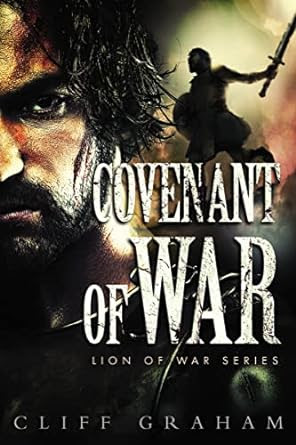
Covenant of War (Lion of War Series #2) by Cliff Graham
348 pages.
There have been plenty of historical fiction books written about ancient wars as of late. Stephen Pressfield's Gates of Fire about the Battle of Thermopylae or Conn Iggulden's Emperor Series about Julius Caesar come to mind. Bible-based historical fiction about war is pretty rare, however. Cliff Graham has chosen to write about the Old Testament's most complicated and best-documented warrior, David in the Lion of War Series.
In Covenant of War, David has just become King of Israel after the deaths of Saul and Jonathan. The kingdom is still quite torn and David's control of some areas is in name only. While he is still consolidating his power, the Philistines invade, yet again.
Graham has written the book based on the warriors described in 2 Samuel 23 and 1 Chronicles 11. The texts are hardly true histories in the sense that they tell a complete story and there is a lot of detail to fill in to make a full-fledged novel out of the material provided. Graham has done a solid job of providing a coherent story. The story focuses on the thirty leaders mentioned in the text, especially the three mentioned as "David's mighty warriors" is 2 Samuel 23:8. There is intrigue aplenty as David defends his people from the Philistines.
Graham fleshes out those warriors pretty well, but David is pictured as an erratic, capricious ruler throughout the book. I never got a feel for David throughout the book. It made the whole book seem rather difficult to read because the motivations of David are hidden. The battle scenes, however, are quite vivid (and bloody).
I rate this book 3 stars out of 5.
This book can be found on Amazon.com here: Covenant of War.
Reviewed on June 4, 2012
Mysteries of the Ancient World by National Geographic Society
Okay, but a bit disappointing
Published in 1979 by National Geographic
So, why am I disappointed?
I was hoping for an theme-based work that looked at different mysterious objects, behaviors and cultures of the ancient world across the world and made comparisons and connections between them.
Instead, Mysteries of the Ancient World is a series of unrelated articles that have the look and feel of the National Geographic style. Don't get me wrong - I like the National Geographic style but the book as a whole lacks flow and feels more like a copy of the magazine than a special book. It is not an integrated work and leaves out plenty of big mysteries (Great Zimbabwe, Nazca Lines, Petra, the Olmecs) in favor of smaller mysteries such as the Etruscans and Catal Huyuk.
Topics include:
-The Etruscans
-Ice age cave paintings
-Stonehenge and related Megaliths
-Minoan civilization
-Mycenaean civilization
-Catal Huyuk and Jericho
-Easter Island and the South Pacific Ocean
-Ancient Egypt
-Ancient India
I rate this book 4 out of 5 stars
This book can be found on Amazon.com here: Mysteries of the Ancient World.
Reviewed January 8, 2008
Palestine: The Special Edition (graphic novel) by Joe Sacco
Published in 2007 by Fantagraphics books.
320 pages.
Joe Sacco headed off to to the Palestinian refugee camps with a few bucks in his pocket, a sketchpad, a little training in how to draw comic books, a rarely used camera (film was too expensive) and a curious mind. Sacco interviewed Palestinians and asked them about all sorts of aspects of their lives: jobs, the intifada, women's rights, Land for Peace, and much more. Sacco turned those interviews into this graphic novel (although Sacco does not like that term much - instead he prefers "comic book journalist").
![]() |
| Joe Sacco (self-portrait) |
Sacco occasional touches on the topic of who is right and who is wrong in this book. It does carry a pro-Palestinian slant (it was designed to be that way - I have no idea where Sacco's real sympathies lie), but it does not hammer on those issues.
Not a fun book, but an important one. Strongly recommended for anyone interested in the Israeli-Palestinian conflict, no matter which side you come down on.
I rate this book 5 stars out of 5.
This book can be found on Amazon.com here: Palestine: The Special Edition
Reviewed on February 2, 2008.
After America: Get Ready for Armeggedon by Mark Steyn
Published in 2011 by Regnery.
The above quote is from the economist Herbert Stein. Besides being a clever little bit of the obvious, a Yogi Berra-type quote, it is also part of a scary thought about America itself that Mark Steyn points out in After America - America cannot keep doing what it is doing forever and hope to lead the world - it will stop. It cannot keep borrow 40% of its budget forever and hope to keep its economy afloat or offer its children a decent future. America cannot hope that a post-America world will be pleasant - as Steyn notes on page 14 "...it's not hard to figure out how it's going to end."
After America: Get Ready for Armageddon is really the sequel to America Alone: The End of the World As We Know It
![]() |
| Mark Steyn |
What are his points? Steyn starts with commentary about the national debt that seems as fresh as if it were a column written today thanks to the government's extended wrangling over the debt ceiling this summer. He also comments about how politically correct thought, excessive regulation and years upon years of erosion of free speech rights and property rights are changing this country from a can-do country to an entitlement country.
Steyn changes his style a bit in a chapter called After: A Letter from the Post-American World. This is a sobering, even depressing chapter As the title suggests, this is a letter from the future and it shows how when the West hamstrings itself, the whole world suffers and it does not become a place you would want your children to live in. Or your Jewish friends. Or your gay friends. Or perhaps even your Christian friends. It's not like we aren't being warned about this possibility now - Steyn points out headline after headline, trend after trend that should be screaming to us. But, we have Facebook to play with and Jersey Shore to watch. Plus, who are we to judge? So, Steyn predicts on page 306: "...incremental preemptive concession was the easiest option. To do anything else would have been asking too much."
This is not a perfect book. Not all of Steyn's arguments hold water, in my opinion. But, most of them do and this is a must-read book for anyone interested in big picture history. In this entertaining and sobering book Steyn predicts that we are at one of those hinges of history moments and we are not going to succeed.
****
On a separate note, I criticized America Alone because it had no footnotes or end notes. It didn't even have a bibliography. This book has extensive end notes with bibliographical reference and is meticulously indexed so the reader can easily find this information and articles for him(her)self and inform others.
This book can be found on Amazon.com here: After America: Get Ready for Armageddon
My Glorious Brothers by Howard Fast
A great piece of historical fiction - strongly recommended
Originally published in 1948.
When I teach world history I always give my students a project in which they are to read a piece of historical fiction and do a bit of research. This book is exactly the type of book I recommend for them to read and why I created the project in the first place. My Glorious Brothers is well-written and re-creates a little bit of the historical world for the reader.
Set in 2nd Century B.C. Israel, this is a story of national liberation and freedom of religious expression. Many Protestants will be unfamiliar with the Maccabees since Maccabees 1-4 is not included in the Protestant Bible. This book is an ideal place to start to explore that time between the exile in Babylon and the Roman occupation that is featured in the New Testament.
The main characters are 5 brothers and their father, descendants of the Tribe of Levi. They refuse to be "civilized" by Hellenized (Greek-influenced) Syrians - they want to keep their old traditions and religion. They revolt against too many taxes, too many injustices and being forced to worship Greek gods. ("Thus they 'Hellenized' us, not with beauty and wisdom, but with fear and terror and hate." - p. 33)
![]() |
| Howard Fast (1914-2003) |
I strongly recommend this one. Despite being more than 60 years old, this book can stand on its own among newer and more popular works about the ancient world such as Gates of Fire: An Epic Novel of the Battle of Thermopylae
Quote from the book I particularly liked this line based on a Bible verse from the Old Testament book of Micah: "What does the Lord require from a man, but that he should walk humbly and love righteousness?" (p. 142)
I rate this book 5 stars out of 5. It can be found on Amazon.com here: My Glorious Brothers.
Reviewed on August 19, 2008.
Featured Post
<b><i>BAN THIS BOOK (audiobook)</i></b> by Alan Gratz
Published in 2017 by Blackstone Audio, Inc. Read by Bahni Turpin. Duration: 5 hours, 17 minutes. Unabridged. My Synopsis Ban This Book is t...
Popular posts over the last 7 days
-
Published by Hourly History in 2025. Hourly History specializes in histories and biographies that take a reader about an hour to read. It s...
-
Would Serve as an Excellent Introduction to the Civil War Originally published in 1981. Bruce Catton (1899-1978) was the top Civil War histo...
-
Originally published in 2009. In 1960, a six year old little girl named Ruby Bridges was to be the first African-American student to integ...
-
Published by Recorded Books in 2015. Read by Jonathan Davis. Duration: 13 hours, 7 minutes. Unabridged. In the mid-1400s Portugal was poised...
-
Published in May of 2016 by HarperAudio. Read by Kaleo Griffith Duration: 5 hours, 44 minutes Unabridged Besides being a Law Professor ...
-
Originally published in 1973. Breakfast of Champions , to me, is the second most well-known Vonnegut novel after Slaughterhouse-Five . The ...
-
Published in 2013 by Top Shelf Productions. Written by John Lewis and Andrew Aydin. Illustrated by Nate Powell. Congressman John Lewis (19...
-
Originally published in 2000 as Rope Burns: Stories from the Corner . F.X. Toole (1930-2002) worked as a trainer and as a corner man in su...
-
Originally Published in 2020. Published by Oxford Press in 2022. Historian Heather Cox Richardson has made herself into a name brand histori...
-
Published in 2013 by Blackstone Audio. Read by William Hughes Duration: 11 hours, 42 minutes. Unabridged Thomas Fleming readily admits ...