Showing posts with label North Carolina. Show all posts

KING RICHARD I: THE AUTOBIOGRAPHY of AMERICA'S GREATEST AUTO RACER by Richard Petty with William Neely


Originally published in 1986.


Richard Petty is NASCAR's winningest driver, with 200 wins. He raced from 1958-1992. He won seven championships, he won the Daytona 500 7 times and is one of the few drivers to win at every track he competed on during the course of his career. In 1967 he won 10 races in a row (!) on his way to winning 27 races for the season. 

He also won the very first NASCAR big time car race I ever saw at Michigan in 1981. 

I was already a fan - and I was sure that he would win every race I attended from the point forward (he didn't).

The Petty family raced in stock car races back when they really were stock cars - you could buy replacement parts at local dealers or in junkyards. They raced when you could drive the car to the track - but that was a bad idea if you were caught up in an accident and couldn't drive it back home.

They got in on the ground floor of NASCAR, with Richard Petty's dad winning 3 of the early championships and Richard, his brother, and his cousin serving as his underaged pit crew and car builders.

Petty's story is interesting enough, but because his story coincides with so much of the early history of NASCAR, it also tells their history as well - especially from the beginning to the mid-1970s. One could easily say that Richard Petty and NASCAR grew up together.

I found this to be an enjoyable well-told autobiography/history. Very well told. The cover quotes Playboy magazine as saying that King Richard I was "The best sports book of the year." They may have been right - it is very good.

I rate this book 5 stars out of 5. It can be found on Amazon.com here: King Richard I: The Autobiography of America's Greatest Auto Racer.

THE INSTINCT for COOPERATION: A GRAPHIC NOVEL CONVERSATION with NOAM CHOMSKY (graphic novel) by Noam Chomsky and Jeffrey Wilson


Published in 2018 by Seven Stories Press.
Written by Noam Chomsky and Jeffrey Wilson.
Art by Eliseu Gouveia.


Jeffrey Wilson interviewed Noam Chomsky for The Instinct for Cooperation and the results probably would have been a typical interview with Chomsky. The interview was about the Occupy Wall Street Movement and the little groups that organically formed within the protests, such as the food tent, the medical tent, and the library. 

Wilson wove in interviews that he had done with people who participated in the Occupy Movement, students and teachers who had bad interactions with education "reform" movements, and other topics like student loan debt. 

This could have easily been a mess, but Wilson does a very good job of weaving together all of the interviews so that it felt more like a natural free-flowing conversation. The illustrations helped move everything along to make this very digestible. There is a lot of food for thought.

Well done.

5 out of 5 stars.

This graphic novel can be found on Amazon.com here: The Instinct for Cooperation: A Graphic Novel Conversation with Noam Chomsky.

THE ENIGMA AFFAIR: A NOVEL (audiobook) by Charlie Lovett


Read by Nicole Zanzerella.
Duration: 12 hours, 6 minutes.
Unabridged.


Synopsis:

An Enigma Machine from World
War II.
Patton Harcourt is a very small town librarian in North Carolina. One morning, while cooking in the kitchen, a sniper round comes through her window and nearly hits her. She reacts well (thanks to her previous career in the military) and finds a stranger at her door. 

He is not the sniper, but he is an assassin that was hired to kill another person in town. Against her better judgment, she joins with the assassin to elude the sniper team.

All of that happens in the first 10 minutes or so of this audiobook.

From there, they discover a handmade copy of World War II Enigma machine (the British machine that broke the German secret codes) and are off to confront modern-day Neo-Nazis...

My Review:

This book was certainly action-packed, extremely fast-paced ,and had some good moments. But, it also had some practical issues that just didn't jive with reality. For example, one of the main plot points is that they cannot access the internet because they will be detected and tracked down. This completely ignores the existence of proxy servers. A professional assassin should have been familiar with this technology as a way to hide his location when communicating with clients.

Later, the characters are speaking German and passing off as native speakers (this is a vitally important point more than once). Granted, it is not complicated German, but very few untrained people can pass themselves off as native speakers in a second language. I've been speaking Spanish as a second language for years and I would never be confused for a native speaker.

This is not a bad book. The quick pace was fun, the bad guys are truly bad, and the flashbacks to World War II were well-done. But, the end result was 3 stars out of 5.

This book can be found on Amazon.com here: THE ENIGMA AFFAIR: A NOVEL by Charlie Lovett.

THE FALSE CAUSE: FRAUD, FABRICATION, and WHITE SUPREMACY in CONFEDERATE MEMORY (audiobook) by Adam H. Domby


Published by Blackstone Publishing in 2022.
Unabridged.

The cover of the book and the short description offered by my library app gives the impression that this book is pretty much about the "Silent Sam" Confederate memorial that stood at the University of North Carolina from 1913-2018.

This book is much more than that, though. It uses Silent Sam as an entry point into a larger discussion of how North Carolina chose to remember how it performed in the Civil War (more than 10% of Civil War soldiers from North Carolina actually fought for the Union.)

He also discusses how White men lied about their service to get Confederate pensions and the government turned a blind eye in the name affirming White unity and White Supremacy. Whites that fought for the Union (but couldn't qualify for a Union pension) or actively fought the Confederate draft with violence or by simply going AWOL at every point possible were given pensions. 
The idea is that by the late 1800s and early 1900s the idea was to deny that any Whites had ever disagreed with the Confederacy in the first place. If a little graft and fraud had to be tolerated to achieve the illusion of White Unity than that was a reasonable price to pay.
A billboard during the height of the 
Silent Sam controversy

A large chunk of the book is devoted to making the point of the previous paragraph. It is convincing and a little tedious. Much more profound is the text of the speech that was given by a Confederate veteran and political bigwig at the 1913 dedication. Julian Carr was a political moderate when it came to African Americans in North Carolina, but he makes it abundantly clear that the Silent Sam statue is there as a visible reminder to everyone of the "good old days" when all Whites stood together against the North and all Blacks knew their place. 

Interestingly, that is exactly what the modern day anti-monument protesters claimed and exactly what the Neo-Confederates denied. 

The book patiently lays out all of its arguments (there are a lot more than I have laid out here) and proves its points - just not always in the most compelling manner. 

I rate this audiobook 4 stars out of 5. It can be found on Amazon.com here: 
THE FALSE CAUSE: FRAUD, FABRICATION, and WHITE SUPREMACY in CONFEDERATE MEMORY by Adam H. Domby.

WALKING ACROSS EGYPT by Clyde Edgerton


Originally published in 1987.

Mattie Rigsbee is a 78 year old widow whose primary activities are cooking great meals, mowing the yard and going to church on Sundays.

Lately, she has been pondering Matthew 25:40-45 and Jesus' command to help "the least of these".

40 “The King will reply, ‘Truly I tell you, whatever you did for one of the least of these brothers and sisters of mine, you did for me.’41 “Then he will say to those on his left, ‘Depart from me, you who are cursed, into the eternal fire prepared for the devil and his angels. 42 For I was hungry and you gave me nothing to eat, I was thirsty and you gave me nothing to drink, 43 I was a stranger and you did not invite me in, I needed clothes and you did not clothe me, I was sick and in prison and you did not look after me.’44 “They also will answer, ‘Lord, when did we see you hungry or thirsty or a stranger or needing clothes or sick or in prison, and did not help you? 45 “He will reply, ‘Truly I tell you, whatever you did not do for one of the least of these, you did not do for me.’

The author, Clyde Edgerton
A stray dog leads her to call the dogcatcher. She discovers that the dogcatcher has a nephew in the county juvenile detention center and she decides to visit him because he is one of the "least of these" and bring along some of her home cooking. 

And that's where the fun starts...

*****

I had never heard of this book or this author before. I literally picked this book up from a pile of books on a cart full of books about to be discarded by a high school. I had no expectations. I was surprised at how readable and funny the book was. Very enjoyable.

I rate this book 4 stars out of 5. It can be found on Amazon.com here: Walking Across Egypt by Clyde Edgerton.

THE RECOVERY AGENT: A NOVEL (audiobook) by Janet Evanovich


Published in 2022 by Simon and Schuster Audio
Read by Lorelei King
Duration: 7 hours, 26 minutes.
Unabridged.


Janet Evanovich's The Recovery Agent features Gabriela Rose. Recovery agents can be another term for bounty hunters who look for fugitives, but Gabriela Rose is not a bounty hunter. She searches for missing property. Sometimes it's insurance fraud, sometimes it's stolen property and sometimes it's just looking for something rare for a wealthy client. She is based in New York City, is quite successful and flies all over the world recovering items. 

Gabriela Rose is dismayed to hear that her hometown in North Carolina has suffered a direct hit from a hurricane and (somehow) won't get any help from FEMA or any other government recovery program. The town is dying but Gabriela's grandmother knows where a fortune might be found. She was somehow told about the fortune by the ghost of her dead grandmother. In that fortune there is a ring called the Seal of Solomon. This ring is mostly in Arabic language legends about King Solomon of Israel who could use it to talk to animals and to control demons and djinn (genies).

Most of the book is a hunt to find and keep the ring in various settings with an ongoing simmering romance on the side. Readers familiar with the 1980s movie Romancing the Stone or the 2022 movie The Lost City will get the idea - except this book has competent protagonists.

My review:

This book is just all over the place, literally. There are 5 different trips to 4 different countries with jungles to find this ring. It gets old.

*****caution: spoilers*****

The goal of all of this searching is to find a treasure to save the town. Time after time the main characters leave behind literal fortunes of common, run of the mill gold trinkets, jewel-encrusted necklaces, statues, and at least one other famous golden item that would certainly have saved the town. 

There are other issues as well. Evanovich loves to name drop products in her books - pistols, boats, cars and more are named by brand. At one point, there is a planned attack on a compound. Gabriela Rose goes into battle with a fully automatic machine gun wearing a $465 La Perla Balconette bra (the price is mentioned). We know what bra she is wearing because at one point her bra is used as a tourniquet. Who wears a $465 lacy push-up bra into battle and not a sports bra? Sure, it made for a funny scene in the book, but it makes no sense - especially when she goes to a Target later on and buys common everyday underclothing and makes comments about how great they are.

*****end spoilers*****

What is good in the book is interesting supporting characters throughout the book.

I rate this audiobook 2 stars out of 5. It can be found on Amazon.com here: THE RECOVERY AGENT: A NOVEL (audiobook) by Janet Evanovich.

CONFEDERATE GENERALS of the CIVIL WAR (Collective Biographies series) by Carl R. Green and William R. Sanford


Published in 1998 by Enslow Publishers, Inc.


Part of a series of 8 books, Confederate Generals of the Civil War was intended to be a classroom or school media center supplement for students to use as a resource. It is not a large book - 112 pages including a glossary, some charts comparing the the Union and the Confederacy, 2 maps and a timeline of the Civil War.

There are 10 biographies, arranged in alphabetical order. Each biography is 8-9 pages, including a photograph of the general and a related picture (photo of a battlefield, drawing of a battle scene, etc.). 

The biographies themselves are pretty neutral, although it does take some mild stands on a few controversial items. It states in a matter of fact manner that Robert E. Lee was anti-slavery (It was definitely more complicated than that). It puts a lot of blame for Pickett's Charge on Longstreet, not on Lee. And, it gets sappily sentimental in the last paragraph of Pickett's biography. I would rate it as very mildly slanted towards the old "Lost Cause" theory of the war (the three areas I mentioned are all at the heart of the theory), but not fatally so. 

The featured generals are:

Nathan Bedford Forrest;
William Joseph Hardee;
A.P. Hill;
John Bell Hood;
"Stonewall" Jackson;
Confederate General George Pickett
(1825-1875)
Joseph Johnston;
Robert E. Lee;
James Longstreet;
George Pickett;
J.E.B. Stuart

Other books in the series include a collection of biographies of Union Generals, "Women in America's Wars" and "American Heroes of Exploration and Flight".

I rate this book 3 stars out of 5. The biographies are just not all that interesting out of context. This book can be found on Amazon.com here:CONFEDERATE GENERALS of the CIVIL WAR (Collective Biographies series) by Carl R. Green and William R. Sanford.

RACER by John Andretti and Jade Gurss


Published by Octane Press in September of 2020.

I thoroughly enjoyed this autobiography because John Andretti was my favorite race car driver - period. 

I have watched auto racing for as long as I can remember. Some of my earliest memories are going to qualifications for the Indy 500. I have Janet Guthrie's autograph - not realizing when I got it that it was actually an amazing autograph to have. The sound of a single car circling the track with the roar and whine of the engine (it has both sounds at the same time) echoing off of the stands makes the hair on the back of my neck stand up. The history at that track cannot be topped by any other venue in the world.

I attended my first NASCAR race at Michigan in 1981 with my father. The spectacle of the whole thing was amazing. It was won by my favorite driver at the time, Richard Petty. In 1986, we went to our first Indy 500 and haven't missed one since (the 2020 race doesn't count since no spectators were allowed due to Covid-19). 

John Andretti first came to my attention as the cousin and nephew of his more famous relatives, Michael and Mario Andretti. He was like an also-ran compared to them because he didn't come with fully-funded top-notch rides and I paid him little attention - he had the famous name but I wasn't particularly fond of his cousin Michael Andretti. Michael had a reputation for complaining about everything and everyone. He has gotten much better as an owner and I have to say I am truly a fan of the way he manages his IndyCar teams.

So, when a local Indianapolis radio station started to interview him every week I listened with some serious skepticism. Before long, I found that I had a lot in common with John. We were born in the same hospital (5 years apart) and I live on the West Side of Indy, where he grew up. It became clear that he was much more of a regular guy race car driver than his more famous cousin. Plus, he had a great sense of humor. 

Soon enough, his segment became "must listen" radio for me and I became a fan. He started a go-kart race as a joke competition with one of the on-air personalities and raised money for Riley Children's Hospital in Indianapolis. It became know as the Race for Riley. I attended a few of them as the event grew from just a few thousand dollars to raising hundreds of thousands at a time (almost $5 million at the time this book was published). In fact, a portion of the purchase price of the hardcover edition of this book goes to Race for Riley.

John Andretti really lies at the intersection of my racing interests. I love the Indy 500 - and so did he. My favorite driver in NASCAR was Richard Petty and I was the absolute happiest as a fan when John drove Petty's 43 car. And John was the first driver to race the Indy 500, climb on a plane and then fly to Charlotte, North Carolina to race in NASCAR's longest race - the World 600 (as it was called then).

John's reaction when he discovered he had colon cancer was not surprising. His was so advanced when he found out that he really had almost no chance. He went out of his way to let people know that that was easily preventable and they could learn from his example and get a colonoscopy early on to have a better result. I did - one month before his death. And, it was a good thing, too! Thanks, John. 

Having heard John in several year's worth of weekly interviews, I can tell you that this book does have the true feel of his voice, which says a lot for his ghost author Jade Gurss. Gurss seems to specialize in racing-related books, which had to be a big help for writing this one.

The last page of this book hit me like a ton of bricks, even though I knew exactly how it ended. 

Left to Right: Richard Petty, John Andretti and
Michael Andretti. John ran a car with Richard
Petty's traditional colors for his cousin's
team in the 2010 Indy 500.
There are four forwards to the book and they are a testament to John Andretti's level of connection in the racing community: Mario Andretti, A.J. Foyt, Michael Andretti and Richard Petty. This is a collection of American racing royalty that is unrivaled. 

So, there is my mess of a review of a book that I absolutely enjoyed. I rate this book 5 stars out of 5. It can be found on Amazon.com here: RACER by John Andretti and Jade Gurss.

THE STORY of the CHEROKEE PEOPLE by Tom B. Underwood


Originally published in 1961.


According to the price tag on this book, I picked it up at a souvenir store in The Great Smoky Mountains National Park. I couldn't tell you when for sure, but my best guess is that it was about 45 years ago. This is a small book, almost like a large children's book, so it just moved along with me wherever I went and I never read it until now.

The cover of the book is deceiving. The cover looks like it was written for small


children (that is most certainly how I acquired it) but the pictures in the book are much more detailed and complicated, much more like those found in an old-fashioned encyclopedia or an old-style museum. The text is certainly not written for small children, although it does have a slightly paternalistic tone. It feels dated.

The one really strong feature to this book is a seven page testimony about the Trail of Tears from Private John Burnett. Burnett was ordered to accompany the Cherokee because he could speak their language. The inclusion of his story brings the rating for this book up to 3 stars out of 5.

This book can be found on Amazon.com here: The Story of the Cherokee People by Tom B. Underwood.

ROANOKE: THE MYSTERY of the LOST COLONY by Lee Miller


Published in 2007 by Scholastic Nonfiction.
Suggested for readers grades 9-12
.

I've read my fair share of articles about the lost colony of Roanoke. They all have a similar story line. They tell the story from the colonists' point of view. And why wouldn't you tell it that way? It's a compelling story when it is told that way. Roanoke: The Mystery of the Lost Colony comes at this story differently - it incorporates the court politics back in England and the mixed motivations for creating the coloy in the first place.

If you are not familiar with the story. Roanoke was England's first serious attempt to put a colony in the New World. It originally had a duel purpose. The first was simple enough. Sir Walter Raleigh had legal claim to the land as part of an inheritance, but only if he could establish a permanent colony on it by 1591. It was an immense piece of property, if he could keep it. It would have included all of the North American coast north of Spanish Florida and south of Newfoundland.

The second purpose of the colony was to provide a protected port to allow English ships to attack Spanish galleons full of gold, silver and other riches. The barrier islands of North Carolina looked like a perfect fit.

But, Raleigh was not allowed to supervise the colony because he was required to stay in the Queen's court, at her request (or demand - she was a queen, after all). So, he sent out a military-type expedition in 1585. It failed, but it did offer some valuable information for the next attempt in 1587. 

A painting by John White. 

John White participated in the 1585 venture as the expedition's artist. His paintings and maps fill this book and most are quite beautiful. in 1587, White led the second attempt to start a colony. If you have studied the original English colonies, you will recognize the familiar pattern - the colony struggles with the local environment and the local people, sends for more supplies and more people and will go on to grow and prosper.

Except that Roanoke sent for more supplies and more people but none were sent out to reinforce the colony...

As I alluded to above, most stories of Roanoke spend a lot of time looking at where the missing colonists might have gone but gloss over why the English never sent more supplies and more people. Lee Miller focuses on the intrigue in the Elizabethan Court and how Raleigh was prohibited from sending out relief supplies. I thought this was a fascinating take on the story. It becomes a story of backroom deals, spies, betrayal and desperation.

John White was convinced to leave behind his family in late 1587, including an infant granddaughter, to personally ensure that the relief supplies were delivered and he was stymied at every turn. By the time he returned almost three years later the colony was gone with only a couple of mysterious clues as to where they may have gone. They were never found and England didn't successfully plant a colony until 1607.

I rate this book 5 stars out of 5. It can be found on Amazon.com here: ROANOKE: THE MYSTERY of the LOST COLONY by Lee Miller.

ALISTAIR COOKE'S AMERICA by Alistair Cooke


Published in 1973.

In 1973, undoubtedly to prepare for the upcoming 1976 bicentennial of the American Declaration of Independence, BBC reporter and author Alistair Cooke released a book and a television mini-series telling the history of the United States to the U.K. The book and the series came to America as well with the book selling nearly 2 million copies. This massive "coffee table" type book has 393 pages and weighs in at 3 pounds, 9 ounces (compare that to a random paperback book I weighed at just 5 ounces).

Photo by Lewis Hine
Cooke presents a straight-forward history of America, skimming over lots of details but getting the highlights. This has to be the case when you cover more than nearly 500 years of history in less than 400 pages. He focuses half of the book on the exploration/colonial/Revolutionary War/Constitutional era and it is by far the strongest part of the book.

This book is filled with beautiful, sometimes profound photographs. On pages 312-313 there is a two page spread of a lynching. Cooke claims that "no one knows who took this picture, or exactly when." (p. 311)   It was taken by Lawrence Beitler in Marion, Indiana on August 7, 1930. Beitler sold this photo for 10 days straight to sell as souvenirs of the lynching. Here is a link to a great book on the topic: 
A Lynching in the Heartland: Race and Memory in the Heartland by James H. Madison. Here is a link to the Wikipedia page on this lynching: Lynching of Thomas Shipp and Abram Smith.

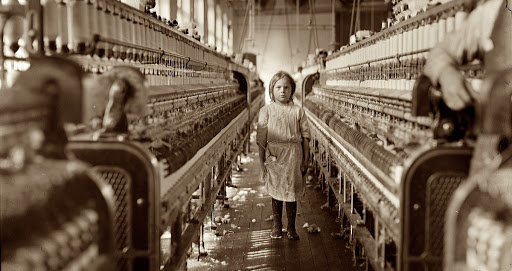
The photograph of the girl working in a clothing factory in North Carolina is another great photograph in book full of great paintings and photographs. I have included it in this review.


It is very readable, but clearly a product of its time, and Cooke is a reporter, not an historian. The book has a bit of a racist feel to it. For example, when discussing where the United States lays on the globe (not too hot, not too cold), he notes: "...the United States spans the limits of the climates that white men can live and work in." Cooke mostly skips over the Native American civilizations that inhabited the Americas before Columbus. He spends almost as much time discussing entertaining but mostly nonsensical theories about the Phoenicians settling in the Americas as he does the actual Native American civilizations themselves. Cooke's reasoning is that he is covering a history of the United States itself, so Native Americans get the short end of the stick, except as an impediment to American expansion for the first 2/3 of the book.

Cooke does a similarly poor job dealing with African Americans, a group that he cringingly calls "the blacks" throughout. 
He does, however, clearly observe (in a clunky manner) that slavery and the continuing racial prejudice against African Americans is an ongoing open sore and has never been dealt with properly.

Final rating - 4 stars out of 5, keeping in mind that this history book is clearly old enough to be an historical artifact itself.

It can be found on Amazon.com here: 
ALISTAIR COOKE'S AMERICA by Alistair Cooke.

THE FINAL DAY (audiobook) by William R. Forstchen


A Review of the Audiobook

Published in January of 2017 by Blackstone Audio
Read by Bronson Pinchot
Duration: 12 hours, 11 minutes
Unabridged

The conclusion of the John Matherson trilogy*** does not bring a fairy tale ending to his story of post-EMP America, but it does answer an important question from both of the previous novels - just who has taken over the reins of what remains of the Federal Government?

For those who don't know, an EMP is short for Electro-Magnetic Pulse. Nuclear weapons generate this pulse when they explode and these weapons can be fine-tuned to generate an pulse that will cover a large part of North America. The pulse completely fries modern electronics and in this book series the United States is thrown 100 years back into the past in terms of technology.

John Matherson continues to lead his North Carolina community and they are having some success in re-establishing some of the technology that existed before the attack. They are slowly adding new communities into the fold and are now calling themselves the State of Carolina.

But, this is interrupted by the arrival of a message from Matherson's old commanding officer from his Army days. The Federal government has not forgiven Matherson's community for their attack on a poorly-trained Federal army made up of draftees last year and they are demanding that his community submit to their authority or be invaded by regular Army troops with tons of air support. Matherson is torn - he wants to trust his old friend and mentor but he knows he cannot trust this group that claims to be the reconstituted Federal government...

Unfortunately, this book continues in the trend of the second book in this series instead of the first.  There are plot holes, forgotten characters and lots and lots of repetitive long lectures from characters. So many characters don't have conversations - they deliver speeches. And, some don't just deliver them once, they deliver them again and again. This audiobook could have been edited down by 2 or 3 hours and it would have been a much better experience.

Forstchen has a lot of cursing which does not bother me - soldiers curse and people curse when they get shot at and these things happen plenty throughout the series. I grew up in a family that brought cursing up to the level of art. The cursing in this book oftentimes sounds so inauthentic that it was like it was inserted to butch up the story some. Bronson Pinchot's attempt to read the curses and the random yelling like the book described just served to reinforce how clunky so much of this dialogue really is (how many times can you look out the window and curse the people that attacked America in just one book? How many characters can make the same curse in the same book?)  I was reminded of Harrison Ford's comment about George Lucas's dialogue in Star Wars: "George, you can type this $#!+, but you sure can't say it!"

Also, while I was glad to finally see who was behind this re-constituted Federal government, I did not buy the backstory. It was a let-down.

I rate this audiobook 3 stars out of 5.

This audiobook can be found on Amazon.com here: The Final Day by William R. Forstchen
.

***NOTE: a fourth book was added to the series in 2023. I am not going to look into it. 

ONE YEAR AFTER (John Matherson #2) (audiobook) by William Forstchen


The Story Continues...


Published in Blackstone Audio in 2015
Read by Bronson Pinchot
Duration: 9 hours, 51 minutes
Unabridged


In this sequel to the bestseller One Second After, Forstchen continues to tell the story of what happens to a North Carolina community called Black Mountain after the United States is attacked by multiple EMP attacks from nuclear weapons. All of the modern technology is fried (computers, modern cars, the electrical grid, anything with a circuit board) and America reverts back to a pre-industrial technology level.

*********SPOILER ALERT*************


An Apache helicopter
This book starts one year after the ending of the first book which ended one year after the attack. The main thrust of One Year After is that the federal government has returned in the guise of an appointed administrator working out of Asheville, NC. It is unclear exactly who is in control of the federal government, but they are drafting most of the able-bodied soldiers of the communities that survived the chaos after the EMP attack. The largest cities, like Chicago and New York City, are in complete chaos. A leader of a cult has taken over giant areas of Chicago and has successfully resisted a federal invasion led by largely untrained troops. So, the idea is to recruit local militias into a million man army to re-take America - an army led, in part, by John Matherson, who would be promoted to General.

A main theme is a burgeoning federal vs. local conflict symbolized by this demand for most of Black Mountain's local militia. If the militia joins the national army the town of Black Mountain is left defenseless The federal administrator is a cardboard cut-out of a toady bureaucrat who does not really know how to lead people but uses his connections to bully them instead. He has the superior military hardware in the form of Apache helicopters, but no particular skill in using his advantage. In opposition we have John Matherson who has become his town's patriarch and is willing to have his town destroyed rather than submit.


The series of fights throughout the second half of the book were interesting but rather pointless. Why would this federal administrator want to destroy one of the few places that can actually feed and defend itself? His style is all wrong for a brown-nosing toady - those guys know how to manipulate people and this guy does not. Most of the conflict in this book could have been solved with two or three short-wave radio conversations that included John Matherson from Asheville to the new federal government location outside of Washington, D.C.

***********End Spoilers************

Bronson Pinchot read the book and, for the most part, he did a good job. However, the accent he created for the bad guy federal administrator kept going in and out and sounded at various times like he was from the midwest or the south. But, the character said he was from Boston. I don't know if it was a really clever intentional thing - something to emphasize the guy was a liar about everything, including his accent, or if it was just a series of mistakes.

In short, there is a large drop-off in quality from book #1 in this series to book #2. I will finish the series but I am expecting a lot less of the third installment. 


I rate this audiobook 3 stars out of 5.

This book can be found on Amazon.com here: One Year After

ONE SECOND AFTER (John Matherson #1) (audiobook) by William R. Forstchen


A Review of the Audiobook


Published in 2009 by Blackstone Audio
Read by Joe Barrett
Duration: 13 hours, 21 minutes
Foreword by Newt Gingrich
Unabridged

When One Second After was first published, it made a sensation of sorts, which is pretty tough to do if you are a science fiction book. As the book's promoters are proud to point out, excerpts from this book were even read into the Congressional Record from the floor of the House of Representatives as a warning about the dangers of an Electromagnetic Pulse (EMP) weapon to the United States.

An EMP happens as a by-product of the explosion of a nuclear weapon. In short, a nuclear weapon detonated high in the atmosphere can generate this pulse and fry almost all modern electronic circuits by overwhelming them much like a lightning strike will due when it hits someone's home. The pulse can be generated from high enough in the atmosphere that the bomb itself does not cause an explosion on the planet's surface or even cause a radiation danger. In this book, no characters saw the nuclear weapons explode, all they certainly felt the effects of the EMP.


In this book, three weapons disable almost every piece of electronics in the United States. The book demonstrates that America is remarkably vulnerable to such an attack. Almost none of our facilities are "hardened" to survive such an attack. In fact, almost none of our military facilities and vehicles are hardened to survive EMP attacks - the exception being the few bits of machinery that were survivors from the Reagan Administration. Sadly, the Reagan Administration was the last administration to take EMP seriously enough to take steps to survive it.

So, all vehicles from the mid-1970s forward are rendered inoperable due to their electronic controls. Power plants are wiped out. The phone companies are gone. Cell towers, television, computers, printers - all gone. Everything stops in its tracks right where it was all over the country. Planes crash. Trains stop. Cars stop all over the country right where they are.

America reverts back to its pre-electricity days and America is totally unprepared.


The strength of this book is the detailing of how America would fall apart after such attack but not its actual prose. There are lots of repetitive phrases and way too much detail about the nearby college (which also happens to be the where the author teaches). Lots of the story is told by way of discussion in the town council. The local doctor tells the council how horrible things will be once modern medicines are used up, etc. and then the narration goes on to say that it happened just like the doctor had predicted. It gets the story moving forward but it is not particularly compelling. Sometimes the book is just hamfisted and clunky in its approach.

But, I found myself intrigued by the story and I totally bought into the premise. I found myself listening whenever I could because I simply had to know what happened next. And, that is the mark of a good book, despite its faults. I was so intrigued that I immediately picked up its sequel.


The book was read by veteran reader Joe Barrett who does a solid job with a variety of accents. He did an especially good job with retired Army sergeant Washington Parker.

I rate this book 4 stars out of 5.

This audiobook can be found on Amazon.com here: One Second After by William R. Forstchen.

THE ENEMY (Jack Reacher #8) by Lee Child


Originally published in 2004.


Some authors are fastidious about their books being written in the order that events happen to the character. So, the events in book 5 will follow the events in books 3 and 4 and precede the events in books 6 and 7.

Lee Child does not feel the need to do that in his Reacher series. While The Enemy is number 8 in the order of publication, it is the first chronologically which makes it a great place to start the series.

Reacher is in the Military Police and has just been re-assigned from the invasion of Panama to remove General Manuel Noriega in December of 1989 to Fort Bird in North Carolina. It is New Year's Eve and just at the stroke of midnight Reacher gets a call. A General is dead in a seedy hotel off base. It turns out he died from heart attack while he was just starting an intimate moment with a mystery partner. Reacher is not too worried about things until he notes that the General's briefcase is missing.

So, Reacher starts digging and the mystery keeps getting bigger. When he finds out that the General's wife was killed by a burglar on the same evening, Reacher knows something is definitely wrong and he is somehow in the middle of it...

This was an enjoyable, engrossing novel. I was literally surprised about who had taken the General's briefcase until it was revealed at the end even though all of the facts were clearly laid out before me. My only consolation is that Reacher was just as surprised as I was.

Good read. I am going to start seriously reading this series.

I rate this book 5 stars out of 5.

This book can be found on Amazon.com here: The Enemy (Jack Reacher)

BONES in HER POCKET (Temperance Brennan #15.5) (audiobook) (short story) by Kathy Reichs


Published by Simon and Schuster Audio in December of 2013.
Read by Linda Emond
Duration: 1 hour, 56 minutes.
Unabridged.

This short story is designed to go between books 15 & 16 in the series and is the audiobook version of a kindle e-book that was released in the summer of 2013.

In Bones In Her Pocket forensic anthropologist Temperance Brennan is called out to a remote location called Mountain Island Lake. It is the site of an artist colony and a raptor rescue center (they help deal with injured hawks, eagles and owls as well as advocate for policies that will help those animals).

A body was found floating in a canvas bag that floated up in the aftermath of a serious flood. As Brennan figures out whose body was found she soon discovers that there is no shortage of suspects...

This is my first Kathy Reichs book of any sort. To her credit, Reichs did not lose this newbie to her series despite the short length of the audiobook. The story moves along quickly and is easy to follow.

The reader, Linda Emond did a fabulous jobs with the reading, particularly the  accents. 

Note: This audiobook was sent to me by the publisher through Audiobook Jukebox's Solid Gold Reviewer program in exchange for an honest review.

I rate this audiobook 4 stars out of 5.

This book can be found on Amazon.com here: Bones in Her Pocket.

Reviewed on January 25, 2014

Letters from a Slave Girl: The Story of Harriet Jacobs by Mary E. Lyons


The fictionalized version of a real-life runaway slave story.

Originally published in 1996.

Mary E. Lyons' book Letters from a Slave Girl is a fictionalized account of the true story of Harriet Jacobs, a slave girl from North Carolina who escaped and hid in her grandmother's attic for seven years, beginning in 1835, before making her way north to freedom.

Lyons chose to use a fictional diary format to tell the story of Harriet Jacobs. In real life Jacobs could read and write and actually published a book about her life in 1861 called Incidents in the Life of a Slave Girl.

The reward notice for Harriet Jacobs
The diary format has some strengths - it is an efficient way to note the passage of time and to tell about Harriet's feelings. However, it is not nearly as memorable as telling her story as a novel. The letters just do not have the same flow and impact as a story.

The book also include a set of pictures of some of the real people and places involved, a family tree and a thorough bibliography.

I rate this book 4 out of 5 stars.

This book can be found on Amazon.com here: Letters from a Slave Girl.

Reviewed on August 15, 2007.

April 1865: The Month That Saved America by Jay Winik


This is how history should be written!


Published in 2006 by Harper Perennial.

Winik asserts that the month of April 1865 was the single most important month in the history of the United States due to the confluence of historical events and decisions that came with the end of the Civil War.

The decisions include Lincoln's plan for a "soft" peace rather than a vengeful one. Lee's decision not to opt for guerrilla warfare but rather surrender and urge his men to become good citizens for their country (meaning the USA), Johnston's similar decision in North Carolina, the assassination of Lincoln, the uncertain rules of Presidential succession, the North's collective decision not to lash out blindly at a prostrate South in revenge for Lincoln's murder and a host of other issues.

My take: Winik is one of that new breed of historian that knows that good writing as at least as important as good research (You can't teach anything if you write poorly). Winik's synopsis of the issues of slavery and the Wilderness campaign are so good that if I ever get the chance to teach US history again I am going to copy them and hand them out to my students.

Jay Winik
This book renewed my awe of Robert E. Lee as a man. Flawed, like all of us, he made the exact right decisions at the end. Perhaps the most interesting was in the summer of 1865 - the war was over and Lee was back in Richmond awaiting his fate. It is communion Sunday and a black man decided to assert his rights as a free man and he goes up to the altar FIRST to get communion (traditionally, blacks were last). The whole church stops. The minister is flustered at the change of social niceties. Lee gets up - goes up to the front and stands next to the man for Communion. Now, the service must go on- because you can't refuse Robert E. Lee. Together, the two men integrated the church - with no prior planning. Lee just knew that this was the way it had to be now, so get over it.

Great book. I heartily recommend it.

I rate this book 5 stars out of 5.

This book can be found on Amazon.com here:  April 1865: The Month That Saved America

Reviewed on August 22, 2004.

Daytona: From the Birth of Speed to the Death of the Man In Black by Ed Hinton


Great book but there are a few errors

Originally published in 2001.

The title basically says it all. This fascinating book uses Daytona International Speedway and the old racing surface of Daytona Beach itself as its lens to focus on the world of NASCAR. Hinton has been a beat reporter covering NASCAR since the mid-1970s and knows all of the old stories and Hinton is able to package them so that the reader is reading one little vignette after another until the history of Daytona is told.

I was reading another book when I picked up this one (a Christmas gift that I hadn't really paid a lot of attention to) and began thumbing through it. I couldn't put it down! It is well-written and at times it is laugh out loud funny, especially if you are a NASCAR fan and are familiar with the older, retired drivers.

However, a couple of disturbing, trivial factual errors throw a negative light on the book as a whole. Two that I noted were Hinton's assertion that no rookie has won the Indy 500 since the 1926 race (in case you're wondering, Daytona Beach used to be used as a high-speed test site, much like Bonneville Salt Flats in Utah is used today and the 1926 winner died making such a high-speed run). I knew that his assertion was wrong since I witnessed rookies win the 2000 race (Juan Montoya) and the 2001 race (Helio Castroneves) - both were well-before publishing time for his book. Besides that, 2 minutes on Google told me there were two others - the 1927 and 1966 winners.

The Dukes of Hazzard  
in a car chase
Willy T. Ribbs
Secondly, he makes the assertion that California driver Willy T. Ribbs was encouraged by the example set by the TV show The Dukes of Hazzard to get drunk and play chasing games with the police in downtown Charlotte, NC in May of 1978. Since I spent a great deal of my own childhood watching the Dukes, I thought that that seemed a bit early. Sure enough, two more minutes on Google told me that the show premiered in January of 1979, so it really had no part in Ribbs' ill-conceived misadventures. Oddly enough, Ribbs' trip to the drunk tank gave Dale Earnhardt the chance to take his car - his first chance to drive a good car in the Winston Cup Series and this opportunity eventually led him to the career that made him a household name.

Despite these errors the book was a hoot to read and I'm sure I'll be lending it to every NASCAR fan I know.

This book can be found on Amazon.com here: Daytona: From the Birth of Speed to the Death of the Man in Black.

I rate this book 5 stars out of 5.

Reviewed on July 26, 2004.

Featured Post

<b><i>BAN THIS BOOK (audiobook)</i></b> by Alan Gratz

Published in 2017 by Blackstone Audio, Inc. Read by Bahni Turpin. Duration: 5 hours, 17 minutes. Unabridged. My Synopsis Ban This Book is t...

Popular posts over the last 7 days