Showing posts with label Tennessee. Show all posts

GRANT and LEE: VICTORIOUS AMERICAN and VANQUISHED VIRGINIAN by Edward H. Bonekemper III


Originally published in 2007.

Edward Bonekemper was a Civil War historian who came to the game kind of late in life - after he retired as an attorney for the federal government. 

However, he brings his skills as an attorney to this book. Imagine a regulatory attorney bringing all of his research to bear in order to win a case by simply  overwhelming the other side with binder after binder of evidence. In this case, the evidence is almost 200 pages of appendices, endnotes, and a bibliography. 

Bonekemper makes an argument in this book that Grant was undoubtedly the superior general when compared to Lee. In fact, he makes the arguments that Grant was the best general in the Civil War by far and Lee squandered his soldiers and his resources by going on the offense almost all of the time.

Being the best general does not mean Grant made no mistakes. It does not mean Grant was perfect. Bonekemper acknowledges mistakes by Grant in every campaign and gives Lee his due from time to time. 

Grant and Lee is really a dual history of these two generals, comparing their pre-war careers and then various stages of the war itself. For example, there is a chapter called May-July 1863 where the Vicksburg campaign is compared to the Chancellorsville/Gettysburg campaigns. 

A constant refrain is that Lee's biggest weakness is that he did not conserve his resources by falling back on the defensive. His argument is that Lee did not grasp the strategic fact that the North had to literally conquer the South while the South just had to stay alive until popular support collapsed in the North and the Europeans recognized the Confederate government. 

Instead of building a series of fortifications and compelling the Union forces to destroy themselves in useless attacks, Lee kept lashing out at Union forces and invaded the North twice only to lose both times and discourage European intervention after both failures.

Lee rarely lost more soldiers than the Union forces he fought, but he did not have a constant supply of new soldiers coming to the front - and the North did. Not only did the North replace soldiers at an amazing rate, they also managed to create all new armies when needed.

I found that I basically agreed with Bonekemper. Grant was the better general. Lee was too focused on Virginia and too eager to go on the offense. He did not save his resources and did not share the ones he had with other theaters of the war.

I rate this book 5 stars out of 5. It can be found on Amazon.com here: GRANT and LEE: VICTORIOUS AMERICAN and VANQUISHED VIRGINIAN by Edward H. Bonekemper III.

VICKSBURG, 1863 by Winston Groom


Originally published by Knopf in 2009.

Winston Groom will always be best known as the author of Forrest Gump, but he should be equally well known as the author of a series of well-told American histories. Included in those histories is a trilogy of Civil War histories that focus on the Western Theater of the war.

Vicksburg 1863 is the second book in the trilogy, but it can be easily read as a stand-alone history. After a short introduction to the war itself, it follows Grant's campaign to take the Mississippi River away from the Confederacy, beginning with a mess of a battle in Missouri that proved nothing of any importance except that Grant was game to fight and push forward, even if the conditions were not perfect.

That, it turns out, was pretty much the key to Grant's eventual success in this campaign and in the war.

From there, we follow Grant through Kentucky, into Tennessee and the terrible Battle of Shiloh. Although ultimately successful, this marked a low point for Grant because he nearly lost his army. His immediate superior came to Shiloh to supervise him and killed most of the momentum of the campaign

Eventually, Grant regained his command (his superior officer was promoted to a desk position in the Eastern Theater) and began his campaign to remove the last major obstacle for Union control of the Mississippi River - Vicksburg, Mississippi.

Vicksburg was a challenge due to its location on an imposing cliff on a massive bend in the Mississippi River. The Confederate military placed cannons on the cliff that threatened any ship that dared to try to pass by. This book details the many efforts he made to bypass Vicksburg, including attempts to build a canal to reroute the Mississippi and an attempt to go through the swamps around Vicksburg. Eventually, he crossed the river south Mississippi and quickly moved his army to cut off Vicksburg, lay siege to it while also engaging and driving away any Confederate troops that could have helped to lift the siege.

Some people will argue with Groom's assertion that Grant did have bouts of drunkenness during the campaign. He describes a rather wild bender featuring Grant cruising through the swampy rivers north of Vicksburg during a lull during the siege, switching boats, and looking for more and more booze. Grant's defenders will deny it all, Grant's detractors will claim it was probably even worse. I go with the simple knowledge that addiction is powerful and Grant often brought along people that kept him accountable. If those people weren't around, I can easily imagine him falling off the wagon. Whether it was a wild run through the swamps or a binge drunk in the corner of a cabin...well, that depends on who told the story back then and who is writing the story now.

I rate this history 5 stars out of 5. It reads as easy as a novel. It can be found on Amazon.com here: Vicksburg, 1863 by Winston Groom.

See my review of Groom's Shiloh, 1862 here. 

GHOSTED: AN AMERICAN STORY (audiobook) by Nancy French


Published by Zondervan in April of 2024.

Read by the author, Nancy French.

Duration: 9 hours, 56 minutes.

Unabridged.

My synopsis:

Ghosted is an autobiography of Nancy French. Nancy French had a career as a Conservative political columnist and ghost-writing for people in Conservative circles. She helped Conservative politicians write opinion pieces, helped them come up with clever lines for radio and TV interviews, and even books. She worked with such Conservative stars as Sarah Palin and Ben Sasse. She even worked with the Romney campaign. 

The book starts with her childhood in Kentucky, including an awful story of sexual abuse at the hands of a manipulative youth pastor and how that sent her life into a spiral into she met her future husband while she was in college.

Nancy French is married to David French, a well-known Conservative political columnist, commentator, and attorney. He worked for two organizations that defended the rights of Christian groups and Conservatives on college campuses and Christian businesses that did not want to support the birth control provisions of the Affordable Care Act. 

This couple epitomized the pre-Trump Christian Conservative movement.

When Trump became the Republican nominee in 2016, they were mortified. He was the opposite of every moral position they stood for in so many ways. They refused to back Trump and their friends refused to support them. Nancy's work dried up and people from their local church began shunning them. They were ghosted by their friends and colleagues.

My review:

This book is an up and down affair. The beginning and the end are very strong, the middle is a bit slow until the Donald Trump campaign throws their lives into disarray. On the whole, I rate Ghosted 4 stars out of 5.

This book can be found on Amazon.com here: Ghosted: An American Story by Nancy French

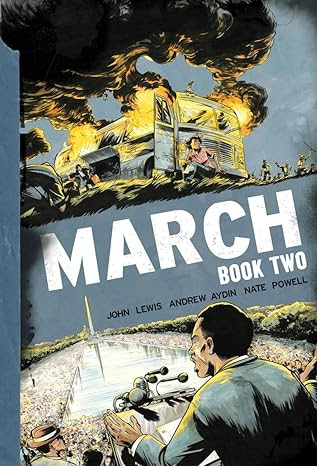
MARCH: BOOK TWO (graphic novel) by by John Lewis and Andrew Aydin


Published in 2013 by Top Shelf Productions.

Written by John Lewis and Andrew Aydin.

Illustrated by Nate Powell.

Congressman John Lewis (1940-2020) continues his life story in book two of the March series, focusing on his struggles in the Civil Rights Movement. The book starts in November of 1960 and ends with the 16th Street Birmingham Church Bombing in September of 1963.


The story includes some very harsh responses to attempts to integrate restaurants in Tennessee, the freedom riders (young African Americans were attempting to desegregate bus lines after a court ordered them to be desegregated), and the bus boycott campaign in Birmingham. 

The violent response is horrible and shocking

Infamous segregationist lawman Bull Connor of Birmingham figures prominently throughout the middle of the book. I am pretty well-versed in the major points of the Civil Rights Movement but I was still moved by the portrayal of the Children's Crusade.

The book includes all of the negotiations, concerns, and demands before the famed March on Washington. Lewis spoke at the march, followed by the world-famous "I Have a Dream" speech by Martin Luther King. 

And, as often happens in this history, a giant step forward is followed by tragedy. In this case, the book ends with the death of 4 girls in the terrorist bombing of a church in Birmingham. 

I rate this book 5 stars out of 5. It can be found at Amazon.com here: MARCH: BOOK TWO (graphic novel) by by John Lewis and Andrew Aydin.

Click here to see my review of March: Book One.

Click here to see my review of March: Book Three.

MARCH: BOOK ONE (graphic novel) by John Lewis and Andrew Aydin


Published in 2013 by Top Shelf Productions.
Written by John Lewis and Andrew Aydin.
Illustrated by Nate Powell.

Winner: National Book Award

Winner: Will Eisner Comic Industry Award

Winner: Coretta Scott King Book Award

Winner: ALA Notable Books

Winner: Reader's Digest Graphic Novels Every Grown-Up Should Read

Congressman John Lewis (1940-2020) tells his life story in this graphic novel, focusing on his struggles in the Civil Rights Movement. This is the first book in a trilogy, covering the first 20 years of his life.

Lewis is interested in three things as a young man - education, preaching, and the Civil Rights movement. Lewis listens to the traditional African American leaders and he hears talk of moderation (or, even worse, nothing at all about Civil Rights.) He doesn't know what to do, but he knows this is not the way forward. 

Lewis's growing frustration and the moment when Lewis hears MLK.
One day, he hears Martin Luther King, Jr. speak over the radio and he knows the way to go: non-violent resistance.

The last half of the book goes into the effort to integrate lunch counters in several department stores in Nashville, Tennessee. He details the training, the cat and mouse tactics and the way the movement grew and grew to the point that it simply overwhelmed the legal system. 

So, the legal system withdrew and let vigilantes try to deter them. Anyone who has studied the time period knows about the violence and how it ended up in the end, but that doesn't stop the reader from being drawn in. 

This graphic novel can be found on Amazon here: MARCH: BOOK ONE (graphic novel) by John Lewis and Andrew Aydin.

Click here for my review of March: Book Two

AN ABUNDANCE of KATHERINES (audiobook) by John Green


Colin Singleton is a child prodigy who has recently stopped being a child. He has graduated from high school, is preparing to go to a great college but he is unsettled by a couple of things.

Number one: being a child prodigy means that you are potentially an important adult. Colin is aware that it is now time for potential to turn into something - anything - meaningful.

Number two: Colin just got dumped - again. He has dated 19 different girls and all are named Katherine. Technically it is 18 different girls because Katherine 1 is also Katherine 19, but the point is pretty much the same.

So, Colin is wallowing in self-pity when his best friend, a slacker named Hassan, comes to him and suggests that they need to go on a road trip. They head south through Indiana and eventually end up in Gutshot, Tennessee where Colin meets a girl named Lindsey who has only dated a boy named Colin...

My Review:

Despite the 3 star review, I thought this book has several good quotes.
This is a fair to middling audiobook. For the first half of the audiobook, I would have rated it 2 stars out of 5. I kept on listening because I am a fan of John Green (both his books and him generally) and he and I have both adopted the same city as our hometown. 

As the book went on, I bumped it up to a weak 3 stars because it did get better. By the way, I am very aware of the irony of reviewing a John Green book on a 5 star scale considering how much that Green hates assigning stars to things in reviews (check out his excellent collection of essays The Anthropocene Reviewed for more info.)

Part of the problem with this book was the reader Jeff Woodman. He has a perfectly pleasant reading voice and is very clear but - whatever "it" is, he didn't have "it" in my opinion. By the way, this is the reason that Green hates the 5 star system - I am rating the reader based on something that I can't define. We all do this, though. You hear two different bands play the same song and one has "it" and one clearly doesn't. In this case, I may very well have liked the book a little better with a different reader.

My other complaint about this book is Colin's insistence on trying to create a mathematical formula to figure out who is going to dump who in a relationship. I get that only a kid would try to do such a thing, but there were so many tedious scenes describing the development of the formula and discussions of the formula that I got sick of hearing about it. At one point, I thought that Colin had accidentally shot the notebook with the formula with a shotgun and I was so happy to be done with it all. I think it was a convenient thing for Green to use to occupy Colin's time - a sponge to suck up his time while other things were going on. Character A does this, Character B does that and Colin goes into the other room and works on his formula for 3 hours. 

So, while not a bad book, certainly not a great book. So far, I've read 5 of his books. 3 have 5 stars and 2 have 3 stars. That's a pretty good track record.

Update  - in November of 2023 it was announced that the  group Moms for Liberty challenged 300+ books in Florida. This book is one of them. See the entire list of books that the Moms want banished here.

I rate this audiobook 3 stars out of 5. It can be found on Amazon.com here: AN ABUNDANCE of KATHERINES by John Green.

TEAR IT DOWN (Peter Ash #4)(audiobook) by Nick Petrie


Published in 2019 by Penguin Audio.
Read by Stephen Mendel.
Duration: 11 hours.
Unabridged.


Synopsis:

Peter Ash served multiple tours of duty with the Marines in Iraq and Afghanistan. When he left the service, he wandered the roads of America - partly because he could not find a place to settle down and partly because he suffers from claustrophobia as a form of PTSD. He can't sleep indoors. He has a very tough team being inside unless it's a spacious room or has lots and lots of windows. 

The author, Nick Petrie.
Peter has been living with his very serious (and very rich) girlfriend helping maintain her compound and recuperating from the misadventures of the last book. But...he's getting bored.

His girlfriend gets word from a friend named Wanda in Memphis that people are threatening her in her new house that she bought in a tax auction. They are throwing bricks through windows and the like. Peter drives across the country in his restored work truck to help keep an eye out. When he arrives he discovers that things have gotten a lot worse.

They're not just throwing bricks any longer - they've driven a dump truck right into her house...

My review:

This owes a lot to Lee Child's Jack Reacher series (lone drifter who is retired from the military who works very well with smart, talented, independent women) and to Robert B. Parker's Spenser series (man with a moral code, a girlfriend and an African American friend with a brother-like bond of questionable background that comes in with things get tough) but it has a distinct voice of its own.

The series also has a formula that I happen to like. It would be wise of Petrie to shake it up a bit, but it is a formula that is working for me.

Petrie's descriptions of a musician in the grove approached poetry. Nicely done. It more than makes up for the touch of the paranormal that was throw in.

I rate this audiobook 5 stars out of 5. It can be found on Amazon.com here: TEAR IT DOWN (Peter Ash #4)(audiobook) by Nick Petrie.

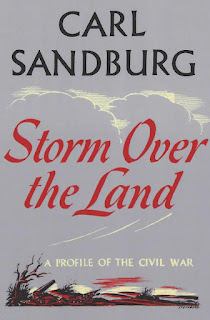
STORM OVER the LAND: A PROFILE of the CIVIL WAR by Carl Sandburg


I read a 2009 re-print published by Konecky and Konecky.

Carl Sandburg (1878-1967)
In 1940, the famed poet, journalist and author Carl Sandburg won a Pulitzer Prize for his four volume biography Abraham Lincoln: The War Years (published in 1939.)

In 1942, his publishers came to him and asked him to re-work the biography into a history of the Civil War in response to America's recent entry into World War II. 

The result is a pretty solid history of the Civil War from basically the Union point of view. 

Carl Sandburg is best known as a poet and that shines though with some of his prose. From time to time, he comes up with a different and interesting way of telling the story of the war. 

The most obvious weakness to this history is the story of African-Americans in the war - the free, the enslaved, the recently freed, the soldiers and others. He mentions them, but does not look at them very hard. To be fair to Sandburg, this book was published 81 years ago and he covered the topic about as well as any mainstream history would have.

I rate this history 4 stars out of 5. It can be found on Amazon.com here: STORM OVER the LAND: A PROFILE of the CIVIL WAR by Carl Sandburg.

DEEP SLEEP (Devin Gray Book 1) (audiobook) by Steven Konkoly


Published in February of 2022 by Brilliance Audio.
Read by Seth Podowitz.
Duration: 10 hours, 18 minutes.
Unabridged.


Synopsis:

Devin Gray is a retired military operator working for a high-end private security contractor. He is on assignment that goes a little sideways in the D.C. metro area and he is sent away to let things cool off.

While packing up to go, he is contacted about his mother. She is estranged from the rest of the family because she is always off researching a conspiracy theory, which is kind of ironic because she works in a government intelligence agency that looks for conspiracies. She is dead after some short of shoot out in Tennessee and everyone is keeping it quiet.

Gray discovers a note from his mother to him with instructions. It turns out to lead to her evidence that proves the conspiracy and he finds it to be plausible enough to reach out to others. Once they start digging, they find more than it is worse than they ever imagined...

My review: 

I was excited about this book. I really enjoyed the first two book of an his unfinished Rogue State series (link to review of the first book here: Fractured State.) That series is full of non-stop and, frankly, ridiculous action - but it is fun and demands your attention.

This book had a complicated conspiracy that you know in your head is simply too complicated to work, but your gut says, "Oh crap! This could really happen!" I had no problem with the premise of the book.

I had problems with the pacing of the book and the proliferation of characters. Konkoly decided to make characters out of some of the bad guys in an effort to confuse the reader at first. It worked and it was kind of a good choice except that he keeps on adding character after character after character and this audiobook reader got confused as to who exactly was who. I just decided to ignore character names and label them "good guy" and "bad guy" in my head. That totally defeated the purpose of creating a named character with lines and a personality, but I couldn't keep up. When one of them goes down in a gun fight, I didn't care a whole lot - I just kept a little running tally in my head to see if any of the good guys were going to survive.

For an action story, this book has an awful lot of sitting around and talking. Sitting around and talking in a restaurant, in a car, in a secret hideout, in another car, in an SUV, in a rented house, in another SUV, in a hotel, in a mansion, in a helicopter, in another hotel.

So many of these conversations were repeats of other conversations. The conspiracy is discovered and then explained to another person. That person explains it to a small group. That group explains and discusses with another group and by that point I felt like I could have stepped in and gave the explanation myself.

So, to sum up - too many characters makes the story hard to follow. Too much repeat conversations stretched the story out for no real reason.

On a pet peeve note: Konkoly is from Indianapolis and lives in Indianapolis. So do I. I was pleased to see part of the book took place in an Indianapolis suburb that he described perfectly (Carmel.) However, the audiobook reader mispronounced it. It is pronounced the way many people mispronounce the candy "caramel." He pronounced it like the California city "Carmel by the Sea." This was not important to the story and people who do not live in Indiana would have no idea but considering that the author lives here...

I rate this audiobook 2 stars out of 5. I will not be moving on to book two in this series. This book can be found on Amazon.com here:  DEEP SLEEP (Devin Gray Book 1) (audiobook) by Steven Konkoly.

SHILOH, 1862 by Winston Groom


Published by National Geographic in 2012.
443 pages.

Winston Groom is best known as the author of the novel that inspired the classic Tom Hanks movie Forrest Gump. Most people don't know that Winston Groom wrote several histories, including three about the Civil War.

****Synopsis****

Shiloh, 1862 is, of course, about the Civil War Battle of Shiloh, sometimes known as Pittsburg Landing in southern Tennessee very close to where Tennessee, Alabama and Mississippi touch. 

The commanders were Ulysses S. Grant, William Tecumseh Sherman and Don Carlos Buell for the Union and Albert Sidney Johnston, P.G.T. Beauregard and Braxton Bragg for the Confederacy. 

Ulysses S. Grant (1822-1885)
Grant was on a roll of sorts. He was the only winning Union commander, having won the Battles of Fort Henry and Fort Donelson in Kentucky in the winter of 1861-62. These welcome victories not only buoyed the sagging morale of the Union after the loss of the first big battle of the war, Bull Run, but it also opened up Tennessee, Mississippi and Alabama to invasion following the river systems of the area.

This is how Grant ended up at Pittsburg Landing in southern Tennessee in April of 1862 and this is how this almost unknown location became the site of the first truly large battles of the war with casualties rivaling those of later battles such as Antietam and Gettysburg. Much like those battles, there were also a lot of questionable decisions made by the principal generals during this battle.

****My review****

This is one of the finest histories of the early days of the Western Theater of the Civil War that I have ever read. This is the 144th book that I have reviewed that has been tagged Civil War and I honestly cannot think of a more approachable and well-written history as this one. 

Highly recommended.

I rate this book 5 stars out of 5. It can be found on Amazon.com here: SHILOH 1862 by Winston Groom.

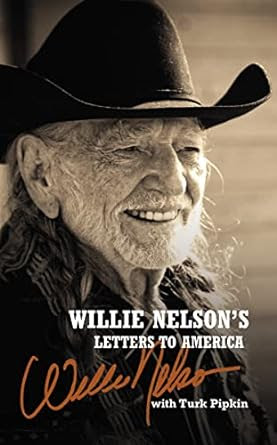
WILLIE NELSON'S LETTERS to AMERICA (audiobook) by Willie Nelson and Turk Pipkin


Published in 2021 by Harper Horizon.
Read by co-author Turk Pipkin
Duration: 3 hours, 6 minutes.
Unabridged.

During the Covid-19 lockdowns Willie Nelson decided to write a book. This is not an unusual thing for Willie - he has written a handful of memoirs focusing on various parts of his almost 80 years as a professional musician (he was paid to play in a local band at the age of 10) and this book almost certainly overlaps with other books. 

The format of Willie Nelson's Letters to America is that Willie is writing thank you letters to various people, places and things that influenced his life and his career. He has a letter to his hometown, his grandparents, his sister, various members of his band over the years, his ex-wives, his wife, his kids, the fellow members of the supergroup The Highwaymen, among others.
Nelson's guitar, Trigger

There is also a letter to his guitar, Trigger. Nelson bought Trigger, sight unseen, in 1969 because he needed a new guitar after someone accidentally damaged the guitar he had been playing. Nelson has been playing that guitar ever since. He has literally worn a nasty-looking hole in it. This iconic instrument has its own Wikipedia page and was the subject of a Rolling Stone magazine documentary in 2015.

Nelson's last big theme is a series of politically-inspired letters. He writes to the Founding Fathers and he notes that although he is politically active, he refuses to talk politics on stage because that's not why people buy tickets and it ruins the fun.

I listened to this as an audiobook, but I liked these quotes well enough to get out a piece of paper and write them down:

"Rather than hiding our flaws, it's best to use our right of free speech and discuss them in the open."

"I've been asked if I believe people should be allowed to kneel during the national anthem. Regarding peaceful protests, and just about everything else, I believe everyone should do whatever the f*** they want to."

The biggest disappointment if this audiobook is that Willie Nelson chose not to read it. Instead, he asked his co-author Turk Pipkin to read it. Pipkin seems like a great guy and he does a good job with the reading, but he does not have that iconic Willie Nelson voice. 

I rate this audiobook 4 stars out of 5. It can be found on Amazon.com here: WILLIE NELSON'S LETTERS to AMERICA (audiobook) by Willie Nelson and Turk Pipkin.

THE RANGER (Quinn Colson #1) (audiobook) by Ace Atkins


Originally published in 2011.
Audiobook version published in 2022 by Recorded Books.
Read by MacLeod Andrews.
Duration: 8 hours, 36 minutes.
Unabridged.


Synopsis:

Quinn Colson is an Army Ranger at the end of his "storming the castle" days. He is in the process of transitioning to a role as a trainer of Army Rangers at Fort Benning, Georgia when he finds out that his Uncle has committed suicide.

So, Colson goes to Northern Mississippi for the funeral.

His uncle was the country sheriff and one of the deputies (a high school friend) tells Colson that she believes that it was a murder staged to look like a suicide. Colson doubts it. 

Meanwhile, word gets out that Colson will inherit all of his father's land, his house, and everything else. Colson starts to believe the deputy's theory of murder vs. suicide once he starts getting major pressure to dump the property as soon as possible to a shady county board member with a reputation of putting together shady deals.

So, Colson decides to stay a few more days to try to figure out what is going on. The more he digs, the worse it gets...

My Review:

First, the negatives:

*Colson knows EVERYBODY in this small county (except for the outsider bad guys). Like this character, I grew up in a rural area and left due to work. I have met literally hundreds of new people and I have tended to forget the ones that I left behind because I didn't see them any longer. Colson has been on active military duty in war zones for the majority of the 9 years and has met lots and lots of people and he still remembers every detail about everyone he knew. He must've been the most well-connected 18 year old in the county because he knows everyone. Someone will say something like, "Do you remember Jimmy?" and he will say sure - and ask if he still dyes his hair, works the morning shift at the gas station, likes ketchup on his scrambled eggs and drives a blue ford 4x4 with a white passenger door. C'mon. Also, yes, Jimmy still does all of these things 9 years later.

*The situation that caused Colson to come back to town would have worked out for the bad guys if they had just stayed patient for a few more days. It's weird that they didn't because they had spent years working on it.

*The first third of the book worked so hard to set a Southern Gothic mood that I almost quit at the 1 hour mark and the 2 hour mark. It was as if the author went down a checklist and tried to squeeze as many things in as soon as possible:

-Broken down homes? Check.

-People with eccentric hobbies or obsessions? Check.

-Grotesque characters? Check.

-Decayed surroundings? Check.

-The weight of the past upon the present? Check.

-Sinister events related to or stemming from poverty, alienation, crime or violence? Check, check, check and check. This is the plot of the book.

Positives: 

-In some books, when a person gets hit or shot it's no big deal and they get up and fight again even though they have a broken jaw or a punctured lung or their spine was severed. Not in this book. When someone gets shot or punched hard that injury stays with them.

-The conspiracy, when it is finally uncovered, makes a lot of sense and rings true.

-The reader of this book is excellent. He doesn't just read the book - he performs it. 

So, three really annoying things and three really good things. That's why I am rating this book 3 stars out of 5. It can be found on Amazon.com here: The Ranger (Quinn Colson #1) by Ace Atkins.

DOWN ALONG with THAT DEVIL'S BONES: A RECKONING with MONUMENTS, MEMORY, and the LEGACY of WHITE SUPREMACY (audiobook) by Connor Towne O'Neill


Connor Towne O'Neill was attending the 50th anniversary recognition of the Selma to Montgomery March when he discovered something unexpected. The Selma to Montgomery march ended when Alabama State Troopers joined local deputies at the Edmund Pettus bridge and beat them until they retreated. The bridge is named for a Confederate General and a Grand Dragon of the Alabama KKK.

O'Neill was looking for a place to park and drove into a graveyard. In the graveyard, he discovered a group prepping a part of the graveyard for the re-installation of a bust of Nathan Bedford Forrest (the original had been stolen) in the graveyard. It was on a piece of property owned by the United Daughters of the Confederacy in the middle of the graveyard.

O'Neill sensed that this was the more powerful story, no matter how dramatic that moment on the bridge had been 50 years earlier. He decided to investigate the power that the memory of Nathan Bedford Forrest has over so many Confederate apologists. 

He begins with an interesting mini-biography of Forrest. He began with almost nothing and made himself quite wealthy trading slaves, including slaves straight from Africa (Constitutionally prohibited since 1808). At the beginning of the war, he joined as a private and is the only person on either side to go from private to general. He outfitted a squad of cavalry and became on of the most daring and active Confederate generals of the war. He led from the front and the omnipresent threat of his sudden appearance was a constant source of worry in the Western Theater of the Civil War.

After the war, Forrest was approached to lead a group designed to resist the new rights granted to the ex-slaves with a wave of terrorism - the Ku Klux Klan (also known as America's first terrorist organization). He formally led the group for a while and then may have become a leader in the background after it was formally disbanded (maybe he was still their leader, maybe he wasn't. Maybe they disbanded, maybe they didn't - it is surprisingly unclear).

O'Neill's search for the story of the hold that Forrest has on so many takes him from Selma to Memphis to Nashville to Montgomery and sees how people use Forrest as a symbol to oppose racial integration. 

Close up of the face of the Forrest statue
in Nashville. It was not the intent of the artist,
but Forrest looks plenty crazy
For me, the most interesting section was the discussion of the Forrest statue near I-65 in Nashville. I always keep an eye for it whenever I drive through Nashville (not often). It is so cartoonish that many people have joked that they want this statue to stay up even if all other Confederate statues come down. It is on private property, however, so it will stay there as long as its current owner wants to keep it.

Often, this was a difficult book. But, I think it is an important one, especially if you are interested in the Confederate monument controversies. 

Highly Recommended.

I rate this audiobook 5 stars out of 5. It can be found at Amazon.com here: DOWN ALONG with THAT DEVIL'S BONES: A RECKONING with MONUMENTS, MEMORY, and the LEGACY of WHITE SUPREMACY by Connor Towne O'Neill.

Note: the Forrest statue along Interstate 65 in Nashville was removed by the new owners after the death of the original owner. Here is a news story describing the situation: Click here.

CONFEDERATE GENERALS of the CIVIL WAR (Collective Biographies series) by Carl R. Green and William R. Sanford


Published in 1998 by Enslow Publishers, Inc.


Part of a series of 8 books, Confederate Generals of the Civil War was intended to be a classroom or school media center supplement for students to use as a resource. It is not a large book - 112 pages including a glossary, some charts comparing the the Union and the Confederacy, 2 maps and a timeline of the Civil War.

There are 10 biographies, arranged in alphabetical order. Each biography is 8-9 pages, including a photograph of the general and a related picture (photo of a battlefield, drawing of a battle scene, etc.). 

The biographies themselves are pretty neutral, although it does take some mild stands on a few controversial items. It states in a matter of fact manner that Robert E. Lee was anti-slavery (It was definitely more complicated than that). It puts a lot of blame for Pickett's Charge on Longstreet, not on Lee. And, it gets sappily sentimental in the last paragraph of Pickett's biography. I would rate it as very mildly slanted towards the old "Lost Cause" theory of the war (the three areas I mentioned are all at the heart of the theory), but not fatally so. 

The featured generals are:

Nathan Bedford Forrest;
William Joseph Hardee;
A.P. Hill;
John Bell Hood;
"Stonewall" Jackson;
Confederate General George Pickett
(1825-1875)
Joseph Johnston;
Robert E. Lee;
James Longstreet;
George Pickett;
J.E.B. Stuart

Other books in the series include a collection of biographies of Union Generals, "Women in America's Wars" and "American Heroes of Exploration and Flight".

I rate this book 3 stars out of 5. The biographies are just not all that interesting out of context. This book can be found on Amazon.com here:CONFEDERATE GENERALS of the CIVIL WAR (Collective Biographies series) by Carl R. Green and William R. Sanford.

THE GOOD KILLER (audiobook) by Harry Dolan


Published in 2020 by Highbridge, a division of Recorded Books.

Read by James Patrick Cronin.
Duration: 9 hours, 15 minutes.
Unabridged
.

In The Good Killer, Sean Tennant and Molly Winter are living under assumed names around Houston, Texas. They are in hiding (the story eventually lets the reader know why) and live off of the grid as much as possible. 

Tennant is a retired soldier who served a very rough tour in Iraq. He still has the skills that helped him survive: he is hyper-vigilant and always carries a weapon and tourniquet. On a trip to the mall to buy a new pair of boots a man attracts his attention. When he moves away, Tennant is relieved. When the man opens fire in a clothing store, Tennant leaps into action. He kills the shooter and saves a mother's life with his tourniquet. 

And he runs because he knows he will be on the news and the people who desperately want to find Sean and Molly will be coming...

I am a big fan of what I call "the chase book." That is a book where the hero (protagonist) is being chased by evil forces or police who will stop them from achieving some important goal to stop the evil forces.

A critical component of this formula (for me) has to be a likable set of protagonists. In this book, I found Sean and Molly to be nowhere near the most likable characters. I even found one of the bad guys to be more likable than them.

The reader, James Patrick Cronin, has an excellent reading voice even though he struggled with the pronunciation Midwestern place names. That wasn't necessarily his fault - his producers should have caught it and corrected it.

I rate this audiobook 3 stars out of 5. It can be found on Amazon.com here: The Good Killer by Harry Dolan.


HARRY STARKE (Harry Starke #1) (audiobook) by Blair Howard


Audiobook edition published in November of 2015.
Published by Blair Howard.
Read by Tom Lennon.
Duration: 7 hours, 23 minutes.
Unabridged.


Harry Starke is a former cop turned private detective in Chattanooga, Tennessee. He has a successful agency with several associates with different skill sets. Harry is also connected to the Chattanooga political scene through his father, a federal judge.

Most importantly, Harry is connected through his connections as a former police officer. He knows a lot of cops, knows the department's habits and has a romantic relationship with an important detective. 

Most important, Harry is a smart, tough detective who can put two and two together, get four and figure out why that answer is important to the rest of the problem. Plus, he can shoot and fight well.
The Walnut Street Bridge in Chattanooga.

Harry is out for a late night drink and he notices a beautiful young lady. Later, while strolling across the Walnut Street Bridge he sees her running seemingly running away from someone and running towards him. She stops when she sees him and she jumps off of the bridge to her death. Harry wants to know what would make her do that for two reasons. He is simply curious and he feels guilty that she may have mistaken him for someone else and killed herself in a vain effort to escape.

The positives of the book:

-The setting. I love mysteries but way too many are set in New York or Los Angeles. Do they have crime in Chattanooga? Certainly. Let's explore some new territory. I spent some time in Chattanooga last summer and I enjoyed the fact that I was able to recognize some of the areas that the book mentioned.

-The audiobook narrator. Tom Lennon did a good job of giving his characters a soft Southern accent. He did a good job of creating multiple voices for these characters.

The negatives of this book:

-In some ways this book was a throwback to an earlier time when private detectives encountered one beautiful woman after another in the course of their investigations and slept with them all. I know that all fiction is fantasy, but this was more than a little ridiculous. The woman practically fell over themselves in an effort to take this man to bed.

-The mystery, once it was uncovered, was certainly a throwback idea. Almost something that you might find on an old episode of Columbo.

-Harry Starke talks too much. He talks in his head. He talks out loud. He just goes on and on and on. If you are reading a book you can skim but there is no such option when you are listening.

While not bad, I just did not enjoy this book. My 3 out of 5 star rating means that it was good, not great. If I were to grade it, I would give it a C+.

Note: I was provided with an audiobook copy of this book in exchange for a fair and honest review.

This book can be found on Amazon.com here: Harry Starke #1.

THE SMOKE at DAWN: A NOVEL of the CIVIL WAR (Civil War in the West #3) (audiobook) by Jeff Shaara


Published by Random House Audio in June of 2014
Read by Paul Michael
Duration: 19 hours, 42 minutes
Unabridged

 Jeff Shaara is well-known by fans of military historical fiction. The Smoke at Dawn is his fifth book about the Civil War, the third about the campaign in The Western Theater. This book picks up a few months after Grant's victory at Vicksburg and focuses on Chattanooga.

The crushing defeat at Chickamauga suffered by Union General Rosecrans was a terrible blow after the Union's massive twin victories at Gettysburg and Vicksburg just two months earlier. Confederate General Braxton Bragg swept Rosecrans' army from the Chickamauga battlefield and they fled back to the safety of Chattanooga. Bragg's forces occupy the mountains that surround Chattanooga and have effectively laid siege to the city. Already, the Union forces are suffering and Rosecrans seems confused about what to do next. Luckily, Bragg is worried about dissension among his own junior officers more than the Union forces so an extremely tough situation has not been turned into an impossible one.

Union General Ulysses S. Grant is called to Indianapolis for a meeting and is told that he has been promoted to the command of the entire Union army on the condition the he resolve the situation in Chattanooga. Rosecrans is removed, General George Thomas is placed in charge and Grant is smuggled into the city so that he can break the siege.

I was critical of the second book in this series (A Chain of Thunder) and I was more than a little reluctant to listen to this one. I am glad to report that this was a much better book.

The brooding, repetitive nature of the second book was replaced with a more balanced approach. There was plenty of brooding but most of it was Braxton Bragg verbally accosting everyone in his army that he could reach - privates, captains, generals and even getting a little dicey with Confederate President Jefferson Davis who personally came the outskirts of Chattanooga to help his old friend Bragg sort out his army's personality conflicts, not that it did much good.
Confederate General Braxton Bragg
(1817-1876)


 The book was not entirely about generals and politicians. It also followed Wisconsin-born "Dutchie" Bauer and his friend Captain Willis to give a view from the common man's perspective. 

The reader was Paul Michael and he did an excellent job with the wide array of voices and accents. Pretty much everyone had their own voices and there were multiple Southern accents (they vary by region, of course) and even an excellent Irish accent.

This series continues on with a fourth installment.

I rate this audiobook 5 stars out of 5.


This audiobook can be found on Amazon.com here: The Smoke at Dawn: A Novel of the Civil War (the Civil War in the West)

FORT PILLOW: A NOVEL of the CIVIL WAR (audiobook) by Harry Turtledove


Audiobook Edition Published in 2009 by Tantor Audio

Published in hardback in 2006.
Read by John Allen Nelson
Duration: 11 hours, 13 minutes
Unabridged

The massacre at Fort Pillow truly stands out in a bloody Civil War in which hundreds of thousands of men and women died. Even though the American Civil War had so many casualties, the war itself was remarkable in that the two sides were often quite civil with one another off of the battlefield. There are numerous stories of local truces to trade coffee for tobacco and the like. My favorite is the story of Confederate and Union pickets (perimeter guards) who co-built a cabin in stages during the winter and agreed to share it in shifts as the day went along. Prisoners of War were generally cared for (there were exceptions, but they stick out as exceptions), the enemy wounded were treated by the doctors (the care was bad, but the best that was available), and so on.

Nathan Bedford Forrest
(1821-1877)
The battle at Fort Pillow in April of 1864, though, stands out as something different. It was much more like the Missouri Bushwhacker and Kansas Jayhawker fighting. It was more than just Union vs. Confederate. It had a personal side to it that resulted in a massacre. 

The positive side to Fort Pillow: A Novel of the Civil War is that Turtledove has clearly done an exceptional amount of research. He presents Nathan Bedford Forrest as a complicated man. An uneducated man who outsmarts most West Pointers he fights against and outshines most of his experienced and educated peers. He truly was one of the most talented officers of the war. But, he was also a slave trader and certainly could not approve of Black soldiers fighting against white men.

An advertisement
for Forrest's
slave-trading business.
Fort Pillow was garrisoned with white and black soldiers. The U.S. Colored Troops were roughly half of the soldiers, the balance were white soldiers, mostly  from Tennessee. Even though Tennessee was a Confederate state, these white soldiers had sat out of the war and then volunteered for the Union army when they could or had deserted the Confederate army to join the Union. Tennessee supplied 100,000 men to the Confederate cause, but it also supplied 50,000 Union soldiers. A lot of Forrest's men were from Tennessee and they looked at Tennessee men who became Union soldiers as traitors or worse. Forrest's men also believed that these Union soldiers had attacked pro-Confederate families, including unsanctioned raping and looting. Turtledove hints that even though these attacks were unsanctioned, they may very well have been unofficially approved of by the Union leadership at Fort Pillow. Clearly, the fighting in Tennessee was more than just about secession or slavery - it had a personal dimension as well.

The U.S. Colored Troops had a different set of problems. The Confederate government had pledged to enslave any black soldiers that they captured, on the premise that they were all escaped slaves. 

Forrest and his men launched a surprise, raid-style attack on Fort Pillow in an effort to pick up more arms and other supplies and in a non-stop effort to harass Yankee soldiers wherever they could be found. 

Fort Pillow was poorly designed and its officers did little to improve its viability. For example, fields of fire were not cleared around the fort, little thought had gone into what would happen if the defenders got in close (the artillery could not hit them due to the limited ability of the cannons to fire downward). 

After some hard fighting it became obvious to Forrest that he would eventually take the fort and he asked for a truce to discuss surrender terms. The original commander of the fort had been killed and his replacement refused to surrender, even though Forrest promised to not enslave the U.S. Colored Troops and that they would not seek reprisal against the white soldiers from Tennessee. He also threatened that if his men were forced to take the fort by force he could not ensure that he could stop them from committing these sorts of atrocities.

And, it turns out, Forrest was right...

Turtledove does so much right in this book. It is well-researched. He makes characters out of people in multiple levels of both armies so that he can give a very thorough view of the battle. He does not get bogged down in the technical details of each weapon, but his description of how to operate a Civil War cannon was detailed and extremely interesting.

What does he do wrong?

- He is repetitive. It is great that he gives multiple perspectives, but he gives long, long multiple perspectives on the same topic.

-He has an annoying habit of having the omniscient narrator tell the reader something and then have the characters note the same thing, think about the thing that they noted, tell another character about that thing and then they discuss whether or not to tell other people about it. Any single one of these devices would have been sufficient. Even worse, sometimes a soldier on the other side of the battle notices the same thing and the entire process is repeated.

-There is a long, rather boring chase of a single Union officer after the battle. He sneaks away from the fort, tries to get to Union lines, gets captured and eventually is executed. Way too long and no real pay off at the end.

In sum, the book is too repetitive. The good parts of the book are simply overwhelmed by the tedium of the slow parts. Easily 25% of the book could have been thrown out or condensed. Probably more.

The reader, John Allen Nelson, did some good work in his reading. He did not have enough unique voices to make each character stand out. But, he was great at adding emotion and drama to the story. He often yelled as he read about the men charging Fort Pillow or becoming wounded. 

But, no matter how well read this book was, the story was damaged by an author that does not seem to believe that his readers can follow along unless they are constantly told the same facts over and over again.

I rate this story 2 stars out of 5.

This book can be found on Amazon here: 
Fort Pillow: A Novel of the Civil War.

Featured Post

<b><i>BAN THIS BOOK (audiobook)</i></b> by Alan Gratz

Published in 2017 by Blackstone Audio, Inc. Read by Bahni Turpin. Duration: 5 hours, 17 minutes. Unabridged. My Synopsis Ban This Book is t...

Popular posts over the last 7 days