IRON MAN: STEEL TERROR by Dean Wesley Smith


Originally published in book form in 1996.
Published in 2019 by Marvel.
Read by James Patrick Cronin.
Duration: 2 hours, 15 minutes.
Unabridged (but maybe not - see below)


As the Avengers settle down for a Christmas Eve dinner in Tony Stark's mansion (which doubles as Avengers headquarters), they are interrupted by news of a robot attack on a super secure research facility. TESS-One, a World War II era robot designed to counter super serum soldiers if it turned out to be necessary has returned from the dead. Can robots die? No matter - this robot was thought to be disposed of, but it is back. 

TESS-One
Even worse, it is under the control of another robot - the dreaded Ultron. He was also thought to have been killed/destroyed, but he is back and is pursuing his goal to kill off humanity...

My take:

******Caution - spoilers*******

The Iron Man: Steel Terror audiobook was created from a 160 page novel published in 1996 by Pocket Books that was aimed at 12-15 year-olds. If you are expecting a continuation of the characters from the Marvel Cinematic Universe (MCU), you will be disappointed. 

The details for the audiobook say that it is unabridged, but I think that 2 hours and 15 minutes is simply too fast for a 160 page novel to be read. An abridgement would explain the breakneck pace of the plot. For example, Black Widow travels from New York to Russia (and has a fight) and then back to New York and then to Antarctica (and has an even bigger fight) and then back to New York in the span of about 12 hours. 

Featured heroes include: Iron Man, Black Widow, Jarvis the butler, Vision, Quicksilver, Crystal, Hercules and Hank Pym as Giant Man.

This audiobook was not particularly riveting. There was room for a lot of character development, but instead it became a punch fest (or energy blast attack fest) and Ultron was defeated by lab work done by Hank Pym that took him no more than half an hour to think up, create and then place on a rocket that he programmed to go to Ultron's lair. 

Missed opportunities to go for a quick buck on the good name of Iron Man from the MCU..

I rate this audiobook 2 stars out of 5. It can be found on Amazon.com here: IRON MAN: STEEL TERROR by Dean Wesley Smith. The original 1996 book can be found on Amazon.com here: Steel Terror: Iron Man Super Thriller by Dean Wesley Smith.

PEEPS: A NOVEL (Book #1 of Peeps) by Scott Westerfeld


Published in 2005 by RazorBill (Penguin Group)

In the novel Peeps, author Scott Westerfeld has written a very original take on one of the oldest monster stories of all times - the vampire story.

Cal Thompson knows something that almost nobody knows - he knows that vampires are real because he is one. Sort of.

Cal Thompson also knows how vampirism is spread. The bite on the neck made famous in the movies is really just one way to spread. It is commonly spread sexually, much like HIV. The virus compels its host to engage in sexual contact, ensuring the spread of the virus - much like rabies encourages animals to attack and bite other animals in order to spread rabies. Infected people are called "parasite positive" or "peeps".

Cal Thompson was infected as the result of a one night stand sexual encounter on his first day in New York City. However, he is one of the rare carriers of the disease. He has some of the characteristics of a vampire such as being able to see in the dark and increased strength, but he is not a full-blown vampire. He has been trained and recruited to join an ancient secret organization that captures vampires to limit the spread and maybe offer some therapy to help with this infection.

Cal is new to the job and he knows that the vampires in this story are not like movie vampires - capes, weird accents and sleeping in coffins, etc. But, he is finding things that he had never heard during his training and no one back at the home office is taking his concerns seriously...

I loved the twist on the vampire story that this book presented. Just as interesting were the even-numbered chapters presented information about behavior-changing viruses and microscopic parasites (like rabies that I mentioned above) presented in a conversational way that reinforced the underlying premise behind vampirism in this book.

The only reason that this book is not receiving a 5 star rating is the ending. I thought it could have gone a lot of ways, but the way it went was underwhelming. 

Still, this was a good read and fans of vampires would really enjoy it's take.

I rate this book 4 stars out of 5. It can be found on PEEPS: A NOVEL (Book #1 of Peeps) by Scott Westerfeld.

GUNSLINGER: THE DRAGON of YELLOWSTONE (Mythic West Series)(kindle) by Edward Knight


Published in April of 2021 by WordFire Press.

Gunslinger: The Dragon of Yellowstone is part of a series of books set in post-Civil War years, but with a major twist - the giants from Norse mythology crossed through a thin spot between their reality and Earth in an attempt to conquer Earth. 

The fighting began in Andersonville, Georgia. It interrupted the Civil War but everything East of the Mississippi was basically lost. As the army of the giants pushed west, they were finally stopped in an epic battle featuring a number of names that were big names in the normal timeline of the Old West and an uneasy truce is in place, mostly because both sides have exhausted themselves.

This book features a threat to end that uneasy truce that is investigated by a minor character from other books in the series, a teenaged gunslinger named Beth who was trained by none other than Wild Bill Hickock himself. 

I really appreciate the world building that went into this series. This reminds me of the kind of work that Harry Turtledove does (with a little extra oomph) and I liked the combination of Norse myths and American history. 

I also liked the way that characters just didn't simply shake off injuries. When a character got hurt, they had to deal with the injuries for an appropriate amount of time. 

However, I kept feeling like I was reading a story where the best parts were being hidden from me.  I was getting a little tiny story when I really wanted to know about the bigger story. Did Jefferson Davis and Abraham Lincoln decide to join forces? Did Robert E. Lee and Ulysses S. Grant make a mega army? How hard was it for the two sides to put aside their differences, or did they just fight independently and maybe even continue to fight one another?  How badly did those Civil War armies maul the invading giant army? How was the entire East lost? From what I can tell, those stories have not been told in this series, which is too bad.

I rate this book 3 stars out of 5. It can be found on Amazon.com here: GUNSLINGER: THE DRAGON of YELLOWSTONE (Mythic West Series)(kindle) by Edward Knight.

THE GOD WHO SEES: IMMIGRANTS, the BIBLE, and the JOURNEY to BELONG (audiobook) by Karen Gonzalez


Published by Tantor Audio in November of 2020.
Read by Joana Garcia.
Duration: 5 hours, 25 minutes.
Unabridged.


This is the second time in less than a month that I am reviewing and audiobook that covers the topic of immigration written by an Hispanic immigrant. In both cases, I came to the book highly prepared to like it and in both cases I was disappointed.

The author, Karen Gonzalez
I have no problem at all with the points that Gonzalez makes in The God Who Sees. As a Christian, I think many Christians have been on the wrong side of this issue for decades (including me, for a while).

However, this book just doesn't seal the deal. It says a lot of the right things, but it doesn't do the trick.

Issues:

1) There are pieces of sloppy research, or maybe just sloppy writing or editing.

For example, when the author asserts that the concept of borders came around with the end of the Thirty Years War and the series of treaties known as the Peace of Westphalia in 1648. I think she was referring to immigration and borders (which would be stretch), but the way it came out is that there were no defined borders. I found that to be quite ridiculous - all the more ridiculous considering the audiobook I am currently listening to discusses the peace treaty between Ramses II and the King of the Hittites which laid out clearly defined borders and led to peace between the two empires for more than 100 years. Not to mention the Great Wall of China - some of it has been in place for more than 2,700 years. 

Another example is when the author argues that "chain migration" is different than commonly understood (in very short terms, family members of current American residents are given priority when it comes to legal immigration). She uses her own family as an example, but her example is pretty much a version of chain migration.

2) The audiobook reader is Joana Garcia. Her reading was so slow that I had to change the setting on my app and play it at 120% of the normal speed. This is my 602nd audiobook review (no kidding), this is only the 3rd time I have had to adjust the speed.

Garcia reads a lot of Spanish in this audiobook, including a long passage from Psalms. The problem is, in this Spanish teacher's opinion, Garcia is not particularly proficient at Spanish. She sounds like one of my more advanced high school students, not a native speaker. I found a listing for her as an audiobook reader online and they only mention skills in reading English. Why would they hire a reader to read a lot of Spanish who really can't read Spanish?

I rate this audiobook 2 stars out of 5. It can be found on Amazon.com here: THE GOD WHO SEES: IMMIGRANTS, the BIBLE, and the JOURNEY to BELONG by Karen Gonzalez.

A HOBBIT, A WARDROBE and a GREAT WAR: HOW J.R.R. TOLKIEN and C.S. LEWIS REDISCOVERED FAITH, FRIENDSHIP and HEROISM in the CATACLYSM of 1914-1918 (audiobook) by Joseph Laconte


Published in 2015 by Thomas Nelson.
Read by Dave Hoffman.
Duration: 6 hours, 38 minutes.
Unabridged


A Hobbit, a Wardrobe and a Great War is a decent introductory history of World War I from the point of view of the common English soldier, a decent (but incomplete) look at the philosophical and religious trends of the West before and after World War I, decent introductory biographies of C.S. Lewis and J.R.R. Tolkien and really kind of a pleasant mess of a book.

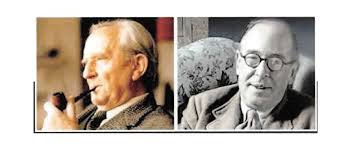
Tolkien (1892-1973) and Lewis (1898-1963)
All of these topics are thrown into the mix in a willy nilly. If that concept bugs you, this is not your book. I found it to be a pleasant enough listen, even if not particularly deep. 

I think the author makes his best points about the complete and utter waste and despair of a World War I battlefield when he compares it to the waste and desolation of Tolkien's Middle Earth battlefields and its heroes. The heroes are not generally the big leaders - they are flawed. They refuse to fight, have preconditions, are misinformed or are so full of their own agendas that the war becomes secondary.

Instead, the true heroes are people like Faramir, the younger brother of the "chosen one" hero whose pride and greed almost ruins the venture from the start. Or, it is 2 little hobbits who no one expects anything from. They literally have no power and yet they convince the very trees of the forest to stride out and destroy one of the enemies' strongholds. Of course, Sam Gamgee stands as the greatest hero of them all in my mind. He is the modeled from the stereotypical British World War I common foot soldier who heads off to fight in the war because it is his duty and keeps slogging all the way through to the end because his friends need him and it is simply the right thing to do. No pretense, just heart.

The connections with C.S. Lewis' fiction were a little less strong for me because I am not as familiar with his work. 

I rate this audiobook 4 stars out of 5. It can be found on Amazon.com here: A HOBBIT, A WARDROBE and a GREAT WAR: HOW J.R.R. TOLKIEN and C.S. LEWIS REDISCOVERED FAITH, FRIENDSHIP and HEROISM in the CATACLYSM of 1914-1918 by Joseph Laconte.

HOW ROBERT E. LEE LOST THE CIVIL WAR by Edward H. Bonekemper, III


Published in 1998 by Sergeant Kirkland's Museum and Historical Society, Inc.

Bonekemper lived the dream of most students of the Civil War - once he retired as an attorney, he created a second career as a Civil War author, college lecturer and a frequent guest on C-SPAN to talk about leadership in the Civil War. He also gave 10 lectures at the Smithsonian!

Bonekemper is an unabashed fan of the Union side in the war, especially General Grant. I reviewed a book he wrote about Grant here. As Bonekemper loves to point out, only 4 armies were captured during the Civil War and Grant captured 3 of them Grant's subordinate Sherman captured the fourth after Lee had already surrendered his army to Grant. The only general on the Confederate side that can compare to Grant is, of Course, Robert E. Lee. Lee is generally celebrated as the best general in the war and Bonekemper dedicates How Robert E. Lee Lost the Civil War to proving that wrong. 

Bonekemper ignores the easiest place to go after the iconic image Lee - his betrayal of his oath as an officer of the U.S. Army to go fight for the Confederacy. Literally, no human being is responsible for more deaths of American soldiers than Robert E. Lee. Instead, he goes after Lee's record as a general on the battlefield - the part that is supposed to be unassailable. 

Bonekemper doesn't argue that Lee's tactical skills on the battlefield weren't formidable and sometimes even brilliant. 

Instead, Bonekemper argues that Lee was a failure when it came to national military strategy for the Confederacy. Lee spent most of the war as CSA President Jefferson Davis's main military advisor - oftentimes the only one Davis took seriously. At the end of the war he commanded every soldier in the entire Confederacy.

Yet, he never left the Army of Northern Virginia to see what else was happening. He never demonstrated that he understood the value of any army other than his own except that they might send him extra troops (which they did on a regular basis. The exception was when he loaned out a chunk of his army with Longstreet for a few months to Braxton Bragg in Tennessee and Georgia. Within a few weeks Lee was lobbying to have them returned)

All Lee had to do was not lose. This sounds obvious, but it is much easier than the North's goal. The North had to actually conquer the South - defeat all of its armies, stop it from operating as a government and take away its ability to keep on fighting. Lee's model should have been George Washington in the Revolutionary War. Washington hung around long enough that the British home front got sick of the war and agreed to terms.

Lee's surrender at Appomattox in April of 1865.
But, instead of fighting for time and playing defense, Lee acted like he was trying to conquer the North. Twice he invaded the North (Antietam and Gettysburg) and twice he was defeated and came back to Virginia with nothing to show for it except the worst losses he suffered in the war. After Gettysburg he never was able to gather enough troops to go on the offense in any meaningful way again. 

The Battle of Chanecellorsville is symptomatic of the problem with Lee. Lee was outnumbered by more than 2 to 1 and still won the battle with a combination of speed, daring and confidence. It is an impressive victory by any standard. But it came at a massive cost. The Union had 17,000 casualties out of 130,000 (13%) that were replaced within weeks. Lee had 12,000 casualties out of 60,000 (20%) that were only replaced by pulling troops away from other fronts and causing them to lose. 

If it costs you a greater percentage of your force to win battles and you have the smaller army you cannot win. Almost every battle Lee fought in could be described in that way. 

Bonekemper argues that Lee ground his army to dust, refused to consider the needs of other theaters and kept fighting for months after it had become obvious that he had no hope of winning the war, costing the lives of tens of thousands of soldiers on both sides.

The research is impeccable and the facts become overwhelming as the pages go rolling along. It almost becomes tedious - another battle, another costly win (usually) that bled away irreplaceable men for a win that did little to further the war effort. Meanwhile, Generals Grant, Sherman and Thomas chewed up every army in the West, conquered or cut off every state except for Virginia and North Carolina until Lee finally surrendered.

Ironically, if Lee had stayed with the Union, the rumor was that he would have been offered the command of Union forces. He would have been the general that that army desperately needed - not afraid to attack, not afraid to strike the enemy to win the war and he would have had the extra men and resources that his fighting style required. It might have been a short war.

5 stars out of 5 because it proves a long-needed point.

This book can be found on Amazon.com here: 
HOW ROBERT E. LEE LOST THE CIVIL WAR by Edward H. Bonekemper, III.

MIRACLE on the 17th GREEN by James Patterson and Peter de Jonge


Originally published in 1996 by Little, Brown and Company.

The high school I teach at is in the midst of library book purge. I have no idea why Miracle on the 17th Green was ever in a high school library because it is aimed at adults. I don't mean that it has "adult themes" like a movie might label them (drugs, sex, violence, etc.), I mean that it has adult themes like questioning whether you have made the right choices in life, which comes first - family or career? Is it okay to put your family at risk just to achieve your personal goals, especially when they are a long shot?

I really enjoyed this book despite never having played even one hole of real golf (I have played plenty of putt-putt golf, but that doesn't really apply, does it?). It didn't really matter - the story was compelling and I faked my way through the golf stuff.

James Patterson has a long history of co-writing books. I always figure he's lending his name to up and coming authors in exchange for a little bit of co-writing, a lot of advising and a paycheck. This book was his first co-writing venture and Patterson and de Jonge have co-written 5 books in total.

I rate this book 5 stars out of 5. It can be found on Amazon.com here: 
MIRACLE on the 17th GREEN  by James Patterson and Peter de Jonge.

Note: there are 2 sequels that were added to this book to make a trilogy in 2105 and 2019. I am not going to read them because this book ended at a good place.

Featured Post

<b><i>BAN THIS BOOK (audiobook)</i></b> by Alan Gratz

Published in 2017 by Blackstone Audio, Inc. Read by Bahni Turpin. Duration: 5 hours, 17 minutes. Unabridged. My Synopsis Ban This Book is t...

Popular posts over the last 7 days