CORYDON: THE FORGOTTEN BATTLE of the CIVIL WAR by W. Fred Conway


Published in 1991 by FBH Publishers.


If you have ever traveled across Southern Indiana visiting historical sites like the Falls of the Ohio (a great fossil bed and a Lewis and Clark site), the Lincoln boyhood site and New Harmony then you have certainly seen a history written by W. Fred Conway.

I know that the top-rated, best-selling history authors depend a lot on writers like W. Fred Conway in order to get the more popular, wider-audience histories written. Why? Because Conway is a fan of Indiana history and he has done a lot of research that big name historians would never have time to do simply out of a love for his local area. This is one of the many books he has written about Indiana, Kentucky and/or Ohio and life along the Ohio River. Conway knows his stuff.

Unfortunately, there's not much of a story in the story of the Battle of Corydon. It was part of John Hunt Morgan's July 1863 into Union territory. The raid started June 11 in Tennessee and after more than 1,000 miles ended July 26 in Ohio along the Ohio River near West Virginia and Pennsylvania.

Along the way, Morgan fought one real battle, although he had lots of little skirmishes. On July 9 a little less than 400 members local home guard militia set up a battle line and fought more than 2,000 Confederate cavalry in the Battle of Corydon. They were quickly outflanked on both sides and captured. This was one of two Civil War battles fought on Union soil - the other one was Gettysburg a week earlier. 

To their credit, the militia gave better than they got. The militia killed 11 Confederate soldiers and wounded 40 and suffered 4 dead and 10-12 wounded. The captured militia was paroled (released on the promise that they would no longer fight in the war in any way) and Morgan's men moved on after some looting and taking more than $25,000 in Union money from local businessmen in exchange for not burning down their businesses. 

That's the basics of the battle. It didn't take very long and was tiny in comparison to the two massive battles that took place in July of 1863: Vicksburg, Mississippi and Gettysburg, Pennsylvania. It was interesting to note that Morgan learned about the results of those other two battles while he was in Corydon.

The book goes on to tell a "lite" version of the rest of the raid, including Morgan's capture and subsequent escape. However, there's still not a lot to this book. There are dozens of photos and drawings (always appreciated - but there were so many that it felt like filler). There is also an appendix about "Corydon Today" - a historical document in it's own right, considering it was printed 31 years ago. All of the pictures and the appendices made me wonder of the publisher had a minimum page requirement. 

I rate this book 3 stars out of 5. It can be found on Amazon.com here: 
CORYDON: THE FORGOTTEN BATTLE of the CIVIL WAR by W. Fred Conway.

THE BOMBER MAFIA: A DREAM, A TEMPTATION and the LONGEST NIGHT of the SECOND WORLD WAR (audiobook) by Malcolm Gladwell


Published in 2021 by Pushkin Industries.
Read by the author, Malcolm Gladwell.
Duration: 5 hours, 14 minutes.
Unabridged.


Before there was a U.S. Air Force, there was the U.S. Army Air Corps. Before the Army Air Corps (re-organized as the U.S. Army Air Forces in 1942) built the largest collection of flying fighting machines to relentlessly bomb the Axis Powers in World War II, they had a tiny budget and a few air bases. One of these was Maxwell Field, a training facility in Alabama. That facility became the intellectual home of a group of pilots who espoused the concept of precision bombing. They were known as The Bomber Mafia.

Precision bombing is the theory that teaches that you don't have to blow an enemy's entire military to pieces, you can just hit certain key industries and choke out their ability to produce more weapons/feed their people/move soldiers and so on. This was intended to be a more humane way to wage war - an antidote to the mass slaughter the world saw in World War I. Precision bombing could end wars before they got to that point by simply forcing an opponent to stand down. The invention of the Norden Bomb Sight convinced them that bombers could fly as high as they wanted over the enemy and could still drop bombs precisely where they wanted them

The other argument when it comes to bombing is strategic bombing. Strategic bombing, in simple terms, is brute force bombing. It is simply dropping bombs on enemy territory to inflict maximum mayhem and damage with the goal of breaking the morale of the enemy. Think of it as something like Sherman's infamous March to the Sea from the Civil War, but delivered from the air.

In the European Theater, the U.K.'s Royal Air Force followed a policy of strategic bombing. They flew at night in order to give their pilots cover and they indiscriminately dropped bombs on German cities. The Americans flew during the day and used the daylight to try to hit certain high value targets as part of a precision bombing strategy. 

This audiobook is about the debate over the two points of view, specifically in the Pacific Theater. For months, the United States tried precision bombing, but a combination of things made it difficult, including factors like the weather was much more erratic and the manufacturing base was more diffuse (a lot of parts were actually made by small-time family-based manufacturers).

US Navy Grumman TBF Avenger aircraft dropping
bombs on 
Hakodate during July 1945
When Curtis LeMay arrived in the Pacific Theater, he brought a different plan. He had personally flown and led precision bombing missions and was not impressed. He brought massive fire bombing campaigns to Japan and leveled city after city.

Gladwell comes up with a mixed bag of conclusions. He gives the impression that strategic bombing was the obvious choice, but it clearly wasn't that simple. LeMay leveled huge chunks of 66 Japanese cities and the Japanese kept on fighting. Tokyo was hit so hard that it was actually removed from the official target list. 

Imagine of the situation was reversed and America was subject to such attacks. New York City would be hit so hard that it was effectively gone and so would the next 65 cities by population. That would include Chicago, Los Angeles and Dallas, of course. But that would also include the destruction of such smaller cities as Indianapolis, Albuquerque, Milwaukee, Cleveland, Fresno, San Juan (Puerto Rico), Tulsa, Corpus Christi, Tampa and Cincinnati.  Would we have kept fighting?

I say we would have kept right on fighting. Strategic bombing was used against England at the beginning of the war and, in the end, it seems to have made England all the more determined to fight and inflict as much strategic bombing as possible on Germany. One could argue that the Germans and Japanese surrenders owed more to fear of Soviet occupation than a desire to end the firebombings. 

Gladwell brings the discussion into the modern world with discussions of cruise missiles that can hit specific GPS locations and drones that can target individual people. He gives the impression that precision bombing is actually the way to go. 

But, did our targeted "Shock and Awe" campaign in the Iraq in 2003 make the Iraqi people decide to just go along with America's plans? Did the Taliban just quit even though we killed who knows how many of them with drone attacks that demonstrated we have the ability to sift through all of the data, figure out who they are and find them no matter where they hide?

What were are left with is an unresolved question even though Gladwell gives the impression that he did provide them.

But, the discussion was interesting.

This audiobook was produced by Gladwell's podcasting company. He includes special effects and audio from the time period and interviews that were conducted after the war. It was a really slick production.

I rate this audiobook 4 stars out of 5. It can be found on Amazon.com here: THE BOMBER MAFIA: A DREAM, A TEMPTATION and the LONGEST NIGHT of the SECOND WORLD WAR (audiobook) by Malcolm Gladwell.

WALKING ACROSS EGYPT by Clyde Edgerton


Originally published in 1987.

Mattie Rigsbee is a 78 year old widow whose primary activities are cooking great meals, mowing the yard and going to church on Sundays.

Lately, she has been pondering Matthew 25:40-45 and Jesus' command to help "the least of these".

40 “The King will reply, ‘Truly I tell you, whatever you did for one of the least of these brothers and sisters of mine, you did for me.’41 “Then he will say to those on his left, ‘Depart from me, you who are cursed, into the eternal fire prepared for the devil and his angels. 42 For I was hungry and you gave me nothing to eat, I was thirsty and you gave me nothing to drink, 43 I was a stranger and you did not invite me in, I needed clothes and you did not clothe me, I was sick and in prison and you did not look after me.’44 “They also will answer, ‘Lord, when did we see you hungry or thirsty or a stranger or needing clothes or sick or in prison, and did not help you? 45 “He will reply, ‘Truly I tell you, whatever you did not do for one of the least of these, you did not do for me.’

The author, Clyde Edgerton
A stray dog leads her to call the dogcatcher. She discovers that the dogcatcher has a nephew in the county juvenile detention center and she decides to visit him because he is one of the "least of these" and bring along some of her home cooking. 

And that's where the fun starts...

*****

I had never heard of this book or this author before. I literally picked this book up from a pile of books on a cart full of books about to be discarded by a high school. I had no expectations. I was surprised at how readable and funny the book was. Very enjoyable.

I rate this book 4 stars out of 5. It can be found on Amazon.com here: Walking Across Egypt by Clyde Edgerton.

THANK YOUR for YOUR SERVITUDE: DONALD TRUMP'S WASHINGTON and the PRICE of SUBMISSION (audiobook) by Mark Leibovich


Published in 2022 by Penguin Audio.
Read by Joe Barrett.
Duration: 8 hours, 57 minutes.
Unabridged.


Mark Leibovich is an experienced political reporter. For years, he covered Washington, D.C. and various presidential campaigns while working for New York Times Magazine. He also writes with a sarcastic, funny edge.

As made clear by the title, Thank You for Your Servitude does not look positively on former President Donald Trump.  Also, as made clear by the title, this book looks at the name brand people that worked for and with the Trump Administration and the ways that they debased themselves for a seat at the table. There are also a few people that stood up the former President and paid a political price.

Former President Donald Trump and South
Carolina Senator Lindsey Graham.
These well-known people include Mitch McConnell (he both stood up to the President and debased himself), Mitt Romney, John McCain, Sean Spicer, Paul Ryan, Chris Christie, Reince Preibus and the incomparable Lindsey Graham. Leibovich calls Graham "Gilligan to Donald Trump's Skipper". Personally, I have always said that Graham doesn't actually have a spine - he borrows his spine from his friends. When McCain was alive, Graham stood up to Trump. When McCain passed away, Graham became Trump's "Gilligan" and went back on everything he stood for before (if he actually really stood for anything on his own)

This book is similar to another book I reviewed 2 months ago, Why We Did It by Tim Miller. Miller talks about some of the big names, but spends more time discussing the connected but unknown people that fill out a campaign and an administration. The two books compliment each other very well.

This audiobook was read brilliantly by Joe Barrett. He carried the tone perfectly and helped make this an audiobook that I quickly marathoned.

I rate this audibook 5 stars out of 5. It can be found on Amazon.com here: THANK YOUR for YOUR SERVITUDE: DONALD TRUMP'S WASHINGTON and the PRICE of SUBMISSION (audiobook) by Mark Leibovich.

SHILOH, 1862 by Winston Groom


Published by National Geographic in 2012.
443 pages.

Winston Groom is best known as the author of the novel that inspired the classic Tom Hanks movie Forrest Gump. Most people don't know that Winston Groom wrote several histories, including three about the Civil War.

****Synopsis****

Shiloh, 1862 is, of course, about the Civil War Battle of Shiloh, sometimes known as Pittsburg Landing in southern Tennessee very close to where Tennessee, Alabama and Mississippi touch. 

The commanders were Ulysses S. Grant, William Tecumseh Sherman and Don Carlos Buell for the Union and Albert Sidney Johnston, P.G.T. Beauregard and Braxton Bragg for the Confederacy. 

Ulysses S. Grant (1822-1885)
Grant was on a roll of sorts. He was the only winning Union commander, having won the Battles of Fort Henry and Fort Donelson in Kentucky in the winter of 1861-62. These welcome victories not only buoyed the sagging morale of the Union after the loss of the first big battle of the war, Bull Run, but it also opened up Tennessee, Mississippi and Alabama to invasion following the river systems of the area.

This is how Grant ended up at Pittsburg Landing in southern Tennessee in April of 1862 and this is how this almost unknown location became the site of the first truly large battles of the war with casualties rivaling those of later battles such as Antietam and Gettysburg. Much like those battles, there were also a lot of questionable decisions made by the principal generals during this battle.

****My review****

This is one of the finest histories of the early days of the Western Theater of the Civil War that I have ever read. This is the 144th book that I have reviewed that has been tagged Civil War and I honestly cannot think of a more approachable and well-written history as this one. 

Highly recommended.

I rate this book 5 stars out of 5. It can be found on Amazon.com here: SHILOH 1862 by Winston Groom.

POSTCARDS from BABYLON: THE CHURCH in AMERICAN EXILE by BrIan Zahnd


Published by Spello Press in 2019.

Brian Zahnd is a pastor in Missouri and he is concerned with American Christianity. American Christianity is in trouble because it has stopped doing what it is supposed to do. For so many Christians, Christianity has stopped being a counter-cultural force preaching love and grace. Instead, it has become, at best indifferent to the flaws in American culture. At worst, it is a cheerleader for American culture, as though Jesus was born in America, drank Coca-Cola and ate Chick-fil-A at least twice a week.

Zahnd points out on page 34 that this is not a new thing - it has happened over and over again in history. "Rome. Byzantium, Russia, Spain, France, England and Germany have all done it. Seventeen centuries ago the Roman church got tangled up in imperial purple. In the 1930s, the German evangelical church got tangled up in Nazi red and black."

A Christian flag at the January 6 riot. Is the place
for a symbol of Christ on the side of rioters who attack
their "enemies", smear feces on the wall, and threaten to
kidnap and kill politicians? Is that the message he taught?
The problem is this: "A church in bed with empire cannot credibly call the empire to repent. The loss of prophetic courage leads to a pathetic capitulation."

The church finds itself with two masters - America and Jesus. "We need to make it abundantly clear that 'America First' is incompatible with a global church whose mission is announce and embody the kingdom of Christ." (p. 47)

Zahnd is concerned with the conflation of political goals and ideals with religious goals and ideals. "What I see among evangelicals - especially among some of the most prominent evangelical leaders - is an enthusiastic, uncritical, carte blance support of Donald Trump that has more than a touch of religious aura to it...I'm profoundly uncomfortable when I see enthusiastic support for Donald Trump impinging upon allegiance to Jesus Christ and what he taught his followers." (p. 138-9)

Later on the same page he quotes Pat Robertson saying that opposing Donald Trump is "revolting against God's plan." 

Zahnd writes plenty of memorable quotes and also sometimes meanders around quoting old song lyrics and poetry that sometimes has only a tangential relationship to the topic at hand, but he has a point - the church serves Jesus, not a political leader (regardless of party).

The church's creation story has to be, at the very least, the one in the New Testament with Jesus, the cross, the empty tomb, the disciples and Pentecost. It cannot be the one with the Founding Fathers, the Declaration of Independence and Benjamin Franklin. That is a fine story, but it doesn't offer the hope that Jesus does.

Zahnd has come to the conclusion that followers of Jesus should be non-violent and he works that in throughout the book. This is my second Zahnd book and he's starting to persuade me.

I rate this book 4 stars out of 5. It can be found on Amazon.com here: POSTCARDS from BABYLON: THE CHURCH in AMERICAN EXILE by BrIan Zahnd.

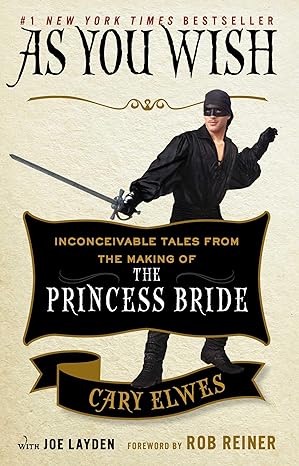
AS YOU WISH: INCONCEIVABLE TALES from the MAKING of THE PRINCESS BRIDE (audiobook) by Cary Elwes


Unabridged.

If you are a fan of the movie The Princess Bride, like I am, this is a must-read book (or must-listen if you are an audiobook listener like me). Cary Elwes, if you don't know, stars in the movie as Wesley/The Dread Pirate Roberts.

Elwes interviews all of the major actors in the movie who are still with us and tells the story of the creation of the movie from the writing of the original script by William Goldman all the way through the eventual success of the movie in the video rental market. Goldman is the author of the book that the movie is based and was an experienced and well-respected writer of screenplays, having written the Academy Award-winning scripts for All the President's Men and Butch Cassidy and the Sundance Kid. He also said that The Princess Bride was his favorite script and he wouldn't trust it to just anyone.

Cary Elwes as the Dread Pirate Roberts
When he can, Elwes incudes audio clips for the quotes he included in the original book. If there are no audio clips available, he has the same actor consistently read the quotes. It is a nice touch, actually hearing things like director Rob Reiner describe the pitch he made to Golden and Wallace Shawn describe how nervous he was making the movie and how he never really understood the humor of his character Vizzini and never has no idea why everyone thinks this is an iconic role.

The book is a joy to listen to and I thoroughly enjoyed all of the little stories that made up this audiobook.

I rate this audiobook 5 stars out of 5. It can be found on Amazon.com here: AS YOU WISH: INCONCEIVABLE TALES from the MAKING of THE PRINCESS BRIDE (audiobook) by Cary Elwes.

Featured Post

<b><i>BAN THIS BOOK (audiobook)</i></b> by Alan Gratz

Published in 2017 by Blackstone Audio, Inc. Read by Bahni Turpin. Duration: 5 hours, 17 minutes. Unabridged. My Synopsis Ban This Book is t...

Popular posts over the last 7 days