HAS ANYONE SEEN the PRESIDENT? (audiobook) by Michael Lewis


Published by Simon and Schuster Audio in 2018.
Only available in audiobook format.
Read by the author, Michael Lewis.
Duration: 0 hours, 54 minutes.
Unabridged.

Originally, Has Anyone Seen the President was originally written for Bloomberg View, the editorial/opinion site of Bloomberg News. Lewis went to Washington. D.C. during the run up to President Trump's "State of the Union Address". Lewis visits the press room in the White House, speaks with a former press secretary from the Obama Administration and visits with Trump advisor Steve Bannon. He also spends time with a former ethics official in the government who quit because President Trump and his administration openly flout the standards for ethics that were established in previous administrations (like divesting your portfolio of investments that could be a conflict of interest with your position in government). Finally, Lewis ends up watching the State of the Union with Steve Bannon in Bannon's home with running commentary from Bannon.

Michael Lewis, for me, is best known as the author of the books that inspired the movies Moneyball and The Blind Slide.  Turns out that he also writes a lot about finance and politics. Who knew? Well, a whole lot of people did, so I guess I was just out to lunch on Michael Lewis and his many facets.

Steve Bannon
The biggest coup of the entire book is the access to Steve Bannon. Bannon is widely regarded as the man who masterminded Trump's 2016 election win. There used to be people that would say that the secret to Ronald Reagan's success was to just "let Reagan be Reagan" because his folksy charm would work wonders. Bannon was the one advisor that would push to "let Trump be Trump." He recognized that Trump's abrasive style and quirky speaking style repelled people by the millions but it also attracted just as many diehard supporters and that was the secret to victory.

If you are part of the group that is repelled by former President Trump, this book will only confirm that repulsion. Bannon's hired gun style is obvious, but he does nothing to betray former President Trump. If you are a fan of the former president, this book will not shake you from those convictions. It is all old news, albeit old news packaged in an interesting story told by a talented story teller. 

I rate this audiobook 5 stars out of 5. It can be found on Amazon.com here:  HAS ANYONE SEEN the PRESIDENT? (audiobook) by Michael Lewis.

CUSTER'S LAST STAND (Landmark Books #20) by Quentin Reynolds


Published in 1951 by Random House.

In the 1950's and 1960's Random House created an extraordinary history series for children called Landmark Books. There were 122 books in the American history series and 63 in the World Landmark series. A very solid description of the series can be found here: link. When I was a kid my little hometown library had what seemed like an endless shelf of these books (I even remember where it was in that little library nearly 40 years later). Undoubtedly, these books are part of the reason I am a history teacher. I have started a collection of these books. When I run across them at library sales and thrift sales I pick them up. Some of the texts have aged well, some have not.

Custer's Last Stand is aimed at students from 3rd to 8th grade. It is a simple read with line drawings. It could use a few more maps. 

The history is basically accurate in the broad strokes, but it is full of "quotes" and scenes that never happened in order to make the story move along. This whole series is like that, though. They are basically like a movie that is "based on a true story."

Brevet Major General George Armstrong Custer 
in 1863. The term "brevet" means it was a 
temporary rank that would be reconsidered
after the war when the Army shrank to
peacetime size. 
This story is easy to read, but comes up short in the story of George Armstrong Custer (called "Autie" throughout the book) of the famous (infamous?) Custer's Last Stand. It really focuses on the time when he was in school, including West Point.  The story of his transition from West Point to the Battle of Bull Run was well told, but the rest of his remarkable career as a Civil War officer was glossed over. 

It barely discusses the reasons for the Civil War and skips most of Autie Custer's impressive Civil War accomplishments. Besides fighting with distinction at First Bull Run, he also checked Jeb Stuart of Gettysburg (a rarity), Sheridan's Shenandoah Valley Campaign and played a prominent role in Lee's surrender. He was the youngest general in American history when he received that rank at the age of 23. 

Even worse, his brother Thomas Custer is giving the short shrift in this book. If all you knew about Thomas Custer was what you read in this book, one would get the idea that Thomas joined up with his more famous brother just to join in his campaigns in the West with no prior military experience.  Thomas Custer fought from almost the beginning of the Civil War, entering as a private at age 16 and leaving as a brevet Lt. Colonel at age 20. Along the way he became the first solider to win two Congressional Medals of Honor.  

This book tries to deal fairly with the situation that the Sioux found themselves in 1876, but it comes off as clunky and cringey 70 years after it was written. The book readily and frequently acknowledges that the United States "made hundreds of promises to the Indians and broke almost all of them." (p. 139)

But, the book tries to walk a fine line compromise position: "Everyone has to judge for himself who was right. Was it the Indians, to whom this land was given? Was it the Americans, who insisted that the country had to grow in the West, and that you needed a railroad to help the country grow? There were good arguments on both sides, but Autie Custer didn't care about arguments. He was a soldier...Soldiers obey orders." (p. 139)

The book mentions over and over that Custer wanted to be a soldier so he coukd be an "Indian fighter" - from age 4 on that was his goal. As a literary device, it works. As history - it makes Custer look like an obsessed nut.

I am sure that the ending of the book was not accurate - with Custer and his brother being the last two of 200+ soldiers to survive, surrounded by dead soldiers and dead horses while bravely fighting on. Very dramatic, highly unlikely.

Some history books hold up well over time. This one is 70 years old and it did not.

I rate this book 2 stars out of 5. It can be found on Amazon.com here: CUSTER'S LAST STAND (Landmark Books #20) by Quentin Reynolds
.

THE PURPOSE of POWER: HOW WE COME TOGETHER WHEN WE FALL APART (audiobook) by Alicia Garza


Published in 2020 by Random House Audio.

Read by the author, Alicia Garza.
Duration: 9 hours, 31 minutes.
Unabridged.


Alicia Garza is one of the founders of the organization Black Lives Matter

This reader decided that he only had a superficial knowledge of the movement and wanted to learn more. The Purpose of Power seemed like a reasonable place to start.

The first part of the book is basically a recounting of Garza's early life and her beginnings as a community organizer. This was quite enjoyable. Garza is a talented writer and she tells her story well.

The author, Alicia Garza
The middle part gets bogged down with some esoteric political movement talk. Lots of discussion over meanings of words like "intersectionality." I thought she made her point very clearly early on and kept on making it. This was clearly very important to the author, but the lay reader who is not heavily invested in the movement and its specific language would, like me, find this to be too much insider talk. 

It got more interesting when Garza discussed a man who the media thinks was a BLM founder (he often appears on the political discussion shows with that descriptor), the reaction of old guard civil rights groups to BLM and the reaction to old guard groups to female leadership voices.

Garza frequently mentions a lot of serious economic reforms she would like to see. This is different from and in addition to the protests against police brutality in all of its forms.  However, she doesn't make take many steps to flesh out what she wants to do and why she is adamant that those reforms need to be made. She mostly assumes that the reader knows what she talks about and agrees with her. 

I rate this audiobook 3 stars out of 5. The middle part with esoteric political talk was a rough slog and the lack of explanation of her economic plans made it an average audiobook.

This book can be found on Amazon.com here: THE PURPOSE of POWER:  HOW WE COME TOGETHER WHEN WE FALL APART by Alicia Garza.

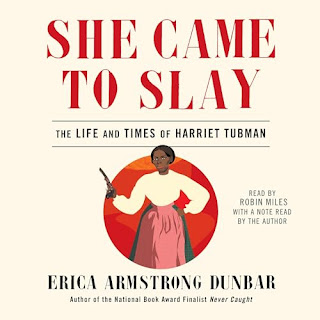
SHE CAME to SLAY: THE LIFE and TIMES of HARRIET TUBMAN (audiobook) by Erica Armstrong Dunbar


Published in 2019 by Simon and Schuster Audio.

Read by Robon Miles.

Duration: 5 hours, 53 minutes.

Unabridged. 

Erica Armstrong Dunbar brings us an accessible biography of one of the true heroes of American history - Harriet Tubman. She Came to Slay is long enough to give a decent picture of her life but short enough that it doesn't intimidate potential readers.

A traveling statue named honoring
Harriet Tubman named "Journey to Freedom"
I am not going to go through the entire biography of her life, but this book covers all of the major points of her life such as: 

-Her escape from slavery; 

-Her multiple trips back to Maryland to free family, friends and anyone that would go;

-Her work in anti-slavery societies where she met and worked with people like Frederick Douglass, William Seward and John Brown;

-The communities she helped start in New York and Canada;

-Her work with women's rights groups and her struggles to get white women to include black women in their fight;

-Her service as a nurse in the Civil War;

-Her service as a spy and a scout in South Carolina in the Civil War and her fight to be recognized for that service.

The book has a lively pace.

I rate this audiobook 5 stars out of 5. It can be found on Amazon.com here:  SHE CAME to SLAY: THE LIFE and TIMES of HARRIET TUBMAN by Erica Armstrong Dunbar.

ON TYRANNY: TWENTY LESSONS from the TWENTIETH CENTURY by Timothy Snyder


Published in 2017 by Tim Duggan Books, an imprint of Crown Publishing Group, a division of Penguin Random House LLC.


Timothy Snyder is a historian that specializes in Central and Eastern Europe in the 1930's and 1940's. This coincides with the rise of the Nazis in Germany the rise of the USSR as a world power. 

In On Tyranny, Snyder has written up several mini essays about the dangers that he sees in modern day politics that are actually echoes from the past. Or, as he puts it: "History can familiarize, and it can warn." (p. 11) He also warns, "We might be tempted to think that our democratic heritage automatically protects us from such threats. This is a misguided reflex." (p.13)

The author, Timothy Snyder
Snyder is clearly warning against the movement that brought Donald Trump to the Presidency, but as a Never Trump Republican, I am of the opinion that both parties do all twenty of these things. But, I am a Never Trump Republican because I am certain that Donald Trump went and keeps going too far. 

In his 5th point, Snyder reminds his readers to remember their professional ethics as a bulwark against authoritarianism. For example, judges need to stay fair and follow the law even if a ruling would reward the President who appointed them. Plenty of  judges that were appointed by Donald Trump wouldn't change their rulings when it came to overturning election results. Attorney General Jeff Sessions wouldn't change his mind about recusing himself from Justice Department Investigations and Vice President Mike Pence would not assert a Constitutional right he clearly does not have in order to stop the Electoral College from voting on January 6. 

His 6th point is to "Be Wary of Paramilitaries", especially when the groups that "...have always claimed to be against the system start wearing uniforms and marching with torches and pictures of a leader, the end is nigh." (p. 42) Witness the Proud Boys and similar groups and the January 6 attack in D.C.

There are 18 other points, some with just some good basic advice like "Contribute to Good Causes" because it helps civil society and keeps the basic building blocks of society strong. Another bit of good advice is to be a patriot, not a nationalist. There's a massive difference.

This small book is a quick, thought-provoking read.

I rate this book 4 stars out of 5. It can be found on Amazon.com here: ON TYRANNY: TWENTY LESSONS from the TWENTIETH CENTURY by Timothy Snyder.

ARCHAEOLOGY: AN INTRODUCTION to the WORLD'S GREATEST SITES (audiobook) by Eric H. Cline


Published in 2016 by The Great Courses.

Read by the author, Eric H. Cline.
Duration: 12 hours, 37 minutes.
Unabridged.

Eric H. Cline is a well-respected and highly experienced archaeologist who is a professor at George Washington University. He has excavated at several sites for a total of 30 seasons, doing everything from being an inexperienced newbie to being Co-Director of well-established sites.

Turns out that Cline is also a very likable guy who does a good job of explaining archaeological techniques. He tells about a number of sites that he worked on and some of the most famous digs in history (King Tut's tomb, Troy) in the first half of the book. It was a bit frustrating for me because they were all within 100 miles of the Mediterranean Sea. 

In the second half of the book, Cline tells about other digs around the world - Machu Pichu, the Terracotta soldiers, Teotihuacan and more. 

On the whole, this was a pleasant if not particularly riveting listen as an audiobook. I rate it 4 stars out of 5.

ZONE ONE: A NOVEL by Colson Whitehead


Originally published in 2011 by Doubleday.

I don't often read zombie novels. I have reviewed 1600+ books and this is only my second one featuring zombies. They're not really my thing, but I figured that if an author who won two Pulitzer Prizes wrote a zombie book, it must be worth reading.

I was wrong.

The premise behind ZONE ONE is quite good, but it is an over-written mess.

Mark Spitz (a nickname) is a man who has gone through his life as a B/B+ type of guy. Never the smartest guy in class, never the first guy picked to play for the schoolyard games, but certainly not close to the last. He kind of floats through life being "good enough."

The reader meets Mark Spitz well into the Zombie Apocalypse. He is working as part of a mopping up crew in New York City. He and his crew are seeking out Zombies that the military may have missed in their sweep through the city. The worst of the Zombie attacks has passed and a provisional government is working out of Buffalo, New York. 

This new government is very concerned with crafting a narrative of the recovery - a narrative of hope and rebuilding with an official theme song and heroes and brand name sponsors and news from all of the other little colonies that it has established on the East Coast.

But, there are rumblings that things aren't going according to the plan...

My take: 

Whitehead has said that he was inspired by his childhood love of Stephen King and Isaac Asimov. King's The Stand is certainly a benchmark to judge all "end of the world" books by, but his lesser-known Cell has the most in common with this book. 

Cell has a focused plot with little character development (a rarity for King). Zone One's plot is constantly interrupted with flashbacks - some fill in important gaps, some seemingly just to fill up some pages. That's not quite fair, but the incessant flashbacks just ruined the momentum of the story. I think it would have been better if he had just cut the book up into its little narrative chunks and placed them in chronological order.

For a reason that is never explained, this new government is obsessed with re-
establishing New York City. As one of the most crowded urban environments in the United States, I would think that NYC would be a horrible place for a fledgling government to spend its limited resources. High urban populations would mean more zombies per city block. Why not just stay in Buffalo and take over Vermont, New Hampshire and Maine, areas with low populations and less zombies? I guess it was more of the symbolism over substance pattern that this new government had already exhibited. Yes, re-establishing NYC would be a major feat, but would it be worth the cost? I think it is really a product of Whitehead leading a NYC-centric life, almost like he couldn't imagine that they would abandon New York City and head to West Virginia or Arkansas or South Dakota. 

On a different note, my edition of this book (first edition) was written in a font that I found very hard to read - tiny and very busy. 

I rate this novel 2 stars out of 5. It can be found on Amazon.com here: ZONE ONE: A NOVEL by Colson Whitehead.

Featured Post

<b><i>BAN THIS BOOK (audiobook)</i></b> by Alan Gratz

Published in 2017 by Blackstone Audio, Inc. Read by Bahni Turpin. Duration: 5 hours, 17 minutes. Unabridged. My Synopsis Ban This Book is t...

Popular posts over the last 7 days