Deogratias, A Tale of Rwanda (graphic novel) by J.P. Stassen


An important tale to be told - unfortunately this one fails to tell it well enough

Published by First Second in 2006.

Deogratias is the name of a young man from Rwanda. The story dances back and forth between pre- and post-1994 massacre Rwanda. Pre-massacre Deogratias is a likeable young man. Post-massacre Deogratias is insane. As one reads this graphic novel one finds out what drove him insane - in a climax that is not all that surprising or shocking (just sad), especially if one knows any of the detail of the Rwanda massacre.
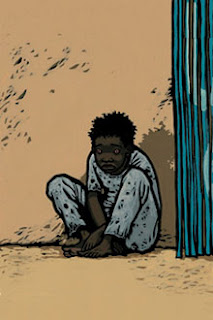
An image from the graphic novel
Great works take the story of one person or group of people in a tragic situation and somehow make their story universal. For example, the Civil War movie Glory is the story of the first all-Black Federal regiment in the Civil War - it is also the story of every soldier - black or white, Union or Confederate. In Saving Private Ryan, the Tom Hanks character epitomizes the average man stuck in a terrible situation doing the best he can and dying in the process.


Deogratias fails to do this. It is too personal. The story is too small. Not to say it isn't important, but rather to say that it fails to become a universal story of the Rwanda tragedy.

My copy of the book has an introduction from Alexis Seigel, the translator. He does an exceptional job of explaining the Rwanda tragedy and its aftermath. I would give his introduction 5 stars.

However, the grade has to go to the graphic novel, not its introduction. So, I give this graphic novel 3 stars out of 5.

This graphic novel can be found on Amazon.com here: Deogratias: A Tale of Rwanda.

Reviewed on December 11, 2006.

This book was listed on a "banned book" list in Florida. Ugh.

And it was put on a book ban list in Tennessee. The article has a searchable database because the list has more than 1,100 unique titles.

The Glory Field by Walter Dean Myers


Published by Scholastic in January of 1994.

The Glory Field is the story of an African-American family and their tie to a piece of land on Curry Island in South Carolina over the course of 250 years.

Reminiscent of the James Michener sagas that follow the same format, The Glory Field is not nearly as detailed or as rich as a Michener selection. However, Michener's primary audience was adults and Myers' intended audience is young adults, most of whom would not have the patience or the courage to pick up a 1,000+ page book.

Myers has broken this book up into a series of six stories, snapshots of the Lewis family throughout nearly 250 years of history. The quality of the stories goes up and down. The 2nd, 3rd and 4th stories are so-so. The first is vivid, strong and way too short. The last two are so strong that, in my mind, they saved the book. I was considering not including it in my classroom library because of the middle stories - they drug along and just didn't have any pizzazz - they were historically accurate - just with no zip.

So, final grade: 4 stars out of 5 (and a place in my classroom library!)


This book can be found on Amazon.com here: The Glory Field by Walter Dean Myers.

Reviewed on December 7, 2006.

The Shape Shifter (Leaphorn and Chee #18) by Tony Hillerman


Despite some flaws, still a strong story (and a possible explanation for the flaws- as a literary device...)


Published by Harper in November of 2006. 

There are numerous flaws in Hillerman's newest book, The Shape Shifter, including a confusing, often rambling first 100 pages or so. However, at about the halfway point in the book it catches some traction and moves forward with purpose and speed and the last half of the book reminds me of the Hillerman of old.

For those readers who are disappointed with this one, might I suggest that some of the flaws are built in on purpose. Not to see if you are paying attention to the overarching plot line, but because the story is not being told with strict and exact attention to detail. Remember, the story is being told from Leaphorn to Chee and Bernadette. Leaphorn makes several references to the old days in which the Navajo stories would be passed down from one generation to the next. Leaphorn missed out on those days because he was bussed to mandatory English school and kept there for months at a time.

Tony Hillerman (1925-2008)
I propose that the story is being told as one of those stories being told from one generation to the next: Leaphorn to Chee and Bernie. It starts and ends in Chee's kitchen with Leaphorn telling them the story. In the end, we know that Leaphorn does not tell them the complete story since they do not know all of the details of the death of the "Shape Shifter". It would be interesting to look at the details of the Navajo creation myths that Leaphorn references so many times (especially those of the brothers who defeat the evil mountain monster that represents greed) and the details of Leaphorn and his ragtag group as they ascend the mountain to take on Mr. Delos, an evil man of multiple personas. Leaphorn's story is not exact to the timeline since it is not really of the timeline - he has taken it out of the timeline and made it one of the stories that the elders teach to their children (Chee is the closest thing Leaphorn has to a son in the stories). Leaphorn's lesson might be that despite the fact that Leaphorn is the Legendary Lt, sometimes the strictest attention to the law is not necessary and does not lead one to Justice.

For those that tire of the references to "Legendary Lt. Leaphorn" and "Lt. Leaphorn, retired" - those are most certainly plot devices. He uses Legendary to poke fun in a self-deprecating way at Leaphorn when he is not doing well at detecting (as in, look at the legend - he's not doing so hot right now, is he?) and Retired when he is confronting new physical limitations. This would go quite well with my thesis of the previous paragraph. It would also explain why Bernie is so insistent on being called Mrs. Chee every time we see her - she is not the real her, she is the Bernie of Leaphorn's story - a caricature of herself, as is everyone else.

So, if my thesis is correct, Hillerman still really has it and has moved on to a higher level of storytelling. Or, he's lost it in a lot of ways and I'm just grasping at straws and seeing connections that are not really there.

Either way, I give this one a grade of 4 stars out of 5 - the last half of the book is so strong that it saves the rambling beginning.

Reviewed on December 3, 2006.

This book can be found on Amazon here: The Shape Shifter

Q-Squared (Star Trek: The Next Generation) (abridged audiobook) by Peter David


A thoroughly entertaining audiobook experience

Published in 1994 by Simon and Schuster Audio Division
Read by John de Lancie
Duration: 2 hours, 59 minutes
Abridged

I picked this audiobook up at a library sale - they were clearing out all of their audiobooks on cassette. So, I picked up a bunch of them and dusted off the Sony Walkman (literally) and gave it a listen. Back in the day (1994) most audiobooks were edited to about 3 hours. This book was originally over 400 pages long so it was edited extensively as well, although the cover does not admit to it. That being said, the editing was very well done here. This could have been an extraordinarily confusing book considering that it bounces around in 3 different universes, but the editors have demonstrated a great deal of skill. All that being said, Q-Squared is not an audiobook for the Star Trek newbie.

In the original Star Trek, Captain Kirk and company encountered Trelane, a being of extraordinary power but very little maturity who called himself "the Squire of Gothos." Trelane captured the Enterprise, verbally sparred with Spock and Kirk and finally ended up in a sword fight with Kirk. He was just about to beat Kirk when Trelane's parents interceded and took their very naughty boy away and set the Enterprise free.

Peter David goes ahead and makes Trelane a member of the Q Continuum and has Q, the character from Star Trek: The Next Generation serve as Trelane's godfather. Trelane is basically working as an apprentice under Q as a favor to Q's friends, Trelane's parents. Trelane and Q come to Captain Picard's Enterprise to learn about humans and see how they operate.

Picard and Q. Q is played by the reader of this audiobook, 
John de Lancie
But, Trelane gets a bellyfull of being told he's a nuisance and that he shouldn't use his awesome powers to make people he dislikes disappear. Trelane comes up with a plan...


There is a theory that there are actually multiple universes out there, not just one. This book follows three of them. The first is the standard Star Trek storyline. The second is a storyline in which the Federation and the Klingons are at war and the Federation is losing badly. The third is one in which Jack Crusher, husband of Dr. Beverly Crusher and best friend of Captain Picard is not dead. In fact, he is the Captain of the Enterprise, newly divorced from Dr. Crusher and Picard and Dr. Crusher are having a secret torrid affair.

Trelane's plan to get even with the Enterprise involves melting away the "walls" that separate these universes (and all of them, I suppose), blocking the Q Continuum from interfering and killing Q. But, Q does not die and the injured Q works his way through all 3 universes to fight Trelane with Picard's help. It is entertaining to listen to the interaction amongst them all and painful to listen to Trelane do his best to make Jack Crusher a source of even more pain for Dr. Crusher and Picard.

Trelane and his harpsichord in the original 
Star Trek series
The audiobook is read by John De Lancie, the actor who portrayed Q in the Star Trek: The Next Generation television shows. He captures the voice of his own character perfectly (of course) but he also nails the voice of Trelane as well with a manic and injured tone that captures his insanity and his dangerous side. Throw in some decent sound effects (including what has to be the loudest turbolift in Star Fleet...) and an interesting twist to the musical score that includes a harpsichord being played as Trelane's insanity builds to a crescendo (Trelane really enjoys the harpsichord) at the end of the book and you have a thoroughly entertaining audiobook experience.

I rate this audiobook 5 stars out of 5.

This audiobook can be found on Amazon.com here: Q-Squared by Peter David.

Reviewed on June 19, 2012.

Guilt (Abe Glitsky #2) by John Lescroart


I hate to be the party pooper but...


Published in 1997.

Despite good experience with Lescroart in the past, despite the rave reviews on the back cover of Guilt and a dozen rave reviews inside the front cover, I found myself only caring about what happened to Abe Glitsky. The slow-moving, plodding plot line only reinforced the fact that I did not care what happened to the Mark Dooher. Did he kill his wife? I don't know - it's mentioned in the first sentence in the plot synopsis on the back cover and 200 pages into the book she's still alive and I'm getting irritated at reading about Dooher's connivings to sleep with one of his young employees.

So, anyway, I read exactly 200 pages of this book. It was not easy. I was forcing myself to continue on, much like I would do with a college textbook.

Then I came across the new Tony Hillerman book and I gladly dropped this one into the box of books that I'm dropping off at the Goodwill. Thank goodness I am now "Guilt" free!.

I rate this book 1 star out of 5.

This book can be found on Amazon.com here: Guilt by John Lescroart.

Reviewed on November 26, 2006.

God Save the Child (audiobook) (Spenser #2) by Robert B. Parker


Good Early Spenser novel


Published August 1st 1988 by Books on Tape, Inc.
Read by Michael Prichard
Duration: 5 hours, 4 minutes
Unabridged

Robert B. Parker and Tony Hillerman are the two authors I most consistently check when I go to a library or a bookstore. When it is a great day, one of the two has a new book. When it is a tremendous day, they both have a new one out and I have to decide which to read first!

In the meantime, I am making do by going back over their collected works as audiobooks. I have a long drive to work every day and Spenser makes a very good ride-along companion. I have long-since read all of the older Spenser books, but the beautiful thing about a faulty memory is that the plot lines get a bit hazy over time and now I can enjoy them all over again!

Besides, it is always interesting to see how the reader interprets Spenser and the gang. One of the best to capture Spenser smart-aleck comments was Burt Reynolds, although his interpretation of Hawk was pleasurable, but questionable in terms of accent.

The reader for God Save the Child was a Michael Prichard. His interpretation of Spenser was neither here nor there, neither good nor bad. However, his reading of the character Mrs. Bartlett was right on the money. Here's the scoop on Mrs. Bartlett: She and her husband hire Spenser to find her son. He is missing and a note has been sent to the Bartletts asking for $50,000 for his safe return. This book was written in 1974 when $50,000 was a whole lot of money. Mrs. Bartlett is an insipid, vapid twit of the first order. A woman more concerned with fashion than her child's safety. She hosts a dinner party in her house on the same day that a man is killed in it and during the time her son is missing. She is a woman who believes herself to be an artist because it gives her an excuse for her bad behavior. Prichard nails her voice so dead on that you wish you could reach through the radio speakers and smack her upside the head on at least half a dozen occasions.

Robert B. Parker
So, how's the plot? Good thriller, although you could see the ending coming as soon as you hear the details of the missing boy's case. Of course, that could be some latent memories from when I read the book 10 years ago...

We meet Susan Silverman.

We meet Healey of the State Police (Prichard nails him too - I never noticed before that Healey was funny, but Prichard reads him as Spenser's straight man foil and I laughed out loud a couple of times).

There's plenty of Spenser's dogged style of detecting and plenty of smart comments.

This listener was struck as to how old Spenser really is - there is a lot of descriptive detail about clothing from the 1970s that reinforce that fact. Luckily, Spenser is forever middle aged but tough enough to take on the world and Susan Silverman is forever ageless and beautiful, no matter the decade.

I rate this audiobook 5 stars out of 5.

This book can be found on Amazon.com here: God Save the Child by Robert B. Parker.

Originally reviewed on November 23, 2006.

In the Heat of the Night by John Ball


After seeing the movie I was expecting much more

First published in 1965.

If you've seen Sidney Poitier and Rod Steiger tear into one another in the movie version of this book you may be expecting a few more fireworks than this book delivers. Heck, even if all you know of the story is the TV show with Carrol O'Connor and Howard Rollins than you have already seen more fireworks than this book delivers. And why is that? Because in the book version of In the Heat of the Night, Virgil Tibbs is a proud man but he often fails to show the fire that both Poitier and Rollins brought to the character.

John Ball (1911-1988)
Throw in a near-total lack of action (there are two small fight scenes, but they are almost incidental to the plot) with about 50 pages worth of driving around a small Southern town in the middle of the night and you can quickly figure out why the movie version remains popular, with more than 50 reviews on Amazon.com at the time of this writing, while the book has just a handful.

What this book most reminded me of was an Agatha Christie mystery. Sure, there's a lot of racial tension, but the book version of Virgil Tibbs is willing to take whole lot more of the racial runaround than the Sidney Poitier version, so that just becomes more of a nuisance than anything else. Similarities to an Agatha Christie novel include: rich guy gets killed, visiting detective gets on the case, a big "wrap-it-all-up" scene in the living room of one of the characters in which the visiting detective explains everything to everyone.

I rate this book 3 stars out of 5.

This book can be found on Amazon.com here: In the Heat of the Night by John Ball.

Reviewed on November 19, 2006.

Featured Post

<b><i>BAN THIS BOOK (audiobook)</i></b> by Alan Gratz

Published in 2017 by Blackstone Audio, Inc. Read by Bahni Turpin. Duration: 5 hours, 17 minutes. Unabridged. My Synopsis Ban This Book is t...

Popular posts over the last 7 days