Star Trek IV: The Voyage Home (abridged audiobook) by Vonda N. McIntyre, Leonard Nimoy, and Harve Bennett


Published in 1986 by Simon and Schuster

Read by Leonard Nimoy and George Takei
Duration: 90 minutes
Abridged.

I picked up this audiobook of Star Trek IV: The Voyage Home on cassette at a clearance book sale in the "who's going to want this stuff?" section. Mostly, it was serious junk. Educational software that only operates on Apple IIe,  VHS copies of movies that I've never heard of starring some guy that was on some TV show that I barely remember and DVDs of some pastor's sermons on any number of topics (still in the plastic!). And, suddenly, I find a memory from my high school and college years - a genuine Star Trek audiobook from 1986!...on audiocassette! And...narrated by George Takei and Leonard Nimoy! So, I scuttle out of there like I've found a gold bar and pop it in car's cassette player - one of the advantages of having an old car is that it has a multimedia (CD and cassette) stereo system.

Back in the day, audiobooks were almost always abridged, sometimes criminally. This 274 page book is abridged to a mere 90 minutes. To be honest, if it weren't for my faded memories of the movie, I don't even know if there is enough plot here to tell the story.

George Takei from a scene in the
movie Star Trek IV
But, I enjoyed it immensely - I am a fan . Takei reads the story except for the internal musings of Spock, which are, of course, handled by Nimoy. It turns out that George Takei is a very strong audiobook narrator. His Scottish accent for Scotty is very strong, his southern accent for McCoy is smooth and understated and his Kirk is interesting. Several times Takei sneaks in his take on Shatner's stilted....way...of...pausing....when...he...speaks. I loved it.


So, in a sentence, the book is way too abridged but the fact that it was narrated by Takei and Nimoy made it a joy to listen to anyway.

Get this book as a audio download from Audible on Amazon.com here: Star Trek IV: The Voyage Home (Adapted) .

I rate this audiobook 4 stars out of 5.

Reviewed on April 1, 2012.

The Good Fight: How World War II Was Won by Stephen E. Ambrose


Great book for school age kids

Published in 2001 by Atheneum Books for Young Readers

Stephen E. Ambrose is perhaps best known as the author of Band of Brothers, the book that inspired the HBO mini-series of the same name. His passion for World War II continues in this book aimed at upper elementary through high school students.

A Kamikaze plane about to hit an American ship
(In the book on page 78)
While there is nothing new in The Good Fight, it is a fantastic introduction to the war. All of the major theaters are covered and, perhaps best of all, there is a full page 10" x 10"  picture from the war that show everything from the home front to kamikaze planes to Hitler in a elaborate Nazi rally to Holocaust victims and even more. Those pictures and the little ones scattered on the other pages make the book much more vivid. There are also plenty of pictures of the young men and women that were involved - pictures that make the war seem more real. Throw in Ambrose's mastery of the details and great writing and this is a must have book for any library or grades 5-12 history classroom.

I rate this book 5 out of 5 stars.

This book can be found on Amazon.com here: The Good Fight : How World War II Was Won.

Reviewed on March 29, 2012.

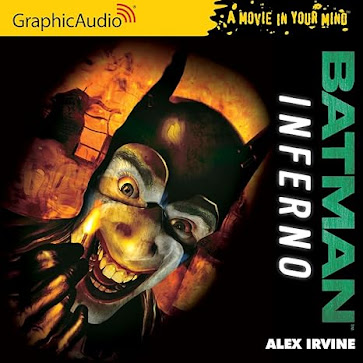
Inferno (Batman) (audiobook) by Alex Irvine


Okay story, great production

Published in 2009 by GraphicAudio
Multicast performance featuring 26 actors
Duration: Approximately 7 hours.

Batman is called to duty to fight Enfer, a new villain whose name means "Hell" in French. Enfer is skilled with fire and explosives and suffered a transformation similar to that of Joker but his change involved a massive explosion. Enfer is hired to free the inmates of Arkham Asylum by its director, Dr. Crane. His arson burns the asylum and lets dozens of inmates free, including the Joker.

While escaping through Gotham City's sewer system, the Joker accidentally stumbles into a back entrance into the Bat Cave. The Joker assaults Alfred, steals a Bat Suit and the BatMobile and starts a crime wave while pretending to be Batman, turning public opinion against Batman.

Enfer continues to burn the city. He wishes to attract the attention of The Joker in hopes of joining forces. Can Batman stop Enfer and The Joker before his reputation is completely ruined or the city is burnt to a crisp?

As always, GraphicAudio does a top notch job of creating "A Movie In Your Mind" with their production. The characters are well-portrayed, the background music is great (there is a cloying musical "theme" for Enfer's innermost thoughts and memories that helps create a haunting ambience). Throw in the sound effects and you can see why these audiobooks are so popular. 

This story had giant holes.  At one point, there is a giant push to get a DNA sample of the Joker. No one has one. Are we really supposed to believe that no one has taken a sample of it - not the courts, not the Asylum even though the man has been in and out of the system dozens of times- no one, not even Batman? Really??? Not even Batman????

Even worse,  the plot hatched by Crane and Enfer is never quite explained so we never know why Arkham Asylum was burned. The whole story turns on this event and it is a mystery.

But, the old-fashioned radio show format is so well done that plot issues become secondary. It's just entertaining and engrossing.

I rate this audiobook 4 stars out of 5.

This audiobook can be found on Amazon.com here: Inferno.

Reviewed on March 27, 2012.

Berserker (Bersker series #1) (audiobook) by Fred Saberhagen


Published in 1983 by Recorded Books
Narrated by Aaron Lustig and Henry Strozier.
Duration: approximately 6.5 hours
Unabridged


I just stumbled upon Berserker, not realizing that there is an entire series of these books. I'm not terribly surprised, the structure of the first book lends itself to sequel after sequel.

The premise of the book is that giant intelligent killing space machines are out to destroy all of the life they discover. Why? We are never told, but we assume that they are by-products of a long-ended war by a long-forgotten people.

Fred Saberhagen (1930-2007)
Photo by Beth Gwinn
This first volume was written in the late 1960s. The only reason I point this out is that I believe that the 1960s was an especially fertile time for science fiction, especially sci-fi that wanted to discuss big issues and themes. For example, TV's "Star Trek" and "Twilight Zone" are often more than a creepy story or a space alien story - they explore deep themes, such as "What is beauty?" and "What does it mean to be human?". Saberhagen openly explores these themes and more.

Saberhagen bounces around from one episode in humankind's struggle against these machines to another, giving the reader (in my case, listener) a bit of the flavor of the struggle as a whole. There are minor battles, major battles, backroom political struggles, stories of prisoners, accidental encounters and attempts to make peace. All stories are told by an alien historian in short story format. Some characters overlap from story to story but many do not.

Abuse of power, treason, forgiveness, revenge and what it means to be human are themes that Saberhagen explores. The quality of the stories vary. The first one is particularly weak in my opinion, so don't let it deter you from continuing on.

The audiobook is well read, with Aaron Lustig and Henry Strozier sharing the work - one acts as the historian narrator that introduces each short story while the other reads the main body of the book.

This audiobook can be found on Amazon.com here: Berserker #1 by Fred Saberhagen.

Reviewed on October 26, 2007

I rate this audiobook 4 stars out of 5.

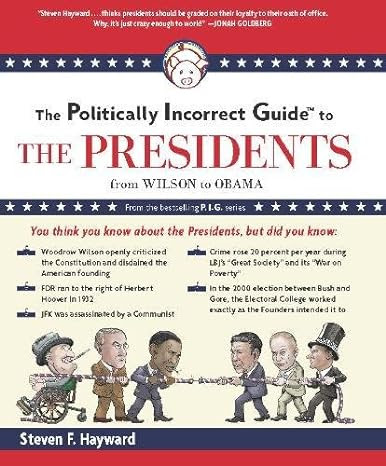
The Politically Incorrect Guide to the Presidents from Wilson to Obama (P.I.G. Series) by Steven F. Hayward


An entertaining read and a great way to rate the presidents

Published in 2012 by Regnery Publishing, Inc.

First and foremost, the latest entry in the P.I.G. series is a great read. Steven Hayward is to be commended for making what could have been a very stale read into an entertaining read - he has a light touch.

Secondly, how sad is it that grading presidents by how well they "preserve, protect, and defend" the constitution is a unique idea?

Hayward begins The Politically Incorrect Guide to the Presidents with a look at what the founders wrote about the office of the president and compares that to the modern presidency. He then looks at the presidency in the 19th century and how most presidents took the restrictions of the Constitution very seriously.

As Hayward proceeds to grade the 17 presidents we have had from 1913 until the 2012 (from Wilson to Obama) on an A to F scale (just like in school) he gives a thumbnail sketch of each president with the major issues of the election and/or his time in office, where he diverged from the Constitution (or supported it) and how the Supreme Court justices he appointed fared by way of the Constitution as well.

Each president gets about 8-12 pages per term in office and the text includes sidebar boxes with recommended readings, great quotes and interesting factoids. The overall grade is presented on the first page of each president's particular chapter and the last page explains how it was arrived at.

Richard Nixon, president from 1969-1974
So, what did I think? I agreed with the great majority of the grades given, although there were some I would have been a little tougher on or a little easier on (a C+ vs. a C- type of thing). I very much disagreed with the C+ for Richard Nixon - and not because of Watergate (although Hayward largely excuses it with the "the other guys did it, too!" defense) . The growth of the regulatory bureaucracy under Nixon was incredible - according to a factoid on page 173 it grew by 121% under Nixon. Throw in federal wage and price controls and I don't see how you can give Nixon the C+ that Hayward does.

But, that is just one grade out of 17 (and even that chapter was interesting). This is a book that I am going to keep handy for those great online political debates. Nothing like a great Warren G. Harding quote like this one: "There is not a menace in the world today like that of growing public indebtedness and mounting public expenditure" to get a little discussion going in this election year, huh?

Note: I would love to see an expanded re-issue of this book with 2 co-authors. One co-author would be a presidential historian who would provide a lot of the heavy lifting for the section detailing the history of each president's administration. The third co-author would be someone from the left politically. This would be a much larger book, but also a much more comprehensive and accurate book. 

I rate this book 5 stars out of 5.

This book can be found on Amazon.com here: The Politically Incorrect Guide to the Presidents from Wilson to Obama.

Reviewed on March 23, 2012.

The Girl Next Door (Carter Ross #3) by Brad Parks


Entertaining Mystery

Published by Minotaur Books on March 12, 2012.

Carter Ross is a good reporter on the staff of a struggling newspaper in Newark, New Jersey. When a delivery person for his paper is killed in a hit and run accident, Ross decides to do a little human interest piece for the paper. But, as he starts to interview her friends and family for the background material some things just do not add up. Throw in the insistent claims from her sister that she was murdered and the strange behavior of his paper's publisher and Ross gets curious and starts to do some digging of his own. Of course, things do not
Brad ParksPhoto by
James N. Lum.
 go smoothly and Ross gets involved in all sorts of dangerous (and embarrassing) situations.


Ross is a likeable character and his cast of friends and colleagues that fill the book make this a very entertaining read. This is not a dark,  gritty, hard-edged novel although the mystery is plenty convoluted and quite satisfying. I have not read Brad Parks before and I will certainly keep an eye out for his other books.

I rate this mystery 4 stars out of 5.

This book can be found on Amazon.com here: The Girl Next Door.

Reviewed on March 17, 2012.


David Farragut and the Great Naval Blockade (The History of the Civil War Series) by Russell Shorto


Solid history for grade 5 and above.


Published in 1991 by Silver Burdett Press
119 pages of text. 9 pages of timelines, sources and and index at the end.

David Farragut and the Great Naval Blockade is part of a larger series (The History of the Civil War Series). It is very readable with a good balance of national history versus the biography of David Farragut.

Farragut joined the United States Navy at age 9 in 1810, fought against the Barbary Pirates and in the War of 1812. Until the Civil War, Farragut was known as an great officer, the kind of officer that sailors were glad to work under, but also the kind of officer that just missed doing something great. He was not sent to "open" Japan with Matthew Perry. He tried to get involved in the Mexican War but the fighting in Veracruz was over by the time his ship arrived.

When the Civil War began, it was assumed that Farragut would go with the Confederacy. After all, he was born in Tennessee, he lived in Norfolk, Virginia and his wife was also a Southerner. But, Farragut was a U.S. Navy man so he moved to New York and soon found himself in charge of the blockade of the Gulf states (from Texas to Florida).

David Farragut in 1858
Farragut's ships took New Orleans and Mobile, Alabama. Both conquests involved a great deal of clever strategy and a lot of nerve. While his ships were going through a mine field (called torpedoes in Civil War times), his men were scared and stopped moving forward into Mobile Bay. Farragut yelled out, "Damn the torpedoes! Full speed ahead!" and on they went to victory.


Due to health issues, Farragut headed home to New York. He became the first person in American history to become a vice-admiral and in 1866 he became the first admiral. Farragut died in 1870. The date of his funeral was a national holiday and 10,000 soldiers and sailors marched in the funeral procession, led by President Grant.

This book is a solid introduction to the role of the Navy in the Civil War as well as being an great little biography of Farragut. The maps are simple and the maps of the Battles of New Orleans and Mobile Bay are excellent. Lots of pictures help to tell the story.

I rate this biography 4 stars out of 5.

This book can be found on Amazon.com here: David Farragut and the Great Naval Blockade.

Reviewed on March 17, 2012.

Featured Post

<b><i>BAN THIS BOOK (audiobook)</i></b> by Alan Gratz

Published in 2017 by Blackstone Audio, Inc. Read by Bahni Turpin. Duration: 5 hours, 17 minutes. Unabridged. My Synopsis Ban This Book is t...

Popular posts over the last 7 days