Eragon (Inheritance, Book 1) by Christopher Paolini


A pleasant enough read but Paolini seriously needs to send an apology to George Lucas...


Originally published in 2003.

I enjoyed the book but I kept on thinking that I've read this book before. No, I'm not talking about the obvious debt Paolini owes the Tolkein and also to the "Dragonriders of Pern" series.

I'm talking Star Wars: Episode IV: A New Hope or plain old Star Wars to all of us old-timers.

Both feature an orphaned teenage farm boy, left with his uncle under mysterious circumstances that no one wants to discuss.

The uncle dies when dangerous outsiders come looking for the boy.

Luke Skywalker has the Force. Eragon has magic.

Both Luke and Eragon are watched over by strange older men who eventually provide them with their first weapon - the very weapon that wiped out a set of good knights in the name of an evil emperor.  In both stories, the strange older man character teaches them a type of magic and how to fight.

The older man dies.

Eragon frees a girl from a castle with the help of that wanted-by-the-law Rogue Murtagh. Luke frees a girl from the Death Star with the help of that wanted-by-the-law rogue Han Solo.

The Emperor uses magic to turn a dragonrider to kill off all of the good dragonriders. The Emperor uses the Force to turn a Jedi Knight to kill off all of the good Jedi Knight.

Are there more comparisons? Surely there are but my point has been made.

I rate this book 4 stars out of 5.

This book can be found on Amazon.com here: Eragon.

Reviewed on May 29, 2007.

Update: This book was placed on a "banned books" list in Texas in the 2022-2023 school year. Ugh. 

In the Fullness of Time: A Historian Looks at Christmas, Easter, and the Early Church by Paul L. Maier


Published by Kregel Publications in 1998.
384 pages

Paul Maier is a truly gifted lecturer. I've had the pleasure of watching two of his videos and if I lived anywhere near Western Michigan University, I'd sneak into the back of his classroom (he is a member of the history faculty there) on a regular basis - he has a gift for making the First Century A.D. accessible.

In the Fullness of Time continues this tradition. Maier has basically consolidated 3 other books into one larger volume (with a few changes) and he discusses the first Christmas, the first Easter and the ministries of the early Apostles, especially Paul and Peter.

Dr. Paul Maier
Maier does a great job of bringing actual documentation that supports the stories of Christmas, Easter and the Book of Acts. He includes the works of Roman and Jewish historians, explains Roman and Jewish religious and political practices and deals with alternate theories that have been proposed. While this could be dry reading, Maier makes it lively and this volume reads more like a novel than a textbook.

So, who is this book for? If you are a well-read Christian who has looked into many of the facts that back the New Testament as it is written on your own, you won't find much new ground covered in this book. The internet has lots of this information scattered about. However, you are unlikely to find sources as concise and as well-written as this one. Plus, if you are interested in further research, it is well-documented with tons of footnotes.

If you are a new Christian or are newly interested in the history behind Christianity, this is a powerful introduction.

I give this one 5 stars out of 5.

This book can be found on Amazon.com here: In the Fullness of Time: A Historian Looks at Christmas, Easter, and the Early Church by Paul L. Maier.

Reviewed on May 14, 2007.

Team of Rivals: The Political Genius of Abraham Lincoln by Doris Kearns Goodwin


Published in 2005 by Simon and Schuster

944 pages
 
"No harm's done to history by making it something someone would want to read." -David McCullough

When I read a history book I realize that there multiple types of history books out there. Setting aside the ones that are designed to distort history (such as holocaust denier literature) there are still several styles of history book. They range from the small topical books that offer a brief overview to the more popular histories such as those that David McCollough specializes to definitive works - the type of work that others will refer back to for decades to come.

Doris Kearns Goodwin's Team of Rivals is just such a definitive work. It checks in at 754 pages of text with more than a hundred pages of 8 font footnotes. It took her 10 years to produce this book and it is a work of which she can be proud. It is exhaustively researched and documented.

However, that is also the problem with the book. It is so large, so thorough that only the heartiest of readers will ever finish it. There are so many details, so many quotes, so much substance to this book that it gets tiring to read, especially the middle 500 pages or so. I started this book in January and I finished it the last week of April. In the meantime, I read 12 other books and many magazines. I never stopped reading this one, but so many other books pulled me away from this one along the way.

Unlike the McCollough books (or Stephen Ambrose or James McPherson or Bruce Catton), the level of detail overwhelms the reader. A valuable resource to refer back to but just not the stuff that popular histories are made from.
Lincoln's Cabinet - 1861


So, I'm giving this one multiple grades:

Research, thoroughness: A+
Readability, high level of interest to the average history buff: C+
Final Grade: B+

A suggestion: It would have been instructive to have gone into more detail and tell more about how Lincoln's "Team" collapsed with under President Andrew Johnson. She briefly touches on it, but bit more would have been interesting. Perhaps another volume?

I rate this book 5 stars out of 5.

This book can be found on Amazon.com here: Team of Rivals: The Political Genius of Abraham Lincoln

Reviewed on April 30, 2007.

Great Tales from English History: Volume II. Chaucer to the Glorious Revolution (audiobook) by Robert Lacey


A Real Treat As An Audiobook


Published by Whole Story Audio Books
Read by the author, Robert Lacey
Duration: 5 hours, 50 minutes
Unabridged

Robert Lacey has done something that many writers have failed to do (unfortunately) - he has written history in a fun, accessible, easy to grasp manner. After all, as Lacey points out in his introduction to Volume 1, the "history" and "story" come from the same Latin root word. Essentially, history should be the simple story of how things happened, to the best of the teller's knowledge.

Geoffrey Chaucer (1343-1400)
Lacey's power as a storyteller is highlighted here in spades. He narrates his audiobook as well so there is the added bonus of hearing the author add nuance to the reading - essentially reading it the way he meant it to be heard.

The stories are short and entertaining. Only a couple of times in nearly six hours of listening did I find my attention wandering. This is a terrifically fun experience for any history lover. Full of interesting tidbits but not lacking in the larger themes or commentaries.

I am going to look for volume 3 and hopefully he has written or is writing his promised volumes on Scotland and Ireland as well.

Bravo!

I give this one an enthusiastic 5 stars out of 5.

This book can be found on Amazon.com here: Great Tales from English History. (Note: I was unable to find the audiobook on Amazon, but I did find multiple version and combinations of these stories. The link goes to a 3 volume book collection.)


Reviewed on April 18, 2007.

Michener's the Name by Robert Vavra


A chance to get to know a bit of Michener's personality


Published in 2007 by University Press of Colorado
208 pages.

I am a huge fan of Michener's sweeping epics. Some look at those gigantic books as drudgery, but that is only because they have not opened one up and read it. I've read all but two - I own them but I'm saving them back like a wine connoisseur would save back a couple of his favorites. I know these books will be great and I know that once I read them there will be no more new Micheners for me.

James Michener
(1907-1997)
Vavra's book focuses on their mutual interest in Spain and Spanish culture, especially bullfighting, Spanish dance and the Spanish countryside. Vavra met several famous authors, actors and personalities while in Spain in the 1960s. He mentions them, but it rarely acquires the character of a name-dropping book. Mostly, he uses those others as a point of comparison to Michener, and Michener comes off very well in the comparison. Never flashy, sometimes socially awkward, oftentimes astute, Michener is a friend to great and small alike. He seems to have been able to keep his head despite the fame and fortune. Perhaps that is because, unlike Hemingway, Michener never sought the limelight. He did not shrink from it, but he did not seek it.

Two-thirds of the book consists of Vavra's black and white photographs of Spain and/or Michener. This is appropriate considering that Vavra is an internationally famous photographer. The text is just as strong as the pictures, just surprisingly short. But, then again, maybe not. After all, this book is not intended to be a complete biography of Michener. Rather, it is the collected remembrances of one of his friends and the good times they had together.

I rate this book 4 stars out of 5.

This book can be found on Amazon.com here: Michener's the Name.

Reviewed on April 18, 2007.

Captured! A Boy Trapped in the Civil War by Mary Blair Immel


Published in 2005 by the Indiana Historical Society.
153 pages


Based on a true story, and full of relevant historical photographs, Captured! A Boy Trapped in the Civil War fails to deliver on action in many ways which will make it less attractive to the 10-14 year old (estimated) target audience..

Camp Morton in Indianapolis
It concerns a 14 year old boy named Johnny Ables who was captured by Confederate soldiers and pressed into service as a wood hauler. Ironically, those Confederate soldiers are themselves taken prisoner and Johnny is mistaken as a young Confederate soldier and is sent to prison camp (Camp Morton) in Indianapolis.

Although it will find a place on my classroom's bookshelf, I can only give this short volume 3 stars out of 5.


This book can be found on Amazon.com here: Captured! A Boy Trapped in the Civil War.

Reviewed on April 17, 2007


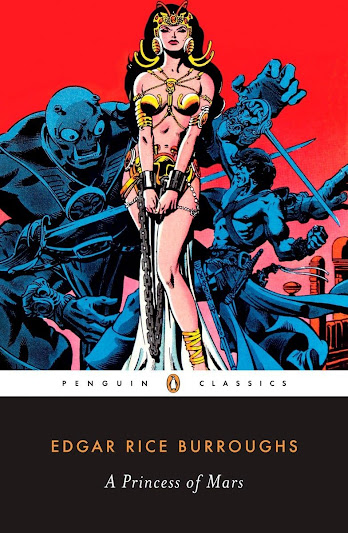
A Princess of Mars (Barsoom/John Carter of Mars #1) by Edgar Rice Burroughs


A Classic Sci-Fi Novel

Originally published 1912 in a magazine serial. (1917 in book form)

Since the movie John Carter is coming out in a couple of months I decided to go back and re-read the original of the 11 books that Burroughs wrote about Mars (or, as he calls it, Barsoom).

The Whelen cover.
I originally read the entire series, or at least most of it, nearly 30 years ago, when I was in high school. I must admit, I was struck by the art of Michael Whelen's cover more than anything else when I first picked it up and my circle of friends read at least some of them.

I remembered them fondly but found myself very vague on the specifics. I remembered the Princess was very beautiful and there were multiple races on Mars and that some had four arms and that Carter, a former Confederate soldier, traveled from Earth to Mars in some kind of psychic manner and that there was a lot of fighting.

Turns out, what I took as a poor memory was actually pretty accurate. The Princess is beautiful, there are multiple races of Martians and the green Martians have four arms and Carter does travel to Mars in some sort of psychic way. I had totally forgotten that it happens while he is being hunted by a group of Apache in Arizona at the time, but that really is not germane to the rest of the story.

Edgar Rice Burroughs (1875-1950)
The story is supposed to be the writings of John Carter himself (who is ageless and cannot remember his childhood). Carter told his nephew not to publish it until he had been dead for 21 years. The plot is mostly Carter's descriptions of his adventures told in first person with little conversation. There are lots and lots of battle scenes since Mars is a very violent place. Then again, Earth is not much better with Carter making a name for himself in the Civil War and in the first few pages being involved in a running battle with the Apache.

Short on character development and long on description and action, A Princess of Mars was not as good as I remembered it but I am very impressed with Burroughs and his imagination. In a time before science fiction was a normal part of the national psyche, he created an entirely new world, peopled it with aliens with new customs, languages and animals and made the world work in an interesting way. Some of his science is rather silly (the generator that creates the Martian atmosphere comes to mind), but it is a classic and a trendsetter.

This book can be found on Amazon.com here: A Princess of Mars by Edgar Rice Burroughs.

I rate this novel 4 stars out of 5.

Reviewed on January 8, 2012.


Featured Post

<b><i>BAN THIS BOOK (audiobook)</i></b> by Alan Gratz

Published in 2017 by Blackstone Audio, Inc. Read by Bahni Turpin. Duration: 5 hours, 17 minutes. Unabridged. My Synopsis Ban This Book is t...

Popular posts over the last 7 days