Crazies to the Left of Me, Wimps to the Right: How One Side Lost Its Mind and the Other Lost Its Nerve (audiobook) by Bernard Goldberg


Published by HarperAudio in 2007.

Narrated by the author, Bernard Goldberg
Duration: 7 hours, 27 minutes.
Unabridged.


Bernard Goldberg, who used to work at CBS news until two opinion pieces that he wrote for the Wall Street Journal nearly 10 years ago made him a persona non grata. What was in these two opinion pieces that caused Dan Rather to say he would never forgive Goldberg and Goldberg's boss to accuse him of "disloyalty"?  He said that CBS and the other major media outlets are biased towards the political left in their reporting. Not the kind of bias that involves meetings and sercret cabals. Instead, it is a sort of groupthink. The sort that never even considers asking the questions that the people with a more conservative worldview would ask. So, most of this bias is from a series of "sins of omission" (to borrow a phrase) rather than an overt plot. As a result, Goldberg wrote his book Bias: A CBS Insider Exposes How the Media Distort the News.

In Crazies to the Left of Me, Wimps to the Right: How One Side Lost Its Mind and the Other Lost Its Nerve Goldberg goes after both the Left and the Right with thoughtful criticism. Goldberg narrates the audiobook version himself (and does a great job, too) and throws in plenty of humor, irony and satire to leaven the heavy doses of criticism. As he implies in the title, many on the left have gone right off of the edge and many on the right have forgotten their roots and have lost the intestinal fortitude to stand up for what they claim to believe in.

Written in 2006 and 2007, some parts of the book are a bit dated (the discussion of race and politics, for example, seems quaint without reference to Barack Obama), but it is clear that Goldberg predicted the electoral disaster that hit the Republicans in 2008 and he seems downright prophetic when he predicts that frustration with "wimpy" Republicans will cause people to look for other political voices. Clearly, the Tea Party movement was the expression of that frustration.
Bernard Goldberg

The heart of the book feels like a series of columns that were re-worked for the book, which is fine because Bernard is a good writer, he organized them nicely by topic and he edited them to avoid repeating himself.

Topics include:

A personal history;

A history of the Conservative movement, including the warts;

The NAACP and George W. Bush;

Ann Coulter (not as a "wimp on the right" but as someone who needs to tone herself down);

Alec Baldwin (actually not about Alec as a crazy man of politics but as a man who could step out and ask for an end of the name-calling since he's been a victim of it himself);

Barry Goldwater;

Religion in politics on the Right and the Left;

Mel Gibson (he makes a good point, but it seems dated with Mel's outbursts);

Jack Henry Abbot;

A brilliant satire about the coarsening of TV's "family hour";

race-based preferences in hiring and college admissions;

anti-Semitism among the liberal elite on America's college campuses;

Congressional earmark spending;

TSA profiling;

Terrorism by radical Muslims (including a brilliant point about not trying to "understand" terrorists any more than he would try to "understand" the white men who participated in 1950s lynchings;

9/11 Truthers;

The New York Times and CBS News;

Tony Blair;

and just a little too much about Israel (I didn't disagree with it, it just was a bit too much on one topic).

All in all, an entertaining and well thought-out look at America's political culture.

I rate this audiobook 5 stars out of 5. It can be found on Amazon.com here: Crazies to the Left of Me, Wimps to the Right: How One Side Lost Its Mind and the Other Lost Its Nerve.

Reviewed on November 13, 2010.

Wild Justice (Amanda Jaffe #1) by Phillip Margolin


Finally, Margolin is back on his game!


Published in 2000.

I've read Margolin's books since I came across The Burning Man but I've been sorely disappointed by many one of them since because they have never approached the power or the storytelling of that book.

While Wild Justice is very much different than The Burning Man, it is a great page turner. I found the story to be inventive, if not twisted. Although, I figured out who the killer was with about 100 pages to go, there were so many plot twists that I doubted my conclusion several times. The ending was tension-filled and full of poetic justice. I'll be reading more.

I rate this book 5 stars out of 5. It can be found on Amazon.com here: Wild Justice (Amanda Jaffe #1) by Phillip Margolin.

Reviewed on October 26, 2004.

Dave Barry's Book of Bad Songs (audiobook) by Dave Barry


Funny, but the audiobook format begged the question - "why not include parts of the actual songs?"

Published by HighBridge in 1999.
Read by Mike Dodge.
Duration: 1 hour, 30 minutes.

Abridged.

Yes, I realize it would be a publishing nightmare - trying to convince someone to let you use their song just so you could make fun of it, but it would have been so much more effective!


Dave Barry
Oh well, what might have been!

Dave Barry's Book of Bad Songs really is a funny book. Dave's quirky sense of humor was effective, as always. I thoroughly enjoyed Dave's list of bad songs and his analytical dissection of the lyrics, especially when I also intensely disliked the song. However, I liked it even more when I actually loved the song ('American Pie' comes to mind)!

I rate this book 4 stars out of 5.

Reviewed on October 20, 2004.

Desperate Measures by David Morrell


Once you get past the first 35 pages, its quite a ride!


Originally published in 1994.

Desperate Measures begins with newspaper reporter Matt Pittman, the protagonist, who is literally preparing to kill himself with his pistol out of grief for his son that has died from cancer when the phone rings.

Pittman decides to answer it because he wants to make sure that he exits this life without owing anything to anyone. It is his best friend and his boss who covered for him innumerable times when his son was sick. He asks for one more favor and Pittman reluctantly goes back on the job for one more story.

It was at this point in the book that I was about ready to close it up and start another book because the whole "I'm going to kill myself" angle was getting very, very old. I realize that Morrell was writing out of the pain of losing his own son to cancer, but the book was rapidly losing interest for me.

David Morrell
Suddenly, the pace of the book changed and Pittman's research into a well-connected diplomat leads to murder, mayhem and a multi-state manhunt for Pittman. From about page 35 on the book is a roller-coaster of a ride, very reminiscent of The Fugitive. It is well worth the read - despite the fact that you have to slog through the first 35 pages.

I rate this book 5 stars out of 5.

This book can be found on Amazon.com here: Desperate Measures by David Morrell.

Reviewed on October 20, 2004.

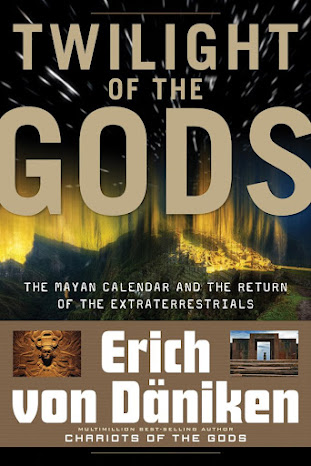
Twilight of the Gods: The Mayan Calender and the Return of the Extraterrestrials by Erich von Daniken


Enthusiastic but disjointed

Published in 2010.

Erich von Daniken is most famous for his 1968 book Chariots of the Gods in which he put forth the theory that civilization was brought to earth by alien space travellers that taught some humans their ways and this is the source of the world's major religions and brought mankind from the caveman era to civilization in places such as Egypt. He believes that this truth is documented in the art and writings of the ancient civilizations. The 1970s documentary In Search of Ancient Astronauts. Just to be fair to those that read this review, I do not espouse von Daniken's beliefs, but I do find him to be interesting and I enjoy reading about the connections that he sees.

Pumu Punku
In  Twilight of the Gods: The Mayan Calendar and the Return of the Extraterrestrials von Daniken expounds upon his theory with a bit with more examples of items that should pique the interest of those that endorse von Daniken's assertions. Although the title implies this is a exhaustive look at the Mayan Calendar and the popular belief that it says the world will end on December 23, 2012, von Daniken does not even address the Mayans until he is two-thirds of the way through the book. Most of his book concerns a pre-Incan site in Bolivia called Puma Punku and the amazing buildings and stonework there.

I do have some argument with von Daniken's history of the Maya. He leads his readers to believe that the Maya were a very healthy civilization before the Spanish began to push into their territory after conquering the Aztecs in 1521. In reality, the classic Maya, the ones that von Daniken is referring to in his book, had collapsed more than 500 years earlier. The Maya that the Spanish conquered were a shell of the classic Maya with a lot of outside influence (if not outright occupation) by such groups as the Toltecs.

Von Daniken implies that the Maya were the earliest civilizations in the area and there is no way that they could have observed some of the older astrological phenomena that they record. He fails to note that the "source" culture for the region is believed to be the Olmec, who existed nearly 2000 years before the Classic Maya.

Interestingly, von Daniken is very derisive of evolution (not of changes in species but in the idea of all life coming from some sort of primordial goo). He uses terminology that reminds me very much of Ken Ham and his Answers in Genesis books. However, von Daniken espouses a theory (I think he does anyway, he throws around a lot of theories at the end of the book) called Panspermia that teaches that an unknown life form shot out its DNA all over the universe, much like one would scatter seeds out of an airplane. Most of it was unsuccessful, but in some places life took hold.

Erich von Daniken
Von Daniken is interesting, as always. However, he is in serious need of an editor to keep him on the topic at hand.  I have already mentioned the complete lack of mention of the Maya in the first half of the book, despite the title. Von Daniken discusses everything from Bolivia's archaeological community to Hitler to climate change in his most disciplined section of the book, the first half.

In the last half of the book he seems to toss out random thoughts about the Mayan predictions about the end of time and then moves on to comment on long distance space travel, alien visitors to Tibet, how ideas spread, SETI, warp drives, the astronomers of the Catholic Church and electrons, among other things, in a conclusion that is most unsatisfying.

Is the book entertaining?

Yes, but it could have been much better organized.

Is there food for thought here?

Sure - it's fun to play with goofy theories like these but, if von Daniken were a chef and not an author, this would be a very sloppy, half-considered meal indeed.

I rate this book 3 stars out of 5. It can be found on Amazon.com here: Twilight of the Gods: The Mayan Calendar and the Return of the Extraterrestrials.

Reviewed on November 8, 2010.

Justice League of America: Exterminators (audiobook) by Christopher Golden


Published in 2008 by Graphic Audio.
5 CDs
5 Hours
28 Actors

Graphic Audio published the audio version of a DC Comics graphic novel featuring the Justice League of America. Graphic Audio boasts that it is "A Movie In Your Mind" and while that may be a bit of an exaggeration, it is every bit as good as those old radio plays that, if you're lucky, a local radio station may play from time to time. Graphic Audio has 28 actors (if my count was correct as they named them all), music, lots of special effects and they use them all to create a thoroughly engrossing story.

There is nothing particularly new in JLA: Exterminators. A wave of new "meta-humans" are popping up all over the globe with one thing in common (besides super powers): they were all in the UK about 10 years previously and were exposed to something that gave them these new powers.

The Flash and The Green Lantern become friends with a new meta-human with telekinesis and the audience is given a perspective on both sides of this issue - the old superheroes and the new ones, some good and some bad. I was reminded of that old TV show,  The Greatest American Hero, as their new friend, Ian, struggles with the desire to be a regular guy and the desire to use his new powers for good.

Later, things start to go even more haywire and giant monsters begin stomping around in just about every metropolitan area in the world, including Metropolis, Hong Kong, Long Beach, Edinburgh, Paris and especially London. Somehow, Gotham City is not pestered by this homage to Godzilla movies. These monsters are tough and the JLA has to call out anyone and everyone to stop them (except the military, which is featured big-time in a similar problem 10 years ago but is strangely absent while Superman gets thrown through entire buildings).

The audiobook features The Flash, The Green Lantern, Aquaman, Superman, Batman, Wonder Woman and the Martian Manhunter throughout. The Atom gets extended focus later on and eventually everyone gets called in including the retired versions of Flash and Green Lantern, Nightwing, the Titans, Steel, Black Lightning, Superboy, Wonder Girl, the Blue Beatle and pretty much everyone in the DC universe except for the Bizarro world folks.

In the end, Superman, Batman and the Martian Manhunter spend way too much time agonizing over whether or not to destroy these giant monsters that are destroying buildings by the minute and killing untold thousands. That over-thinking is not something that generally plagues Batman, but in this case it got annoying. For the record, I am all for killing giant alien monsters that are destroying the world's urban centers - without delay! The Flash and The Green Lantern respond by blowing off this psychological self doubt by asking if they should have gone ahead and  let them destroy the cities? No, is the answer. Then move on.

I've done a lot of critical observations here but the question is, is this an entertaining audiobook?

Yes!

Lots of fun - very entertaining. The multi-actor old-fashioned radio play format works very well.

I rate this audiobook 5 stars out of 5.

This audiobook can be found on Amazon.com here: JLA: Exterminators.

Reviewed on November 7, 2010.

The Rising Tide: A Novel of World War II by Jeff Shaara


Originally published in 2006.

The Rising Tide: A Novel of World War II is the first book in Jeff Shaara's series about World War II. It is the weakest in many ways. Shaara approaches most of his books with the docudrama format - a little bit of narrative history, a lot bit of historical fiction. His narrative history is quite well written and flows nicely.

The historical fiction in this book is its weak point. The action is very good, but there is not a lot of action - just a few pages in the Africa Campaign and some very solid stuff from the Sicily campaign. The majority of the historical fiction part of the book, among the Allied characters at least, is Shaara's characters putting themselves into place to fight Rommel and setting the scene for the second book. It would have moved more briskly if Shaara would have reverted to the historical narrative form, but it would severely limit the fictional aspects of the book.

Jeff Shaara
On the Axis side, Rommel is the compelling figure of the book. Clearly Shaara builds him up to be the ultimate professional officer of the war - not a Nazi, just a man fighting his country as he has always done. Shaara skirts around the issues that Rommel must have surely considered when those orders come from thugs like the Nazis. Perhaps he just assumed that Rommel chose to mostly ignore the uncomfortable aspects of taking orders from people like the Nazis. Perhaps Rommel was just as afraid of the Communists and just as angry at the Allies as Hitler was - we just don't know from this book. What I did not get from this series was a sense that Rommel was a real "super general". After all, for the layman he is the only battlefield German General with a "name brand" recognition. What I got from this portrayal of Rommel was a sense that he could have defeated two particular British commanders with ease if he had the resources and that he could see that Germany was extending itself too far.

There are plenty of great maps in this series, but especially in this book.

I rate this book 4 stars and it can be found on Amazon.com here: The Rising Tide: A Novel of World War II by Jeff Shaara.

Reviewed on November 16, 2010.

Featured Post

<b><i>BAN THIS BOOK (audiobook)</i></b> by Alan Gratz

Published in 2017 by Blackstone Audio, Inc. Read by Bahni Turpin. Duration: 5 hours, 17 minutes. Unabridged. My Synopsis Ban This Book is t...

Popular posts over the last 7 days