Amberville by Tim Davys


The hardest thing about this book is describing it to other people.

Published in 2009 by Harper.

I was telling my wife about Amberville. I told her I was reading a book about stuffed animals (her face softened) and I said but it's not a "nice" book. One of the animals used to be a gofer for the mafia, one's a thug enforcer, one's a backstabber and one is a pill-popping male prostitute that specializes in S&M sex-for-hire.

She got a confused look on her face and asked why the author used stuffed animals? Well, he had to because these stuffed animals are all delivered by way of truck and when they die they are all hauled out of the city by truck as well and the big bad mobster dove has found out he's on a fabled list of stuffed animals that are to be hauled away and he wants four stuffed animals to reunite to find the list and save his life - or else.

At that point she waved me off and changed the subject.

Throw in a bit of insanity on the part of one character, some bribery, jealousy, lots of lies, a rat Queen who lives in a garbage dump and a church called the Sagrada Bastante (Spanish for sacred enough) and you have a mix that creates a powerful new world - I found myself reading as much to explore this world as to find out what was going to happen next in the plot.

How do you classify this book? Is it sci-fi? Fantasy? Noir? Thriller? Mystery? Yes to all of those.

Davys (a pseudonym) has written another book called Lanceheim: A Novel about another neighborhood in the city of stuffed animals, Mollisan Town. There are four neighborhoods so I can imagine he (or she) will write four book in total. Good. This is an interesting addition to anyone's library.

I rate this book 5 stars out of 5. It can be found on Amazon.com here: Amberville by Tim Davys.

Reviewed on August 15, 2010.

Bad Business by Robert B. Parker


Published in 2004.

This is a typical Spenser book. I happen to like a typical Spenser book quite a bit. I think I've read them all and usually I am pleased. Bad Business was a keeper.
Robert B. Parker

Oh, to be sure, there's the required comments about Spenser and Susan's relationship and why they don't want to get married. There's the required comments about Spenser and Hawk's relationship and how they'd die for each other, etc. There's the required comments about Spenser's checkered career in law enforcement. It's a formula to be sure, but I like the formula.

Spenser's comments and observations are pure gold and the case was interesting because it (sort of) explains what happened to Enron.

I guess I'm over the fact that Spenser never ages. Parker must have been hearing comments because he includes a NY Times review that excuses this fact inside the dust cover at the beginning of the synopsis. It doesn't bother me with James Bond, why should it bother me with Spenser?

I rate this book 4 stars out of 5.

You can find a copy of this book on Amazon.com here: Bad Business.

Reviewed on October 15, 2004.

Rebel Moon by Bruce Bethke


I was real happy until I got to the end -or maybe it wasn't?


Published in 1996.

Rebel Moon is a fast-paced, fun sci-fi book. Set in 2069, the various colonies of the moon have revolted against the United Nations and declared their independence. The UN is not happy and responds by sending in peacekeepers to pacify things. A small, professional armed force augmented by volunteer militia fend off the UN and German forces (the world may be dominated by the UN but some individual countries still pursue their own agendas).

This is a non-techno space romp. There's enough science to please most sci-fi fans but it as kept simple as we are introduced to the fighting styles of the future through the eyes of a computer geek militia member. The politics of the day are murky enough to seem plausible.

I would have easily have rated this book a '4 stars' or, perhaps, even a '5 stars' if the ending had not been so terribly abrupt. Will there be a sequel. Did he just run out of time or space? Who knows, but it left a curious taste in my mouth. 

I rate this book 3 stars out of 5.

This book can be found on Amazon here: Rebel Moon

Dirt (Stone Barrington) by Stuart Woods


Man oh man! Is this the same guy that wrote "Chiefs"?


Originally published in 1996.

I ask the question because Chiefs was an absolutely fantastic novel. One of my favorites. This story is easy to read, quick-moving and entertaining but, for me, ultimately it is disappointing because I know that he could do sooooooo much better. If you've never read Stuart Woods, read Chiefs and maybe you'd be better off just walking away.

So, why am I irritated? The characters are two-dimensional cutouts of what we might suspect the rich and the famous are really like. They reminded me of unpleasant parodies of the Howells from Gilligan's Island. Woods can do so much more.

To be fair, I guess I'm really irritated to see a man who showed so much early promise resort to being a hack writer, pounding out the same story time after time. I tolerate, in fact, I revel in it when it comes to Robert B. Parker. But in the case of Stuart Woods - what an incredible waste of writing talent!

I rate this book 3 stars out of 5.

This book can be found on Amazon.com here: Dirt by Stuart Woods.

Reviewed on October 14, 2004.

The Culture of Disbelief: How American Law and Politics Trivialize Religion by Stephen L. Carter


A
thoughtful look at the poo-pooing of religion by secular American society


Published in 1993 by Basic Books.

I found The Culture of Disbelief: How American Law and Politics Trivialize Religion while reading another book by Stephen L. Carter, one that I did not care for, Jericho's Fall. However, I am glad I read Jericho's Fall because I found this book listed on a page of the author's other works.


Read the discussion boards on popular blogs, newspaper pages and any other site that attracts people from all walks of life and you will find a strong anti-religious bias. In fact, there is a rather insulting review of this book that does much the same on Amazon.com. Carter takes a look at this relatively new fact of American life - the secularization of everything and the expectation that religious people treat "God as a hobby" and the expectation of people not to use their religious beliefs as a framework for their lives. Fear of someone "imposing" one's religion on another rules all.

Carter explores the history of this movement, looks at legal cases that have run roughshod over religion and discusses the irony of the fact that Martin Luther King and the Civil Rights Movement was based on religious arguments against discrimination and highlighted the main strength of autonomous religion in a pluralistic society: it can serve as a counterweight to government. In more common terms, it can "speak truth to power."

Carter is far from advocating theistic government (he is, in my opinion, very liberal politically), he is merely pointing out that religion cannot be a tool of the state - they have different goals. He warns that "nearly everyone seems to operate with the general presumption that the government can and should regulate in whatever areas suit its constituents' fancy - unless opponents can interpose a claim of constitutional right. And as federal constitutional rights go, the right to exercise religion freely is quite near the bottom of the totem pole."(p. 138)

The only problem with this book is that it is dated. There are many, many references to the 1992 Republican Convention (one that I vaguely remember for a particularly vitriolic speech by Patrick Buchanan) which was the last big national event that involved religion and politics. I would love for Stephen L. Carter to re-write this book and include recent events such as the Jeremiah Wright controversy, the Schiavo case, Islam in America and so much more.

I rate this book 5 stars out of 5.

This book can be found on Amazon.com here: The Culture of Disbelief.

Reviewed on September 19, 2009.
<

Six-Legged Soldiers: Using Insects as Weapons of War by Jeffrey A. Lockwood


Interesting topic but a chore to read in many places


Published in 2008 by Oxford University Press.

As a history teacher, I was excited to see a whole new take on warfare so I eagerly snatched up Six-Legged Soldiers: Using Insects as Weapons of War.

However, as good as the information in the book is, it is a difficult read. There's a lot of repetition in the first part of the book and it just bogs down in the sections on World War II, Korea and the Cold War. A good co-author would have been my recommendation.

The best two sections are the ones on the American Civil War and the last chapters on the dangers we face nowadays from the prospect of insect-based terrorism. They are shorter and move along nicely.

Lockwood admits that he is not a professional historian in his introduction on page X and at times it shows. He is probably the only person to have ever asserted in print that General Henry Halleck was a good field commander after he assumed command from Grant after the Battle of Shiloh. He assumes Halleck made the connection between mosquitoes and malaria (most assumed malaria came from things such as "swamp vapors") and let the mosquitoes force Beauregard to retreat.

Vigo County, Indiana,
home of Terre Haute and
a World War II defense plant.
Named for a true hero of the
Revolutionary War,
Francis Vigo.
In another chapter he made the mistake of "creating" an entire new county in Indiana on page 147 (he mislabels Vigo County as Terre Haute County). I would have let it slide and not even have mentioned it but he is so snide and so specific for so many pages about where the defense plant was and how foolish it was to build it near a population center (Terre Haute) that I was shocked that he made the simple mistake of getting the name of the county wrong.

Perhaps the biggest frustration for me was his constant pointing out that the United States captured and used the scientists involved in Japan's large-scale insect/biological warfare unit. He acts as though this were unique and not just part of the larger pattern that played out after the war. The West and the Soviets both used captured Axis power scientists after the war in their rocket, nuclear and biological programs. Not a pretty thought, but nothing unique, either.

I rate this book 2 stars out of 5.

This book can be found on Amazon.com here: Six-Legged Soldiers.

Reviewed on September 19, 2009.

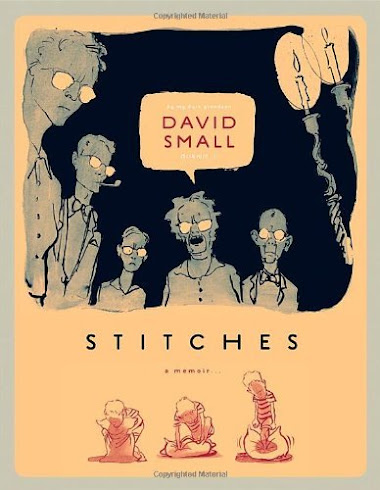
Stitches: A Memoir by David Small


A sad, engrossing read


Published in 2010.

I hated the first 20 pages of Stitches: A Memoir. It seemed like another self-pitying artistic look at a pseudo-dysfunctional family and I'm just a little tired of that right now.

But...

the story develops a bit more and pretty soon I was totally absorbed. I read it in two sittings for a total time of less than an hour, despite its 300+ page length. The story pulls you in. I was amazed at the literal insanity of Small's maternal family. It is also the autobiographical struggle of David Small dealing with his own struggles with mental instability.

The stitches referred to in the title are stitches that David Small has to have after a radical surgery on his neck. He had suffered from a growth in his neck for years before his parents decided to have it investigated, an inexcusable act considering that his father worked at a hospital as a radiologist.

Small's artwork catches and defines the mood so well. There are many pages with no text at all but nothing but artwork that conveys the story with body language, a raised eyebrow, raindrops or an odd angle.

Not only that but Small catches the accent of his family from southern Indiana dead on accurate in his writing. I'm a native of southern Indiana and I appreciated his effort to catch the distinctive twang and drawl.

I rate this book 5 stars out of 5.

This book can be found on Amazon.com here: Stitches: A Memoir by David Small.


Reviewed on September 21, 2009.

Note: Stitches 
was put on a book ban list in Tennessee. The article has a searchable database because the list has more than 1,100 unique titles.

Featured Post

<b><i>BAN THIS BOOK (audiobook)</i></b> by Alan Gratz

Published in 2017 by Blackstone Audio, Inc. Read by Bahni Turpin. Duration: 5 hours, 17 minutes. Unabridged. My Synopsis Ban This Book is t...

Popular posts over the last 7 days