Team of Rivals: The Political Genius of Abraham Lincoln by Doris Kearns Goodwin


Published in 2005 by Simon and Schuster

944 pages
 
"No harm's done to history by making it something someone would want to read." -David McCullough

When I read a history book I realize that there multiple types of history books out there. Setting aside the ones that are designed to distort history (such as holocaust denier literature) there are still several styles of history book. They range from the small topical books that offer a brief overview to the more popular histories such as those that David McCollough specializes to definitive works - the type of work that others will refer back to for decades to come.

Doris Kearns Goodwin's Team of Rivals is just such a definitive work. It checks in at 754 pages of text with more than a hundred pages of 8 font footnotes. It took her 10 years to produce this book and it is a work of which she can be proud. It is exhaustively researched and documented.

However, that is also the problem with the book. It is so large, so thorough that only the heartiest of readers will ever finish it. There are so many details, so many quotes, so much substance to this book that it gets tiring to read, especially the middle 500 pages or so. I started this book in January and I finished it the last week of April. In the meantime, I read 12 other books and many magazines. I never stopped reading this one, but so many other books pulled me away from this one along the way.

Unlike the McCollough books (or Stephen Ambrose or James McPherson or Bruce Catton), the level of detail overwhelms the reader. A valuable resource to refer back to but just not the stuff that popular histories are made from.
Lincoln's Cabinet - 1861


So, I'm giving this one multiple grades:

Research, thoroughness: A+
Readability, high level of interest to the average history buff: C+
Final Grade: B+

A suggestion: It would have been instructive to have gone into more detail and tell more about how Lincoln's "Team" collapsed with under President Andrew Johnson. She briefly touches on it, but bit more would have been interesting. Perhaps another volume?

I rate this book 5 stars out of 5.

This book can be found on Amazon.com here: Team of Rivals: The Political Genius of Abraham Lincoln

Reviewed on April 30, 2007.

Great Tales from English History: Volume II. Chaucer to the Glorious Revolution (audiobook) by Robert Lacey


A Real Treat As An Audiobook


Published by Whole Story Audio Books
Read by the author, Robert Lacey
Duration: 5 hours, 50 minutes
Unabridged

Robert Lacey has done something that many writers have failed to do (unfortunately) - he has written history in a fun, accessible, easy to grasp manner. After all, as Lacey points out in his introduction to Volume 1, the "history" and "story" come from the same Latin root word. Essentially, history should be the simple story of how things happened, to the best of the teller's knowledge.

Geoffrey Chaucer (1343-1400)
Lacey's power as a storyteller is highlighted here in spades. He narrates his audiobook as well so there is the added bonus of hearing the author add nuance to the reading - essentially reading it the way he meant it to be heard.

The stories are short and entertaining. Only a couple of times in nearly six hours of listening did I find my attention wandering. This is a terrifically fun experience for any history lover. Full of interesting tidbits but not lacking in the larger themes or commentaries.

I am going to look for volume 3 and hopefully he has written or is writing his promised volumes on Scotland and Ireland as well.

Bravo!

I give this one an enthusiastic 5 stars out of 5.

This book can be found on Amazon.com here: Great Tales from English History. (Note: I was unable to find the audiobook on Amazon, but I did find multiple version and combinations of these stories. The link goes to a 3 volume book collection.)


Reviewed on April 18, 2007.

Michener's the Name by Robert Vavra


A chance to get to know a bit of Michener's personality


Published in 2007 by University Press of Colorado
208 pages.

I am a huge fan of Michener's sweeping epics. Some look at those gigantic books as drudgery, but that is only because they have not opened one up and read it. I've read all but two - I own them but I'm saving them back like a wine connoisseur would save back a couple of his favorites. I know these books will be great and I know that once I read them there will be no more new Micheners for me.

James Michener
(1907-1997)
Vavra's book focuses on their mutual interest in Spain and Spanish culture, especially bullfighting, Spanish dance and the Spanish countryside. Vavra met several famous authors, actors and personalities while in Spain in the 1960s. He mentions them, but it rarely acquires the character of a name-dropping book. Mostly, he uses those others as a point of comparison to Michener, and Michener comes off very well in the comparison. Never flashy, sometimes socially awkward, oftentimes astute, Michener is a friend to great and small alike. He seems to have been able to keep his head despite the fame and fortune. Perhaps that is because, unlike Hemingway, Michener never sought the limelight. He did not shrink from it, but he did not seek it.

Two-thirds of the book consists of Vavra's black and white photographs of Spain and/or Michener. This is appropriate considering that Vavra is an internationally famous photographer. The text is just as strong as the pictures, just surprisingly short. But, then again, maybe not. After all, this book is not intended to be a complete biography of Michener. Rather, it is the collected remembrances of one of his friends and the good times they had together.

I rate this book 4 stars out of 5.

This book can be found on Amazon.com here: Michener's the Name.

Reviewed on April 18, 2007.

Captured! A Boy Trapped in the Civil War by Mary Blair Immel


Published in 2005 by the Indiana Historical Society.
153 pages


Based on a true story, and full of relevant historical photographs, Captured! A Boy Trapped in the Civil War fails to deliver on action in many ways which will make it less attractive to the 10-14 year old (estimated) target audience..

Camp Morton in Indianapolis
It concerns a 14 year old boy named Johnny Ables who was captured by Confederate soldiers and pressed into service as a wood hauler. Ironically, those Confederate soldiers are themselves taken prisoner and Johnny is mistaken as a young Confederate soldier and is sent to prison camp (Camp Morton) in Indianapolis.

Although it will find a place on my classroom's bookshelf, I can only give this short volume 3 stars out of 5.


This book can be found on Amazon.com here: Captured! A Boy Trapped in the Civil War.

Reviewed on April 17, 2007


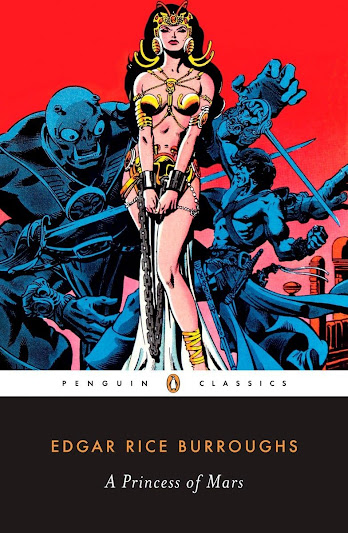
A Princess of Mars (Barsoom/John Carter of Mars #1) by Edgar Rice Burroughs


A Classic Sci-Fi Novel

Originally published 1912 in a magazine serial. (1917 in book form)

Since the movie John Carter is coming out in a couple of months I decided to go back and re-read the original of the 11 books that Burroughs wrote about Mars (or, as he calls it, Barsoom).

The Whelen cover.
I originally read the entire series, or at least most of it, nearly 30 years ago, when I was in high school. I must admit, I was struck by the art of Michael Whelen's cover more than anything else when I first picked it up and my circle of friends read at least some of them.

I remembered them fondly but found myself very vague on the specifics. I remembered the Princess was very beautiful and there were multiple races on Mars and that some had four arms and that Carter, a former Confederate soldier, traveled from Earth to Mars in some kind of psychic manner and that there was a lot of fighting.

Turns out, what I took as a poor memory was actually pretty accurate. The Princess is beautiful, there are multiple races of Martians and the green Martians have four arms and Carter does travel to Mars in some sort of psychic way. I had totally forgotten that it happens while he is being hunted by a group of Apache in Arizona at the time, but that really is not germane to the rest of the story.

Edgar Rice Burroughs (1875-1950)
The story is supposed to be the writings of John Carter himself (who is ageless and cannot remember his childhood). Carter told his nephew not to publish it until he had been dead for 21 years. The plot is mostly Carter's descriptions of his adventures told in first person with little conversation. There are lots and lots of battle scenes since Mars is a very violent place. Then again, Earth is not much better with Carter making a name for himself in the Civil War and in the first few pages being involved in a running battle with the Apache.

Short on character development and long on description and action, A Princess of Mars was not as good as I remembered it but I am very impressed with Burroughs and his imagination. In a time before science fiction was a normal part of the national psyche, he created an entirely new world, peopled it with aliens with new customs, languages and animals and made the world work in an interesting way. Some of his science is rather silly (the generator that creates the Martian atmosphere comes to mind), but it is a classic and a trendsetter.

This book can be found on Amazon.com here: A Princess of Mars by Edgar Rice Burroughs.

I rate this novel 4 stars out of 5.

Reviewed on January 8, 2012.


Why Men Hate Going to Church (Completely Revised and Updated) by David Murrow


Powerful and dead on.

Published 2011 by Thomas Nelson
237 pages, including end notes.

David Murrow has put a lot of thought into why men do not go to church. I am in my mid-40s and have gone to church all of my life, with the exception of 2 or 3 years right after college where my wife and I went every once in a while at best.  We have been at the same church for 18 years.

We have a great church but we do have wives that come to church without their husbands week in and week out - not many, but after reading this book and being made more aware of the issue I am sure I will notice more. Murrow has studied and interviewed and talked and listened about this topic for years and he has come up with 12 reasons that men do not come to church. Among them are:

-I'll hate church, like when I was a kid;

-I'll lose control;

-If I become a Christian, I'll become soft;

-Church is full of hypocrites;

-All they want is my money;

-I'm jealous (women who idolize the pastor or men resenting the time their wives spend at church);

-I'm being held to an impossible standard.

I've heard all of these excuses (and more) for not going to church and I've had those thoughts myself so I got it when Murrow discusses these topics. Sometimes he even brought up things that I hadn't even realized I was bothered by, such as songs and church language that emphasize "relationship and romance" (p. 99) Men, if you have not noticed, are notoriously clutzy, as a group, with relationships. Don't talk about being intimate with Jesus. Not a comfortable image for most guys. Instead, give men a mission (like the old Blues Brothers movie where Jake and Elwood tell everyone they "are on a mission from God.").

The problem is that church, like school, has gradually become an environment run by women, maintained by women and very female-centric. It is highly verbal, lots of talk about relatioships, full of songs that Murrow refers to as "Jesus is my boyfriend" songs (he fulfills your every emotional need and holds you in his arms). The largest Christian music radio network is K-Love. My wife loves it. I don't. She ought to love it - it is aimed at a mythical listener named "Kathy" - a thirty-something soccer mom with two kids, a minivan and a mortgage. 2/3 of K-Love listeners are women and a whole lot of their songs are soft rock "Jesus is my boyfriend" stuff. (pages 66-7) 

Men feel like they are not welcome by the decor, the songs, the style of service and the lack of things they can do to participate. Who wants to stay where they are not welcome?

I am a public school teacher. I can testify to the fact that boys and girls tend to learn differently. Church (and the sermon) is the weekly chance to teach men and women about the Christian faith. Do not make this experience all "girl friendly" and leave out many (but not all) men because the church favors one gender's way of doing things (Murrow actually presents statistics that show that women stay and enjoy church even if it really tilted towards a man's way of thinking).

Murrow provides lots of examples of what to do and what not to do, including success stories (including one from a church led by a female pastor - statistically the worst indicator of male involvement). I was excited by the chapter entitled "How Men Minister to Others" - lots of great ideas. It made me think about how two of our most active leaders were motivated to become more involved by mens' retreats. One really did not want to go, but he came back all fired up because he found out there were regular guys at church who drink beer while they study the Bible (yes, we do, but only on the mens' retreat) and he has organized and participated in any number of activities (as well as being an Elder). The second guy I was thinking about went on a weekend servant event (I went, too) - we helped a family re-do their home after a devestating flood (this event was organized by the first guy I was talking about) and had a couple of small Bible studies, played some cards, and had a real good time when we were not working. I enjoyed it but the second guy was inspired to really get involved and he has not slowed down a bit.

My wife is reading this book next (I talked about it while I was reading it) and we're passing it on to others in our church. Who knows what will happen?

The book has an accompanying discussion guide available at Murrow's website: http://www.churchformen.com/ .

I rate this book 5 stars out of 5.

This book can be found on Amazon.com here: Why Men Hate Going to Church.

Reviewed on January 6, 2011.

I received this book as part of Thomas Nelson's BookSneeze program in exchange for an honest review.

The Politically Incorrect Guide to the British Empire (P.I.G. Series) by H. W. Crocker III


A breezy look at a worthy topic


Published in 2011 by Regnery Publishing, Inc.
394 pages including extensive notes and an index.

Generally intended as an antidote to the slanted education that many of us have received, the Politically Incorrect Guide (P.I.G.) series is an entertaining series loosely based on the "Idiots Guide..." and the "Dummies..." books.

The Politically Incorrect Guide to the British Empire is an immensely readable look at the British Empire - it's origins, its ideals, its controversies and its rather abrupt ending after World War II. The format of the book is pretty simple. Crocker picks an area of the British Empire and than gives a brief (15-25 pages) history of the Empire in that part of the world, from beginning to end. Then, he focuses on several of the personalities mentioned in the brief history with biographies that go into greater detail.

Sir Francis Drake (1540-1596)
Those personalities are way more interesting than bland descriptions of policy edicts issued from the Lord such-and-such from the Ministry of This-and-that. The focus on the men that made the Empire makes this an interesting book from one end to the other. I especially enjoyed Sir Francis Drake, Sir Henry Morgan and General Charles George Gordon. Throw in sidebar articles with titles like "Nearly 1,000 Englishman against more than 55,000 soldiers of the nawab of Bengal = advantage England", "Kipling on the American War of Ingratitude - er, Independence" and "Films about British Africa That Anti-Colonialists Don't Want You to See" and you have the recipe for an entertaining, surprisingly breezy book that gives an interesting counter-argument to the crowd that argues that Western colonization ruined the world.

The question is, does the argument succeed? Was the British Empire a positive force for good? Is it like the front cover says: "Three cheers for colonialism!"

Well, yes and no. Did the British Empire spread the ideas of free speech, democracy, rights and responsible government around the world? Certainly. This book champions those notions and makes a series of strong arguments. But, rarely it is asked, "But, at what cost?" I can be certain that if I lived in Africa and if I were going to be colonized by a European power, I would want it to have been the British Empire. By far, they were the most humane, most generous and did their best to impart their ideals to their subjects. The proof is in the relative success of the former British colonies compared to the former colonies of other European powers. But, the caveat here is "If I were going to be colonized..." I would prefer not, thanks just the same.

But, this is a worthy counterpoint to the stuff that is dribbled out in most college classes (I took a few myself - "everything from the West is evil" , blah, blah, blah.) Read that stuff, read this book and you have a more realistic idea of what happened - everything was not evil, nor was it all wonderful. Like most things, Western colonization was a mixed bag. Colonization can be generally listed as a bad thing, but one can be certain that the British colonies, as a group, got a much better deal than the other colonies.

This book can be found on Amazon.com here: The Politically Incorrect Guide to the British Empire.

I rate this book 4 stars out of 5.

Reviewed on January 6, 2012

The Swamp Fox of the Revolution (Landmark Books) by Stewart Holbrook


A bit of nostalgia


Published 1959 by Random House
180 pages

Many, many years ago Random House published a series of more than 100 books called "Landmark Books". These were short histories of a little more than 150 pages that were long on action and short on historical analysis.

Nevertheless, these were this history teacher's first introduction to written history. The library in Hope, Indiana had a whole shelf of these books and I happily read about Daniel Boone and the Alamo and John Paul Jones. I happened across this one at a middle school library clearance.

The book delivers as I remember - lots of action and not much into the motivations of Francis Marion and the others who hid in the swamps of South Carolina with him and fought the British Army. That's okay, though. It's aimed at middle schoolers/upper elementary students and they don't care much for analysis anyway. Better to get them an appealing taste of history and let the whys and the wherefores fill themselves in later on.

I give this book 4 stars out of 5. It can be found on Amazon.com here: The Swamp Fox of the Revolution (Landmark Books) by Stewart Holbrook.

Reviewed on April 17, 2007.

My Best Friend, Abe Lincoln: A Tale of Two Boys from Indiana by Robert L. Bloch.


A fun introduction to American history for young children


Published June 2011 by Big Tent Books
Illustrations by John W. Ewing
32 pages


My Best Friend, Abe Lincoln
is a children's book (ages 5-8) that creates a fictional account of the adventures of Abraham Lincoln and his best friend as a child in southern Indiana. The best friend, Sam Harding, is entirely made up (as the book makes clear) but the story is based on known details of Lincoln's childhood (for example, Lincoln called the school of his sparse formal education a "blab" school and this book does too) and includes details that would have been common to almost all children of the frontier.

The illustrations should be very approachable to all children since the illustrator, John Ewing, is a former Disney illustrator and he uses a familiar Disney-esque style with his characters. I thought his interpretation of young Lincoln's face was interesting - I had never considered how Lincoln's distinctive, weathered face would have looked as a young man.

The book touches on young Lincoln's love of books, story-telling and introduces the idea of slavery and why he was against it. Young Sam Harding moves to Ohio after his Indiana family farm failed and the young friends say goodbye. The last few pages talk about Sam hearing about Abe Lincoln in the Lincoln-Douglass debates and very briefly covers the Civil War.

Several pages that have no specific illustrations have an interesting background: the text of the Gettysburg Address. I recommend this for kids that have interest in history. Also, this would be a great addition to any classroom library or school library.

I rate this book 5 stars out of 5.

This book can be found on Amazon.com here: My Best Friend, Abe Lincoln.

Reviewed on January 4, 2012.

Taft 2012 by Jason Heller


A little book about a big man (Would you like a little sci-fi with your politics?)


Published by Quirk Books in January of 2012.
248 pages.


Okay, let's get the ridiculous part of  the book out of the way. Yes, Taft 2012 is based entirely on a silly premise: What if William Howard Taft disappeared from history the day Wilson was inaugurated and arrived in the year 2011 and fired up everyone's imagination to run for president again in 2012? But, setting that aside, what if Taft were alive and well today? What would he think of the United States 100 years after it rejected him for his re-election bid?

If you love The Twilight Zone or those Harry Turtledove time-traveling books and you are interested in politics, this one will satisfy.

William Howard Taft (1857-1930)
I liked the book because I liked Heller's characterization of William Howard Taft. It's not hard for this overweight reviewer to sympathize with our fattest president (he got stuck in the presidential bathtub, a fact that embarrasses Heller's interpretation of Taft to no end - he cannot believe that people still remember that about him) who eats when he's under stress. But, Heller makes him understandable, likeable and gets us to sympathize with him. Taft's wonder at modern gadgets is short-lived (although his attempts to use Twitter are funny) but his amazement at the changes in American society such as the clothing, relations between the sexes and the freer interaction among the races continue to throw him throughout the book. At times, Taft is a man adrift, at times he is a man who knows he has been given an extraordinary second chance.

As a groundswell builds for a "draft Taft" to run for president in 2012, Heller introduces the political world and political issues of 2012. His portrayal is a bit simplistic but this is a short book. Taft becomes a single-issue candidate and the issue is not very well explained (giant corporate food interests) except that Taft gets an upset stomach when he eats too much processed food. It's almost as though Heller assumes that everyone is already sold on the issue and they will just go along with him so he makes very little effort to explain except for one creepy scene in a restaurant.

But, this is still an enjoyable book and I am pleased that I started out the New Year by meeting and sharing and adventure with Mr. Taft.


I rate this book 4 stars out of 5.

This book can be found on Amazon.com here: Taft 2012: A Novel

Reviewed on January 3, 2012.


Comrades: Brothers, Fathers, Sons, Pals (abridged audiobook) by Stephen E. Ambrose


Very good

Published by Audioworks in 1999.
Read by the author, Stephen Ambrose.
Duration: approximately 3 hours on audio cassette.
Abridged.


Ambrose's stories of male friendship in Comrades: Brothers, Fathers, Sons, Pals would be good in any format, but why read what Ambrose wrote when you can hear him read it to you? There is the added benefit of hearing Ambrose's emphasis on a phrase, his light-hearted tone in some areas and, even more important to the emotional punch of some of the stories, hearing his voice break at particularly touching moments (perhaps the most touching was a comment that is highlighted in HBO's Band of Brothers. A veteran of Easy Company is asked by his grandson, "Grandpa, were you a hero in the war?" "No. I served in a company of heroes.")
Stephen Ambrose
(1936-2002)

Ambrose focused on the friendship he and his brothers share, his friends from college, from work, the friendships of Lewis and Clark, Dwight Eisenhower and his brother Milton, Lewis and Clark, the men of Easy Company in 'Band of Brothers', the friendship of men who fought against one another in war but meet again as old men and the friendship between Ambrose and his father. I was surprised that he did not mention the friendship that he shares with his sons since he did the friendship between he shared with his father. Perhaps it was edited out in the abridgement.


Ambrose comments on the beauty of friendship between old men - no rivalry, nothing but support and love. He notes that he can't wait until he is old and can enjoy such friendships. Sadly, Ambrose died of cancer in 2002 at the age of 66.

I rate this book 5 stars out of 5.

This audiobook can be found on Amazon.com here: Comrades: Brothers, Fathers, Sons, Pals by Stephen E. Ambrose.

Reviewed on April 5, 2007.

Rough Draft by James W. Hall


Strong, entertaining read

Published in 2000 by St. Martin's Press
352 pages 

Rough Draft is my first foray into a book by James W. Hall. I found it to be an entertaining read with a couple of really good plot twists. The original premise of the FBI sting seems so silly that I cannot imagine anybody would permit it, but once I got past that part it was a great spring break thriller.

While the villains were fairly interesting, I found myself really rooting for the underachieving FBI agent, Frank Sheffield.

I wonder about the source of Mr. Hall's fascination with Indiana. I'm a lifelong resident of the Hoosier state so I was interested in the fact that the main bad guy comes from Evansville (his bare description of Evansville, even though it is vague, tells me that he's never seen it or has not seen it in a loooong time). Also, his knowledge of Indiana geography seems a bit sketchy since he has the boy in the foster care system in Evansville yet committing crimes in Indianapolis. They are a good 2 1/2 to 3 hour drive apart. Plus, Hall mentions some overweight teachers from Fort Wayne in a bar trying to get lucky with some Cuban lotharios. Yes, my beloved Hoosier state, home to serial killers and desperate big girls...

Despite that, I give this book a final rating of 4 stars out of 5.

This book can be found on Amazon.com here: Rough Draft by James W. Hall.

Reviewed on March 30, 2007.

Superman: Red Son (graphic novel) by Mark Millar


Very, very, very good


Published by D.C. Comics in 2004
160 pages

First things first.

I am not a gigantic comics fan. I've never been to a comic book shop. I know the big names. Basically, if they had a live action TV show, I know them.

So, my opinion is not as well-informed as that of some.

But, I know what I like and I thought this was some grade-A, high test sci-fi with a good deal of political science thrown in.

Superman has always been of limited interest to some because he is an all-powerful good guy. He can't be hurt (technically, I know he can but who has Kryptonite sitting around?). He has the tools to deal with any situation. He has a healthy psyche. He is a good guy to have on your side but not particularly interesting.

But, let's take away his All-American freedom-loving politics and partner him with a truly soul-crushing totalitarian regime - the Soviet Union. Stalin backed by Superman's talents is a truly scary thought. Soviet theory becomes reality. A true dictatorship of the proletariat becomes possible since Superman hears and sees nearly everything.


With that you have enough to make this history teacher happy. Add to it the Lex Luthor (USA)/Superman (USSR) Cold War, a reference to Plato's Republic, a Soviet Batman (loved him! Loved the hat!), Wonder Woman, Area 51 and Nixon winning the 1960 Presidential election instead of JFK and you've got a great read!

Some may quibble with details, but when you get down to it, aren't the comics supposed to entertain and take you to another world for a little while? Mission accomplished.

Bravo.

I rate this graphic novel 5 stars out of 5.

This graphic novel can be found on Amazon.com here: Superman: Red Son.

Reviewed on March 26, 2007.

Great Tales from English History: Cheddar Man to the Peasants' Revolt by Robert Lacey


Thoroughly enjoyable


Published by Whole Story Audio Books
Narrated by the author, Robert Lacey
Duration: 5 hours, 45 minutes.


Robert Lacey has done something that many writers have failed to do (unfortunately) - he has written history in a fun, accessible, easy to grasp manner. After all, as Lacey points out in his introduction, the "history" and "story" come from the same Latin root word. Essentially, history should be the simple story of how things happened, to the best of the teller's knowledge.

Lacey's power as a storyteller is highlighted here in spades. He narrates his audiobook as well so there is the added bonus of hearing the author add nuance to the reading - essentially reading it the way he meant it to be heard.

The stories are short and entertaining. Only a couple of times in 5 hours and 45 minutes of listening did I find my attention wandering. This is a terrifically fun experience for any history lover. Full of interesting tidbits but not lacking in the larger themes or commentaries.

I am going to look for volumes 2 & 3 and hopefully he has written or is writing his volumes on Scotland and Ireland as well.

Bravo!

I give this one an enthusiastic 5 stars out of 5.

This book can be found on Amazon.com here: Great Tales from English History(Note: I was unable to find the audiobook on Amazon, but I did find multiple version and combinations of these stories. The link goes to a 3 volume book collection.)

Reviewed on March 25, 2007.

High Profile (Jesse Stone) (Sunny Randall) by Robert B. Parker


The Jesse Stone novels continue a rally for the legion of Parker fans - score this one a double.

Published in 2007 by Putnam
304 pages

To use a baseball analogy (Robert B. Parker fans would surely approve...), this one keeps the current rally of good Parker books going.

If you are unsure what I am referring to then you must not get much of the baseball comments that Stone and Spenser use. Anyway, a rally is a run of good offensive plays when your team is down a few runs. Ideally, those offensive plays would be smashed out of the park home runs. However, in a pinch, a base hit beats a strike out.

Robert B. Parker
(1932-2010)
Now, notice that I did not label this one a great book. This is not a home run. It's more of a double. It is a good book but not Parker's best. It's not even the best Jesse Stone novel. The mystery is not terribly complicated (I think I could have solved this one) but I enjoyed this quick read. In a lot of ways the mystery is secondary to Jesse's turbulent personal life (the enticement of Sunny Randall is complicated by issues with his ex-wife) - for me that is not a plus. Not that I'm not interested but I like the ratio of mystery to personal struggles to lean a bit more heavy on the mystery side.

So, I give this one a grade of B- (4 stars out of 5).

This book can be found on Amazon.com here: High Profile.

Reviewed on March 21, 2007.
Updated December 24, 2024.

If I Were You (audiobook) by L. Ron Hubbard


Two great stories

Published in 2008 by Galaxy Audio
Multicast performance with music and sound effects
Duration: approximately 2 hours.


The audiobook If I Were You is actually two very entertaining short stories written by L. Ron Hubbard when he first began his writing career writing for class pulp fiction magazines. The stories are performed by multiple actors and include music and sound effects to help the story move along.

The first story ("If I Were You") has a celebrity voice, Nancy Cartwright, the voice of Bart Simpson for the last 23 years. She portrays Little Tom Little, a little person in a traveling circus who, despite his great success, wants to be big more than anything else. A mysterious circus magician (who really dislikes Tom) leaves Little Tom Little his magic books when he dies with instructions for Tom to look for a certain spell - a spell that allows someone to change bodies with another person. Tom finds the spell, follows the instructions and begins to understand that this blessing may well have been a curse from his old enemy.


The second story ("The Last Drop") is the more fun of the two. It involves a bartender who is sent a secret ingredient from his brother in Borneo. The ingredient causes people to shrink or to grow, depending on the amount they consume. The characters don't realize this before they consume it as part of an experimental new drink at the bar, though!

I rate this audiobook 5 stars out of 5. It can be found on Amazon.com here: If I Were You by L. Ron Hubbard.

Reviewed on January 1, 2012.

The Reversal (Harry Bosch #16 and Mickey Haller #4 ) by Michael Connelly


Not the best Harry Bosch (or Mickey Haller) book but solid enough


Published in 2010 by Little, Brown and Company
389 pages

Bosch and Haller are half brothers, as has already come out if you follow the series. Bosch has become a bit more domesticated, now that he is a full time dad and has a niece and a brother and an ex-sister-in-law and I am not sure if I like it. I like the brooding intensity of the earlier installments of the  Bosch series.

Not that The Reversal does not have its creepy moments, its dramatic moments and action. It has all of that, but it just didn't feel like a Bosch book - and that was all because of the inclusion of Haller and the fact that it was a hybrid book.

In The Reversal defense attorney Mickey Haller has been asked to step in as a special prosecutor in a 24 year old case involving a child murder. The case was resolved 24 years ago but a DNA test has cast doubt on the verdict and a court has ordered the conviction to be reversed. The prosecutor has chosen Haller to re-try the case and Haller has picked his ex-wife to help and Bosch to be his investigator.

I rate this book 4 stars out of 5.

This book can be found on Amazon.com here: The Reversal by Michael Connelly.

Reviewed on January 1, 2012.

Batman: The Complete Knightfall Saga (audiobook)


Very entertaining


Published by Hachette Audio in 2005
Multicast performance
Duration: 3 hours, 12 minutes.

Fast-paced, loud, chaotic, sometimes confusing. Sounds like a typical night with Batman. Also, it describes the Batman: The Complete Knightfall Saga audiobook.

This project was completed as a full-fledged production, just like an old-time radio show rather than having one reader cover all of the characters. I am an occasional Batman reader but a regular listener to audiobooks and I found this one to be outstanding.

I am not totally enamored - the ending was too "Leave It To Beaver", the Joker degenerated from credible threat to goofy annoyance as the story went along and Avenging Angel Azrael was more hilarious than scary on the first CD (he constantly yelled out the beginnings of a speech about transgressors, punishment, etc. He did it so many times that it became slapstick).

However, I'm going to grade it on a Batman curve. Was it better than the movies? All but the Nicholson "Batman" and "Batman Begins series". I looked forward to hearing more of it during my commute (unlike Clooney's Batman - I watch just to see if they are as bad as I remember - and invariably they are worse!)

Others who have reviewed this one have complained about the use of sound effects to describe the battle scenes. I liked it - it reminded me of the sound effects as described in a comic - Thwap! Pow! The audiobook covered it in a similar manner to keep the pace going.

Kerry Shale did a tremendous job as the voice of Joker, especially in the opening scenes at Arkham Asylum.

Despite its flaws, I give this one a grade of A-. 5 stars out of 5.

This audiobook can be found on Amazon.com here: Batman: The Complete Knghtfall Saga

Reviewed on March 16, 2007.

Chosen (graphic novel) by Mark Millar and Peter Gross


An interesting read with a twist at the end

Published in 2005 by Dark Horse Books
Written by Mark Millar.
Illustrated by Peter Gross
72 pages.

I will not include any spoilers here - suffice it to say that a 12 year old starts to exhibit powers that Jesus once exhibited - healings, etc. The artwork highlights the drabness and ordinary, humble origins of this boy and hints that others have been waiting for these powers to surface.

The ending has a good plot twist - good enough that I read it 3 times to make sure I got it right.

The end of this edition has a "DVD extras" discussion between author and artist full of the little clues they had put in along the way and their motivations for making this graphic novel. It's a welcome addition.

Good work on this one. I give it 5 stars out of 5 and it can be found on Amazon.com here: Chosen by Mark Millar and Peter Gross.

Reviewed on March 16, 2007.

Featured Post

<b><i>BAN THIS BOOK (audiobook)</i></b> by Alan Gratz

Published in 2017 by Blackstone Audio, Inc. Read by Bahni Turpin. Duration: 5 hours, 17 minutes. Unabridged. My Synopsis Ban This Book is t...

Popular posts over the last 7 days