ALL the WAY to the TIGERS: A MEMOIR by Mary Morris


Published by Recorded Books in 2020.
Read by Susan Bennett.
Duration: 6 hours, 32 minutes.
Unabridged.


Sometimes I fall asleep listening to the news on my local NPR station. One morning I woke up to PBS's Rick Steves (the guy who does all of the European travel shows) interviewing Mary Morris about this book. Turns out he has a travel-themed NPR radio show and they discussed her travels around the world. They discussed where she went in India and why she went (to see a tiger in the wild) and I immediately looked it up on my audiobook up and requested it.

But, I was unpleasantly surprised to find out that this book was not the book I heard described in the interview. I heard a great discussion about a travelogue book to India. I am always interested in hearing about India because it is an ancient society, it is a democracy and it is an up-and-coming economic power.

Also, I am a sucker for travelogue books.

I have read a book by a man who hiked across America following an oil pipeline, a man who hiked the Appalachian Trail with his semi-drunk friend, two guys who hiked from Mexico to Colombia, a guy who biked from the UK to India, a guy who rode a motorcycle around Afghanistan, a guy who hiked across Afghanistan when the Taliban collapsed in the early 2000's, and two ladies that rode bikes from Turkey all the way to India and China. I am sure there are more.

This book has some travelogue features to it, but about 1/3 of the book is flashbacks to her childhood and her parents. They are both weird. One could easily argue that they were abusive.  About 1/3 is flashbacks to the time she broke her ankle while ice skating and all of the reconstructive surgery she had to endure. The remaining 1/3 (maybe less) talks about her trip to India to look for tigers in the wild.

The travelogue portion was the best part. The flashbacks parts, at their best, were tolerable. I almost quit listening at multiple points. But, in the end, I just had to know if she saw a tiger or not (they are elusive, solitary creatures).

I rate this audiobook 2 stars out of 5. It can be found on Amazon.com here: All the Way to the Tigers: A Memoir by Mary Morris.

CULPER SPY RING: A HISTORY from BEGINNING to END by Hourly History


Published by Hourly History in 2022.

The Hourly History series features e-book histories and biographies that can be read in about an hour. They are great if you want to learn more about a topic, but you don't want to read a regular-sized book or biography. Plus, they offer a set of free books every weekend so you can explore without spending a dime.

The Culper Spy Ring has become a trendy topic in Revolutionary War history (if you can have such a thing). The spy ring grew out of the need of Continental Army to keep tabs of the British forces based in New York City. The spies were untrained but clever amateurs who, over time developed fairly sophisticated techniques to deliver information, including newspaper ads, letters with invisible ink and secret codes. They used the fact that they were private citizens to their advantage by taking advantage of their normal business routes and family visits to pass along knowledge.

I was intrigued by the fact that after the war the spy ring kept their secret spy ring a secret until they died. Their roles were pieced together by historians in the 20th century. 

Hercules Mulligan, 1740-1825
I was surprised find Hercules Mulligan in the book. I was only aware of him because of my daughter's love for the Broadway musical Hamilton. Mulligan is on the edges of the action in the production (he has less than a minute of solo singing parts - here is a link to all of them put together. Be aware that Mulligan uses foul language in the musical.)

It turns out that Hercules Mulligan may be worthy of his own musical. He was a member of the Sons of Liberty and he ran a high end tailor shop that was so good that the British officers used despite his political leanings. He must have been a great conversationalist because he pumped those officers for information even after Benedict Arnold had him briefly imprisoned for being a suspected spy. He started the war as a slave owner but freed his slave Cato in 1778. He also co-founded the New York Manumission Society, a group dedicated to gradually abolishing slavery and protecting free African Americans who were wrongfully accused of being runaway slaves. 

I enjoyed this e-book quite a bit. I rate it 5 stars out of 5. It can be found on Amazon.com here: 
CULPER SPY RING: A HISTORY from BEGINNING to END by Hourly History.

CORYDON: THE FORGOTTEN BATTLE of the CIVIL WAR by W. Fred Conway


Published in 1991 by FBH Publishers.


If you have ever traveled across Southern Indiana visiting historical sites like the Falls of the Ohio (a great fossil bed and a Lewis and Clark site), the Lincoln boyhood site and New Harmony then you have certainly seen a history written by W. Fred Conway.

I know that the top-rated, best-selling history authors depend a lot on writers like W. Fred Conway in order to get the more popular, wider-audience histories written. Why? Because Conway is a fan of Indiana history and he has done a lot of research that big name historians would never have time to do simply out of a love for his local area. This is one of the many books he has written about Indiana, Kentucky and/or Ohio and life along the Ohio River. Conway knows his stuff.

Unfortunately, there's not much of a story in the story of the Battle of Corydon. It was part of John Hunt Morgan's July 1863 into Union territory. The raid started June 11 in Tennessee and after more than 1,000 miles ended July 26 in Ohio along the Ohio River near West Virginia and Pennsylvania.

Along the way, Morgan fought one real battle, although he had lots of little skirmishes. On July 9 a little less than 400 members local home guard militia set up a battle line and fought more than 2,000 Confederate cavalry in the Battle of Corydon. They were quickly outflanked on both sides and captured. This was one of two Civil War battles fought on Union soil - the other one was Gettysburg a week earlier. 

To their credit, the militia gave better than they got. The militia killed 11 Confederate soldiers and wounded 40 and suffered 4 dead and 10-12 wounded. The captured militia was paroled (released on the promise that they would no longer fight in the war in any way) and Morgan's men moved on after some looting and taking more than $25,000 in Union money from local businessmen in exchange for not burning down their businesses. 

That's the basics of the battle. It didn't take very long and was tiny in comparison to the two massive battles that took place in July of 1863: Vicksburg, Mississippi and Gettysburg, Pennsylvania. It was interesting to note that Morgan learned about the results of those other two battles while he was in Corydon.

The book goes on to tell a "lite" version of the rest of the raid, including Morgan's capture and subsequent escape. However, there's still not a lot to this book. There are dozens of photos and drawings (always appreciated - but there were so many that it felt like filler). There is also an appendix about "Corydon Today" - a historical document in it's own right, considering it was printed 31 years ago. All of the pictures and the appendices made me wonder of the publisher had a minimum page requirement. 

I rate this book 3 stars out of 5. It can be found on Amazon.com here: 
CORYDON: THE FORGOTTEN BATTLE of the CIVIL WAR by W. Fred Conway.

THE BOMBER MAFIA: A DREAM, A TEMPTATION and the LONGEST NIGHT of the SECOND WORLD WAR (audiobook) by Malcolm Gladwell


Published in 2021 by Pushkin Industries.
Read by the author, Malcolm Gladwell.
Duration: 5 hours, 14 minutes.
Unabridged.


Before there was a U.S. Air Force, there was the U.S. Army Air Corps. Before the Army Air Corps (re-organized as the U.S. Army Air Forces in 1942) built the largest collection of flying fighting machines to relentlessly bomb the Axis Powers in World War II, they had a tiny budget and a few air bases. One of these was Maxwell Field, a training facility in Alabama. That facility became the intellectual home of a group of pilots who espoused the concept of precision bombing. They were known as The Bomber Mafia.

Precision bombing is the theory that teaches that you don't have to blow an enemy's entire military to pieces, you can just hit certain key industries and choke out their ability to produce more weapons/feed their people/move soldiers and so on. This was intended to be a more humane way to wage war - an antidote to the mass slaughter the world saw in World War I. Precision bombing could end wars before they got to that point by simply forcing an opponent to stand down. The invention of the Norden Bomb Sight convinced them that bombers could fly as high as they wanted over the enemy and could still drop bombs precisely where they wanted them

The other argument when it comes to bombing is strategic bombing. Strategic bombing, in simple terms, is brute force bombing. It is simply dropping bombs on enemy territory to inflict maximum mayhem and damage with the goal of breaking the morale of the enemy. Think of it as something like Sherman's infamous March to the Sea from the Civil War, but delivered from the air.

In the European Theater, the U.K.'s Royal Air Force followed a policy of strategic bombing. They flew at night in order to give their pilots cover and they indiscriminately dropped bombs on German cities. The Americans flew during the day and used the daylight to try to hit certain high value targets as part of a precision bombing strategy. 

This audiobook is about the debate over the two points of view, specifically in the Pacific Theater. For months, the United States tried precision bombing, but a combination of things made it difficult, including factors like the weather was much more erratic and the manufacturing base was more diffuse (a lot of parts were actually made by small-time family-based manufacturers).

US Navy Grumman TBF Avenger aircraft dropping
bombs on 
Hakodate during July 1945
When Curtis LeMay arrived in the Pacific Theater, he brought a different plan. He had personally flown and led precision bombing missions and was not impressed. He brought massive fire bombing campaigns to Japan and leveled city after city.

Gladwell comes up with a mixed bag of conclusions. He gives the impression that strategic bombing was the obvious choice, but it clearly wasn't that simple. LeMay leveled huge chunks of 66 Japanese cities and the Japanese kept on fighting. Tokyo was hit so hard that it was actually removed from the official target list. 

Imagine of the situation was reversed and America was subject to such attacks. New York City would be hit so hard that it was effectively gone and so would the next 65 cities by population. That would include Chicago, Los Angeles and Dallas, of course. But that would also include the destruction of such smaller cities as Indianapolis, Albuquerque, Milwaukee, Cleveland, Fresno, San Juan (Puerto Rico), Tulsa, Corpus Christi, Tampa and Cincinnati.  Would we have kept fighting?

I say we would have kept right on fighting. Strategic bombing was used against England at the beginning of the war and, in the end, it seems to have made England all the more determined to fight and inflict as much strategic bombing as possible on Germany. One could argue that the Germans and Japanese surrenders owed more to fear of Soviet occupation than a desire to end the firebombings. 

Gladwell brings the discussion into the modern world with discussions of cruise missiles that can hit specific GPS locations and drones that can target individual people. He gives the impression that precision bombing is actually the way to go. 

But, did our targeted "Shock and Awe" campaign in the Iraq in 2003 make the Iraqi people decide to just go along with America's plans? Did the Taliban just quit even though we killed who knows how many of them with drone attacks that demonstrated we have the ability to sift through all of the data, figure out who they are and find them no matter where they hide?

What were are left with is an unresolved question even though Gladwell gives the impression that he did provide them.

But, the discussion was interesting.

This audiobook was produced by Gladwell's podcasting company. He includes special effects and audio from the time period and interviews that were conducted after the war. It was a really slick production.

I rate this audiobook 4 stars out of 5. It can be found on Amazon.com here: THE BOMBER MAFIA: A DREAM, A TEMPTATION and the LONGEST NIGHT of the SECOND WORLD WAR (audiobook) by Malcolm Gladwell.

WALKING ACROSS EGYPT by Clyde Edgerton


Originally published in 1987.

Mattie Rigsbee is a 78 year old widow whose primary activities are cooking great meals, mowing the yard and going to church on Sundays.

Lately, she has been pondering Matthew 25:40-45 and Jesus' command to help "the least of these".

40 “The King will reply, ‘Truly I tell you, whatever you did for one of the least of these brothers and sisters of mine, you did for me.’41 “Then he will say to those on his left, ‘Depart from me, you who are cursed, into the eternal fire prepared for the devil and his angels. 42 For I was hungry and you gave me nothing to eat, I was thirsty and you gave me nothing to drink, 43 I was a stranger and you did not invite me in, I needed clothes and you did not clothe me, I was sick and in prison and you did not look after me.’44 “They also will answer, ‘Lord, when did we see you hungry or thirsty or a stranger or needing clothes or sick or in prison, and did not help you? 45 “He will reply, ‘Truly I tell you, whatever you did not do for one of the least of these, you did not do for me.’

The author, Clyde Edgerton
A stray dog leads her to call the dogcatcher. She discovers that the dogcatcher has a nephew in the county juvenile detention center and she decides to visit him because he is one of the "least of these" and bring along some of her home cooking. 

And that's where the fun starts...

*****

I had never heard of this book or this author before. I literally picked this book up from a pile of books on a cart full of books about to be discarded by a high school. I had no expectations. I was surprised at how readable and funny the book was. Very enjoyable.

I rate this book 4 stars out of 5. It can be found on Amazon.com here: Walking Across Egypt by Clyde Edgerton.

THANK YOUR for YOUR SERVITUDE: DONALD TRUMP'S WASHINGTON and the PRICE of SUBMISSION (audiobook) by Mark Leibovich


Published in 2022 by Penguin Audio.
Read by Joe Barrett.
Duration: 8 hours, 57 minutes.
Unabridged.


Mark Leibovich is an experienced political reporter. For years, he covered Washington, D.C. and various presidential campaigns while working for New York Times Magazine. He also writes with a sarcastic, funny edge.

As made clear by the title, Thank You for Your Servitude does not look positively on former President Donald Trump.  Also, as made clear by the title, this book looks at the name brand people that worked for and with the Trump Administration and the ways that they debased themselves for a seat at the table. There are also a few people that stood up the former President and paid a political price.

Former President Donald Trump and South
Carolina Senator Lindsey Graham.
These well-known people include Mitch McConnell (he both stood up to the President and debased himself), Mitt Romney, John McCain, Sean Spicer, Paul Ryan, Chris Christie, Reince Preibus and the incomparable Lindsey Graham. Leibovich calls Graham "Gilligan to Donald Trump's Skipper". Personally, I have always said that Graham doesn't actually have a spine - he borrows his spine from his friends. When McCain was alive, Graham stood up to Trump. When McCain passed away, Graham became Trump's "Gilligan" and went back on everything he stood for before (if he actually really stood for anything on his own)

This book is similar to another book I reviewed 2 months ago, Why We Did It by Tim Miller. Miller talks about some of the big names, but spends more time discussing the connected but unknown people that fill out a campaign and an administration. The two books compliment each other very well.

This audiobook was read brilliantly by Joe Barrett. He carried the tone perfectly and helped make this an audiobook that I quickly marathoned.

I rate this audibook 5 stars out of 5. It can be found on Amazon.com here: THANK YOUR for YOUR SERVITUDE: DONALD TRUMP'S WASHINGTON and the PRICE of SUBMISSION (audiobook) by Mark Leibovich.

SHILOH, 1862 by Winston Groom


Published by National Geographic in 2012.
443 pages.

Winston Groom is best known as the author of the novel that inspired the classic Tom Hanks movie Forrest Gump. Most people don't know that Winston Groom wrote several histories, including three about the Civil War.

****Synopsis****

Shiloh, 1862 is, of course, about the Civil War Battle of Shiloh, sometimes known as Pittsburg Landing in southern Tennessee very close to where Tennessee, Alabama and Mississippi touch. 

The commanders were Ulysses S. Grant, William Tecumseh Sherman and Don Carlos Buell for the Union and Albert Sidney Johnston, P.G.T. Beauregard and Braxton Bragg for the Confederacy. 

Ulysses S. Grant (1822-1885)
Grant was on a roll of sorts. He was the only winning Union commander, having won the Battles of Fort Henry and Fort Donelson in Kentucky in the winter of 1861-62. These welcome victories not only buoyed the sagging morale of the Union after the loss of the first big battle of the war, Bull Run, but it also opened up Tennessee, Mississippi and Alabama to invasion following the river systems of the area.

This is how Grant ended up at Pittsburg Landing in southern Tennessee in April of 1862 and this is how this almost unknown location became the site of the first truly large battles of the war with casualties rivaling those of later battles such as Antietam and Gettysburg. Much like those battles, there were also a lot of questionable decisions made by the principal generals during this battle.

****My review****

This is one of the finest histories of the early days of the Western Theater of the Civil War that I have ever read. This is the 144th book that I have reviewed that has been tagged Civil War and I honestly cannot think of a more approachable and well-written history as this one. 

Highly recommended.

I rate this book 5 stars out of 5. It can be found on Amazon.com here: SHILOH 1862 by Winston Groom.

POSTCARDS from BABYLON: THE CHURCH in AMERICAN EXILE by BrIan Zahnd


Published by Spello Press in 2019.

Brian Zahnd is a pastor in Missouri and he is concerned with American Christianity. American Christianity is in trouble because it has stopped doing what it is supposed to do. For so many Christians, Christianity has stopped being a counter-cultural force preaching love and grace. Instead, it has become, at best indifferent to the flaws in American culture. At worst, it is a cheerleader for American culture, as though Jesus was born in America, drank Coca-Cola and ate Chick-fil-A at least twice a week.

Zahnd points out on page 34 that this is not a new thing - it has happened over and over again in history. "Rome. Byzantium, Russia, Spain, France, England and Germany have all done it. Seventeen centuries ago the Roman church got tangled up in imperial purple. In the 1930s, the German evangelical church got tangled up in Nazi red and black."

A Christian flag at the January 6 riot. Is the place
for a symbol of Christ on the side of rioters who attack
their "enemies", smear feces on the wall, and threaten to
kidnap and kill politicians? Is that the message he taught?
The problem is this: "A church in bed with empire cannot credibly call the empire to repent. The loss of prophetic courage leads to a pathetic capitulation."

The church finds itself with two masters - America and Jesus. "We need to make it abundantly clear that 'America First' is incompatible with a global church whose mission is announce and embody the kingdom of Christ." (p. 47)

Zahnd is concerned with the conflation of political goals and ideals with religious goals and ideals. "What I see among evangelicals - especially among some of the most prominent evangelical leaders - is an enthusiastic, uncritical, carte blance support of Donald Trump that has more than a touch of religious aura to it...I'm profoundly uncomfortable when I see enthusiastic support for Donald Trump impinging upon allegiance to Jesus Christ and what he taught his followers." (p. 138-9)

Later on the same page he quotes Pat Robertson saying that opposing Donald Trump is "revolting against God's plan." 

Zahnd writes plenty of memorable quotes and also sometimes meanders around quoting old song lyrics and poetry that sometimes has only a tangential relationship to the topic at hand, but he has a point - the church serves Jesus, not a political leader (regardless of party).

The church's creation story has to be, at the very least, the one in the New Testament with Jesus, the cross, the empty tomb, the disciples and Pentecost. It cannot be the one with the Founding Fathers, the Declaration of Independence and Benjamin Franklin. That is a fine story, but it doesn't offer the hope that Jesus does.

Zahnd has come to the conclusion that followers of Jesus should be non-violent and he works that in throughout the book. This is my second Zahnd book and he's starting to persuade me.

I rate this book 4 stars out of 5. It can be found on Amazon.com here: POSTCARDS from BABYLON: THE CHURCH in AMERICAN EXILE by BrIan Zahnd.

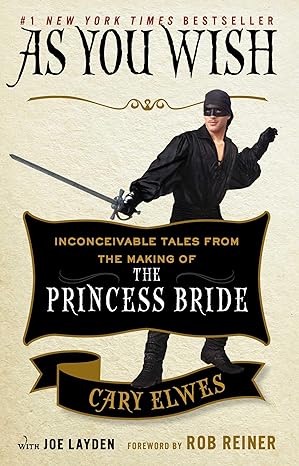
AS YOU WISH: INCONCEIVABLE TALES from the MAKING of THE PRINCESS BRIDE (audiobook) by Cary Elwes


Unabridged.

If you are a fan of the movie The Princess Bride, like I am, this is a must-read book (or must-listen if you are an audiobook listener like me). Cary Elwes, if you don't know, stars in the movie as Wesley/The Dread Pirate Roberts.

Elwes interviews all of the major actors in the movie who are still with us and tells the story of the creation of the movie from the writing of the original script by William Goldman all the way through the eventual success of the movie in the video rental market. Goldman is the author of the book that the movie is based and was an experienced and well-respected writer of screenplays, having written the Academy Award-winning scripts for All the President's Men and Butch Cassidy and the Sundance Kid. He also said that The Princess Bride was his favorite script and he wouldn't trust it to just anyone.

Cary Elwes as the Dread Pirate Roberts
When he can, Elwes incudes audio clips for the quotes he included in the original book. If there are no audio clips available, he has the same actor consistently read the quotes. It is a nice touch, actually hearing things like director Rob Reiner describe the pitch he made to Golden and Wallace Shawn describe how nervous he was making the movie and how he never really understood the humor of his character Vizzini and never has no idea why everyone thinks this is an iconic role.

The book is a joy to listen to and I thoroughly enjoyed all of the little stories that made up this audiobook.

I rate this audiobook 5 stars out of 5. It can be found on Amazon.com here: AS YOU WISH: INCONCEIVABLE TALES from the MAKING of THE PRINCESS BRIDE (audiobook) by Cary Elwes.

MAHDIST WAR: A HISTORY from BEGINNING to END (kindle) by Hourly History


Published by Hourly History in 2020.

One of the nice things about the e-books that Hourly History publishes is that they offer free books every week and they cover a wide range of topics in a manageable size. This book is a great example. There is no way that I would have read a 400 page history of this war simply but I was perfectly willing to read about it for an hour while while waiting for an appointment.

If you have never heard of the Mahdist War, join the club. This is one of the seemingly never-ending series of colonial wars that Britain took up as the European powers divided up Africa in the 1800's. 
The Mahdist flag

In this case, Sudan rose up and threw out their joint Ottoman/Egyptian overlords, which caused a lot uproar in the area. The British thought it would be a danger to their vassal state of Egypt and possibly Ethiopia, Somalia and may even threaten shipping along the Horn of Africa and access to India.

This was probably an overreaction, but the British decided to put the rebellion down. They sent in Egyptian troops, they tried to recruit local troops and, finally, they decided to send in soldiers from other parts of the British Empire. When they failed (due to some seriously bad choices by their officers), they did it again. At various points there were 3 or 4 different armies marching around fighting against each other. Eventually, they subdued Somalia. 

Looking back on this war more than 100 years later, it looks like a big waste of lives and money. The UK is no longer a presence in the area and Sudan continues to be in an uproar. 

I rate this ebook 3 stars out of 5. It can be found on Amazon.com here:  THE MAHDIST WAR: A HISTORY from BEGINNING to END (kindle) by Hourly History.

UNCIVIL AGREEMENT: HOW POLITICS BECAME OUR IDENTITY (audiobook) by Lilliana Mason


Published by Tantor Audio in 2019.
Read by Rebecca Gibel.
Duration: 5 hours, 57 minutes.
Unabridged
.


Lilliana Mason is an associate research professor at Johns Hopkins University. She collects, analyzes and breaks down the raw data that tells us what we already know about American politics right now - we are polarized.

For me, the most interesting part in when she looks at what that means and who is actually being polarized here. If you are a true political junkie - the type of person that reads a lot of news, watches the Sunday morning talking head shows and the has clearly identifiable ideological positions you can be very partisan, but are unlikely to be truly polarized. 

The true insight in this book came from a deep look at the most polarized people - the people that truly believe that the other party is a clear and present danger to the country and that all Republicans are clearly Nazis or all Democrats are clearly communists. You run across the people in the comment sections on social media all of the time.

It turns out those people don't really have ideological positions. Instead, they simply identify with their "team" and will support it no matter what happens or even if they flip-flop ideologically. They are literally the most ignorant of the ideological positions their party takes, they just support the party - very similarly to sports fans that support their team no matter how badly it is managed or how badly it plays. However, it is not dangerous to the country if a fan continues to support the NFL's Detroit Lions (statistically the 2nd worst team over the last 20 years) despite their obvious incompetence. It can be dangerous to the entire country if "fans" always show up to support their party's nominee for any office if they are clearly incompetent and have no business being in office.

One sees this easily with those "man on the street" interviews at political rallies with people who are remarkably enthusiastic and also remarkably ill-informed (links to people on both sides of this polarized political landscape). The problem with these  types of political partisans is that they literally cannot be talked out of their positions because they have no positions outside of "My side is right and your side is evil and possibly demonic" (thank you Franklin Graham for that one).

Your party can literally flip-flop on major policy issues like international trade and people just roll with it like it's no big deal because they had no idea that their party stood for that policy to begin with. You can't argue them out of a policy position because they don't know any policy positions in the first place. Tell them their party is for a position and they are all in. Tell them that the position changed the next week and they are still all in because it is not about the position because there are no standards and no ideals - just supporting the brand no matter what the brand does.

I recently had an encounter online with an old friend who went to school to be an ordained youth minister and has served as one for a long time (25+ years.) We have lost track with one another and only came back into contact because of an online political discussion over the post of a mutual friend. He was totally for a political stunt that I was against on a religious basis (not abortion - another policy). When I brought up the religious perspective on what had happened, he admitted he hadn't considered that perspective at all (!), conceded that it was problematic on a religious basis and then went right back to defending it. I took a peek at his other posts and, thanks to this book, I knew that there was no point to continuing on with the conversation. He was going to root for his "team" no matter what - even though it went against the religious beliefs he literally taught for years.

The downside to this book is that it was mostly written in a more formal academic style that was just not very listener-friendly. Plus, there were a lot of references to charts that are available as pdf downloads - good luck looking at those charts if you are listening to this audiobook and driving!

This book can be found on Amazon.com here: UNCIVIL AGREEMENT: HOW POLITICS BECAME OUR IDENTITY (audiobook) by Lilliana Mason.

LETTERS to MY WHITE MALE FRIENDS by Dax-Devlon Ross


Published by Macmillan Audio in 2021.
Read by the author, Dax-Devlon Ross.
Duration: 5 hours, 4 minutes.
Unabridged.


Dax-Devlon Ross makes a simple observation that it is entirely possible to participate in a racist system and not be racist. Not only is it possible, it is quite common. A person can participate in a system that looks fair on the surface, but somehow always results in the same kinds of people and the same kinds of people at the bottom. 

He notes that this is not a particularly popular idea among white Americans, especially white male Americans. But, he also noted that the death of George Floyd caused a lot of white people to reconsider what they thought they knew. 

This book offers an explanation of structural racism and gives concrete examples from the author's life and recent American history and offers some suggestions as to how to identify structural racism and break it up. That is good.

On the other hand, there is some Human Resources jargon that I had to look up and a lot of open-ended suggestions of something along the line of "do better."  Maybe that is a good thing - in the end, the corrections have to come from the people who have been imposing the old racist rules because they have to fix it.  If the rules are imposed on them from the outside and they will just find ways to work around them. If a new understanding of the problems is reached, the solutions just might come right along.

Hopefully.

I rate this audiobook 4 stars out of 5. It can be found on Amazon.com here: LETTERS to MY WHITE MALE FRIENDS by Dax-Devlon Ross.

SO COLD the RIVER (audiobook) by Michael Koryta


Published in 2010 by Hachette Audio.
Read by Robert Petkoff.
Duration: 13 hours, 33 minutes.
Unabridged.


Synopsis:

Eric Shaw is a down on his luck film maker who has moved back to Chicago from Hollywood. His marriage is on the rocks, he feels sorry for himself and he is making ends meet by making little movies out of family photos for funerals. He is good at his job - so good at it that he is offered a special job.

A woman asks him to travel to French Lick, Indiana and research the early years of her father-in-law, an eccentric billionaire. The only clue he has is a strange bottle of Pluto brand mineral water, bottled in French decades earlier. The bottle seems to be forever cold and the water inside looks strange.

Once Shaw arrives in French Lick the water is not the only strange thing he encounters...

*******

My Review:

This is good supernatural thriller. I did not realize this when I started listening because I had picked out this book because it was set in the French Lick area. I have vacationed in the area a few times over the years and wanted to read what this author had to say about the area. This author is from nearby Bloomington, Indiana and he absolutely captures the over-the-top beauty and splendor of the West Baden Springs Hotel (see picture.) 

All of his Indiana references are spot-on perfect, which made the book all the more enjoyable for this lifelong Hoosier.

The audiobook is enhanced with a violin music and other occasional sound effects. 

This book was adapted into a movie on 2022.

I rate this book 4 stars out of 5. It can be found on Amazon.com here: So Cold the River by Michael Koryta.

MYTHS, LIES, and HALF-TRUTHS of LANGUAGE USAGE (audiobook) by John McWhorter

Originally Published by
The Great Courses in 2012.
This version published by
The Great Courses in 2013.
Read by the author, John McWhorter.
Unabridged.
Linguist John McWhorter takes a look at the history of the English language in this 24 lecture presentation. He includes the origins of some of our more unique features and also the origins of some of our "rules" that aren't really rules at all.

The author,
John McWhorter
McWhorter takes a long view, going all of the way back to English's roots in proto-Indo-European. Proto-Indo-European language from the Caucus mountains region that spread all over the place and eventually became lots and lots of modern languages, including English.

For me, the most interesting theory was based on English's relative lack of verb endings. If you have ever studied Spanish, like me, than you remember the endless verb charts and verb endings. The same goes with French and German. Why doesn't English have all of those endings? We used to, but they disappeared - perhaps thanks to the Vikings!

The first half of this audiobook was an absolute joy to listen to. It was interesting and presented well - 5 stars. However, somewhere in the middle, the lectures became less interesting and somewhat repetitive - sometimes it became . It would have been better to have tightened up a few of the presentations and cut down the 24 lectures to 18 or 20 very lean and effective lectures.

So, the final result is 4 stars out of 5. This book can be found on Amazon.com here:  MYTHS, LIES, and HALF-TRUTHS of LANGUAGE USAGE (audiobook) by John McWhorter.

LONG RANGE (Joe Pickett #20) (audiobook) by C.J. Box


Published in 2020 by Recorded Books.
Read by David Chandler.
Duration: 10 hours, 35 minutes.
Unabridged


This book is the 20th in the Joe Pickett series, but in a lot of ways it is the sequel to the 19th book in the series: Wolf Pack. More about that below.

The book starts out with Joe in the deep woods on an investigation of a bear attack. But, he is called back to Saddlestring, Wyoming on an emergency run. The wife of a legendary local judge was shot during a presumed attempted very long range sniper attack on the judge. The judge has demanded that every law enforcement officer in the area investigate immediately, including Game Warden Joe Pickett.

Of course, things are more complicated than that...

************Spoilers*************

In Wolf Pack a Mexican drug cartel assassination team shot up Saddlestring, killing the sheriff, the prosecutor, critically injuring an FBI agent and more. Nate Romanowski killed the leader of the hit squad and in this book their best assassin comes after Nate to exact his revenge. 

Personally, I am getting tired of the plots that take Joe Pickett away from being a game warden. Joe and Nate have disrupted international terrorists and taken on Mexican drug cartels in the last few books. They are good adventure stories, but they get away from the types of stories that made me like this series and they start to get more and more improbable. 

I was more interested in the bear attack part of the book than the attempted assassination of the judge and WAY more interested in the bear attack part of the book than the return of the drug cartel. The drug cartel angle seemed to be a clunky, heavy handed way of redirecting the arc of the Nate Romanowski story line.

**********END SPOILERS***********

I rate this book 3 stars out of 5 mostly based on the fact that I like the main characters and it is always good to spend time with them, even in a frustrating book.

This book can be found on Amazon.com here: LONG RANGE (Joe Pickett #20) by C.J. Box.

JOHNNY CASH: A LIFE from BEGINNING to END (kindle) by Hourly History


Published by Hourly History
in 2022
The Hourly History series features e-book histories and biographies that can be read in about an hour. They are great if you want to know a little more about a topic, but you don't want to read a regular-sized book or biography. Plus, they offer a set of free books every weekend so you can explore without spending a dime.

I already knew the bare outlines of Johnny Cash's life, but this small biography filled it out a little more. It would have been great if there had been embedded links to the songs that are discussed throughout, but since this is an e-book it's not particularly hard to minimized the Kindle app and open up YouTube and find the song. I did this exact thing with the original version of Cash's classic hit Ring of Fire. Here is the original version, performed by one of June Carter's relatives. I had no idea that Cash didn't write this song himself.
Johnny Cash (1932-2003)
I was struck by the fact that Cash continued to struggle with drugs throughout his life. He was in and out of drug rehab centers from the 1960's into the 1980's. For me, this makes his take on the Nine Inch Nails song Hurt all the more poignant.

I enjoyed this e-book. I rate it 4 stars out of 5. It can be found on Amazon.com here: JOHNNY CASH: A LIFE from BEGINNING to END (kindle) by Hourly History.

NOT in IT to WIN IT: WHY CHOOSING SIDES SIDELINES the CHURCH (audiobook) by Andy Stanley


Published in 2022 by Zondervan.
Read by the author, Andy Stanley.
Duration: 5 hours, 11 minutes.
Unabridged.


Andy Stanley brings a warning to churches across the United States: Do not become involved in partisan politics. Jesus is not a Republican and he is not a Democrat. He did not come to rule this world and he did not make his church a government for this world. Nevertheless, Stanley has been criticized by church members he has known for years for not taking splashy political stands.

.

Stanley goes on to detail very practical reasons not to get involved in partisan politics, such as ticking off 40% of your potential mission field by endorsing a certain candidate and being known as a Democrat or Republican church. 

The answer? Neither. 
By identifying with a political candidate or a party, you are rejecting your fellow Christians who disagree with you by identifying with a party more than identifying with the body of Christ. This is literally a heresy. The body of Christ has work to do (and always has) under every sort of political system. That work is not acting as a government. Once the Church becomes a part of a political system it is compromised - it's just another political player.

The only government ever established by God in the Bible was in the Old Testament with Israel. God had a special covenant with Israel. The United States DOES NOT have a special covenant with God. This book is a kindly, Bible-based warning to the Christian Nationalists and the Dominionists that they are on the wrong track. It it is not thundering condemnation, but it is intended to be a correction. It is much more polite and well-written than this review has been.

I rate this audibook 5 stars out of 5. It can be found on Amazon.com here: NOT in IT to WIN IT: WHY CHOOSING SIDES SIDELINE the CHURCH (audiobook) by Andy Stanley.

THE AMERICAN STORY: CONVERSATIONS with MASTER HISTORIANS (audiobook) by David M. Rubinstein


Published in 2019 by Simon and Schuster Audio.
Voice work by various historians hosted by David M. Rubinstein.
Duration: 9 hours, 52 minutes.
Unabridged
.


David M. Rubinstein is an avid amateur historian and financial supporter of history-related projects. He organized a series of 16 interviews of historians by the Library of Congress with the intended audience to be actual members of Congress with invited guests. 

He picked historians who have written popular and professionally respected histories and biographies of famous Americans such as Ron Chernow (Alexander Hamilton), David McCullough (Adams and Truman), Cokie Roberts (Abigail Adams) and Doris Kearns Goodwin (Lincoln) and just let them discuss the person they studied.

Doris Kearns Goodwin
The audiobook consists of the actual audio of these interviews with a little introduction

The interviews were all solid, but could have been better if Rubinstein had not insisted on inserting himself in the middle of them so often. So many times the historian would be discussing an interesting topic and Rubinstein would interrupt to ask a question that totally changed the trajectory of the conversation. I noted to my wife that Cokie Roberts and Doris Kearns Goodwin were best at fielding his questions and then going right back to the topic they were pursuing. Perhaps they have a lot more experience with men interrupting to say something that was not relevant. 

This is still a good listen and I do recommend it. I did remove 1 star for the interruptions. Yes, I found the interruptions to be that annoying.

I rate this book 4 stars out of 5. This book can be found on Amazon.com here: THE AMERICAN STORY: CONVERSATIONS with MASTER HISTORIANS by David M. Rubinstein.

Featured Post

<b><i>BAN THIS BOOK (audiobook)</i></b> by Alan Gratz

Published in 2017 by Blackstone Audio, Inc. Read by Bahni Turpin. Duration: 5 hours, 17 minutes. Unabridged. My Synopsis Ban This Book is t...

Popular posts over the last 7 days