THE MEN WHO UNITED the STATES: AMERICA'S EXPLORERS, INVENTORS, ECCENTRICS and MAVERICKS and the CREATION of ONE NATION, INDIVISIBLE (audiobook) by Simon Winchester


Published in 2013 by Harper Audio
Read by the author, Simon Winchester
Duration: 13 hours, 33 minutes

Simon Winchester's sprawling book, The Men Who United the States, tells a history of the United States organized around five themes: Wood, Earth, Water, Fire and Metal. To be honest, I largely ignored the themes and just enjoyed listening to this magnificent, chaotic, rambling history.

Starting roughly with Lewis and Clark (Winchester backtracks a lot), the story of America is told through the tales of the people that made America a more perfect union through their explorations or their inventions. The reader (or listener if you are enjoying the audiobook) is told about Lewis and Clark and the Pony Express and the invention of the telegraph, the first transcontinental rail line, the exploration of the Grand Canyon, the role of New Harmony (Indiana) in the study of American geography,  a con game involving jewels, how George Washington toured the Frontier before he became president, the Erie Canal, the telephone, Edison vs. Tesla, the first plane to travel across America, television, radio, the internet, modern day nuclear silos, the path of the Mississippi River and so much more that I cannot possibly remember it all.


I listen to audiobooks as I drive and this book was like having a history professor just ramble along with the most interesting stories about American history and the interesting places he has been. Like in a conversation, the story meanders but it flows quite naturally almost all of the time as the author throws in lots of interesting anecdotes about his own experiences, the lives of related historical figures or just something that was odd.

The author, Simon Winchester, narrates his own audiobook. It always concerns me when I see that the author is the reader of his or her own audiobook. Frankly, most authors do not have the voice or the skill to pull it off. Winchester's voice is pleasant and he succeeds with his narration even though his English accent sometimes made for some interesting pronunciations and served to remind me that he is not an American by birth but by choice (he recently became a Naturalized citizen).

I rate this audiobook 5 stars out of 5.

This book can be found on Amazon.com here: The Men Who United the States

Reviewed on February 28, 2014

SURVIVAL of the NICEST: HOW ALTRUISM MADE US HUMAN and WHY IT PAYS to GET ALONG by Stefan Klein


Published in 2014 by The Experiment

German science writer Stefan Klein looks into the concept of altruism vs. egocentrism and the current thinking behind why people act altruistic or egocentric in Survival of the Nicest. This has been a popular topic in many news reports as the idea of a "stingy gene" or a "sharing gene" is discussed. 

Of course, the idea of a single stingy or sharing gene is simplistic, but Klein does spend a lot of time discussing altruistic behaviors and egocentric behaviors and why people actually act as altruistic as they do, even going so far as to donate money to people they will never meet in countries they will never go to. Why is that?

Klein reports that the current thinking is that simple Darwinian competition is too simplistic to explain altruistic behavior - giving away resources or time that could be used to raise one's own offspring makes no sense in a simple Darwinian worldview.

But, when you move out a little bit and look at groups of people and see that groups of people who are willing to give to one another and enforce a set of norms that expect a certain amount of fair play and giving to help the entire group have more success than groups that do not than you see that the Darwinian model may yet have some merit - it is not a single person vs. a single person but groups of people vs. groups of people.

Klein compares the behavior of chimpanzees to people, looks into tests of when young children start to display altruism and into experiments involving games that are supposed to test the altruistic nature of people (to be honest, I had a hard time understanding the value of the games, they were rather poorly explained). 

Survival of the Nicest has its interesting moments but vague explanations of the experiments and games and meandering discussions about other animals like vampire bats made the book an up and down read at best. There are some wonderful ideas in this book and a good editing could have knocked off about 50 pages and made it a tighter, more effective read.

I rate this book 3 stars out of 5. It can be found on Amazon.com here: SURVIVAL of the NICEST: HOW ALTRUISM MADE US HUMAN and WHY IT PAYS to GET ALONG by Stefan Klein.

Reviewed on February 19, 2013.

RUNAWAY HEART (audiobook) by Stephen J. Cannell


Great Characters, Giant Plot Holes


Published in 2003 by Sound Library (BBC Audiobooks America)
Read by Nick Sullivan
Unabridged
Duration: 11 hours, 47 minutes

Stephen J. Cannell (1941-2010) was best known as a television writer, producer and the creator of such classic shows as the A-Team, The Rockford Files, and The Greatest American Hero. But, late in his career Cannell also wrote a lot of novels, mostly action-based mysteries (not all that surprising considering his history in television).

Runaway Heart is, in some ways, a typical Cannell story, but it does have some distinct differences. There are three main characters. The book starts with Herman Stockmire, an overweight, idealistic Los Angeles-based attorney with a bad heart (arrhythmia) who heads up a law firm called The Institute for Planetary Justice. Despite the big name, the Institute consists of Herman and his daughter Susan. Together, they go to court for all sorts of hopeless causes. They have sued mega-corporations, the CIA, the military and almost all for naught. 

The story starts with a lawsuit over genetically modified crops and how they are affecting Monarch butterflies. Herman fares poorly in court (again) and is fined $1 million for wasting everyone's time in court. Of course, Herman and the Institute have no way to pay this off. This is typical of Cannell's TV shows - he loves to write about likable, idealistic losers with real faults.

But, in this case, Herman Stockmire is onto something. He has a friend in San Francisco (from a previous case) who is a highly skilled hacker that succeeds in getting into the deep data files of this agribusiness corporation in order to steal their files and find evidence that they did not properly test their creations to see if they affected species like the Monarch. But, he also finds files associated with DARPA (Defense Advanced Research Projects Agency). This real-life agency helped create the internet, military drones and passive radar (and much, much more). He doesn't know what he is looking at for sure but it seems to him that this agribusiness company is doing some research on genetic modification for DARPA. So, this hacker steals that file as well and that's when things start to get out of control.
Stephen J. Cannell
(1941-2010)


Within hours, the hacker is found dead, his body horribly shredded by someone's bare hands - someone with amazing brute strength. His corpse has been claimed from the morgue by the federal government and they are denying that they know anything about it.

Looking for a little help and some information, Susan Stockmire hires Jack Wirta, a former LAPD policeman who has just retired due to severe injuries to his back sustained in the infamous 1997 North Hollywood Bank Shootout. Jack's pain has caused him to become addicted to painkillers. Jack is also a very new Private Investigator - this is his first case and he has no idea what he's going to get into. 

There are a ton of interesting supporting characters throughout. I was kind of bugged by the over-the-top ultra-stereotypical portrayal of the man who operates the gay escort service down the hall from Wirta's new office, but as the book continues on his character displays an immense amount of character and physical bravery. He may be effeminate to the extreme but he knows how to "man up" when he needs to.

My favorite scene was probably the one where the men of a dying Indian nation have a council of war to determine what to do about illicit activities taking place on their reservation. They meet in a Denny's in one of those big corner booths and discuss over tuna salad sandwiches. Not what you expect from a Council of War if you grew up watching westerns like I did!

Nick Sullivan read this book. He is the winner of two Audiofile awards. I found his performance to be up and down. His characterization of Herman Stockmire was low key, but it was just too low key. Herman's bad heart and perpetual exhaustion should be part of the character, but his monotone delivery in court was so boring that I found it unlikely that he would actually perform so poorly in front of a jury. But, the other characters were well done, especially the hacker and the overly-effeminate proprietor of the gay escort service. 

The book is filled with strong characters - but it has a disjointed plot that is full of gaping holes and strange fits and starts. If that bothers you, this story is going to be torturous to you. For me, I overlooked the plot problems and just went with the story because of the characters. I am docking its final score by one star for those plot problems but that still leaves me with a score of 4 out of 5 stars.

This audiobook can be found on Amazon.com here: Runaway Heart by Stephen J. Cannell.


Reviewed on February 15, 2014.

KILL DECISION by Daniel Suarez


Great sci-fi always asks, "What if...?" and gives the reader something to think about.


Published in 2012 by Dutton (Penguin Group)

The premise behind Kill Decision is really quite simple: What if the concept of attack drones was re-thought a bit and instead of having them be small airplanes carrying big missiles, have them be the size of hobby-sized toy helicopters (about the size of a two year old person) and instead of spending almost $17 million per drone (according to Wikipedia) you spend just a few thousand dollars per drone and have them attack low and in close and in a swarm?

Think about it. Instead of one $17 million drone that fires a missile that may or may not hit its target,  let's say you have 170 $100,000 drones that swarm over an area using facial recognition software that already exists (the government uses more advanced versions of it but you may already be familiar with the simple recognition system Facebook uses to let you tag people and your digital camera may have it) to swarm over a GPS-targeted area and shoot every face that it finds in that area. Then imagine if they can be fitted with a variety of weapons such as guns, poison gas or plastic explosives so that some part of the swarm has the right tool for the job at hand.

All that is missing is the programming that enables this swarm to work together...

Three weaver ants working together to build a nest.
Photo by Karmesinkoenig
In Kill Decision, the programming is provided quite by accident by Linda McKinney, an expert in ants. To be more specific, she is an expert in weaver ants, an aggressive species that works so well together that some ask if the collective of all the ants should really be thought of as a single mind. McKinney has described their swarming behavior mathematically and when her research is stolen and applied to the swarm of small drones they become an almost unstoppable force that can overwhelm traditional defense systems on the cheap.

But, when McKinney is rescued/kidnapped right before a old-style single drone missile attack destroyed her research facility in Tanzania, her rescuers tell her that she was killed so her research could not be duplicated and her expertise could not be used to counter the swarm drone attacks. But, she does not know whether this odd group of soldiers and their enigmatic leader are truly what they say they are or if she is on the wrong side of this fight...

In the background of the main story is an ongoing story of the escalation of international drone warfare and a series of terrorist attacks in the United States that is fueling the drive to automate America's drone fleet and have them go on a perpetual hunt for America's enemies without having anyone actually having to  make the kill decision, or the decision to attack. 

This is a thoroughly enjoyable sci-fi action adventure with just enough near-future realism to make everyone pause and wonder where our current policy of using attack drones may lead. It seems to me that all we are missing is the software. If you are a fan of Michael Crichton, you will enjoy this book.

I rate this book 5 stars out of 5 and it can be found on Amazon.com here: Kill Decision by Daniel Suarez

Reviewed on January 28, 2014.

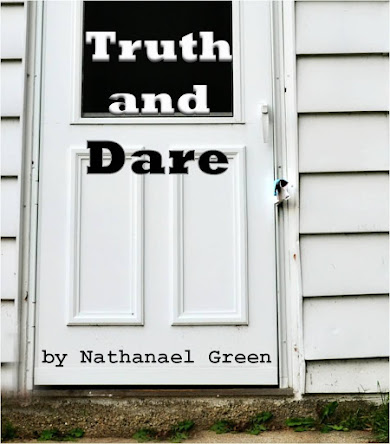
TRUTH and DARE (short story) by Nathanael Green


Published in December of 2013 as an e-book

Simon is the second least popular kid in his summer camp.  Sadly, the least popular kid in camp, Charlie Fergle, is going home and Simon knows he will be be the target of the nightly rounds of "truth or dare."  But, Simon does not want to leave his summer camp because he has met the girl of his dreams, Opal Finley.

Well, he hasn't really met her properly. He has admired her from afar, he has tried to speak to her and he has failed in spectacular fashion every time.


So far, this makes TRUTH and DARE sound like a horrible short story, but it is actually very funny and very sweet. 


This is my first short story by Nathanael Green, but I can guarantee it won't be my last.


I rate this short story 5 stars out of 5.


This story can be found on Amazon.com here: Truth and Dare by Nathanael Green.

Reviewed on January 25, 2014

BONES in HER POCKET (Temperance Brennan #15.5) (audiobook) (short story) by Kathy Reichs


Published by Simon and Schuster Audio in December of 2013.
Read by Linda Emond
Duration: 1 hour, 56 minutes.
Unabridged.

This short story is designed to go between books 15 & 16 in the series and is the audiobook version of a kindle e-book that was released in the summer of 2013.

In Bones In Her Pocket forensic anthropologist Temperance Brennan is called out to a remote location called Mountain Island Lake. It is the site of an artist colony and a raptor rescue center (they help deal with injured hawks, eagles and owls as well as advocate for policies that will help those animals).

A body was found floating in a canvas bag that floated up in the aftermath of a serious flood. As Brennan figures out whose body was found she soon discovers that there is no shortage of suspects...

This is my first Kathy Reichs book of any sort. To her credit, Reichs did not lose this newbie to her series despite the short length of the audiobook. The story moves along quickly and is easy to follow.

The reader, Linda Emond did a fabulous jobs with the reading, particularly the  accents. 

Note: This audiobook was sent to me by the publisher through Audiobook Jukebox's Solid Gold Reviewer program in exchange for an honest review.

I rate this audiobook 4 stars out of 5.

This book can be found on Amazon.com here: Bones in Her Pocket.

Reviewed on January 25, 2014

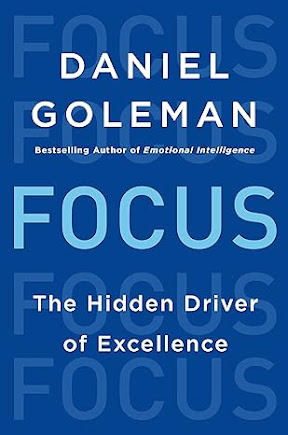
FOCUS: THE HIDDEN DRIVER of EXCELLENCE (audiobook) by Daniel Goleman


"Focus" lacks focus


Published in 2013 by HarperCollins.
Read by the author, Daniel Goleman.
Duration: 8 hours, 8 minutes.
Unabridged

Dr. Daniel Goleman is best known as the author of Emotional Intelligence. In many ways this book is less of a book about the importance of focus and more of a sequel to Emotional Intelligence. It is also a anti-global warming manifesto, an education reform book, a self-help book for business leaders who want to be the real leaders in their offices and there is a little bit about how people are able to focus their attentions a bit more and get better results.

That, of course, is the problem with the book called Focus. The primary topic should be the ability of people to focus and some hints to help you focus better. The book starts out with exactly this...well, focus. We learn how a store detective is able to focus on a crowded room full of bustling and sort out the normal shopping behaviors from the actions of a shoplifter. Goleman discusses how the give-it-to-me-now world of Tweets, Instagram, instant video makes our attention span short (I knew this already - I teach high school and my kids are on their phones all day long and I see the results).


But, then Goleman leaves this area of personal focus largely unexplored and veers into the focus of whole groups of people and uses global warming as his "focus" for this section. I listened to this as an audiobook on CDs and this lasted for more than a CD - well more than an hour of discussion about a topic that is basically off topic. He throws in a suggestion that schools adopt a global warming science project that probably would not hit most state's standards, goes on about carbon footprints, promotes websites that track your carbon footprint, tells how various companies have shrunk their carbon footprints. None of this, not one bit, not one iota, not one word is described in the blurb on the back of the audiobook. I got bored and started skipping whole chunks of text. To his credit, Goleman does point out that the concept of a zero-emission car is a misnomer since electric cars are charged up by an electric grid that is powered largely by coal and coal plants do have emissions (and if you get your electric car charged by a solar panel, there are emissions associated with the manufacture of those panels).  


Then we veer into the world of corporate leadership and the book becomes an extended discussion of what makes a good leader. Turn out it is mostly paying attention the the feelings and needs of those that are following you - this is where the book becomes a sequel to his book Emotional Intelligence with a special focus on CEOs. I felt like I was not the intended reader (or listener, in my case).


Speaking of being a listener, the audio portion of this experience needs to be discussed. The author, Daniel Goleman, read his own book. I am always leery of this because sometimes the author may have a perfectly fine speaking voice but just should not read an audiobook. It is more than a reading, it has to be a performance. Goleman does a lot of public speaking (his website has a place to contact his agent to schedule Dr. Goleman to speak to our corporate gig about leadership, emotional intelligence or maybe even global warming) but public speaking is not the same as reading an audiobook. I cannot hear gestures or hear the fact that the speaker moved across the stage or stood up to put more emphasis on a point in an audiobook. It all has to be done with your voice. Goleman's voice is okay, but not great. He does not quite drone, but it is not really lively either. It definitely took on a nagging tone during the extended global warming discussion. Even worse, there was a bass reverb echo while he spoke that I could not get rid of no matter how much I fiddled with the bass in my car. It sounded like that echo sound you hear when someone is speaking to you on the phone in a small, enclosed room. A professional audiobook should not have this problem. 


Note: This book was sent to me by the publisher in exchange for an honest review.


I rate this audiobook 1 star out of 5. I was so relieved to finish this thing and it took me forever to listen to it.


If you want to give this audiobook a try for yourself you can find it on Amazon.com here: Focus: The Hidden Driver of Excellence.

Reviewed on January 25, 2014.

Featured Post

<b><i>BAN THIS BOOK (audiobook)</i></b> by Alan Gratz

Published in 2017 by Blackstone Audio, Inc. Read by Bahni Turpin. Duration: 5 hours, 17 minutes. Unabridged. My Synopsis Ban This Book is t...

Popular posts over the last 7 days