V for VENDETTA (graphic novel) by Alan Moore and David Lloyd


Originally published in 1982.
Originally published in completed form in 1988 by DC Vertigo.

This iconic graphic novel has been on my to-be-read list for a long while. I tried watching the movie, but it had been a long week and I soon fell asleep. I assumed that the movie missed some of the pizazz of the graphic novel. I decided to go ahead and read the book when I noticed it was on the list of some 850 books that a Republican Texas state legislator wanted to ban from all Texas schools. 

V for VENDETTA is the story of a masked vigilante who decides to stand up against the fascist government of an alternative history version of the United Kingdom. The masked character has become the single most recognizable feature of the book and the face of the "anonymous" movement that swept over social media a few years ago.

Many people assume that it was put on the censorship list because it features a character that fights back against a repressive government. They assume that Texas is afraid of people that fight back, but they forget that this is a state that loves its own history of fighting back. The story of the Alamo and the Texas Revolution is revered in Texas. Texas was also a member of the Confederacy in the Civil War and some people in the Texas Republican Party have openly discussed another attempt at secession.

Based on the other books on this list, I think that the book was added to the list because there are 4 or 5 little panels in the comic that show a naked woman. They are not particularly lurid drawings, but most of the books are on this list for some sort of sexual reason. What appears in this book is certainly not worth the fuss of banning the book, but if you are making a list of 850 books you don't care about not making a fuss.

On to my review:

I was very much looking forward to this book. I like dystopian novels and I am very sympathetic to the themes of this book. However, I must admit that my reaction to the movie pretty much matched my reaction to the graphic novel. It is stylish but very slow and boring. I had a hard time finishing it and probably wouldn't have if not for occasional bursts of interesting plot showing up from time to time. 

I rate this graphic novel 2 stars out of 5. It can be found on Amazon.com here: V for VENDETTA by Alan Moore and David Lloyd.

CHINESE CIVIL WAR: A HISTORY from BEGINNING to END (Chinese History) (kindle) by Hourly History


Published in 2022 by Hourly History.


Hourly History is a series of histories and biographies that a reader can read in about an hour. Sometimes, that works out quite well. Sometimes, the topic is just too big to cover in an hour.

The first half of the twentieth century was a time of great turmoil for China. There were multiple wars, political chaos, multiple governments. There was also 15 years of civil war in two distinct phases, interrupted by the Japanese invasion of China during World War II.

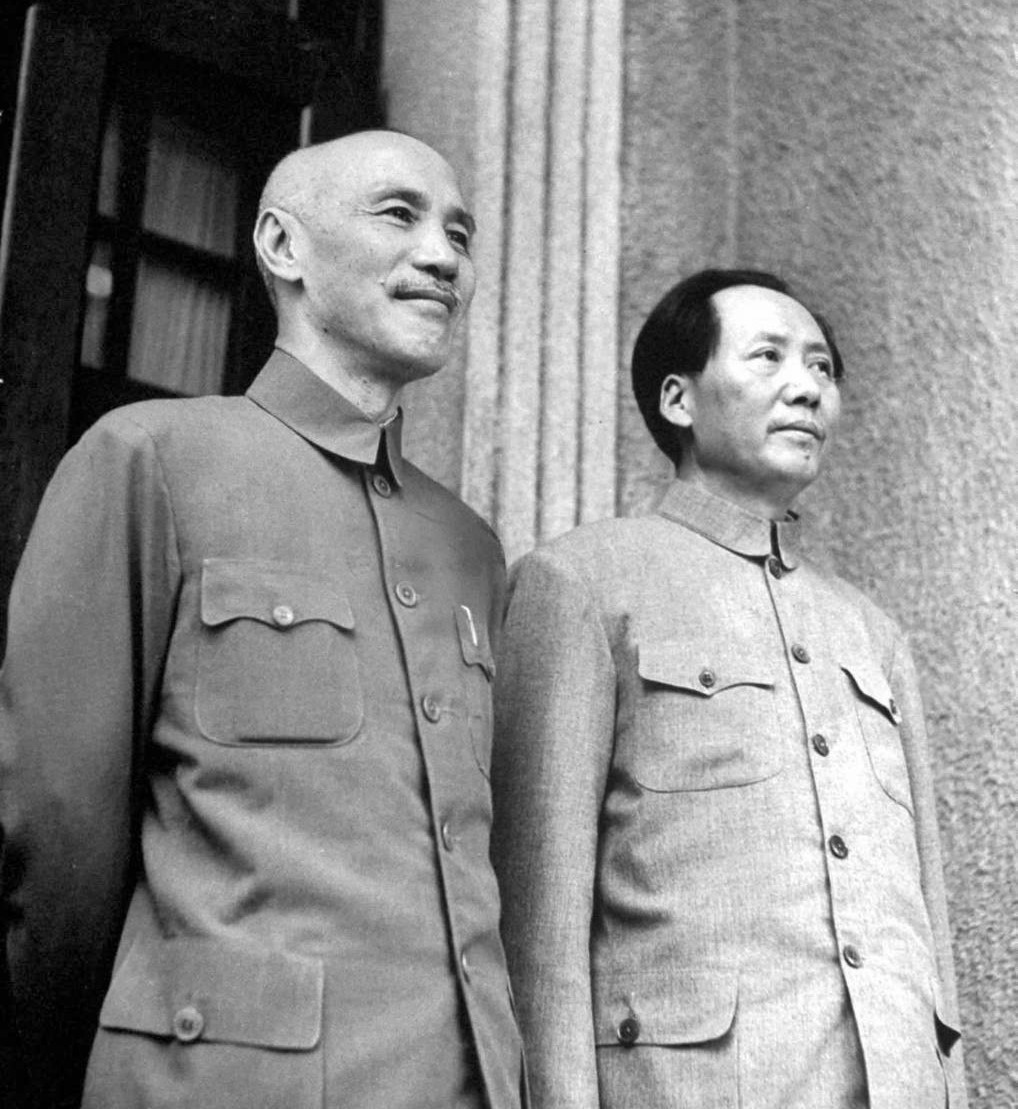
From 1927-1937, Chaing Kai-shek's Nationalist government and Mao Zedong's Communist government fought a civil war. When Japan invaded China, the civil war was suspended (sort of) and a united front was formed. Soon after the end of the war, the civil war resumed and the communist faction won, with the exception of the island of Taiwan.

Chiang Kai-shek (1887-1975) and
Mao Zedong (1893-1976)
This short history suffers from a couple of problems. There is simply too much to cover. The book attempts to describe Mao's politics, but never even tries to explain the Nationalist program, such as it was. 

The book also suffers from an abundance of clunky writing. For example, this is from a paragraph about 2/3 of the way through the book: "...the next stages of the Chinese Civil War would commence. This state of civil war would last for more than three years, sending China into a state of warfare once more."

In two sentences there are three references to the civil war starting up again that state nothing more than the fact that the civil war was starting up again. Space is tight in a book that is only supposed to last an hour and also tell the story of almost 20 years of warfare. Cleaning up this sort of writing would make more room for other important items, like an explanation of Chiang Kai-shek's policies. 

I rate this audiobook 3 stars out of 5. It can be found at Amazon.com here: CHINESE CIVIL WAR: A HISTORY from BEGINNING to END by Hourly History.

FRANCIS of ASSISI (The Great Courses)(audiobook) by William R. Cook and Ronald B. Herzman


The idea behind The Great Courses is a simple one - take a college lecture course given by an expert that knows how to give an interesting lecture and package it up as an audiobook that anyone can listen to.

In the case of this audiobook, there are two college professors that have a great chemistry together and really enjoy a discussion of St. Francis.

Before this audiobook, I knew only the barest of details of St. Francis so I found the entire discussion interesting and informative.

I do have a rather big complaint about the way the information was presented, however. They start with a biography of St. Francis up until the moment when he becomes recognized by the Pope and his movement is up and going. From that moment, they move to a thematic presentation and the listener hears about moments in his life that are not tied to any sort of biography. 

For example, they mention more than once that he participated in a crusade as a bystander and as a person that wanted to reach out to the Muslims that were defending, but there is no coherent narrative to that story that makes it more than just a few random snatches of extremely interesting information and teachings. I do not like the fact that I listened to a six hour audiobook about the life of a person and I do not have a grasp of many of the basics about the life of that person. As a fellow teacher of history, I cannot imagine the thought process that went into that decision.

Fortunately, they provided an interesting list of books or presentations written by other, well-known authors such as W.E.B DuBois and G.K. Chesterton.

I rate this audiobook 4 stars out of 5. It can be found here: FRANCIS of ASSISI (The Great Courses)(audiobook) by William R. Cook and Ronald B. Herzman.

THE FLAG, the CROSS, and the STATION WAGON: A GRAYING AMERICAN LOOKS BACK at HIS SUBURBAN BOYHOOD and WONDERS WHAT the HELL HAPPENED (audiobook) by Bill McKibben


Published in 2022 by Macmillan Audio.
Read by Eric Jason Martin.
Duration: 6 hours, 39 minutes.
Unabridged.


McKibben looks back at his life in the suburbs in the 1960s and the 1970s and modern America and compares the two.

In certain circles this is an invitation to complain about the modern world with comments like, "When I was a kid, we didn't have all of this blah, blah, blah foolishness."

This is not that sort of book.

McKibben looks at three general areas:

1) The way that history was taught and the ways that he perceived that his country acted ("The Flag"). He grew up in Lexington, Massachusetts and was a tour guide as a young man for tourists who came to celebrate the bicentennial in 1976. The more he has learned, the more he knows that he was taught a simplistic, feel-good version of American history in school;

2) The things that his church taught him and how churches have fared over the intervening years ("The Cross"). He grew up and was very active in his church. He is really quite complimentary of his church upbringing. But, all denominations of churches have been shedding members. He even describes how one of the churches he attended had to consolidate with another congregation.

His thesis is not that the church in America was doing bad things, necessarily. His thesis is that the church gave up its best role - the role of speaking truth to power (for example, of the Old Testament story of when the prophet Nathan went to King David to tell him that he was wrong for sleeping with Bathsheba, the wife of one his trusted soldiers and then having that soldier killed so he could keep her).

Instead, the church became a part of the power structure. It worked with the government with the best of intentions. It seemed like a good idea to put these two institutions to work on social issues, but it neutered the church when it came to calling out the government on areas where it fell/falls short because the church owes certain things to the government or it is just too tied in to see the problems. McKibben uses the example of an attempt to build low income apartments in Lexington that was nixed because "those people" would come out of Boston and live with them in the suburbs. 
Bill McKibben in 2016
(photo by Gage Skidmore)

3) The situation of the American family and how it has changed over the years, including the wealth gap, how it relates generational wealth and policies that have exacerbated the wealth gap, especially among minority groups. He also throws in a healthy serving of environmental concerns - an area that he was worked in for a long time ("The Station Wagon"). This ties in well with the low income apartments in the previous paragraph.

I found this book to be a well-written and surprisingly tight set of arguments, considering that this book could have meandered all over the place with the topics of American history, the church in America and the American family. At the end, McKibben tosses in too much environmental discussion. It is the only part of the story that is not very tight, very focused and very integrated with the rest of the book. I'm not saying he didn't have a point, I am saying that it may not have been the best place to insert that point.

Still, I rate this book 5 stars out of 5. It can be found on Amazon.com here: 
THE FLAG, the CROSS, and the STATION WAGON: A GRAYING AMERICAN LOOKS BACK at HIS SUBURBAN BOYHOOD and WONDERS WHAT the HELL HAPPENED (audiobook) by Bill McKibben.

PABLO PICASSO: A LIFE from BEGINNING to END (Biographies of Painters #5) by Hourly History


Published in 2020 by Hourly History.

Despite me having talked extensively about Pablo Picasso (1881-1973) in my recent review of an e-book about Francisco Franco, I am not an expert on Picasso, but I know way more than the average person. He has some paintings that I really like, but I am mostly not a fan. 

This short biography hit the spot in that it covered the details of his life without focusing too much on one particular part. This covered his 70+ year career in an even manner and included his personal life well.
Pablo Picasso in 1962

The real weakness of this e-book was the fact that they couldn't license his paintings and insert them into the book. But, since I read this on my cell phone it was pretty easy to switch to the browser and search the piece of art that was being discussed and take a look at it.

I wasn't much of a fan of Picasso as a person before I read this book and my impression was not changed one bit.

I rate this e-book 4 stars out of 5. It can be found on Amazon.com here: PABLO PICASSO: A LIFE from BEGINNING to END (Biographies of Painters #5) by Hourly History.

THE PRESIDENTS' WAR: SIX AMERICAN PRESIDENTS and the CIVIL WAR THAT DIVIDED THEM by Chris DeRose


Published in 2014 by Lyons Press.

This is my 142nd Civil War-related review. When I heard about this book, I found myself wondering how no one else thought to write this book before.

Former presidents have their own political power and impact current events. Nowadays, you can see this with Jimmy Carter's modeling of volunteerism and his attempts to be a peace mediator in the 1980s and 1990s, Bill Clinton's maneuvering to remain relevant, George W. Bush's refusal to endorse or approve of anything done by Donald Trump, the calls that the Biden Administration is really just the third Obama Administration and, obviously, the 45th President's refusal to admit he lost the 2020 election.

DeRose starts with a rundown of the political careers of each politician involved: John Tyler, Martin Van Buren, James Buchanan, Millard Fillmore, Franklin Pierce and Abraham Lincoln. 

Then, he discusses how they reacted to Lincoln's candidacy, the break up of the Democrat Party in 1860, Lincoln's election and the Secession Crisis. 

John Tyler, the 10th President (1790-1862)
To a man, they were all critical of Lincoln's handling of the Secession Crisis. John Tyler surprised me, though. Tyler was from Virginia and owned slaves and had a working slave labor plantation so he was never going to be supportive of Lincoln who was philosophically against slavery but only against expanded it into new territories and/or states as a matter of policy. 

Tyler left the presidency politically unpopular and seemed to have relished in the attention he received during the Secession Crisis. Suddenly, people were seeking his opinion on the most important issue of his lifetime. Tyler came to D.C. and led a peace conference hosted by Virginia in the Willard Hotel. 

Nothing came from the conference. Tyler operated as a proxy for the Confederacy, in my opinion, and his proposals were ridiculous. Tyler was elected to the Confederate Conference and served in the Provisional Confederate Congress until his death. He remains the only President that ever served in a government at war with the United States. 

I was amused by the constant thread of James Buchanan's post-presidency - he was going to write a book to explain his actions during the Secession Crisis. He claimed over and over again that he would be vindicated once everyone knew all of the facts and ... he never was. It was almost like a running gag throughout the book. Even today, he is universally acknowledged to be the one of the worst presidents of all of the presidents. 

The book continues on with reactions from each of the surviving presidents to the events of the war such as Antietam, the Emancipation Proclamation, Gettysburg, the fall of Atlanta, Lee's surrender and, finally, the assassination of Lincoln. 

I rate this book 5 stars out of 5. It can be found on Amazon.com here: THE PRESIDENTS' WAR: SIX AMERICAN PRESIDENTS and the CIVIL WAR THAT DIVIDED THEM by Chris DeRose.

INDIANA from the AIR by Richard Fields and Hank Huffman


Published in 1996 by Indiana University Press and Indiana Department of Natural Resources.

From 1993 to 1995 the two authors combined to take pictures of Indiana from an Indiana Department of Natural Resources helicopter - one was the pilot and one was the photographer.

They chose 100 pictures of the state for this coffee table book. There are 92 counties in Indiana, but there is not a picture of each county. However, these pictures are a good representative sample of the state ranging from the Indiana Dunes on Lake Michigan to the fossil bed at the Falls of the Ohio. The pictures include urban areas, suburbs, small towns, farms and pictures of Indiana's understated beauty. There are no commanding views like the Grand Canyon or the Rockies, but it is beautiful in its own way.

Since the book is more than 25 years old, it was interesting to note some of the changes. The Indianapolis skyline has changed with the addition of at least two very large buildings on either side of downtown. The photograph featuring the campus of IUPUI (Indiana University Purdue University at Indianapolis) is, I am pleased to say, very out of date. That university has really expanded and come into its own in the last 25 years. The West Baden Springs Hotel is pictured as it used to be - an abandoned but still glorious piece of architecture. Now, it is completely restored and very high class working hotel. 

I rate this book 4 stars out of 5. I liked the book, but I would have made an effort to have a wider variety and included architectural gems like Columbus and Indiana University - Bloomington. 

This book can be found on Amazon.com here:  INDIANA from the AIR by Richard Fields and Hank Huffman.

Featured Post

<b><i>BAN THIS BOOK (audiobook)</i></b> by Alan Gratz

Published in 2017 by Blackstone Audio, Inc. Read by Bahni Turpin. Duration: 5 hours, 17 minutes. Unabridged. My Synopsis Ban This Book is t...

Popular posts over the last 7 days