THE FLAG, the CROSS, and the STATION WAGON: A GRAYING AMERICAN LOOKS BACK at HIS SUBURBAN BOYHOOD and WONDERS WHAT the HELL HAPPENED (audiobook) by Bill McKibben


Published in 2022 by Macmillan Audio.
Read by Eric Jason Martin.
Duration: 6 hours, 39 minutes.
Unabridged.


McKibben looks back at his life in the suburbs in the 1960s and the 1970s and modern America and compares the two.

In certain circles this is an invitation to complain about the modern world with comments like, "When I was a kid, we didn't have all of this blah, blah, blah foolishness."

This is not that sort of book.

McKibben looks at three general areas:

1) The way that history was taught and the ways that he perceived that his country acted ("The Flag"). He grew up in Lexington, Massachusetts and was a tour guide as a young man for tourists who came to celebrate the bicentennial in 1976. The more he has learned, the more he knows that he was taught a simplistic, feel-good version of American history in school;

2) The things that his church taught him and how churches have fared over the intervening years ("The Cross"). He grew up and was very active in his church. He is really quite complimentary of his church upbringing. But, all denominations of churches have been shedding members. He even describes how one of the churches he attended had to consolidate with another congregation.

His thesis is not that the church in America was doing bad things, necessarily. His thesis is that the church gave up its best role - the role of speaking truth to power (for example, of the Old Testament story of when the prophet Nathan went to King David to tell him that he was wrong for sleeping with Bathsheba, the wife of one his trusted soldiers and then having that soldier killed so he could keep her).

Instead, the church became a part of the power structure. It worked with the government with the best of intentions. It seemed like a good idea to put these two institutions to work on social issues, but it neutered the church when it came to calling out the government on areas where it fell/falls short because the church owes certain things to the government or it is just too tied in to see the problems. McKibben uses the example of an attempt to build low income apartments in Lexington that was nixed because "those people" would come out of Boston and live with them in the suburbs. 
Bill McKibben in 2016
(photo by Gage Skidmore)

3) The situation of the American family and how it has changed over the years, including the wealth gap, how it relates generational wealth and policies that have exacerbated the wealth gap, especially among minority groups. He also throws in a healthy serving of environmental concerns - an area that he was worked in for a long time ("The Station Wagon"). This ties in well with the low income apartments in the previous paragraph.

I found this book to be a well-written and surprisingly tight set of arguments, considering that this book could have meandered all over the place with the topics of American history, the church in America and the American family. At the end, McKibben tosses in too much environmental discussion. It is the only part of the story that is not very tight, very focused and very integrated with the rest of the book. I'm not saying he didn't have a point, I am saying that it may not have been the best place to insert that point.

Still, I rate this book 5 stars out of 5. It can be found on Amazon.com here: 
THE FLAG, the CROSS, and the STATION WAGON: A GRAYING AMERICAN LOOKS BACK at HIS SUBURBAN BOYHOOD and WONDERS WHAT the HELL HAPPENED (audiobook) by Bill McKibben.

PABLO PICASSO: A LIFE from BEGINNING to END (Biographies of Painters #5) by Hourly History


Published in 2020 by Hourly History.

Despite me having talked extensively about Pablo Picasso (1881-1973) in my recent review of an e-book about Francisco Franco, I am not an expert on Picasso, but I know way more than the average person. He has some paintings that I really like, but I am mostly not a fan. 

This short biography hit the spot in that it covered the details of his life without focusing too much on one particular part. This covered his 70+ year career in an even manner and included his personal life well.
Pablo Picasso in 1962

The real weakness of this e-book was the fact that they couldn't license his paintings and insert them into the book. But, since I read this on my cell phone it was pretty easy to switch to the browser and search the piece of art that was being discussed and take a look at it.

I wasn't much of a fan of Picasso as a person before I read this book and my impression was not changed one bit.

I rate this e-book 4 stars out of 5. It can be found on Amazon.com here: PABLO PICASSO: A LIFE from BEGINNING to END (Biographies of Painters #5) by Hourly History.

THE PRESIDENTS' WAR: SIX AMERICAN PRESIDENTS and the CIVIL WAR THAT DIVIDED THEM by Chris DeRose


Published in 2014 by Lyons Press.

This is my 142nd Civil War-related review. When I heard about this book, I found myself wondering how no one else thought to write this book before.

Former presidents have their own political power and impact current events. Nowadays, you can see this with Jimmy Carter's modeling of volunteerism and his attempts to be a peace mediator in the 1980s and 1990s, Bill Clinton's maneuvering to remain relevant, George W. Bush's refusal to endorse or approve of anything done by Donald Trump, the calls that the Biden Administration is really just the third Obama Administration and, obviously, the 45th President's refusal to admit he lost the 2020 election.

DeRose starts with a rundown of the political careers of each politician involved: John Tyler, Martin Van Buren, James Buchanan, Millard Fillmore, Franklin Pierce and Abraham Lincoln. 

Then, he discusses how they reacted to Lincoln's candidacy, the break up of the Democrat Party in 1860, Lincoln's election and the Secession Crisis. 

John Tyler, the 10th President (1790-1862)
To a man, they were all critical of Lincoln's handling of the Secession Crisis. John Tyler surprised me, though. Tyler was from Virginia and owned slaves and had a working slave labor plantation so he was never going to be supportive of Lincoln who was philosophically against slavery but only against expanded it into new territories and/or states as a matter of policy. 

Tyler left the presidency politically unpopular and seemed to have relished in the attention he received during the Secession Crisis. Suddenly, people were seeking his opinion on the most important issue of his lifetime. Tyler came to D.C. and led a peace conference hosted by Virginia in the Willard Hotel. 

Nothing came from the conference. Tyler operated as a proxy for the Confederacy, in my opinion, and his proposals were ridiculous. Tyler was elected to the Confederate Conference and served in the Provisional Confederate Congress until his death. He remains the only President that ever served in a government at war with the United States. 

I was amused by the constant thread of James Buchanan's post-presidency - he was going to write a book to explain his actions during the Secession Crisis. He claimed over and over again that he would be vindicated once everyone knew all of the facts and ... he never was. It was almost like a running gag throughout the book. Even today, he is universally acknowledged to be the one of the worst presidents of all of the presidents. 

The book continues on with reactions from each of the surviving presidents to the events of the war such as Antietam, the Emancipation Proclamation, Gettysburg, the fall of Atlanta, Lee's surrender and, finally, the assassination of Lincoln. 

I rate this book 5 stars out of 5. It can be found on Amazon.com here: THE PRESIDENTS' WAR: SIX AMERICAN PRESIDENTS and the CIVIL WAR THAT DIVIDED THEM by Chris DeRose.

INDIANA from the AIR by Richard Fields and Hank Huffman


Published in 1996 by Indiana University Press and Indiana Department of Natural Resources.

From 1993 to 1995 the two authors combined to take pictures of Indiana from an Indiana Department of Natural Resources helicopter - one was the pilot and one was the photographer.

They chose 100 pictures of the state for this coffee table book. There are 92 counties in Indiana, but there is not a picture of each county. However, these pictures are a good representative sample of the state ranging from the Indiana Dunes on Lake Michigan to the fossil bed at the Falls of the Ohio. The pictures include urban areas, suburbs, small towns, farms and pictures of Indiana's understated beauty. There are no commanding views like the Grand Canyon or the Rockies, but it is beautiful in its own way.

Since the book is more than 25 years old, it was interesting to note some of the changes. The Indianapolis skyline has changed with the addition of at least two very large buildings on either side of downtown. The photograph featuring the campus of IUPUI (Indiana University Purdue University at Indianapolis) is, I am pleased to say, very out of date. That university has really expanded and come into its own in the last 25 years. The West Baden Springs Hotel is pictured as it used to be - an abandoned but still glorious piece of architecture. Now, it is completely restored and very high class working hotel. 

I rate this book 4 stars out of 5. I liked the book, but I would have made an effort to have a wider variety and included architectural gems like Columbus and Indiana University - Bloomington. 

This book can be found on Amazon.com here:  INDIANA from the AIR by Richard Fields and Hank Huffman.

FRANCISCO FRANCO: A LIFE from BEGINNING to END (kindle) by Hourly History


I am an avid reader of history, but I have areas of weakness that I am perfectly willing to shore up a bit, but I don't want to invest a ton of time in. Francisco Franco was one of those people for me. 

I came into this biography knowing only the barest of facts about the long-time dictator of Spain. Franco ruled from 1939 until his death in 1975. This biography spends little time on his early life and could have expanded on the Spanish Civil War that brought him to power. For example, the most famous image of the war is the painting Guernica

Guernica by Pablo Picasso (1937)
Guernica
is one of the most famous paintings of the 20th century. It depicts the chaos of an attack by the German air force on the city of Guernica. Guernica was holding out against Franco's forces and Franco enlisted German help to deal with the city. German and Italian bomber planes tried out the relatively new technology in real life. Pablo Picasso painted Guernica to protest the attack and had it displayed at the 1937 World's Fair in Paris. Because of that, perhaps the most famous artist in the world and perhaps the most famous citizen of Spain was not allowed to return to Spain because of Franco. Most likely, Picasso wouldn't have wanted to return anyway - because of Franco.

This is the problem with the series. Since each book is limited in length, the author has to pick and choose what to include. In this case, they skimped on how he came to power. I enjoyed the discussion of how he sorted out a third way between the Axis and the Allies during World War II (not that I thought he was a good man for having done so, but it was interesting) and continually sought to become an accepted member of the western alliance against the Soviets after the war. I wouldn't have cut a word from the coverage of World War II, but I would have cut some of the talk about how he ran things on a day-to-day basis.  Why? Going back to Picasso, what most of the world outside of Spain knows about Franco comes from that painting of the bombing and it should have been addressed.

Anyway, I confirmed what I had gleaned about Franco. I found it interesting how he picked a member of the royal family, Juan Carlos, to be his successor. Juan Carlos went on to lead his country to a democratic system of government.

This e-book is a good choice to fill in some blanks (what I did) or get an introduction to one of the longest-ruling dictators of the 20th century. But, it is not the complete story. 

I rate this e-book 3 stars out of 5. It can be found on Amazon.com here: 
FRANCISCO FRANCO: A LIFE from BEGINNING to END (kindle) by Hourly History.

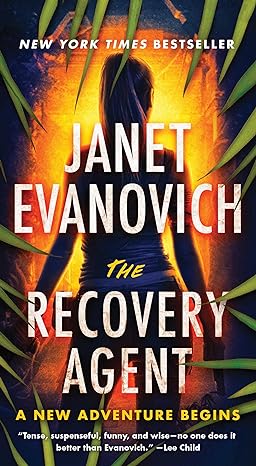
THE RECOVERY AGENT: A NOVEL (audiobook) by Janet Evanovich


Published in 2022 by Simon and Schuster Audio
Read by Lorelei King
Duration: 7 hours, 26 minutes.
Unabridged.


Janet Evanovich's The Recovery Agent features Gabriela Rose. Recovery agents can be another term for bounty hunters who look for fugitives, but Gabriela Rose is not a bounty hunter. She searches for missing property. Sometimes it's insurance fraud, sometimes it's stolen property and sometimes it's just looking for something rare for a wealthy client. She is based in New York City, is quite successful and flies all over the world recovering items. 

Gabriela Rose is dismayed to hear that her hometown in North Carolina has suffered a direct hit from a hurricane and (somehow) won't get any help from FEMA or any other government recovery program. The town is dying but Gabriela's grandmother knows where a fortune might be found. She was somehow told about the fortune by the ghost of her dead grandmother. In that fortune there is a ring called the Seal of Solomon. This ring is mostly in Arabic language legends about King Solomon of Israel who could use it to talk to animals and to control demons and djinn (genies).

Most of the book is a hunt to find and keep the ring in various settings with an ongoing simmering romance on the side. Readers familiar with the 1980s movie Romancing the Stone or the 2022 movie The Lost City will get the idea - except this book has competent protagonists.

My review:

This book is just all over the place, literally. There are 5 different trips to 4 different countries with jungles to find this ring. It gets old.

*****caution: spoilers*****

The goal of all of this searching is to find a treasure to save the town. Time after time the main characters leave behind literal fortunes of common, run of the mill gold trinkets, jewel-encrusted necklaces, statues, and at least one other famous golden item that would certainly have saved the town. 

There are other issues as well. Evanovich loves to name drop products in her books - pistols, boats, cars and more are named by brand. At one point, there is a planned attack on a compound. Gabriela Rose goes into battle with a fully automatic machine gun wearing a $465 La Perla Balconette bra (the price is mentioned). We know what bra she is wearing because at one point her bra is used as a tourniquet. Who wears a $465 lacy push-up bra into battle and not a sports bra? Sure, it made for a funny scene in the book, but it makes no sense - especially when she goes to a Target later on and buys common everyday underclothing and makes comments about how great they are.

*****end spoilers*****

What is good in the book is interesting supporting characters throughout the book.

I rate this audiobook 2 stars out of 5. It can be found on Amazon.com here: THE RECOVERY AGENT: A NOVEL (audiobook) by Janet Evanovich.

LAST ONES LEFT ALIVE: A NOVEL (audiobook) by Sarah Davis-Goff


Published in 2019 by Macmillan Audio.
Read by Anne-Marie Gaillard,
Duration: 5 hours, 33 minutes.
Unabridged.


Set in a dystopian future in Ireland, Last Ones Left Alive is the story of Orpen, a teenage girl. The world is overrun by "skrakes".

The reader is never exactly told what skrakes are, but it is useful to just think of them as a sort of zombie. Skrakes hunt humans and when a human is bitten by a skrake, the human gets an infection and becomes a skrake. 

Orpen grew up on an island off of the coast of Ireland. There are three of them - Orpen, her mother and another woman named Maeve, The skrakes never come to the island, but from time to time her mother and Maeve must leave the island to scrounge for supplies and hunt.

The story is told in chapters that alternate between the present and flashbacks to Orpen's childhood. There are hints as to what Maeve and her mother did before they came to the island. It is clear is that they have extraordinary hand-to-hand combat skills, both individually and especially as a team. Orpen is trained in those skills as she gets older and has finally reached the point where she can head to the mainland as well....

This is a debut novel for the author and she did an extraordinary job of telling the story from the point of view of just one character. There is no all-knowing narrator that tells us what happened to unleash the skrakes and there is no change of perspective that lets the reader go "Oh! Now I see." Instead, we get the perspective of this one young lady and it's more than enough to build a compelling story.

The audiobook was read by Anne-Marie Gaillard. Her Irish accent was an amazing change of pace for this audiobook reader. Her tone was perfect, no matter the accent.

I rate this audiobook 4 stars out of 5. It can be found on Amazon.com here:

Featured Post

<b><i>BAN THIS BOOK (audiobook)</i></b> by Alan Gratz

Published in 2017 by Blackstone Audio, Inc. Read by Bahni Turpin. Duration: 5 hours, 17 minutes. Unabridged. My Synopsis Ban This Book is t...

Popular posts over the last 7 days