GETTYSBURG: THE GRAPHIC NOVEL by C.M. Butzer


Sometimes Brilliant, Sometimes Lacking and Sometimes Just Plain Wrong


Published in December of 2008 by HarperCollins

This is the 65th review of a book that is somehow connected to the Civil War that I have written. I am also a teacher of American history. I only mention this so that the reader knows that I do not come to my critiques of this book lightly.

In Gettysburg: The Graphic Novel, Butzer has attempted to do something that would be tough no matter who the author is - tell the entire story of Gettysburg in just 80 pages of a graphic novel. By the entire story, I mean why the war was going on in the first place, the status of both sides when the battle started, the battle itself and dealing with the dead, the wounded and the dignitaries that came to nose around afterwards. It also includes the decision to make a special cemetery at Gettysburg and the Gettysburg Address and a discussion of the famed speech, plus additional comments and a bibliography.

If I were asked to do this as two typewritten pages I would find it to be a difficult challenge, so I do appreciate the task faced by Butzer.

Butzer's treatment of the Gettysburg Address is brilliantly conceived and wonderfully demonstrates the power of the little speech to the crowd at the cemetery and the power of the speech as it has resonated down through time.

He also does a great job of talking about how difficult it was to deal with so many dead and wounded once the armies had moved on. The awful nature of Civil War surgery is shown (including a pile of amputated limbs).

 However, his focus was just wrong in so many ways and there are at least two factual errors. The battle itself gets just 9 pages out of the 80 - the little skirmish in Gettysburg itself that started the battle gets two complete pages! If you are uninformed as to the particulars of the Battle of Gettysburg, this book will do little to inform you. But, there is a great deal of, in my opinion, wasted space dedicated to Lincoln's trip to Gettysburg and the build up to the dedication ceremony. 

On pages 22 and 23 Pickett's Charge is drawn in one epic sweep, but the dimensions are wrong (the length of the charge is dramatically shrunken) and the height and angle of Cemetery Ridge is greatly exaggerated. It is a low rise, not the steep angle shown in the book. It looks like Pickett is leading a charge up the dam of a man-made lake, not up the gentle heights of Cemetery Ridge. This distinction makes Lee's decision to attack the Union line directly look like less of a calculated risk and more like a cruel suicidal attack on an impregnable position.

The Evergreen Cemetery Gatehouse
On page 38 workers are building the gatehouse to the cemetery in order to prepare for the ceremony. He also alludes to this in his notes at the end of the book. But, this gatehouse was built before the war (its cornerstone was laid in 1855 and it was used as Union General O.O. Howard's headquarters during the battle) as a part of Evergreen Cemetery, not the national cemetery. When I first visited Gettysburg, I also assumed that the gatehouse went with the National Cemetery so it's an understandable mistake - if you weren't writing a book on the topic. When you visit the cemetery they let you about 

So, sometimes brilliant, sometimes lacking and sometimes just plain wrong, I rate this graphic novel 3 stars out of 5.

This graphic novel can be found on Amazon.com here: Gettysburg: The Graphic Novel.

Reviewed on May 17, 2014

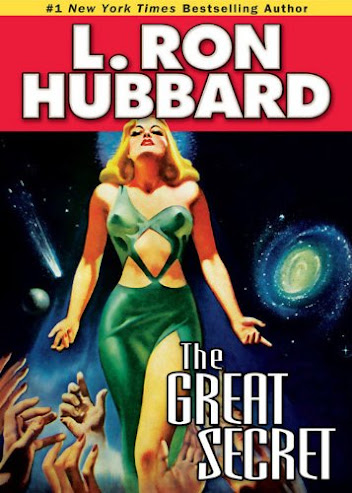
THE GREAT SECRET (Stories from the Golden Age) by L. Ron Hubbard


Re-published in 2008 by Galaxy Press.

These stories were originally published in 1942 and 1943.


Before L. Ron Hubbard became famous for creating Scientology he wrote a whole bunch of short stories for the pulp magazines from 1936 to 1950. Galaxy Press has been re-releasing them in small collections as paperbacks and audiobooks. This collection consists of four short stories.

The first story is "The Great Secret" which was originally published in Science Fiction Stories in April of 1943. It is an okay story about a man who is willing to give anything to find out what the secret of a great, lost civilization was.

Story number two is "Space Can" - the best story in the bunch. Originally published in Astounding Science Fiction in July of 1942 it features a fight between two space fleets and the hand-to-hand combat that ensues.

"The Beast" is a forgettable safari tale based on Venus rather than Africa. But
File:L. Ron Hubbard in 1950.jpg
L. Ron Hubbard (1911-1986) in 1950
, it is filled with submissive natives and a great foreign hunter - just in case you like to ponder how racist a story can be without actually involving human beings being oppressed. Originally published in Astounding Science Fiction in July of 1942.

"The Slaver" (Astounding Science Fiction, June 1942) would have been a good novel if it had been extended but it is an unsatisfying short story. It features an alien race capturing humans and using them as slaves after the humans lost an interstellar war.

The "Stories from the Golden Age" collection is an admirable attempt to preserve stories from the age of pulp fiction but this particular book is mostly not worth the effort. 

Reviewed on May 13, 2014.

I rate this collection 2 stars out of 5. It can be found on Amazon.com here: THE GREAT SECRET (Stories from the Golden Age) by L. Ron Hubbard.

NPR AMERICAN CHRONICLES: WORLD WAR I (audiobook) by NPR


Multicast performance
Duration: 3 hours, 25 minutes

National Public Radio (NPR) has gone through its archives and pulled out almost thirty stories about World War I in honor of the 100th anniversary of the start of the war. The stories include interviews with soldiers and historians and various authors. 
File:Eddie Rickenbacker.gif
World War I flying ace Eddie
Rickenbacker (1890-1973) in his Spad
plane in October of 1918.

Topics include a look at pre-World War I Europe, a look at the creator of the Sopwith Camel, discussions of several battles, hand-created masks for men whose faces were damaged in the war, a mini-biography of America's famed flying ace Eddie Rickenbacker, a look at the post-war Bonus Army during the Great Depression and audio visits to several World War I museums, including one that recognizes Herbert Hoover's efforts to feed Belgium during the war (mostly forgotten in America).

The audio quality of all of these stories is excellent since they were all originally broadcast on the NPR network. They are told in a logical manner and make for an interesting look at this oft-overlooked war.

I rate this audiobook 5 stars out of 5 and it can be found on Amazon.com here: NPR American Chronicles: World War I by NPR

THE GREAT DIVORCE (audiobook) by C.S. Lewis


Originally Published in 1944-1945
Published by HarperAudio
Read by Robert Whitfield
Duration: about 3 hours.

First published as a newspaper serial in 1944-45, The Great Divorce is a fictional look at heaven and hell. The story is not so subtly built to be a vehicle for Lewis to discuss his major themes, including God's forgiveness, the pride of men and women who chose to remain in hell rather than accept heaven and the respect and power accorded to those with strong faith in heaven. 

C.S. Lewis (1898-1963)
This short book (160 pages in print, 3 hours as an audiobook) starts with the narrator riding a bus away from a disagreeable grey suburban town. The town is not really a bad place but its residents are all difficult in some way and they squabble and then move away from each other. 

Later, the reader learns that the grey town is purgatory or hell, depending on the person. From time to time a free bus comes to the town and its residents can ride to a new place, which turns out to be the outskirts of heaven. The people from the bus get out and are greeted from people they knew from earth but are now residents of heaven. They are implored to give up the things that are keeping them from heaven so that the can stay. Some do. Most don't.

The narrator visits different conversations and Lewis uses these as a chance to give some common arguments as to why the resident of hell should not have to repent. Some are funny (the nagging housewife is actually hilarious) and some are pathetic. 

I grew rather tired of the stilted back and forth format, found the descriptions of the residents of heaven off-putting and I think the whole story comes off as very heavy handed. Robert Whitfield's narration was strong and the variety of voices and accents were commendable but the book rated a mere 3 stars from me.

This audiobook can be found on Amazon.com here: The Great Divorce by C.S. Lewis.

MANDELA: AN AUDIO HISTORY by Radio Diaries


Published in 2014 by HighBridge Audio
Hosted by Desmond Tutu
Commentary by Nelson Mandela
Duration: 1 hour, 15 minutes.

Winner of the Audie Award - Audiobook of the Year for 2015.

Considering that Mandela: An Audio History is the history of the entire apartheid era of South Africa in 75 minutes, this short history is surprisingly thorough and very compelling. 

The audiobook tells the story of apartheid through the story of Nelson Mandela - why he decided to fight against it, how he decided to fight against it, his trial for treason, his time in prison, how the struggle continued with him as the symbol of hope and resistance, the collapse of the apartheid system and it ends with the election of Mandela as president. Each chapter begins with a short introduction by Anglican Bishop Desmond Tutu (also a large voice against apartheid).
Nelson Mandela  (1918-2013)
casting his vote in the 1994
election.

The story is mostly told through interviews with Mandela and dozens of others and also includes snippets from radio and TV news broadcasts. Of course, details are left out. Desmond Tutu's Nobel Prize is not mentioned and Winnie Mandela is glossed over and nothing is mentioned about their marital troubles (to be expected considering their age difference and considering that he was imprisoned for such a long part of their marriage) and her implication in a murder and virtual endorsement of the heinous practice of necklacing.

But, like I already noted, things have to be left out if the goal is a short history. This is a very fine short history of apartheid - very approachable and I found it to be quite engrossing. 


I rate this audiobook 5 stars out of 5. It can be found on Amazon.com here: Mandela: An Audio History by Radio Diaries

INFLUX by Daniel Suarez


Published in 2014 by Dutton Adult (Penguin Group)

Have you heard the stories of the engineer that invented the engine that gets 200 miles per gallon and the oil companies put a stop to it? Or, of the Japanese inventor that created the car that burns hydrogen from water but he suddenly disappeared? Or, the story that cold fusion really was invented but the energy companies nixed it?

Well, that is the premise behind Influx by Daniel Suarez. The Bureau of Technology Control (BTC) is a secret government agency that was established to identify and isolate "disruptive" technologies - technologies that would seriously de-stabilize the world economy and/or the current social order. The inventors are imprisoned or, if they are willing to cooperate, allowed to develop their technologies for the good of the BTC.

Now, imagine if the BTC's lead on technology kept on growing and the BTC started to disdain the government that it was supposed to report to (think about our own news and imagine an NSA that started to turn on its own leaders with its listening program). That's where the story starts.

Jon Grady is a physicist who has just invented a gravity mirror - it reflects gravity. The BTC has determined that this will be very disruptive and kidnaps Grady and imprisons him. But, Grady won't make it easy on his captors...

No one currently writing does near-future sci-fi better than Daniel Suarez and this book keeps that trend going with an interesting story line and a true David vs. Goliath story. He has picked up where Michael Crichton left off.

I rate this novel 5 stars out of 5.

This book can be found on Amazon.com here: Influx by Daniel Suarez

Reviewed on March 30, 2014.

DEEDS of a MASTER ARCHER, A SHORT STORY (short story) by J.H. Bogran


Published as a Kindle e-book in 2012 by Pretur

Estimated length: 28 pages

The story starts with two friends in the modern world trying to move a washing machine from a basement. Suddenly, they are sucked into another world (no explanation) where they discover a typical medieval fantasy village after they rescue a captive princess.

Turns out she was to be a sacrifice to a dragon and the dragon is no mood to be denied. One of the travelers from our world is a former U.S. Marine and somehow this enables him to be proficient with a sword and a bow and arrow. Actually, he is not just proficient - he is a master, as described in the title. I was not aware that the Marines trained in those weapons, but I have never been a Marine, what do I know?

So, the young men do battle not once, but twice with unfamiliar weapons against the shocking might of a dragon while hampered with almost no character development, a story with the thinnest of plots and an absurd willingness on the part of everyone in the story just to go along with this story just because it makes the story go along.

Yikes.

I rate this story 1 star out of 5.
Reviewed on March 25, 2014.

Featured Post

<b><i>BAN THIS BOOK (audiobook)</i></b> by Alan Gratz

Published in 2017 by Blackstone Audio, Inc. Read by Bahni Turpin. Duration: 5 hours, 17 minutes. Unabridged. My Synopsis Ban This Book is t...

Popular posts over the last 7 days