Bleachers (audiobook) by John Grisham


Change of pace for Grisham

Published by Random House Audio in 2003.
Read by the author, John Grisham
4 hours, 22 minutes
Unabridged.

I, for one, am not especially enamored of Grisham's legal thrillers but I do enjoy Grisham's foray into non-legal fiction.

Bleachers was read by the author. Grisham's southern accent and good ol' boy style are sometimes helpful but his occasional odd emphasis and flat read can be distracting.

The book features a Bobby Knight/Woody Hayes type of small-town high school football coach. He is cruel, petty and completely breaks his players as he builds them into his mold and makes them successful teams year after year after year. His teams have won 13 Texas state championships.

The coach is dying of cancer now and his players are returning home to honor him and await his funeral. They meet several times on the bleachers of the field they played on and discuss their memories of school, football and of course the coach. Thus, the title.

We see the reunion of players through the eyes of Neeley, a former All-American quarterback who suffered a career-ending injury in college and never reached his full potential as a player. Although Neeley is our window to this world, he is not the true focus of the book - it is the coach and the love/hate relationship his players and the town have with him.

An interesting book. This Indiana University graduate couldn't help but wonder if the alumni of Bobby Knight's basketball program have had similar discussions about him.

I rate this audiobook 4 stars out of 5.

This book can be found on Amazon.com here: Bleachers by John Grisham.

Reviewed on October 7, 2008.

Crunchy Cons: The New Conservative Counterculture and Its Return to Roots by Rod Dreher


Neat idea but bad follow through

Published in 2006 by Three Rivers Press.

I grabbed Crunchy Cons: The New Conservative Counterculture and Its Return to Roots on impulse as I was leaving the local purveyor of books. You see, I am a "Crunchy Con" of sorts, being an avid recycler. But, this book really failed to reach me. In fact, I felt like I was being preached at with certain topics being outright hammered into my skull due to their repetitive re-occurrence.

Pluses:

-The book addresses the fact that the conservative movement is not monolithic and their are a variety of reasons for people to espouse conservatism.

-Embraces a belief in buying local - something I try to do when I go out to eat or shop whenever reasonably possible.

-Points out how silly it is to apply big business agricultural regulations to family farms.

Negatives:

-What the heck is "crunchy"? Search the internet and you may get a reference to "Crunchy granola", which basically means being hippie-like. Or, you may get a reference to this book, or you may get a reference to some sort of street drug.

-Dreher gets too preachy, too mystical about the virtues of organic farming and quaint old neighborhoods that time forgot in the inner city. Plus, he goes on and on for dozens of pages about these topics with multiple interviews that do little but reinforce the points already made.

-Dreher repeats the old worn line that we in the West should be more like the East: "...in the West, economics is built on philosophically materialist assumptions, but in the East, the whole person is taken into account." (p. 49) Really. The East, home to the Khmer Rouge, sex slavery, the caste system and foot binding. Besides, which "Eastern" philosophy are you going to follow? Confucianism? Daoism? Sikhism? Samurai Bushido? There really is no "Eastern" philosophy. Let's admit it - no society, East or West has all of the answers.

-Dreher's answer to the un-competitive nature of organic farming is a decidedly un-conservative one, have the power of the federal government choose in favor of the organic farmers "and encourage through tax incentives the development of small-scale, locally based agriculture." (p. 86) This is especially odd considering his prior exhortation: "We object to the idea that there's nothing wrong with our country that a new tax or a government program can't fix." (p. 10)

-Dreher waxes poetically about homeschooling. For page after page we hear about how his family does it and how others do as well. He drags up quotes from the 1800s and the 1920s about how the philosophical underpinnings of public schools are inherently anti-family. He offers only two choices: A) immoral public schools who are only out to indoctrinate your children (pp. 136-139) or B) perfect family homeschoolers. 

To be fair, you should know that I am a public school teacher that does not believe in the inherent goodness of public schools (or any other human institution, for that matter). I've seen families do homeschooling right (some of our family's best friends do it right), but I've also seen it done so poorly that when their kids finally come to school they are functionally illiterate.

While sympathetic to many of his points, the most I can say about this book is "disappointed."

I rate this book 2 stars out of 5.

This book can be found on Amazon.com here: Crunchy Cons: The New Conservative Counterculture and Its Return to Roots.

Reviewed on October 13, 2008.

Note: Rod Dreher has gone off the deep end politically since I have read this book. My 2/5 star review isn't much of an endorsement to begin with, but I wanted to make it clear that I do not agree with his embrace of Viktor Orban of Hungary.

Trader of Secrets (Paul Madriani #13)(audiobook) by Steve Martini


Paul Madriani continues fighting terrorists and never enters the courtroom


Published by Harper Audio in 2011.
Read by Dan Woren.
Duration: 10 hours, 57 minutes.
Unabridged.

Steve Martini completes a trilogy within his Paul Madriani series that does not have attorneys Paul Madriani and his partner Harry Hinds even enter a courtroom. Instead, Madriani finishes a three book fight against terrorists (both foreign and domestic) in Trader of Secrets.

If you are looking for a good courtroom drama, this book will surely disappoint. However, if you are looking for an international chase over 3 different continents, traitors, spies, secret agents, international assassins, a good and loyal dog, secret government agencies and a conspiracy that may kill millions...well this is your book.

What are Madriani's qualifications for chasing international terror plots? Hardly any. He is too old, too slow and doesn't really carry a weapon. However, he has a good sense of right and wrong and an international assassin is out to kill his daughter because she can identify him. So, Paul tracks the international assassin "Liquida" the "Mexicutioner" and the ever-gruff Harry Hinds comes along to offer lots of smart comments and a measure of physical intimidation, should it be required. Paul's new love interest, Joselyn Cole comes along, too.

Steve Martini
The trail leads to an international conspiracy against both the United States and Israel. Paul, Harry and Joselyn know that they cannot wait for the FBI to save the day so they must act. To Martini's credit, he does not morph these middle-aged lawyers into special forces soldiers that shoot first and ask questions later. Instead, they use their heads and if that fails, the front bumper of a car works too!

I have no idea how realistic any of this stuff actually is, but Trader of Secrets was a great bit of summer entertainment.

Reader Dan Woren does a solid job. He has a lot of accents to attempt and he does a solid job with that. He captures the voice of Harry Hinds perfectly.

I rate this audiobook 4 stars out of 5.

This book can be found on Amazon.com here: Trader of Secrets by Steve Martini.

Reviewed on July 8, 2011.

The Tripods Trilogy by John Christopher


A wonderful sci-fi trilogy


Trilogy originally published in 1967 and 1968.

The White Mountains is just the first in a trilogy of sci-fi adventures aimed at young people. This classic trilogy was a childhood favorite of mine and I was fortunate enough to have rediscovered them. I re-read them after 20+ years and still find them to be engaging and really quite good. The second book is called The City of Gold and Lead and the final book is The Pool of Fire.

The premise of The Tripods Trilogy is that an alien race called the "Masters" have taken over earth, destroyed its great cities and control men's minds with a device called "the cap". All people are capped at age 14 and human beings live in small villages at a near-medieval level of technology.

The main characters are Will, Henry, Beanpole and Fritz who are all young men who question the practice of capping and the presence of the Tripods - giant three-legged machines that enforce the capping and are worshipped by some and feared by the uncapped. These characters head off for the White Mountains (actually the Alps) where free men are rumored to live. Eventually the series focuses on the struggle of the free men (as they begin to recover some of mankind's lost knowledge and technology) versus the Masters.

During the boys' travels we get to see the author's vision of a destroyed world, especially Europe, and how mankind reacts to the imposed (brain-robbing) peace and harmony of the Masters. The Masters are truly alien - we have very little concept of their motivation, how their bodies work, their technology or their society. These are not your garden-variety Star Trek humanoid-style aliens, and I think that it one of its great strengths.

Later, Christopher wrote a prequel called When the Tripods Came. You may click on the TRIPODS or John Christopher tag below to see my review of that book.

I give this trilogy 5 stars out of 5.

This series can be found on Amazon.com here: The Tripods Trilogy.

Reviewed on June 9, 2006.

The Black Flower: A Novel of the Civil War by Howard Bahr


An excellent beginning to a promising career.

Originally published in 1997.

First off - The Black Flower is one of the best books I've read in a long time. It follows a group of Confederate soldiers during and after the Battle of Franklin, Tennessee (November of 1864), especially an educated Private named Bushrod Carter. I will not go into great detail, for fear of ruining the plot for others.

For a first book, this is a remarkable work. The characters are well-written and "feel" like real people. They have weight and depth, a feature that many readers and writers on this forum have decried as missing in most of modern literature. They speak in dialect that is easy to read and does not take much decoding (as opposed to some of Twain's). I am a Civil War buff, and I can testify that the historical aspects of the story ring true.

Confederate Soldiers
This book reminded me very much of The Red Badge of Courage, but not in its theme or its plot. It reminded me of Crane's battle scenes - the confusion and the noise and the smoke and the pain and death are so well-described in both books. The "Black Flower" the title refers to is a metaphor for battle - a battle is a black flower that opens up and brings death, a wondrous and fearsome thing.

I can do this book no further praise than just quit writing about it.

I rate this book 5 stars out of 5.

This book can be found on Amazon.com here: The Black Flower: A Novel of the Civil War.

Reviewed on June 8, 2006.

The American Revolution in the West by George Macgregor Waller


General history of the American frontier during the Revolution.


Published in 1976 by Burnham Inc Pub

Synopsis: 

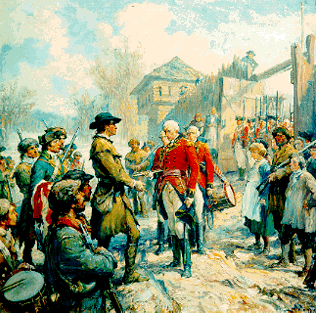
The American Revolution in the West is designed to be a general review or introduction to the American Revolution in what is now Kentucky, Western Pennsylvania, Ohio, West Virginia, Indiana, Illinois and Michigan. At that point in time, that was the American West. It features George Rogers Clark prominently.
George Rogers Clark (1752-1818)  accepts
the surrender of Vincennes


My review:

This is a decent history. Nothing great, nothing terrible. I would recommend along with it the historical fiction book Long Knife by James Alexander Thom and a good biography of Daniel Boone to get a better understanding of the warfare along the frontier. I would also recommend a book I also reviewed entitled The Red Heart by Thom for an impression of the war from the American Indian's point of view.

I give this book 3 stars for being neither great nor awful. It was simply a history.

If you are not familiar with Clark's story, I urge you to read the short history on the National Parks Service's site from the George Rogers Clark National Historic Site in Vincennes, Indiana - hopefully it will encourage you to read more. I personally find the story to be most amazing - Clark is one of the few outright heroes I have in my study of history.

I will leave you with a quote from Clark that was featured in the book: "Great things have been effected by a few men well conducted."

I rate this book 3 stars out of 5.

This book can be found on Amazon.com here: The American Revolution in the West.

Reviewed on June 8, 2006.

Out of the Dark (audiobook) by David Weber


A near-great, but flawed, epic story

Published by Macmillan Audio in 2010
Read by Charles Keating
Duration: 16 hours, 48 minutes
Unabridged

Ultra-prolific author David Weber visits familiar territory in this audiobook. Weber is a master of the military-based science fiction story and Out of the Dark delivers Weber’s expertise and interest in weapons, weapons systems and military organization in spades in this near-great but flawed epic story that, according to Publishers Weekly, is actually the first book in a trilogy.

The novel Out of the Dark is based on a short story of the same name that Weber published in 2010. The story begins with an alien survey of Earth (called KU-197-20) in the year 1415. The aliens are part of a multi-species alliance called the Galactic Hegemony. The aliens are exploring and documenting all habitable planets and rate all inhabited planets on a technology scale.

David Weber
They find the Earth of 1415 backward technologically but decide to watch some military action in Europe. What they witness is the Battle of Agincourt between Henry V’s England and France – some of the fiercest fighting of the Hundred Years War and the site of horrific slaughter, including the killing of hundreds of French prisoners and wounded after the battle. The aliens that witness this slaughter are horrified. The member races of the Galactic Hegemony are almost all herbivores and they cannot understand the raw violence of humans and assume that humans will wipe themselves out as soon as they develop greater technology.

But, there is one carnivorous member of the Hegemony – the Shongairi a race that might best be described as dog people. The other members of the Hegemony fear the Shongairi and decide to recommend that the Shongairi colonize KU-197-20, figuring that the warlike humans and the Shongairi will keep one another occupied for a while.

By the time the Shongairi arrive nearly 600 years have passed and humans have advanced their technology at a breathtaking pace by the standards of the Hegemony. The Shongairi realize that humans and Earth are technically not eligible for colonization anymore – they are too far advanced and should be sealed from Hegemony contact until humans start interstellar travel or destroy themselves in a nuclear war, either way it’s not Hegemony business. The Shongairi decide that the rate of human technological growth indicates that humanity would be a great “client race” for the Shongair Empire and they hop to harness some of that human creativity for their own ends and an invasion of earth starts by annihilation of the capitol of every country with a Kinetic Energy Weapon or, in layman’s terms, by dropping asteroids on them. Half of humankind dies in one day.

The strong parts of Out of the Dark lie in describing the equipment, weapons and strategies of both the humans and the Shongairi. Everything fits and makes sense, especially when the Shongairi start to have problems conquering earth. In Shongairi culture, a culture based on pack animal psychology, humans should submit because the Shongairi have demonstrated they are the superior race, much like other dogs submit to the alpha dog in a pack. They do not understand why humans continue to fight with improvised explosive devices, with suicide attacks and with small arms  - they are particularly irritated that in the United States there are so many weapons and so many people know how to use them.  In fact, human psychology is a complete mystery to the Shongairi – they cannot fathom that mothers would die to save their children and grief-stricken fathers would fight to the death to avenge their families.

To make it all the worse, the Shongairi military is simply not prepared to fight such a technologically advanced foe – they usually fight Stone Age level villagers. Their tanks are not designed to ward off Russian tank rounds. Their body army will stop swords, but not the high-powered rifles of American hunters. Even worse for the Shongairi, they awaken an ancient power while fighting in the wilds of Romania…

At the beginning of this review I called Out of the Dark a near-great but flawed epic story. All of the elements are there to make this an end of the world classic like Stephen King’s The Stand. Instead, the very elements that make the story viable and interesting – the attention to the detail of the weaponry, the motivations of both species, the way they adapt to each other’s strategies, the battle scenes – they all get buried in the detail. There is simply too much of it. We are privy to too many meetings of the Shongairi high command. There is simply way too much detail about the rifles, pistols, IEDs, tanks and other weapons of the human resistance. I am no shrinking violet when it comes to guns, but the constant descriptions of the grains in every bullet, the weights of the various weapons and their relative strengths and weaknesses did more than just approach the level of a gun fetish. Long, clunky conversations that transmit lots of information to the reader but could have been expressed better by an omniscient narrator. The North Carolina family is so self-sufficient and proficient with firearms that they could have been taken straight from a bad historical fiction novel about the pioneers. The book can be read as a how-to guide to building your own bunker and with overly long detailed descriptions of how to create a steady water supply and what food to stock.

But, despite the flaws, it still worked for me. Could it have been better? Yes. But, it was a great ride nonetheless. When American fighter pilots strike down Shongairi landing ships on the first day of the invasion I found myself actually pumping my fist a bit when those ships were shot out of the sky and the planes somehow managed to escape. I was proud of our confusing human psychology that allowed humans to continue to fight. I bought in to the story and, in the end, that’s what is all about.

Charles Keating read the audiobook and he did a great job of creating multiple distinct voices for the characters. His interesting accent worked especially well with the Shongairi characters and undoubtedly made the book a better experience.

I rate this audiobook 4 stars out of 5.

This audiobook can be found here on Amazon.com: Out of the Dark by David Weber.

Reviewed on June 24, 2011.

Featured Post

<b><i>BAN THIS BOOK (audiobook)</i></b> by Alan Gratz

Published in 2017 by Blackstone Audio, Inc. Read by Bahni Turpin. Duration: 5 hours, 17 minutes. Unabridged. My Synopsis Ban This Book is t...

Popular posts over the last 7 days