The Black Flower: A Novel of the Civil War by Howard Bahr


An excellent beginning to a promising career.

Originally published in 1997.

First off - The Black Flower is one of the best books I've read in a long time. It follows a group of Confederate soldiers during and after the Battle of Franklin, Tennessee (November of 1864), especially an educated Private named Bushrod Carter. I will not go into great detail, for fear of ruining the plot for others.

For a first book, this is a remarkable work. The characters are well-written and "feel" like real people. They have weight and depth, a feature that many readers and writers on this forum have decried as missing in most of modern literature. They speak in dialect that is easy to read and does not take much decoding (as opposed to some of Twain's). I am a Civil War buff, and I can testify that the historical aspects of the story ring true.

Confederate Soldiers
This book reminded me very much of The Red Badge of Courage, but not in its theme or its plot. It reminded me of Crane's battle scenes - the confusion and the noise and the smoke and the pain and death are so well-described in both books. The "Black Flower" the title refers to is a metaphor for battle - a battle is a black flower that opens up and brings death, a wondrous and fearsome thing.

I can do this book no further praise than just quit writing about it.

I rate this book 5 stars out of 5.

This book can be found on Amazon.com here: The Black Flower: A Novel of the Civil War.

Reviewed on June 8, 2006.

The American Revolution in the West by George Macgregor Waller


General history of the American frontier during the Revolution.


Published in 1976 by Burnham Inc Pub

Synopsis: 

The American Revolution in the West is designed to be a general review or introduction to the American Revolution in what is now Kentucky, Western Pennsylvania, Ohio, West Virginia, Indiana, Illinois and Michigan. At that point in time, that was the American West. It features George Rogers Clark prominently.
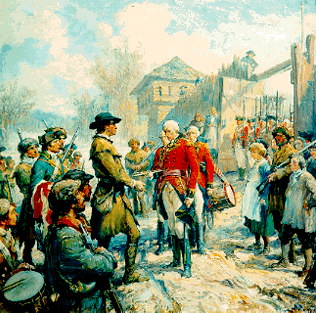
George Rogers Clark (1752-1818)  accepts
the surrender of Vincennes


My review:

This is a decent history. Nothing great, nothing terrible. I would recommend along with it the historical fiction book Long Knife by James Alexander Thom and a good biography of Daniel Boone to get a better understanding of the warfare along the frontier. I would also recommend a book I also reviewed entitled The Red Heart by Thom for an impression of the war from the American Indian's point of view.

I give this book 3 stars for being neither great nor awful. It was simply a history.

If you are not familiar with Clark's story, I urge you to read the short history on the National Parks Service's site from the George Rogers Clark National Historic Site in Vincennes, Indiana - hopefully it will encourage you to read more. I personally find the story to be most amazing - Clark is one of the few outright heroes I have in my study of history.

I will leave you with a quote from Clark that was featured in the book: "Great things have been effected by a few men well conducted."

I rate this book 3 stars out of 5.

This book can be found on Amazon.com here: The American Revolution in the West.

Reviewed on June 8, 2006.

Out of the Dark (audiobook) by David Weber


A near-great, but flawed, epic story

Published by Macmillan Audio in 2010
Read by Charles Keating
Duration: 16 hours, 48 minutes
Unabridged

Ultra-prolific author David Weber visits familiar territory in this audiobook. Weber is a master of the military-based science fiction story and Out of the Dark delivers Weber’s expertise and interest in weapons, weapons systems and military organization in spades in this near-great but flawed epic story that, according to Publishers Weekly, is actually the first book in a trilogy.

The novel Out of the Dark is based on a short story of the same name that Weber published in 2010. The story begins with an alien survey of Earth (called KU-197-20) in the year 1415. The aliens are part of a multi-species alliance called the Galactic Hegemony. The aliens are exploring and documenting all habitable planets and rate all inhabited planets on a technology scale.

David Weber
They find the Earth of 1415 backward technologically but decide to watch some military action in Europe. What they witness is the Battle of Agincourt between Henry V’s England and France – some of the fiercest fighting of the Hundred Years War and the site of horrific slaughter, including the killing of hundreds of French prisoners and wounded after the battle. The aliens that witness this slaughter are horrified. The member races of the Galactic Hegemony are almost all herbivores and they cannot understand the raw violence of humans and assume that humans will wipe themselves out as soon as they develop greater technology.

But, there is one carnivorous member of the Hegemony – the Shongairi a race that might best be described as dog people. The other members of the Hegemony fear the Shongairi and decide to recommend that the Shongairi colonize KU-197-20, figuring that the warlike humans and the Shongairi will keep one another occupied for a while.

By the time the Shongairi arrive nearly 600 years have passed and humans have advanced their technology at a breathtaking pace by the standards of the Hegemony. The Shongairi realize that humans and Earth are technically not eligible for colonization anymore – they are too far advanced and should be sealed from Hegemony contact until humans start interstellar travel or destroy themselves in a nuclear war, either way it’s not Hegemony business. The Shongairi decide that the rate of human technological growth indicates that humanity would be a great “client race” for the Shongair Empire and they hop to harness some of that human creativity for their own ends and an invasion of earth starts by annihilation of the capitol of every country with a Kinetic Energy Weapon or, in layman’s terms, by dropping asteroids on them. Half of humankind dies in one day.

The strong parts of Out of the Dark lie in describing the equipment, weapons and strategies of both the humans and the Shongairi. Everything fits and makes sense, especially when the Shongairi start to have problems conquering earth. In Shongairi culture, a culture based on pack animal psychology, humans should submit because the Shongairi have demonstrated they are the superior race, much like other dogs submit to the alpha dog in a pack. They do not understand why humans continue to fight with improvised explosive devices, with suicide attacks and with small arms  - they are particularly irritated that in the United States there are so many weapons and so many people know how to use them.  In fact, human psychology is a complete mystery to the Shongairi – they cannot fathom that mothers would die to save their children and grief-stricken fathers would fight to the death to avenge their families.

To make it all the worse, the Shongairi military is simply not prepared to fight such a technologically advanced foe – they usually fight Stone Age level villagers. Their tanks are not designed to ward off Russian tank rounds. Their body army will stop swords, but not the high-powered rifles of American hunters. Even worse for the Shongairi, they awaken an ancient power while fighting in the wilds of Romania…

At the beginning of this review I called Out of the Dark a near-great but flawed epic story. All of the elements are there to make this an end of the world classic like Stephen King’s The Stand. Instead, the very elements that make the story viable and interesting – the attention to the detail of the weaponry, the motivations of both species, the way they adapt to each other’s strategies, the battle scenes – they all get buried in the detail. There is simply too much of it. We are privy to too many meetings of the Shongairi high command. There is simply way too much detail about the rifles, pistols, IEDs, tanks and other weapons of the human resistance. I am no shrinking violet when it comes to guns, but the constant descriptions of the grains in every bullet, the weights of the various weapons and their relative strengths and weaknesses did more than just approach the level of a gun fetish. Long, clunky conversations that transmit lots of information to the reader but could have been expressed better by an omniscient narrator. The North Carolina family is so self-sufficient and proficient with firearms that they could have been taken straight from a bad historical fiction novel about the pioneers. The book can be read as a how-to guide to building your own bunker and with overly long detailed descriptions of how to create a steady water supply and what food to stock.

But, despite the flaws, it still worked for me. Could it have been better? Yes. But, it was a great ride nonetheless. When American fighter pilots strike down Shongairi landing ships on the first day of the invasion I found myself actually pumping my fist a bit when those ships were shot out of the sky and the planes somehow managed to escape. I was proud of our confusing human psychology that allowed humans to continue to fight. I bought in to the story and, in the end, that’s what is all about.

Charles Keating read the audiobook and he did a great job of creating multiple distinct voices for the characters. His interesting accent worked especially well with the Shongairi characters and undoubtedly made the book a better experience.

I rate this audiobook 4 stars out of 5.

This audiobook can be found here on Amazon.com: Out of the Dark by David Weber.

Reviewed on June 24, 2011.

Middle Passage (audiobook) by Charles Richard Johnson


Winner of the 1990 National Book Award

Published in 1990.
Read by Dion Graham.
Duration: 7 hours, 4 minutes.
Unabridged.

I have rarely heard a narrator's voice so well-suited to a character as is Dion Graham's voice is to Rutherford Calhoun. Middle Passage (winner of the 1990 National Book Award) is written in first person as a personal journal of a ne'er-do-well former slave from Illinois who lives in New Orleans in 1830. Calhoun is forced to go on the run. He stows away on a slave ship bound for West Africa. It is captained by a diminutive American explorer and adventurer with a strong personality and an insatiable desire for new experiences.The crew is discontented and on the edge of mutiny.

Along the way, Calhoun discovers that the slaves and the cargo in the hold are not normal, in fact they might be more accurately described as paranormal. I would say more but I want to avoid spoilers.

Charles Richard Johnson
In reality, this book is not a good piece of historical fiction - historical anachronisms abound. Rather, it is an exceptional piece of fiction full of good old-fashioned literary themes, adventure, personal growth and literary allusions, like other, more famous novels about the sea, including the obvious ones such as Moby Dick and Homer's Odyssey.

One of the larger themes is freedom and servitude. Most obviously there are the slaves, but Charles Johnson also explores the debts we owe one another, society in general, employer/employee, men and women, parent and child, god and man and the way our past binds us to our future. Looked at in all of these contexts, the reader may wonder if any of us are really free?

I highly recommend Middle Passage, especially the audio version, since it so perfectly narrated.

I rate this book 5 stars out of 5.

Reviewed on October 23, 2008.

This book can be found on Amazon here: Middle Passage

The Intellectual Devotional: Modern Culture: Converse Confidently about Society and the Arts by David S. Kidder and Noah D. Oppenheim


Learn a little every day. 


Read by Oliver Wyman and Helen Litchfield
Duration: a little more than 17 hours.
Published in 2008.

The Intellectual Devotional: Modern Culture is designed on the same format as a religious devotional - a small bit of inspiration every day. In this case, it is designed to be a small bit of learning every day. It is not set up with specific dates (Such as Thursday, October 23), but it starts with Monday of Week 1 and works it way through the year. There are 16 CD's in this set, with an estimated length of a little more than 3 minutes for each day and a little more than 17 hours overall. There are Intellectual Devotionals with other themes as well, such as American history.

The topics vary widely. The first CD ranges from Sigmund Freud to Hal Roach (the man behind the Little Rascals). The topics are interesting and I found myself dispensing with the intended one-a-day format and listening to upwards of 20 of them as I putter around the kitchen.

The only complaint I have is that there is no index included to remind the listener of the location of interesting entries. Unlike the book version, I really can't easily go flipping through it until I find the entry I'm looking for.

Nonetheless, this one comes highly recommended by this reviewer.

This audiobook can be found on Amazon.com here: The Intellectual Devotional.

I rate this audiobook 5 stars out of 5.

Reviewed on October 23, 2008.

The Judas Field: A Novel of the Civil War by Howard Bahr


Majestic and Poetic - an Outstanding Experience

Published in 2007 by Picador

Howard Bahr
If you pick up The Judas Field give it about 30 pages. Up to that point I was fairly confused and lost. Then, it suddenly comes together and this book became one of the most powerful books I've read all year.

The book features two story lines - one set approximately 20 years after the Civil War and one that consists of flashbacks about the Battle of Franklin. Both are interesting. Bahr's descriptions of the battle contain some of the most poetic descriptions of the most awful things that men can do to one another that I've ever read. Truly beautifully written.

On top of that there is an ongoing discussion about the role of God in war. Does he take sides? Has he forsaken both sides? This discussion is not done lightly. These are not post-modernist characters - they believe in God but they must reconcile that belief with the awful experience of war - what they did, what they saw done, what they prayed for, and why God has allowed it. Here's a snippet of this discussion:

Confederate soldiers at the end of the war.
" 'What do you ask for then?' said the boy.

Roger pulled the quilt around his shoulders. 'To be forgiven,' he said.

They were quiet then. The snow swirled around them, borne on a cutting wind, and through it ghostly shapes began to pass, bending, searching, speaking softly." (pp. 168-9)

The dialogue works. The descriptions are so thorough that I could almost hear the horses stamp and the men groan and stretch. This book is an outstanding experience.

I rate this novel 5 stars out of 5. It can be found on Amazon.com here: The Judas Field: A Novel of the Civil War by Howard Bahr.

Reviewed on October 24, 2008.

Worlds at War: The 2,500-Year Struggle Between East and West by Anthony Pagden


Disappointed


Published in 2008.

Anthony Pagden's Worlds at War: The 2,500-Year Struggle Between East and West was a book I was really looking forward to reading. It sat on my wish list for months and when I saw it just sitting there at my local library I greedily snatched it up and considered myself lucky to even have found it checked in.

Thank goodness I did not waste my money buying it.

I suppose the problem with a book of this nature is that it is bound to disappoint - some things will be "too" highlighted, some left out. Even worse for this book, niggling factual errors crop up that bother the careful reader and throw into doubt the validity of the more complicated interpretations of the work as a whole.

Positives:

The book is quite readable and you must give a tip of the hat to anyone who undertakes such a large and sweeping history.

Negatives:

The anti-religious comments taint large sections of the book: "...nor have I made any attempt...to disguise the fact that I believe the myths perpetrated by all monotheistic religions - all religions indeed- have caused more lasting harm to the human race that any other set of beliefs..." (p. xix) In my opinion, his anti-religious bias does immeasurable harm to this history because holders of religious belief are held in disdain. This is a history full of religious beliefs, perhaps even based on it. Viewing all of those beliefs as despicable and marginalizing them leads to some of the more simplistic interpretations noted in other reviews of this book.

-The author comments that in this book Christianity "seems to fare slightly better than Islam in this story..." (p. xix) but I really doubt that. At least he spent several pages on the life of Muhammad and the early history of Islam. He doesn't even bother to tell about the life of Jesus (not even a "supposed" version) or a history of St. Paul (whom he refers to in passing several times, but the uninformed reader is left, well, uninformed.) Imagine, a history of the West without even a page devoted to the beginnings of Christianity. The closest we get to an outline of Christ is a brief comparison to Mithraism (pp. 130-1). Christians are often slighted, such as on page 519 when he opines that Christians would like to make Shari'a law for the United States if only they could figure out how.

-Judaism fares even worse. It is rarely mentioned. Even then it has inaccuracies, such as on pages 151-2 when he notes, incorrectly that Moses was only given 10 laws. A passing glance through the book of Deuteronomy would tell the most casual of reader that dozens and dozens of laws were given to Moses.

-The Persian-Roman conflicts. I was looking forward to learning more about the Persian empire(s) that fought Rome to a standstill. Usually in this type of history there is just one paragraph that tells you little more than I've already mentioned - that the Persians fought the Romans to a standstill and an accomodation was made. He includes a fancier explanation, but it is still just the one paragraph. (pp. 175-6) I was hoping for much more - especially since this accounts for roughly 500 years of the 2,500 years of conflict that is discussed in the book.

--Refers to the year 1098 as being a part of the "ninth-century". (p. 231)

Martin Luther (1483-1546)
-Luther's teachings are misstated at times. "Mankind did not need to labor to win God's favor, as the Church had always maintained; it could be vindicated by faith alone. To be justified in the eyes of God, one had only to believe and lead a true and godly life." (p. 297) The part about leading a true and godly life would be the same as laboring to win God's favor. It is not Luther's theology. He stated the godly life would proceed from one's faith, it would not, in and of itself, do anything to get one into heaven.

Some might find the point about Luther trivial, but this is not a small thing. In the last 500 years there have been two large-scale organized religious movements in the West and both were inspired by Martin Luther - the Reformation and the Counter-Reformation (aka the Catholic Reformation). Failing to understand this simple part of Luther's theology means that those two movements are not understood as well. If you were reading a book that mentioned the philosopher Socrates and the author failed to grasp the concept that Socrates wanted people to question everything you'd have to question the author's competence as an authority on the topic. If the author also openly ridiculed philosophers in general and Greek philosophers in particular you'd question why he even bothered to write on the topic in the first place.   

-On page 74 there is a reference to "brothels in Pompey" (p.74). Pompey was one of Julius Caesar's rivals. Pompeii is the standard spelling for the city he is referring to.

-On page 249 he refers to the Afghan War of 1991. 2001, perhaps?

-There is a complete failure to mention the clash between Communism, Fascism and the East. The Ba'ath Party was influenced by the Fascist movements. Afghanistan was nominally Communist when the USSR invaded it to support the floundering government in 1979. He expounds on the murderous history of religious movements but blows off the terrible history of secular movements like Communism with one really long sentence (pp. 533-4) that fails to address the issue or the scope of their own murderous pasts.

-"Soviet Block"? (p. 526). The standard spelling is bloc, not block.

-On page 526 it is claimed that East Germany "took the first steps that would eventually bring down the Communist regimes of eastern Europe." (p. 526) Funny, I remember it being Poland with Lech Walesa and Solidarity being the first. The Wall came down only when Hungary and other countries had already lowered their barriers and made East Germany's Communist rulers irrelevant.

Final thought: Buy something else. Perhaps more specific histories rather than a more general, biased one that demonstrates little respect for the religious traditions of the peoples involved.

I rate this book 2 stars out of 5.

This book can be found on Amazon.com here: Worlds at War: The 2,500-Year Struggle Between East and West.


Reviewed on October 28, 2008.

Featured Post

<b><i>BAN THIS BOOK (audiobook)</i></b> by Alan Gratz

Published in 2017 by Blackstone Audio, Inc. Read by Bahni Turpin. Duration: 5 hours, 17 minutes. Unabridged. My Synopsis Ban This Book is t...

Popular posts over the last 7 days