Drive Thru History: East Meets West DVD


I love this series


Published in 2006 by Coldwater Media

I teach history in a public school so using this Drive Thru History: East Meets West in my classroom is not a viable option due to the contemporary religious references. However, if you are in a Christian school or homeschool with a Christian emphasis I can enthusiastically recommend this series.

East Meets West has two 30 minute plus programs about Turkey and Asia Minor. Turkey is literally where the Middle East meets the West.

In episode 1, Dave Stotts takes us to Cappadocia, a unique area with an underground city and roots in the Old Testament and in the post-Biblical era as a scene of anti-Christian persecution by both the Romans and the Muslims.

Episode 2 is the stronger of the two. It covers the Emperor Constantine, the controversy that caused the creation of the Nicene Creed, the fall of Constantinople and the wonderful Hagia Sofia church turned to mosque now museum.

Episode 3 is a "best of" for the first 4 volumes with a blooper reel.

Okay - bottom line. The history is good. The presentation is light and effective. The graphics are great. It's funny. Highly recommended.

I rate this DVD set 5 stars out of 5. It can be found on Amazon.com here: Drive Thru History: East Meets West DVD.

Reviewed on July 21, 2009.

Flushed: How the Plumber Saved Civilization by W. Hodding Carter


An entertaining read


Published in 2006 by Atria.

W. Hodding Carter covers plumbing from the Ancient Indians, Greeks and Romans to modern day Japanese bidet toilet in Flushed: How the Plumber Saved Civilization, a meandering romp through sewers, both past and present.

Carter's light-hearted writing style makes it a fun read. He meanders all over the world of bathrooms, pipes and open-pit sewers but the trip is a fun one. There are a lot of detours, but it's fun and informative.

W. Hodding Carter
That being said, there are a couple of stumbles. On page 30 he claims the Hellenistic Age is named for Helen of Troy, which is ridiculous. Chapter 8 "Blame It On the Christians" is an equally ridiculous attempt to blame all of the Western world's issues with defecation and urination (mostly cutesy names like poo-poo and the desire to defecate alone) on Christianity. He quotes Francis of Assisi to make his case that Christianity made using the bathroom and being physically clean a "dirty" thing (page 144) but also quotes him to say that Christians should be clean (page 145).

But, those slip-ups do not diminish the book as a whole. He more than proves his point that plumbing and plumbers have made the modern world possible. Very entertaining.

I rate this book 4 stars out of 5 and it can be found on Amazon.com here: Flushed: How the Plumber Saved Civilization.

Reviewed on July 21, 2009.

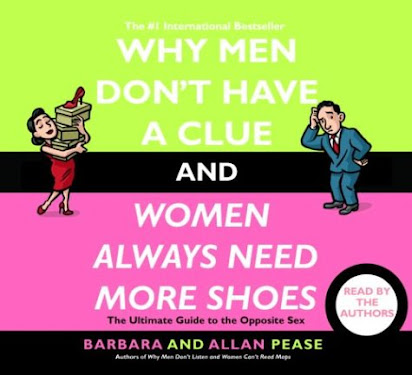
Why Men Don't Have a Clue and Women Always Need More Shoes (audiobook) by Barbara and Allan Pease


Starts out strong, ends up tiresome


Published by Random House Audio Dimension in 2004.
Read by one of the authors, Allan Pease.

3 discs
3 hours
Abridged.

Why Men Don't Have a Clue and Women Always Need More Shoes starts out with a bang, delving into a lot of the differences that drive men and women crazy. These are mostly humorous and mostly full of good advice. But, we never do find out about women and shoes, nor do we find the answers to some of the questions posed in the opening section, such as, "Why don't women initiate sex more often?"

Barbara and Allan Pease
There is interesting commentary on the reactions of men and women to retirement, why men switch the channels so often and the comments on men's behaviors in public restrooms is dead on accurate. However, I felt cheated that so much of the book (about 1/3 by my estimate as a listener) is about the physical characteristics that of the opposite sex that interest men and women. I felt that this was not germane to the topic at hand and really offered no new insights - is anyone really surprised that men like breasts, long legs, sensuous mouths and long, full hair? No. I didn't think so.


There was one "fact" that was certainly not true. The Peases claim that Coca Cola picked its unique bottle shape to remind soldiers of the women at home and make more sales. Sounds good except for the fact that the bottle shape was chosen in 1915 and the United States was not involved in World War I until 1917. This sounded false to me from the beginning because as a proud Hoosier, I know that the unique shape of the Coca Cola bottle was created in Terre Haute, Indiana to distinguish Coca Cola bottles from all of its competitors so it would be harder to sell fake Coca-Cola in stores.

I believe that the abridgment hurt this audiobook quite a bit.


I rate this audiobook 3 stars out of 5.

This audiobook can be found on Amazon.com here: Why Men Don't Have a Clue and Women Always Need More Shoes.

Reviewed on October 17, 2010.

The Broker by John Grisham


Fairly boring story, lots of good info on Italian culture, history and cuisine


Published by Random House Audio in 2005.
Read by Michael Beck.
11 hours, 4 minutes.
Unabridged.

The last two thrillers that I have read by John Grisham have been anything but. A couple of years ago I listened to The King of Torts and came away with a great education in class action lawsuits but at the cost of a disappointing story. With The Broker, I came away with a great education in Italian culture, cuisine and great insights into the oft-overlooked city of Bologna, Italy - but it was a thriller with precious few thrills.

The Broker is centers around Joe Blackman, a Washington, D.C. lobbyist that plays fast and loose with all of the rules and revels in throwing his weight all over town. Blackman is approached by Pakistani computer hackers who have discovered and hijacked a set of super high tech spy satellites with a special computer program. They want Blackman to sell it to the highest bidder and soon enough the Israelis, the Saudis, the Chinese and the CIA are all interested. One of Blackman's associates winds up murdered and an FBI probe into Blackman's practices place him in prison.

A portico (covered walkway) in Bologna - I felt the need
to include a picture because Grisham
mentioned them so often.
Suddenly, he is part of a surprise last minute pardon deal by an outgoing president and he is whisked into a witness protection program administered by the CIA in Italy. Blackman is forced to learn a new language and a new culture. Most of the book deals with Blackman's lessons and endless trips to drink espresso in one coffee shop after another in Bologna, Italy. Seriously, at least 2/3 of the book is Italian lessons, lunch at one Italian restaurant after another or visits to Italian cultural sites. I am quite sure the inspiration to write this book was the desire to spend a great deal of time in Italy and still be able to write off every bill as a business expense on Grisham's income taxes.

If you are a fan of Italy, this may very well be your book. If you are a hardcore international spy thriller book fan, don't bother.

I rate this book 2 stars out of 5. It can be found on Amazon.com here: The Broker.

Reviewed on October 17, 2010.

The Law by Frederic Bastiat


I cannot recommend this book enough.


Originally published in 1850.

The Law is a small book on the basics of economic principles written by Frederic Bastiat (1801-1850), a French economist and member of their National Assembly. He only published works during the last 5 years of his life, which was cut short by a lingering illness.

The Law struck me as an economics version of Thomas Paine's Common Sense - a short, easy to understand book full of impassioned, clearly laid out arguments and examples that clearly demonstrate the author's arguments.

Bastiat was a man who was not in synch with his times or his country. He grew up in Napoleonic France, a time and place that replaced the idea of individual liberty with government action for the good of the individual. Bastiat argues (and supplies plenty of examples to back his arguments) that this is a perversion of the purpose of government: "The organizers maintain that society, when left undirected, rushed headlong to its inevitable destruction because the instincts of the people are so perverse. The legislators claim to stop this suicidal course and to give it a saner direction. Apparently, then, the legislators and the organizers have received from Heaven an intelligence and virtue that place them beyond and above humankind; if so, let them show their titles to this superiority. They would be shepherds to us, their sheep. Certainly such an arrangement presupposes that they are naturally superior to the rest of us." (pp. 62-3)

Bastiat begins with a look at the origins of government. He argues, like Locke and Hobbes that governments had to have been organized to protect life and property. That is their purpose and when they stray from it, be it with protectionist schemes like tariffs or with Legal Plunder programs that "take from some persons what belongs to them, and gives it to other persons to whom it does not belong...if the law benefits one citizen at the expense of another by doing what the citizen himself cannot do with committing a crime...then abolish this law without delay, for it is not only an evil itself, but it is a fertile source for further evils...it will spread, multiply and develop into a system." (p. 21)

Bastiat would not be happy with amount of influence most modern Western governments have over the economies of their countries and the lives of their people. I can only imagine this Frenchman would be a proud supporter of the Tea Party movement - low taxes, no loopholes or special breaks for favored industries, take a hard look at all government programs and get rid of those that engage in the "Legal Plunder" that I mentioned in the previous program.

So, what is this short book The Law? I found it to be exciting, invigorating, intellectually stimulating, simple in it language and argument and every bit of a match for Thomas Paine's Common Sense. If the opening lines of the Declaration of Independence have meaning for you, if Adam Smith's Wealth of Nations makes sense to you, if you think Hayek's Road to Serfdom and Friedman's Free to Choose are relevant to the modern world make a point of reading this short book - it is powerful in its simplicity and it still has meaning 160 years after its initial publication.

I cannot recommend this book enough. 5 stars out of 5 and it can be found on Amazon.com here: The Law by Frederic Bastiat.

Note: Please make sure you get the 1950 translation - by all accounts it is superior.

Reviewed on October 16, 2010.

Jericho's Fall by Stephen L. Carter


It just didn't work for me


Published in 2009 by Knopf.

This wasn't a bad book - I finished it and I wanted to know what was going on, but...


The book successfully creates a mood. It reminds me of one of those novels set in the Highland Moors in which creepy Lord Whatshisname gathers his family, friends and professional acquaintances to his manor as he lies dying. The sparks fly and secrets are revealed as the horrible weather howls outside.

Jericho's Fall is not based on the Highlands, but on a lonely mountaintop mansion compound in Colorado. There is no English Lord, but instead we have a former Secretary of Defense/CIA Director. His daughters, his ex-lover and loads of professional contacts are in and out of the compound. Sparks do fly and secrets are revealed as freezing rain and snow fall.

Well, I hate those kinds of books and this one had a few too many hidden agendas, double secret agents and super spy secret gadgets for my tastes. Too much posturing and too many mind games. It is readable, but not great.
Stephen L. Carter
On the positive side, however, I was intrigued by the author's non-fiction titles inside the front cover and have begun to read them. I have found them to be quite well-written and have added many of them to my wish list.

I rate this book 3 stars out of 5. It can be found on Amazon.com here: Jericho's Fall by Stephen L. Carter.

Reviewed on July 23, 2009.

The Great Progression: How Hispanics Will Lead America to a New Era of Prosperity by Geraldo Rivera


Much like Geraldo himself, this book is a lot of sizzle and not much substance

Published in 2009 by Celebra.

Sadly, I have to do some explaining before we start. I am a history and a Spanish teacher (20th year this year!). I live in an ethnically mixed neighborhood in which my best neighbors are, by far, a Mexican family. I live with illegal immigration every day, in my neighborhood and at my work. I am not a raving nut that says "round 'em up!" Nor am I an open borders guy that wants to take in the whole world. My neighborhood has been materially improved by immigrants who have moved in.

So, now that we've gotten that out of the way, on to Geraldo's book, The Great Progression: How Hispanics Will Lead America to a New Era of Prosperity. It is a lot of sizzle, half-baked commentary and an endless series of attacks on Lou Dobbs (who I must admit that I have not watched for years now since we ditched cable and we don't have satellite - I thought he was the host of a financial show).

Early on Geraldo Rivera attacks Rush Limbaugh for a series of anti-immigrant comments entitled "Limbaugh's Laws." I did an internet search and I found 3 paragraphs of the same title. They are inflammatory. They are awful. But, here's the essential third paragraph of the commentary - the paragraph that Rivera ignores: "I can imagine many of you think that the Limbaugh Laws are pretty harsh. I imagine today some of you probably are going, "Yeah! Yeah!" Well, let me tell you this, folks. Every one of the laws I just mentioned are actual laws of Mexico, today. I just read you Mexican immigration law. That's how the Mexican government handles immigrants to their country."

That's a telling example of the slipshod commentary throughout. Rivera's thesis doesn't even hold up to his own scrutiny. He is critical of those that claim illegal immigration drives down wages and than, a few chapters later, he notes that Cesar Chavez of the United Farm Workers fame was against illegal immigration for that same reason. He even calls it an economic law.

Rivera asserts that the anti-illegal immigration crowd (he disingenuously calls them anti-immigration, meaning against immigration of all sorts) is racist because it is afraid of the gang violence of such groups as MS-13 and than he has a whole chapter devoted to drug-related gang violence on the border. So, the violence is real, but trying to keep it out or even to talk about it is racist? He does a similar thing with ARM mortgages and immigrant families (they aren't overly-represented, but then, a few chapters later they are because they are victims). He gets upset that Hispanics are hassled for ID to prove they are citizens and then notes that the presence of "obviously foreign" day laborers. Is only Mr. Rivera allowed to make such assumptions?

The book begins with "hard hitting" interviews with such political greats as J-Lo, George Lopez and Rosario Dawson. We get lists of baseball players of Hispanic origin (literally - paragraph after tedious paragraph) is a chapter called "Beisbol." I am still unsure as to the purpose of the chapter.

Geraldo Rivera gives us a look into his jet-setting lifestyle (he notes that he is writing in L.A. for this paragraph, Puerto Rico for another and so on) but shows how truly out of touch he is when he comments that America's lawns wouldn't be mowed, their kids cared for or our toilets cleaned if it weren't for Hispanics. Really? I wish I had that kind of money. The only lawn mowed by Hispanics in my neighborhood belong to houses with Hispanic families living in them.

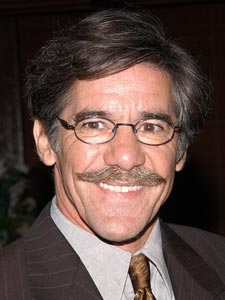
Geraldo Rivera
Is he all wrong? No. Rivera gives an impassioned argument as to why education must become a priority in the Hispanic community. His chapter on "The Hispanic Consumer" is fascinating and entertaining. He makes valid points when discussing allowing illegal aliens to join the military as a path to citizenship in another chapter.

But, more often he wanders afield in commentary such as his on unions - he wants the so-called "Card Check" legislation to pass but isn't quite clear as to why, especially when businesses can just go to newly arrived workers with fake IDs to replace the strikers.

More irritating is his tendency to name call. For example, he calls "Joe the Plumber" a "douchebag".

If you want a lot of splash, this is your book. If you want well-reasoned commentary - the kind that has been thoroughly researched, discussed and evaluated, well, this is not it. There is no middle ground in this book. Even attempting to have a reasoned conversation about immigration with Rivera would be cause for attack and liberal use of the epithet "anti-immigrant".

I rate this book 2 stars out of 5. It can be found on Amazon.com here: The Great Progression: How Hispanics Will Lead America to a New Era of Prosperity.

Reviewed on August 3, 2009.

Note: This review was edited on January 19, 2025. Update: My Mexican neighbors who lived behind me (I referred to them in the first paragraph)
 have long since moved away. It's a rental property and no one stays more than a couple of years. But, multiple houses further down their street have been purchased and flipped by a Hispanic family that is using their skills to build wealth and turn some of the worst houses in the neighborhood into some of the best. Good for them and good for the neighborhood! I still think Rivera makes a few good points, but weakens the overall argument with weird comments, name-calling, off-topic points, edited quotes intended to be "gotcha" moments, and comments that reinforce stereotypes.

Featured Post

<b><i>BAN THIS BOOK (audiobook)</i></b> by Alan Gratz

Published in 2017 by Blackstone Audio, Inc. Read by Bahni Turpin. Duration: 5 hours, 17 minutes. Unabridged. My Synopsis Ban This Book is t...

Popular posts over the last 7 days