Cherish the Word: Reflections on Luther's Spirituality by Thomas C. Peters


A simple series of Bible studies about everyday life


Published in 2000 by Concordia Publishing.

Lots and lots of Bible studies are concerned with literally studying the stories of the Bible. There is a place for that, but many times problems of everyday life are not addressed, or at least not directly.

This Bible study mines the immensely rich vein of Martin Luther's commentaries, sermons and even dinner table discussions in an attempt to create a Bible study that deals with 13 real life issues such as "Dealing With Temptations", "Counterfeit Christians", "Work...But Don't Worry", "Be Patient in Adversity" and "God Really Forgives Our Sins."

Luther's practical teachings written in everyday language and cemented in a thorough reading and study of the New Testament, shine throughout. Every short study (8-10 pages) begins with a relevant passage from the New Testament, a short story that frames the problem, Luther's relevant commentaries with supportive verses from the Bible and study/discussion questions. Sometimes a relevant hymn written by Luther is included as well.

I rate this study 4 stars out of 5. It can be found on Amazon.com here: Cherish the Word: Reflections on Luther's Spirituality.

Reviewed on March 4, 2010.

The Light In The Forest by Conrad Richter


Two incompatible ways of life symbolized by one young man


Some books stand the test of time, so do not. The Light in the Forest was originally published in 1953 and it still rings true - both historically and as a story.

Based in Pennsylvania during the years preceding the French and Indian War, the story revolves around True Son, a young man who had been kidnapped from his family by Lenni Lenape Indians at age four. True Son is adopted by an honorable, respected man named Cuyolga to replace a son who died from disease. Over time, True Son forgets his white parents and becomes a full Lenni Lenape.

However, a treaty is signed that requires that the white "captives" be returned to their white families. True Son is returned and the bulk of the book concerns itself with True Son's reactions to the white society he was forced to leave more than a decade earlier. Eventually, True Son escapes back to his adopted family and settles back into his comfortable way of life.

Conrad Richter
Up until the last few pages, the reader is left with the impression that the conflict between the settlers and the Indians was primarily a war of brutality on the part of the settlers, but True Son discovers, to his horror, that warriors from his own family group massacred a family and even scalped the children - an accusation that he angrily denied when settlers threw it in his face while he was forced to live with them.

Richter leaves the reader with an unconventional ending, but one that feels right, nonetheless.

Makes a great companion to longer, more detailed (but less conflicted) books by James Alexander Thom such as Follow the River and The Red Heart.

I rate this book 5 stars out of 5. It can be found on Amazon.com here: The Light In The Forest by Conrad Richter.

Galapagos by Kurt Vonnegut


My first exposure to Vonnegut and I liked it!

Originally published in 1985.

The premise in Galapagos is that a group of people get stranded on an island in the Galapagos and end up becoming the sole survivors of the human race, due to war and famine. Their gene pool decides the fate of humanity biologically, which is why it is set in the Galapagos Islands (thank you, Charles Darwin).

I could tell you the plot, but that would just gloss over all of the intentionally contradictory themes of the book (for instance: the importance of the individual is emphasized vis-a-vis evolution, but the individual is also not important because the individual is also swept away in several instances due to his stupidity and/or just being in the wrong place at the wrong time). There is actually some meat on the bones of this book - a nice change of pace when compared to some others I've read lately.
Kurt Vonnegut (1922-2007)

P.S. for those Hoosiers out there - as you may know, Vonnegut is from Indianapolis. One of the characters went to IU (and survives! - probably due to conditioning from the dorm food) and the ships motors were made by a diesel company in Columbus, IN - sound familiar?

I rate this book 5 stars out of 5 stars. It can be found on Amazon.com here: Galapagos by Kurt Vonnegut.

Reviewed in 2004.

Hocus Pocus by Kurt Vonnegut


Originally published in 1990.

Hocus Pocus starts out at the end and you spend the whole book reading little stories to see how the character ended up where he is now.

Eugene Debs Hartke is a prisoner being held in the library of Tarkington College. The book is his collected memoirs which were written on numbered pieces of scrap paper. The future he lives in is dominated by the Japanese economy and the American foreign and domestic policies are consumed by "The War on Drugs." Racism is much more prevalent.

Eugene Debs Hartke was a teacher at Tarkington College, a college for very rich Special Education students who would not graduate from a traditional university. Across the lake is a maximum security prison that holds 10,000 prisoners - most of them were Special Education students who turned to crime to make a living.

This is a good book, but it starts out a little slow. There are similar themes as other Vonnegut books I've read, especially his focus on how life's little choices can radically change what happens to you.

Vonnegut is a master at coming up with quotable odd thoughts and here are a few that caught my eye:

Kurt Vonnegut (1922-2007)
"In an era as foulmouthed as this one, (someone saying) 'Good gravy' had the same power to startle as a cannon shot."

On human space travel:
"How could all that meat, needing so much food and water and oxygen, and with bowel movements so enormous, expect to survive a trip of any distance whatsoever through the limitless void of outer space? It was a miracle that such ravenous and cumbersome giants could make a round trip for a 6-pack to the nearest grocery store."

"Another flaw in the human character is that everybody wants to build and nobody wants to do maintenance."

On Freedom of Speech:
"That isn't something that someone else gives you. That's something you have to give yourself."

Anyway, its a good book. I enjoyed it. It made you think sometimes and that is always good.

Reviewed in 2004.

This book can be found on Amazon.com here: Hocus Pocus.

5 stars out of 5.

Dead Crazy (Jenny Cain #5) by Nancy Pickard


A decent little mystery

Published in 1989 by Pocket Books

Dead Crazy is set in small-town New England and features Jenny Cain, the woman in charge of the areas philanthropical foundation (very much like Indianapolis's Lilly Foundation) that makes investments and gives grants for the public good. The foundation is asked to buy a building so that it can be converted into a recreation/meeting hall for the mentally ill of the community - a place where they can get out of the cold and still be welcome. But, things quickly get complicated when people start dying in and around the building and a mentally ill man is the main suspect.

The characters are believable, the book is well-paced and the killer is a surprise (I thought I had it figured out for about half the book, but ... I was wrong).

I rate this book 4 stars out of 5. This book can be found on Amazon.com here: Dead Crazy by Nancy Pickard.

Reviewed August of 2004.

Founding Father: Rediscovering George Washington by Richard Brookhiser


An interesting biography, a valuable perspective


Published in 1997.

Founding Father: Rediscovering George Washington is not a long biography (199 pages), but it is an interesting piece of writing. It is split into 3 areas - about one-half of the book is straight biography, about one-third is an analysis of the character of our first president and the balance is an analysis of what it means to be a founding father, how Washington measures up to that ideal and what kind of "father" he was.

The biography section is great - straightforward and written in an engaging and lively style. The character portion bogs down quite a bit and the founding father section is interesting (it asserts that he was the kind of father who was most concerned with preparing his children for life outside of his home - life on their own. He encourage other people to step into leadership roles to fill the vacuum that would be there when he walked away from the national spotlight.)

One quote, above all, highlights the best parts of Washington. It comes from Napoleon, who comments in a moment of self-pity after Waterloo, "They wanted me to be another Washington." Think of it - Washington was handed the power to be a dictator and he turned it down. In fact, this book mentions that in all of Washington's letters, he only gets truly angry at one man, and immediately writes a rough letter to a colleague who suggests that Washington make himself king when the Articles of Confederation government begins to founder.

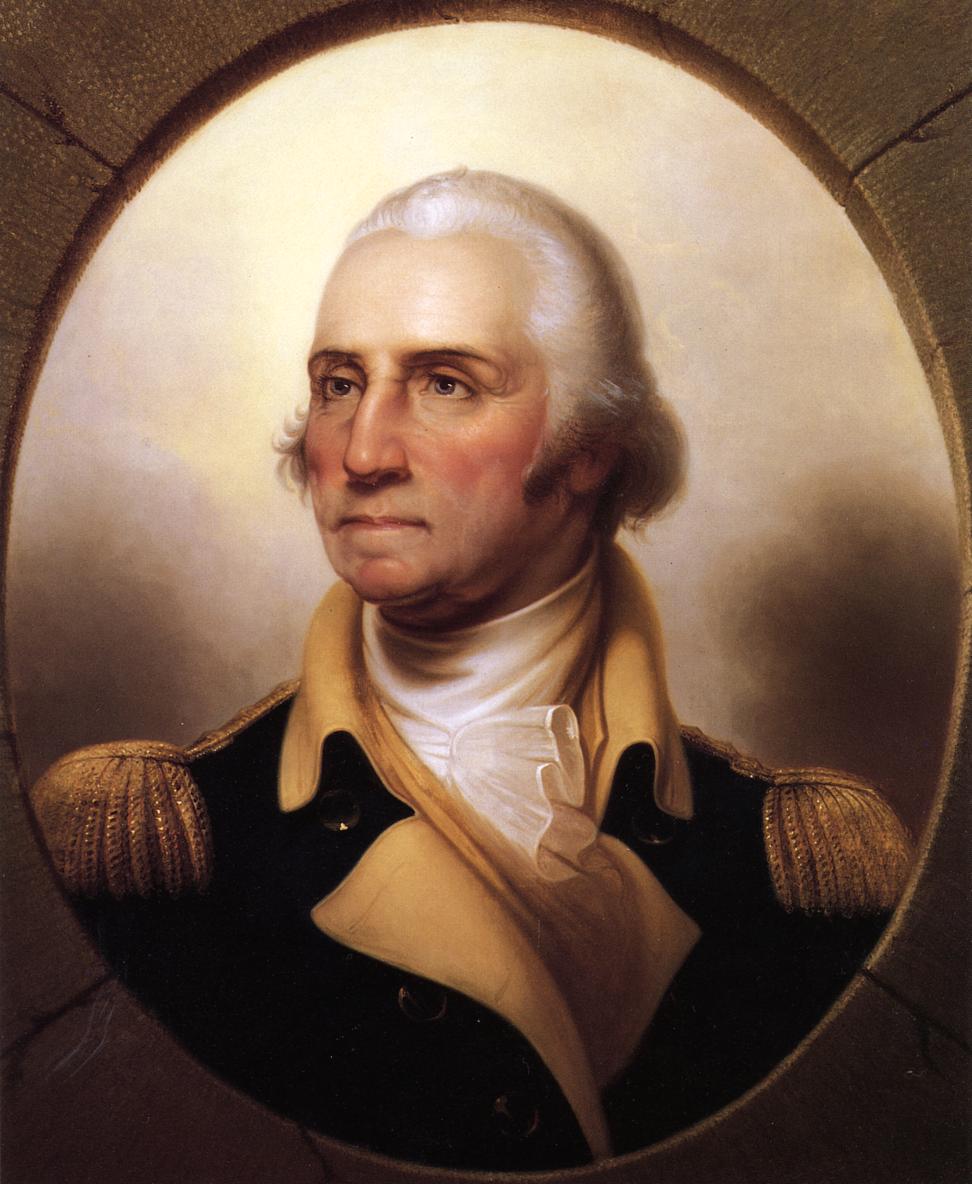
George Washington
(1732-1799)
Brookhiser makes an interesting observation about Washington's impact on American politics by pointing out the length of time he was nationally prominent in comparison with other American leaders. For example, FDR was president for 12 years, Reagan was only politically important for the 8 years of his presidency, Eisenhower was important for the 8 years of his presidency plus his time as a general in WWII (12 years total). Lincoln - 7 years if you count from the time of the famed Lincoln-Douglas debates in 1858. Washington, in comparison was a national figure for 24 years - 17 of them as the leader of the country (you've got to count him as de facto leader of the country while he was leading the Continental Army since everybody knew that if he failed the whole Revolution would fail).

Brookhiser focuses on Washington and slavery in the character portion of the biography and, while Washington does not live up to modern standards on this issue, he was remarkably progressive for his time. He refused to sell any of his slaves since that would tear apart families. He is the only American president who freed his slaves upon his death. Washington seems to have dealt with the contradictions of "All men are created equal..." and slavery by mostly ignoring it.

So, to sum up, there are 3 sections to the book and I found the middle section to be a bit tedious.

I rate this book 4 stars out of 5.

This book can be found on Amazon.com here: Founding Father: Rediscovering George Washington.

Reviewed in August of 2004.

Conan the Rebel by Poul Anderson


Not so hot


Originally published in 1980.

I was feeling the need to read something different, so as I walked past the new books section at the library I saw a Conan book. I've never read Conan, but one of my friends is a giant fan, so I picked it up.

The plot was pretty simple - hero gets even with sworn enemies who have wronged him in many ways, along the way he gets to use a magical weapon, and he fulfills some sort of prophecy as it he goes along. It was entertaining enough, especially in the middle but the ending was way too abrupt.  Conan completes all of the accomplishments I mentioned above in just 35 pages.

The language was too clunky. I realize it's a style thing, but it's like Mr. Anderson (1926-2001) sat in front of his typewriter with a thesaurus and looked for the more macho version of each verb used to describe Conan's behavior. He never throws anything, he heaves it. He always cleaves skulls, rather than splits them. I got tired of this overly macho telling of the story rather quickly.

I rate this book 2 stars out of 5. It can be found on Amazon.com here: Conan the Rebel by Poul Anderson.

Reviewed on August 21, 2004.

Featured Post

<b><i>BAN THIS BOOK (audiobook)</i></b> by Alan Gratz

Published in 2017 by Blackstone Audio, Inc. Read by Bahni Turpin. Duration: 5 hours, 17 minutes. Unabridged. My Synopsis Ban This Book is t...

Popular posts over the last 7 days