THE BRIDGE of SAN LUIS REY by Thornton Wilder


Originally published in 1927.
Winner of the 1928 Pulitzer Prize.


This book has been on my To-Be-Read list since I was in high school. One of my English teachers back in high school used to talk about The Bridge of San Luis Rey quite a lot and I finally got around to reading it.

Synopsis:

The setting is Peru, back when Spain held it as a colony. Outside of Lima in the Andes Mountains there is a magnificent rope bridge for pedestrians. Baggage and animals take a long trail they take down to the river below and they cross a traditional bridge that takes a lot longer. One day the rope bridge breaks and several people fall to their deaths. 

A monk is approaching the rope bridge and sees it break and everyone fall to their deaths. He decides to investigate the lives of each person who fell. He wants to see if there is something in common - perhaps they were all adulterers or thieves or the like?

What follows are elaborate character sketches for each of the victims all ending with them walking across the bridge.

My review:

These character sketches are tedious to read. This is not a long book (123 pages), but I felt like about half of it could've been edited away and it would have only made the book better. I know that is a sign of age - the book is 93 years old and I am not the generation the book was written for. I nearly didn't finish it.  I hate to break it to my English teacher but I didn't find the book very memorable.


I rate this book 2 stars out of 5. It can be found on Amazon.com here: THE BRIDGE of SAN LUIS REY by Thornton Wilder.

WEST from APPOMATTOX: THE RECONSTRUCTION of AMERICA after the CIVIL WAR (kindle) by Heather Cox Richardson


Published in 2007.

Heather Cox Richardson is a historian I have only recently discovered because of her prolific social media presence that she developed while under Covid lockdown. She writes a daily news summary of a few paragraphs with a view towards how these events match up with historical events or trends. Plus, she takes questions from people and develops a one hour daily online lecture. They are interesting, sometimes rambling little presentations and this book shares a lot of the same features. 

In West from Appomattox, Richardson is looking at the time right after the Civil War in American History.  In the history books, Reconstruction, the Old West, the Gilded Age and the Spanish-American War are all treated a separate things. Combining all of these typical divisions of American history into one book makes for a more comprehensive study of the time period. 

Teddy Roosevelt (center with glasses) and
the Rough Riders in the Spanish-American War
Traditionally, they are studied separately - in a typical history book they are literally different chapters. Mostly, Richardson does this, too. Mostly - but she is very willing to cross over to the other areas of study. 

For example, it really impossible to understand the Old West without having an understanding of Reconstruction and of the Gilded Age. Reconstruction encouraged a lot of people to move West. The West received attention and governmental support for economic development and the South did not. The economic growth in the Northeast was largely possible because of Federal Government support of resource extraction from the West. Federal support of settlement of the West and Federal support of building a network of privately owned railroads helped spur further economic growth in the Northeast.  

Due to the overlapping nature of the book, there are a lot of overlapping stories and themes. I don't consider it to be a weakness, though. I consider it to be a reminder that the same policies, the same movements and the same rules were affecting the whole country. 

This time period was truly the transition from the old Revolutionary Era politics to our current modern political system because slavery was finally out of the way. Instead of discussing what to do about slavery it became a discussion about when (or even if) government power should be used to intervene in the free market or to help certain people in society. 

In the South, pushing for public schools for poor children was often decried as Socialist because rich people were being taxed to provide a basic education for the children of the poor. It was even more Socialist if it meant funding schools for poor black children. Meanwhile, out in the Western states the government actively intervened in the Free Market by handing out 160 acre parcels of land, providing land grants to fund railroads and breaking treaties with Native Americans and clearing them out of the way to provide access to mineral wealth.

The point about Socialism is interesting. Richardson pointed out something that I have noticed about American political discussions - we throw about the term Socialism and use it with a completely different meaning than the meaning the rest of the world uses. When everyone discusses Socialism, they are talking about the government owning the means of production (factories, farms, mines, etc.). In the United States, it is tossed about when we talk about taxing anyone to pay for community services and we have done that ever since the time period this book covers. I still hear this argument used against the existence of public schools, public libraries and even public roads. In the United States, Socialism is also a term used to describe non-economic things such as Covid mask mandates and gay marriage because the term has consistently been used by the current conservative party (the Dems back in the 1800s and the GOP nowadays) to discredit new concepts. 

I rate this history 5 stars out of 5. It can be found on Amazon.com here:  WEST from APPOMATTOX:  THE RECONSTRUCTION of AMERICA after the CIVIL WAR (kindle) by Heather Cox Richardson.

ABRAHAM LINCOLN: A LIFE from BEGINNING to END (Biographies of U.S. Presidents)(kindle) by Hourly History


Published in 2016.

This little biography is part of an extensive series of short histories produced by Hourly History. The idea is to be a history or a biography that you can read in an hour. Amazon says that his particular biography is the equivalent to 48 pages long. 


Some historians have asserted that there are more biographies written about Lincoln than anyone else in history, with the exception of Jesus. This is the 73rd book that I've reviewed that with the #tag of "Abraham Lincoln." What does this book have to offer that literally thousands of biographies and histories haven't already covered?

To be honest - nothing.

But, it is exactly the sort of biography that someone who hates history might pick to read because it is not an intimidating length and it is not written in highfalutin language. 

There is nothing in this biography that is inaccurate, just a matter of what the Hourly History people decided to highlight and emphasize.

I rate this kindle book 3 stars out of 5. Not bad, for what it is. Nowhere near a complete biography, but a solid place to start.

This book can be found on Amazon.com here: ABRAHAM LINCOLN: A LIFE from BEGINNING to END (Biographies of U.S. Presidents)(kindle) by Hourly History.

MESSY GRACE: HOW a PASTOR with GAY PARENTS LEARNED to LOVE OTHERS WITHOUT SACRIFICING CONVICTION (audiobook) by Caleb Kaltenbach


Be Warned - it changes tone quite abruptly

Published in 2015 by ChristianAudio.com

Read by the author, Caleb Kaltenbach.
Duration: 6 hours, 3 minutes.
Unabridged.


I checked out the audiobook version of Messy Grace from my local library using the Overdrive app. I highly recommend this app, but it does have a small failing - it does not include any sort of reviews of the digital ebooks or audiobooks. It only includes the publisher's description and the publisher's description of this audiobook only tells part of the story. 

As the title says, Kaltenbach did indeed grow up with gay parents. They married young and divorced after a few years. His mother lived life as a married couple with another woman (this was pre-gay marriage) and his father lived as a closeted gay man. His mother hated Christians because of Westboro Baptist Church-type protesters, but to be fair to his mother, there are plenty of people that express in private the same thoughts that the Westboro folks publicly proclaim. Kaltenbach does not deny this - in fact he decries it throughout the book.

Kaltenbach spends the first 60% of the book or so telling the story of his life and about his parents. He is very much against the Pharisee-type behavior you see in plenty of churches - the behavior that automatically rejects anyone that doesn't seem church-y enough. Kaltenbach argues you can't reach the "lost" if you don't actually engage with them - something that Jesus said and did over and over again.

As Kaltenbach discusses this point, he begins to sound less like he is making projects out of people rather than reaching out to people because they are friends and family. I didn't have a way to describe this inkling in the back of my mind until Kaltenbach did - he said churches have to be careful of this very thing and he called it "project vs. people". It ends up sounding like, "We're going to save a gay man" instead of "I think my friend Bob would really like to check out my church and my church would really like my friend Bob." 

The problem with turning people into projects is that once the project is done (the project joins the church) you move onto to a new project and drop the old project. But, people aren't projects so you are just dropping this person that you made big investment in because you weren't friends with them - you were busy fixing them.
The author and narrator,
Caleb Kaltenbach

But, the part that really bothered me above all else was the fact that the book pitches itself as a pro-gay inclusion book right up until the moment that it is not. Once it switches gears it hurts every other argument the book made before. It becomes a turn people into projects book. It becomes a "pray the gay away" book of sorts. The celibacy passage was completely horrible. 

My suggestion: read the first half of the book and then stop.

I rate this book 2 stars out of 5. I took away 3 stars because of the contradictory message and the deceptive description from the publisher.

This audiobook can be found on Amazon.com here: MESSY GRACE: HOW a PASTOR with GAY PARENTS LEARNED to LOVE OTHERS WITHOUT SACRIFICING CONVICTION by Caleb Kaltenbach.


1914 by Jean Echenoz (translated by LInda Coverdale)


Published in 2014 by The New Press

Synopsis:

It is 1914 and World War I is starting. This story is about 5 young men who live in a small town in France leave together to join the fight. 

If you have studied this war, you know that this war was a meat grinder from one end of it to the other, but the beginning of any war is especially rough. The technologies have changed but the techniques have not kept up. Men die and get maimed out of ignorance. This war is no different.

My Review:

I have no problem with the depiction of anything in this book. But, I do have a problem with the book's lack of passion. No one is particularly excited about life before the war, during the war and definitely not after the war. Everything is stated matter of factly. I lnow it's a style thing but it served to push me away from the story rather than draw me in. If the characters can't muster enough interest to care, why should I?

I rate this book 2 stars out of 5. It can be found on Amazon.com here: 1914 by Jean Echenoz (translated by LInda Coverdale).

WE ARE WHAT WE PRETEND to BE: THE FIRST and LAST WORKS by Kurt Vonnegut


Published in 2012 by Vanguard Press.

Kurt Vonnegut (1922-2007) is from Indianapolis, the city I have lived in since 1998. He was always proud to be FROM Indianapolis but never moved back once he and his family moved away right after World War II. His sense of humor and cynical/sarcastic of view has often been compared to Mark Twain, but I am reminded of the humor of another Indianapolis boy a few years later who also went off to the big city and made it big - David Letterman. 

We Are What We Pretend to Be contains the first real story written by Vonnegut and the beginning of the novel he was working on when he passed away. These are the bookends of his literary career. 

The first story is called Basic Training. It was written when he was about age 30 and was never published. His daughter describes stacks of rejection letters and one can assume that this story helped create that stack.  
The giant mural honoring Vonnegut in
downtown Indianapolis. 

The story is about a recently orphaned teenaged boy who goes to live on a relatives farm. He already has a college scholarship to learn music but it all is at risk because he can't seem to get the hang of how to get along with his relative that runs the farm - an old guy nicknamed "The General".

The second story is called If God Were Alive Today.  This story is actually the beginning of an unfinished book about a George Carlin-type stand-up comic. The comic has several mental issues, including drug, alcohol and sexual problems.

Of the two stories, I think Vonnegut's first one is clearly superior. It doesn't sound like a Vonnegut story and feels much more like a John Steinbeck story but it is pretty good. I would rate it 4 out of 5 stars.

The second story suffers from the fact that it is not a complete story - it is simply the opening pages of a larger work that we'll never be able to read. That being said, I found the main character interesting but very unlikable. Even worse, even though he was a stand-up comic the main character was not funny. He said outrageous things, but not funny things. That struck me as odd because Vonnegut was well-known for his very dark but very real sense of humor. I rate it 2 out of 5 stars.

So, a 2 star story and a 4 star story make a 3 star average.

I rate this book 3 stars out of 5. It can be found on Amazon.com here:  WE ARE WHAT WE PRETEND to BE: THE FIRST and LAST WORKS by Kurt Vonnegut.

FALLING FREE (Vorkosigan Saga #4) (audiobook) by Lois McMaster Bujold


Audiobook published in 2009 by Blackstone Audio.. 

Originally published in book form in 1988.
Read by Grover Gardner.
Duration: 8 hours, 44 minutes.
Unabridged.

Synopsis:

Falling Free is entry #4 in a long series of published books and short stories.

Leo Graf is an engineer. Actually, he's more than an engineer. He's a space engineer - he builds habitats, space stations, space ships and more. And - he's really good at it.

He has been brought by his company to a space station in orbit around an out of the way space colony to teach outer space welding. But, his students are not what he expects.

He finds the station has nearly 1,000 genetically modified residents that are named quaddies. They are designed to work in no gravity environments - they have no legs. Instead of legs there is a second set of arms. They can grip onto something and still have two or three hands to work with - especially welding together new space stations and expansions to current space stations. 

Graf finds out that the quaddies are not considered to be people. Instead, they are company property. They are an experiment and when experiments run their course, they can be trashed. 

So, when Graf finds out that the quaddie experiment has been made outdated by a new technology he has to decide if he lets the company destroy 1,000 genetically modified people or if he intervenes...

What I thought:

I really appreciated the old school sci-fi feel to the book. It just felt like a book from the 1950s or 1960s. 

The premise of the book was compelling, but as the book went along, more and more obstacles had to be surmounted that seemed to be put in place just to make the book longer rather than spur on character growth. There was a long part of the book that reminded me of the scene in the Marvel Cinematic Universe movie The Infinity War where Thor builds his battle axe to fight Thanos. Actually, looking at the publication dates, the scene with Thor is reminiscent of the scene from the book... except that the scene with Thor did not drag on, was not boring (it had very funny parts) and it moved the plot forward with character growth. The scene from the book just drug things out for about an hour. 

I rate this book 3 stars out of 5. Not a bad book, not a great book. It can be found on Amazon.com here:   
FALLING FREE (audiobook) by Lois McMaster Bujold.

ENGLISH in AMERICA: A LINGUISTIC HISTORY (audiobook) by Natalie Schilling


Published in 2016 by The Great Courses.
Read by Natalie Schilling.
Duration: 5 hours, 55 minutes.
Unabridged.

If you are not aware of The Great Courses, they are basically college-level lectures (undergrad) on a topic. Most of them clock in at around 20 hours in length, but this one came in at just under 6 hours. 

When I saw that the subtitle of English in America was "A Linguistic History", I thought the audiobook would be a more formal history. Rather than present it in a typical history format, the book was presented in a scattergun type style. Everything she covered was perfectly fine to put in her presentations and sounded perfectly good to me - I've listened to and read a few books on this topic (not enough to make me any sort of an expert).

She discusses such topics as how English may have sounded when the first English colonies were established, how American English developed new words, influences on American English from immigrants groups, African American dialects, regional dialects and more.

But, the scattered presentation style made for repeated presentation of facts and prevented a smooth flow. 

There is nothing wrong with this presentation, but I think it should have gone deeper and been gone from topic to topic in a more cohesive manner.

I rate this audiobook 3 stars out of 5. It can be found on Amazon.com here: ENGLISH in AMERICA:  A LINGUISTIC HISTORY (audiobook) by Natalie Schilling.

THE LAST BATTLE: WHEN U.S. and GERMAN SOLDIERS JOINED FORCES in the WANING HOURS of WORLD WAR II in EUROPE (audiobook) by Stephen Harding


Published in 2013 by Blackstone Audio.

Read by Joe Barrett.
Duration: 7 hours, 11 minutes.
Unabridged.


At the very end of World War II there was an extraordinary pairing of German soldiers and American soldiers to protect French dignitaries and celebrities being held in an Austrian castle prison.

How late was it in the war? Hitler was already dead. The Allies were well into Germany and Americans had pushed all of the way into Austria. 

But, that does not mean that the German military was without power. They had fantastic equipment and there were still plenty of "true believer" SS troops insisting that the war wasn't over - or it it was over, the Allies should pay for every inch of territory until the last German soldier fell.

The unlikely alliance happens when a Austrian-born German officer comes to an agreement with the leaders of the local anti-Nazi resistance movement in Austria. Technically, Austria was a part of Germany but it had only been a part of Germany for 7 years when Germany absorbed independent Austria. It seemed like a popular move at the time, but World War II started about a year and a half later and it had brought disaster and ruin to Austria.

Germany had converted a castle in the Austrian Alps into a prison under the supervision of the Dachau concentration camp. Multiple VIPs from France ended up at Dachau and the German supervisors realized that they couldn't just keep those VIPs in the middle of a death camp. So, they moved them to the castle. 

And, some members of the German military thought that killing off these VIPs would be a fantastic way to deliver one more bit of cruelty in an obviously lost cause. 

****

This audiobook has some issues. 

The production is fine, although I am not a big fan of the reader, Joe Barrett.

The biggest thing is the very slow pacing of the book. The title of the book is "The Last Battle" and the actual fighting is really just a few minutes of a 7 hour audiobook. I did not measure it, but my impression is that the author spent more time describing the history of the castle and various facelifts, upgrades remodels and repurposing that had been done over the years than the time he spent describing the actual fighting.

It felt like he was packing the book with filler to make it longer, like a freshman college student might do to make sure his essay is exactly a certain number of pages in length. My favorite example of this filler is the fact that the author actually took the time to note that handrails were installed on a certain staircase during a remodel in the early 1900s. That struck me as odd when I heard it (because who actually cares?) so I listened carefully for a time when the handrails might become a part of the story. I had imagined that the VIPs might have removed the handrails and used them to barricade a door or something. No luck. It was just filler.

There were long biographies of each of the French VIPs. There was no particular reason to do this. They could have been edited down because they were not important to the story except that they were the people to be rescued. Saying that they were former members of the French government and various other celebrities, including a world famous tennis star would have been enough. I guarantee that the American officers that decided to save them had less information than the author gives and those officers decided to go join forces with a German unit and go out of their way to save them.

So, I rate this audiobook 2 stars out of 5 because it really should have been nothing more than a very long article in a history magazine or a chapter in a book called "Improbable Stories of World War II". 

COST of ARROGANCE (Jake Clearwater #1) by H. Mitchell Caldwell


Published in October of 2021 by Nine Innings Press.

Cost of Arrogance features Jake Clearwater who used to be a prosecutor. However, rough and tumble office politics encouraged him to take a job as a law professor. He is happy with his choice, but he decides to take on long shot death penalty appeal after being asked by an organization called Death Penalty Project.

The argument in the appeal is that the man on death row is there because of an incompetent defense lawyer in the original trial. The trial was for the murder of a married couple.  The client knew that his lawyer was not doing a good job so he made a spectacle of himself - cursing, yelling and more in front of the jury. Considering that he had already served serious prison time in the past, the jury was only too happy to put this angry felon on death row - after all, if he's this crazy during the trail, it's not hard to imagine that he killed two people. 

Clearwater successfully argues that the defense was incompetent and is assigned as the attorney in the re-trial. In the re-trial he will go against the people in the prosecutor's office where he used to work. The prosecutor in the re-trial will be the man who basically drove him out. 

And that's when things start to get really interesting - and not always in a good way...

The first novel in what is intended to be a series of novels can suffer from too much world-building - establishing all of the intended characters and all of the intended locations that the series could possibly include in its run. Happily, Caldwell does not give in to that temptation.

The courtroom scenes are well done - with the exception of just having too many dramatic moments to interrupt the trial. I can't discuss them without revealing the plot, so just let me say that the author went to the same plot device well one too many times.

That being said, I would be more than happy to read another installment of this series.

I rate this book 4 stars out of 5. It can be found on Amazon.com here:  
COST of ARROGANCE (Jake Clearwater #1) by H. Mitchell Caldwell.

Note: I received a free Advanced Readers Copy of this book from the publisher so that I could make an honest review. 

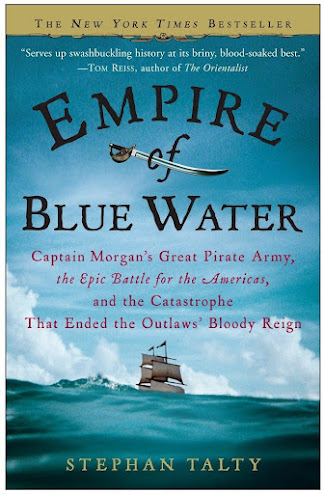
EMPIRE of BLUE WATER: CAPTAIN MORGAN'S GREAT PIRATE ARMY, the EPIC BATTLE for the AMERICAS, and the CATASTROPHE that ENDED the OUTLAWS' BLOODY REIGN (audiobook) by Stephan Talty


Published in 2007 by Random House Audio
Read by John H. Mayer
Duration: 13 hours, 26 minutes.
Unabridged.

Stephan Talty writes a lot about pirates in Empire of Blue Water. Not modern pirates, but the swashbuckling pirates that most Americans imagine when they hear the word "pirate". The modern personification of that word is Johnny Depp's Captain Jack Sparrow. In the late 1600s, the personification of that word was a Welshman named Henry Morgan.

Morgan was technically not a pirate. He was a privateer. If you were in the Spanish government, there was not much of a difference between a privateer and a pirate, except that privateers came with an extra level of annoyance. 

17th century England did not have the money to expand the Royal Navy enough to confront Spain. Spain was more than 200 years into looting the Americas and had a very, very large navy to protect that loot as it came across the Atlantic to the home country. 

England did have something that Spain did not have - a lot of entrepreneurs that owned their own ships. England decided to license any interested ships to attack Spanish ships for their cargoes. The crown got a cut and basically a navy for hire. 

Privateer ships were staffed by a diverse group of men (women were almost never allowed on one of their ships). They were very democratic - everyone got to vote on targets and everyone got an equal share of the booty afterwards. Bonus shares were given to men who performed bravely or completed certain acts in battle. Once a target was chosen, the officers had command and their orders were to be followed - or else. Officers got bonus shares. If you were injured, you were compensated from the loot. If you died, your heirs were compensated. 

Pirate ships worked a lot like privateer ships, except they did not have to report back to any government and share any of their treasure. But, they had no safe havens to return to. If a Spanish ship chased a privateer, it could, theoretically, flee towards any English port and find safety. 

Jamaica served that purpose in the Caribbean, particularly the city of Port Royal. Port Royal was destroyed by an earthquake in the 1690s. It was never rebuilt, but at one point it was the largest and wildest city in any English colony in the New World. You could easily make an argument that it was the wildest port in the entire English empire.

The danger with privateers, of course, is that once unleashed, they are hard to rein in. The English came to an agreement with the Spanish that was dependent on the privateers stopping and then had a very hard time bringing them under control - until someone had the bright idea (not being sarcastic) of bringing Henry Morgan into the government of Jamaica and letting the ultimate privateer bring the privateers under control.

Talty talks about A LOT of things in this book. It is a thorough examination of the entire privateer phenomenon - from the instability of the Spanish royal family to the ossification of the Spanish bureaucracy to the craziness of Port Royal, Talty tells the story well. 


Where he falls short is the description on just about any military campaign. It becomes an unending list of what happened in the order they happened - like a series of bullet points on a boring history professor's PowerPoint. As an audiobook listener, I frequently found my attention wandering at the points that should have been the most interesting parts of the book simply because of the way it was presented. 

Because of that, I am going to give this audiobook a score of 3 stars out of 5. I was irritated at the number of times I had to go over parts of the audiobook because of the way it was told.

This book can be found on Amazon.com here: EMPIRE of BLUE WATER: CAPTAIN MORGAN'S GREAT PIRATE ARMY, the EPIC BATTLE for the AMERICAS, and the CATASTROPHE that ENDED the OUTLAWS' BLOODY REIGN by Stephan Talty.

WILDLAND: THE MAKING of AMERICA'S FURY (audiobook) by Evan Osnos


Published in September of 2021 by Macmillan Audio.

Read by the author, Evan Osnos.
Duration: 17 hours, 7 minutes.
Unabridged.

Evan Osnos is a reporter for The New Yorker. He was inspired to write about the phenomenon of Donald Trump and the 2016 and 2020 elections when he returned from an multi-year assignment in China and noted that politics, journalism and even economics in the United States had changed. He didn't use this analogy, but I will: Parents don't notice their kids changing and growing because they see them every day. But, the aunts and uncles who only see them at the holidays can easily detect the changes.

For Wildland Osnos went to three places that he used to live to investigate: Greenwich, Connecticut; Chicago, Illinois; and Clarksburg, West Virginia. 

In West Virginia, he primarily looks at the changes in journalism such as the loss of local news and small town newspapers. He also looks at government pulling back environmental regulations and business avoiding responsibilities such as living up to pension obligations and cleaning up their messes. The shenanigans from Peabody Energy to avoid pension obligations were especially egregious.

In Connecticut he follows up on the business theme by looking at Greenwich - a town seemingly full of hedge fund managers. Really, it's not, but their wealth and their change of mindset is changing the town. The mindset embraces famed economist Milton Friedman's maxim that the purpose of a corporation is to maximize returns for its shareholders. I grew up in a town with one very large corporation with multiple factories. It provided scholarships, paid for public art and architecture and provided benevolent leadership through boards, committees and generally being engaged with the community that its leadership lived in and provided its labor force. 

In Chicago, he looks at the near-collapse of some communities - the ones that make the news all of the time for the murders. He discusses how the manufacturing base of Chicago left and how that helped lead to the decline of some neighborhoods. which ties into the Greenwich part of the book.

On top of all of this, throw in the Supreme Court case generally known Citizens United. It opened up the flood gates for money in politics. Now millions of dollars could be spent on primary campaigns. In 2020, my state was not really a player in Presidential politics, but we saw almost non-stop ads over 1 race for the House of Representatives. One ad after another from both sides. Those kinds of ad campaigns are the result of the Citizens United decision in 2010.  The Supreme Court held that the First Amendment prohibits the government from restricting independent expenditures for political campaigns by corporations, including non-profit corporations, labor unions, and other associations. With that decision, politics changed.     

Outsiders with a lot of money now had a chance to come in and be effective without having the strong organization and the political contacts of a political party.    

The book takes a long time to develop and I nearly quit several times in the first couple of hours. There was so much talk of hedge fund managers and the new prevailing mercenary quality in big business. Notice that I said "prevailing" - the mercenary quality has always been there but it was restrained by other cultural norms. But, once it moves on to West Virginia and Chicago the book got more interesting to me. I guess it's simply because I don't know ultra-rich hedge fund managers and I don't identify with that lifestyle, but I do know poor black people in a big city and I grew up in a rural area. 

At the halfway point, he starts to tie all of this stuff together and then the book gets good. About 3/4 of the way through the book he starts to tie in the rise of Trumpism. To be honest, I had forgotten that this was the point of the book in the frist place. 
Osnos ties it together. It's not some big nefarious plot, but rather the result of a lot of forces converging - the Citizens United decision, the change in the philosophy of big business, the loss of local news reporting, the loss of good jobs in rural areas and the big cities all come together.

Toss in a great deal of frustration, Osnos makes it seem that the arrival of a person like Donald Trump was inevitable. I contend that it also explains Bernie Sanders. Like Trump, Sanders is truly a political outsider. Sanders isn't even a member of the Democrat party and has not put in a lot of work building the party organization. Still, he almost won their nomination in 2016 and ran very strong in 2020 because this decision lets money make up for not being part of a party and having access to all of the connections and organization that political parties can provide. 

This book doesn't have a lot of answers, but it points out a lot of problems and you have to know what the problems are before solutions can be found.

I rate this audiobook 5 stars out of 5. It can be found on Amazon.com here: WILDLAND: THE MAKING of AMERICA'S FURY by Evan Osnos.

SANITY: IN a TIME of CONSPIRACY, UPHEAVAL, and PANDEMIC by Gary John Bishop


Published in July of 2021 by HarperAudio.

Read by the author, Gary John Bishop.
Duration: 1 hour, 34 minutes.
Unabridged.

Gary John Bishop is a life coach/motivational speaker from Scotland. He calls himself a Personal Development expert. 

His topics in Sanity: In a Time of Conspiracy, Upheaval, and Pandemic include how to deal with the pandemic, conspiracy theories that we may believe in and how to deal with conspiracy theories that loved ones may hold dear. He talks about mask mandates and the wildly varied response to them, especially in the United States. He also talks about how we hate the changes to our lives that were brought on by the pandemic, even if we weren't happy with our pre-pandemic lives because the human mind both craves change and loves stability and those are not compatible goals. 

The author, Gary John Bishop
He gives practical advice. For example, don't argue with advocates of conspiracy theories and welcome them back if they come back to reality because you've had your crazy moments yourself. He also advises people to keep up with the news but to be consumed by it and use it as an entertainment source (translation: don't watch Tucker Carlson or Rachel Maddow - they get paid to make you indignant and they're good at it)

There is nothing new about what Bishop talks about in his talk, but his presentation makes it really effective. It's direct, peppered with curse words and comes off just like you are sitting in a bar listening to your Scottish uncle give you some solid advice.

I rate this audiobook 4 stars out of 5. It can be found on Amazon.com here: SANITY: IN a TIME of CONSPIRACY, UPHEAVAL, and PANDEMIC by Gary John Bishop.

BLUEBEARD by Kurt Vonnegut


Originally published in October of 1987.

The premise of Bluebeard is that it is the autobiography of a has been artist named Rabo Karabekian. Karabekian also appears in an earlier Vonnegut book (Breakfast of Champions).

Karabekian is an abstract expressionist, like the real-life famed artist Jackson Pollock, who is in this novel as a friend of Karabekian. Karabekian's paintings are basically canvases covered with a coat of house paint and then some strips of tape. They were popular for a while.

Karabekian's paintings are really a way for him to deal with his PTSD from World War II. He doesn't want to deal with the details so he basically paints pictures of nothing.
A self portrait of Kurt Vonnegut.

Karabkeian tells about how he got started in the art business, kind of hints around at his World War II experience and intersperses the whole thing with talk about what is going on in his life as he is writing. 

I read the book with Karabekian and his author friend Paul Slazinger as sort of a stand-ins for Vonnegut himself. Both have loads of sarcastic comments and a lot of dark humor. 

This is a bit different for a Vonnegut book. There are a lot of absurd scenes and situations and there are references to the Battle of the Bulge. But, unlike most of his books, there is a relatively happy ending.

I rate this book 5 stars out of 5. It can be found on Amazon.com here: Bluebeard by Kurt Vonnegut. 

OUT of SEASON (Posadas County Mysteries #7) (audiobook) by Steven F. Havill


Published in 2008 by Books In Motion.

Originally published in 1999.
Read by Rusty Nelson.
Duration: 8 hours, 56 minutes.
Unabridged.


In Out of Season things are not going well for Undersheriff Bill Gastner, the second in command of the Posadas County Sheriff Department in southern New Mexico. He is planning to retire in a few months and the person he had hoped he would take over for him is moving out of state. He found out another officer has applied to a much larger department where there are more opportunities. 

Things get even worse, though. A woman that most would consider more than a little mentally off balance calls the department and says that she has seen a struggling small plane disappear behind a mesa near her home. She says that it must have crashed. When a deputy checks it out, he spots wreckage. When they finally get close they find two bodies - and one of them is the Sheriff, a man who notoriously hates to ride in planes.

When Gastner and the department start to dig into what happened, they find more than they ever bargained for...

Rusty Nelson has read most if not all of the audiobooks in this series. I have read or listened to most of them. His folksy tone of voice goes well with Bill Gastner. Since the book is told from Gastner's point of view, that works out well.

Gastner continues to be a lovable grump. His age-related physical limitations encourage him use his head rather than charge blindly into a situation. He continues his insomniac ways while he guzzles coffee and takes any chance to sit down at the Don Juan Restaurant and eat a plateful of spicy burritos.

My only problem with the book is the character of Estelle Reyes-Guzman. She is always perfect. She is pretty, married to a fantastic guy, has a great family, figures out the case before anyone else, drives better than anyone else and is unfailingly polite. Don't get me wrong - I'd love it if she were a cop in my town, but she is a boring character.

I rate this audiobook 4 stars out of 5. It can be found on Amazon.com here: OUT of SEASON (Posadas County Mysteries #7) (audiobook) by Steven F. Havill.
.

A VOYAGE LONG and STRANGE: REDISCOVERING the NEW WORLD (audiobook) by Tony Horwitz


Published in 2008 by Random House Audio.
Read by John H. Mayer.
Duration: 17 hours, 16 minutes.
Unabridged.

In A Voyage Long and Strange Tony Horwitz set out to fill in a big gap in his understanding of American history. He vaguely knew that the Vikings arrived in the New World and did something or other and he knew about Columbus' voyage in 1492 and he knew about the Pilgrims and Plymouth Rock and the First Thanksgiving in 1621, but what happened in between? Also, what about the people that were already here?

Horwitz decided to find out what he didn't know and this book is a combined travelogue and history lesson. He starts with the small failed Viking settlement in Newfoundland, Canada, moves on to the Dominican Republic to learn about Columbus and comes to the United States to look at the first Spanish explorers and settlements in New Mexico and Florida. He also looks at the epic and eventually tragic expeditions of exploration that the Spanish sent out. Finally, he turns toward the early English attempts to explore and build colonies. 

A reconstruction of what a Viking longhouse in
Newfoundland may have looked like.
Typically, Horwitz starts out a section of his book by looking at the geographical area he is visiting as it is nowadays. He finds a variety of different locals to interview and lets them supplement the history he presents. Many times those local experts get very philosophical about how the past has influenced their homes.

Horwitz's roundabout way of discussing the history is almost always interesting - usually extremely interesting. However, the section on the Dominican Republic and a museum he visited there was too long and too repetitive. But, he bounces back from that and does a splendid job from that point forward.

I rate this audiobook 5 stars out of 5. It can be found on Amazon.com here: 

UNOFFENDABLE: HOW JUST ONE CHANGE CAN MAKE ALL of LIFE BETTER (audiobook) by Brant Hansen


Published in August of 2015 by Tantor Audio.
Read by the author, Brant Hansen.
Duration: 4 hours, 21 minutes.
Unabridged.

Brant Hansen came to a realization that righteous anger, an emotion that a lot of my fellow Christians seem to adore should not actually be a tool in the Christian toolbox. It's on display all over social media and at public events like the current spate of contentious school board meetings. For example, recently a former member of 2 Contemporary Christian bands was seen at the forefront of a mob that was menacing people in the parking lot after a school board meeting. He yelling, "You can live freely, but we will find you!" at medical personnel who testified in favor of masks. He became the story and all Christians got a black eye as Taliban-type extremists. 

The author, Brant Hansen
Instead, Hansen is trying his best to take the words of God seriously when he says  to avoid anger. Here are 20 verses that give that counsel. He describes the change in mindset that is required - a move away from selfishness towards others. 

He does not claim to have perfected it or even to have come close to perfecting it, but the change in perspective has made a tremendous difference in his faith walk. He gives examples of others being unoffendable, including people reacting to things he did to offend them. The difference is that Christians are not perceived as the world's judges - a big point since God has made it clear that he is the world's judge.

I rate this audiobook 4 stars out of 5. I liked the points it had to make, but it felt like the book was repetitive in an attempt to make it bigger. 

This book can be found on Amazon.com here:  UNOFFENDABLE:  HOW JUST ONE CHANGE CAN MAKE ALL of LIFE BETTER by Brant Hansen.

10 DAYS (Dee Rommel Mystery #1) by Jule Selbo


Published by Pandamoon Publishing in August of 2021.

Waterfront in Portland, Maine
Synopsis:

Dee Rommel is at a crossroads of her life. She is on leave from the police department of Portland, Maine because she lost half of one of her legs on duty. After months of diligent physical therapy (and less then diligent psychiatric therapy) she is being pushed to decide if she is coming back to work or not.

She has been helping her godfather Gordy, her deceased father's best friend. He is a private detective and she feels very comfortable with the paperwork and the billing. When Gordy takes some time off to donate a kidney in Florida, a situation arises. One of Gordy's lifelong friends urgently needs help now and Dee is asked to step in and do some investigating while Gordy is down and out from the surgery.

The friend is a famous billionaire named Claren - Maine's version of Bill Gates. A local boy who made it big in the tech business. Claren's twenty-something daughter is also a tech whiz and a genius who graduated early from college and runs her own independent division of Claren's company.  She has gone missing.

Dee takes the job but there are other things demanding her attention as well. A local bully has been released from prison and is menacing all of the people who testified against him. Also, Dee continues to look into the case that cost her her leg. Plus, the new guy in the town is surprisingly sophisticated and intriguing considering that he cultivates a biker persona...

My thoughts:

The first book of any series is always tough to gauge because so much world-building has to be done. This book builds a pretty credible world with a lot of potential characters to use in future books. For me, that slowed the book down quite a bit - there were so many characters to process. I am assuming that future books won't go out of there way to include everybody like this one did.

The main mystery with the missing heiress was simply okay for me. I was much more intrigued by the secondary mystery with the local bully.

I rate this book 4 stars out of 5. It can be found on Amazon.com here: 10 Days (Dee Rommel Mystery #1) by Jule Selbo.

Note: I received an ARC copy of this book in exchange for a unfiltered review. 


DOOKU: JEDI LOST (audiobook) by Cavan Scott


Performed by multiple readers.
Duration: 6 hours, 21 minutes.
Unabridged
.


Part of the new Disney "canon" books, Dooku: Jedi Lost is a look at the origins of one of the characters of the Star Wars prequels - Count Dooku. It is part of a series of "stand alone" books. For me, Dooku just shows up in the movies with a minimum of explanation - not nearly enough.  We learn a lot more about him in the Star Wars: Clone Wars cartoon show but not enough for me. Dooku is interesting as the original model for Anakin Skywalker - the talented Jedi who often argues with the Jedi Council and eventually falls to the Dark Side.

This book tells little about Dooku's activities during the Clone Wars. Even though it is set in the first half of the Clone Wars cartoon series, that is mostly a frame that is used to lead the reader through a series of flashbacks that tell about Dooku's early life. The use of all of the flashbacks was annoying in my mind, though. I think it would have been better to have just told the story of young Dooku without all of the flashbacks.

The audiobook was performed like an old fashioned radio play with different actors playing each of the characters. That part was well done, but I was irritated that a book called "Jedi Lost" really didn't give much detail about how Dooku became a lost Jedi. 

I rate this audiobook 3 stars out of 5. It can be found on Amazon.com here:  DOOKU: JEDI LOST by Cavan Scott.

NOTHING to LOSE (Jack Reacher #12) (audiobook) by Lee Child


Published by Random House Audio in 2008.

Read by Dick Hill.
Duration: 14 hours, 25 minutes.
Unabridged.


I think that I have worked my way through all of the Jack Reacher novels and short stories over the last 5 years. Nothing to Lose is the last one (I think). I read them all out of order, but fans know that that is okay since they were never written in order in the first place.

Sadly, this was one of the weakest of the entire very large collection. 

Reacher is travelling from Maine to San Diego just to see the country. He notes that Colorado has two towns with interesting names very close to one another: Hope and Despair.

The author, Lee Child.
Hope is a pleasant enough place with a hardware store and a hotel and diner. Reacher decides to hike to nearby despair and is immediately arrested for being a vagrant. Technically, he is a vagrant. He has no job, no fixed address and no plans to acquire either. 

Despair locks him up (after a bit of a fight) and runs him through a kangaroo court, finds him guilty and expels him from the town limits, which is about halfway to the town of Hope. Reacher meets up with the police chief of Hope, discusses the weird behavior of Hope's town government. And...he heads back for more.

He also finds a lot more than ever imagined he would...

This book felt disconnected from reality a lot more than the average Jack Reacher book. I don't mean that as an insult to the series, but let's face it - a giant ex-soldier beating the crap out of groups of big men in the middle of the street in every book is just nor normal behavior. 

Anyway, the whole book seemed sort of half-baked all the way through and Reacher's choice on how to end things seemed completely out of character considering the long-term implications (decades, maybe even centuries) of his choice. 

Dick Hill read the audiobook and he is my all-time favorite audiobook reader. He "gets" Jack Reacher.

Despite Dick Hill's reading, I rate this audiobook 3 stars out of 5. It can be found on Amazon.com here: NOTHING to LOSE by Lee Child.

Featured Post

<b><i>BAN THIS BOOK (audiobook)</i></b> by Alan Gratz

Published in 2017 by Blackstone Audio, Inc. Read by Bahni Turpin. Duration: 5 hours, 17 minutes. Unabridged. My Synopsis Ban This Book is t...

Popular posts over the last 7 days