PEEPS: A NOVEL (Book #1 of Peeps) by Scott Westerfeld


Published in 2005 by RazorBill (Penguin Group)

In the novel Peeps, author Scott Westerfeld has written a very original take on one of the oldest monster stories of all times - the vampire story.

Cal Thompson knows something that almost nobody knows - he knows that vampires are real because he is one. Sort of.

Cal Thompson also knows how vampirism is spread. The bite on the neck made famous in the movies is really just one way to spread. It is commonly spread sexually, much like HIV. The virus compels its host to engage in sexual contact, ensuring the spread of the virus - much like rabies encourages animals to attack and bite other animals in order to spread rabies. Infected people are called "parasite positive" or "peeps".

Cal Thompson was infected as the result of a one night stand sexual encounter on his first day in New York City. However, he is one of the rare carriers of the disease. He has some of the characteristics of a vampire such as being able to see in the dark and increased strength, but he is not a full-blown vampire. He has been trained and recruited to join an ancient secret organization that captures vampires to limit the spread and maybe offer some therapy to help with this infection.

Cal is new to the job and he knows that the vampires in this story are not like movie vampires - capes, weird accents and sleeping in coffins, etc. But, he is finding things that he had never heard during his training and no one back at the home office is taking his concerns seriously...

I loved the twist on the vampire story that this book presented. Just as interesting were the even-numbered chapters presented information about behavior-changing viruses and microscopic parasites (like rabies that I mentioned above) presented in a conversational way that reinforced the underlying premise behind vampirism in this book.

The only reason that this book is not receiving a 5 star rating is the ending. I thought it could have gone a lot of ways, but the way it went was underwhelming. 

Still, this was a good read and fans of vampires would really enjoy it's take.

I rate this book 4 stars out of 5. It can be found on PEEPS: A NOVEL (Book #1 of Peeps) by Scott Westerfeld.

GUNSLINGER: THE DRAGON of YELLOWSTONE (Mythic West Series)(kindle) by Edward Knight


Published in April of 2021 by WordFire Press.

Gunslinger: The Dragon of Yellowstone is part of a series of books set in post-Civil War years, but with a major twist - the giants from Norse mythology crossed through a thin spot between their reality and Earth in an attempt to conquer Earth. 

The fighting began in Andersonville, Georgia. It interrupted the Civil War but everything East of the Mississippi was basically lost. As the army of the giants pushed west, they were finally stopped in an epic battle featuring a number of names that were big names in the normal timeline of the Old West and an uneasy truce is in place, mostly because both sides have exhausted themselves.

This book features a threat to end that uneasy truce that is investigated by a minor character from other books in the series, a teenaged gunslinger named Beth who was trained by none other than Wild Bill Hickock himself. 

I really appreciate the world building that went into this series. This reminds me of the kind of work that Harry Turtledove does (with a little extra oomph) and I liked the combination of Norse myths and American history. 

I also liked the way that characters just didn't simply shake off injuries. When a character got hurt, they had to deal with the injuries for an appropriate amount of time. 

However, I kept feeling like I was reading a story where the best parts were being hidden from me.  I was getting a little tiny story when I really wanted to know about the bigger story. Did Jefferson Davis and Abraham Lincoln decide to join forces? Did Robert E. Lee and Ulysses S. Grant make a mega army? How hard was it for the two sides to put aside their differences, or did they just fight independently and maybe even continue to fight one another?  How badly did those Civil War armies maul the invading giant army? How was the entire East lost? From what I can tell, those stories have not been told in this series, which is too bad.

I rate this book 3 stars out of 5. It can be found on Amazon.com here: GUNSLINGER: THE DRAGON of YELLOWSTONE (Mythic West Series)(kindle) by Edward Knight.

THE GOD WHO SEES: IMMIGRANTS, the BIBLE, and the JOURNEY to BELONG (audiobook) by Karen Gonzalez


Published by Tantor Audio in November of 2020.
Read by Joana Garcia.
Duration: 5 hours, 25 minutes.
Unabridged.


This is the second time in less than a month that I am reviewing and audiobook that covers the topic of immigration written by an Hispanic immigrant. In both cases, I came to the book highly prepared to like it and in both cases I was disappointed.

The author, Karen Gonzalez
I have no problem at all with the points that Gonzalez makes in The God Who Sees. As a Christian, I think many Christians have been on the wrong side of this issue for decades (including me, for a while).

However, this book just doesn't seal the deal. It says a lot of the right things, but it doesn't do the trick.

Issues:

1) There are pieces of sloppy research, or maybe just sloppy writing or editing.

For example, when the author asserts that the concept of borders came around with the end of the Thirty Years War and the series of treaties known as the Peace of Westphalia in 1648. I think she was referring to immigration and borders (which would be stretch), but the way it came out is that there were no defined borders. I found that to be quite ridiculous - all the more ridiculous considering the audiobook I am currently listening to discusses the peace treaty between Ramses II and the King of the Hittites which laid out clearly defined borders and led to peace between the two empires for more than 100 years. Not to mention the Great Wall of China - some of it has been in place for more than 2,700 years. 

Another example is when the author argues that "chain migration" is different than commonly understood (in very short terms, family members of current American residents are given priority when it comes to legal immigration). She uses her own family as an example, but her example is pretty much a version of chain migration.

2) The audiobook reader is Joana Garcia. Her reading was so slow that I had to change the setting on my app and play it at 120% of the normal speed. This is my 602nd audiobook review (no kidding), this is only the 3rd time I have had to adjust the speed.

Garcia reads a lot of Spanish in this audiobook, including a long passage from Psalms. The problem is, in this Spanish teacher's opinion, Garcia is not particularly proficient at Spanish. She sounds like one of my more advanced high school students, not a native speaker. I found a listing for her as an audiobook reader online and they only mention skills in reading English. Why would they hire a reader to read a lot of Spanish who really can't read Spanish?

I rate this audiobook 2 stars out of 5. It can be found on Amazon.com here: THE GOD WHO SEES: IMMIGRANTS, the BIBLE, and the JOURNEY to BELONG by Karen Gonzalez.

A HOBBIT, A WARDROBE and a GREAT WAR: HOW J.R.R. TOLKIEN and C.S. LEWIS REDISCOVERED FAITH, FRIENDSHIP and HEROISM in the CATACLYSM of 1914-1918 (audiobook) by Joseph Laconte


Published in 2015 by Thomas Nelson.
Read by Dave Hoffman.
Duration: 6 hours, 38 minutes.
Unabridged


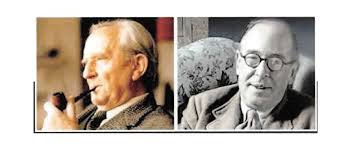
A Hobbit, a Wardrobe and a Great War is a decent introductory history of World War I from the point of view of the common English soldier, a decent (but incomplete) look at the philosophical and religious trends of the West before and after World War I, decent introductory biographies of C.S. Lewis and J.R.R. Tolkien and really kind of a pleasant mess of a book.

Tolkien (1892-1973) and Lewis (1898-1963)
All of these topics are thrown into the mix in a willy nilly. If that concept bugs you, this is not your book. I found it to be a pleasant enough listen, even if not particularly deep. 

I think the author makes his best points about the complete and utter waste and despair of a World War I battlefield when he compares it to the waste and desolation of Tolkien's Middle Earth battlefields and its heroes. The heroes are not generally the big leaders - they are flawed. They refuse to fight, have preconditions, are misinformed or are so full of their own agendas that the war becomes secondary.

Instead, the true heroes are people like Faramir, the younger brother of the "chosen one" hero whose pride and greed almost ruins the venture from the start. Or, it is 2 little hobbits who no one expects anything from. They literally have no power and yet they convince the very trees of the forest to stride out and destroy one of the enemies' strongholds. Of course, Sam Gamgee stands as the greatest hero of them all in my mind. He is the modeled from the stereotypical British World War I common foot soldier who heads off to fight in the war because it is his duty and keeps slogging all the way through to the end because his friends need him and it is simply the right thing to do. No pretense, just heart.

The connections with C.S. Lewis' fiction were a little less strong for me because I am not as familiar with his work. 

I rate this audiobook 4 stars out of 5. It can be found on Amazon.com here: A HOBBIT, A WARDROBE and a GREAT WAR: HOW J.R.R. TOLKIEN and C.S. LEWIS REDISCOVERED FAITH, FRIENDSHIP and HEROISM in the CATACLYSM of 1914-1918 by Joseph Laconte.

HOW ROBERT E. LEE LOST THE CIVIL WAR by Edward H. Bonekemper, III


Published in 1998 by Sergeant Kirkland's Museum and Historical Society, Inc.

Bonekemper lived the dream of most students of the Civil War - once he retired as an attorney, he created a second career as a Civil War author, college lecturer and a frequent guest on C-SPAN to talk about leadership in the Civil War. He also gave 10 lectures at the Smithsonian!

Bonekemper is an unabashed fan of the Union side in the war, especially General Grant. I reviewed a book he wrote about Grant here. As Bonekemper loves to point out, only 4 armies were captured during the Civil War and Grant captured 3 of them Grant's subordinate Sherman captured the fourth after Lee had already surrendered his army to Grant. The only general on the Confederate side that can compare to Grant is, of Course, Robert E. Lee. Lee is generally celebrated as the best general in the war and Bonekemper dedicates How Robert E. Lee Lost the Civil War to proving that wrong. 

Bonekemper ignores the easiest place to go after the iconic image Lee - his betrayal of his oath as an officer of the U.S. Army to go fight for the Confederacy. Literally, no human being is responsible for more deaths of American soldiers than Robert E. Lee. Instead, he goes after Lee's record as a general on the battlefield - the part that is supposed to be unassailable. 

Bonekemper doesn't argue that Lee's tactical skills on the battlefield weren't formidable and sometimes even brilliant. 

Instead, Bonekemper argues that Lee was a failure when it came to national military strategy for the Confederacy. Lee spent most of the war as CSA President Jefferson Davis's main military advisor - oftentimes the only one Davis took seriously. At the end of the war he commanded every soldier in the entire Confederacy.

Yet, he never left the Army of Northern Virginia to see what else was happening. He never demonstrated that he understood the value of any army other than his own except that they might send him extra troops (which they did on a regular basis. The exception was when he loaned out a chunk of his army with Longstreet for a few months to Braxton Bragg in Tennessee and Georgia. Within a few weeks Lee was lobbying to have them returned)

All Lee had to do was not lose. This sounds obvious, but it is much easier than the North's goal. The North had to actually conquer the South - defeat all of its armies, stop it from operating as a government and take away its ability to keep on fighting. Lee's model should have been George Washington in the Revolutionary War. Washington hung around long enough that the British home front got sick of the war and agreed to terms.

Lee's surrender at Appomattox in April of 1865.
But, instead of fighting for time and playing defense, Lee acted like he was trying to conquer the North. Twice he invaded the North (Antietam and Gettysburg) and twice he was defeated and came back to Virginia with nothing to show for it except the worst losses he suffered in the war. After Gettysburg he never was able to gather enough troops to go on the offense in any meaningful way again. 

The Battle of Chanecellorsville is symptomatic of the problem with Lee. Lee was outnumbered by more than 2 to 1 and still won the battle with a combination of speed, daring and confidence. It is an impressive victory by any standard. But it came at a massive cost. The Union had 17,000 casualties out of 130,000 (13%) that were replaced within weeks. Lee had 12,000 casualties out of 60,000 (20%) that were only replaced by pulling troops away from other fronts and causing them to lose. 

If it costs you a greater percentage of your force to win battles and you have the smaller army you cannot win. Almost every battle Lee fought in could be described in that way. 

Bonekemper argues that Lee ground his army to dust, refused to consider the needs of other theaters and kept fighting for months after it had become obvious that he had no hope of winning the war, costing the lives of tens of thousands of soldiers on both sides.

The research is impeccable and the facts become overwhelming as the pages go rolling along. It almost becomes tedious - another battle, another costly win (usually) that bled away irreplaceable men for a win that did little to further the war effort. Meanwhile, Generals Grant, Sherman and Thomas chewed up every army in the West, conquered or cut off every state except for Virginia and North Carolina until Lee finally surrendered.

Ironically, if Lee had stayed with the Union, the rumor was that he would have been offered the command of Union forces. He would have been the general that that army desperately needed - not afraid to attack, not afraid to strike the enemy to win the war and he would have had the extra men and resources that his fighting style required. It might have been a short war.

5 stars out of 5 because it proves a long-needed point.

This book can be found on Amazon.com here: 
HOW ROBERT E. LEE LOST THE CIVIL WAR by Edward H. Bonekemper, III.

MIRACLE on the 17th GREEN by James Patterson and Peter de Jonge


Originally published in 1996 by Little, Brown and Company.

The high school I teach at is in the midst of library book purge. I have no idea why Miracle on the 17th Green was ever in a high school library because it is aimed at adults. I don't mean that it has "adult themes" like a movie might label them (drugs, sex, violence, etc.), I mean that it has adult themes like questioning whether you have made the right choices in life, which comes first - family or career? Is it okay to put your family at risk just to achieve your personal goals, especially when they are a long shot?

I really enjoyed this book despite never having played even one hole of real golf (I have played plenty of putt-putt golf, but that doesn't really apply, does it?). It didn't really matter - the story was compelling and I faked my way through the golf stuff.

James Patterson has a long history of co-writing books. I always figure he's lending his name to up and coming authors in exchange for a little bit of co-writing, a lot of advising and a paycheck. This book was his first co-writing venture and Patterson and de Jonge have co-written 5 books in total.

I rate this book 5 stars out of 5. It can be found on Amazon.com here: 
MIRACLE on the 17th GREEN  by James Patterson and Peter de Jonge.

Note: there are 2 sequels that were added to this book to make a trilogy in 2105 and 2019. I am not going to read them because this book ended at a good place.

SPACE COWBOY by Justin Stanchfield


Published in 2008 by Usborne Publishing, Ltd.

In Space Cowboy, Travis McClure is a teenaged cowboy with a horse named Deuce. He's good at his job and starting to work more and more on his own and he really enjoys being trusted with more responsibility, even if the work is hard and mostly boring. If they make enough money his family can finally return to their own ranch on Earth and make a go of it.

You see, Travis and his family are part of a terraforming operation in a future where human beings are starting to move out into the galaxy. They are on Aletha Three, a planet with a climate and atmosphere similar to Earth's. Terraformers bring a few animals, a few planets and try to jump start a biosphere by spreading grass the old-fashioned way - by having animals eat the seeds and spread them in their manure. Or, as the book more delicately describes it: "On Earth, animals like wild bison and wild horses had once covered the grasslands, their hoofs churning the barren soil like a million tiny plows, spreading seed as they moved. Here, the scattered herds of hardy, more manageable cattle served the same purpose."

The planet was supposed to be confirmed lifeless before they started, but Travis has a feeling that there is something very dangerous out there. It's bigger than the coyotes that were brought along and it sometimes screeches in the canyonlands when Travis is alone moving the cows along.

When he finally sees it, everything will change...

This was an enjoyable YA novel. There is nothing here but a lot of adventure and the promise of a bit of romance, but it was still a fun read. Don't think too hard, just go along for the ride.

I rate this novel 4 stars out of 5. It can be found as a kindle e-book on Amazon.com here: SPACE COWBOY by Justin Stanchfield.

TULAROSA (audiobook) (Kevin Kerney #1) by Michael McGarrity


Published by Recorded Books in 2012.
Read by George Guidall.
Duration: 8 hours, 16 minutes.
Unabridged.

Tularosa features Kevin Kerney, a retired police detective living in New Mexico.

His former partner has come to him with a plea for help. His former partner's son (Kerney's godson) has gone AWOL from White Sands Missle Range in New Mexico. He had been a model soldier up to the time of his disappearance with clear plans to attend art school once he left Army career. 

Here's the difficulty. It wasn't Kerney's choice to retire - he was at the top of his game when he was shot twice in the line of duty in his gut and his knee. This happened because his partner and best friend was out of place -- drinking. 

It has been three years. It took Kerney a long time to physically and mentally rehabilitate and he never forgave his former partner for letting him get hurt.

Kerney is not asked to forgive his former partner, but to put aside his dislike to go and find his godson.

Kerney agrees and finds a whole lot more than he expected...

I really enjoyed veteran audiobook reader George Guidall's reading of the book - he is a classic narrator who set a high standard for all that followed. He has read more tham 1,200 audiobooks and did a good job with this one.

Well, he did as good job as one could with this book. The first half of the book was very good, but somewhere near the halfway point McGarrity started splitting the point of view that the story was told from more and more often (it had primarily been told from Kerney's point of view in the first part of the book) and it takes a lot of the steam out of the story. The mystery is removed from a story and then the book simply becomes a question of HOW the bad guy gets caught by the good guy and not IF the good guys can work out the mystery. It's too bad because McGarrity has one very good surprise twist in the middle that I did not see coming but he doesn't keep up with it.

I rate this audiobook 3 stars out of 5. It can be found on Amazon.com here: TULAROSA by Michael McGarrity.

DIVIDED WE FALL: AMERICA'S SECESSION THREAT and HOW to RESTORE OUR NATION (audiobook) by David French


Published in September of 2020 by Macmillan Audio.

Read by Sean Patrick Hopkins and David French.
Duration; 7 hours, 18 minutes.
Unabridged.

David French is, like me, a Never Trump Republican, which means he is a man without a party right now. French starts Divided We Fall with some observations that rang very true to me. For example, he noted that while he was still a part of the two party system, he didn't really think about the automatic intensely negative reaction both sides have to the other side's proposals. The other side isn't just misinformed, they are evil. They are not just mistaken, they are trying to overthrow America and all of its institutions. They want to murder us in our sleep by taking away our rights. They HATE us.

The author
It doesn't matter which side is the "they" and which side is the "us" - it is the same argument, it is a dangerous pattern and it threatens to tear the country apart as we self-segregate into communities that tend to think alike and sometimes literally don't know someone from the other party. 

The middle part of the book consists of possible scenarios that could cause a secession crisis. They are not meant to be literal predictions. Rather, they are possible futures in which one region becomes so disenchanted that it attempts to secede and what that means for national politics, the national . This section was valuable but it was stretched out way too long.

His answer to the problem (a renewed commitment to federalism and states' rights combined with an ironclad guarantee of the rights of minorities in every state) is probably the only real solution to the problem, but it will not be easy.  

This book is well worth reading, but the section with multiple secession scenarios was simply too long and almost felt like French was padding the book to achieve a pre-specified length. Also, what does it say about our the state of American politics right now when a book published in September of 2020 already felt a little dated because of the election of in November, the refusal to accept the result of the election throughout December and the January 6 attack on the Capitol Building?

I rate this audiobook 4 stars out of 5. It can be found on Amazon.com here: DIVIDED WE FALL: AMERICA'S SECESSION THREAT and HOW to RESTORE OUR NATION by David French.

EVERYWHERE that MARY WENT (audiobook)(Rosato and Associates #1) by Lisa Scottoline


Originally published in 1994.

Audiobook version published in 2016 by HarperAudio.
Read by Teri Schnaubelt.
Duration: 9 hours, 5 minutes.
Unabridged.


Back in the 1990's, I worked at a used book store. A copy of Everywhere That Mary Went came in. I was intrigued so I read it.  After that, whenever a fan of legal thrillers would come in and ask if we had anything new or a little different I'd hand them that book. Soon enough, we were sold out and we kept on selling them whenever they came in. I even talked a group of ladies to use it for their book discussion group and they loved it. I sort of feel like I had a part in promoting Lisa Scottoline when she was starting out.

Eventually, this one book grew into a series of eleven books and I read most of them (maybe all of them - it's been a while). 

While I was scrolling through my possible choices of my next audiobook, I decided to go back and revisit this series. 

Mary DiNunzio is a lawyer from a working class background about to make partner in a fancy Philadelphia law firm. Things seem to be going well for her, except for the strange typewritten letters and the hang up phone calls at home and at the office. Also, there's the car that seems to be following her. Is it her imagination? Is it related to one of her cases? Is it from one of the other lawyers trying to make partner? Is it the creepy judge? Her supervisor?

I liked the audiobook, but I remember absolutely loving this book 25 years ago. It had funny scenes and endearing characters and it had been so long that I really didn't remember the plot at all. 

I rate it 4 stars out of 5. 

This book can be found on Amazon.com here: 
EVERYWHERE that MARY WENT (audiobook)(Rosato and Associates #1) by Lisa Scottoline.

NEWS of the WORLD (audiobook) by Paulette Jiles


Book originally published in 2016.

Audiobook published by Harper Audio.
Read by Grover Gardner.
Duration: 6 hours, 17 minutes.
Unabridged.


News of the World is a pretty simple book - on the surface. Set in 1870 Texas, a 70+ year-old veteran of the War of 1812 and the Mexican War is asked to travel more than 300 miles to deliver a 10-year old girl to her extended family near San Antonio, Texas. When she was 6, she was adopted by the Kiowa after they killed immediate family in a frontier attack. Their journey starts in Wichita Falls (near the Oklahoma-Texas border) and faces a lot of difficulties. 

The author
Jefferson Kyle Kidd goes by the name Captain Kidd because that was his rank in the Mexican War, where he served as a messenger. That is appropriate since his true love is bringing news to others. He worked on newspapers, he owned newspapers, he edited newspapers and now he is out of the newspaper business completely due to post-Civil War Reconstruction rules. 

Kidd can't stay out of the game, though. Since he can't be a publisher or a writer of the news, he becomes a newscaster of sorts. He buys all of the current newspapers, finds articles that would be of interest to local communities and then charges a dime per person for a reading of the news. He avoids local news (Reconstruction era politics were every bit as divisive as our modern politics) and instead prefers to read articles about faraway places and modern discoveries. He prefers to expose his audiences to news of the wider world to local news. 

The girl, Johanna,  has very few memories of life before the Kiowa and a great deal of the book deals with Kidd and Johanna, how they work out a way of communicating and the bond that forms between them. There are various adventures and outrages along the way, but the heart of the book is these two strangers traveling on a very long trip together in a wagon.

And, it is a fantastic book.

Grover Gardner read this audiobook. Gardner is a prolific narrator of audiobooks. He has read well over 1,000 audiobooks and I tend to think of his voice as more of a folksy style and it works perfectly with this book.

I rate this audiobook 5 stars out of 5. Highly recommended.

This book can be found on Amazon.com here:  NEWS of the WORLD (audiobook) by Paulette Jiles.

THE UNDOCUMENTED AMERICANS (audiobook) by Karla Cornejo Villavicencio


Published in 2020 by Random House Audio.
Read by the author, Karla Cornejo Villavicencio.
Duration: 4 hours, 53 minutes.
Unabridged.

Villavicencio is a "Dreamer", also known as a DACA kid. DACA is the program started by President Obama to deal with immigrants who came to the United States illegally as children. Generally speaking, the only country they've ever known is the United States and they had no say in immigrating to the United States. Congress refused to deal with this situation so President Obama created a program through executive orders. This meant that when President Trump came to office he was able to undo a lot of this plan with another executive order. 

Villavicencio's very personal look at the DACA program and the general mess of our immigration policy in The Undocumented Americans was inspired by the election of Donald Trump, but it was not what I was hoping for when I started listening to this audiobook. I was really hoping for policy analysis with a healthy bit of personal stories and interviews tossed in. 

Instead, this book is very much the reverse of the book that I was looking for. It was more of an extended highly personal rant about several immigration-related topics. Many of the (somewhat fictionalized, according to the author) stories she tells have compelling features, but I found the author's style to be too personal, as though the entire screwed-up immigration system was designed just to make her miserable, like most things in life. 
The author

Villavicencio is such a large part of this book that you literally cannot separate the author from the message or the stories she tells. I found her to be so annoying and almost intentionally unhappy that I was forcing myself to read the book, like it was some sort of assigned text. This was especially annoying because I really did agree with her at least 80-90% of the time. 

I rate this audiobook 2 stars out of 5.

It can be found on Amazon.com here: THE UNDOCUMENTED AMERICANS (audiobook) by Karla Cornejo Villavicencio.

HARRY POTTER and the DEATHLY HALLOWS (audiobook) by J.K. Rowling


Originally published in 2007.

Audiobook re-mastered and re-published in 2015 by Pottermore Publishing.
Read by Jim Dale.
Duration 21 hours, 37 minutes.
Unabridged.

Ten months ago I started to listen to the Harry Potter books. I had never read them before and only watched the first movie so I came to the party quite late.


But, with Harry Potter and the Deathly Hallows, I have finished the series.

What did I think?

The series is quite good. There are plenty of great themes and memorable themes throughout. It is well worth the time to read (or listen, like I did).

The last book is an up and down affair. It certainly drags in the middle of the book. This was the part I heard my oldest daughter complaining about years ago when she said it was just three people sitting in the middle of a field talking for way too long. I agree.

But, the book does bring the series to a satisfying conclusion with plenty of surprises (that I will not reveal). 

So, in the interest of not providing any spoilers, I will just say that I rate this book 4 stars out of 5. It can be found on Amazon.com here: HARRY POTTER and the DEATHLY HALLOWS (audiobook) by J.K. Rowling.

Note: this entire book series has been on banned book lists multiple times since it was originally published due to complaints from religious conservatives. Check out this website for more info.

ON FASCISM: 12 LESSONS from AMERICAN HISTORY (audiobook) by Matthew C. MacWilliams


Published in September of 2020 by Macmillan Audio.

Read by Kevin Stillwell.
Duration: 4 hours, 18 minutes.
Unabridged.


MacWilliams is a sociologist who studies authoritarianism. He has done a number of surveys over American attitudes towards the Constitution and the freedoms of their fellow citizens and there are areas of concern that he outlines in On Fascism.

For example, "31% of Americans agree that having a strong leader who does not have to bother with Congress and elections is a good way of governing the United States" and "30% of Americans agree with the statement 'I often find myself fearful of other people of other races.'"

Other stats of concern are:

"44% of Americans agree that increasing racial, religious and ethnic diversity represents a threat to the security of the United States"

When you break down the numbers about "18 percent of Americans are highly disposed to authoritarianism. Another 23 percent or so are attitudinally just one step below them on the authoritarian scale." He goes on to explain that people who are disposed to authoritarianism value "authority, obedience and uniformity over freedom, independence  and diversity" and when they grow fearful or are manipulated by an autocrat they will not defend the freedoms of the minority - the freedoms enshrined in the Constitution. 

MacWilliams argues that this is not a new phenomenon. There are some old surveys he can access but there is also the historical record, which is spotty. He didn't have to look very deep - most of these items are in every school child's American history book. For example, the Alien and Sedition Acts of 1798, the Trail of Tears, The Dred Scott decision, the Japanese Internment camps and the McCarthy hearings. 

Lesson 1: American Enlightened or Authoritarian?
Lesson 2: Fomenting Fear
Lesson 3: All Lies Matter
Lesson 4: Gagging the press, Quashing Dissent
Lesson 5: Taking What is Rightfully Ours
Lesson 6: Using Fear and Violence to Control and Subordinate Others
Lesson 7: The Driving Out
Lesson 8: Fear as a Path to Power
Lesson 9: Galvanizing Group Identity
Lesson 10: Silence of the Law
Lesson 11: Fear Breeds Repression; Repression Breeds Hate; Hate Menaces Stable Government
Lesson 12: The Surveillance Society and the Big Lie


I found this short audiobook to be engaging and thought-provoking. I just kept wondering what MacWilliams would have thought about everything from Election Day up to January 6.

Highly recommended.

I rate this audiobook 5 stars out of 5. It can be found on Amazon.com here: On Fascism: 12 Lessons from American History.

STARMAN JONES (audiobook) by Robert A. Heinlein


Originally published in 1953.

Digital Audiobook version published in 2008 by Blackstone Audio, Inc.
Read by Paul Michael Garcia.
Duration: 8 hours, 29 minutes.
Unabridged.

Legendary science fiction author Robert A. Heinlein (1907-1988) wrote a set of novels for the Scribner's publishing house early in his career as a novelist starting in 1947. Scribner's published 12 of them. One of his most famous works, Starship Troopers, was rejected as a volume in this series, but it was fully intended to be a part of it.  A 14th and final book featuring a female lead character was also rejected.  They all share a theme of space exploration moving roughly from humanity's first steps away from Earth to contact with massive alien empires in far and distant places.
Robert A. Heinlein (1907-1988)

Starman Jones falls right in the middle. It is the seventh novel in the series and humanity can travel to far and distant places and has met alien species, but it is exceedingly tricky. 

Max Jones is a teenager in the Ozarks on a future Earth. Times are tough and people with pull, connections or money are moving off-planet. Max has no pull, maybe has a connection and certainly has no money. When his widowed step-mother marries the neighborhood bully and lets him sell the family farm without warning Max runs away from home to find his own way.

As you can tell by the title, Max eventually makes it to space. The problem is that Heinlein spends a lot of time explaining the bureaucracy of the various space guilds (every profession has its own guild and its own obscure rules) and then goes on to explain in excruciating detail the formal and informal rules of a ship - how the galley works, how discipline is maintained, how to run an illegal still on board, how the crew relates to the passengers, how the crew relates to the officers, how the officers relate to the passengers, how the bridge officers relate to the other officers, how the bridge officers relate to each other and how the captain can help or hinder the ship's morale. It reminded me quite a bit of the extended descriptions of military life in Starship Troopers

If all of the "explaining" were edited out, or at least cut back, this book would probably come in 3 hours shorter and be all the better. 

I rate this audiobook 3 stars out of 5. It can be found on Amazon.com here: Starman Jones by Robert A. Heinlein

HARRY POTTER and the HALF-BLOOD PRINCE (Harry Potter #6) by J.K. Rowling


Originally published in 2009.
Published by Pottermore Publishing in 2015.
Read by Jim Dale.
Duration: 18 hours, 32 minutes.
Unabridged.


The Half-Blood Prince is the book that one of my daughters complained about several years ago when she read it. She said it was too much talking and not enough action. Certainly when compared to the previous two books, there is a lot less action and a whole lot more talking. Rowling changed up the narrative and tells the back story of the villain of the series, Lord Voldemort, by way of an investigation by Dumbledore and Harry.

The pace is certainly slower, but the information was valuable. Perhaps it might have been delivered differently, but I was glad to have it. 

The last two hours of the audiobook were full of nothing but action and consequential moments. 

Jim Dale continued to do a great job with the book, with the exception of the voice of Hermione. 


This is my favorite cover of the entire series. Once you get done with the book you can see that it covers the major points of the story in one picture. Well done.

I rate this audiobook 4 stars out of 5 and I look forward to the last book of the series.

This audiobook can be found on Amazon.com here: HARRY POTTER and the HALF-BLOOD PRINCE (Harry Potter #6) by J.K. Rowling.

Note: this entire book series has been on banned book lists multiple times since it was originally published due to complaints from religious conservatives. Check out this website for more info.

LINCOLN and the FIRST SHOT (Critical Periods of History Series) by Richard N. Current


Originally published in 1963.

27 years ago I took a night class about the Civil War offered by Ball State University in a middle school off campus. It was a great class and Lincoln and the First Shot was the first book that we discussed. The book covers the two month period from the day that Lincoln arrived in D.C. after he was elected President and the day that P.G.T. Beauregard opened fire on Fort Sumter at Charleston, South Carolina.

When the Confederate states seceded they took over all Federal property, including forts and military bases. Two forts were not surrendered - Fort Pickens in Pensacola and Fort Sumter. Fort Sumter was always the most argued over because of the symbolism of being smack in the middle of the main port of the first state to secede. 

Lincoln refused to give up the fort because he refused to give up any of the seceded states. South Carolina demanded the fort because they insisted they were part of a new country and they did not want a foreign power to have a fort blocking a port in their new country.

South Carolina was ready to fire on the fort but did not want to look like they were provoking a fight. A peaceful separation might still be possible. Lincoln was preparing to reinforce the fort if he could - but without provoking a fight. After all, the country might be peacefully reunited. 
Fort Sumter immediately after its surrender
to South Carolina troops in April, 1861.

Neither side wanted to fire the first shot, but both sides could foresee the rush of patriotism that follow if their side were fired upon.

Historian Richard N. Current's description of the situation faced by both the North and the South at the beginning of the crisis was excellent and well done. But, his description of all of the plotting, fake peace proposals and sometimes outright confusion felt like he was stretching out the story to fill the pages of this book - like there was a minimum number of words he had to reach to fulfill his book contract.

So, I rate this book 3 stars out of 5. It can be found here on Amazon.com:  LINCOLN and the FIRST SHOT (Critical Periods of History Series) by Richard N. Current.


SOLDIER BOY by Michael Shaara


Published in 1982 by Pocket Books (a Timescape book)

Back in the 1980's Simon and Schuster had a division called Pocket Books that specialized in paperback books. Pocket Books had an even smaller division called Timescape. Timescape published sci-fi books, including some of the earliest of the Star Trek novels so they were quite a successful line. Soldier Boy is part of that Timescape line.

Michael Shaara (1928-1988)
Michael Shaara won the Pulitzer Prize for his 1974 novel about the Battle of Gettysburg, The Killer Angels. Shaara had knocked out a few novels before then, but none were about the Civil War. Instead, a great deal of his writing was sci-fi. He started out selling stories to magazines in 1951. This book is a collection of 14 of those short stories.

If you read this book, I recommend reading the Author's Afterword first. He wrote commentary on every story and I used those notes as an introduction to each one.  Like all short story collections, they vary in quality. The book is named after the first story in the collection. Shaara really likes the story, but I found it so-so. But, I enjoyed most of them. There were a lot of them with a Twilight Zone gotcha moment at the end. I really enjoyed those.

This collection was an enjoyable read. I rate it 4 stars out of 5. It can be found on Amazon.com here: Soldier Boy by Michael Shaara.

Note: Amazon is selling all of these short stories as individual Kindle stories. Be careful if you buy the one named "Soldier Boy" - it is not this book, it is just the first story. 

THE BITTERROOTS (Cassie Dewell #4) (audiobook) by C.J. Box


Published in 2019 by Macmillan Audio.

Read by Christian Delaine.
Duration: 9 hours, 49 minutes.
Unabridged.


In The Bitterroots, Cassie Dewell has left her career in law enforcement and is now a private investigator in Montana. This is perhaps the first series featuring a private investigator in Montana because there can't be that many private investigators in Montana. Box notes that she is actually doing quite well for herself because there are so few private investigators in Montana.

A lawyer who is also the daughter of a man she owed a favor to contacted her to do some investigating work. The attorney had been hired to defend a man who was accused of raping his niece. His case had been moved away from his home county due to pre-trial publicity and Cassie Dewell soon discovers that his home country. That county, despite being physically large, feels like small because everyone knows everyone else and one family runs everything through a combination of physical and financial intimidation.

The problem is that Dewell's client is a member of this family - the oldest son. He is the black sheep that moved away and made it big and came back home with a plan to sell the family ranch since the family patriarch is close to death. The will states that the oldest will inherit the whole ranch so long as he has never committed an act of moral turpitude - which is why the client says he was set up.

Dewell goes off to investigate expecting to find trouble and she finds even more than she expects...

I listened to The Bitterroots as an audiobook. Christian Delaine did a fantastic job of actually performing the book rather than simply reading it. She made the story better than it would have been if I had simply read it.

I rate this audiobook 4 stars out of 5. It can be found on Amazon.com here: The Bitterroots (Cassie Dewell #4) by C.J. Box.

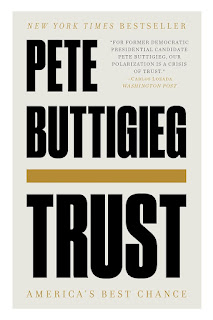
TRUST: AMERICA'S BEST CHANCE (audiobook) by Pete Buttigeig


Pete Buttigeig was, for me, the most interesting Democrat that sought the 2020 nomination. The first I ever heard of was a lengthy interview he gave on NPR when no one on the national level had ever heard of him. I found him to be thoughtful and serious and open to new ideas and discussion. 

This book is a short discussion on how politics (and life in general) depends on a certain level of trust to proceed. There is nothing really new here, but it is a worthwhile discussion and it is good to hear it reiterated in a time when trust is so short. To his credit, Pete Buttigeig doesn't feel the need just to stretch out a book just to pad the number of pages.

At the end of the audiobook is a recording of Mayor Pete's speech where he announces that he is ending his Presidential campaign.

I rate this audiobook 4 stars out of 5. It can be found on Amazon.com here: TRUST: AMERICA'S BEST CHANCE  by Pete Buttigeig.

Featured Post

<b><i>BAN THIS BOOK (audiobook)</i></b> by Alan Gratz

Published in 2017 by Blackstone Audio, Inc. Read by Bahni Turpin. Duration: 5 hours, 17 minutes. Unabridged. My Synopsis Ban This Book is t...

Popular posts over the last 7 days