Blackout (audiobook) by Connie Willis


Be prepared - this is only half the story

Published in 2010.
18 hours, 44 minutes
Read by Katherine Kellgren

Connie Willis continues her on again/off again time travel series with Blackout, a book about time travelling historians from mid 21st century Oxford who are visiting World War II England. Katherine Kellgren does a fantastic job of nailing the great variety of English accents and the one American accent as well as the male voices.

Time travel has become routine for these historians - they have teams to help prepare them for their jumps into the past, including clothing, paperwork and implants to help them with accents. They are also able to learn vast amounts of information by way of sleep learning, which can be helpful for memorizing such things as every location of a V-1 attack or what time all of the air raids happened during the Blitz. But, the routine of time travel belies a deeper problem - that of "slippage".  The trips back and forth are becoming less and less accurate. They used to be able to pinpoint the placement of historians down to the minute but now they can be off by hours, days and even weeks. Some have a theory that, despite assurances to the contrary, this is evidence that the historians are actually changing history bit by incremental bit.

St. Paul's Cathedral, rising above the smoke and flames 
of a firebomb attack on December 29, 1940. The 
adjacent neighborhoods burned but St. Paul's was saved. 
This photo became a symbol of London surviving 
these attacks.


Blackout is both science fiction and historical fiction, if one can do that. All of the main characters are historians from the future, but the great majority of the story is set in World War II England. There are 5 main plotlines. One features an historian working with evacuee children from London in the English countryside. Another features an historian who is sent to interview participants in the Dunkirk evacuation. A third historian is researching the Blitz - the German air raids on London during the Battle of Britain. There are two orphan stories about the V-1 Buzz Bomb attacks and Patton's in 1944 and Patton's Ghost Army in the D-Day invasion.

I called the last two "orphan stories" because they have no seeming connection with the rest of the story (except that one of the historians is in both 1940 and 1944). That is because Blackout is actually the first part of a single book that Willis had planned called All Clear. But the book became so long that it was split into two parts by her publisher. Willis makes it clear on her website that it should be considered one continuous book Blackout-All Clear. Well, that's great, but I have looked at the audiobook over and over again and I can find no reference to another book (All Clear) coming out, the fact that this is the first half of a single book or anything to indicate that Blackout is anything but a stand alone novel. Frankly, it never occurred to me that this 18 hour, 56 minute audiobook would only be the first half of a single novel. This is a pet peeve of mine - publishers not telling readers that the book is the first of a trilogy (or in this case, a duology) or is actually the book in the middle of a series of books. How hard it is to add that little bit of printing to a cover?

Connie Willis
I found the descriptions of World War II England to be wonderful - gritty but not maudlin. They are detailed enough that this history teacher found himself immersed in another world, along with the time travelling historians. The description of the evacuation at Dunkirk was as fine a bit of action writing as I have run across, especially for a book that is mostly about the mundane details of everyday life during a war of terror against the civilian population of England (as if air raids and torpedo bombs dropped on parachutes so as to maximize their damage can be mundane!).

I've already ordered All Clear.  When I've listened to all 23 hours of it I'll let you know...

I rate this book 5 stars out of 5.

This audiobook can be found on Amazon.com here: Blackout.

Reviewed on Feburary 6, 2011.

See my review of All Clear by clicking here.

Void Moon by Michael Connelly


Originally published in 1999.

In Void Moon Connelly takes a break from the Harry Bosch stories and introduces a new character, a professional thief named Cassie Black. Black is sexy, smart and very good at picking locks. Currently, she is on parole in Los Angeles working at a high end car dealership where her specialty is selling cars to up and coming script writers. Black was convicted for being involved in the crime that caused the death of her partner in crime (and in romance) several years earlier in Las Vegas (apparently states can exchange parole cases which is how she ended up in L.A.)


Black's specialty was robbing high rollers in Vegas casinos, usually in their rooms while they slept. She has been contacted to do one last job with a big payoff by an old colleague and, of course, things go wrong. Soon enough, the Vegas underworld is after Black and mayhem and destruction are on her tail.

Michael Connelly
It would be a spoiler to tell you why Black needs the money and even more so to tell you her true intentions for the money. Suffice to say, Black's intentions are not all that honorable (in fact, they are horrible) and I found myself in the rare position of reading a Connelly book and not really rooting for the "good guy". Well, that's because there are bad guys and worse guys in this book. Some may say, well that's the way life is. That may be so, but I find myself not really getting into the story. I can't identify with anyone.

All of the characteristics of a good Connelly story are there - action, intrigue, good character development, interesting bad guys. But, I found myself waying the various cost/benefit analyses wondering which bad guy should win and hoping for a moment in which they could all take themselves out without hurting any innocent bystanders.

You can find this book at Amazon.com here: Void Moon by Michael Connelly.

I rate this book 3 stars out of 5.

Reviewed on February 5, 2011.

Defiant Joy: The Remarkable Life & Impact of G.K. Chesterton by Kevin Belmonte


A great introduction to a terrifically important writer


Published in 2011 by Thomas Nelson.

For most people, including this reviewer, C.S. Lewis was the gateway to G.K. Chesterton. Lewis, of course, is famous for being THE Christian apologist for his generation - a man who did not believe but then, after his conversion, was able to voice the thoughts and beliefs for millions with such landmark books as Mere Christianity. When I found out that it was the writings of G.K. Chesterton that helped to convert Lewis I had to start to looking into Chesterton (fortunately I have a Kindle - they have more than 2 dozen Chesterton books and essays for free, so I was able to get my feet wet in the ocean of writing that Chesterton produced without any worries).

That being said, I am a relative newbie to Chesterton so this biography was a welcome addition to my on again off again studies of the man.

Rather than give a blow by blow book report of this biography, I'll outline its general strengths and weaknesses.

Strengths:

-Good coverage of Chesterton's early life, including his early education. Like so many geniuses, he was indifferent to his studies and gave little indication that he would be celebrated throughout the English-speaking world for his written works.

-The book is fantastic at covering his intellectual life. All of his most important works are covered - the biggest ones with individual chapters. His relationships with other authors are discussed throughout the book. We learn about his prolific books, his play, his novels, his literary criticisms and his essays. Sadly, almost nothing is mentioned about his columns and work with newspapers and magazines.

G.K. Chesterton (1874-1936)
-Belmonte makes extensive use of quotes. He often lets Chesterton speak for himself and that is a good thing because Chesterton is extremely well-spoken.

-Chesterton's larger than life personality, good humor and charm are discussed throughout the book. Belmonte does a good job of using quotations from other sources, such as fellow authors or newspaper interviews to tell us about him.

Weaknesses:

-Belmonte tells us almost nothing about Chesterton's personal life after Chesterton's becomes a successful author. The focus shifts to his writing and its impact and only rarely shifts back. I can only think of four times: when he became gravely ill, when his brother died in World War I, his trip to the United States and his death. I would have appreciated more about Chesterton the man in this biography.

To sum up, Belmonte's biography of Chesterton gave this beginning Chesterton scholar a better foundation to build upon. Solidly done.

Due to some crazy federal regulation, I am required to inform all readers that I received this biography free of charge from Thomas Nelson's BookSneeze program. However, the thoughts and opinions expressed above are my actual thoughts and opinions because I tell it to you straight.

I rate this biography 4 stars out of 5.

This book can be found on Amazon.com here: Defiant Joy: The Remarkable Life & Impact of G.K. Chesterton by Kevin Belmonte.

Reviewed on February 4, 2011.

Pest Control by Bill Fitzhugh


Entertaining, but not his best work.

Originally published in 1996.

Fitzhugh specializes in filling his books with absurd characters in absurd situations. This is my third Fitzhugh book and I have to rank it in second. It is funny, but at times his characterization of New Yorkers as oblivious and callous to the violence that can be inherent in that city is even a bit much for me.

The premise of Pest Control is that a down and out exterminator who has come up with an entirely new way to control pests is confused for a professional hit man - a top level hitman. Soon, other top level hit men are swarming after the exterminator in an effort to eliminate the newest "star" in the hit man world.

The overall premise is funny but the book somehow fails to hit the high level of promise that this reader anticipated. That said, this would be a heck of a good movie if you get the right actors involved.


If you've never read a Fitzhugh novel, I'd recommend Cross Dressing to start with instead.

I rate this book 4 stars out of 5.

This book can be found on Amazon.com here: Pest Control.

Reviewed on April 4, 2005.

Codes of Betrayal (audiobook) by Dorothy Uhnak


What's the point? There's better stuff out there.


Published by DH Audio in 1997
Read by Bruce Weitz

Codes of Betrayal is about betrayal (thus, the title) and family and it ultimately left this listener (I heard it as an audiobook, narrated by Bruce Weitz of 'Hill Street Blues' fame) wondering what the point of the novel was. Nick O'Hara, our protagonist and NYPD detective, is upset when he discovers that his grandfather on his mother's side ordered the killing of his father when he was a boy and was obliquely responsible for the death of his son in a gangland dispute.

So, Nick goes after his grandfather by becoming a spy in the family organization. Along the way, he betrays his own wife and breaks his relationship with his father's brother - his only blood relative he trusts. So, while avenging part of his family he ends up screwing up the rest of his family.

So, when I finished this dark novel I had to wonder, "What was the point?" If you like to watch a man self-destruct - this is your book.
Bruce Weitz


Not my favorite piece of literature.

I rate this book 2 stars out of 5. It can be found on Amazon.com here: Codes of Betrayal by Dorothy Uhnak.

Reviewed April 4, 2005

Charles Kuralt's Summer (audiobook) by Charles Kuralt


For fans of Kuralt, this will be a treat!


Originally published by Audioworks in 1997
Read by the author, Charles Kuralt
Duration: 1 hour, 9 minutes
Abridged

I hadn't thought about Charles Kuralt for years - until I ran into Charles Kuralt's Summer. Kuralt pulls summer-based items from his reports from CBS News and reminds us (this listener anyway) that we've missed his folksy approach on the reporting on everyday life in America since his passing a few years ago.

Kuralt lays it on a bit thick from time to time but he avoids being too schmaltzy as he reports to us about Maypole dances in Minnesota and tubin' down the Apple River in Wisconsin. The best reports are on side two, where he focuses on the Fourth of July. He travels to Gettysburg and Independence Hall, New York City and Brazil and takes us along for an emotional ride.

Although he takes a lot of his audio from his actual television reports, only once or twice did this listener feel that he was missing something by not actually seeing the pictures.
Charles Kuralt (1934-1997)


The link above is for the cassette version of the audiobook but Amazon sells it as a digital download too.

I rate this audiobook 4 stars out of 5.

This audiobook can be found on Amazon.com here: Charles Kuralt's Summer.

Reviewed on March 29, 2005.

Bland Ambition: From Adams to Quayle - the Cranks, Criminals, Tax Cheats and Golfers Who Made it to Vice President by Steve Tally


An irreverent look at the vice presidency

Published in 1992.

In Bland Ambition: From Adams to Quayle - the Cranks, Criminals, Tax Cheats and Golfers Who Made it to Vice President, Steve Tally looks at America's vice presidents and gives us the inside scoop on each of these men's foibles and character flaws. The chapters are short and sweet and hilarious!

Tally introduces us to Vice Presidents who assumed that they were really assistant presidents, vice presidents who never really showed up to work, vice presidents who showed up to work but really shouldn't have bothered and vice presidents who never really grasped the idea that they were supposed to work with their presidents to get things passed through the Congress.

For the research paper writers out there, Tally's work would be inappropriate to use as the main source of your information, but it would make a fantastic book to add that little bit of extra to make your paper more interesting to read!

This was truly an enjoyable read. I borrowed mine from the library but I'm adding it to my wish list because I want to have a copy of my own!

I rate this book 5 stars out of 5.

Reviewed on May 18, 2005

Glory Lane by Alan Dean Foster


Published in 1987.

Glory Lane is a good old-fashioned sci-fi romp that is just made worse by the inclusion of all three human characters.

This is one of those stories where lovable losers get caught up in something really big and really complicated that they didn't even know existed. Typically, as these types of stories go along, the lovable losers do better, they grow, and they rise to the occasion.

These characters do not grow. They remain petty, impudent little pests and I found myself wondering why the other races tolerated the human species if this was all the better examples that they were going to meet!

Seriously, the actual sci-fi was top-notch. There were a multitude of worlds and species that were well-done. But, it was marred by the inclusion of a punk rocker, a geek and a ditzy blond who continued to bicker, and sometimes actually fistfight with one another, no matter the situation. I wish he'd haven given that aspect of the story a rest.

I rate this book 3 stars out of 5. It can be found on Amazon.com here: Glory Lane by Alan Dean Foster.

Reviewed on May 15, 2005.

To America: Personal Reflections of a Historian by Stephen E. Ambrose


Originally published in 2002.

To America: Personal Reflections of a Historian
 wanders and meanders its way through American history and, while this may bother others, personally, I love it. For me, it was as if I were able to sit and listen in on a conversation with a master story-teller.

Ambrose discusses such things as the hypocrisy of Jefferson ('unalienable rights' for all men - how about your own slaves?) and most of the Founding Fathers - but still he does not just topple them for their hypocrisy - he also points out, with wonder, that they accomplished the near-impossible. He also notes the seeds for social change that they all planted, such as universal education (Jefferson). In fact, he directly confronts the 'but he was a slaveholder' mentality - acknowledge the terrible fault - in fact, insist on acknowledging it. But, judge them by the whole of their work.

Stephen E. Ambrose
(1936-2002)
Ambrose covers such flawed men as Andrew Jackson, Theodore Roosevelt in a similar fashion. He also discusses other things that he had a hand in, such as D-Day museum, the Band of Brothers TV shows and the process of writing.

Ambrose also throws in his own personal experiences - both with items of a historical nature (such as his own experiences as a vocal protester of the Vietnam War - some he's proud of and others that he wished he wouldn't have done) and his own experiences with success and tragedy.

Thoroughly enjoyable.

I rate this book 5 stars out of 5. It can be found on Amazon.com here: To America: Personal Reflections of a Historian by Stephen E. Ambrose.

Reviewed on May 14, 2005.

Cold Service by Robert B. Parker


Reading a Spenser novel is better than not reading one but..


Published in 2005.

...this one doesn't make me want to run out and get another one, either.

I've read every Spenser novel and just about everything else Parker has produced and Cold Service just felt tired.

This book started out so well - the action was moving, the lines were crisp. I laughed out loud and I couldn't wait to open the book back up.

Then, the psychobabble began. There was way, way, way too much relationship study between Spenser and Susan about Spenser and Hawk. Enough already! We know that they'd do anything for each other - not out of debt but out of male-bonded love! We got that during the last book and the other 15 or so that have had this exact same conversation (except in shorter form!)!!

Too bad, because Parker's last Jesse Stone novel was the best of the series and his Jackie Robinson book Double Play was very, very good. This one was not up to those high standards
 
I rate this book 3 stars out of 5.

This book can be found on Amazon.com here: Cold Service by Robert B. Parker.
 
Reviewed May 14, 2005.

Chance by Robert B. Parker


Check out the audiobook - it is worth it


Published by Phoenix Books
Read by Burt Reynolds
Duration: 6 hours, 52 minutes
Unabridged

I avoided this audiobook performance of Chance because its read by Burt Reynolds and I figured that if anybody has a chance to ruin a Spenser novel it would be Burt Reynolds. Not that Burt is a bad actor, but he tends to do what he wants to do rather than what he's told to do.

Boy, was I wrong.

Despite his talent for finding bad movies, Reynolds is, underneath it all, a real actor. He finds the voice for the wise-cracking Spenser and hits it dead on. Spenser's observations and one-liners are read perfectly. Not only that, but he covers the voices of all of the mob leaders and his characterization of Shirley Meeker/Ventura gives the reader a great deal of sympathy for how truly pathetic and harmless she was as she got herself caught up in events beyond her control.
Burt Reynolds


Reynold's portrayal of Hawke was different (more southern, but just as tough) because in my mind I always picture Avery Brooks and his precise delivery of lines. But, once I got used to it, it was very good.

Robert B. Parker
(1932-2010)
Now, on to the book. Typical Spenser - wise-cracks, a little violence and a lot of people irritated about him sticking his nose in their business. In this case, Spenser spends a lot of time in Vegas and he isn't very fond of the strip. Susan isn't prominent in this book, but she does her level best to drag down every scene she's in with her incessant discussions about Spenser's character as a man.

Normally, I would give this audiobook 4 stars, but the reading by Reynolds was strong enough that I had to bump it up to 5 stars.

This book can be found on Amazon.com here: Chance by Robert B. Parker.

Reviewed on March 23, 2005.

Darwin's Plantation: Evolution's Racist Roots by Ken Ham and A. Charles Ware


Published in 2007.

Ken Ham is a lightning rod of a figure for outspoken atheists, especially for those who use evolutionary biology as the basis for their beliefs about religion. The internet is full of attacks and counterattacks on this topic. Ken Ham gets a lot of attention from people who have really not read his work. Whether you disagree with a person or not, it makes no difference to me, but at least be somewhat familiar with the person's work before you attack it.

Darwin's Plantation: Evolution's Racist Roots, in particular, has attracted some attention, mostly because of its provocative title. So, let me start this review with a general rundown about Ham's theses.

Ken Ham's point in the book is this (made in this quote by a quite famous evolutionary scientist):

"Biological arguments for racism may have been common before 1859, but they increased by orders of magnitude following the acceptance of evolutionary theory." - Stephen Jay Gould (Ontogeny and Phylogeny - 1977)(p. 15)

That's what Ham is saying.

At no point does he remotely excuse the "Christian" excuses for racism that were common in the 18th and 19th centuries.

At no point does he claim that Darwin invented racism.

Ken Ham
Ham correctly notes that scientists used any number of ways to measure human racial groupings and rank them (head size, brain weight, etc.) in the late 19th and early 20th centuries. Hitler used those biological arguments to justify his genocides against the Jews, gypsies and everyone else he hated.

In my master's in education program that I completed two summers ago I saw similar research done to explain low achievement rates by African-Americans in school. It was not being promoted by the school, but I found it doing research for a paper. Seriously. I think it's junk -  but this garbage is still out there.

Even the co-discoverer of DNA, Dr. James Watson weighs in with a bit of old-fashioned scientific racism: "There is no firm reason to anticipate that the intellectual capacities of peoples geographically separated in their evolution should prove to have evolved identically. Our wanting to reserve equal powers of reason as some universal heritage of humanity will not be enough to make it so." (October 2007) (p. 55) Search it - I typed in his name and got lots of articles about it.

Science-based racism does exist because of this old line: "Figures don't lie but liars figure." Science generates lots of facts and figures and they can be twisted to say just about anything.

Does that mean all scientists are racists? Certainly not! Ham never claims it.

So, why only the three stars?

Ken Ham and his co-author A. Charles Ware wrote the book in turns - each wrote different chapters. I give the part that Ham wrote 4 stars. It was interesting and I found it to be quite well-written - a lively style with numerous quotes.

Dr. A. Charles Ware
The part written by Ware was tedious to me. Ware is the president of Crossroads Bible College in Indianapolis and his focus was on mitigating the effects of racism in society. He wants the church to recognize and acknowledge racist attitudes that were commonly taught from the pulpit in the past and move beyond them with the grace of God in a spirit of forgiveness.

It was an important topic but full of cutesy lines like needing to move beyond " 'race' relations to the unity of grace relations". (p. 136) He also has lots of lists and constructions like D.R.E.A.M.S. to help you remember how to build a multicultural church. I found myself in the odd situation of absolutely of agreeing with an author wholeheartedly but the text was ... rather bland. Great information but delivered in a way that did not work for me. I give Dr. Ware's section 2 stars, which makes an average of 3 stars.

This book can be found on Amazon.com here: Darwin's Plantation: Evolution's Racist Roots.

Reviewed June 20, 2009.

Unbroken: A World War II Story of Survival. Resilience, and Redemption by Laura Hillenbrand


Believe the hype - this is a fantastic book!

Originally published in 2010.

Sometimes books, movies, or restaurants get a lot of hype and buzz but really are not what they are cracked up to be.  Unbroken is everywhere nowadays - bookstores, my local grocery store is selling it. I just saw online that there is a movie deal. 

Is it the real deal?


Laura Hillenbrand
Yes, Unbroken is an amazing biography, and it is most definitely the real deal. I plowed right through 450 pages of text in near-record time, devouring chunks of a story that continued to take new twists and turns and lead me to follow Louis Zamperini from the heights of athletic glory in the 1936 Berlin Olympics to the literal pits of despair in a digging out prison camp latrine with his bare hands in order to earn enough grains of rice to barely fuel his ravaged, starved body.

Louis Zamperini grew up as a juvenile delinquent in Torrance, California - a restless kid who, at the urging of his big brother, finally channeled his impressive running skills into something more acceptable than running away from the law. Louis used those skills to earn a spot on the 1936 U.S. Olympic team. He competed well, but expected to do better at the 1940 and 1944 games, which of course were later cancelled due to World War II.

 
Louis Zamperin looking through a
hole blasted through his B-24
on a mission.
Instead of running in the Olympics, Louis found himself training to be a bombardier on a B-24 and heading off to fight in the Pacific Theater.  On a search and rescue mission in 1943, his plane went down and only Louis and two crewmates survived. After floating at sea for 47 days (and losing a raftmate), Louis and his pilot Russell Phillips were picked up by Japanese soldiers and eventually transferred through a series of POW camps, each new one more horrific than the last until the end of the war, including one horrible guard nicknamed The Bird.

Hillenbrand 's descriptions of the terrible torture of floating at sea, the humiliations he suffered in the POW camps, the incredible kindness showed by a precious few guards are exquisite. Her descriptions of his post-traumatic stress disorder and his difficulties in adjusting to civilian life after the war are painful but it is a joy to see him turn his life around, discard the justifiable and understandable anger and move on to make his life count in the best ways he knows how.

This is a fantastic book. I rate it 5 stars out of 5. It can be found on Amazon.com here: Unbroken: A World War II Story of Survival. Resilience, and Redemption by Laura Hillenbrand.

Reviewed February 1, 2011.

The Darkest Evening of the Year by Dean Koontz


Not very complicated plot, lots of info about rescue dogs

Published in 2007.

I have not read a Koontz book for over five years, but a relative passed The Darkest Evening of the Year off to me in an informal family book exchange and it didn't sit in my to-be-read pile for very long

What did I think?

Having just added a rescue dog to our family the week I started reading this book I had some interest in one of the overarching theme of the book: the tragedy of wasting the lives that fills our world, especially those of our pets.

Koontz hits his other basic themes such as good vs. evil and the good cannot flee evil - they must confront it.

But, was it a good book?

Yes and no.

I read it quickly - Koontz's writing style remains breezy and easy to digest. But, the evil sociopaths were so over the top that I felt that they weren't even interesting. Their prisoner is so saintly that she is equally over the top.


Dean Koontz
The extended lecture on the need for adopting dogs gets old after a bit. Maybe it's a preaching to the choir thing, but I was already converted to this concept before I picked up the book.

The most interesting character by far is a post-modern hitman who names himself after a series of postmodern characters and writers (Billy Pilgrim, Tyrone Slothrop and others).

So, in sum, same old themes, one really interesting character and a lot of info on dog adoptions.

I rate this book 3 stars out of 5. It can be found on Amazon.com here: The Darkest Evening of the Year

Reviewed June 29, 2009.

Joker One: A Marine Platoon's Story of Courage, Leadership and Brotherhood by Donovan Campbell


An enthusiastic 5 stars! A fantastic book.

Published in 2009.

I was offered Joker One as part of the Amazon Vine program and I decided to take it because I am a history teacher and I decided I needed to read a book about the Iraq War just to have a greater sense of what was/is going on and to be able to speak more intelligently about it to my classes.

So, I picked Joker One and I let it sit on my pile of books. I let it sit and sit because I was afraid it would be preachy, depressing and difficult.

Finally, with classes over I picked up Joker One and I was hooked by page 2 with Lt. Campbell's description of an explosion that he had just avoided. It was filled with honest emotions, including a bit of honest, self-deprecating humor.

I shot through Joker One. I carried it everywhere I went. I read passages to my long-suffering wife. I told her shortened versions of the stories. Literally, I laughed (his account of their first night mission and the pack of dogs is hilarious!) and I teared up multiple times, especially at poignant moments like after their first serious day of all out fighting when Campbell is asked, "...do you think we fought well today, sir? I mean, that was our first big fight. Would the Marines who fought at Iwo Jima and Okinawa, you know, be proud of us?" (p. 178)

Donovan Campbell
I guess I identified with Campbell - a married college graduate who is likely to think too much, feel too much and questions himself. Campbell is a Christian and his faith is lightly woven into the text throughout.


Campbell offers no answers to what is going on in Iraq. He barely mentions Bush administration policy, except for his stated dislike of the Coalition Authority government. His concerns are the survival of his men, not winning the war by re-writing policies and strategies.

His descriptions of battles are gritty and can be bewildering - not due to poor writing but rather due to an accurate portrayal of the fighting as he lived it.

The book was mostly created as part of a veteran's writing project class at the Harvard Business School. To me the book has the feel of being crafted - being re-written many times and being thoroughly discussed. I think the writing pulls out the best out of Campbell's story. For example, his story of his battle-hardened Sargeants watching the DVD of The Notebook in the NCO room with tears streaming down their faces is priceless.

The day of reckoning is April 6. "Golf Company knew that something was wrong, because for the first time since our arrival we knew exactly what each mosque was saying during its call to prayer. From every minaret in the city, the same word rang out, over and over, in short, chanted blocks:  JIHAD, JIHAD, JIHAD...JIHAD, JIHAD, JIHAD...JIHAD, JIHAD, JIHAD...Every single muezzin in Ramadi was calling for a holy war against the Marines." (p. 156) Campbell effectively expresses how completely alone this little cluster of Marines were. I got chills up my spine as I read and re-read these pages.

Pages 299-302 are as beautiful a description about the nature of love - sacrificing love - as I have ever read. Those pages are an extended play on the faith, hope and love verse in the Bible (1 Corinthians 13:13) and are brilliantly written - masculine, yet tear-evoking. Good stuff. Makes you proud of those men and grateful that Campbell can bring their story to us.

The best book I read in 2009.

Highly recommended.


I rate this book 5 stars out of 5.

This book can be found on Amazon.com here: Joker One.

Reviewed June 30, 2009.

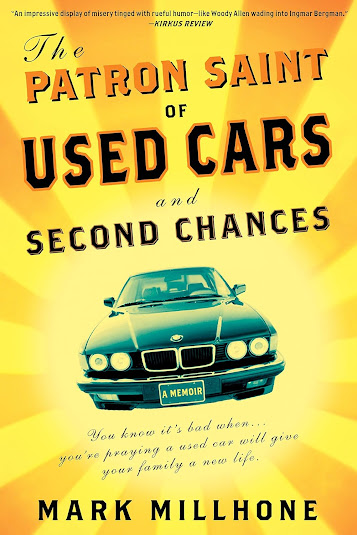
The Patron Saint of Used Cars And Second Chances: A Memoir by Mark Milhone


Fun story, but not completely resolved


Published in 2008 by Rodale Books.

Mark Milhone's memoir is about his self-described "Year from Hell," which included marriage troubles, a reconciliation with his dad and a road trip to pick up a used BMW he purchased on E-Bay (who does that?) is a fun, sad read.

Millhone tells his story about the death of his mother, the death of his first dog, the near-death of his newborn son, the dog bite his oldest son suffers and the deterioration of his marriage.

So, does he resolve these issues?

Not really.

He tells his story in an entertaining manner. His relationship with his father is strengthened (as a kid, his father sent his number one man from the office to take him to see The Empire Strikes Back because he has no time for his family) but the other issues are not fixed, there is just a renewed resolve to work on them.

Nonetheless, it's still a fun read - good for a summer trip. Lots of parts to read and discuss with others in the car.

I rate this book 4 stars out of 5.

This book can be found on Amazon.com here: The Patron Saint of Used Cars and Second Chances.

Reviewed on July 1, 2009

The Complete Idiot's Guide to World Religions (3rd edition) by Brandon Toropov & Luke Buckles


Fits the Bill Perfectly


Published in 2004

Some people have criticized this book for not having enough detail. Well, this book is just intended to be an introduction to a number of the world's great religions: Judaism, Christianity, Islam, Hinduism, Buddhism, Confucianism, Taoism and Shinto.

The descriptions are short (20-40 pages) and full of enough detail to give the reader a useful outline of the religion's teachings. For more detail on a particular religion, I would recommend the 'Complete Idiot's Guide to Islam (or Buddhism, or Judaism, etc.)

I was searching for a textbook to use for my school's new 9 weeks-long program on world religions. This book fits the bill perfectly - there is enough here to get us off to a very good start towards discussing any of these religions.

Less useful are the sections on similar ideas that span all world religions and the section on ancient and (basically) dead religions such as worship of the Ancient Egyptian and Greek gods.

I rate this book 5 stars out of 5.

This book can be found on Amazon.com here: The Complete Idiot's Guide to World Religions.

Reviewed on March 23, 2005

Melancholy Baby by Robert B. Parker


Sunny and Spenser's worlds come ever so closer together...


Published in 2004

Melancholy Baby is probably my 40th plus Parker book. While the Jesse Stone series was much improved by its last offering, I think this was the weakest of the Sunny Randall series.

The mystery part of Melancholy Baby was excellent, but Sunny spends forever in a day seeing Susan Silverman, expert psychologist and also Spenser's girlfriend. The book gets bogged down with too much detail about feelings, Oedipal complexes and the like.

Robert B. Parker
Don't get me wrong, I like Sunny and I'll read the next Sunny Randall book. I'm just hoping that this book was a bridge to Sunny going on to bigger and better things and moving away from this self-pitying/loathing over her strange relationship with her ex-husband.

One has to wonder, will Spenser and Randall bump into one another? Randall knows cops that Spenser knows, she's been to his girlfriend's house... Do I want to see that? yes and no. Sometimes it's best to leave the characters in their two different worlds, but it's also fun to mix and match, as 'Law and Order' likes to do on occasion.

I rate this book 3 stars out of 5.

This book can be found on Amazon.com here: Melancholy Baby.

Reviewed on March 23, 2005.

Voodoo River (Elvis Cole #5) (audiobook) by Robert Crais


My first Elvis Cole novel - not my last


Originally published in 1995.

I heard Voodoo River  as an audiobook way back in 2005 - it was not my first choice but I gave it a shot and I was very pleased. The story was convoluted but had a real feel to it. Elvis is tough, but not Superman. The situation was complicated but not impossible.

I seem destined to be perpetually out of sync with Elvis and the real order of his series. Voodoo River is #5 in the Elvis Cole series. In Voodoo River, Elvis leaves Los Angeles for the Louisiana bayou country in search of the birth parents of a Hollywood starlet who is in need of some medical information. Soon enough, Cole finds himself in trouble with the local crime boss who has a special use for alligators.  If you are familiar with the series (as I now am) this book is pivotal as it is where Cole meets Lucy . For Crais (the author) this is a homecoming of sorts since he was raised in Louisiana.The audiobook was well-read and the reader added a lot to it with his great command of the mix of accents of Louisiana.

So, how much did I like this book? I went out and bought another Elvis Cole novel less than a week after I finished my first!

This book can be found on Amazon.com here: Voodoo River.

I rate this audiobook 4 stars out of 5.

Featured Post

<b><i>BAN THIS BOOK (audiobook)</i></b> by Alan Gratz

Published in 2017 by Blackstone Audio, Inc. Read by Bahni Turpin. Duration: 5 hours, 17 minutes. Unabridged. My Synopsis Ban This Book is t...

Popular posts over the last 7 days