WELCOMING the STRANGER: JUSTICE, COMPASSION, and TRUTH in the IMMIGRATION DEBATE by Matthew Soerens and Jenny Yang


Published in 2018 by IVP.

A few years ago I was determined to learn a lot about immigration in the United States. I bought Welcoming the Stranger during that time, but I put it aside because the other books I had read were, to put it simply, not good. 

So, this book went into the dreaded to-be-read pile, and it might have stayed there forever except for the reelection of President Trump. His actions to fight immigration of just about any sort prompted me to pick up this book and learn a little more about the immigration system.

Even though this book was written in 2018, just 7 years ago, some parts of it felt hopelessly out of date thanks to Trump's relentless push against so many norms, rules, and laws in 2025 when it comes to immigration. 

The basics are there, however, so the book does have value as a primer on immigration. But, the book is more than that - it is a Christian look at this issue because the authors work for World Relief, a Christian organization that works with refugees around the world and helps immigrants seeking asylum in the United States. Their budget was decimated when the DOGE cuts came after USAID funding in January of 2025.

Even though this book was written long before that, its look at what the Bible teaches about how to deal with foreign people living among God's people. The book is actually designed to be used as a small group Bible study - there are discussion questions included in the back.

I rate this book 4 stars out of 5. It can be found on Amazon.com here: Welcoming the Stranger: Justice, Compassion, and Truth in the Immigration Debate.

THE PRICE YOU PAY (Peter Ash #8) (audiobook) by Nick Petrie


Published in 2024 by Penguin Audio.
Read by Stephen Mendel.
Duration: 13 hours, 18 minutes,
Unabridged.


Almost every book of this series follows this model:

1) Peter Ash, a retired Marine, travels the backroads of America in an effort to deal with his PTSD from his service in Iraq and Afghanistan. Peter is more than competent in a fight and he is much smarter than the average wandering do-gooder. Despite these advantages, he eventually runs into a person that needs so much help that even Peter can't take care of it. 

2) At that point he calls his friend and business partner Lewis for backup. Lewis is also a former soldier, but his post-Army life is much more checkered. The details have always been been kept shrouded in mystery, but everyone knows that it was a criminal enterprise. 

3) Lewis shows up with a whole lot of guns and his special talents for mayhem and destruction. Peter and Lewis save the day going forth and kicking butt.

*****

It's a formula, but I like the formula. It's time-honored and has been used in plenty of other series. The main character calls in their mysterious friend to help finish the fight. Robert Parker's Spenser called Hawk for backup. Robert Crais' Elvis Cole calls Joe Pike. C.J. Box's Joe Picket calls Nate Romanowski. Peter Ash calls Lewis. 

This time it's different. This time Lewis comes to Peter Ash and asks for help in the first few minutes of this audiobook.

Peter drops everything and they head off to the frozen woods of northern Wisconsin to meet with a old member of Lewis' crew from back in the bad old days. They soon find out that someone from the bad old days is tracking down Lewis and his old crew and looking for revenge...

*****

The action is top notch, and even though some of the scenes are a bit ridiculous (the computer hacker scene, for example). That being said, I quickly plowed through this audiobook. The action is compelling, the bad guys are truly bad.

Stephen Mendel's reading was excellent. He covered a wide variety of accents like a trooper and his female voices are quite good.

i rate this audiobook a weak 5 stars out of 5 - if it were a letter grade, it would be an A-.

This book can be found on Amazon.com here: The Price You Pay by Nick Petrie.

THE FEARLESS BENJAMIN LAY: THE QUAKER DWARF WHO BECAME the FIRST REVOLUTIONARY ABOLITIONIST (audiobook) by Marcus Rediker


Published in 2017 by Brilliance Audio.
Read by Cornell Womack.
Duration: 7 hours, 2 minutes.
Unabridged.

As the title states, Benjamin Lay (1682-1759) was indeed a Quaker and a dwarf. He grew up in the Quaker faith in England, learned how to spin cloth and sew gloves and then took those skills to see and became a sailor. Eventually, he settled in Barbados and became a merchant. Barbados was a plantation colony and Lay got to know several of the slaves and their owners and the experience turned him into an abolitionist, a concept that was nearly unknown in a world where slavery was commonplace.

Lay moved to Philadelphia and naturally joined the local Quakers. Lay had always been an agitator back in England and was often in trouble with local church officials for questioning what they were teaching. Now, he ramped things up considerably in the hopes of convincing the Quakers that slavery was an evil that should not be tolerated in their midst.

He published an anti-slavery book that was published by Benjamin Franklin - a fact that Franklin kept secret because being anti-slavery was a radical idea. Later, Franklin himself became a public face for anti-slavery but Lay was far ahead of him.

Lay also protested physically and verbally at every Quaker meeting (service) that he attended. He called out the slave owners by name and was often punished for it.

He ended up living in a little hut on the edge of Philadelphia where he refined his beliefs ever further and became a vegan because he did not want to harm any living creature.

This bare bones outline of his life seems radical and interesting, but the presentation in the book was not. This is one of those biographies that seeks to include every detail of its subject's life and in doing so becomes his or her definitive biography. It's a worthy goal, but the first 2-3 hours of this book featured a whole lot of citations of church paperwork about whether or not Benjamin Lay was in good standing or not and what he would have to do to return to good standing. It was tedious. 

The reading by Cornell Womack was subpar. He has a distinctive voice, but he often reads mundane things (like lists) as if they are dramatic moments. It got old, especially when combined with the excessive detail.

I rate this audiobook 3 stars out of 5. It can be found on Amazon.com here: The Fearless Benjamin Lay: The Quaker Dwarf Who Became the First Revolutionary Abolitionist.


SLAUGHTERHOUSE-FIVE: THE GRAPHIC NOVEL by Kurt Vonnegut and Ryan North.


Adapted by Ryan North.
Illustrated by Albert Monteys.

Graphic novel published in 2020 by Archaia. 
Original novel published in 1969.

This is my third review of Slaughterhouse-Five. I've reviewed the audiobook, the written novel, and now the graphic novel. 

All are different, of course. I've given 5 out of 5 stars to every version, but the graphic novel is the weakest of the three. It's a good graphic novel, but it seemed a little thin when compared to the novel. It's good for its medium.

I'm not going to review the plot of one of the most famous anti-war books of the last century - it's too well-known for that. Vonnegut can be weird, but he's always approachable. He writes in an friendly, easy to follow style, no matter if it is the audiobook, the written novel, or this graphic novel.

But, if the very idea of reading this book intimidates you, read the graphic novel. It hits the main plot points and it would certainly support you if you went ahead and read the novel at some points afterwards.

I very much enjoyed the style of the art in this graphic novel. I think Albert Monteys did an exceptionally good job of making the art clear, clean, and easy to follow. Let's face it, the story goes all over the place - the art did not need to add to the confusion. I really liked the way he drew the Tralfamadorians.

I rate this book 5 stars out of 5. It can be found on Amazon.com here: Slaughterhouse-Five: The Graphic Novel.

Note: This book has been challenged multiple times over the last 50 years for sexual content, foul language and teaching principles contrary to the Bible. Amazingly, it has stayed on "banned books" lists for more than 50 years. The graphic novel is no different. It made a banned book list in Florida and in Missouri and other places as well (Texas, Utah, and Iowa - to name a few.)

Note: This book was put on book ban lists in Tennessee in multiple counties in 2025. The article has a searchable database because the list has more than 1,100 unique titles

To its credit, the Vonnegut Museum in Indianapolis has a history of sending free copies of Slaughterhouse-Five to students at schools where the book has been banned.

THE BIG EMPTY (Elvis Cole/Joe Pike #20) (audiobook) by Robert Crais


Published by Brilliance Audio in 2025.
Read by Luke Daniels.
Duration: 8 hours, 25 minutes.
Unabridged.

My synopsis:

Elvis Cole is back on the case in The Big Empty. This time around he is working for a social media personality that specializes in making muffins and making people who watch the videos feel included, like they are talking to the girl next door. 

This social media star wants to hire Cole to figure out why her dad went missing about 10 years before. She hired an quality Private Investigations firm earlier, but the results were inconclusive. Her handlers are not enthused about reopening old wounds, but she overrules them.

Cole heads out to the small town (by L.A. standards) where her father disappeared and finds lots of stuff - including people who are determined to keep the secrets of the past buried in the past...

My review:

This was a complicated mystery with an ending that leaves a lot of moral questions about what is best for just a few people vs. what is best for everyone. Also, there is a heckuva plot twist in this one.

Well done. I rate this audiobook 5 stars out of 5. It can be found on Amazon.com here: The Big Empty by Robert Crais.

BRIAN EPSTEIN: A LIFE from BEGINNING to END (kindle) by Hourly History


Published by Hourly History in 2024.

Brian Epstein was a record store owner from Liverpool that heard the Beatles play in a local club and decided that they were going to be really big and he knew how to make that happen. He asked for a meeting to discuss being their manager and about two months later they had an official deal.

The young Beatles were impressed by Epstein. He dressed well, had polished mannerisms, drove a nice car, and had the most successful record store in Liverpool.  Not much about Epstein's earlier ventures would have indicated that Epstein would have had any success at managing the Beatles. He was a college dropout and had bounced around from one thing to another until his father let him use part of the family store to sell records. He parlayed that into a stand-alone store and became well-known in the Liverpool music scene. 

To be fair, this was a different music scene than what followed from the 1970s. It was very much a bottom up industry - a band could become big in a relatively small market, like Liverpool and, based on local record sales, could explode out into the world. Tommy James and the Shondells (not in this book) did a similar thing out of Pittsburgh, as detailed in his autobiography that I have previously reviewed. 

From left to right: George, Paul, Ringo, Brian and John.
Epstein cleaned up the Beatles and made them in his own image. He put them in suits and made them be very polite and polished (but still fun) young men. They rocketed to the top, and Epstein managed it all - the TV appearances, tours, the hotels, the venues. He did it all with no prior experience and it seemed to take a massive toll on him, leading to drug abuse and his eventual death in 1967 at the age of 32.

This little biography (it takes about an hour to read, as does everything from the publishers at Hourly History) covers a lot of detail. The reader learns about the original Beatles drummer (Pete Best) was pushed out in favor of Ringo Starr, Epstein's semi-closeted homosexuality, the drug abuse, all while presenting Epstein in a humane light. Some of Hourly History's biographies fail to give the reader a sense of the person behind the story. This one succeeded.

I rate this short e-book 5 stars out of 5. It can be found on Amazon.com here: Brian Epstein: A Life from Beginning to End.

VICKSBURG, 1863 by Winston Groom


Originally published by Knopf in 2009.

Winston Groom will always be best known as the author of Forrest Gump, but he should be equally well known as the author of a series of well-told American histories. Included in those histories is a trilogy of Civil War histories that focus on the Western Theater of the war.

Vicksburg 1863 is the second book in the trilogy, but it can be easily read as a stand-alone history. After a short introduction to the war itself, it follows Grant's campaign to take the Mississippi River away from the Confederacy, beginning with a mess of a battle in Missouri that proved nothing of any importance except that Grant was game to fight and push forward, even if the conditions were not perfect.

That, it turns out, was pretty much the key to Grant's eventual success in this campaign and in the war.

From there, we follow Grant through Kentucky, into Tennessee and the terrible Battle of Shiloh. Although ultimately successful, this marked a low point for Grant because he nearly lost his army. His immediate superior came to Shiloh to supervise him and killed most of the momentum of the campaign

Eventually, Grant regained his command (his superior officer was promoted to a desk position in the Eastern Theater) and began his campaign to remove the last major obstacle for Union control of the Mississippi River - Vicksburg, Mississippi.

Vicksburg was a challenge due to its location on an imposing cliff on a massive bend in the Mississippi River. The Confederate military placed cannons on the cliff that threatened any ship that dared to try to pass by. This book details the many efforts he made to bypass Vicksburg, including attempts to build a canal to reroute the Mississippi and an attempt to go through the swamps around Vicksburg. Eventually, he crossed the river south Mississippi and quickly moved his army to cut off Vicksburg, lay siege to it while also engaging and driving away any Confederate troops that could have helped to lift the siege.

Some people will argue with Groom's assertion that Grant did have bouts of drunkenness during the campaign. He describes a rather wild bender featuring Grant cruising through the swampy rivers north of Vicksburg during a lull during the siege, switching boats, and looking for more and more booze. Grant's defenders will deny it all, Grant's detractors will claim it was probably even worse. I go with the simple knowledge that addiction is powerful and Grant often brought along people that kept him accountable. If those people weren't around, I can easily imagine him falling off the wagon. Whether it was a wild run through the swamps or a binge drunk in the corner of a cabin...well, that depends on who told the story back then and who is writing the story now.

I rate this history 5 stars out of 5. It reads as easy as a novel. It can be found on Amazon.com here: Vicksburg, 1863 by Winston Groom.

See my review of Groom's Shiloh, 1862 here. 

JOHN DENVER: A LIFE from BEGINNING to END (kindle) by Hourly History


Published in January of 2025 by Hourly History.

Hourly History specializes in biographies and histories that take about an hour to read. 

In this case, Hourly History has a history of a favorite in my household as I grew up - John Denver.

The book gives a good accounting of his early life, his early struggles as a musician, and his impressive drive that just kept pushing him forward until he made it. Once he made it, there was no one bigger than John Denver - He had a series of number one songs, number one albums, multiple awards, and movies and TV show appearances. But, it all seemed to come at the expense of his personal life.

This little biography covers the timeline of his life pretty well, but skimps on any sort of analysis on his uneasy position as a Country Music artist. For example, he won their official awards, but many mainstay country music artists considered him an interloper - a folk artist who was sort of assigned the title of "country artist."

Still, this was an enjoyable read for longtime fan. I rate this e-book 4 stars out of 5.
This book can be found on Amazon.com here: JOHN DENVER: A LIFE from BEGINNING to END by Hourly History.

BEAT the REAPER (audiobook) by Josh Bazell


Published by Hachette Audio in 2007.
Read by Robert Petkoff.
Duration: 6 hours, 49 minutes.
Unabridged
.

The premise of this book is very strong - what if a mafia hitman goes into witness protection, becomes a doctor in a hospital, and then runs into a former mafia colleague who has come to the hospital for a serious surgery. They recognize each other and deadly hijinks ensue.

Sounds good, but the follow through leaves a lot to be desired. The main character is unlikeable almost all of the time - deeply unlikeable. The more you learn about him, the worse he gets. On top of that, the parade of horrible events that happened to him is simply ridiculous - literally stuff stolen from a Timothy Dalton James Bond movie, except even more over the top.

The audiobook reader is great, but the text of the book - not so much.

I rate this book 1 star out of 5. It can be found on Amazon.com here: Beat the Reaper by Josh Bazell.


HAILE SELASSIE: A LIFE from BEGINNING to END (kindle) by Hourly History


Published in 2021 by Hourly History.

Haile Selassie is one of those men that shows up here and there in a detailed histories of the twentieth century, but I didn't know much about him beyond his determined stand against colonialism before and after World War II.

This small e-book filled in a lot of blanks for me. The Hourly History series consists of biographies and histories that take about an hour to read and, to be honest, this book filled in a lot of those gaps for me - enough that I probably won't look into Haile Selassie any further.

The biography tells the story of Selassie's privileged, very connected upbringing in a monarchial Ethiopia. Selassie used those connections to push his way to the top, but also to tried to modernize his country in order to protect it from European colonization. Imperial Japan did something similar 50 years earlier (not a connection made in the book - just an observation from a history teacher that took a couple of Japanese history classes in college.)

Selassie's life was interesting and often quite tragic. He often was a symbol more than he was substance. He inspired the Jamaican Rastafarian movement, even though he ad nothing to do with it. His pleas to the League of Nations about Italian aggression proved it to be a great idea but an empty promise in the time of actual need. His attempts to modernize Ethiopia made people question the need to have an outmoded style of government led by a man who who wasn't willing to adept to modern times.

I rate this short biography 4 stars our of 5. It can be found on Amazon.com here: Haile Selassie: A Life from Beginning to End by Hourly History.

SEPTEMBER 11 ATTACKS: A HISTORY from BEGINNING to END (kindle) by Hourly History


Published in 2024 by Hourly History.

Hourly History's telling of the events of September 11, 2001 is surprisingly well-told for a history that is supposed to take a person about an hour to read. 

Is this a complete history? Hardly. Why not? Read the first paragraph again.

But, it gets all of the elements across in broad strokes - the motives of the
 hijackers, the reasons for their targets, and the mass casualties - but not as bad as they could have been thanks to the bravery and professionalism of the NYPD and FDNY.

The book moves on to discuss the aftermath, including tearing down the remains of the buildings, the creation of the Department of Homeland Security, beefed up airport screenings, and the invasion of Afghanistan in order to search for the Osama Bin Laden and other terrorists responsible for the attacks. All of it is tied up neatly in a bite-sized e-book that younger readers (not kids, but younger adults that simply don't remember 9/11) could read to grasp the basics.

I rate this e-book 4 stars out of 5. It can be found on Amazon.com here: September 11 Attacks: A History from Beginning to End.

A PAPER ORCHESTRA (audiobook) by Michael Jamin


Published in 2024 by 3 Girls Jumping.
Read by the author, Michael Jamin.
Duration: 9 hours, 39 minutes.
Unabridged.


Michael Jamin is a professional Hollywood screenplay writer. He works in television, working on comedy shows like King of the Hill, Just Shoot Me, and Tacoma FD.

In the afterword he talked about his desire to write something more than TV shows. He wasn't unhappy with writing screenplays, but he wanted to branch out. 

The stories in A Paper Orchestra are from Jamin's life. Some are funny, some wistful, some very sad. As a group, they all have the feel of NPR's Moth Radio Hour - but instead of having a variety of performers, it is all from the same man.

Jamin read the audiobook. In the afterword, he and his wife talked about how they worked together so that he could perform these stories live on stage. She is an actress and she helped him with presentation style - and I think she was successful at it.

I worked my way through this audiobook rather slowly. At the end of almost every story I stopped and let it marinate a bit rather than going on to the next story. For that reason, I rate this audiobook 5 stars out of 5.

A Paper Orchestra can be found on Amazon.com here.

TYRANNY, INC.: HOW PRIVATE POWER CRUSHED AMERICAN LIBERTY - AND WHAT to DO ABOUT IT (audiobook) by Sohrab Ahmari


Published in 2023 by Random House Audio.
Read by the author, Sohrab Ahmari.
Duration: 7 hours, 30 minutes.
Unabridged.

Writing about government overreach is a common theme among conservatives like Sohrab Ahmari. In Tyranny, Inc. he switches gears and writes about overreach from the private sector instead. 

He talks about predatory hedge funds that purchase reasonably healthy companies, load them with debt, and then let them die. He tells the pathetic story of the decline and fall of both Sears and K-Mart, but it's happened over and over again with multiple companies.

He also talks about a number of court cases, legal rulings, new laws, and relatively new interpretations of laws that have slid the balance of societal power to private corporations. He gives tons of examples like expansive Non-Disclosure Agreements, tracking software on employee's private phones because they are forced to use them for work, and hidden clauses in multi-page employment agreements that give employers perpetual rights to use their employees' physical likeness, speaking voices, and singing voices.

He's not so keen on privatization of public services, like fire and ambulance services and tells some horror stories about those as well.

His answer is to empower the employee and the consumer through things like breaking the stranglehold of the NDA system, breaking up monopolies, and bringing back unions as a counterweight to corporate power.

This book is guaranteed to generate thought, even if you disagree with its conclusions. I rate this book 4 stars out of 5. It can be found on Amazon.com here: TYRANNY, INC.: HOW PRIVATE POWER CRUSHED AMERICAN LIBERTY - AND WHAT to DO ABOUT IT by Sohrab Ahmari.


FALKLANDS WAR: A HISTORY from BEGINNING to END by Hourly History


Published in 2020 by Hourly History

Hourly History specializes in one hour reads about a historical topic. Giant events in history don't fare to well in this series, but a war that lasted 2 and 1/2 months is perfect for this format.

This little history tells the history of the Falklands (it keeps switching hands between the U.K., Argentina, and France with occasional periods pf complete abandonment) and continues on to detail the political situations in Argentina and the U.K. leading up to the war.

I was 14 years old during this war and one of my friends was very interested in this war while it was going on so I heard about it a lot. But, it turns out that I was about half right about everything I remembered. Surprise! 14 year old misses a lot of things!

I thought this was an excellent little history. I rate this e-book 5 stars out of 5. It can be found on Amazon.com here: Falklands War: A History from Beginning to End


ELEVEN NUMBERS: A SHORT STORY (kindle) by Lee Child


To be published by Amazon Original Stories in February of 2025.

If you have Amazon Prime, you get to choose from a limited selection of soon-to-be-published e-books every month. I am a big fan of Lee Child's Jack Reacher books, so I jumped at the chance to get this short story by Lee Child.

I believe I have read every book and every short story that Lee Child has written about Jack Reacher, but I don't think I've read anything he's written that didn't feature Reacher. In fact, I didn't know he wrote about any character but Reacher.

This is the story of a mathematician - a college professor. He's kind of a nobody, except that he has a specialty, some would say a gift, in an obscure little corner of mathematics. Not many people have even heard of it, let alone know anything about it. 

Then, one day, he gets a call from the White House...

My review:

This was a quick story. It is well-written and takes several twists and turns that I did not see coming.  It's quite good, just not a Reacher action-fest.

I rate this short story 5 stars out of 5. It can be found on Amazon.com here: Eleven Numbers: A Short Story by Lee Child.

INCA EMPIRE: A HISTORY from BEGINNING to END (kindle) by Hourly History


Published in October 2024 by Hourly History.

Hourly History has published a large catalog of short histories and biographies. The idea is that each book can be read in about an hour. That's not enough to make the reader an expert, but it is enough to make the reader more knowledgeable than most people and it lets the reader know if this is a topic they want to delve into more deeply.

I thought I was pretty well-informed on the topic of the Incas when I started Inca Empire: A History from Beginning to End. I am a Spanish and a history teacher, so I know way more than most people. However, that's not saying much. Let's face it, the average American hasn't heard of the Incas and the ones that have are likely to confuse them with the Aztecs or the Maya.

A short history is not much of a problem when it comes to the Incas. Their Empire existed for only about 95 years before the Spanish Conquistadores arrived in 1532. The Spanish arrived with small numbers (less than 200 soldiers) but superior technology, including horses, a cannon, firearms, and armor. 

A strength of the Incan Empire also led to its downfall. The Inca understood the value of a dependable highway system to move goods, information, and troops. Unfortunately, European diseases spread to the heart of the empire before the Spanish even arrived. The emperor and his designated heir probably died from diseases brought from Europe, kicking off a brutal civil war that meant the empire was ill-equipped to meet a foreign threat, even a tiny one.

Until I read this short history, I was completely unaware that a rump Incan state survived the original conquest and continued on for another 35 years on the Eastern slopes of the Andes and into the Amazon basin.

Map by QQuantum
My review:

This e-book was in serious need of MAPS. It kept of referring to pre-Colombian locations and civilizations I had never heard of and that meant that I had no real idea of the geography of the relative locations. They might as well have been telling me that Group A took over Group B, Group B rebelled and then Group A destroyed Group B city and Group B stopped fighting. 

A MAP would have helped. 5 or 6 MAPS would have been very enlightening. I have included a helpful map that I lifted from Wikipedia. Just seeing the growth of the empire on this map gives the reader a better idea of the extent of the Incan Empire and how quickly it grew. Kindle can easily handle pictures, so not including a map is inexcusable.

The lack of any sort of map is why I rate this e-book 3 stars out of 5. It can be found on Amazon.com here: Inca Empire: A History from Beginning to End.

THE BEST of 2024


This is a "best of" list based on the 89 books I read and reviewed in 2024. I do not focus on new books, so there are books on this "best of" ranging from being published in 1953 to being published in October of 2024.

The titles are active links to my reviews.

*** = Best of the best in that category.


HISTORY/MEMOIR/BIOGRAPHY/NON-FICTION

This is a tough category every year. Every one of these is great, but Tim Alberta's book just stuck with me. His look into the world of Christian Nationalism was an alarm bell in the night for all American Christians.

***The Kingdom, and the Power, and the Glory: American Evangelicals in an Age of Extremism by Tim Alberta.

Attucks! Oscar Robertson and the Basketball Team that Awakened a City by Phillip Hoose. 

Travels with George: In Search of Washington and His Legacy by Nathaniel Philbrick.

Star-Spangled Jesus: Leaving Christian Nationalism and Finding a True Faith by April Ajoy.

The Boys: A Memoir of Hollywood and Family by Ron Howard and Clint Howard.

The Other Side of the Wall: A Palestinian Christian Narrative of Lament and Hope by Munther Isaac. 

Kurt Vonnegut: The Last Interview and Other Conversations edited by Tom McCartan.

FICTION

Clearly, I was doing a deep dive into older authors this year. Among this list of eight novels I have 4 books from the 1950s and 1960s - all classics of their genre.

***Fahrenheit 451 by Ray Bradbury.

The Waiting (Ballard and Bosch book 6) by Michael Connelly.

Cost of Malice by H. Mitchell Caldwell.

The Outsiders by S.E. Hinton.

Slaughterhouse Five by Kurt Vonnegut.

God Bless You, Mr. Rosewater by Kurt Vonnegut.

Ban this Book by Alan Gratz.

Sun Moon Star by Kurt Vonnegut and Ivan Chermayeff


GRAPHIC NOVEL

I chose to read several graphic novels this year. All of these were good for different reasons. I chose the one that most would not - a crossover comic with Batman in the Fortnite universe. This could have been such a cheesy mess, but it was made into an interesting mystery.

***Batman/Fortnite: Zero Point by Christos Gage and others.

Superman Smashes the Klan by Gene Luen Yang and Gurihiru.

March (Series - Books 1, 2, 3) by John Lewis and Andrew Aydin.

Run: Book One by John Lewis and Andrew Aydin.

They Called Us Enemy by George Takei, Justin Eisinger, and Steven Scott.

Illegal by Eoin Colfer and Andrew Donkin.

SHORT STORY

All of these short stories were excellent in their own way. There is a paranormal story, a Western, a what if? war story and a sci-fi story. 

***Tiger Chair by Max Brooks.

Ushers by Joe Hill

Comrades in Arms by Kevin J. Anderson.

The Turkeyfeather Riders by Louis L'Amour

A CANTICLE for LEIBOWITZ (audiobook) by Walter M. Miller, Jr.


Originally published in 1960.
Read by Tom Weiner.
Duration: 10 hours, 55 minutes.
Unabridged.

Winner of the Hugo Award for Best Novel, 1961.

A Canticle for Leibowitz is a Golden Age of sci-fi novel that originally started out as three related short stories that were published in The Magazine of Fantasy & Science Fiction in 1955, 1956, and 1957. The author, Walter M. Miller (1923-1996) was convinced to rework them into a single novel - the only novel he published in his lifetime (a sequel to this book was published after his death.)

Synopsis:

The story is set in a dystopian future. During the late 1950s or early 1960s the Cold War between the United States and the Soviet Union became a nuclear war called the "flame deluge." Human life was nearly destroyed and genetic mutations are fairly common in man and nature. 

Six hundred years later the only surviving constant from the pre-war times is the Catholic Church. The story focuses on an abbey of monks in New Mexico who collect any and all information about science and technology from the past and treat them as relics of Leibowitz, the founder of their order. They collect technical drawings and anything else they can find. Over time, their abbey becomes one of the places of learning that spark a new technological revolution over the centuries because of its isolation.

The second part of the book features the beginnings of technological renaissance. Governments and universities are now recreating technology of the past and even start working together to learn and create even faster.

Eventually, after around 1800 years, in the third part, mankind has gone beyond the technology of the 1960s. There is space travel to other systems, travel around the world is easy. But, the world is not an integrated place and the world faces another Cold War with nuclear weapons...

My Review:

Like so many books in the Golden Age of Science Fiction, A Canticle for Leibowitz goes for big themes in a big way. You have to give it credit for being much more than a sci-fi adventure.

But, big themes does not necessarily mean a good read. The pacing is slow, especially in the first third of the book. I almost stopped listening to the audiobook multiple times because I could not figure out what was going on and the story seemed to be going nowhere.

The book is stuffed full of Latin phrases that may have been familiar to plenty of Catholics (when the book was written, the Latin Mass was the norm) but was not necessarily familiar to this Lutheran. I mostly followed along, allowing for context, the similarity of Lutheran and Catholic liturgies, and my knowledge of Spanish. The Latin added authenticity, but it also was also mostly unnecessary padding. I appreciate that the Latin symbolized a constant moving through time - in the story Latin, along with the Church, survived the Fall of Rome, the Dark Ages, a nuclear war, a horrific dystopian period with genetic mutations, a rebuilding, and was still here in a new Cold War.  My criticism is that a lot of it could have been translated into English with a note that said that the priests or monks were speaking to one another in Latin.

On last criticism is the reader. I am not fond of Tom Weiner as a reader. I've listened to a few books he has read and he just turns me off.

I rate this audiobook 3 stars out of 5. It's not bad. I am glad I read it, but it is hardly a page turner. It can be found on Amazon.com here: A Canticle for Leibowitz.

WHAT DOES ISRAEL FEAR from PALESTINE? (audiobook) by Raja Shehadeh


Published by Tantor Audio in June of 2024.
Read by Khalid Abdalla.
Duration: 2 hours, 26 minutes.
Unabridged.


Raja Shehadeh is a Palestinian lawyer, human right advocate, and author. Shehadeh grew up as a Christian and Palestine has been occupied his entire life. This short book is an extended essay of sorts on the state of Palestinian/Israeli relations. 

The book is often critical of Israeli policy and actions, especially under Benjamin Netanyahu, but it is hardly a justification of the October 7 attacks.

Shehadeh does question the sincerity of Israel's attempts to work out something with Palestine - be it a two state solution, a common government with Israeli and Palestinian representatives, or some other system. Ignoring the situation does not make it go away. There are more than 5 million Palestinian refugees and they are not going anywhere - mostly because they are not really allowed to.

It was an interesting listen, providing a lot to think about. It was read very well by Khalid Abdalla.

I rate this audiobook 4 stars out of 5. It can be found on Amazon.com here: What Does Israel Fear from Palestine?

CHESTER NIMITZ: A LIFE from BEGINNING to END (kindle) by Hourly History


Published in 2024 by Hourly History.

Hourly History publishes short histories biographies and histories that are designed to be read in about an hour. Most are pretty good, but this one came up as a middling biography for me.

Chester Nimitz was the Admiral of the Pacific Fleet during World War II. He was appointed to the position just 10 days after the Japanese bombing of Pearl Harbor and he led the Navy throughout. 

This biography is excellent when it comes to personal details of his early life and even details of his early career. That is great, but this book is too sparse when it comes to the controversies and strategies of World War II. He was there for all of the important decisions and events from 10 days after Pearl Harbor until the signing of Japan's formal surrender on one of his ships and this book just gives the bare facts details that anyone can find on Wikipedia. They aren't incorrect, but they don't tell any sort of compelling story.

I rate this e-book 3 stars out of 5. It can be found on Amazon.com here: Chester Nimitz: A Life from Beginning to End

KURT VONNEGUT: THE LAST INTERVIEW and OTHER CONVERSATIONS (Last Interview Series) edited by Tom McCartan


Published in 2011 by Melville House.

The Last Interview Series is a collection of 42 books that collect interviews with various artists, celebrities, and political figures. The book includes the last interview given by the featured person.

In the case of Vonnegut, his last interview is very short because he was ill at the time so he cut it short.

There are six interviews here. The best is a co-interview with fellow author Joseph Heller (best known for Catch-22) from Playboy (turns out their interviews were a good reason to buy the magazine!) Heller helps Vonnegut focus a bit - he tends to go off on riffs and some interviewers don't know what to do with that (the first one seemed annoyed by this tendency.)

If you like Vonnegut's essays, you will enjoy these interviews. I love his collections of essays so I rate this book 5 stars out of 5. This book can be found on Amazon.com here: Kurt Vonnegut: The Last Interview and Other Conversations.

WILD BILL HICKOK: A LIFE from BEGINNING to END (kindle) by Hourly History


Published by Hourly History in November of 2024.

Hourly History offers free e-books every week. Each of the books take about an hour to read and the smaller topics are really quite good. The series is good for things you want to know more about, but you don't want to read a 400 page book on the topic.

There is probably a large book about Wild Bill Hickock (1839-1876), but I don't want to read it. This length made for a perfectly enjoyable and interesting read.

Hickock started out fighting in the pre-Civil War Bleeding Kansas conflict on the anti-slavery side, worked as a guide, a hunter, a sheriff, and eventually ended up being shut in the back of the head while playing poker in Deadwood in the Dakota Territory by a man who was too afraid to fight Hickock in a duel.

I rate this audiobook 5 stars out of 5. It can be found on Amazon.com here: Wild Bill Hickock: A Life from Beginning to End

YEAR WITHOUT SUMMER: A HISTORY from BEGINNING to END (kindle) by Hourly History


Published in July of 2024 by Hourly History.

In April of 1815, a volcano called Mount Tambora on an island in Indonesia erupted in a massive explosion. It was one of the largest explosions in human history. It obliterated most of the volcano, buried nearby villages and causes tsunamis. There were more eruptions that followed. It was a massive local problem, but the rest of the world had no idea it had even happened.

But, the rest of the world soon was affected by these explosions. Debris from the explosion got into the stratosphere and spread all around the world. There was so much ash in the upper atmosphere that 1816 became known as "The Year Without a Summer." 

This short e-book details some of the results, including snowfalls well into what are popularly regarded as summer months in regions of North America that rarely see snowfall after March. There were crop failures across North America, Europe, and Asia and political instability soon followed, especially in the Old World with its larger, more densely crowded populations. 

The cold conditions were less strong in North America the further one got from the Atlantic Ocean. It served as an inducement to to increase the population shifts towards the Western frontier (Ohio, Indiana, Illinois.)

I enjoyed this short history, even if I think it overplayed the long-term consequences, projecting them out decades afterwards in Europe. 

I rate this e-book 4 stars out of 5. It can be found on Amazon.com here: Year Without Summer: A History from Beginning to End by Hourly History.

WELCOME to PAWNEE: STORIES of FRIENDSHIP, WAFFLES, and PARKS and RECREATION (audiobook) by Jim O'Heir


Published by HarperAudio in November of 2024.

Read by Jim O'Heir, George Newbern, Eva Kaminsky, Janina Edwards, Roger Wayne, Jim Meskimen, and Adam Verner.

Duration: 6 hours, 24 minutes.

Unabridged.

Jim O'Heir has been knocking around Hollywood for years as a journeyman actor. He has had roles in dozens and dozens of TV shows and movies - good stuff and bad stuff - but always regular stuff. He was well on his way to becoming one of those character actors that you see so often that you say, "Oh! There's that guy! He was on that one show."

Then in 2009, he showed up on the new NBC show Parks and Recreation playing the bumbling and often befuddled lovable loser Jerry Gergrich. He kept playing this character for all 123 episodes of the show.

This book is a dual biography of sorts. It is the story of Jim O'Heir and how he came to the show, but it's also the story of the show itself. Jim interviews producers, writers, directors, and other actors to give us the story of Parks and Recreation itself. We learn about how it was conceived, how they cast the main characters, what life was like on the set, and more.

Indianapolis is my adopted hometown so I particularly was interested in the field trip episodes that were filmed in Indianapolis. I do have to point out that O'Heir incorrectly claims that the famed St. Elmo Steak House in downtown Indianapolis is not named after the 1985 Rob Lowe movie St. Elmo's Fire. The restaurant first opened in 1902.

I rate this audiobook 4 stars out of 5. It is a must read for fans of Park and Recreation. It can be found on Amazon.com here: Welcome to Pawnee: Stories of Friendship, Waffles, and Parks and Recreation.

THE HARLEM HELLFIGHTERS (graphic novel) by Max Brooks.


Published by Del Rey in 2014.

Illustrated by Caanan White.

Synopsis:

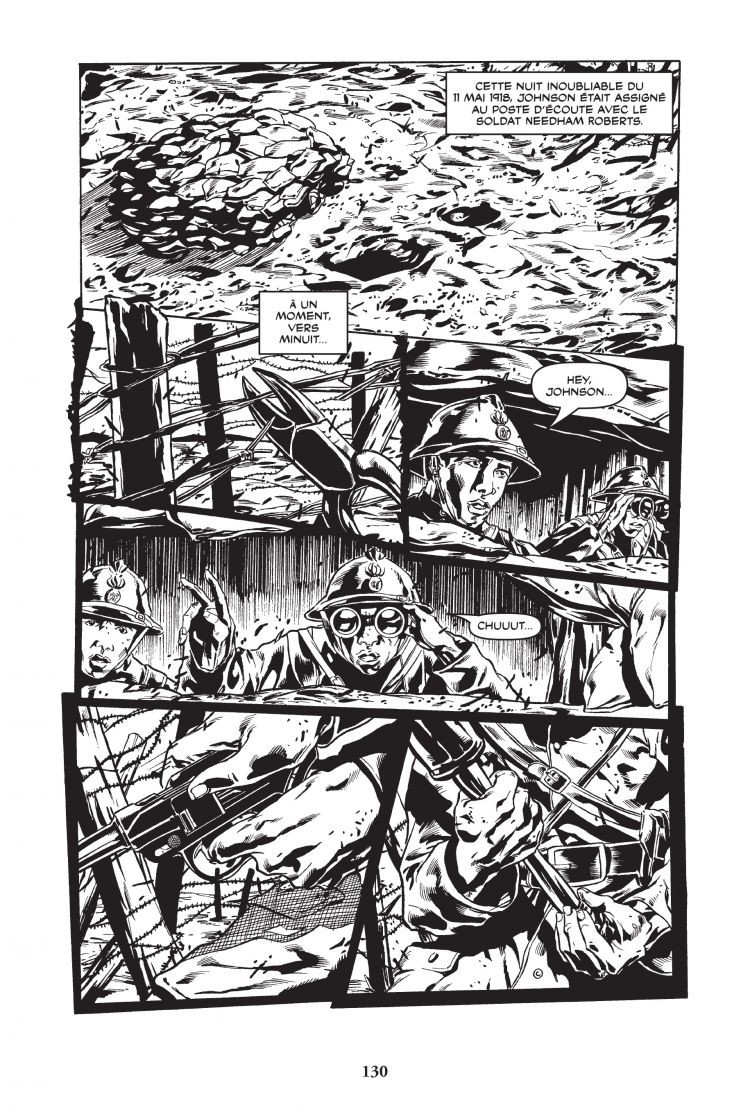
The Harlem Hellfighters is Max Brooks' history of an all African American unit (the 369th Infantry) that fought on the Western Front alongside French units. They mostly came from New York.

This unit was allowed to fight precisely because they were assigned to a mostly French army. The American army would not let African Americans fight and had originally used the 369th as laborers, alongside civilian laborers.

The French were in need of immediate manpower. French white soldiers already had experience fight alongside regiments of soldiers from their African colonies and were eager to bring American troops to the front, no matter their color.

The 369th spent more time than almost any other American unit on the front lines. They may have spent the most time on the front lines. They were the first Allied unit to reach the Rhine River. 

Legend has it that the nickname "The Harlem Hellfighters" was given to the unit by their German foes.

They were among the first units to return to the United States and were given the honor of marching in a tickertape parade in New York City.

My Review:

The story that Max Brooks tells in this graphic novel is a little herky jerky. He tells the story with plenty of emphasis on individual soldiers, the terrible conditions on the front, and the racism they experienced. But, the overall plot of the war is rather poorly told.


The biggest reason that I am giving this book a rating of 3 stars is the illustrations. I truly dislike the art style. I found it distracting and hard to follow. There were details that are included that just filled the page and often made it difficult for me to figure out what I was supposed to be looking at. I bought this graphic novel from an online source without having seen the art. I hated it so much that I didn't read this graphic novel for nearly 7 months. 

Note: The publisher says that this book is aimed at children 8-12 years old. I believe that all of those ages are too young. It has graphic depictions of the violence of trench warfare. There are bullets blasting though heads, spraying bloods and brains across the page. There is a depiction of a bayonet going into someone's mouth and coming out the back of his skull. 

To be clear, I DON'T have a problem with showing the war as it really was. I DO have a problem with showing an eight year old a soldier being vaporized by an artillery shell. I would give this book a PG-13 rating.

This graphic novel can be found on Amazon.com here: The Harlem Hellfighters by Max Brooks.

Featured Post

<b><i>BAN THIS BOOK (audiobook)</i></b> by Alan Gratz

Published in 2017 by Blackstone Audio, Inc. Read by Bahni Turpin. Duration: 5 hours, 17 minutes. Unabridged. My Synopsis Ban This Book is t...

Popular posts over the last 7 days