CAMINO ISLAND: A NOVEL (audiobook) by John Grisham


Published by Random House Audio in 2017.
Read by January LaVoy.

Duration: 8 hours, 45 minutes.
Unabridged.

Princeton University in New Jersey owns the original manuscripts of all five of F. Scott Fitzgerald's novels. Camino Island starts out strong with an elaborate heist of these manuscripts and eventually ends up with an elaborate scheme to find the presumed purchaser of these priceless, purloined compositions in Camino Island, Florida.

This audiobook was a great example of great characters but a really loose story that really doesn't hang together too well. It's almost as if John Grisham had no real concept where the book was going so he started moving one way and then changed his mind and just left his plot hanging while he went a new way - again and again and again.

The result is a lot of interesting characters with a plot that goes all over the place and finally ends up with a pretty boring ending followed up by a nice little turn of the plot at the end. To be honest, I think Grisham wanted to write about a little island he vacationed on and have an excuse to write about sea turtles, authors, book tours, booksellers and the publishing industry.

It's a pleasant enough book, but hardly anything exceptional - especially not for someone who has written books that have struck me hard to the core in the past (A Time to Kill, A Painted House, Gray Mountain).

The audiobook was read by January LaVoy who does a great job with some accents but has a disappearing/re-appearing Southern accent with the main character, an author who grew up in Memphis and Florida and lives in North Carolina when the story starts.

I rate this audiobook 3 stars out of 5 and it can be found on Amazon.com here: Camino Island: A Novel by John Grisham.

PRIVILEGED to KILL (Bill Gastner Mystery #5) (audiobook) by Steven F. Havill


Published by Books in Motion in 2008.
Read by Rusty Nelson.
Duration: 8 hours, 57 minutes.
Unabridged.

Undersheriff Bill Gastner returns in Privileged to Kill, another mystery set in a sleepy New Mexico county on the Mexican border set in the mid-1990's. However, in this story, Posadas County is anything but sleepy.

To be fair, the story starts out sleepy enough with Bill Gastner feeling his age and talking with a a 51 year-old stranded bicyclist with a busted tire that he picks up on the side of the road just for the heck of it and totes him, his bike and all of his equipment into town. Bill and the bicyclist become friendly and the bicyclist heads off to make camp somewhere and then move on the next morning after he gets his tire fixed.

But, things pick up quickly when Gastner gets a phone call in the middle of the night. A freshman girl has been found dead under the bleachers at the high school football field and the bicycle rider was camped nearby and he has been arrested. But, that's not the end of it...

The charm of this series is Bill Gastner's slow pace (he is the oldest character in the book) and the fact that he uses experience and his extensive knowledge of Posadas County to figure things out. But, he also uses his mouth. For a self-professed hermit, he is talks to everyone and listens. This can make the book slow-paced, but that makes sense for a cop looking at retirement. For me, this book series is the literary version of comfort food. I know the characters, the stories move to a slow-but-steady pace and the mysteries are pretty good.
The author, Steven F. Havill


Rusty Nelson read the book and he really does a very solid job with the accents. I think he gets Bill Gastner very well. As normal, there is a bit of Spanish in the book and that is Nelson's weakness. I am not sure why no one call help him with his Spanish, but if you don't know any Spanish it won't bug you either way.

I rate this audiobook 4 stars out of 5 and it can be found on Amazon.com here: PRIVILEGED to KILL (Bill Gastner Mystery #5) by Steven F. Havill.

DETROIT: AN AMERICAN AUTOPSY (audiobook) by Charlie LeDuff


Published by HighBridge in 2013.
Read by Eric Martin.
Duration: 7 hours, 21 minutes.
Unabridged.

Detroit: An American Autopsy is one of the best audiobooks I have listened to in a very long time.

It made me laugh, made me think, made me glad I don't live in Detroit, made me worried that I live in another Rust Belt city that has lost a lot of its industrial base, and, over and over again, it shocked me.

Charlie LeDuff grew up in the Detroit area and moved away to do a lot of different things, including being a reporter for the New York Times (where he won a Pulitzer Prize). He came back home to Detroit to work for a newspaper and to be close to family. When you go away from someplace and come home you see things a little more clearly and he was more than a little surprised Detroit was not only every bit as bad off as most of the country believes - it was actually a lot worse.

I recently read the book Janesville: An American Story by Amy Goldstein.  In a lot of ways, it is similar to Detroit: An American Autopsy in that they both detail the stories of a community wrecked by the collapse of the American automobile industry during the Great Recession. Janesville, Wisconsin is a small city that lost its lifeblood - a General Motors truck factory. Janesville lost one factory - Detroit has been losing factory after factory after factory for 50+ years. When Charlie LeDuff was growing up in Detroit, it was dying - but nobody knew it. When he returned it was painfully obvious that Detroit was gone.

The author, Charlie LeDuff
But that's too simple. Detroit is not dead. It has firefighters fighting to save the town from chuckleheads that set fire to abandoned homes just to watch the show when the fire department shows up. It has police that keep plugging away, even though Detroit is regularly known as the "murder capitol" and its leadership seems focused on looking good rather than being good. It has people just trying to make a living even though almost all of the good factory jobs are long gone.

It has its lost people, its thieves and hustlers. It has people that use religion as a tool to fleece the people. Its schools are literally falling down around its children. It has people that just don't care. But it also has Keiara Bell, a middle schooler who scolded a member of Detroit's City Council for being rude during a council meeting (if only Keiara Bell had known the half of it). Bell, it turns out, graduated from a Detroit public school, went on to Wayne State University (in Detroit) and graduated and wants to go into city management. She is featured in this TV story by Charlie LeDuff.

This is a tough book. There is no happy ending. It's a messy discussion of race, class, crime, politics, money and LeDuff's personal life and it is compelling. I blasted through this audiobook, looking for chances to listen a little more. Eric Martin read the audiobook and he was perfect for it. He never hit a wrong note as he read the book. I hope he won some sort of award, but in keeping with the theme - why would he? After all, it is about Detroit.

I rate this audiobook 5 stars out of 5 and it can be found on Amazon.com here: DETROIT: AN AMERICAN AUTOPSY (audiobook) by Charlie LeDuff.

NIGHT SCHOOL (Jack Reacher #21) (audiobook) by Lee Child


Published by Random House Audio in 2016.

Read by Dick Hill.
Duration: 13 hours, 7 minutes
Unabridged.

Fans of Jack Reacher know that the Lee Child does not write his books in a linear pattern - he bounces around on the Jack Reacher timeline quite a bit. Night School is set in the 1990's when Reacher was still in the military. Reacher has just come off of a secret mission in the Balkans.  He helped find and eliminate war criminals from the fighting that erupted in the wake of the collapse of Yugoslavia. It was the kind of mission that the government was glad to have done, but not glad to acknowledge.

Reacher receives a medal in a private ceremony and then is sent off to an inter-agency training seminar in the suburbs of Washington, D.C. But, it turns out that there are only two other people at this "training" - an FBI agent and a CIA agent that are also fresh off of missions that 
the government was glad to have done, but not glad to acknowledge.

The State Department has gathered them together as a team of go-getters to figure out what is behind a piece of intelligence that they have picked up thanks to an embedded operative - a terror network is offering $100 million for something to a seller in Germany. Reacher and company are being asked to figure out what is for sale and how they can get it before the bad guys do without losing the operative...

This is my fifteenth Jack Reacher book and it was one of the best. It's got some action, but mostly it is a detective story with really big consequences if it is not solved soon.

Dick Hill read this audiobook. He reads most of this series and that is a very, very good thing because Dick Hill has nailed the narration and character voices perfectly.

I rate this audiobook 5 stars out of 5 and it can be found on Amazon.com here: Night School by Lee Child.

STRUGGLE for a CONTINENT: THE WARS of EARLY AMERICA (The American History Series) by John Ferling


Published in 1993 by Harlan Davidson, Inc.

This unique volume looks at the near-constant state of war that existed in one part or another of the English colonies, from the first attempt at colonization in 1585 until the end of the French and Indian War in 1763.

The first quarter of Struggle for a Continent deals with the frequent wars that erupted between the English and the Native Americans that they encountered. Similar patterns emerge as disagreements and misunderstandings become full-fledged brutal and desperate wars of survival in colony after colony, with the exception (at first, at least) of Pennsylvania. 


The rest of the book is devoted to the English struggle against other colonial powers, namely the Spanish and the French. Spain was already a declining power at this point so they posed a minor threat when compared to the ever-growing French Empire. A great part of the book is spent discussing the French threat emanating from Canada towards New England and what is now the states of Michigan, Indiana, Ohio, West Virginia and Western Pennsylvania.

Time and again the colonies are brought into wars that started in Europe. The colonies became a sideshow to the war and many times their hard won gains were given away on the bargaining table in order to make a peace treaty work for Europeans.

Ironically enough, the last of these wars, the French and Indian War, was clearly started by a young colonial soldier named George Washington who stumbled into a group of French soldiers while leading troops in Western Pennsylvania and was forced to surrender them at Fort Necessity. This fight led to the removal of France from Canada and sowed some of the seeds that became the American Revolution.

This is a very informative, concise volume. Well done.

I rate this book 5 stars out of 5 and it can be found on Amazon.com here: STRUGGLE for a CONTINENT: THE WARS of EARLY AMERICA.

THE LAST CHECKOUT (audiobook) by Peter Besson


Published by Peter Besson, Inc. in 2018.
Read by Conner Goff
Duration: 7 hours, 7 minutes.
Unabridged.

In the near future the population of the world has reached the breaking point and climate change has made it all the harder to feed everyone. Throw in a near-continuous state of war and a collapsing economy and you might understand why some people would want to go and kill themselves before someone else gets around to doing it.

So many people were killing themselves that a niche industry formed - suicide hotels designed to deal specifically with the needs of those that want to kill themselves. They are called "Last Resorts" and have any number of conveniences for those that are determined to "check out" of this life, such as handguns, poisons, drugs for overdosing and convenient places to throw oneself off of the roof without harming passersby. The only real rule is that once you check in, you cannot check out alive. You can stay as long as you'd like, so long as you have the funds. Also, if you change your mind, you will be killed by a professional assassin. No one gets out alive.

Ansel Grayson has lived in a Last Resort for 12 years. He and a few other long term residents have watched hundreds of people check in and leave via the morgue in the basement of the hotel. For 12 years, Grayson has tried to work up the courage to finally kill himself and on the day he truly works up the nerve, he gets interrupted by a new female resident who is determined to kill herself as soon as possible. It's love at first sight for Grayson and suddenly he has found a reason to live...


The Last Checkout was an interesting audiobook. I can't say that it was fun to listen to, although it times it was very funny. It was a book full of misery, pain, addiction, greed and despair, but it was also hopeful. I am glad I listened to it, but I never want to listen to it again.

The book could easily be adapted to an Amazon Prime Video or Netflix 10 show mini-series format since it explores not only this brutal vision of the future, but it also explores the reasons why many of the long term residents of the hotel have checked themselves into a "Last Resort."

Conner Goff did an outstanding job as reader. He struck the right tone throughout, which had to be tough considering how many of the characters are trying to kill themselves.

I rate this audiobook 4 stars out of 5 and it can be found on Amazon.com here: The Last Checkout by Peter Besson.

MATTHEW BRADY: PHOTOGRAPHER of the CIVIL WAR (Historical American Biographies series) by Lynda Pflueger


Published in 2001 by Enslow Publishers, Inc.

Matthew Brady is most famous for being THE photographer of the Civil War, but he had quite the career before the war. He was arguably the most famous photographer in the world before the war and the war cemented him in the historical record.

Every American has seen his team's handiwork - one of his photographs of Lincoln was the model for Lincoln's image on the penny. But, if you are a student of the Civil War, you have seen Brady's handiwork over and over again - such as his picture of Lincoln conferring with McClellan in a tent at the Antietam battlefield, his portrait of Lincoln with his son Tad, and his picture of Robert E. Lee taken right after the war.

This biography is intended to be a supplemental reading in a fifth grade or higher classroom. I am a voracious reader of just about anything about the American Civil War (this is my 100th book I am reviewing with a Civil War theme) and I found this slim volume to be quite informative. The pictures that were chosen for the book were excellent. The book features 110 pages of pictures and text followed by a chronology of Brady's life, a set of end notes, a glossary, suggestion for further reading and an index for a grand total of 128 pages.

Matthew Brady (1822-1896)
The maps in the book are accurate, but I don't think I have ever found a more worthless set of maps in a Civil War history. They are focused so close in to the action that the reader cannot see the larger picture. For example, the map showing McClellan's Peninsular Campaign is so tight that you cannot see how the sweep of the Army of the Potomac's movements and how this would have been a stunning attack on Richmond that would have avoided the bulk of the Confederate Army if it had been implemented more quickly. 

I rate this book 4 stars out of 5 and it can be found on Amazon.com here: Matthew Brady: Photographer of the Civil War

CHILDREN of WRATH (audiobook) by T.A. Ward


Published by T.A. Ward Books in May of 2018.
Read by Tom Askin.

Duration: 8 hours, 41 minutes.
Unabridged.

In this science fiction novel, the United States suffered a horrible day of terrorist attacks known as the Day of Destruction in the 2040's. There were nuclear attacks in some places but Philadelphia was attacked by a nerve gas called Obcasus. The gas itself was bad enough, but the side effects are worse. Women who were exposed give birth to children with brain damage that makes them uncontrollably violent - even as infants. They are called inexorables.

The main character of Children of Wrath is Dr. Ethan King, a Philadelphia infectious disease doctor that has treated patients for Obcasus exposure since the Day of Destruction. He is happily married but he and his wife cannot have children.

One day, Dr. King spots a starving, nearly dead Inexorable child as he is leaving the hospital late at night and he decides to take it home...

The premise behind this book was very strong. However, I did not enjoy the presentation very much. There is way too much description in scene after scene. There are also long soliloquies and strange turns of phrase by Dr. King that I can't imagine people actually saying in real life. On top of that, I cannot imagine that no one has figured out the big mystery in this story before now.

I listened to this book as an audiobook. The reader, Tom Askin, has a pleasant voice but reads with a soft tone, like a parent might read a bedtime story to a child. He also makes strange pauses, like William Shatner. It made for an odd listen.

There is a sequel to this book and I will not be listening to it.

I rate this audiobook 2 stars out of 5 and it can be found on Amazon.com here: Children of Wrath by T.A. Ward.

Note: the author provided me with a copy of the audiobook so that I could write an honest review.

EATS with SINNERS: LOVING LIKE JESUS by Arron Chambers


Published in 2017 by NavPress

The title of the book Eats with Sinners: Loving Like Jesus Eats with Sinners: Loving Like Jesus comes from a passage in the fifteenth chapter of the Book of Luke. In the previous chapter, Jesus ate with Pharisees (a Jewish sect that prided themselves on their strict adherence to all of the religious rules of the day) and told them not to be too prideful as they picked their seats for this "dinner party". In Chapter 15, we come across this passage:

Now the tax collectors and sinners were all gathering around to hear Jesus. But the Pharisees and the teachers of th law muttered, "This man welcomes sinners and eats with them."
Then Jesus told them this parable: "Suppose one of you has a hundred sheep and loses one of them. Doesn't he leave the ninety-nine in the open country and go after the lost sheep until he finds it?  And when he finds it, he joyfully puts it on his shoulders and goes home. Then he calls his friends and neighbors together and says, 'Rejoice with me; I have found my lost sheep. I tell you that in the same way there will be more rejoicing in heaven over one sinner who repents than over ninety-nine righteous persons who do not need to repent. (NIV translation)

Jesus makes two points. The most obvious to the modern reader is the story. It is clear that he is saying that you have to reach  out to the lost in order to find the lost. The shepherd does not find the lost sheep by sitting around wondering where it is - he seeks it out. He follows uo with two more stories with the same point, including the famed story of the Prodigal Son. 


But, lost to most modern readers is the complaint: "This man welcomes sinners and eats with them."  Should "good" church people hand out with people that are not "good" church people hang out with people that aren't "good" church people? What was Jesus doing hanging out with the unrighteousness? Why was rabbit eating with them like they were his equals?
Jesus' answer? He told three  stories that make it clear that you have to seek the lost and welcome them when they come back to the fold. That means go out and engage the world where it is. And, those that would be righteous have to remember that they aren't so perfect, either. 

One of the common refrains of the book is that if you want to bring Christ to the people you actually have to go out to the people. Pretty simple, huh? Well, the book goes into more detail than that, but it is still pretty simple. 
Now, how do you do that? Chambers eschews the idea of going out and screaming at people, as some street preachers do (p. 35.) Instead, he looks at the example of Jesus. "Jesus didn't yell at lost people. He ate with lost people." (p. 36) Who listens to people who yell at them without even knowing them? No one. But, you just might listen to someone who sits down with you and gets to know you.

This book is also designed to be used as a Bible study. I think it would be an excellent small group study. It would also be good as a resource to get a an entire congregation to re-think how they approach outreach. 

I rate this book 4 stars out of 5. It can be found on Amazon.com here: Eats with Sinners: Loving Like Jesus. Eats with Sinners: Loving Like Jesus. 

ASIANS and PACIFIC ISLANDERS and the CIVIL WAR by the National Park Service


Published in 2015 by Eastern National


A year and a half ago I visited the Lincoln home at Springfield, Illinois (a great place, by the way) and in the visitors center I found this book. I was intrigued for three reasons: 1) the Park Service books are always beautifully put together, like a National Geographic with lots of color pictures; 2) I knew nothing about any Asian participation in the Civil War - I figured there had to be some because the war was so vast and involved so many people - but I knew nothing about them; 3) This was the physically largest book in the series - even bigger than the books on the Underground Railroad and American Indians in the Civil War - two areas that are well documented.

This book continues in the tradition of being beautiful visually. It is written as a series of articles, each telling a part of the overall story and each article is illustrated with high quality photos. However, the articles are often overlapping, with mentions of some of the same men in multiple articles, sometimes repeating the same information.

I did learn a few things, though. I had never heard of the "Pacific Pig Trade" before this book. It was an attempt to circumvent the official international prohibition on trade in African slaves by bringing in contract labor from China. Many of them went to Cuba. However, many of these laborers did not voluntarily sign these labor contracts and they were bought and sold like the African slaves were. Many were tied up for their trip in the same nets that were used to haul pigs, thus the name Pacific Pig Trade.
There was also a lot of confusion as to how to classify the Asian volunteers that stepped forward. This was a world that categorized everyone by race and nationality, sometimes even measuring people down to 1/64 of African blood in order to properly classify people. Were Asians to be considered people of color, forced to serve in segregated units? Where they white? Did it matter? Turns out, there was no official policy, most likely because there weren't enough Asian volunteers to force the government to make one. So, it depended on the local recruiting officer and the men that the Asian volunteer would serve with.

For me, the most interesting story was that of Chang and Eng Bunker (1811-1874). These brothers were the origin of the term Siamese Twins. After touring the country in an exhibition, they settled in Mount Airy, North Carolina (later it served as the inspiration for Andy Griffith's fictional Mayberry) They married, bought  plantations and had lots of children - two of whom served in the Civil War as Confederate soldiers. Between them, the brothers had 33 slaves and were outspoken supporters of the Confederacy.

The main issue that I have with the book is that it is very repetitive. There were simply is not enough original material to fill a book of this size so the articles tend to overlap, as I already noted above. This book would have been well-served to have an editor put together articles and make the book tighter.

I rate this book 3 stars out of 5. It can be found on Amazon.com here: Asians and Pacific Islanders and the Civil War.

THE TRUTH ABOUT ANIMALS: STONED SLOTHS, LOVELORN HIPPOS, and OTHER TALES from the WILD SIDE of WILDLIFE by Lucy Cooke


Published by Basic Books in 2018.

Zoologist Lucy Cooke explores some of the offbeat bits of the animal world in The Truth About Animals - a book that shows us that most of us think we know a lot about the animal world, but we really don't. None of the animals featured are obscure - they are all well-known, with the possible exception of the eel (at least in the United States). 

The animals featured in the book are: eels, beavers, sloths, hyenas, vultures, bats, frogs, storks, hippos, moose, pandas, penguins and chimpanzees.

Cooke usually begins with a look at the animal in question in historical texts so that we can see that these misunderstandings have been going on for hundreds, if not thousands, of years. For example, bats have been misunderstood and mis-classified since...well, forever. The struggle to figure out how exactly bats travel at night was especially gruesome, featuring scientists blinding live bats, plugging up their noses and coating their bodies with lacquer in an effort to determine exactly how they can fly so well in the dark.

All too often, these animals are associated with an human-introduced invasive species of some sort. Sometimes, they are the victims of that species (frogs) and sometimes they are that species, as in the case of hippos. Did you know that there is a colony of hippos in Colombia? Four of them were introduced by the drug lord Pablo Escobar as a part of a personal zoo but they escaped when his drug empire fell. Now, there are more than 40.
A surprising example of an invasive species -
wild hippos thriving in Colombia
thanks to Pablo Escobar.


Every animal description has a long description of the sex life of the animal. Ironically, this usually comes after a withering commentary about how Victorian or medieval writers were overly concerned about the sex lives of animals. Sometimes it is interesting and has a larger point (as in the story of the eels), other times it is simply presented in a vulgar manner that detracts from the book. 

For example, when Cooke is discussing Hyenas she spends a lot of time talking about the fact that the genitalia of a female hyena look a great deal like those of a male - so much so that they are often confused for males without benefit of a very close inspection (which would be dangerous for most people). This setup makes it difficult for them to mate and makes giving birth a highly dangerous activity. All of that is interesting information. But, calling them "the original chicks with dicks" (p. 73) is unnecessarily crude and that type of thing occurs throughout the book.

I learned a lot with this book. I learned how storks are making a comeback and how they they were the species that taught us about bird migration. In the section on eels, I learned that we are still uncovering mysteries about common animals - even animals that are eaten by the millions. I learned that the female hyena is a mighty animals and she may be the leader of a very large pack with an exceedingly complex social order and a large territory. I learned all about how the sloth is perfectly adapted to his environment and his slow-moving ways are actually an immense advantage. But I was bothered by its too-crude tone when discussing the breeding habits of the animals. For that, I deducted a star. 


I rate this book 4 stars out of 5.

This book can be found on Amazon.com here:  THE TRUTH ABOUT ANIMALS: STONED SLOTHS, LOVELORN HIPPOS, and OTHER TALES from the WILD SIDE of WILDLIFE.


Note: I received a pre-publication copy of this book as a part of the Amazon Vine program in exchange for an honest review.

HOW SHOULD CHRISTIANS VOTE? by Tony Evans


Published by ChristianAudio.com in 2012.
Duration: 2 hours, 19 minutes

Read by Mirron Willis
Unabridged

Even though How Should Christians Vote was published 4 years prior to the 2016 election, it was surprisingly relevant to the Trump era of politics. Tony Evans is a pastor and also a chaplain for an NFL team. This is important, because he uses a football analogy the referee to describe the role of Christians in the election process.

I went into this audiobook ready to be irritated - irritated because so many big name Christian leaders have become very political as of late - forgoing the work of God's kingdom for the work of a politician or a political party, in my mind.

Evans is quite clear that Christians should vote and should fully participate in the process - to not do so would be not using one of the tools we have to impact the culture and the country. BUT, Christians should not become blind followers of a politician or a party because they do not necessarily advocate the kinds of laws and policies that are in line with Christian principals. Too often, people get caught up in the game of Team GOP or Team Dems winning and not if what they are advocating goes along with God's word.


He builds on the theme of teams and games and says that Christians should not be for one party or the other. Rather, they should be like the referees in a game, approving of some plays and calling foul on others - in a non-partisan manner regardless of the team. They should not join a team. Instead, they should point out when the teams break the rules and encourage the teams to conform. Also, each Christian will have certain issues that they are called to be especially on the watch for. For example, for some Christians, social justice issues may be at the top of the list while for others it may be abortion. This means that the body of Christ will not be able to vote as one.

Reader Mirron Willis's strong voice made the audiobook version of this book a pleasant listen.

Warning: Evans is strongly against abortion and gay marriage. If this is a deal breaker for you, I wanted you to know before you invested in the book.

This audiobook can be found on Amazon.com here: How Should Christians Vote

THOSE TURBULENT SONS of FREEDOM: ETHAN ALLEN'S GREEN MOUNTAIN BOYS and the AMERICAN REVOLUTION (audiobook) by Christopher S. Wren


Published by Tantor Audio in May of 2018
Read by Peter Berkrot
Duration: 7 hours, 4 minutes
Unabridged

I pounced on this history because Ethan Allen and the Green Mountain Boys have always been a mysterious presence in my readings on the Revolutionary War. They show up during the early days of the war and add a zest of mystery and frontiersman derring-do that blunts British momentum. And then...they just disappear from the typical history.

Those Turbulent Sons of Freedom follows the timeline history of the American Revolution, going back and forth between a series of the Green Mountain Boys. My fleeting impression of them was that they were some sort of super-patriotic mountain men. The reality, on the surface, seems more nuanced. But, in reality, I think that I was right. They were super-patriotic mountain men, but their loyalties did not lie with the United States - their devotion was to Vermont and only Vermont. 


Vermont was not a colony when the Revolutionary War started. At best, it was the beginnings of a colony, but it was claimed by New Hampshire and New York - especially New York. Before the Revolution, the Green Mountain Boys were already fighting a low-level insurgency against the colonial government of New York in an attempt to make themselves a separate colony.

When the Revolution began, many Vermonters looked at the confusion of the was an opportunity to break away from New York, especially if Vermont could prove itself useful to the 13 colonies as an ally. But, repeated attempts to officially become the 14th state were rebuffed and some of the Green Mountain Boys began to court the British in an attempt to play both sides against each other. The goal was always the same - an "independent" Vermont. There were three options: 1) become the 14th state, 2) become a colony attached to Canada but with its own government, 3) become an independent country (not seriously considered by many, but it was always a thought on the back burner).
Ethan Allen (1738-1789)


Ethan Allen tried all of these options at one point. Some of the Green Mountain Boys dedicated themselves to just one course, and if their course failed, they were forced to move away or suffer other consequences.

There was not as much detail to the book as I would have liked. Sometimes, it seemed like the author was skimming the surface, bouncing back and forth as the narrative moved forward. 


I "read" Those Turbulent Sons of Freedom as an audiobook. The reader, Peter Berkrot, has a beautiful voice for audiobooks, but his presentation was too dramatic. He made every sentence sound like it was the most dramatic moment of the book - even mundane sentences like lists of supplies that were captured in forts and crops sold by Vermont to Canada. There were certainly plenty of dramatic moments in this book, but the overall effect is weakened when so much of the book is presented as a dramatic moment. It made the book tiresome rather than enjoyable.

I rate this book 4 stars out of 5.

This book can be found on Amazon.com here: Those Turbulent Sons of Freedom.

MARTIN LUTHER: IN HIS OWN WORDS (audiobook) by Martin Luther


Published in 2009 by Christian Audio
Published by Christianaudio.com in 2009.
Read by David Cochran Heath
Duration: 2 hours, 26 minutes
Unabridged

This collection of Martin Luther's writings has a great strength in that it lets Martin Luther speak for himself with no other author offering interpretations. However, this is also its weakness since some of these documents could have used a bit of explanation. 

Martin Luther (1483-1546)
Considering that these texts are around 500 years old, most are surprisingly accessible. The editors chose to include the Ten Commandments section from Luther's Small Catechism that was easy to understand with no additional explanation necessary.

However, it would have been helpful to have some sort of introduction to the opening text - Luther's 95 Theses. I am both a lifelong Lutheran and a history teacher and even I found the straight through reading of all 95 theses to be more than a bit dry.  


The most powerful text is a sermon on Confession and the Lord's Supper. Luther does a lot of build up that can be a bit much, but when he got to his point I found it to be quite powerful and relevant to my everyday life - even nearly 500 years after it  was written.

This audiobook can be found on Amazon.com here: MARTIN LUTHER: IN HIS OWN WORDS (audiobook) by Martin Luther.

THE HOTEL TITO: A NOVEL (audiobook) by Ivana Bodrozic. Translated by Ellen Elias-Bursac


Published in 2017 by Blackstone Audio
Read by Eileen Stevens.
Duration: 5 hours, 27 minutes.
Unabridged

The Hotel Tito follows the family of a 9 year old Croatian girl as her family is displaced by war in the former Yugoslavia. In 1991, Croatia declared its independence from Yugoslavia and fought a 4 year war, mostly against the Serbs. The family has fled from Vukovar, a city on the border with Serbia. The father has stayed behind to defend their city and the family ends up in a hotel that has been re-purposed to house refugees.

The story follows the girl as she and her friends go to school and try, unsuccessfully, to blend in with the local children, the activities and pranks they participate in at the refugee camp/hotel and their long wait for an apartment or a house that they can call their very own. Most importantly, they await any word on their father who was part of a spirited, but ultimately failed defense of Vukovar.

The Hotel Tito sheds some light on what is, sadly, a mostly forgotten bit of history. But, this novel only offers a little bit of light. I learned much more about the war and about Croatia researching this review than I did listening to this audiobook. There is precious little context and most of the action is told from a detached point of view of a child so the reader/listener has almost no chance to learn much about the situation. I felt as confused as the child must have, but I am not sure if that was the intention since the story continually mentions cities, generals and politicians.

The problem, I am sure, is that this book was intended to be read by people who have a great deal of familiarity with the events of the 1991-1995 war. Unfortunately, I remember only the vaguest of outlines about what went on during the war. If you are clueless about this war, skip this book (or do a lot of pre-reading research).

The book was translated by Ellen Elias-Bursac and I thought she did a superior job of translation. I am a Spanish teacher and know nothing about Croatian. But, I do know how hard it is to translate colloquialisms into other languages and Elias-Bursac included a lot of them as she attempted to make this text more approachable.

Eileen Stevens read the audiobook. None of my complaints about this book stem from her reading - it was quite good.

I rate this audiobook 2 stars out of 5.

This audiobook can be found on Amazon.com here: The Hotel Tito.

Note: I received a free copy of this audiobook from the publisher so that I might write an honest review.

THE ESCAPE ARTIST by Brad Meltzer


Published in 2018 by Grand Central Publishing.

The Escape Artist features Jim "Zig" Zigarowski, a man who works at Dover Air Force Base. Dover is where many of America's soldiers who have died are brought back to America. Zig is a mortician - the best on the base. He skillfully prepares all but the most damaged bodies for open casket funerals. No one beats his sense of dedication because no one else is dealing with his own personal grief by throwing themselves into their work to try to help others with their grief like Zig does.

One day, Zig notes that the name of an incoming body from a plane crash in Alaska: Nola Brown, a soldier he knew as a girl in his daughter's Girl Scout troop. When he goes to prepare the body he discovers that this is not the same person. And, once he starts to look into things, he quickly finds that no one wants him to find out anything about Nola Brown and are willing to make sure that he doesn't...

The setting of this book was informative and interesting. But, the thriller aspect felt like it was rushed. There are some intriguing twists to the conspiracy that Zig uncovers, but it gets hokey and forced. For example, the inclusion of a bad guy with a special claw weapon that shoots electricity into its victims was more like a kid's comic book character than a story aimed at grown-ups.

I rate this book 2 stars out of 5.

This book can be found on Amazon.com here: The Escape Artist by Brad Meltzer.


Note: I received a pre-publication copy of this book from the publisher so that I could write an honest review.

DEAR BOB and SUE: ONE COUPLE'S JOURNEY THROUGH the NATIONAL PARKS (audiobook) by Matt Smith and Karen Smith


Published by Tantor Audio in 2017.
Read by David Colacci and Susan Ericksen
Duration: 14 hours, 48 minutes
Unabridged

Matt and Karen Smith decided to visit every National Park in the U.S. National Park System. They decided to only visit the 58 sites that are actually named "National Park". This is important because there are over 400 sites in the park system that have titles like National Monument, National Lakeshore and National Recreational Area - so many that it is doubtful that any one person has been to them all. As if to prove this point, just after the Smiths published the first edition to this book, a new National Park was added to the system and they had to go visit it and update their own book just to keep their own record intact. 

The book is written as a series of e-mails back to their sometimes traveling partners Bob and Sue. Bob and Sue never actually accompany them on one of these trips. They alternate back and forth narrating their adventures in the order that they visited them. 

By necessity, the visits to each of these parks is merely a cursory visit and not detailed description of the park. When you do the math, it works out in this audiobook to about 15 minutes per park, minus stories of their travels to and from the parks. Some get more than that - the Grand Canyon and Carlsbad Caverns come to mind. 

Have you ever traveled with another couple? Even if you are best friends, there will be times when you are sick of them and their way of doing things. While I generally found the book to be interesting, there were times that I grew weary of traveling with the Smiths and I put the audiobook on hold for a while, like the time when Karen Smith rinses mud and horse manure off of her hiking boots in the hotel shower and then complains that the shower drain runs slow. Sometimes, their snide comments got a little old but, in the end, I enjoyed this trip through all of the parks. It made me want to get back on the road with the family and start seeing more of the country again.

The audiobook was read by David Colacci and Susan Ericksen. I thought they did a very convincing job as the voices of these two travelers.

I rate this audiobook 4 stars out of 5.

This audiobook can be found on Amazon.com here: DEAR BOB and SUE: ONE COUPLE'S JOURNEY THROUGH the NATIONAL PARKS.

THE DEVIL'S CLAW: A JENNIFER DOREY MYSTERY by Lara Dearman


Published in 2018 by Blackstone Audio
Read by Fiona Hardingham and Ralph Lister
Duration: 10 hours, 3 minutes
Unabridged

The Devil's Claw features Jennifer Dorey, a reporter on the small island of Guernsey in the English Channel. It is very close to France and, in a lot of ways, it is a unique mixture of cultures. Dorey is not like a lot of people in this little insular island society - she has left the island and been a successful reporter in London, but she has returned to the island to start over due to some horrible, mysterious event.

Everything is going well on Guernsey until a young woman is found drowned. At first it seems like a suicide, but Dorey starts to ask questions and everyone except one police officer who is about to retire thinks that she should just leave well enough alone...

This is a moody work, much influenced by both the fairly recent and the ancient history of the island. It works in a lot of local landmarks like the "fairy ring" which has the aura of an ancient landmark but is really fairly modern. 

This is the first book in what is anticipated to be a series so it does a fair amount of "world building", which slows down this first story quite a bit, but it will pay off in future books. Speaking of future books, I will be on the look out for more Jennifer Dorey books. 

The audiobook was read by two readers. Fiona Hardingham read the chapters that were primarily about female characters, Ralph Lister read the chapters primarily about male characters. It was an interesting choice, but I think it worked quite well. 

I rate this audiobook 4 stars out of 5.

This audiobook can be found on Amazon.com here: The Devil's Claw by Lara Dearman

JANESVILLE: AN AMERICAN STORY (audiobook) by Amy Goldstein


Published by Simon and Schuster Audio in 2017.
Read by Joy Osmanski
Duration: 10 hours, 1 minute
Unabridged


In Janesville: An American Story, Amy Goldstein tells the story of Janesville, Wisconsin after its large General Motors SUV plant closed and thousands of employees lost their jobs. On its surface, this book has the potential of being one of the most boring books that you have ever read. But, Goldstein has a real talent when it comes to storytelling and makes this story very compelling.

With the beginnings of the Great Recession, General Motors found itself in serious trouble. They had invested in manufacturing large, expensive, gas-guzzling SUV's when the price of gas was more then $4/gallon and the credit market was getting so tight that it was hard for people to qualify for loans for a $40,000 SUV.

When GM closed this plant it caused an economic shockwave to tear through the community, closing most of the other factories in town that supplied the GM facility. Housing prices fell with the housing bubble and fell even more as people tried to sell their homes and move away.

The closed GM factory in Janesville
But, most didn't move away - most had a strong sense that Janesville was home and it was important to stay and try to make a go of it no matter what. Some transferred to other GM plants in other states and left their families behind and returned to Janesville on the weekends. Others tried to retrain for new jobs with the help of government grants only to discover that there weren't a lot of jobs out there, no matter how well trained you were. Others just picked up as many hours as they could in as many part time jobs as possible and GM buyout plan.

Some families make it work. Others struggle mightily and come up a little short. Some just disintegrate and a few parents literally leave their children to fend for themselves while they move out and start over - a shocking development for a town that prides itself on its family connections, generosity and industriousness.

Goldstein tells the story with much sympathy. She keeps her politics out of the story for the most part (tough to do when 2012 Vice Presidential nominee Paul Ryan  is Janesville's local political star and his run for VP comes right in the middle of this story).

Janesville: An American Story goes nicely with another book that I have listened to recently: White Working Class: Overcoming Class Cluelessness in America. Something is clearly not working for the American working class.

I rate this audibook an enthusiastic 5 stars out of 5. It was read well by Joy Osmanski - she helped make this story come alive.

This audiobook can be found on Amazon.com here: Janesville: An American Story.

VICIOUS CIRCLE (A Joe Pickett Novel) by C.J. Box


Published in 2017 by G.P. Putnam's Sons.

In 2015's Endangered, C.J. Box introduced his readers to the Cates family. The Cates family was a dangerous group by anyone's standards - likely to poach wildlife, cheat business partners or maybe just get in a fight for the sheer fun of it. The most dangerous members of the family are the mom and the golden child Dallas. Dallas is also a champion professional rodeo star and should have been a real celebrity in his hometown of Saddlestring, except for the fact that no one can stand him or his family.

Joe Pickett helped break up the Cates family crime ring and in the process most of the family was killed. Dallas Cates and his mother went to jail. His mother is serving a life sentence. In the process of her family being taken down she broke her neck and is now paralyzed.
Joe Pickett has a problem. Dallas Cates has just been released from jail and it's clear that he wants revenge. He hasn't made a move yet, but it is obvious that he wants to punish Joe by taking out his family, just like Joe took out his.

And, to make matters worse, Joe Pickett's mother-in-law is back in town...

This was a great entry in the long-running Joe Pickett series. It was a return to the basics for Joe (no international plots - as in one of the more recent books). Just a story of revenge told well. A very modern version of a classic Western theme.

I rate this book 5 stars out of 5.

This book can be found on Amazon.com here: Vicious Circle by C.J. Box.

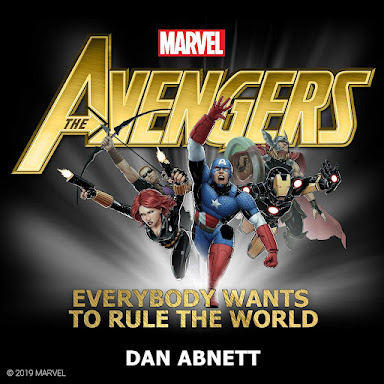
THE AVENGERS: EVERYBODY WANTS to RULE the WORLD (audiobook) by Dan Abnett


Published by GraphicAudio in 2015

Read by a multicast
Duration: 6 hours, 9 minutes.
Unabridged.

Captain America is called to Berlin to uncover a Hydra plot. Iron Man is called to Washington, D.C. to confront Ultron. Thor is in Siberia confronting a magical threat of immense proportions. Dr. Banner is investigating a mystery of his own with SHIELD. And, Black Widow and Hawkeye have their own problems confronting A.I.M.

In The Avengers: Everybody Wants to Rule the World, the Avengers are each pulled into their separate top-level emergencies - each of which could result in a worldwide disaster. Soon enough, the Avengers discover that each of these threats has arisen in response to a much larger threat - if only they can figure out what it is in time...

Usually, I really enjoy GraphicAudio's adaptations of comic book novels. Their use of sound effects and multiple actors remind me of an old-time radio show.

But, a high quality performance could not hide the fact that the action in this audiobook was too crowded with 5 separate plot lines. None of them were properly developed and the whole thing seemed half-baked throughout. It was a hurried mess that would have been better if it were simplified even more (drop out one or more of the plot threads) or greatly extended in order to properly tell each of the stories. 


The voice actor that played Tony Stark/Iron Man deserves special recognition for sounding exactly like the actor that plays the character in the Marvel movies, Robert Downey, Jr. The actor that played Quicksilver had a bizarre accent that sounded more like Katherine Hepburn's accent than his sister's. Truly an odd choice by the GraphicAudio team.

I rate this audiobook 3 stars out of 5.

This audiobook can be found on Amazon.com here: THE AVENGERS: EVERYBODY WANTS to RULE the WORLD (audiobook) by Dan Abnett.

Featured Post

<b><i>BAN THIS BOOK (audiobook)</i></b> by Alan Gratz

Published in 2017 by Blackstone Audio, Inc. Read by Bahni Turpin. Duration: 5 hours, 17 minutes. Unabridged. My Synopsis Ban This Book is t...

Popular posts over the last 7 days