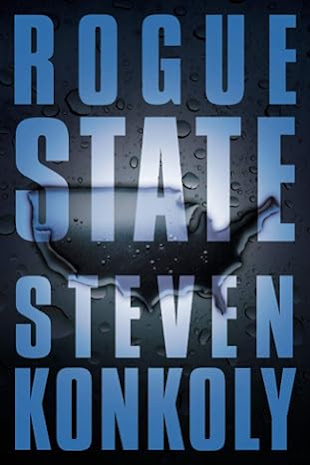
ROGUE STATE: FRACTURED STATE, BOOK 2 (audiobook) by Steven Konkoly


Published in 2017 by Brilliance Audio.
Read by Timothy Andres Pabon.
Duration: 9 hours, 21 minutes.
Unabridged

The action surrounding embattled water engineer Nathan Fisher and his family in the year 2035 continues in Rogue State, the second book in this series. In the first book, Nathan witnessed an act of terrorism designed to egg on a tense situation between the government of California and the federal government. Now, he and his family are being hunted by a mysterious group funded by a group of oligarchs that are determined to manipulate this situation to their advantage.

In the second book of this series the action factor gets ratcheted way up. In many ways, the main story line of the book is one giant chase scene across a series of rural and urban desert landscapes - but it is a heck of a chase scene. We also learn a lot more about the bad guys and the messed up version of America that Konkoly has created for this book (which I found at least as interesting as the chase scene thread).

The audiobook was read by Timothy Andres Pabon who read the first book as well. Once again, he did a great job except he cannot say the word "chassis" correctly.

I rate this audiobook 4 stars out of 5.


This audiobook can be found on Amazon.com here: ROGUE STATE.

See the review of Book 1 in this series here: Fractured State.

FRACTURED STATE: A POST-APOCALYPTIC THRILLER (Rogue State Series #1) (audiobook) by Steven Konkoly


Published by Brilliance Audio in 2016
Read by Timothy Andres Pabon
Duration: 10 hours, 9 minutes
Unabridged

In the year 2035 America is almost unrecognizable. Environmental collapse due the abuse of aquifers and mountain run-off in the West has caused the governments of many Western states to practically collapse. The highway systems have become "No Man's Land" and the Arizona border has practically been overrun by drug cartels who often act as a brutal de facto government in some areas.

California has escaped this fate due to a strict resource protection regimen that limits travel, and strictly watches how much water and electricity each household consumes. The relationship between the strict (yet successful) government of California and the often ineffectual federal government is strained to the point that there is an open and active movement that is pushing for California to secede.

Political assassinations and the sabotaging of a critical power plant make the political situation all the more tense. This is where the main character, Nathan Fisher, stumbles into the story. He is on a public beach loading sea water into big water bottles. He does this frequently because he owns a personal desalinization unit so he is able to augment his family's official water allotment.

But, while he is loading up his water bottles he sees something he shouldn't see - he sees the military unit that attacked the power plant and he realizes that the official story is not the truth. And, he realizes that they know that he saw them and they are coming for him and his family in order to shut him up...

The author, Konkoly, slowly gives out the bits and pieces that make up the political backdrop of this story. But, he quickly gets into the exciting cat and mouse chase as Nathan Fisher and his family try to figure out who they can trust and where they can go.

The audio version of this book was read by Timothy Andres Pabon, a veteran actor and prolific readers of audiobooks. It was quite good except for an occasional mispronounced word. The author uses the word chassis several times and the Pabon mispronounced it every time (he pronounced it like it is spelled so it sounded like "chassus" rather than "chassee"). It struck me as weird every time.

I rate this audiobook 4 stars out of 5.


This audiobook can be found on Amazon.com here: Fractured State.


See my review of Book 2 in this series here: Rogue State.

THE GOOD COP (Carter Ross #4) (audiobook) by Brad Parks


A Review of the Audiobook

Published in 2013 by Dreamscape Media, LLC.
Read by Adam Verner

Duration: 9 hours, 18 minutes
Unabridged

Carter Ross is an excellent reporter in the newsroom of a slowly dying newspaper in Newark, New Jersey. When he hears of the death of a police officer, he immediately rushes to the family and convinces them to talk to him about the officer and the kind of life he lived. Ross is certain that he has the makings of a top-notch human interest story - the kind of story that he would be proud if the family saved it for the officer's tiny baby son to read someday.

But, when Ross calls in the good news to his editor he is immediately waved off of the story because the Newark police are telling everyone that this officer killed himself after he got drunk on the job. But, that sounds fishy to Ross so he starts his own investigation into the case - and soon he finds that he has more suspects than he can possibly investigate...

Brad Parks has a way of making a serious crime book funny and serious all at the same time. When things go wrong, Carter Ross digs harder, makes even more wisecracks and makes the reader enjoy the book even more.

Adam Verner nails the tone of Carter Ross perfectly. The only down thing about the book is that there are too many "soap opera" touches to the book concerning Carter Ross's romantic entanglements. Nonetheless, this is an enjoyable audiobook experience.

I rate this audiobook 4 stars out of 5.

This book can be found on Amazon.com here: THE GOOD COP by Brad Parks.

RUEFUL REGRET (audiobook) by Steve Vernon


Published by Stark Raven Press in 2017.
Narrated by Charles Craig.
Duration: 3 hours.
Unabridged.


Bass Clayton is a bounty killer, basically a paid assassin, in the Old West. He has had no qualms about doing this job - at least he didn't until he tried to kill Silver Grimes. He fired blindly into Grimes' cabin with a shotgun, wounding Grimes and splattering Grimes' girlfriend all over the bed.

Clayton walks away from his bounty hunter gig and becomes the town drunk in a town called Rueful Regret. His plan to slowly drink himself into oblivion is going well until Grimes walks into the bar...
I did not enjoy this audiobook. The book was full of too many folksy expressions and was surprisingly slow-paced considering that it was just a three hour audiobook. But, the worst aspect of the book was an overly detailed description of animal cruelty and bestiality that did nothing to advance the plot. All it did was provide a few minutes of padding in an already slow story in a misguided attempt to add a bit of humor.

Charles Craig was a good choice to read a Western. He has the correct sound for the genre.

I rate this audiobook 2 stars out of 5.

This audiobook can be found on Amazon.com here: Rueful Regret.

Note: I received a free copy of this audiobook from the author in exchange for an honest review.

BLACK PROFILES in COURAGE: A LEGACY of AFRICAN-AMERICAN ACHIEVEMENT by Kareem Abdul-Jabbar and Alan Steinberg


Originally published in 1996.

With Black Profiles in Courage, Kareem Abdul-Jabbar presents a look at American history through a different lens than you usually see. This book follows from even before the arrival of Columbus through Rosa Parks receiving her just accolades in the 1990's. His underlying theme, as explained in the title, is that African-Americans have been contributing in important ways the entire time, but they are often "whitewashed" from history.

Abdul-Jabbar is best known for his time as a top-level basketball player. But he is not just a jock (if you are a fan, you know he never was JUST a jock.) He is also an amateur historian - and quite a thoughtful one. Clearly, he was inspired by the book Profiles in Courage by John F. Kennedy but this book is not structured in any way like that classic.

The book starts with its weakest proposition from a historical perspective. There are historians that assert that African peoples were heavily involved in Mesoamerican history (Mayas, Aztecs, Olmecs) and Abdul-Jabbar agrees with them. While it is interesting to ponder, I think that, at best, it can be said that there maybe some influence there - or maybe not. We cannot be definitively sure, even if there are tantalizingly suggestive clues, due to the lack of historical records on both sides of the Atlantic and a genetic record that has been muddled by intermixing for the last 500+ years. 

But, the rest of the book is really quite strong. I very much enjoyed his biographical sketches of Crispus Attucks, Harriet Tubman and Frederick Douglass, especially Crispus Attucks. Abdul-Jabbar makes a solid case that the people he discusses should be part of everyone's history books, not just special themed history books.

I rate this book 4 stars out of 5.

This book can be found on Amazon.com here: BLACK PROFILES in COURAGE: A LEGACY of AFRICAN-AMERICAN ACHIEVEMENT by Kareem Abdul-Jabbar and Alan Steinberg.

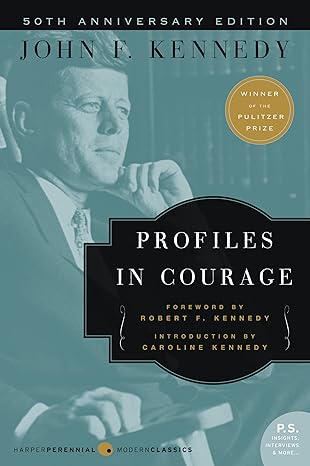
PROFILES in COURAGE (audiobook) by John Fitzgerald Kennedy


A Review of the Audiobook

Winner of the 1957 Pulitzer Prize
Originally Published in 1955

Published by HarperAudio
Duration: 3 hours, 10 minutes
Read by John F. Kennedy, Jr.
Abridged

President John F. Kennedy
(1917-1963)
If you have not read Profiles in Courage, it is comprised of 8 short biographies of Senators that JFK found to be inspirational in some way or another. Those Senators are: John Quincy Adams, Daniel Webster, Thomas Hart Benton, Sam Houston, Edmund G. Ross, Lucius Lamar, George Norris and Robert A. Taft.

Each of these men's stories were very well done, even if some of them, like John Quincy Adams' biography, actually seemed very short compared to what these men actually accomplished. But, then again, this is just a look at one point in time, not a complete list of each man's accomplishments and an abridged version of that short look on top of that.


This audiobook version of JFK's classic work is read by the President's son, John F. Kennedy, Jr. (1960-1999) with an introduction by Caroline Kennedy. The narration was actually quite good. Well worth your time to take a listen or to read.

I rate this audiobook 5 stars out of 5.

This audiobook can be found on Amazon.com here: Profiles in Courage by John Fitzgerald Kennedy

TRUE FICTION (Ian Ludlow #1) by Lee Goldberg


Published in March of 2018 by Thomas and Mercer.


True Fiction features Ian Ludlow, an author of action thrillers. He writes an over-the-top action series that makes James Bond look like a kindergartner and he's on a semi-successful book tour.

But, he knows something wrong (besides the tour and his lame attempts to flirt with his tour handler) when a plane is remotely attacked during a terrorist attack in Hawaii. He knows how it was done because he dreamed it up years before when he was a part of a CIA-led author retreat. The purpose of the retreat was to have authors of thrillers think up "out of the box" terrorist ideas so that the CIA could have an idea of what they might be up against in the future.

But, it turns out that it wasn't the CIA that hosted the retreat - it was a private group that wants the CIA's operations to be outsourced to them so they can make a fortune - and they are trying to kill off the only surviving author from the retreat - Ian Ludlow.

Just to be clear, this book is written as a farce - not as a serious thriller. But, there is plenty of action, weird characters, and a lot of odd situations. A quick, easy and fun read. 

I rate this book 4 stars out of 5.

This book can be found on Amazon.com here: TRUE FICTION by Lee Goldberg

WHAT WOULD SHE DO? 25 TRUE STORIES of TRAILBLAZING REBEL WOMEN by Kay Woodward


Published by Scholastic in 2018

What Would She Do? is collection of very readable short biographies of women - which, after being factually correct, is the most important thing. As David McCullough said, "No harm's done to history by making it something someone would want to read." 

Woodward writes in an informal, approachable style that I enjoyed quite a bit. Each biography is accompanied by a full page illustration of the woman and a little chart with basic biographical information. There is also a large pullout quote from or about her. For example, for Emma Watson there is this quote: "The saddest thing for a girl to do is to dumb herself down for a guy."


Generally, I did not like the "What Would _____ Do?" section that was included at the end of each biography. The author was clearly trying to make a connection between the women in the book and the typical American student with typical American student problems. But, trying to connect Cleopatra to a student who is being laughed at for their fashion choices or Rosa Parks to a girl being left out of group texts was just too far of a stretch for me.

Otherwise, though, this is a strong book. I am gladly handing it over to my 6th grade daughter to read and then we are going to pass it on to her teacher for her classroom library.

The publisher recommends this book for ages 8-12. I would say ages 10-15.


I rate this book 4 stars out of 5.

This book can be purchased on Amazon.com here: WHAT WOULD SHE DO? 25 TRUE STORIES of TRAILBLAZING REBEL WOMEN by Kay Woodward.


Note: I received a free review copy of this book as part of the Amazon Vine program in exchange for an honest review.

A WRINKLE in TIME (audiobook) by Madeline L'Engle


Originally published in 1962.
Winner of the 1963 Newberry Medal.

Published by Listening Library in 2012
Read by Hope Davis
Duration: 6 hours, 26 minutes
Unabridged

Way back in the 1970's I read A Wrinkle in Time as an elementary school student in small town Indiana. I was a voracious reader (I won the library's summer reading contest several years in a row - the only thing that ended my reign was moving away) and I remember that I attached great importance to this book. It must have been handed to me by a teacher or a librarian. But, I also remember that I was indifferent to the book itself. My impression of the book was that it was unique but rather vague and cerebral.

With the new movie version coming out, I was inspired to re-read the book. Also, I must admit that I was curious to see if the book affected me any differently more than 40 years later.

Madeline L'Engle (1918-2007)
This time around I listened to it as an audiobook. Hope Davis read the book and she did a fine job, creating multiple accents and voices and switching back and forth between them with ease. The audiobook also included comments by the director of the new movie (it had to have been just starting to be made when she wrote this introduction on 2012), the author's granddaughter and Madeline L'Engle herself. All three of these commentaries were excellent - for me they were the best part of the audiobook.

And, that is certainly a problem. The text of the book itself should have been the best part of the audiobook, not the comments attached to it. I found the book itself like I found it 40 years ago - rather vague, full of a lot of talking and characters that I just didn't attach myself to. I really like the philosophy behind the book - the ideas that they espouse about fate and faith and our role in the world mirror my own quite a lot. Who knows? Maybe this book really did influence me more than I knew. But, I just found myself rolling my eyes at the stilted dialogue and just about everything Charles Wallace said or did - just like before.

So, how do you rate a book in which you agree with the ideas behind it but can't stand the way the ideas are presented throughout? I'm going to split the difference - 5 stars for the underlying ideas, 1 star for the plot, dialogue, etc. That makes an average of 3 stars.

This audiobook can be found on Amazon.com here: A Wrinkle in Time

THE KIDS DON'T STAND a CHANCE: GROWING UP in TEACH for AMERICA by Harris Sockel


Published in 2016 by Audible Studios
Read by Jacob York
Duration: 1 hour, 18 minutes
Unabridged


Harris Sockel graduated from college and was convinced that he should join Teach for America (TFA) by a dedicated recruiter. He wasn't particularly interested in being a teacher before TFA, but he liked the idea of making a difference.

So, he enrolled in their crash course designed to teach a recent college graduate how to be a teacher and, in just a few weeks, he is certified by TFA and heads off to New York City to be a middle school teacher in a charter school. I teach in an urban public school in the Midwest, so I completely understood much of his commentary - the struggle to get papers graded, the struggle to copy papers (apparently an epic struggle in his school) and trying to keep everything moving forward. I particularly enjoyed his discussion of the ubiquitous SWBAT - a fairly new thing in my school.

In the end, Sockel's audiobook left this listener a little confused. Is TFA a good thing or a bad thing? Was it all worth it? Is it good for a school to have a constant turnover in its teachers as the price for working with TFA?

No real answers, but he does offer a interesting description of life in a classroom. Because of that description, I rate this book 4 stars out of 5.


This book can be found on Amazon.com here: THE KIDS DON'T STAND a CHANCE: GROWING UP in TEACH for AMERICA by Harris Sockel.

NIOURK by Stefan Wul and Oliver Vatine


Adapted from a French novel written in 1957 by Stefan Wul


Published in February of 2018 by Dark Horse Originals.


Synopsis

Set in the future, in Niourk the Earth's ecosystem has been severely damaged by mankind. Very few people have survived the collapse of civilization and those that have live in a Stone Age society.

A shunned member of a tribal band acts out of desperate need to be accepted by the only group of humans he knows. Known as The Dark Child, he accidentally discovers some of the truth as to what happened and leads his people towards the ruined city of Niourk (New York) in search of better hunting. This is a long trip considering that they started in the dried out basin of what used to be the Caribbean Sea.

Along the way, he discovers more and more of the truth and soon becomes something more than he ever could have imagined...

My Review

Niourk
is a beautifully illustrated book. The story itself has three main plot lines that show promise. Sadly, none of them are followed through with and the story goes into a disappointingly ridiculous direction. It felt like the author couldn't figure out what to do so he just finished it up with an idea out of left field just to finish it.

I rate this book 3 stars out of 5. The first 75% of the story is quite intriguing and the illustrations by Oliver Vatine are first-rate.

This book can be found on Amazon.com here: NIOURK by Stefan Wul and Oliver Vatine.

Note: I received a free copy of this graphic novel through the Amazon Vine program in exchange for an honest review.

BLOOD LETTERS: THE UNTOLD STORY of LIN ZHAO, a MARTYR in MAO'S CHINA by Lian Xi


Published by Basic Books on March 20, 2018


Lin Zhao was a political prisoner in China during the reign of Mao, from 1960 until her execution in 1968. She was imprisoned for criticizing the Communist Party for, among other things,  causing an immense amount of suffering for the rural poor during the Great Leap Forward campaign. 

Lin Zhao's early life is a series of contradictions. Her family worked with the Nationalist (anti-Communist) government for a time, but switched sides. She attended a Christian school for a while and seemed devout in her faith, but then ran away from home to join the Communists. Throughout her life, she was a headstrong woman who developed a habit of speaking her mind no matter the consequences. She was a talented writer and often wrote highly symbolic poems that were critical of the Chinese Communist Party, in addition to letters, articles and essays.

When she was actively encouraged to offer constructive criticism of the Communist Party as part of the Hundred Flowers Movement, she did so. Sadly, those criticisms served as the basis of her arrest in 1960.

While she was in prison she was often beaten and treated roughly by her captors. She also returned to her Christian faith. Her criticisms of the party became much more pointed - often calling out Mao himself in letters that were never sent out of the prison. While she usually had access to ink, Lin Zhao often chose to write her letters with her own blood. She developed a way to squeeze out a little blood at a time and write with it before it coagulated.
Lin Zhao (1932-1968)

Her letters were collected by her guards and kept in a file as evidence of her crimes. Later, years after her death, her writings were smuggled to her family. Many of them are now kept in Stanford University.

This was a challenging book to read - and not because of the topic. This book was often a dense, tedious read. If I hadn't had a couple of classes in college 30 years ago, I would have had little background as to the delicate situation that Lin Zao's family was trying to negotiate by going back and forth between the Nationalist and Communist governments. The book assumes that the reader has a solid handle on Chinese history from the 1930's through the 1960's.

Other times, the book seems to make random stabs 
into obscure corners in an attempt to give the book some context but it mostly fails. I left the book feeling like I got a glimpse of what was going on but, on the whole, it was mostly a missed opportunity.

I rate this book 2 stars out of 5.

This book can be found on Amazon.com here: 
BLOOD LETTERS: THE UNTOLD STORY of LIN ZHAO, a MARTYR in MAO'S CHINA.

Note: I received a preview copy of this book through the Amazon Vine Program in order to write an honest review.

NPR DRIVEWAY MOMENTS: LOVE STORIES by NPR


Published in 2014 by HighBridge, a division of Recorded Books

Multicast performance
Duration: 2 hours, 5 minutes

The idea behind NPR's "Driveway Moments" series is that each of these stories is so good that if you were listening to them when they were originally broadcast on NPR you would stay in the car to hear the end of the story rather than turn off the car and head on in to the house.

That is a pretty high standard, when you think about it. The good news is that many of these stories are that good. I enjoyed the story of the couple that fell in love while eyeing one another on a commuter flight and a conversation with author John Green about reactions to his book The Fault in Our Stars. My favorite may have been the story in which a divorced couple fell back in love after the husband became ill with Alzheimer's. He had literally forgotten the woman who came to visit him and re-discovered what he liked about her.

But, there were some real clunkers in the collection as well. One grew so tedious that I skipped the track. Another was the reverse of a love story - it was full of bitter double entendre comments from divorced parents to their children. It seemed very out of place.

On balance, it's a good collection and well worth the time of the listener.

I rate this collection 4 stars out of 5. It can be found on Amazon.com here: NPR Driveway Moments: Love Stories.

RUNNING BLIND (Jack Reacher #4) by Lee Child


Originally published in book form in 2000.

Published by Penguin Audio in 2013
Read by Johnathan McClain
Duration: 13 hours, 45 minutes
Unabridged


In Running Blind Jack Reacher is a suspect in an FBI investigation of several bizarre murders of women that were involved in sexual harassment and/or rape investigations that he conducted while he served as a military policeman. But, as the investigation moves forward, it becomes clear that he is not the suspect. Instead, he is drawn into the case to serve as a liaison between the Army and the FBI so that they can solve the case before the serial killer strikes again.

This is one of the weaker entries into the strong Jack Reacher series. There is one really cool scene at the midway point book that I will not discuss because I hate spoilers but, on the whole, Running Blind just didn't have "it". With three stars, Running Blind just has too many leaps of logic, even for this Jack Reacher fan (this is my 15th Reacher book). Besides that, I figured out who did it about 4 hours into this 13+ hour audiobook.

I think this is the second Reacher audiobook that I have listened to that was read by Johnathan McClain. McClain's take on Reacher is interesting - he sounds less physically intimidating and sounds much more quick with the smart comments - sort of like the Tom Cruise movie version of Reacher. Some of the supporting characters were voiced in an over-the-top manner. For example, one character always yelled (in meetings, in small groups, one-on-one, wherever) and one character was always super-snarky. But, others were done very well.

I rate this audiobook 3 stars out of 5. You will want to hear it if you are a fan of the series but I would not recommend starting the series with this book.

This audibook can be found on Amazon.com here: Running Blind by Lee Child.

I'M STILL HERE: BLACK DIGNITY in a WORLD MADE for WHITENESS by Austin Channing Brown


Published in 2018 by Convergent Books.

Let me address the title of I'm Still Here: Black Dignity in a World Made for Whiteness for all of you that will get hung up on the word "whiteness."

Let me use a rough analogy to explain it.

I am an overweight person. I used to be even more overweight (I have lost 85 pounds). I weighed enough that I had to buy almost all of my clothes online or in special stores. Most major chains literally sold nothing that would fit me. Certain brands make it very clear that they refuse to make clothes for heavy people because they don't want them wearing their brand. Once, I had a salesperson yell at me from across her empty mall store when she saw me walk in that they didn't carry my size (I was looking for something for my daughter).

The normal (easy to find, available everywhere) clothing world was not made for me. I was living in a world designed for thinner people.
The author, Austin Channing Brown


This is how the author, Austin Channing Brown, feels about modern America. It is designed for white people. Period. Everyone else makes large accommodations to the majority while white America makes small ones. For example, in media most television shows feature white characters with maybe a token non-white character. Just this month the Marvel movie Black Panther came out. It is the eighteenth Marvel movie. It is also the first one with a main character who is not a white man. 1 of 18 is not a very good ratio.

Brown grew up in White America in suburban parochial schools. She is not a stranger to the mostly white religious organizations that she has been hired to help with their diversity issues. But, too often, she has been hired as a token hire rather than a guide to how to truly embrace a different part of the body of Christ. It is not enough to get the numbers right.

I understand her first sentence of the book: "White people are exhausting." I am a white man who teaches at a majority minority school. The culture of the school is simply not mine (separated by race and at least one generation) and there are times when I leave school exhausted by the constant mental translating I have to do just to keep up. I understood her comment immediately.

There are weird things that Brown experiences that I also have experienced. For example, she has white people at work that want to touch her hair without permission - simply because they are curious about how it feels. I have that happen, too - on a semi-regular basis from my African American students. I had it happen the day after I read her a passage in the book in which she complains about it. But, I expect that kind of things from kids - they're impulsive and curious and that impulsivity and curiosity overwhelms proper social rules. She gets it from adults who should know better - that's truly inappropriate behavior.

At it's core this is a hard book full of hard teachings. I don't embrace all of them. I think that she takes offense at things that are not necessarily meant to offend. Sins of omission versus sins of commission, if you like. I try to teach my students and my own children to try to not to take offense if there was none intended. She addresses this in the book as well and calls it out as simple excuse-making. 
She may be right.  This I know - she has many more valid points than I would like to admit.

More than most anyone would like to admit.

The biggest and most successful argument she makes is that the church (not one specific denomination, but rather the whole of Christianity) should be the one place that is actively working for justice, not just grudging, half-hearted accommodation (when it is remembered at all).

It took me about 10 days to read this small book because I felt that I often just had to sit it aside for a while and let it digest. It has given me a lot to think about as I approach my own classes every day.

I rate this book 5 stars out of 5.

Note: I was provided an uncorrected proof pre-publication copy of this book through the Amazon Vine program.

This book can be can be found on Amazon.com here: I'M STILL HERE: BLACK DIGNITY in a WORLD MADE for WHITENESS by Austin Channing Brown.

Note: this book was challenged in 2021 because a parent claimed it was 
“filled with hate speech, racial division, anti-white rhetoric and cancel culture all rooted in critical race theory.” That is a whole lot of buzz words. See the story here (towards the bottom.)

BLOOD SWEEP (Posadas County Mystery Book 8) by Steven F. Havill


A Review of the Audiobook

Published by Books in Motion in 2015
Read by Beth Richmond
Duration: 11 hours, 40 minutes
Unabridged

Blood Sweep is my eleventh Posadas County/Bill Gastner mystery. I have been with Bill Gastner when he was on patrol, when he was being lowered into a mine to find a kidnapper, when he was fighting a man in a little plane and through a whole lot of extra-spicy burritos.

Sadly, Bill is a minor character in this book. I understand why - when the series started out he was already old for a sheriff. Now, he's retired and really can't go out and fight bad guys so much.

Estelle Reyes-Guzman and Bob Torres carry the load in this book. I enjoyed the Torres story line, but found the Reyes-Guzman story line to be poorly paced and exceptionally wordy (never a problem with Torres since he famously says as little as possible). The Reyes-Guzman story line features a former resident of a Mexican border town that has spent most of his adult life in prison. This character speaks English like a Shakespearean actor, using tons of fancy words like "beseech" in everyday conversation. No one uses "beseech" in everyday conversation, especially not people who speak English as their second language and must have learned it in a Mexican prison. The whole plot revolves around this character and he is simply not believable as he is presented. Plus, he talks waaay tooo much.

So, this ties my lowest score for a Posadas County mystery. Thank goodness, most of them are much better than this one. I will be visiting Posadas County again.

Beth Richmond read Blood Sweep and did a solid job with most of the characters. Two of her Spanish-speaking characters sounded so much alike that it was difficult to follow who was speaking when they spoke to one another.

I rate this audiobook 3 stars out of 5. It can be found on Amazon.com here: Blood Sweep by Steven F. Havill.

THE HATE U GIVE (audiobook) by Angie Thomas


A Review of the Audiobook.


Published by HarperAudio in 2017.
Read by Bahni Turpin

Duration: 11 hours, 40 minutes
Unabridged

Starr Carter lives two lives in The Hate U Give.

She is an African American high school junior that lives in a rough African American neighborhood. Her best friend was killed in front of her, accidentally caught up in a drive-by shooting, so Starr's parents drive her 45 minutes (one way) out to a "white" school out in the suburbs for her own safety. 

She works in her neighborhood, at her father's store, on the weekends but she feels like she doesn't really live there. Most people don't even know her real name - they know here as "King's daughter that works in the store." She feels like no one at her school knows her either - she speaks differently, acts differently and cares about different pop culture things. She has a white boyfriend - a fact she hides from her father.

On a Friday night Starr goes to a massive party in her neighborhood and meets a boy she grew up with (his grandmother babysat both of them for years). After a scuffle turns into gun play they leave in his car. They get pulled over, the traffic stop goes bad and the officer shoots and kills her friend. The officer claims that he thought her friend had a gun (he didn't - he had a hairbrush).

Both of Starr's worlds come crashing down. In the neighborhood she feels unsafe, the police pressure her family to be quiet and others pressure her to speak up and tell the world about what happened. At school, she hides the fact that she was at the shooting and is mortified when some of her friends make callous racist comments.

Starr doesn't trust the police, but her uncle that she trusts more than anyone else in the world is a policeman. She is proud of her neighborhood, but she never speaks about it at school. She loves her friends at school, but they never come to her home. She loves her boyfriend, but she hides her home and her family from him and she hides him from her family. She is afraid to tell the world about what she saw, but she knows she must. Does she trust the system, like her uncle wants her to do? Does she fight back with her words and her testimony or does she do something more?

I am a middle-aged white man who teaches in an urban high school that is majority minority. I make the lighter-weight version of the trip that Starr makes every day - but in reverse. The cultural notes that author includes struck true to me and made it all the more enjoyable.

The title comes from a quote from Tupac Shakur. Here is how the book explains it: 
“Pac said Thug Life stood for “The Hate U Give Little Infants F***s Everybody. T-H-U-G-L-I-F-E. Meaning what society gives us as youth, it bites them in the a** when we wild out. Get it?” This theme is explored throughout.

I enjoyed the audiobook presentation of this book. The reader, Bahni Turpin, just nailed it. She sounded like my students. Great job.

Note: This book has a lot of vulgar language in it. Guess what? Kids like to use vulgar language. People in stressful situations use vulgar language. If that offends you, you will not enjoy this book.


I rate this audiobook 5 stars out of 5.

This book can be found on Amazon.com here: The Hate U Give

Update February of 2022: This book has now been tagged on my blog with the tag "MAGA Censorship List". Here is why: Click here for article. Also here. Also here (note: read the attached Google Doc that serves as a "review" of the book. One of the concerns of this chapter of Moms for Liberty is a possible George Floyd reference. This book was first published in February of 2017. Floyd died in May of 2020. I verified this with 20 seconds of Google searching. But, at least the unknown reviewer seems to have actually read the book.)

THE POWER of DIFFERENT: THE LINK BETWEEN DISORDER and GENIUS (audiobook) by Gail Saltz


Published by Macmillan Audio in 2017
Read by the author, Gail Saltz
Duration: 8 hours, 18 minutes
Unabridged


Psychiatrist Gail Saltz looks at the larger categories of "brain differences", such as dyslexia, depression and ADD in this interesting audiobook. This is a surface-level look at these brain differences (it comes out to a little more than an hour per difference she discusses - you can't expect any more than surface-level discussion), but informative nonetheless. Considering that the average person probably has no knowledge of any of these differences or, at best, a great deal of knowledge of one or two of the seven she discusses, this book serves as an excellent introduction.

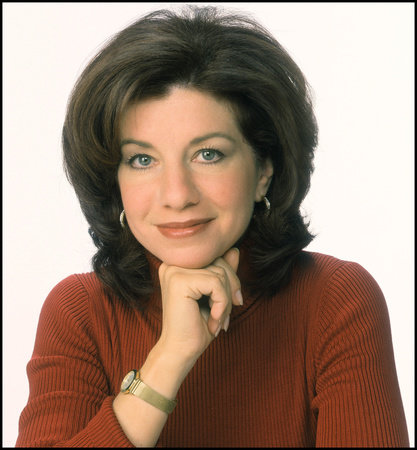
Dr. Gail Saltz. Photo by Sigrid Estrada
Each chapter starts with a description of each of the brain differences including physical differences, if any. Saltz also introduces the reader to two or three high-achieving people with these differences. Some are celebrities, some are not. Then, she lets them describe how they used turned their perceived weakness into a strength. 

Saltz does not sugarcoat these differences and she is sure emphasize the amount of work that these individuals put in to get to where they are now.

Saltz read her audiobook herself. Sometimes authors who read their own books do a less-than-stellar job, but Saltz 
did a very good job with it.

As a teacher, I would recommend this to any general education teacher.

I rate this audiobook 5 stars out of 5.

This audiobook can be found on Amazon.com here: 
THE POWER of DIFFERENT: THE LINK BETWEEN DISORDER and GENIUS by Gail Saltz.

FREEDOM NATIONAL: THE DESTRUCTION of SLAVERY in the UNITED STATES, 1861-1865 (audiobook) by James Oakes


Published by Gildan Media, LLC in 2012
Read by Sean Pratt
Duration: 18 hours, 54 minutes
Unabridged


James Oakes takes a unique look at the Civil War in Freedom National - through the lens of the anti-slavery movement. I have read more than 200 Civil War histories and almost all of them cover this part of the story - but, just in bits and pieces.

Oakes looks at the anti-slavery movement from its roots in the Revolutionary War era and moves forward with the different Abolitionist arguments until they finally stumbled upon the concept of "freedom national". The argument is over the standard, default setting of the slavery issue. Was slavery legal everywhere, except where it was specifically abolished, or was it illegal everywhere, except for where it was specifically made legal? Or, in shorthand - was it "freedom national" or "slavery national"?


This book puts the lie to the idea that the Civil War was over taxes, tariffs or anything else but slavery. This book demonstrates that so much time, energy and effort was expended over how to deal with the slavery issue by both sides that, if it weren't the biggest question of the war, why was there so much constant uproar over it? Slavery was both the carrot and the stick in the Emancipation Proclamation. Slavery would be preserved if the areas in rebellion returned to the fold (the carrot), or it would be the slaves in those areas would be forever free and those slaves could be turned into Union soldiers to use against the Confederacy.

Almost as soon as the war started, it became obvious that the Confederacy's slaves were both an asset and a liability. They were an asset because they were a built-in workforce that would keep the fields in production (and some factories) while the armies were in the field. But, they were a liability because their owners feared an uprising, they were mobile and if they fled to Union lines they could be an invaluable source of military intelligence.


But, Lincoln faced a unique challenge that the Confederacy never faced - how do you free slaves in the Confederacy but maintain slavery in the four loyal slave states? 

I rate this audiobook 5 stars out of 5. 

A DOG'S PURPOSE by W. Bruce Cameron


Originally published in 2010.

This is the book that inspired the controversial movie (not due to content but rather due to how a scene was filmed). The book itself is not controversial, but a sentimental reincarnation story involving a dog who is looking for his purpose in this world.

The dog lives a variety of lives (a stray, a working dog, a pet) as a variety of breeds and eventually discovers his purpose. Along the way the author shows some very solid insight into dog psychology and has a lot of fun trying to guess the motivations of the simple (or maybe not so simple dog). 

There are times when the story is pretty sappy, but there are times when the story is gripping and very touching. It is an easy read, but worth the time of any dog lover.

I rate this book 4 stars out of 5.

The book can be found on Amazon.com here: A Dog's Purpose by W. Bruce Cameron.

THE WAR on KIDS: HOW AMERICAN JUVENILE JUSTICE LOST ITS WAY by Cara H. Drinan


Published by Oxford University Press in November of 2017.

Cara H. Drinan is a law professor at The Catholic University of America in Washington, D.C. Her book The War on Kids: How American Juvenile Justice Lost Its Way deals primarily with the changes to the justice system over the last 30 years and the mostly unforeseen consequences of those changes.

Drinan discusses how in the late 1980's and early 1990's the United States was experiencing a crime wave, including "the nation's peak murder rate" (p. 156) and a number of these criminals were minors. Lawmakers responded by making it easier to move cases involving juvenile offenders into adult court. Juvenile court, although imperfect, at least made some attempt to accommodate itself to the specific needs of youth offenders and offered opportunities to rehabilitate themselves. It also recognized the fact that young people's brains just work differently than adult brains - a point Drinan brings up often throughout the book,

Early in the book, Drinan offers a powerful set of facts about the effects of poverty on youth and the truly dreadful conditions that some young people grow up in. Chapter 2's detailed description of Terrence Graham's childhood is tough reading. He was failed by nearly every adult relative in his life and was clearly failed by the social workers that knew the conditions he lived in and did nothing to remove him from a home filled with drugs, hunger, violence, chaos and deprivation. I wouldn't have let a dog stay in that house, let alone a human child.

Drinan also describes how defendants in the justice system often have to depend on understaffed public defender offices that clearly don't have the time to do much more than process their clients and hope for the best. The book Rights at Risk: The Limits of Liberty in America by David K. Shipler also covers this topic very well. Minors moved up into adult court become a part of an already over-burdened system. 

Not that the juvenile courts are doing much better. On pages 58 and 59 Drinan details a litany of failings, including statistics that show more than half of the minors held in juvenile detention don't even have an attorney. Public defenders that deal in juvenile law are overwhelmed. The industry standard is no more than 200 cases per defense attorney. Some have caseloads with more than 1,500 clients. There is no way they can do any sort of quality work with that sort of caseload. To make matters worse, many are not even trained in juvenile law. 

Drinan argues that there need to be a whole series of safety nets in place to help young people like Terrence Graham from getting into the justice system in the first place, but she offers precious few specifics. She also argues for rehabilitative programming in juvenile detention but only offers one detailed description - a program in Missouri that does sound promising. It is so promising that it makes me wonder why the other states haven't adopted it as well.

The second half of this slim book is a tough read. Not due to the content, but due to a lot of legalese. She makes a series of recommendations that sound all right, but I really can't say for sure because I am not an attorney. It's almost like she forgot who her intended audience was at the halfway point of the book and lapsed into jargon and started talking to the attorneys reading the book.

There are times when Drinan comes off as more than a little naive. She often reminds the reader that youth are often impulsive and their brains don't work like an adult human's brain. True enough. At times, though, she sounds like she would excuse nearly any crime simply because the perpetrator was a youth and youth can be more easily rehabilitated than adults. One case study involved a young man that lured another to a car wash so he could "talk" about an issue they were having. Instead, he ambushed him and shot him three times with a rifle. This is different than a young person who is serving time because he was the driver waiting outside in the car during a robbery in a store that resulted in someone being shot.


The closing is an unsatisfying mish-mash that takes way too many shots at Donald Trump. I am not a fan of the President. Despite all of his faults though, he is a political newbie and had nothing to do with the current state of the juvenile justice system.

Read the first half of this book to find out the depth of the problems with our juvenile justice system. It is powerful reading.

I rate this book 3 stars out of 5.


This book can be found on Amazon.com here: THE WAR on KIDS: HOW AMERICAN JUVENILE JUSTICE LOST ITS WAY by Cara H. Drinan.

Note: I received an advance uncorrected proof of this book for free so that I could write an honest review as a part of the Amazon Vine Program.

TWO KINDS of TRUTH (Harry Bosch #20) (audiobook) by Michael Connelly


Published by Hachette Audio in 2017
Read by Titus Welliver
Duration: 9 hours, 54 minutes
Unabridged

Harry Bosch returns in his twentieth outing, more or less (there are a lot of overlapping characters from other series in Michael Connelly's newer books). Although Bosch is primarily known as an LAPD detective, he is now retired and is working as a volunteer detective for the comparatively tiny San Fernando Police Department. He clears cold cases because San Fernando hasn't had an actual murder in years.

But, the opioid crisis has hit San Fernando and the owners of a family-owned pharmacy in one of San Fernando's main shopping districts are killed in an obvious hit by two gunmen. Bosch and the three full-time detectives swing into action.

Bosch is also distracted by a case from the 1980's that has come back to haunt him. A death row inmate has new evidence that exonerates him and he is blaming Harry Bosch for framing him in the first place and Bosch may be held financially responsible. Bosch, with the help of his half-brother Mickey Haller (The Lincoln Lawyer) has to act to save his good name, his life savings and to keep a murderer on death row.

Two Kinds of Truth is read by Titus Welliver, the actor that plays Harry Bosch in the Amazon streaming TV show Bosch. The Harry Bosch series has had a series of strong audiobook readers and Welliver continues that streak.

Longtime readers of the Harry Bosch series will be pleased to know that Jerry Edgar, an old partner of Harry's comes back to the series and plays a serious role.

This is the fourth Harry Bosch novel in a row that I thought would provide a good exit for the character. However, I am glad that Michael Connelly keeps on finding new things for Harry to do. In this book there were several new situations and new combinations of characters that kept it interesting.

I rate this audiobook 5 stars out of 5.

This audiobook can be found on Amazon.com here: Two Kinds of Truth by Michael Connelly

Featured Post

<b><i>BAN THIS BOOK (audiobook)</i></b> by Alan Gratz

Published in 2017 by Blackstone Audio, Inc. Read by Bahni Turpin. Duration: 5 hours, 17 minutes. Unabridged. My Synopsis Ban This Book is t...

Popular posts over the last 7 days