BEARSKIN: A NOVEL (audiobook) by James A. McLaughlin


Published in 2018 by HarperAudio.
Read by MacLeod Andrews.
Duration: 9 hours, 49 minutes.
Unabridged.


Synopsis:

Bearskin features Rice Moore as the caretaker of a piece of Appalachian Virginia wilderness for a foundation. His job includes is walking the property, cataloging what he finds, remodeling the house on the property, and keeping poachers out. 


He's also hiding. A few years back he was caught smuggling drugs across the border from Mexico and ended up serving time in a Mexican prison. In the prison, Moore killed a man who was highly connected to a Mexican cartel and now he has taken on an assumed identity in the middle of nowhere in Virginia. 

When someone starts killing bears on the foundation property just to harvest organs to sell in Asia, Rice knows that he has to do something, even if it risks blowing his cover...

My Review:

This book sounds interesting and exciting. I found it underwhelming in so many ways. 

The book started out with tons of description. That's not unusual, especially early on. The book continued that way every time Moore entered a new scene - even if he has been in that setting a dozen times already. It just bogged things down to describe the same things over and over again in hyper-detail.

There were so many threads of a plot that started and were never acted upon. I understand that there are red herrings in stories, but these felt more like the author was exploring some ideas and then just walked away from them.  I don't want to provide spoilers, but at least half of the book is dedicated to plot lines that have no resolution.

The ending was just that - an ending. Three was no resolution to the main plot points. The book just ended with so many unresolved threads. A lot like real life, but not very satisfying in a novel. It's like the author just got tired of the whole thing and said, "Screw it!" and sent the manuscript off to the publisher. 

I rate this book 2 stars out of 5. It can be found on Amazon.com here: Bearskin: A Novel by James McLaughlin.

GOD BLESS YOU, MR. ROSEWATER by Kurt Vonnegut


Originally published in 1965.

After a steady stream of science fiction books, Kurt Vonnegut delivers a straight out social commentary with God Bless You, Mr. Rosewater

Synopsis:

Eliot Rosewater is the heir to a family fortune built on selling munitions in the Civil War and every war after that. The family fortune was built in Indiana but the family has moved to Providence, Rhode Island where it has a family mansion along with all of the others along the waterfront. His father is one of the senators from Rhode Island.

The Rosewater family avoids paying income taxes on this vast fortune by funding the Rosewater Foundation. Generally speaking, the foundation has been a legal way to not pay taxes and instead pay Eliot a whole lot of money to do nothing but supervise a foundation that does next to nothing.

A mural of Vonnegut in his
hometown - Indianapolis.
Photo by DWD
Eliot is suffering from PTSD (called "combat fatigue" in this book) from his experiences in World War II and drowns in troubles in bottle after bottle of alcohol. His only interests are science fiction and volunteer fire departments. He often gets black out drunk and comes back to his senses in a new town. He checks out the nearest volunteer fire department and sees if they have any new techniques or if they need any new equipment. Either way, he gives them something with foundation money.

Eliot is convinced to settle down in Rosewater County in southern Indiana. This is where his ancestors came from. He moves the foundation headquarters to Rosewater, Indiana and becomes the de facto caretaker of the people in this small town. People come to him with their problems and he listens. Sometimes, they need a little money to get over a rough patch or to help with a medical expense. It's all tedious, but the town needs him - even if it is to be someone to yell and scream at. 

The problem is, a lawyer at the law firm that handles the foundation business has found a different Rosewater from another branch of the family. The lawyer thinks he can remove Eliot as the head due to insanity. He will replace him with this other Rosewater and then make a fortune by representing him...

My review:

Vonnegut's report card
I am reading the Vonnegut novels in order of publication. This one is my favorite so far. Eliot is both a great man and a terrific loser. In a way, he is an imitation of Jesus and in a way he's a pathetic drunk that reads too much science fiction. This book is also the introduction to Vonnegut's literary alter-ego, Kilgore Trout.

Vonnegut famously graded his own books in the essay collection Palm Sunday. He gave God Bless You, Mr. Rosewater an A and I agree. 

I rate this book 5 stars out of 5. It can be found on Amazon.com here: God Bless You, Mr. Rosewater.

TIGER CHAIR: A SHORT STORY (kindle) by Max Brooks


Published in 2024 by Amazon Original Stories.

The premise of Tiger Chair is that it is a frank letter from a mid-level Chinese officer to a friend back home. World War III has been going on for a while. It started over the invasion of Taiwan and has now spread around the world. Chinese forces are active on many fronts, including India.

China has also attacked the United States in the mistaken belief that America's racial diversity and political animosities would cause American resolve to crumble and it would be a short war.

This has turned out to be wrong and the invasion has turned into occupation duty and occupation duty has always been terrible. 

I think Brooks has an actual agenda with this book and it is a warning. It is not a warning about China. It is a warning about over-dependence on technology and the foolishness of war. On top of that, it is so easy for one country to think that they have a realistic take on another country's internal politics and culture when they really have no idea at all.

Max Brooks
Brooks lectures in military circles about successful military organizations developing blind spots and becoming incapable of conceiving of strategies that will defeat them (or make it too costly to stay.)

It is an easy thing to observe in recent history. Americans have seen it in Iraq and Afghanistan. In both situations, their governments were deposed and it was assumed that new governments would be formed and the political differences would be worked out. Instead, the different rivalries fought one another with amazing ferocity. But, they also fought the Americans because there was one thing they all agreed on - they didn't want a bunch of outsiders telling them what to do.

It is the same in this story. I'd say that it's been this way forever.

I rate this short story 5 stars out of 5. It can be found on Amazon.com here: TIGER CHAIR: A SHORT STORY by Max Brooks.

MARCH: BOOK THREE (graphic novel) by by John Lewis and Andrew Aydin


Published in 2016 by Top Shelf Productions

Written by John Lewis and Andrew Aydin.

Illustrated by Nate Powell.

2016 National Book Award Winner for Young People's Literature

2017 Printz Award Winner

2017 Coretta Scott King Author Award Winner

2017 Sibert Medal Winner

2017 YALSA Award for Excellence in Nonfiction Winner

2017 Walter Award Winner

Congressman John Lewis (1940-2020) continues his life story in book three of the March series, focusing on his struggles in the Civil Rights Movement. The book starts with the 16th Street Birmingham Church Bombing in September of 1963 and ends with the signing of the Voting Rights Act in August of 1965.

These were, by any account, much like the famous Charles Dickens line from A Tale of Two Cities: "It was the best of times, it was the worst of times, it was the age of wisdom, it was the age of foolishness, it was the epoch of belief, it was the epoch of incredulity, it was the season of light, it was the season of darkness, it was the spring of hope, it was the winter of despair..."

It was the best of times in that the Civil Rights Act of 1964 and the Voting Rights Act of 1965 were passed. It was the worst of times because of these landmark laws were passed due to great sacrifices. As noted on page 91, in the state of Mississippi in the summer of 1964 during an attempt to mobilize and register black voters there were "more than 1,000 arrests, 80 beatings, 35 church burnings, and 30 bombings."

A theme that runs throughout the trilogy is that every success is soured by a violent response. I was particularly struck by an act of pointless violence at the end of the book. When the march from Selma, Alabama to Montgomery, Alabama finally happens (it had been turned back on other attempts by violence and by court order) there is a rally, there are speeches, and a concert given by an amazingly diverse crowd of artists - diverse in race and in musical styles. What should have been a beautiful moment is marred by the murder of a volunteer driver named Viola Luzzo from Detroit. She was shuttling people back to Selma. She was heading back to Montgomery to pick up more people when a car pulled alongside. A single shot was fired and she was killed (see picture.)

This is an excellent trilogy and an excellent way to tell this history. I rate this book and the entire trilogy 5 stars out of 5. 

This book can be found on Amazon.com here: MARCH: BOOK THREE (graphic novel) by by John Lewis and Andrew Aydin.

Click here for March: Book One.

Click here for March: Book Two.

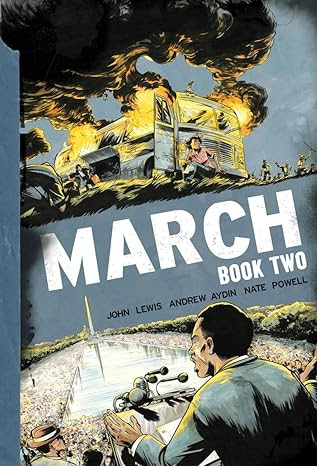
MARCH: BOOK TWO (graphic novel) by by John Lewis and Andrew Aydin


Published in 2013 by Top Shelf Productions.

Written by John Lewis and Andrew Aydin.

Illustrated by Nate Powell.

Congressman John Lewis (1940-2020) continues his life story in book two of the March series, focusing on his struggles in the Civil Rights Movement. The book starts in November of 1960 and ends with the 16th Street Birmingham Church Bombing in September of 1963.


The story includes some very harsh responses to attempts to integrate restaurants in Tennessee, the freedom riders (young African Americans were attempting to desegregate bus lines after a court ordered them to be desegregated), and the bus boycott campaign in Birmingham. 

The violent response is horrible and shocking

Infamous segregationist lawman Bull Connor of Birmingham figures prominently throughout the middle of the book. I am pretty well-versed in the major points of the Civil Rights Movement but I was still moved by the portrayal of the Children's Crusade.

The book includes all of the negotiations, concerns, and demands before the famed March on Washington. Lewis spoke at the march, followed by the world-famous "I Have a Dream" speech by Martin Luther King. 

And, as often happens in this history, a giant step forward is followed by tragedy. In this case, the book ends with the death of 4 girls in the terrorist bombing of a church in Birmingham. 

I rate this book 5 stars out of 5. It can be found at Amazon.com here: MARCH: BOOK TWO (graphic novel) by by John Lewis and Andrew Aydin.

Click here to see my review of March: Book One.

Click here to see my review of March: Book Three.

HOW the SOUTH WON the CIVIL WAR: OLIGARCHY, DEMOCRACY, and the CONTINUING FIGHT for the SOUL of AMERICA by Heather Cox Richardson


Originally Published in 2020.
Published by Oxford Press in 2022.


Historian Heather Cox Richardson has made herself into a name brand historian with her near-daily first drafts of history in which she writes up the day's political news and ties in similar historic themes or long-running trends. 

How the South Won the Civil War follows along those lines. 

The book looks at two long-standing trends in American points of view in American history that are in constant tension with one another.

This quote from page xv of the introduction gets the thesis of the book pretty well:

America began with a great paradox: the same men who came up with the radical idea of constructing a nation on the principle of equality also owned slaves, thought Indians were savages, and considered women inferior. This apparent contradiction was not a flaw, though; it was a key feature of the new democratic republic. For the Founders, the concept that "all men are created equal" depended on the idea that the ringing phrase "all men" did not actually include everyone."

She continues: "So long as these lesser people played no role in the body politic, everyone within it could be equal. In the Founders' minds, then, the principle of equality depended on inequality."

That is the heart of the thesis - some think that everyone should be able to participate, others think that only the best people should participate because some people cannot handle the responsibility (or just want to do all of the wrong things with the power.)

Richardson goes through history and shows how this has played out over the decades. A big theme is that, in general, the South has believed that not everyone should participate. The North has gone back and forth, but consistently more on the side on equality than the South. 

The Civil War was obviously a major flare up in this ongoing struggle and seemed to end the paradox once and for all. But, the same issues migrated west and the Western states generally joined the South as time went on, especially as the Democrats stopped being the conservative party when it came to race relations after the elections of 1964, 1968, and 1972. Movement Conservatives discovered that racists liked it when they said things like letting states keep their own rules about who gets to vote and being able to create special public schools so that they stay segregated.

Not every Republican followed this line of thought and the mainstream Republican Party denied that this line of thought even had a popular foothold. But, the Tea Party Movement followed by MAGA and Christian Nationalism has pushed the radicals (the old John Birch Society types) into the forefront. Trump didn't create it, but he found it and exploited it.

The MAGA movement and Christian Nationalism continues this cementing of the West and the South and the belief that some people should not have a say. Nowadays, it is not slavery or Jim Crow or forcing people to be IN the closet, but MAGA shows spend an inordinate amount of time on gay marriage, trans people, and the bogeyman of CRT. It's not the same old thing (well, it oftentimes is for the LGBTQ+ folks, especially for trans people) but it certainly rhymes.

The only complaint I have about the book is that the author fails to see that the same type of elitism exists in both parties.  Examples include FDR and his brain trust, a center-left media that laid out a certain world view for 40 years and still tries to (I mostly agree with that view, but I also acknowledge that it existed and still exists in a much weakened state.)

I rate this book 4 stars out of 5. It can be found on Amazon.com here: HOW the SOUTH WON the CIVIL WAR by Heather Cox Richardson.

WINGS of HONOR (Forgotten Fleet Book 1) (audiobook) by Craig Andrews

The premise of this book is not particularly original, but it still enjoyable.

Originally published in book form in 2021 by My Story Productions.

Audiobook published in March of 2024 by My Story Productions.
Read by Shamaan Casey.
Duration: 9 hours, 16 minutes.
Unabridged.


Synopsis:

In Wings of Honor, humanity is at war with an alien insectoid species, much like in the book Ender's Game, the movie version of Starship Troopers, and the 1990's Fox Tv show Space Above and Beyond. In this novel, the bad guys (the bugs) are called the Baranyk. 

The fight ebbs and flows - sometimes humanity is winning, but currently humanity is losing. Humans used to use a fighter/carrier system in which fighter space ships launch from carrier space ships to engage the enemy - much like another classic show and its reboot, Battlestar Galactica. The death rate for fighter pilots were atrocious so the fleet developed a sophisticated fleet of drone fighter ships. If the drone ship gets destroyed the pilot just loads up another drone and rejoins the fight.

That system worked out great and was used to push back against the Baranyk - literally turning the tide of the war in favor of the humanity. That is until the the Baranyk developed a jamming system to block out the signals to the drones, leaving the space fleet without its first and best line of defense. 

This book is about the plan to convert the best drone pilots into fighter pilots and all that it entails. There are lots of clashes between pilots with big egos, a demanding commanding officer, and the difficulty of moving from a video game type of system to really being out in the flight vehicle.

My Review:

As I stated in the title, the premise of this book is not a unique science fiction concept. That being said, the author took it and decided to really delve into the characters of the trainees and the nature of the training. I found the book to be interesting and engaging if not always riveting.

The audio reader was Shamaan Casey. His voice was perfect for the commander of the "Forgotten Fleet" - the new squadron of manned space fighters. He did a very good job and helped to make this an enjoyable audiobook. I would be interested in continuing on with this series.

I rate this audiobook 4 stars out of 5. It can be found on Amazon.com here: WINGS of HONOR (Forgotten Fleet Book 1) by Craig Andrews.

My review of the second book in this trilogy can be found here: Wings of Mourning.

Note: A copy of this audiobook was provided to me by the publisher in exchange for an honest review.


Featured Post

<b><i>BAN THIS BOOK (audiobook)</i></b> by Alan Gratz

Published in 2017 by Blackstone Audio, Inc. Read by Bahni Turpin. Duration: 5 hours, 17 minutes. Unabridged. My Synopsis Ban This Book is t...

Popular posts over the last 7 days