DEADLANDS: A NOVEL (audiobook) by Victoria Miluch


Published in October of 2023 by Brilliance Audio.
Read by Laura Jennings.
Duration: 9 hours, 24 minutes.
Unabridged.


Synopsis:

Set in a future dystopian Arizona in a United States that is collapsing due to pollution and climate change.

19 year old Georgia lives with her father and her 16 year old brother in an outpost in the Arizona desert north of Phoenix. They are hiding away from the polluted city of Phoenix and the few people that bother to venture out into the wilderness. 

When Georgia and her brother encounter two "hikers" and their car near their outpost, everything changes...

My review:

This book starts out very interesting and then settles into a moody story about relationships, betrayals, and discovery - but I made it sound way more interesting than it actually was. In reality, it was an interesting 45 minute set-up at the beginning and multiple hints that something really dramatic could happen and then nothing happened - again and again and again.

****Spoiler Alert:**** 

Warning: there is a first sexual experience scene that, to me, seemed more like a first sexual assault scene. Some people, like me, really are repulsed by sexual assault scenes. Once again, this followed the pattern of the rest of the book - a very dramatic thing occurs and not much happens as a consequence. 

****End Spoiler****

We never really find out what's going on with America's environment, or why Georgia's father is implementing secret plans, or why Georgia knows all about swimming in oceans when she has lived her entire life in a desert and has never seen a body of water. And, so it goes on and on and on. 

I rate this audiobook 1 star out of 5. If you want to give it a go, it's on Amazon.com here: DEADLANDS: A NOVEL by Victoria Miluch.

SLAVERY, RESISTANCE, FREEDOM (Gettysburg Civil War Institute Books collection) edited by Gabor Boritt and Scott Hancock.


Published in 2007 by Oxford University Press.

The book consists of six essays about the experience of African Americans from the early American period through Reconstruction. 

They are arranged in chronological order and, as is the way with all collections, of varying quality. I did not enjoy either of the two essays by one of the editors, Scott Hancock. I did enjoy reading two of them quite a bit.

There are two strong essays that read more like small chapters from a Civil War history  about the United States Colored Troops (USCT) - the segregated units of black soldiers led by white officers. 

The last essay was by Reconstruction expert Eric Foner. It was a bit tedious to read, but it ruthlessly lays to rest that old Confederate and neo-Confederate lie that Black Reconstruction (when Blacks could actually vote and the old leaders of the Confederacy were not allowed to run for office) just elected illiterate field hands to the highest offices. The men Foner describes were mostly (80% plus) educated to at least the level of the average state legislators in the North and some were highly educated and exceptional men.

I rate this collection 3 stars out of 5. It can be found on Amazon.com here: SLAVERY, RESISTANCE, FREEDOM (Gettysburg Civil War Institute Books collection) edited by Gabor Boritt and Scott Hancock.

THANK YOU for VOTING: THE MADDENING, ENLIGHTENING, INSPIRING TRUTH ABOUT VOTING in AMERICA (audiobook) by Erin Geiger Smith


Read by Lisa Cordileone.
Duration: 6 hours, 3 minutes.
Unabridged.


As the title says, his book is intended to be a primer on the history of elections in America and how elections work now in different states. It was thorough enough without drowning the listener in details.

The book does a solid job with both of those major topics without feeling partisan. Those topics comprise the first and last two hours of this audiobook. The middle two hours just felt like padding. There was an extended discussion of how to raise the voter participation rate that just dragged with discussions of how businesses can encourage employees to vote, ad campaigns from local government, and so on. 

I would rate the first two sections 4 stars out of 5, but the middle section is a 2 out of 5 at best. That makes a final score of 3 out of 5.

This book can be found on Amazon.com here: THANK YOU for VOTING: THE MADDENING, ENLIGHTENING, INSPIRING TRUTH ABOUT VOTING in AMERICA (audiobook) by Erin Geiger Smith.


FIGHTER PILOT: THE WORLD WAR II CAREER of ALEX VRACIU by Roy E. Boomhower


Published in 2010 by Indiana Historical Society Press.

Alex Vraciu (1918-2015) was a World War II flying ace, ranking fourth in the U.S. Navy in World War II. He destroyed 19 Japanese planes in the air and 21 on the ground. 

This short book is very approachable and tells the story of Vraciu's childhood during the Great Depression in Northwest Indiana (now commonly known as "The Region") and his college years at DePauw University in Greencastle, Indiana. 

Vraciu took advantage of a U.S. government program that trained civilians to be pilots with the understanding that if the U.S. went to war those pilots would become military pilots. He trained in Muncie, Indiana and immediately joined the U.S. Navy after the Japanese attack on Pearl Harbor on December 7, 1941.

Vraciu had a remarkable military career over the next 23 years. Besides destroying 40 Japanese planes, he lost multiple planes, including being shot down over the Philippines and leading a group of guerrilla fighters against the Japanese, he became a test pilot, he led squadrons after they navy transitioned to jets and scored the highest in the predecessor to the Navy's "Top Gun" training program in a jet 12 years after the end of World War II. 

The book is very readable and full of interesting photographs. It would be good for a well-read student of World War II or an interested newbie. I rate it 5 stars out of 5. It can be found on Amazon.com here: FIGHTER PILOT: THE WORLD WAR II CAREER of ALEX VRACIU by Roy E. Boomhower.

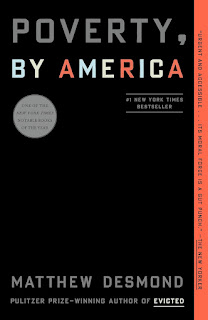
POVERTY, BY AMERICA (audiobook) by Matthew Desmond


Published in 2023 by Random House Audio.
Read by Dion Graham.
Duration: 5 hours, 40 minutes.
Unabridged.


As of the day I am writing this review, 7 of the top 10 richest people in the world live in the United States (the least wealthy has $80 billion.) The rate continues on when you go down the list - 14 of the top 20 live in the United States. 

The United States has 650 billionaires.

But, the official poverty rate in the United States at this moment is 11.5% - the highest rate in the in the leading industrialized economies of the world. This chart shows that it has bounced around between 10.5% and 15%, depending on the economic recessions and the like for the last 30 years. During this entire time, the United States has been the leader in wealth creation for the entire planet.

The author, Matthew Desmond
Sociology professor Matthew Desmond set out to find out why.

It's easy to look at those billionaires and note that they don't pay their fair share. The tax code is tailor made to keep them rich. There are deductions and accounting tricks that people who make less than a million dollars a year cannot imagine. 

But, Desmond notes that people who make less than a million dollars a year take advantage of deductions and accounting tricks that people living in poverty can ever imagine taking.

For example, in my state (Indiana) there is a 20% state income credit for every dollar placed in a 529 college savings account. The growth in value is not taxed and for every dollar you put in up to $7,500 you get 20 cents back. Put in the full amount, the taxpayers of Indiana give you $1,500. Show me a family of four living at the poverty line ($30,000 in 2023 according to this chart) that has an extra $7,500 - or even $500 - sitting around to invest in a college savings account. 

Poor people can receive rent subsidies - if there are enough funds and enough spots available. But everyone with a mortgage receives a mortgage subsidy by being able to write off the mortgage interest. That subsidy has no practical limit. You can get it for financing a tiny home in rural Arkansas or a penthouse condo that looks over Central Park in NYC. That adds up to billions upon billions of dollars every year.

Desmond goes on like this to demonstrate that the system is almost like an inverse pyramid - the higher up you go the more perks and discounts and breaks you get. And, at the bottom, there's some perks - but nothing like you get at the top where some people (like our 45th President) don't even pay federal income taxes some years. Former President Trump paid no taxes in 2020 and only $750 in 2017 and 2018. From 2015-2020 he paid $1.8 million in taxes, which is a lot, but he claims to be a billionaire. A billion is 1,000 million dollars, so he paid about 2/1,000 of his total wealth. I know I paid more than 2/1,000 of my total wealth in my combined federal income taxes for those six years.

Desmond goes on with other things. For example, you can get approved to pay a $1,700/month rent so much easier than to pay a $1,200/month mortgage on the same property. Profit margins on rentals are the highest in poor neighborhoods - even after factoring in things like more maintenance on the (typically) older homes in poorer neighborhoods.

The audiobook was read by Dion Graham who is simply one of the best audiobook readers on the scene right now. 

I rate this audiobook 5 stars out of 5. It will certainly give you plenty to think about. It can be found on Amazon.com here: Poverty by America by Matthew Desmond

This article from NPR does a very good job of reviewing this book as well.

TRACKERS (Trackers, Book 1) (audiobook) by Nicholas Sansbury Smith


Published in 2017 by Blackstone Audio, Inc.
Read by Bronson Pinchot
Unabridged.

Synopsis:

A Colorado police chief named Colton has organized a search for a young girl he suspects has been abducted. He reaches out to the best tracker he knows, Sam "Raven" Spears, for help. Raven is part Sioux and part Cherokee - an important fact because he soon suspects that the abductor is acting out a Cherokee legend featuring cannibals. 

While Colton and Raven are on the hunt, there is a North Korean EMP attack on the United States. For those not aware, EMP stands for Electromagnetic Pulse. Nuclear weapons emit a pulse that absolutely fries most electronics. If you bomb a city normally, the pulse is limited by hills, buildings, and lots of other things.

But, if you blow a nuclear bomb up high up in the air, the bomb doesn't do a lot of damage but the EMP kills all exposed modern cars (older cars have no computer systems, electrical systems, power plants, airplanes, ships, radios, phones, etc. 

The idea behind the North Korean attack is that a few nuclear bombs can expose most of the United States to multiple EMPs and cause our entire society to collapse. EMPs also generate radiation so there will be a weaponized radiation in the form of radioactive rain.

Colton and Raven continue their hunt while also dealing with the collapse of modern American society...

My Review: 

I've read a small handful of novels that feature EMP attacks and more than my share of creepy serial killer books. You'd think that mixing them together would be extra interesting and exciting. But, this was not a good mix. This should have been separated into two books so that the creepy serial killer had more development and had more exploration into the Cherokee mythological story that inspired his craziness.

It sounds like the aftermath of the EMP attack is explored in the next three books in this series but I will not be continuing on.

Why not?

Despite some good moments, so much of this book felt clunky and tired in this book. Surprisingly, even top-notch audiobook reader Bronson Pinchot sounded like he was just mailing it in.

I rate this audiobook 3 stars out of 5. It can be found on Amazon.com here: TRACKERS (Trackers, Book 1) (audiobook) by Nicholas Sansbury Smith.

THE WILD ONE (Peter Ash series #5) (audiobook) by Nick Petrie


Read by Stephen Mendel.
Duration: 9 hours, 59 minutes.
Unabridged.

Synopsis:

Peter Ash is a veteran of the Iraq and Afghanistan Wars. He served with the Marines and even though he is back at home - he is not. He wanders because he can't stay indoors due to PTSD manifesting as claustrophobia. As he wanders, he finds good people in trouble and he tries to get them out of trouble. 

In the past he's been in Milwaukee, Oregon and Washington State, Colorado and Memphis. This time he's in Iceland. 

Ash has been hired by a rich grandmother to find her son-in-law and her grandson. Police in Maryland believe that her son-in-law killed her daughter, kidnapped her grandson, and took him to his home country - Iceland.

So, Peter Ash somehow braves an airplane trip and arrives in Iceland only to find that this case is way more complicated than he ever imagined...

My Review:

Despite the obvious plot hole of a man with SEVERE claustrophobia riding on a jet airplane across North America and halfway to Europe, this book is actually quite good. The action drives the story at a very quick pace and the author keeps adding new bits of mystery.

For my review of the fourth book in this series I wrote:

The series also has a formula that I happen to like. It would be wise of Petrie to shake it up a bit, but it is a formula that is working for me.

This book certainly shook up the formula. Good for Nick Petrie.

The reader, Stephen Mendel, did a fantastic job with a wide variety of accents.

I rate this audiobook 5 stars out of 5. It can be found on Amazon.com here: THE WILD ONE (Peter Ash series #5) by Nick Petrie.

Featured Post

<b><i>BAN THIS BOOK (audiobook)</i></b> by Alan Gratz

Published in 2017 by Blackstone Audio, Inc. Read by Bahni Turpin. Duration: 5 hours, 17 minutes. Unabridged. My Synopsis Ban This Book is t...

Popular posts over the last 7 days