THANK YOU for VOTING: THE MADDENING, ENLIGHTENING, INSPIRING TRUTH ABOUT VOTING in AMERICA (audiobook) by Erin Geiger Smith


Read by Lisa Cordileone.
Duration: 6 hours, 3 minutes.
Unabridged.


As the title says, his book is intended to be a primer on the history of elections in America and how elections work now in different states. It was thorough enough without drowning the listener in details.

The book does a solid job with both of those major topics without feeling partisan. Those topics comprise the first and last two hours of this audiobook. The middle two hours just felt like padding. There was an extended discussion of how to raise the voter participation rate that just dragged with discussions of how businesses can encourage employees to vote, ad campaigns from local government, and so on. 

I would rate the first two sections 4 stars out of 5, but the middle section is a 2 out of 5 at best. That makes a final score of 3 out of 5.

This book can be found on Amazon.com here: THANK YOU for VOTING: THE MADDENING, ENLIGHTENING, INSPIRING TRUTH ABOUT VOTING in AMERICA (audiobook) by Erin Geiger Smith.


FIGHTER PILOT: THE WORLD WAR II CAREER of ALEX VRACIU by Roy E. Boomhower


Published in 2010 by Indiana Historical Society Press.

Alex Vraciu (1918-2015) was a World War II flying ace, ranking fourth in the U.S. Navy in World War II. He destroyed 19 Japanese planes in the air and 21 on the ground. 

This short book is very approachable and tells the story of Vraciu's childhood during the Great Depression in Northwest Indiana (now commonly known as "The Region") and his college years at DePauw University in Greencastle, Indiana. 

Vraciu took advantage of a U.S. government program that trained civilians to be pilots with the understanding that if the U.S. went to war those pilots would become military pilots. He trained in Muncie, Indiana and immediately joined the U.S. Navy after the Japanese attack on Pearl Harbor on December 7, 1941.

Vraciu had a remarkable military career over the next 23 years. Besides destroying 40 Japanese planes, he lost multiple planes, including being shot down over the Philippines and leading a group of guerrilla fighters against the Japanese, he became a test pilot, he led squadrons after they navy transitioned to jets and scored the highest in the predecessor to the Navy's "Top Gun" training program in a jet 12 years after the end of World War II. 

The book is very readable and full of interesting photographs. It would be good for a well-read student of World War II or an interested newbie. I rate it 5 stars out of 5. It can be found on Amazon.com here: FIGHTER PILOT: THE WORLD WAR II CAREER of ALEX VRACIU by Roy E. Boomhower.

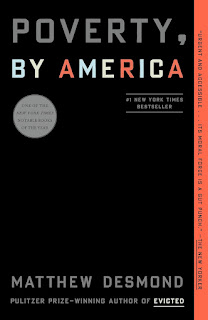
POVERTY, BY AMERICA (audiobook) by Matthew Desmond


Published in 2023 by Random House Audio.
Read by Dion Graham.
Duration: 5 hours, 40 minutes.
Unabridged.


As of the day I am writing this review, 7 of the top 10 richest people in the world live in the United States (the least wealthy has $80 billion.) The rate continues on when you go down the list - 14 of the top 20 live in the United States. 

The United States has 650 billionaires.

But, the official poverty rate in the United States at this moment is 11.5% - the highest rate in the in the leading industrialized economies of the world. This chart shows that it has bounced around between 10.5% and 15%, depending on the economic recessions and the like for the last 30 years. During this entire time, the United States has been the leader in wealth creation for the entire planet.

The author, Matthew Desmond
Sociology professor Matthew Desmond set out to find out why.

It's easy to look at those billionaires and note that they don't pay their fair share. The tax code is tailor made to keep them rich. There are deductions and accounting tricks that people who make less than a million dollars a year cannot imagine. 

But, Desmond notes that people who make less than a million dollars a year take advantage of deductions and accounting tricks that people living in poverty can ever imagine taking.

For example, in my state (Indiana) there is a 20% state income credit for every dollar placed in a 529 college savings account. The growth in value is not taxed and for every dollar you put in up to $7,500 you get 20 cents back. Put in the full amount, the taxpayers of Indiana give you $1,500. Show me a family of four living at the poverty line ($30,000 in 2023 according to this chart) that has an extra $7,500 - or even $500 - sitting around to invest in a college savings account. 

Poor people can receive rent subsidies - if there are enough funds and enough spots available. But everyone with a mortgage receives a mortgage subsidy by being able to write off the mortgage interest. That subsidy has no practical limit. You can get it for financing a tiny home in rural Arkansas or a penthouse condo that looks over Central Park in NYC. That adds up to billions upon billions of dollars every year.

Desmond goes on like this to demonstrate that the system is almost like an inverse pyramid - the higher up you go the more perks and discounts and breaks you get. And, at the bottom, there's some perks - but nothing like you get at the top where some people (like our 45th President) don't even pay federal income taxes some years. Former President Trump paid no taxes in 2020 and only $750 in 2017 and 2018. From 2015-2020 he paid $1.8 million in taxes, which is a lot, but he claims to be a billionaire. A billion is 1,000 million dollars, so he paid about 2/1,000 of his total wealth. I know I paid more than 2/1,000 of my total wealth in my combined federal income taxes for those six years.

Desmond goes on with other things. For example, you can get approved to pay a $1,700/month rent so much easier than to pay a $1,200/month mortgage on the same property. Profit margins on rentals are the highest in poor neighborhoods - even after factoring in things like more maintenance on the (typically) older homes in poorer neighborhoods.

The audiobook was read by Dion Graham who is simply one of the best audiobook readers on the scene right now. 

I rate this audiobook 5 stars out of 5. It will certainly give you plenty to think about. It can be found on Amazon.com here: Poverty by America by Matthew Desmond

This article from NPR does a very good job of reviewing this book as well.

TRACKERS (Trackers, Book 1) (audiobook) by Nicholas Sansbury Smith


Published in 2017 by Blackstone Audio, Inc.
Read by Bronson Pinchot
Unabridged.

Synopsis:

A Colorado police chief named Colton has organized a search for a young girl he suspects has been abducted. He reaches out to the best tracker he knows, Sam "Raven" Spears, for help. Raven is part Sioux and part Cherokee - an important fact because he soon suspects that the abductor is acting out a Cherokee legend featuring cannibals. 

While Colton and Raven are on the hunt, there is a North Korean EMP attack on the United States. For those not aware, EMP stands for Electromagnetic Pulse. Nuclear weapons emit a pulse that absolutely fries most electronics. If you bomb a city normally, the pulse is limited by hills, buildings, and lots of other things.

But, if you blow a nuclear bomb up high up in the air, the bomb doesn't do a lot of damage but the EMP kills all exposed modern cars (older cars have no computer systems, electrical systems, power plants, airplanes, ships, radios, phones, etc. 

The idea behind the North Korean attack is that a few nuclear bombs can expose most of the United States to multiple EMPs and cause our entire society to collapse. EMPs also generate radiation so there will be a weaponized radiation in the form of radioactive rain.

Colton and Raven continue their hunt while also dealing with the collapse of modern American society...

My Review: 

I've read a small handful of novels that feature EMP attacks and more than my share of creepy serial killer books. You'd think that mixing them together would be extra interesting and exciting. But, this was not a good mix. This should have been separated into two books so that the creepy serial killer had more development and had more exploration into the Cherokee mythological story that inspired his craziness.

It sounds like the aftermath of the EMP attack is explored in the next three books in this series but I will not be continuing on.

Why not?

Despite some good moments, so much of this book felt clunky and tired in this book. Surprisingly, even top-notch audiobook reader Bronson Pinchot sounded like he was just mailing it in.

I rate this audiobook 3 stars out of 5. It can be found on Amazon.com here: TRACKERS (Trackers, Book 1) (audiobook) by Nicholas Sansbury Smith.

THE WILD ONE (Peter Ash series #5) (audiobook) by Nick Petrie


Read by Stephen Mendel.
Duration: 9 hours, 59 minutes.
Unabridged.

Synopsis:

Peter Ash is a veteran of the Iraq and Afghanistan Wars. He served with the Marines and even though he is back at home - he is not. He wanders because he can't stay indoors due to PTSD manifesting as claustrophobia. As he wanders, he finds good people in trouble and he tries to get them out of trouble. 

In the past he's been in Milwaukee, Oregon and Washington State, Colorado and Memphis. This time he's in Iceland. 

Ash has been hired by a rich grandmother to find her son-in-law and her grandson. Police in Maryland believe that her son-in-law killed her daughter, kidnapped her grandson, and took him to his home country - Iceland.

So, Peter Ash somehow braves an airplane trip and arrives in Iceland only to find that this case is way more complicated than he ever imagined...

My Review:

Despite the obvious plot hole of a man with SEVERE claustrophobia riding on a jet airplane across North America and halfway to Europe, this book is actually quite good. The action drives the story at a very quick pace and the author keeps adding new bits of mystery.

For my review of the fourth book in this series I wrote:

The series also has a formula that I happen to like. It would be wise of Petrie to shake it up a bit, but it is a formula that is working for me.

This book certainly shook up the formula. Good for Nick Petrie.

The reader, Stephen Mendel, did a fantastic job with a wide variety of accents.

I rate this audiobook 5 stars out of 5. It can be found on Amazon.com here: THE WILD ONE (Peter Ash series #5) by Nick Petrie.

THE COMPLETE MAUS (graphic novel) by Art Spiegelman


Originally published in serial form in Raw magazine from 1980-1991.
Originally published in book form in 1991 by Pantheon Books.

Winner of the Pulitzer Prize in 1992.

Years ago, the high school where I used to teach had a daily silent reading time. We were encouraged to build a classroom library and I had a great one. Two stand alone shelves (one tall, one short) and a little rug in the corner with a chair. I had a lot of books from a lot of different genres but the star books were Of Mice and Men and the two volume paperback version of Maus. Kids kept on stealing Of Mice and Men (If a kid likes it so much that he doesn't want to return it - fine by me) but so many students read Maus that the paperback binding broke and the pages fell out. It was held together with binder clips and big rubber bands. 

What I remember about that book is that every student reverently took off that ridiculous clip and the big rubber band, spread the pages out and just read. Students who "hated to read" read that book. Afterwards, they carefully put it back together again - in order - when they were done. These two books had power and painful truth. They knew it and they respected it.

I'd forgotten all about Maus, the binder clips, and the big rubber bands until I heard about a school board in Tennessee dropping this book from their curriculum due to rough language, nudity and a suicide. Funny how war, genocide and untreated PTSD from having almost all of your family and friends systematically murdered leads to a bit of cursing.

Missouri joined in as well. School districts banned the book because they think it fits the definition of "explicit sexual material." State law would punish them for exposing minors to "explicit sexual material" even though state law also mandates the teaching of the Holocaust. T
here is nudity, but it is rare and it is certainly not racy stuff.

The arrival at Auschwitz
The book is the story of the author's father during World War II. He was a recently married Jewish businessman in Poland before World War II. He had a young son. Their community is forced to move, go into urban ghettos and eventually into the death camp at
Auschwitz. Some hide, some run but they almost all end up in the camps. Most of his father's family and friends die, including his little boy - the older brother that the author never knew.

Spiegelman illustrates his father's story as a series of flashbacks. You can see that his father is miserable and his mother killed herself years earlier. 

There are no "people" in the book. The Jews are mice, the Nazis are cats, the Poles are pigs, the French are frogs and the Americans are dogs. I like the last bit since Hitler regularly referred to Americans as a mongrel people.

This is a powerful book - it is also a tough book. The war still reverberates through our world. We can recognize it and educate our children or we can ignore it.

I rate this graphic novel 5 stars out of 5. It can be found on Amazon.com here: THE COMPLETE MAUS (graphic novel) by Art Spiegelman.

McCLELLAN and FAILURE: A STUDY of CIVIL WAR FEAR, INCOMPETENCE and WORSE by Edward H. Bonekemper, III


Originally published in 2007.
Published in 2010 by McFarland and Company, Inc.


If you are a student of the Civil War, George B. McClellan is a conundrum at best.

After the Frist Battle of Bull Run (Manassas) in July of 1861, the poorly trained Union Army had fled back to Washington, D.C. They were basically a semi-organized mob awaiting someone to take the lead.

Lincoln looked around and felt that the leadership team that lost at Bull Run was not going to provide a credible lead general so he looked around the Eastern Theater for anyone else with the aura of success.

George B. McClellan had a bit of success in Western Virginia and wrote a lot of reports that made him seem an even better General than he was so Lincoln looked to him to retrain and refit the Army of the Potomac (the main Union Army in the East.)

Statue of McClellan outside of the
city hall in Philadelphia. It was 
dedicated in 1894.  I have no idea
why they felt he deserved this honor.
When I have talked with students about McClellan, I like to compare him to a nervous guy who restores cars. He finds a junker with lots of potential, restores it, and then is afraid to take it out and drive it (the entire purpose of a car) because it might get wrecked again. His men loved him for that - they didn't want to go out and fight and die in a pointless battle. But it was up to McClellan to find a way to take the fight to the enemy and the purpose of an army is to fight, to kill people and blow up things, not to drill and drill and drill while the enemy sits just a few miles away in the middle of the war. 

McClellan took over 8 months to rebuild the army before he took it out to fight. It was the largest army of the entire Civil War and was magnificently well-supplied.  His predecessor had only been in charge of the same army for about 6 weeks when he took to the field. 

Bonekemper documents McClellan's excuses, his time wasted on political lobbying, writing political advice to the President, and his constant inflation of the size of Confederate armies. Bonekemper also makes a strong case that McClellan didn't want to push too hard against the Confederacy because he was pro-slavery and that he let another Union Army be defeated at the Second Battle of Bull Run in August of 1862 out of jealousy.

Once again - the most important general in the U.S. Army refused to engage the enemy because he sympathized with their war aims and he let an entire Union army be defeated when he was ordered to provide assistance because he was angry that the other army had an independent command.

Did McClellan make up for that by being a brilliant field general? No. His own men (generals and even privates) noted that he led from far behind the lines and rarely directed the men once the fighting started.

His last battle of any size was Antietam. Have you ever seen a karate movie where the group of bad guys engage the good guy by taking turns so he can defeat them all one at a time? That's how McClellan engaged with Robert E. Lee's much smaller Army of Norther Virginia - one brigade at a time and Lee basically fought them all to a draw - one brigade at a time.

In a modern army, McClellan may have had found a place dealing with logistics and training - procuring supplies and recruiting soldiers, training them and sending them to the front. But, that was not how things worked in the Civil War.

Of course, Bonekemper lays all of this in detail with the original sources and quotes. A lot of historians give McClellan a pass of sorts. To be honest, I don't know why. This book makes it clear that they shouldn't - he was among the worst of the Union generals.

I rate this book 5 stars out of 5. It can be found on Amazon.com here: McCLELLAN and FAILURE: A STUDY of CIVIL WAR FEAR, INCOMPETENCE and WORSE by Edward H. Bonekemper, III.

Featured Post

<b><i>BAN THIS BOOK (audiobook)</i></b> by Alan Gratz

Published in 2017 by Blackstone Audio, Inc. Read by Bahni Turpin. Duration: 5 hours, 17 minutes. Unabridged. My Synopsis Ban This Book is t...

Popular posts over the last 7 days