McCLELLAN and FAILURE: A STUDY of CIVIL WAR FEAR, INCOMPETENCE and WORSE by Edward H. Bonekemper, III


Originally published in 2007.
Published in 2010 by McFarland and Company, Inc.


If you are a student of the Civil War, George B. McClellan is a conundrum at best.

After the Frist Battle of Bull Run (Manassas) in July of 1861, the poorly trained Union Army had fled back to Washington, D.C. They were basically a semi-organized mob awaiting someone to take the lead.

Lincoln looked around and felt that the leadership team that lost at Bull Run was not going to provide a credible lead general so he looked around the Eastern Theater for anyone else with the aura of success.

George B. McClellan had a bit of success in Western Virginia and wrote a lot of reports that made him seem an even better General than he was so Lincoln looked to him to retrain and refit the Army of the Potomac (the main Union Army in the East.)

Statue of McClellan outside of the
city hall in Philadelphia. It was 
dedicated in 1894.  I have no idea
why they felt he deserved this honor.
When I have talked with students about McClellan, I like to compare him to a nervous guy who restores cars. He finds a junker with lots of potential, restores it, and then is afraid to take it out and drive it (the entire purpose of a car) because it might get wrecked again. His men loved him for that - they didn't want to go out and fight and die in a pointless battle. But it was up to McClellan to find a way to take the fight to the enemy and the purpose of an army is to fight, to kill people and blow up things, not to drill and drill and drill while the enemy sits just a few miles away in the middle of the war. 

McClellan took over 8 months to rebuild the army before he took it out to fight. It was the largest army of the entire Civil War and was magnificently well-supplied.  His predecessor had only been in charge of the same army for about 6 weeks when he took to the field. 

Bonekemper documents McClellan's excuses, his time wasted on political lobbying, writing political advice to the President, and his constant inflation of the size of Confederate armies. Bonekemper also makes a strong case that McClellan didn't want to push too hard against the Confederacy because he was pro-slavery and that he let another Union Army be defeated at the Second Battle of Bull Run in August of 1862 out of jealousy.

Once again - the most important general in the U.S. Army refused to engage the enemy because he sympathized with their war aims and he let an entire Union army be defeated when he was ordered to provide assistance because he was angry that the other army had an independent command.

Did McClellan make up for that by being a brilliant field general? No. His own men (generals and even privates) noted that he led from far behind the lines and rarely directed the men once the fighting started.

His last battle of any size was Antietam. Have you ever seen a karate movie where the group of bad guys engage the good guy by taking turns so he can defeat them all one at a time? That's how McClellan engaged with Robert E. Lee's much smaller Army of Norther Virginia - one brigade at a time and Lee basically fought them all to a draw - one brigade at a time.

In a modern army, McClellan may have had found a place dealing with logistics and training - procuring supplies and recruiting soldiers, training them and sending them to the front. But, that was not how things worked in the Civil War.

Of course, Bonekemper lays all of this in detail with the original sources and quotes. A lot of historians give McClellan a pass of sorts. To be honest, I don't know why. This book makes it clear that they shouldn't - he was among the worst of the Union generals.

I rate this book 5 stars out of 5. It can be found on Amazon.com here: McCLELLAN and FAILURE: A STUDY of CIVIL WAR FEAR, INCOMPETENCE and WORSE by Edward H. Bonekemper, III.

THE FREE FALL of WEBSTER CUMMINGS (audiobook) by Tom Bodett


Originally published in 1995 by Brilliance Audio.
Read by the author, Tom Bodett.
Duration: 15 hours, 43 minutes.
Unabridged.


The author and narrator.
I think Tom Bodett's End of the Road series of short stories is just one of the best audiobook experiences out there. Technically, this book is part of that series even though almost none of it takes places in that oddball community of End of the Road, Alaska (it earned its name by being, well, the place where the road ends.)

Bodett is well-known as a frequent panelist on the NPR show Wait Wait...Don't Tell Me! but he is most well-known for his voiceovers for Motel 6 in which he promised in his folksy way, "We'll leave the light on for you."

I say all of this just to say that this book was a major disappointment. 

Everything about this book seems like it should work. It has a grounding in his Alaska stories. It consists of a series of short stories - his area of expertise.

But, there is just way too much going on in this book. There are way too many plotlines going on and Bodett tries to weave them together so they all tie up in a couple of nice little knots at the end and he just doesn't get it done.

There are two plotlines from Alaska, two plotlines from Seattle (one is mysteriously dropped about 1/3 into the book), a cross country plotline from New York City and Los Angeles, a family from Ohio that heads west in stages to find themselves (one finds that Indiana may be far enough west), supernatural forces, PTSD, memory loss, mysticism and a man named Webster Cummings who fell more than a mile from a commercial jet plane over New England and survived. Webster near death experience inspired him to find his biological parents. 

Just too much and I just ended up wanting it to end.

I rate this audiobook 2 stars out of 5. It can be found on Amazon.com here: THE FREE FALL of WEBSTER CUMMINGS (audiobook) by Tom Bodett.
.

IT WILL ALL WORK OUT: THE FREEDOM of LETTING GO (kindle) by Kevin Hart


Published by Amazon Original Stories in August of 2023.

The author
Actor and comedian and author Kevin Hart delivers a short book on how give yourself and all of those around you a break by giving up that feeling that you have to literally do everything yourself and it all has to be done your way.

There was literally nothing wrong with Hart's advice - it's actually excellent advice - but for a 44 page book it was repetitive. 

Hart frequently attempts to put a bit of humor in the book, but I found myself wishing that I was watching Hart deliver a TED Talk so that the humor and stories would actually work so much better. 

Maybe if this had been an audiobook....

I rate this e-book 3 stars out of 5. It can be found on Amazon.com here: IT WILL ALL WORK OUT: THE FREEDOM of LETTING GO (kindle) by Kevin Hart

BAG LIMIT (Posadas County Mysteries #9) (audiobook) by Steven F. Havill


Published in 2001 by Books In Motion.
Read by Rusty Nelson.
Duration: 11 hours, 59 minutes.
Unabridged.


Synopsis:

Sheriff Bill Gastner is coming to the end of his appointed term as Sheriff of Posadas County - a border county in southern New Mexico. Bill has been in the department in one form of another for 31 years and he is looking forward to a well-deserved retirement with no real plans for how to fill his days.

Bill Gastner has got a wild last few days as Sheriff  - he has a drunken teen driver with a fake driver's license issue by the department of motor vehicles, two damaged police cars, two other teens in the hospital, and more.

My Review:

I am a big fan of this series. I love old Bill Gastner - he has insomnia, happily eats the same pepper-filled burrito at the same restaurant 2 or even 3 meals per day, and relies on experience more than the speed an agility of younger officers.

But, this book was padded with a whole lot of nothing. We meet Gastner's son and grandson who are completely incidental to the mystery in the story. We learn about how Gastner's high school-aged grandson is a completely amazing young man who can cook, befriend little kids, enjoy watching old Westerns and even speak Spanish! However, if you took this remarkable young man out of the story it would be 2 hours shorter and nothing would change in the main plot. 

I estimate that the book was about 50% padding and that made a story that started out so strong at the beginning and ended with a lot of twists and turns just a tedious muddle in the middle. 

I rate this book a generous 3 stars out of 5. It can be found on Amazon.com here: BAG LIMIT (Posadas County Mysteries #9) (audiobook) by Steven F. Havill.

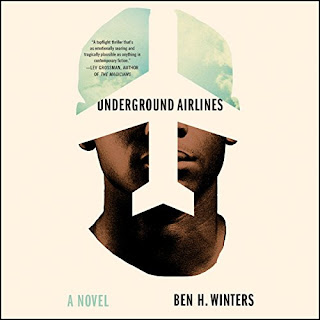
UNDERGROUND AIRLINES (audiobook) by Ben H. Winters


Underground Airlines is set in the year 2015 in an alternate historical timeline. This is a world where the American Civil War almost happened but did not. In the real historical timeline, an amendment to the Constitution called the Crittenden Compromise was proposed in December of 1860 as the first Confederate states were seceding. It preserved slavery, limited its spread and clarified the role of the federal government in returning runaway slaves. The Crittenden Compromise was not taken seriously by most people and it failed.

In this alternate history, the Crittenden Compromise was taken  seriously because President-elect Lincoln was assassinated in Indianapolis as he was traveling to his inauguration in Washington, D.C. The shock of the assassination brought all of the states back together to negotiate and a version of the Crittenden Compromise passed. There was no Civil War and American slavery continues in 4 states on into the 21st century (Louisiana, Mississippi, Alabama and a combined North/South Carolina.

The protagonist of the book is an escaped slave turned into a hunter of escaped slaves. He is working undercover using the name Jim in Indianapolis, Indiana tracking down an escaped slave. He's bothered a bit because the paperwork for this slave is very incomplete and this is rare. Usually, slaves are meticulously tracked, literally tattooed, bar coded and even chipped. 

Jim is nervous because the incomplete file. But, as you can imagine, he's not happy being an escaped slave who hunts down escaped slaves - but he has no choice. He is chipped with a device in his neck that tracks him and, with the flip of a switch, can kill him. It puts him an emotionally painful paradox - in order to maintain his freedom he must catch others.

Jim meets all kinds of people as he searches through Indianapolis - members of the Underground Airlines (the modern successor to the Underground Railroad movement of the 1800s), militant anti-slavers, militant pro-slavers, a white woman searching for the love of her life (an escaped slave), members of the black market that exists in freedman neighborhoods, and more. 

Still, once he finds out what is going on, it involves more than he could ever imagine and makes him go where he never thought he would go...

My review:

I am a fan of:

1) alternate histories,
2) study of the Civil War,
3) my adopted hometown - Indianapolis.

This means I was pretty much perfectly set up to enjoy this book and I did. This was a well-told story. I enjoyed learning about how this alternate world was different and the same. For example, Michael Jackson is a big deal in this alternate world, too.

But, the United States is technologically behind the rest of the world by a few years due to anti-slavery boycotts by the rest of the world and lack of technical innovation coming from America itself. It's about 20 years behind and not really an economic leader in anything except the production of cotton and cotton clothing.  America's big ally is South Africa, with its policy of apartheid.

It's clear that Ben H. Winters knows his way around Indianapolis. Indy is my adopted hometown - I've lived here for 30 years. Every bit of Indianapolis he describes makes sense historically. 

I enjoyed this book. I rate it 5 stars out of 5. It can be found on Amazon.com here: UNDERGROUND AIRLINES by Ben H. Winters.

THE GRAPES of WRATH (audiobook) by John Steinbeck


Originally Published in 1939.
Audiobook version published in 2011 by Penguin Audio.
Performed by Dylan Baker.
Duration: 21 hours, 1 minute.
Unabridged.

Winner of the National Book Award.
Winner of the Pulitzer Prize.
Declared to be the best-selling book of 1939 by the New York Times.

I last read The Grapes of Wrath when I was in high school, nearly 40 years ago. It was assigned reading for my English class and all I really remembered about it was a couple of scenes. I remembered the last scene, with the flood and starving man. And I remembered and early scene where the tractor operator is plowing up the farms, the farmyards and even intentionally damaging homes in Oklahoma. Besides that, I had nothing but a pervasive memory of sorrow and injustice.

I've always thought of this book and Of Mice and Men as kind of a set of books about migrant farm workers during the Great Depression. I've read Of Mice and Men 5 or 6 times, though - a fact that I can one hundred percent attribute to the fact that The Grapes of Wrath is 6 or 7 times longer. 

The Grapes of Wrath is longer and it is much more powerful. 

I am not going to go through all of the plot details for a book that has been labeled in the top 100 books by Le Monde, the BBC, Time magazine and The Daily Telegraph, but I am going to tell you the thoughts I had as I listened.

The book follows the Joad family as they lose their farm, load up all of their family and their worldly goods and head off to California in search of plentiful farm labor jobs that they have been told exist. They join tens of thousands of economic refugees and take Route 66 to California. Collectively, they were insultingly referred to as "Okies."

The problem is that while the jobs do exist, California is a magnet for economic refugees having 10 men and women show up for each job drives the wage down to starvation level. No one can get ahead and they are forced to live in shanty town camps on the edge of town. When the harvests are done, the sheriff and a bunch of local tough guys force everyone out and burn the camp to the town so they can't settle down.

As I was listening, I noted that some things haven't changed. Any time someone discusses organizing the workers or improving the working conditions someone accuses them of being a socialist. Not much has changed almost 85 years later. There are also parallels to the modern era migrant farm workers.

This book is compelling from beginning to end and is performed (not read - performed) wonderfully by Dylan Baker. He creates a series of unique voices and just hits all of the right notes throughout. 

This book deserves all of the hype.

I rate this book 5 stars out of 5. It can be found on Amazon.com here: THE GRAPES of WRATH (audiobook) by John Steinbeck.

ANNE FRANK'S DIARY: THE GRAPHIC ADAPTATION (graphic novel) by Anne Frank (author), Ari Folman, and David Polonsky (illustrator)


Originally published as a book in 1947.
Graphic novel e-book edition published in 2018 by Pantheon.
Adapted into a graphic novel by Ari Folman.

The Diary of Anne Frank is certainly one of the most famous pieces of literature published in the last 100 years. The book the true diary of a young teen Jewish girl that was written as her family lived in a hidden apartment with two other families in an attempt to hide from the Nazi genocide. Before the war ended someone betrayed the families and Anne and almost everyone else in the apartment died in concentration camps shortly before the Nazi surrender.

A page where Anne compares herself
unfavorably to her sister.
Ari Folman adapted the diary into a graphic novel. In the afterword he notes that this was harder than one might expect. This graphic novel is 160 pages, but if he had simply illustrated the entire text of the diary it would have ended up being more than 3,000 pages! The challenge was to maintain the spirit of the print book while editing it down.

I think the book is beautifully illustrated. The moods, emotions, and simple displays of teen attitude come through loud and clear - and make her come to life.

The graphic novel is excellent, which is why it is too bad that it is on a lot of banned book lists. In Florida, Moms for Liberty asked for the book to be banned because of two scenes described like this by Katie Couric in an article: 
it features two “sexually explicit” scenes. In the first, Frank walks along a series of nude statues, and in another, she asks a friend if they want to show each other their breasts." The Moms argue that the book does not accurately teach about the Holocaust because of these pages - as if Nazi hatred were only aimed at Jews.

Anne Frank's diary has always been edited to make the story flow better, but it also was edited to take out some embarrassing details about the family. Those edits included Anne Frank's passing thoughts about possibly being interested in women as well as men. In the 1950s this might have been a deal breaker with potential publishers so it was left out. This is ironic considering that gays and lesbians were sent to the camps by the Nazis with just as much enthusiasm as Jews - but, that was the politics of the day.

It turns out that it also the politics of now. A teacher in Texas was fired because those pages were read aloud in her class. 

It must be noted that even if Anne Frank were not Jewish, she would have been sent to the camps for being bisexual.

I rate this graphic novel 5 stars out of 5. It can be found on Amazon.com here: 
ANNE FRANK'S DIARY: THE GRAPHIC ADAPTATION (graphic novel) by Anne Frank (author), Ari Folman, and David Polonsky (illustrator).

Featured Post

<b><i>BAN THIS BOOK (audiobook)</i></b> by Alan Gratz

Published in 2017 by Blackstone Audio, Inc. Read by Bahni Turpin. Duration: 5 hours, 17 minutes. Unabridged. My Synopsis Ban This Book is t...

Popular posts over the last 7 days