RIOT (audiobook) by Walter Dean Myers


Published in 2009 by Listening Library.
Performed by multiple actors.
Duration: 2 hours, 36 minutes.
Unabridged.


July of 1863 was the height of the American Civil War. The month contained the Battle of Gettysburg, the end of the long siege of Vicksburg, and the battle at Battery Wagner where the 54th Massachusetts demonstrated that African American soldiers would be an effective and important addition to the Union Army.

It also featured one of the worst riots in American history - the New York City Draft Riot.

The riot was ostensibly a violent reaction to the imposition of a draft to fulfill state military quotas, but it was more than that and this short audiobook does a very good job of looking at those reasons.

The draft was unpopular for more than just the fact that the men who were drafted did not want to join the army. Rich people could afford to pay $300 to avoid military service if they were drafted. It took most workers more than 6 months or more to earn this sort of money. This encouraged that common refrain that happens in many wars - It was a rich man's war but a poor man's fight.

About 25% of New York City was made up of immigrants from Ireland. Those immigrants were at the bottom of the social and economic heap, but they were afraid that newly freed slaves would work their way to New York City and be willing to work for less, meaning that their wages would have to drop just to compete. 

Those factors combined to make this riot an ugly mix of economic, racial and anti-governmental violence that lasted for 4 days until Union troops arrived fresh from the Battle of Gettysburg to help New York State Militia restore order with gunfire.

This audiobook reads like a television script, including directions for camera cuts and the like. The actors who read the audiobook read it like an old-fashioned radio play. A narrator read the direction for the cameras and introduced the characters as they came into the drama.

This drama explores the complicated reasons for the riots and gives the listener a surprisingly nuanced view of the riots. This is especially noteworthy considering that the drama is so short.

The last half hour or so of the audiobook is a podcast-type discussion of the drama and the riots between the author and a history professor. This was especially well-done. 

I rate this audiobook 4 stars out of 5. It can be found on Amazon.com here: RIOT by Walter Dean Myers.

PROHIBITION in the UNITED STATES: A HISTORY from BEGINNING to END (kindle) by Hourly History


Hourly History publishes histories and biographies that you can read in about an hour. That can be a tough job for larger topics in history like "The Industrial Revolution" or "The Roman Empire" but it works out about right for this topic.

This history goes all of the way back to the arrival of the
 Mayflower in 1620. Turns out the Puritans brought hundreds of gallons of alcoholic beverages with them to the New World and immediately set up the means to produce even more.

The book then goes on to show the ups and down of America's relationship with alcohol. When the reader gets to the temperance movement, there is a solid context to understand why the 18th Amendment to the U.S. Constitution was passed in 1919 and why it was eventually abolished by the 21st Amendment a mere 14 years later.

For a short read, this book provides a lot of good, basic information. 

I rate this e-book 5 stars out of 5. It can be found on Amazon.com here: PROHIBITION in the UNITED STATES: A HISTORY from BEGINNING to END (kindle) by Hourly History.


TEAR IT DOWN (Peter Ash #4)(audiobook) by Nick Petrie


Published in 2019 by Penguin Audio.
Read by Stephen Mendel.
Duration: 11 hours.
Unabridged.


Synopsis:

Peter Ash served multiple tours of duty with the Marines in Iraq and Afghanistan. When he left the service, he wandered the roads of America - partly because he could not find a place to settle down and partly because he suffers from claustrophobia as a form of PTSD. He can't sleep indoors. He has a very tough team being inside unless it's a spacious room or has lots and lots of windows. 

The author, Nick Petrie.
Peter has been living with his very serious (and very rich) girlfriend helping maintain her compound and recuperating from the misadventures of the last book. But...he's getting bored.

His girlfriend gets word from a friend named Wanda in Memphis that people are threatening her in her new house that she bought in a tax auction. They are throwing bricks through windows and the like. Peter drives across the country in his restored work truck to help keep an eye out. When he arrives he discovers that things have gotten a lot worse.

They're not just throwing bricks any longer - they've driven a dump truck right into her house...

My review:

This owes a lot to Lee Child's Jack Reacher series (lone drifter who is retired from the military who works very well with smart, talented, independent women) and to Robert B. Parker's Spenser series (man with a moral code, a girlfriend and an African American friend with a brother-like bond of questionable background that comes in with things get tough) but it has a distinct voice of its own.

The series also has a formula that I happen to like. It would be wise of Petrie to shake it up a bit, but it is a formula that is working for me.

Petrie's descriptions of a musician in the grove approached poetry. Nicely done. It more than makes up for the touch of the paranormal that was throw in.

I rate this audiobook 5 stars out of 5. It can be found on Amazon.com here: TEAR IT DOWN (Peter Ash #4)(audiobook) by Nick Petrie.

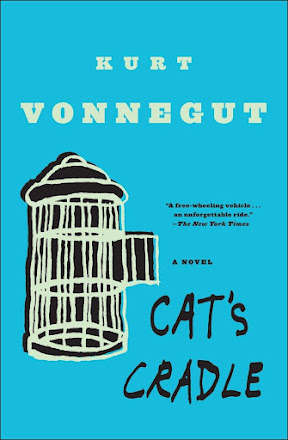
CAT'S CRADLE by Kurt Vonnegut


Originally published in 1963.

Synopsis:

Cat's Cradle
is Kurt Vonnegut's fourth novel. The narrator is a writer who wants to tell the story of the first atomic bombing by telling what various people did that day. One of the people he is interested in is one of the creators of the bomb, a researcher named Felix Hoennikker. 

Hoennikker has already passed away so the author reaches out to his three children and finds two of them. They describe a man with no real emotions. He is not a cruel man, he is utterly detached from everything except research. 

During his interviews with a colleagues at the laboratory he worked at in Ilium, New York (also the setting for his first novel Player Piano, but these books are clearly not in the same time line) the narrator discovers that Hoennikker may have invented a more dangerous weapon than the atomic bomb - a substance called "ice-nine."

Ice-nine was created as a simple thought experiment that came from an offhand comment from a general who had complained about how the U.S. Army kept getting bogged down in the mud. Ice-nine solidifies all of the water it contacts - freezes it at room temperature. And, it keeps spreading. Ice-nine creates more ice-nine as it freezes. Theoretically, if someone dropped it into a body of water it would just keep on going until it runs out of water to freeze. If you dropped it into a river it would just keep going until it got to an ocean and then keep going around the world.

That's when the narrator figures out that each of the three children possesses a chunk of ice-nine and one of them who was missing has just become the head of the military of a very backward third world country in the Caribbean...

My Review: 

Kurt Vonnegut (1922-2007)
This book, unlike the previously mentioned Player Piano, has the complete feel of a Vonnegut novel. There is a lot of dark humor that is barely trying to hide Vonnegut's commentary about the insanity of the Cold War and the concept of Mutual Assured Destruction. It fits in nicely with the 1964 movie Doctor Strangelove.

I found the first part of the book to be fairly slow and tedious (the part described in my synopsis), but the second half zips along pretty well and gets better and better as it gets more ridiculous, including the creation of an original religion.

Vonnegut has a habit of mentioning his native Indiana and/or Indianapolis in his books and this book features plenty of those mentions. 

At one point, Vonnegut gave all of his books a letter grade. He gave Cat's Cradle an A+. I think it was good, but not that good. I will give it a B.

I rate this book 4 out of 5 stars. It can be found on Amazon.com here: CAT'S CRADLE by Kurt Vonnegut.

THE AMERICAN DREAM? A JOURNEY on ROUTE 66 DISCOVERING DINOSAUR STATUES, MUFFLER MEN, and the PERFECT BURRITO: A GRAPHIC MEMOIR by Shing Yin Khor


Published in 2019 by Zest Books.
Illustrated by the author, Shing Yin Khor.


In another recent review I wrote this:

I have a real weakness for oddball travel books. I have read a memoir about a man that hitchhiked throughout Europe and North Africa, a book about a man's bicycle trip from the UK to India, a book about a man who walked across Afghanistan, a book about a man who rode a motorcycle around the edges of Afghanistan, a book about two women who biked from Turkey to China, a book about a man who walked the length of the Nile, a man who walked the Appalachian Trail with his deeply irresponsible friend from high school...and more. And more. And more.

This book continues that tradition with a twist - it is done in comic book style. Usually, this is called a graphic novel, but this book is not a novel because it is not fiction. The author calls it a "graphic memoir."

Illustration from the back cover
The author/illustrator is an immigrant from Malaysia. She came over as a child and is very familiar with southern California. She realizes that she doesn't really know a lot about the rest of her adopted country so she decides to travel the old Route 66.

The author travels with only her little dog as a companion. She is on a tight budget so she often sleeps in her car.

Along the way she sees a lot of interesting Americana, Americans of all types and ponders her relationship with the country and its people. Plus, her dog makes friends everywhere.

I rate this graphic memoir 4 stars out of 5. It can be found on Amazon.com here: THE AMERICAN DREAM? A JOURNEY on ROUTE 66 DISCOVERING DINOSAUR STATUES, MUFFLER MEN, and the PERFECT BURRITO: A GRAPHIC MEMOIR by Shing Yin Khor.

DEAR MARTIN (audiobook) by Nic Stone


Published by Listening Library in 2017.
Read by Dion Graham,
Duration: 4 hours, 32 minutes.
Unabridged.


Synopsis:

Justyce is a African-American scholarship boarding school student originally from a rough neighborhood.  He attends an elite, almost entirely white prep school in Atlanta. He is a senior and a fantastic student who is clearly headed to a top university once he graduates. Everything isn't perfect, but it is going very, very well.

One evening Justyce gets a phone call from an on-again-off-again girlfriend. She is clearly drunk and is talking about driving home. She's not too far away so he walks to her car, gets into an argument with her and struggles with her a bit for the keys while maneuvering her into the backseat where she pukes and passes out. While he is buckling her in to take her home a police officer pulls up and completely misinterprets the scene for a carjacking and a kidnapping. 

From the officer's point of view, it looks suspicious if you go with all of the worst stereotypes. You've got a young black male in a hoodie and a white female (actually she's mixed race, but very light-skinned) being forced into the back of a very nice car in the middle of the night.

This officer is definitely a man who believes in stereotypes. He arrests Justyce, cuffs him and refuses to listen to anything Justyce says. 

While Justyce knows this type of thing happens - but deep down inside he is shocked because it's never happened to him and he didn't think it would happen to a kid like him.

Justyce decides to write out his thoughts on race, racism, policing and life in general in a series of letters to Martin Luther King over the course of the school year, thus the source of the title of the book.

My Review:

Thematically, this book is very similar to the better known YA book The Hate U Give by Angie Thomas. They were published in the same year and are both excellent. The book presents a series of events that are unlikely to all happen to the same character, but do happen all across the country.

The author Nic Stone (left) and the reader Dion Graham.
One thing I very much liked about the book is that it is not literally a black and white book. There is a lot of gray area in this book. All of the white characters aren't racists, all of the black characters aren't saints. Some of the black characters are racist, some the of white characters are pretty saintly. There is also character growth. 

One of the reasons that I decided to listen to this audiobook was a ridiculous news story that I read. A teacher in North Carolina was fired for teaching this book after having sought approval to teach it from the school's administrator. Turns out it possibly violates one of those ridiculous MAGA anti-CRT laws (CRT - the topic that many people are scared of but cannot define.) Not only did the teacher get approval, the principal was enthusiastic about the use of the novel.

Here is a quote from an ABC News story about this case:

Davis claimed that ahead of Black History Month, Gray had a "very intentional conversation" with Rock about what would be an "appropriate curriculum" and that she "specifically said to Mr. Gray that ["Dear Martin"] would be a good book to teach."

What do I think of the audiobook? It is an emotionally engaging book that drags the reader right into the story. It is an excellent book paired with an excellent reader - Dion Graham.

I rate this audiobook 5 stars out of 5. It can be found on Amazon.com here: DEAR MARTIN by Nic Stone.

Update: Dear Martin was also placed on a massive book ban list in Florida.

SOVIET-AFGHAN WAR: A HISTORY from BEGINNING to END (The Cold War) (kindle) by Hourly History


Published in 2023 by Hourly History.

In 1979, the Soviet Union invaded Afghanistan in an effort to stabilize their neighbor. In theory, Afghanistan had a communist government and the USSR had a policy of not letting any communist government fall. 

Soviet troops leaving Afghanistan in 1989 via
a bridge that was special built for the purpose of
letting the USSR withdraw from Afghanistan
even quicker.
In 1989, the Soviet Union finished withdrawing its armed forces from Afghanistan. On paper they had negotiated a stable pro-Soviet government to lead Afghanistan after 10 years of frustrating fighting an elusive enemy that specialized in hitting the much better equipped Soviet army within guerilla hit-and-run tactics. 

Within 3 years both the government of Afghanistan and the government of the USSR had collapsed and Afghanistan became a haven for international Muslim terrorists like Osama bin Laden.

As I read about the difficulties that the Soviets had in fighting against the mujahedeen guerrilla fighters, it struck me that in many ways you could have removed the word Soviet and replaced it with the word American and have a fairly decent description of the American experience in Afghanistan from 2001 to 2021.  

This series is designed to give the reader a solid grasp of a topic in about an hour's worth of reading. Some topics are really too big for this self-imposed limit, but I thought this was a pretty good length for this topic. 

I rate this short e-book 5 stars out of 5. It can be found on Amazon.com here: SOVIET-AFGHAN WAR: A HISTORY from BEGINNING to END (The Cold War) (kindle) by Hourly History.

Featured Post

<b><i>BAN THIS BOOK (audiobook)</i></b> by Alan Gratz

Published in 2017 by Blackstone Audio, Inc. Read by Bahni Turpin. Duration: 5 hours, 17 minutes. Unabridged. My Synopsis Ban This Book is t...

Popular posts over the last 7 days